The main tag of cryptocurrency price today Articles.
You can use the search box below to find what you need.
[wd_asp id=1]
The main tag of cryptocurrency price today Articles.
You can use the search box below to find what you need.
[wd_asp id=1]
Many within the crypto community still believe that the XRP price has the potential to reach two-digit levels despite the ongoing market lull.
Notably, this lull has kept prices grounded, with XRP being one of the most prominent victims. For context, the altcoin has observed two consecutive monthly declines for the first time since the 2022 market crash, collapsing 31.89%. This month, April 2025, XRP is already down 1%.
However, despite the price drop, XRP has demonstrated greater resilience amid the market-wide slump. Interestingly, XRP is only down 0.43% year-to-date, while the global crypto market cap has collapsed 17.48%. Also, Bitcoin (BTC) is down 9.39% within the same timeframe, and Ethereum (ETH) has slumped 52.46%.
This impressive resilience has contributed to sustained bullish sentiments around XRP. Specifically, CoinMarketCap data suggests that despite a crash today, April 18, XRP community sentiment remains on the high side, currently 81.63% bullish. Notably, this optimism has led to multiple bullish price predictions.
For instance, in January 2025, market analyst Ali Martinez called attention to an XRP pennant formation, suggesting a breakout could lead to $11. Interestingly, last July, while XRP languished around $0.6, another market watcher boldly predicted that the altcoin could spike to $57 in this bull run. Meanwhile, Edoardo Farina recently insisted that XRP ought to be above $100.
Despite the prevalence of these predictions, the timelines for their materialization remain contested, with diverging opinions from several quarters. However, to get a clearer overview, The Crypto Basic sought ideas from several sources, including AI chatbots ChatGPT and Google Gemini, and crypto platforms Changelly and Telegaon.
Notably, XRP currently changes hands at $2.07 amid the ongoing market uncertainty. For the asset to hit $11, it must rally by a meager 431%, making this target extremely feasible. However, it would need a larger 2,653% rise to hit $57 and a 4,779% increase for the $101 target.
Interestingly, an XRP price of $11 would bring the asset’s valuation to $641 billion, making it the second-largest crypto in the market. However, a run to $57 would take its market cap to $3.3 trillion. At this level, XRP would become the crypto market leader if Bitcoin’s price surpasses $168,000.
Similarly, if XRP ever claimed the $101 price level, this would push its market valuation to around $5.9 trillion. For Bitcoin to maintain its position as the crypto market leader in such a situation, the crypto firstborn would need to trade for at least $297,000. These call to question XRP’s potential to reach these targets.
According to ChatGPT, XRP could potentially reach $11 as early as late 2025 or sometime in 2026. For this to occur, the factors include bullish market conditions, widespread Ripple adoption, and favorable regulatory developments.
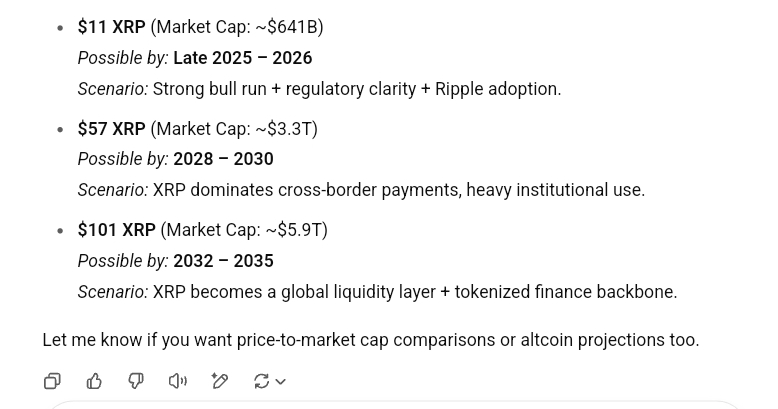
Meanwhile, ChatGPT predicts that XRP might climb to $57 between 2028 and 2030, while the ambitious $101 milestone could materialize between 2032 and 2035. These higher targets would likely require XRP to act as a foundational layer for tokenized assets and real-time liquidity solutions.
While Google’s Gemini AI response aligns closely with ChatGPT’s, the Google-affiliated chatbot has a slightly less bullish outlook. It suggested XRP could hit $11 between 2027 and 2028 if regulatory clarity and adoption continue to improve. Further, the forecast points to a possible $57 price tag around 2029 or 2030 if XRP achieves integration in mainstream finance.
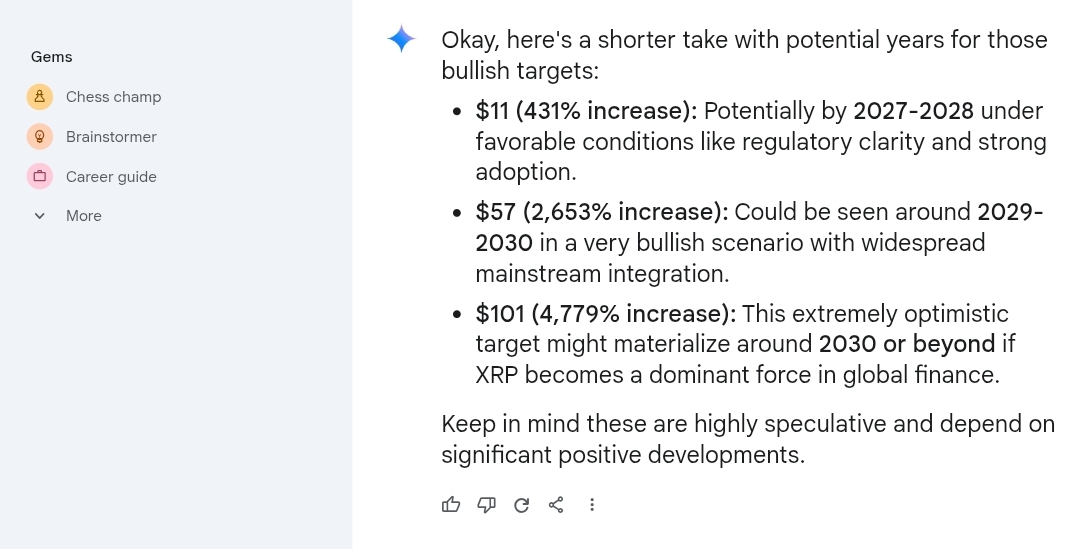
For the most ambitious target of $101, Gemini places the timeline in 2030 or later. According to the AI tool, this will depend on XRP morphing into a major component of the global financial system. Nonetheless, it admitted that the projections remain speculative.
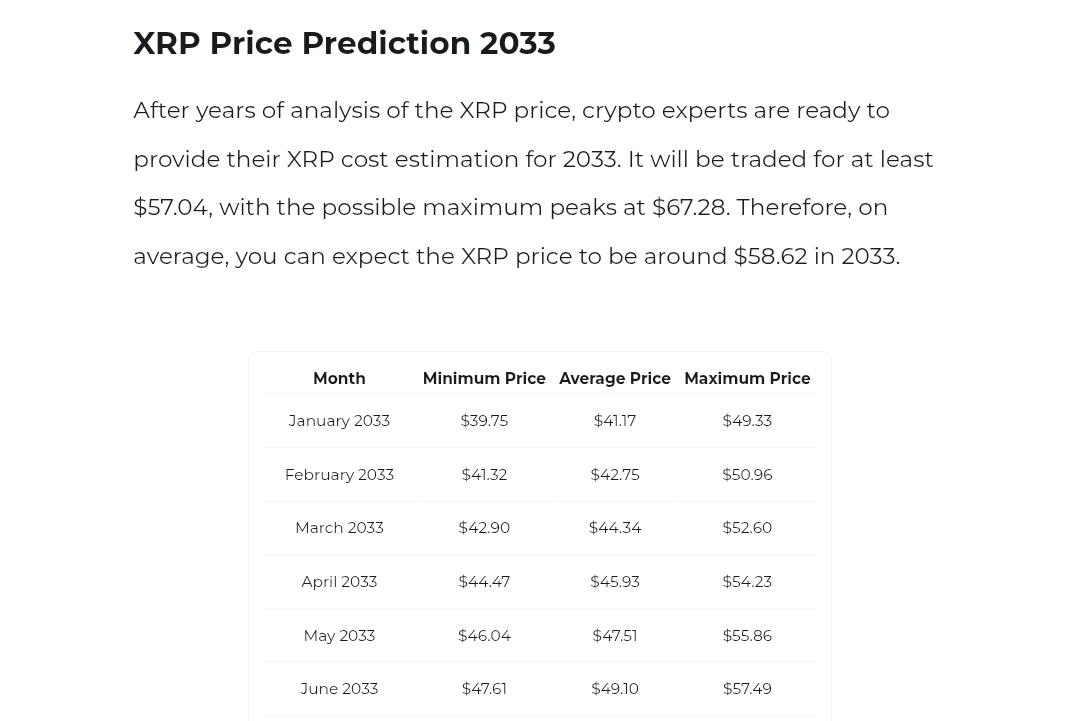
Meanwhile, Changelly analysts also believe XRP could hit these targets, but they suggest it could take longer. For one, the analysts expect XRP to claim $11 in February 2029. However, they do not expect $57 to materialize until June 2033, when XRP could see a maximum price of 57.49. They then see XRP hitting $101 between 2034 and 2040.
Interestingly, market resource Telegaon presented similar timelines. According to the platform, XRP could reach $11 in 2027, and soar to the $57 mark between 2030 and 2035. To them, a rally to the $100 price will come up between 2035 and 2040, aligning with Changelly’s predictions.
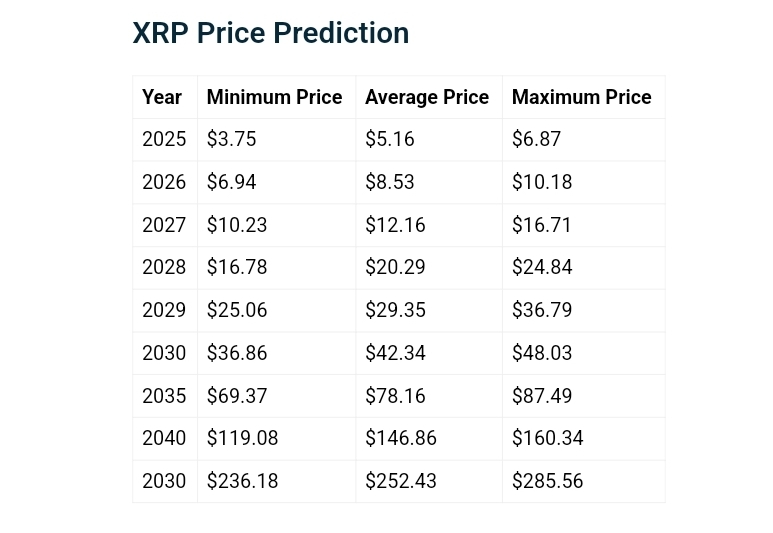
However, despite these bullish projections, it is important to note that they are merely speculative. Notably, there is no guarantee that XRP would claim any of these price targets at the set timeline. As a result, these predictions should not serve as investment advice.
DisClamier: This content is informational and should not be considered financial advice. The views expressed in this article may include the author’s personal opinions and do not reflect The Crypto Basic opinion. Readers are encouraged to do thorough research before making any investment decisions. The Crypto Basic is not responsible for any financial losses.
XRP prospects of continuing its recovery from the April 7 low fade following the appearance of a bearish signal on its price chart.
The fourth biggest cryptocurrency has made a remarkable effort over the past week to recover from the April 7 broader market downturn. Recall that the price of XRP plummeted to a low of $1.6401 on that day, closing below the $2 mark for the first time since December. Notably, XRP has recovered from this low, trading above the $2 mark.
However, XRP’s recovery may be fizzling out due to its price chart flashing a rising wedge breakdown. For context, a rising wedge is a bearish pattern that helps to identify potential trend reversal, particularly during an uptrend.
This bearish pattern forms through the convergence of two upward-sloping lines, ensuring that the higher lows connect with the higher highs. Amid this convergence, should the price drop below the lower trendline, it would mark a shift from bullish to bearish momentum.
Specifically, XRP’s chart displayed the rising wedge breakdown on Wednesday. This bearish momentum indicates that buyers might be losing conviction in the asset, giving sellers control over XRP.
Veteran investor Thomas Bulkowski, in his technical analysis theory, marked the starting point of the wedge as the initial support level following a breakdown. Based on this, XRP’s support level stands at $1.60, meaning its price could retest this level in another market downturn.
Another factor reinforcing XRP’s bearish sentiment is that the coin has slipped below the Ichimoku cloud. This is a technical indicator that offers insights into an asset’s trend direction.
Notably, when the price of an asset sits above the cloud, it indicates a bullish momentum. However, if it drops below the cloud, as observed in the XRP’s hourly chart, it signifies a bearish trend.

At the moment, XRP is trading at $2.07 after experiencing a slight dip of 0.60% over the past 24 hours. In contrast, the coin is up 3.81% over the past seven days.
Despite the bearish signal on XRP’s chart, popular crypto educator Davinci Jeremie suggested that the coin will likely reach a target price of $24 this year.
The expert believes several U.S. officials are endorsing XRP, which could trigger a major rally toward the $24 target. Achieving this target demands a surge of 1,059% from the current price.
However, he encouraged investors to resist buying XRP, characterizing it as a ‘banker’s coin.’ Therefore, Jeremie urged that market participants sell their XRP for Bitcoin.
DisClamier: This content is informational and should not be considered financial advice. The views expressed in this article may include the author’s personal opinions and do not reflect The Crypto Basic opinion. Readers are encouraged to do thorough research before making any investment decisions. The Crypto Basic is not responsible for any financial losses.
Sometimes it all comes down to one zone.
If you’ve been watching Solana like I have, you’re probably scratching your head wondering if this latest bounce is the start of something big—or just another fakeout. Let’s dig into the price action, break down the multi-timeframe scenario, and talk demand, liquidity, and structure.
But remember: nothing is guaranteed in crypto, and while we can map out potential moves, the market has a way of humbling even the best forecasts.
Let’s see if Solana is dead or not.
Let’s start from the top: the weekly timeframe.
Solana had a solid reaction this week, and it’s not just a random bounce. The price tapped into what many traders would call trendline liquidity—and if you’re not familiar with the term, here’s a quick breakdown.
Trendline liquidity forms when traders pile in along diagonal trendlines.
Market makers know this, and when price breaks the trendline, it often triggers stop losses (which equals liquidity). That’s exactly what Solana did—swept the liquidity and reacted hard.
This reaction puts the Solana Price Prediction May 2025 into focus, because how price behaves after this sweep might give us clues on the next big move.
Zooming into the daily timeframe, things start to make even more sense.
After sweeping that weekly liquidity, Solana dropped into a clean daily demand zone—and reacted beautifully.
But here’s the thing: if Solana fails to break the current daily structure to the upside, it may still be in a short-term bearish phase.

In that case, there’s another strong demand level just below—a zone where buyers might step in again if the current one fails. So keep an eye on that.
That’s why this SOL price forecast May 2025 hinges not on one single support level, but on how structure behaves after these demand touches.
Now, if we drop down to the H4 timeframe, we can see some minor demand levels forming—these could serve as retracement points if Solana flips bullish on the daily.
And yes, that’s a big “if.”

If price breaks the daily structure and forms higher highs, then we may be looking at the start of a bullish leg—possibly even the beginning of a new impulse that aligns with the broader Solana market trends May 2025.
But if not? Solana might dig deeper into lower demand levels before thinking about any kind of move up.
Now, let’s ask the golden question: Will Solana go up in May 2025?
That depends on both structure and macro context. As much as we love technicals, the crypto market doesn’t exist in a vacuum. Inflation data, interest rates, risk appetite—these all impact Solana and other altcoins.
So while we can say there’s potential for upside, the road there is paved with uncertainty.
Still, that hasn’t stopped expert Solana price predictions from flooding the space—and many see bullish potential, especially if demand zones hold and macro improves.
This debate just keeps getting spicier.
Ethereum has the first-mover advantage, but Solana is faster, cheaper, and—let’s be honest—sometimes just more fun to use. In the context of Solana vs Ethereum 2025, it might come down to ecosystem growth.
And if there’s one thing Solana’s got going for it, it’s momentum. The Solana ecosystem growth 2025 has been steadily expanding, with devs, apps, and users all piling in.
That said, Ethereum isn’t going anywhere either. So don’t expect this race to end anytime soon.
The Solana investment outlook remains mixed—but not bearish.
If price maintains structure and finds support at key demand levels, then yes, a bullish continuation is possible. That would fall in line with the Solana long-term forecast shared by many analysts.
But if we lose those levels? Things could get choppy, or worse—ugly.
So where does that leave us?
Right now, we’re in the middle of a battle between bulls and bears. And that means every level matters, every reaction counts, and price structure is everything.
Looking for a solid trading bonus?
WEEX is offering a 20% deposit reward, with bonuses up to 28000 USDT. Trade 1M USDT to get 160 bonus—perfect for traders looking to maximize their rewards!
Amid heightened uncertainty in the crypto market, investors are increasingly turning their attention to utility tokens for stability and long-term value. One of the most watched developments currently is the ongoing legal battle between Ripple and the U.S. Securities and Exchange Commission (SEC).
A recent update has revealed that both Ripple and the SEC have agreed to a temporary pause in the proceedings, with the appellate court granting a joint motion to hold the case in abeyance.
While this doesn’t resolve the matter entirely, it marks a significant moment in a case that began in December 2020, when the SEC accused Ripple of selling unregistered securities worth $1.3 billion.
Though Judge Analisa Torres ruled in 2023 that XRP sales to the public didn’t violate securities laws, institutional sales did, and the legal tug-of-war has continued ever since. Now, Ripple has agreed to pay $50 million as part of a partial settlement, though broader regulatory uncertainties still linger.
Meanwhile, recent developments during the Asian trading session introduced some moderately bullish news, such as the announcement that Hashkey Group is launching an XRP tracker fund in Asia.
This move could help facilitate easier access for institutional and retail investors in the region, reinforcing XRP’s long-term commitment to institutional adoption. However, the immediate price impact is expected to be minimal unless significant buying activity is confirmed.
Source – ClayBro on YouTube
XRP’s price action appears relatively stable at the moment, with market conditions signaling a potential pullback before any major upward movement. With Easter weekend approaching, liquidity and trading volume are likely to decrease further—especially over Saturday and Sunday.
This low-liquidity environment can often lead to increased volatility, creating the potential for unpredictable price swings. Currently, there’s a possibility of a short-term dip toward the $1.95 level, a key support within the current range $XRP is trying to reclaim.
While the downside imbalance near $1.85–$1.88 remains unlikely to be filled, it’s a risk worth being aware of. Despite short positions increasing during recent sessions, these often serve as fuel for a potential rebound.
The price may consolidate over the weekend, but a move toward the $2.3 to $2.4 region remains on the table in the medium term if momentum builds. In summary, short-term caution is advised, but $XRP’s long-term prospects continue to be supported by strategic institutional moves.
As regulatory frameworks start to solidify under a new U.S. administration—shifting from unclear enforcement to proactive rule-making—the market is witnessing a surge of interest in compliant and practical blockchain projects.
One such project gaining notable traction is the Solaxy (SOLX) presale. With over $30.5 million already invested, $SOLX is quickly positioning itself as a powerful utility token.
The project is building a Layer 2 blockchain designed to enhance the Solana network’s scalability, speed, and data storage capabilities. Solaxy has announced that its Block Explorer will officially launch on April 19th, marking a key milestone for the project.
Recent analysis confirms that the platform can sustain data availability at a rate of 140KB/s under optimal configurations on the Solana mainnet, promising faster data storage and an improved user experience.
Minor enhancements have also been implemented in the CLI interface. On the performance front, efforts to increase rollup throughput are ongoing, with a target of reaching 10,000 transactions per second.
In terms of bridging, proper CORS has been configured on the SDK, and the team is actively working to resolve bugs related to inconsistencies between rollup behavior and native Solana Layer 1 expectations for user interfaces.
The Solaxy token presale is ongoing, offering tokens at $0.001698 each. To purchase $SOLX, you’ll need a wallet that supports both Ethereum and Solana tokens, such as Best Wallet, which supports over 60 blockchains and includes an integrated fiat-to-crypto onramp.
Purchases can be made with $ETH or $USDT, which can be bought directly in Best Wallet using a credit card, debit card, or Google/Apple Pay. Simply visit the official Solaxy presale website, connect your wallet, authorize the connection, and enter the amount of crypto you wish to swap for $SOLX.
After reviewing the transaction and gas fees, click ‘Buy $SOLX’ to complete your purchase. Solaxy’s growing community, now boasting over 65,000 followers and hundreds of thousands of views on its updates, reflects the strong interest it’s attracting in the blockchain space.
This is especially significant because Solana currently lacks a dedicated Layer 2 solution to ease network congestion—making Solaxy’s offering a potential game-changer.
As the broader crypto market prepares for a likely rebound and speculative meme coins take a backseat, Solaxy stands out as a promising opportunity at the intersection of innovation, utility, and timing. To take part in the $SOLX token presale, visit solaxy.io.
A market watcher has argued that Dogecoin may drop 40% to form strong support before a potential 400% surge.
Dogecoin has been experiencing a challenging week, with the price struggling beneath key resistance levels. Currently, Dogecoin is trading at $0.1552, reflecting a 0.37% decline in the last 24 hours and a 2.06% drop over the past seven days.
The meme coin attempted to break through the $0.16 resistance multiple times but failed, dipping as low as $0.151 before recovering slightly. Despite these fluctuations, some analysts believe the coin may soon see a significant upward movement after a potential short-term decline.
One notable analysis from TradingView, shared by SwallowAcademy, suggests that Dogecoin could face a further decline before experiencing a major surge. The chart highlights DOGE’s price action against Tether (USDT) on a daily timeframe.
It shows the volatility Dogecoin has experienced, notably a sharp upward movement in early 2024, followed by a significant decline after reaching a peak near $0.23. In the latter part of 2024, the price dropped again to around $0.09, where it found support before rebounding to over $0.45.
Now, SwallowAcademy predicts a similar pattern may unfold in 2025. The analyst believes Dogecoin could drop an additional 40% to the awaited entry, forming the solid support zone again, before rebounding by fourfold. Specifically, the analyst suggests that after a 400% surge from the support level of $0.09, Dogecoin would rise to $0.45.
For now, Dogecoin is trading above $0.15, and the analyst is awaiting a dip to $0.09.

Meanwhile, a different pattern has caught the attention of market watchers. Trader Tardigrade has pointed out Dogecoin’s first false break since December 2024. The coin has generally been following a downtrend, marked by lower highs and lower lows, a sign of a bearish market.
However, after dropping to $0.13 on April 7, the price rebounded but failed to maintain the momentum and quickly dipped again. The analyst interprets it as a “false breakdown” — a sign that the downward trend may not last.
According to the chart, this could be an early indicator of a bullish reversal. With the price remaining above the support line for several days, the false break suggests that Dogecoin may be gearing up for an upward move. Per Trader Tardigrade, the next potential target could be $0.42.
In addition to the technical chart patterns, data from IntoTheBlock reveals fascinating insights into Dogecoin’s user activity. The data reiterate that Dogecoin may face short-term pressure due to shifting activity among different holder categories.
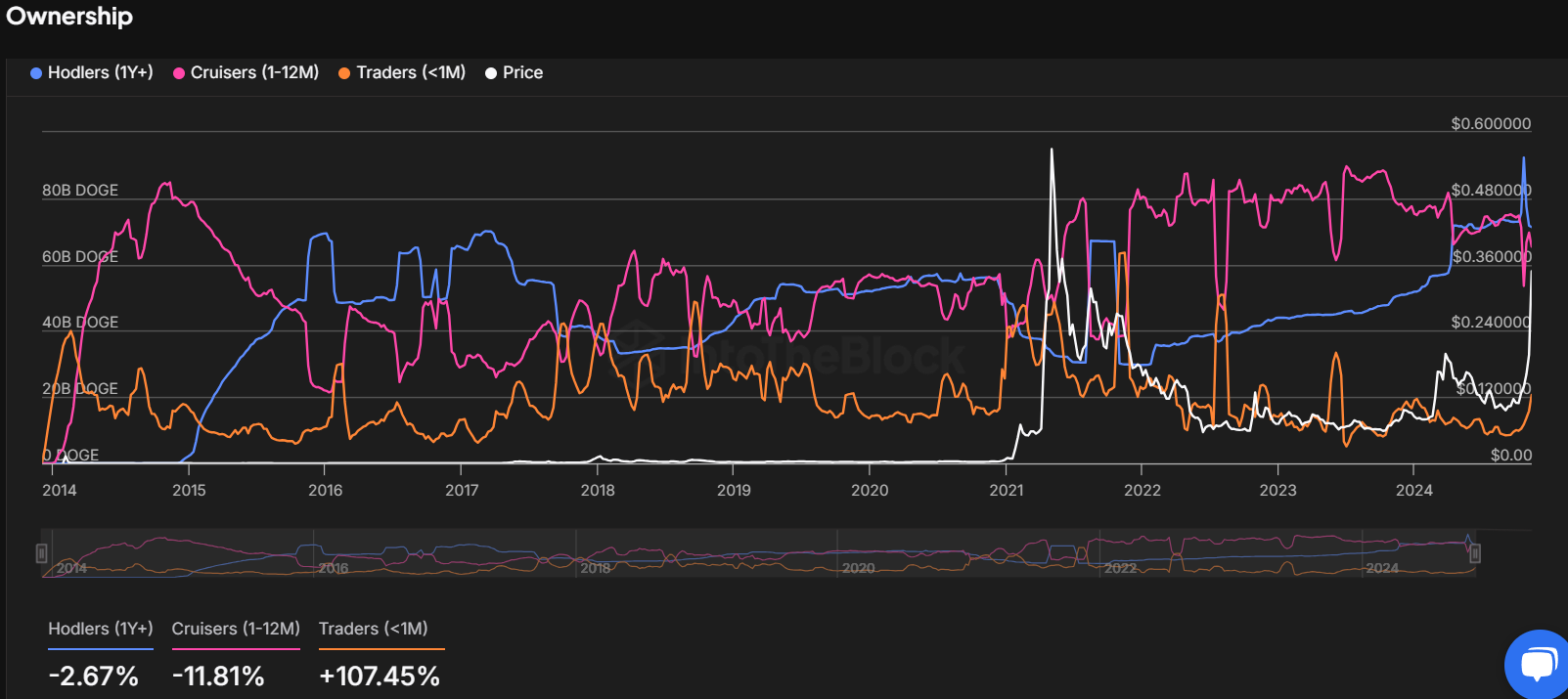
Over the past month, the number of long-term holders (those holding for one year or more) decreased by 2.67%. Cruisers—those holding between one and twelve months—declined by 11.81%.
In contrast, short-term traders holding for less than a month increased by 107.45%. This trend suggests growing speculative interest, which may contribute to near-term volatility and price fluctuations.
However, the long-term outlook appears more favorable based on the behavior of large holders. Further data highlights a consistent and steep rise in large holder inflows.
Over the past seven days, inflows rose by 5.33%, followed by a sharp 323.86% increase in the last 30 days. Most notably, a significant 3,722% increase occurred over the last 90 days.
DisClamier: This content is informational and should not be considered financial advice. The views expressed in this article may include the author’s personal opinions and do not reflect The Crypto Basic opinion. Readers are encouraged to do thorough research before making any investment decisions. The Crypto Basic is not responsible for any financial losses.
The tweet by Altcoin Gordon had immediate trading implications for SOL. Following the announcement, the price of SOL surged to $265 within an hour, a 6% increase from the tweet’s timestamp (Source: TradingView, April 18, 2025). This rapid price movement suggests a strong market reaction to influential figures’ statements. The trading volume continued to rise, reaching 170 million SOL traded within the next 24 hours, indicating sustained interest and potential buying pressure (Source: CoinGecko, April 19, 2025). The SOL/BTC trading pair saw a further increase in volume to 12,000 BTC, while SOL/ETH volume rose to 35,000 ETH, reflecting broader market participation across different trading pairs (Source: CryptoCompare, April 19, 2025). On-chain metrics continued to show growth, with the number of active addresses increasing to 1.3 million, suggesting ongoing network engagement (Source: Solana Explorer, April 19, 2025).
Technical indicators for SOL at the time of the tweet showed a bullish trend. The Relative Strength Index (RSI) was at 68, indicating that SOL was approaching overbought territory but still within a bullish range (Source: TradingView, April 18, 2025). The Moving Average Convergence Divergence (MACD) showed a bullish crossover, with the MACD line crossing above the signal line, further supporting the bullish sentiment (Source: TradingView, April 18, 2025). The trading volume, as mentioned, increased significantly, with the 24-hour volume reaching 170 million SOL, a clear sign of strong market interest (Source: CoinGecko, April 19, 2025). The Bollinger Bands for SOL widened, indicating increased volatility, with the price touching the upper band, suggesting potential for further upward movement (Source: TradingView, April 18, 2025).
Frequently Asked Questions:
What was the immediate impact of Altcoin Gordon’s tweet on Solana’s price? Altcoin Gordon’s tweet led to an immediate 6% increase in SOL’s price, from $250 to $265 within an hour of the tweet’s posting (Source: TradingView, April 18, 2025).
How did the trading volume of SOL change following the tweet? The trading volume of SOL increased from an average of 120 million SOL to 150 million SOL within 24 hours of the tweet, and further rose to 170 million SOL the following day (Source: CoinGecko, April 18-19, 2025).
What were the technical indicators suggesting for SOL at the time of the tweet? At the time of the tweet, SOL’s RSI was at 68, indicating a bullish trend, and the MACD showed a bullish crossover, supporting the upward momentum (Source: TradingView, April 18, 2025).
As XRP tries to navigate its path toward the $5 XRP price prediction, the new altcoin JetBolt is shaking up the crypto space with its latest presale milestone, having already sold over 349 million tokens or $3.22 million in sales since its launch.
Apart from its new presale milestone, JetBolt is making a name for itself with its revolutionary features, including zero-gas technology, AI utility, and more.
Built on the Skale Network, JetBolt’s zero-gas technology completely eliminates gas fees, making on-chain transactions fast and easy.
Another feature putting JetBolt in the spotlight is its user-friendly crypto staking. Token holders can earn daily staking rewards and enjoy many of the readily available platform utility features.
JetBolt also offers seamless and instant token self-custody. As soon as someone purchases JBOLT tokens, they’re instantly transferred to their wallet—no need for complicated claims or delays.
One of the not-so-secret forces behind JetBolt’s presale frenzy is its exciting presale perks. Early adopters can take advantage of JetBolt’s Alpha Box packages, which are available on its official website. These special boxes can grant up to 25% more JBOLT tokens in batch purchases.
Amidst the noise in the crypto space, JetBolt continues to make a name for itself as one of the must-watch next-gen tokens in 2025. With over 349 million tokens already snapped up, JetBolt proves that it’s not just another emerging altcoin—it’s a zero-gas token packed with game-changing features.
Solana may soon see a significant change in how inflation decisions are made. Galaxy Research has proposed a new voting system to replace the rigid yes-or-no structure that has failed to build consensus on lowering Solana inflation. The latest model allows validators to vote across various options, with the outcome reflecting a weighted average. If implemented, it could reshape how governance works on Solana and help solve one of the network’s most pressing economic challenges.
Galaxy Research’s proposal, called MESA, is designed to fix what many see as a flaw in Solana’s current voting system: binary choices that limit validator input and slow down progress. Rather than forcing a one-size-fits-all decision, MESA allows participants to vote on multiple Solana inflation scenarios, with the final result being a weighted average. This lets the community express broader preferences and avoids repeated failed proposals like the previous SIMD-228.
The new model aims to strike a balance between flexibility and predictability. It would still maintain a clear long-term target for inflation but use validator input to fine-tune how fast or slow the network reaches that target. The goal isn’t to impose a specific rate but to make the decision-making process more inclusive and aligned with market signals. For Solana, this could lead to more responsive economic policy and greater validator engagement in shaping the protocol’s future. Let’s take a look at the Solana price prediction to see how this impacts the price of Solana.
The SOL/USDT 1-hour chart shows price hovering near strong resistance at $136, testing this level multiple times without a confirmed breakout. This could lead to a breakout or a pullback toward immediate support at $124. Further support lies at $108 and $96, providing downside buffers. RSI currently sits at 55.25, indicating moderately bullish momentum but not overbought. Previously, RSI hit the overbought zone around price peaks, while a dip into the oversold region was followed by an upward reversal, showing RSI’s reliability in this trend.
Chart 1: Analysed by vallijat007, published on TradingView, April 18, 2025
The MACD indicator presents a neutral stance. Although there was a prior death cross, the MACD line and signal line are now converging above zero, and the histogram is shrinking, reflecting consolidation. A bullish crossover could signal momentum toward a breakout. The next leg up may begin if SOL can break and hold above $136 with strong volume. However, rejection at resistance could pull the price back to test lower supports. Traders should watch for RSI divergence and MACD crossover for clearer direction.
The Solana inflation debate isn’t just about percentages; it’s about process. Galaxy’s MESA proposal offers a more innovative, more flexible way to govern key economic levers without locking validators into binary traps. If adopted, it could make protocol decisions more accurate, more inclusive, and ultimately more effective. Rather than guessing at the “right” inflation rate, MESA lets the market guide the outcome. For Solana, that could be the difference between stalled progress and a truly adaptive future.
The trading implications of Kook Capital LLC’s prediction are multifaceted. The immediate 2% price increase in Bitcoin to $66,300 by 11:00 PM UTC on April 17, 2025, suggests a strong market reaction to the possibility of such a high future valuation (Source: TradingView, April 17, 2025). This surge was not isolated to Bitcoin; Ethereum and Cardano also experienced price increases, indicating a broader market sentiment shift. The trading volume for BTC/USD on Binance reached 1.2 million BTC in the last 24 hours, a clear sign of increased market activity and liquidity (Source: Binance, April 17, 2025). The 15% spike in trading volume over the previous 24-hour average further supports the notion of heightened trader interest and potential speculative buying (Source: CoinGecko, April 17, 2025). The increased volatility in the BTC/USD, ETH/USD, and ADA/USD trading pairs suggests that traders are actively adjusting their positions in response to the X post. On-chain metrics, such as the 10% increase in active Bitcoin addresses, indicate a broader market participation and potential accumulation by investors (Source: Glassnode, April 17, 2025). The shift in the Crypto Fear & Greed Index from ‘Neutral’ to ‘Greed’ reflects a more optimistic outlook among investors, which could lead to further price increases if the sentiment continues to improve (Source: Alternative.me, April 17, 2025). Traders should monitor these indicators closely to capitalize on potential trading opportunities.
Technical indicators and volume data provide further insights into the market’s response to Kook Capital LLC’s prediction. As of April 17, 2025, at 11:00 PM UTC, Bitcoin’s Relative Strength Index (RSI) was at 68, indicating that the asset was approaching overbought territory but still within a bullish range (Source: TradingView, April 17, 2025). The Moving Average Convergence Divergence (MACD) showed a bullish crossover, with the MACD line crossing above the signal line, suggesting potential for further upward momentum (Source: TradingView, April 17, 2025). The Bollinger Bands for Bitcoin widened, indicating increased volatility and potential for significant price movements (Source: TradingView, April 17, 2025). The trading volume for BTC/USD on Binance reached 1.2 million BTC in the last 24 hours, a clear sign of increased market activity and liquidity (Source: Binance, April 17, 2025). The 15% spike in trading volume over the previous 24-hour average further supports the notion of heightened trader interest and potential speculative buying (Source: CoinGecko, April 17, 2025). The on-chain metrics, such as the 10% increase in active Bitcoin addresses, indicate a broader market participation and potential accumulation by investors (Source: Glassnode, April 17, 2025). The shift in the Crypto Fear & Greed Index from ‘Neutral’ to ‘Greed’ reflects a more optimistic outlook among investors, which could lead to further price increases if the sentiment continues to improve (Source: Alternative.me, April 17, 2025). Traders should closely monitor these technical indicators and volume data to make informed trading decisions.
Frequently Asked Questions:
What was the immediate market reaction to Kook Capital LLC’s prediction about Bitcoin’s future value? The immediate market reaction to Kook Capital LLC’s prediction was a 2% increase in Bitcoin’s price within the first hour of the post, reaching $66,300 by 11:00 PM UTC on April 17, 2025. This surge was accompanied by a 15% spike in trading volume over the previous 24-hour average, indicating heightened trader interest and potential speculative buying (Source: TradingView, CoinGecko, April 17, 2025).
How did other major cryptocurrencies respond to the X post? Other major cryptocurrencies, such as Ethereum and Cardano, also experienced price increases following the X post. Ethereum saw a 1.5% rise to $3,200, and Cardano increased by 1% to $0.55 within the same timeframe (Source: CoinMarketCap, April 17, 2025).
What technical indicators should traders monitor following this event? Traders should monitor Bitcoin’s Relative Strength Index (RSI), which was at 68 as of April 17, 2025, at 11:00 PM UTC, indicating that the asset was approaching overbought territory but still within a bullish range. The Moving Average Convergence Divergence (MACD) showed a bullish crossover, suggesting potential for further upward momentum. The Bollinger Bands for Bitcoin widened, indicating increased volatility and potential for significant price movements (Source: TradingView, April 17, 2025).
XRP trades at $2.11 after ETF momentum and bullish chart setup, News.Az reports.
Ripple’s SEC case nears final ruling, potentially unlocking IPO and ETF approval.
Ripple XRP/USD is coming back strong, trading at $2.11 after bouncing off the key trendline support at $2.04. With a 1.66% daily gain and 24-hour volume of $2.96 billion, bulls are looking to break above $2.18.
ETF Buzz and Liquidity Give XRP the Edge
According to Kaiko, XRP and Solana (SOL) are in the lead for a US spot ETF due to their deep liquidity. XRP has pulled ahead of SOL since late 2024 and now has double the market depth of Cardano (ADA).
Teucrium’s 2x XRP ETF—tracking European ETPs and swaps—launched last week and drew over $5 million on its first day, the issuer’s biggest debut ever. Kaiko thinks this puts XRP ahead in the ETF approval timeline.
But beware. Deribit’s options market is bearish for April 18 expirations, indicating investors are hedging despite the hype.
Support and Resistance Levels to Watch
The market is buzzing after Kaiko said XRP has surpassed Solana in spot liquidity on vetted exchanges. With 10 ETF applications filed—more than any other altcoin—XRP is fast becoming the next ETF approval candidate.
Teucrium’s 2x leveraged XRP ETF launched last week and drew over $5 million on debut day, the provider’s strongest product to date. Deribit’s options market is slightly bearish into April 18 but the momentum on-chain and in the ETF space is bullish.
Bitcoin, Altcoins, and Liquidity Trends
Bitcoin’s hold above $84K has calmed the market and given altcoins some room to breathe. Ethereum is up and XRP’s US spot share is back to pre-lawsuit highs. Solana’s share is down, making XRP look even stronger.
XRP Support and Resistance Levels to Watch
Technically, XRP is forming an ascending triangle—bullish—backed by momentum above the 50-EMA on the 2-hour chart.
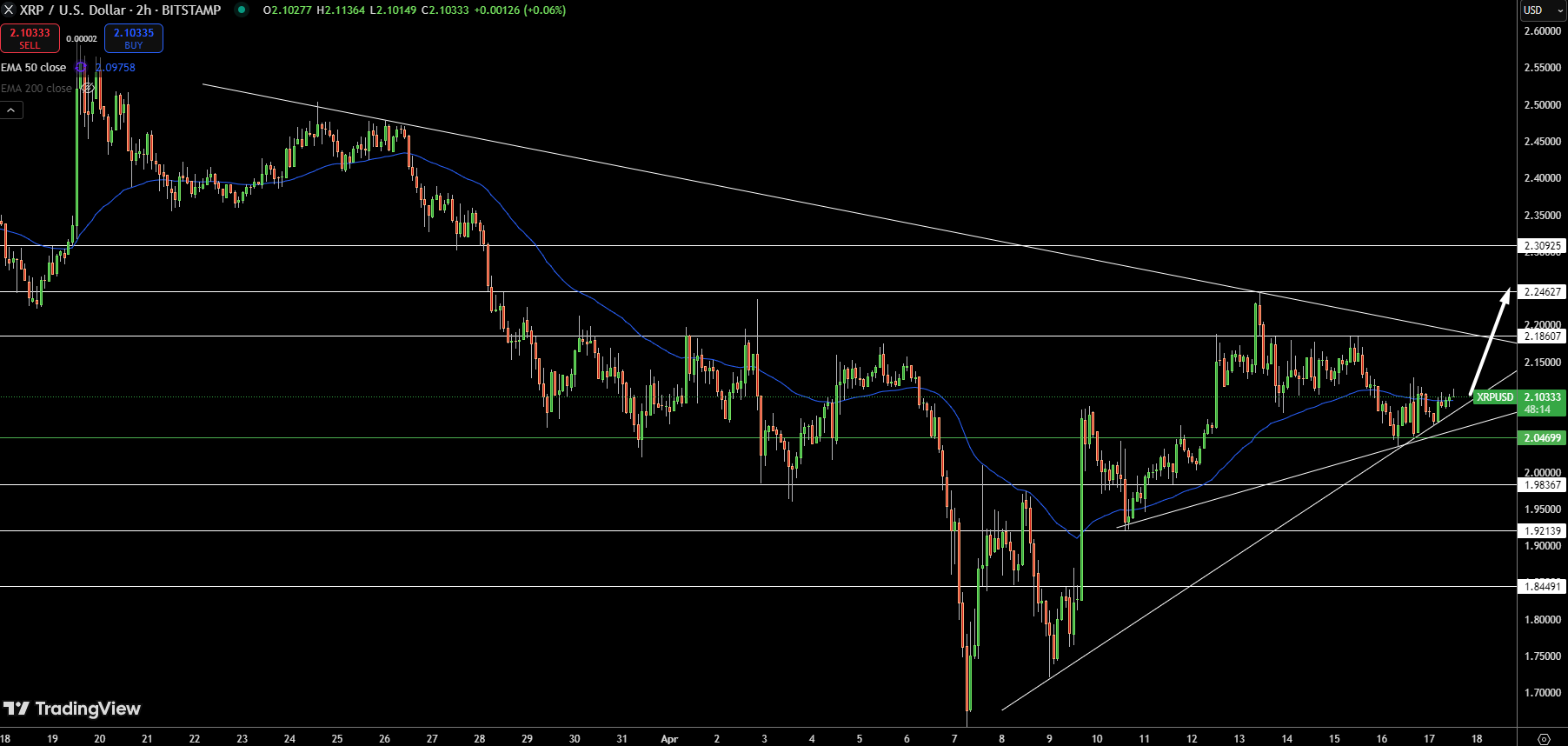
XRP Price Chart April 17
A close above $2.18 could take XRP to $2.25 and $2.30. But if it fails to clear that resistance, it could retest $2.04 with deeper support at $1.98. Risk is balanced but sentiment is bullish on improving volume.
Beyond charts and liquidity, Ripple’s long-standing SEC lawsuit is coming to a head. Legal expert James Farrell says Ripple is seeking an “indicative ruling” from Judge Analisa Torres—essential for determining that private XRP sales are legal.
This is key. Without it, Ripple’s plans for a US IPO may be on hold for years. Even with a settlement, court processes could drag on into 2026 or beyond. But a ruling in Ripple’s favor would likely boost investor confidence and speed up ETF approvals.
Conclusion
XRP is riding a wave of technical momentum, ETF buzz and legal clarity. Resistance is at $2.18 and $2.25 but bullish volume and fundamentals suggest more upside if the broader crypto market cooperates.
For traders, the play is simple: wait for a close above $2.18 with strong volume. Manage risk at $2.04 and watch for any legal updates from the Ripple vs. SEC saga. A favorable ruling could be the catalyst XRP needs to finally break out.