The main tag of Crypto News Articles.
You can use the search box below to find what you need.
[wd_asp id=1]

18 12, 2025

Binance Coin Holds Near $840 as Selling Pressure Builds — Forecast, Key Levels and What’s Next (Dec. 18, 2025)

By |2025-12-18T19:58:31+02:00December 18, 2025|Crypto News, News|0 Comments

BNB-USD (Binance Coin) traded around $840 on Thursday, December 18, 2025, slipping in a choppy session that saw prices probe the low $830s before stabilizing. Real-time quotes showed BNB down roughly 2% versus the prior close, with an intraday swing that—depending on venue and data source—reached from about $830 up toward the mid-$870s. [1]

The bigger story behind “BNB price today” is less about one number and more about a tug-of-war: risk-off macro sentiment and bearish derivatives positioning versus ongoing ecosystem headlines (including fresh stablecoin activity on BNB Smart Chain) that could become bullish catalysts if liquidity and on-chain usage follow through. [2]

Below is a roundup of the current news, forecasts, and market analysis published or updated on 18.12.2025, plus a scenario-based outlook for where BNB-USD could go next.


BNB-USD price today: the live snapshot traders are watching

As of today’s trading (Dec. 18), BNB was quoted around $840. One real-time feed showed $840.06, with a session high near $874.93 and low near $830.42.

Other widely followed datasets put the day’s range similarly anchored around the low-$830s, with one historical table showing a low near $830.60 and a high near $852.99 for Dec. 18 (venue/time-window differences can explain the mismatch versus other feeds). [3]

Zooming out one step, CoinGecko’s BNB page showed BNB around $840.56, and also flagged that over the last month BNB was down about 8.20%, underperforming a broader crypto market that was down roughly 6.60% over the same window. [4]

And yes, the “gravity” number remains the prior peak: CoinGecko lists BNB’s all-time high at $1,369.99, leaving the token roughly ~39% below that level at current prices. [5]


Today’s headlines: what’s driving BNB’s move on Dec. 18, 2025?

1) Selling pressure + leverage cleanup in derivatives

One of the most detailed market write-ups today described a classic de-risking pattern: spot price pressing the lower band of its recent range while derivatives traders reduce exposure. The report cited rising volume alongside falling open interest, a combination often associated with position unwinding rather than confident dip-buying. [6]

2) Technical damage below long-term trend markers

In a Dec. 18 technical note, IG said BNB failed to hold above roughly $928 earlier in December and has since drifted below its 200-day simple moving average (SMA), framing the near-term bias as bearish while BNB remains under a key resistance zone. [7]

3) Macro: rate-cut reality check and “risk-off” mood

IG also linked crypto’s softer tone to macro conditions—arguing that even with a widely anticipated Fed rate cut, markets interpreted guidance as relatively cautious, keeping pressure on risk assets (including BNB). [8]

Separate, broader regulatory context came from Reuters on Dec. 18: the piece highlighted crypto-friendly shifts in 2025 (including regulatory and legislative wins), but warned of uncertainty heading into 2026 as major market-structure legislation remains stalled—an overhang that can feed into cautious positioning across the sector. [9]

4) BNB’s market-cap rank still matters to big allocators

A Dec. 18 market update noted BNB’s position among the largest non-stablecoin cryptocurrencies by market capitalization—important because many funds and index-like products manage exposure based on size and liquidity. [10]


BNB technical analysis today: support, resistance, and the “line in the sand”

Technical analysis isn’t prophecy—it’s a map of where traders are likely to react. Today’s coverage (Dec. 18) converged on a few key zones.

The immediate battleground: ~$830 to ~$880

A market analysis today described BNB trading near the lower Bollinger Band around $830, with repeated failures to reclaim the mid-band area around the high-$800s—implying sellers still control the short-term rhythm unless price can reclaim nearby resistance. [11]

IG’s key levels (Dec. 18): bearish below ~$870–$872

IG’s Dec. 18 levels were notably specific:

  • Bearish while below ~$870.10–$872.10, including the downtrend line and the 200-day SMA region.
  • A retest zone at $802.60–$791.80 (November/early-December lows).
  • A breakdown through that support could put ~$729.70 back in focus. [12]

On the upside, IG said bulls would want to see reclaiming $899.70 to bring the $928 area back into play, with higher resistance levels above that if momentum truly returns. [13]

Investing.com’s indicator dashboard: “Neutral,” with moving averages still heavy

Investing.com’s BNB/USD technical panel (timestamped Dec 18, 2025 02:48 PM GMT) summed the setup as “Neutral” overall, but with a split personality underneath: technical indicators leaned “Buy,” while moving averages leaned “Sell.” [14]

It also published a full set of classic pivot levels, including a classic pivot near 846.73, with nearby resistance and support bands traders often reference for intraday planning. [15]


BNB price forecast: what analysts and models say next (and how to read it)

Forecasts come in two flavors: (1) scenario-based analysis from human analysts, and (2) algorithmic projections that extrapolate price/volatility patterns. Today’s coverage includes both.

Scenario forecast for BNB-USD (next few days to early 2026)

Base case (range + volatility):
If risk appetite remains muted and leverage continues to unwind, BNB can keep rotating inside a wide band where buyers defend the low $800s and sellers show up into rebounds. Today’s reports emphasize that price behavior still favors sellers until key resistance is reclaimed. [16]

Bear case (breakdown):
A decisive move below the most watched support zone (roughly $802–$792) increases the odds of a deeper slide toward the next historical low area around $729 cited in today’s technical analysis. [17]

Bull case (trend repair):
To flip the script, today’s technical playbook is clear: reclaim ~$870–$872, then build acceptance above ~$900. If that happens, the early-December resistance area around $928 becomes the next “prove it” level. [18]

Algorithmic / platform forecasts published today

A Binance-hosted “price prediction” tool displayed short-horizon projections clustered in the high-$830s to low-$840s into mid-January 2026 (and includes its own cautionary language about technical analysis and trading bots). [19]

CoinCodex’s algorithmic forecast also pointed to modest movement in the near term—projecting around $842.85 for Dec. 19 and a range that implies small percentage changes into year-end, while noting a broadly cautious/bearish framing for 2025 based on its indicators. [20]

And Investing.com’s indicator snapshot landing on “Neutral” aligns with a market that’s not screaming “new trend” yet—more like “wait for confirmation.” [21]

How to use this without fooling yourself: algorithmic forecasts often behave like a “statistical weather report”—helpful for framing possible ranges, unreliable for pinpointing turning points. The more useful takeaway today is which levels would invalidate bearish momentum (reclaiming ~$870–$900) and which levels would confirm deterioration (losing ~$802–$792). [22]


BNB Chain and Binance ecosystem news on Dec. 18: stablecoins and “builders keep shipping”

Even on red days, fundamentals can change—and today’s news cycle included a meaningful ecosystem headline: stablecoin expansion on BNB Chain.

$U stablecoin launches on BNB Smart Chain and Ethereum

A Dec. 18 press release announced the launch of $U, a stablecoin deployed on BNB Smart Chain and Ethereum, positioned around cross-chain liquidity and a broad set of use cases spanning DeFi, payments, and settlement. [23]

The release and republished brief also described:

  • 1:1 backing via a mix of cash and audited stablecoins (including USDC and USDT, among others),
  • proof-of-reserves and quarterly audits,
  • integrations with major DeFi venues and wallet support (including Binance Wallet and other widely used wallets). [24]

This matters for BNB-USD because stablecoin liquidity is often the “plumbing” for on-chain trading and DeFi activity—especially on ecosystems where stablecoin volume is a major driver of fees and usage.

Sector mood: risk-off macro, but ecosystem development continues

A CoinMarketCap Academy update created/updated within the last day (aligned with today’s cycle) described a market dominated by fear/risk-off behavior, noting weakness across BNB Chain-related tokens week-over-week, while also emphasizing that development continues despite the soft tape. [25]

The same roundup flagged that BNB Chain teased an upcoming stablecoin initiative aimed at “next-gen liquidity” and large-scale on-chain activity—suggesting stablecoins are becoming a central narrative for the ecosystem heading into 2026. [26]


What to watch next for BNB price (BNB-USD): catalysts and risks

BNB’s near-term direction is likely to be decided by a handful of variables that showed up repeatedly in today’s reporting and dashboards:

  • Does BNB reclaim ~$870–$900, or fail below it again? That’s the technical “trend repair” zone highlighted in today’s analysis. [27]
  • Do derivatives indicators stabilize? Watch whether open interest rebuilds alongside price strength (healthier) or keeps dropping into volatility (de-risking). [28]
  • Stablecoin follow-through on BNB Chain: launches are headlines; sustained adoption is what moves fundamentals. [29]
  • Macro/regulatory clarity into 2026: Reuters’ Dec. 18 note underscores that markets can celebrate “wins” while still discounting uncertainty when key legislation stalls. [30]

Bottom line: BNB-USD forecast for Dec. 18, 2025 points to a market waiting for confirmation

BNB price today sits in a tense spot: near $840, pressured by a risk-off backdrop and technical weakness below major moving averages—but with ecosystem headlines (especially around stablecoins and liquidity) that could become bullish if they translate into higher on-chain activity and improved sentiment. [31]

For now, the most defensible “forecast” from today’s coverage is scenario-based:

  • Bearish continuation if BNB loses the low-$800s support region. [32]
  • Stabilization/range trade if support holds and leverage continues to reset. [33]
  • Trend improvement only if BNB reclaims ~$870–$900 and holds it. [34]

Binance Founder: “The Real Bull Market Hasn’t Even Started Yet” (BNB hits $1,000)

References

1. www.coingecko.com, 2. www.ig.com, 3. www.investing.com, 4. www.coingecko.com, 5. www.coingecko.com, 6. crypto.news, 7. www.ig.com, 8. www.ig.com, 9. www.reuters.com, 10. www.coindesk.com, 11. crypto.news, 12. www.ig.com, 13. www.ig.com, 14. www.investing.com, 15. www.investing.com, 16. crypto.news, 17. www.ig.com, 18. www.ig.com, 19. www.binance.com, 20. coincodex.com, 21. www.investing.com, 22. www.ig.com, 23. www.globenewswire.com, 24. cryptobriefing.com, 25. coinmarketcap.com, 26. coinmarketcap.com, 27. www.ig.com, 28. crypto.news, 29. cryptobriefing.com, 30. www.reuters.com, 31. www.ig.com, 32. www.ig.com, 33. crypto.news, 34. www.ig.com


Source link

18 12, 2025

ETH Holds Near $2,940 as ETF Outflows and U.S. Policy Uncertainty Shape the Forecast

By |2025-12-18T17:57:46+02:00December 18, 2025|Crypto News, News|0 Comments

December 18, 2025 — Ethereum’s dollar price (ETH-USD) is trading around $2,941, roughly flat on the session after a notably volatile day that saw ETH swing between an intraday low near $2,793 and a high around $3,024.

That “whipsaw range” tells you almost everything you need to know about the current Ethereum setup: buyers are still defending the psychologically important $2,800 area, but upside momentum keeps running into supply near $3,000+, especially while U.S. spot Ethereum ETF flows remain negative and crypto regulation headlines keep landing like anvils on risk sentiment. [1]

What follows is a roundup of the key Ethereum price news, forecasts, and market analyses published on December 18, 2025, plus a scenario-based ETH-USD forecast built from today’s most-cited support/resistance levels and the day’s major catalysts.


Ethereum price today: the numbers traders are watching

As of the latest market print on Dec. 18, 2025, ETH-USD is near $2,941 with:

  • Intraday high: ~$3,023
  • Intraday low: ~$2,793

The broader context: multiple market updates today framed Ethereum as stuck below $3,000, with analysts describing ETH as stabilizing only because buyers keep stepping in around the high-$2,700s to low-$2,800s. [2]


What moved Ethereum on Dec. 18, 2025? Three catalysts dominated today’s coverage

1) Ethereum ETF outflows: the “slow leak” that keeps capping rebounds

A central theme in today’s reports is that U.S. spot Ethereum ETFs extended a streak of outflows, even as Bitcoin’s ETF complex showed a burst of inflows.

  • FXStreet reported a fifth consecutive day of ETH ETF outflows, with roughly $22 million withdrawn on Wednesday (Dec. 17), while Bitcoin spot ETFs took in about $457 million the same day. [3]
  • Farside Investors’ daily flow table similarly shows ~$22.4M of outflows on Dec. 17 after a far larger ~$224.2M outflow day on Dec. 16. (Dec. 18 was not yet populated at the time the table was captured.) [4]

This matters for ETH-USD forecasting because ETF flows are one of the few “institutional tape” signals that can overpower short-term chart patterns. When ETH ETFs are consistently bleeding while BTC ETFs are gathering inflows, it often expresses itself as relative weakness in ETH vs. BTC and repeated failures to sustain breaks above major round-number resistance (like $3,000). [5]

2) U.S. regulation headlines: Senate delay adds uncertainty into year-end liquidity

Another recurring driver today was Washington risk. An Economic Times market report (dated Dec. 18) tied a broader crypto pullback to the U.S. Senate deferring key crypto legislation until 2026, arguing this extended regulatory uncertainty into the new year. [6]

Even if you don’t treat one headline as destiny, the mechanism is straightforward: in thin year-end liquidity, “rules uncertainty” tends to widen spreads, amplify liquidations, and increase the odds that rallies get sold quickly.

3) Rotation inside crypto: Bitcoin’s bid is firmer than Ethereum’s (for now)

Today’s market read was less “crypto is dead” and more “crypto is rotating.” Several updates described a tape where Bitcoin holds steadier (helped by ETF inflows) while Ethereum and other major alts struggle to regain their footing.

FXStreet explicitly framed the day as Bitcoin attempting to hold above $87,000 while Ethereum “defends support around $2,800” but remains pressured by ETF outflows. [7]


Ethereum network and ecosystem news today: upgrades + “complexity” debates enter the price narrative

Ethereum scaling plans: gas limit expansion (and why markets care)

One widely circulated analysis today focused on upcoming Ethereum scaling work. FX Leaders reported that developers are preparing to raise Ethereum’s gas limit from 60 million to 80 million, a change that could increase throughput and potentially reduce fees—though it also highlighted weakening on-chain engagement and the drag from ETF outflows in the near term. [8]

Whether you’re a fundamentals purist or a chart maximalist, this type of “capacity expansion” story matters because it feeds the long-running ETH valuation debate: is Ethereum’s base layer becoming a more efficient settlement engine, or are users continuing to migrate activity to Layer-2 networks in a way that suppresses fee-driven narratives?

Vitalik Buterin’s “simplify Ethereum” message: trustlessness vs. complexity

A second Ethereum-specific headline theme today: complexity is a risk factor.

A Cointelegraph-sourced report circulated on Dec. 18 quoted Vitalik Buterin arguing that a key (often overlooked) aspect of trustlessness is increasing the number of people who can understand the protocol end-to-end, and that Ethereum should “get better at this” by making the protocol simpler—even if that sometimes means fewer features. [9]

This aligns with Buterin’s broader 2025 writing on simplifying Layer 1 design (including discussions of making Ethereum more “Bitcoin-simple” over a multi‑year horizon). [10]

From a price/forecast perspective, this “simplification” discourse is not a same-day catalyst like an ETF flow print—but it does influence the longer-term institutional story: protocol robustness, auditability, and decentralization are increasingly part of what big allocators claim to care about when they decide whether ETH is a core holding or a trading vehicle.


Ethereum price forecast: key levels and scenarios for ETH-USD

Forecasting crypto is like forecasting a cat’s next decision: it will do something, and it will be emotionally confident about it. So instead of pretending there’s one “correct” ETH-USD forecast, today’s professional-style coverage mostly converged on scenarios driven by support/resistance and flow trends.

The most-cited support and resistance zones (Dec. 18, 2025)

Support

  • $2,800: repeatedly cited as the line bulls are trying to defend. [11]
  • $2,860–$2,900: described as a nearby consolidation/support band in one price analysis. [12]
  • $2,716 and $2,623: flagged by FX Leaders as next downside levels if selling accelerates. [13]

Resistance

  • $3,000: the psychological ceiling; regaining it is framed as the first step toward improving structure. [14]
  • ~$3,050–$3,120: cited as a resistance band that needs reclaiming to reduce immediate downside risk. [15]
  • ~$3,230–$3,440 area (moving averages): FXStreet noted ETH facing downward-sloping moving averages around the low-to-mid $3,000s, reinforcing the bearish medium-term posture until reclaimed. [16]

Scenario 1: Base case (next several sessions) — range trade with a bearish bias

If ETF flows remain negative and macro/regulatory headlines keep risk appetite constrained, the most likely near-term behavior is a choppy range:

  • ETH oscillates between $2,800 support and $3,000 resistance
  • Breakouts above $3,000 struggle unless accompanied by a clear shift in flows [17]

This is essentially what much of today’s “ETH holds steady but can’t recover” framing points to.

Scenario 2: Bullish rebound (1–2 weeks) — reclaim $3,000, then target the low $3,100s

Some shorter-term “price prediction” coverage today leaned rebound-ish, arguing that oversold conditions could fuel a recovery leg.

  • One technical outlook published Dec. 18 suggested a rebound target zone around $3,150–$3,200 within roughly two weeks, despite bearish momentum. [18]
  • Separately, Investing.com’s ETH/USD technical dashboard (timestamped Dec. 18, 02:36PM GMT) showed a “Strong Buy” summary, with multiple moving averages and indicators pointing upward—even while some oscillators read overbought. [19]

For this bullish scenario to look credible on the chart, today’s coverage implies ETH would need to:

  1. hold above $2,800, and
  2. reclaim and keep $3,000, and
  3. begin challenging the mid-$3,000s resistance bands called out in daily analyses. [20]

Scenario 3: Bear case (days to weeks) — lose $2,800 and slide to the mid-$2,600s

If the $2,800 floor fails decisively, multiple analyses point to “air pockets” below:

  • FX Leaders explicitly mapped downside levels near $2,716 and $2,623 if selling intensifies. [21]
  • Some technical commentary (summarized in a Dec. 18 analysis piece) also discussed the risk of deeper drawdowns if key monthly levels break, though such calls typically rely on longer timeframes and are less about a single day’s tape. [22]

A practical takeaway: $2,800 is not just a number today—it’s the narrative anchor. Lose it, and the forecast shifts from “range and rebound attempts” to “find the next durable bid.”


Model-based ETH price predictions today: what they say (and how to treat them)

A lot of “ETH price prediction” content comes from algorithmic models. They’re useful as sentiment signals (what the crowd is being told), but they are not consensus truth.

For example:

  • Changelly’s near-term read pointed to ETH potentially pushing back toward roughly $3,008 by Dec. 20, 2025 (model-driven forecast). [23]
  • CoinCodex projected ETH could be in the low-to-mid $3,000s by late December if the upper targets are reached. [24]

These projections can be directionally interesting, but they often diverge wildly from one another over longer horizons. The higher-quality way to use them in a news-style forecast is simple: compare them to the hard levels ($2,800 / $3,000) and to real flow data (ETF inflows/outflows). [25]


What to watch next (the “ETH-USD forecast” checklist)

  1. U.S. spot Ethereum ETF daily flows
    The Dec. 18 flow print may lag; prior days show persistent outflows that have been a headwind. [26]
  2. $2,800 support and $3,000 resistance
    Today’s analysis stack basically treats these as the two gates controlling the short-term ETH narrative. [27]
  3. Regulatory headlines out of Washington
    With Senate action pushed into 2026 in at least one widely circulated market report, policy uncertainty remains part of the price backdrop into year-end. [28]
  4. Ethereum scaling/roadmap headlines
    Plans like a gas-limit expansion can help the long-term thesis, but markets will keep asking whether usage and activity confirm the story. [29]

Bottom line for Ethereum price today and the forecast

On December 18, 2025, ETH-USD is hovering around $2,940 after a volatile session that reinforced the current regime: $2,800 is the battlefield, $3,000 is the ceiling, and ETF flows are the gravity. [30]

The near-term forecast is best expressed in scenarios:

  • Hold $2,800 and reclaim $3,000 → rebound attempts toward the low $3,100s become plausible. [31]
  • Lose $2,800 decisively → downside targets in the mid-$2,600s appear in multiple technical roadmaps. [32]

If you invest in Ethereum.. HOLD ON!! ETH to skyrocket 🚀📈

References

1. www.fxstreet.com, 2. www.fxstreet.com, 3. www.fxstreet.com, 4. farside.co.uk, 5. www.fxstreet.com, 6. m.economictimes.com, 7. www.fxstreet.com, 8. www.fxleaders.com, 9. openexo.com, 10. vitalik.eth.limo, 11. www.fxstreet.com, 12. bravenewcoin.com, 13. www.fxleaders.com, 14. www.fxstreet.com, 15. www.fxleaders.com, 16. www.fxstreet.com, 17. www.fxstreet.com, 18. blockchain.news, 19. www.investing.com, 20. www.fxstreet.com, 21. www.fxleaders.com, 22. bravenewcoin.com, 23. changelly.com, 24. coincodex.com, 25. farside.co.uk, 26. farside.co.uk, 27. www.fxstreet.com, 28. m.economictimes.com, 29. www.fxleaders.com, 30. www.fxstreet.com, 31. blockchain.news, 32. www.fxleaders.com

Source link

18 12, 2025

To Crash to $0.10 as DOGE ETFs Inflows Dry

By |2025-12-18T15:56:49+02:00December 18, 2025|Crypto News, News|0 Comments

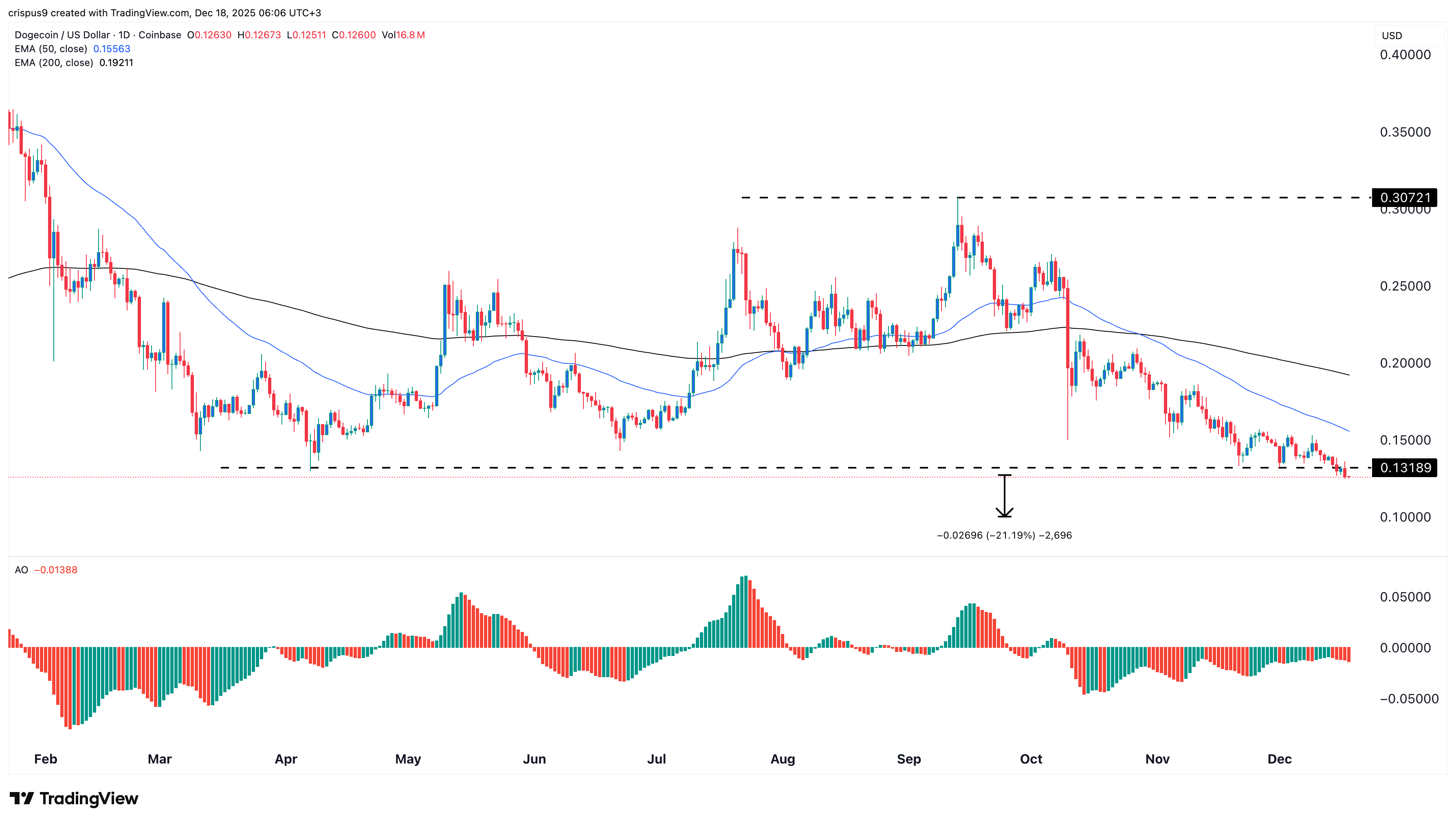
Dogecoin price continued its downward trend as headwinds in the crypto market rose and demand for its ETFs plunged. DOGE was trading at a crucial support level at $0.1265, down by nearly 60% from its highest point in September.

DOGE ETF Inflows Have Stalled

The main reason why the Dogecoin price has crashed recently is that sentiment in the crypto industry has waned. A closer look at the sector shows that Bitcoin and most altcoins have been in the red as the Fear and Greed Index remains in the fear zone.

DOGE price has also slumped as demand for its exchange-traded funds remained muted. Data shows that the Grayscale and Bitwise DOGE ETFs have had no inflows since December 11. The last date these funds had inflows was on December 10 when an investor bought ETFs worth $171k.

Therefore, these funds have brought in $2 million in inflows since their inception in November, and they now hold $5.2 million in assets, which is equivalent to 0.03% of the market capitalization.

Grayscale’s GDOG has $3.95 million in assets, while Bitwise’s BWOW has $1.25 million. Therefore, the implication of all this is that these companies may ultimately decide to shutter the funds in the future if they fail to attract enough assets.

GDOG has an expanse ratio of 0.35%, meaning that its annual revenue will be less than $14,000 if the assets remain this low. Similarly, BWOW will make Bitwise less than $5,000 a year, which is not much for a company with billions of dollars in assets  

The ongoing DOGE ETF woes are a sharp contrast to the performance of other altcoin ETFs. For example, the recently launched XRP ETFs have accumulated over $1 billion in inflows, while Solana funds have gained $725 million in inflows.

Dogecoin Price Technical Analysis 

To Crash to alt=
DOGE price chart | Source: TradingView

The daily chart shows that the DOGE price sits at a crucial support level today. It has dropped to $0.1260, a level it has failed to move below several times since April 7 this year.

Dogecoin price has remained below the 50-day and 100-day Exponential Moving Averages (EMA), while the Awesome Oscillator has remained below the zero line since October 9.

Therefore, the most likely DOGE price forecast is bearish as buyers have remained in the sidelines. If this happens, the next key support level to watch will be at the psychological level at $0.10, which is about 20% below the current level.

READ MORE: Top Catalysts for an Altcoin Season in 2026

Source link

18 12, 2025

Dogecoin, Cardano & Pump.fun – Asian Wrap 18 December

By |2025-12-18T11:54:43+02:00December 18, 2025|Crypto News, News|0 Comments

Dogecoin (DOGE) trades in the red on Thursday, following a 4% decline on the previous day. The DOGE supply in profit declines as large wallet investors trim their portfolios. Derivatives data shows a surge in bearish positions amid declining retail interest. The technical outlook for Dogecoin indicates bearish bias as DOGE breaks below April’s low, targeting $0.1000. 

Cardano (ADA) price trades in the red, slipping below $0.37 on Thursday after correcting more than 7% so far this week. The ongoing pullback could deepen further as ADA’s social dominance declines and dormant wallet activity rises, suggesting bearish sentiment among traders. On the technical side, deteriorating momentum indicators suggest further downside.

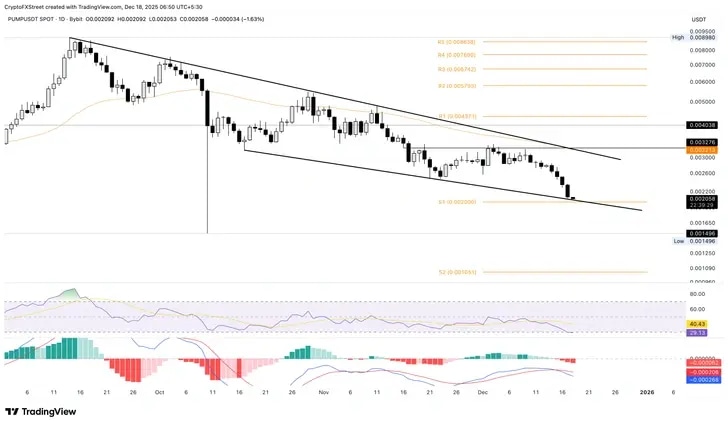
Pump.fun edges lower by nearly 2% at press time on Thursday, extending the 10% decline from the previous day. The meme coin launchpad token approaches the support trendline connecting the November 17 and 21 lows, part of a falling wedge pattern. If PUMP marks a decisive close below the S1 Pivot Point at $0.002000, it would confirm the bearish breakout. The declining trend in PUMP could find support at the October 10 low at $0.001496 or the S2 Pivot Point at $0.001051.

Source link

18 12, 2025

Cardano Price Prediction: ADA Tests $0.38 Support as Analysts Flag Risk Towards $0.29

By |2025-12-18T09:54:01+02:00December 18, 2025|Crypto News, News|0 Comments

Cardano price is testing the crucial $0.38 support zone as bearish technical signals raise the risk of a deeper pullback towards $0.29, keeping participants cautious on near-term direction.

Cardano price is trading near a technically sensitive zone as price action consolidates around the $0.38 level, a threshold analysts consider critical for near-term stability. While ADA has avoided an aggressive breakdown so far, multiple technical signals suggest downside risk remains if buyers fail to defend current levels.

Despite modest intraday strength, the broader structure continues to reflect weakness, keeping participants cautious as Cardano searches for directional clarity.

Cardano Price Approaches a Key Technical Decision Zone

As of December 17, 2025, Cardano price was trading around $0.38, posting minor gains on the day but remaining under pressure on higher timeframes. Price action has slipped below previous consolidation ranges, leaving Cardano price vulnerable to further downside if demand fails to step in.

Cardano trades near $0.38 as price tests a key short-term demand area. Source: Brave New Coin

From a technical perspective, the $0.38–$0.36 region stands out as the nearest support band where buyers have historically attempted to slow declines. A clean hold above this zone could allow for short-term stabilization, while a decisive breakdown would weaken the structure further.

Bearish SuperTrend Signal Raises Caution

Technical analyst Ali Martinez recently highlighted a bearish development on Cardano’s higher timeframe chart, noting that the SuperTrend indicator has flipped bearish. Historically, similar signal shifts on ADA have coincided with extended corrective phases rather than brief pullbacks.

Cardano Price Prediction: ADA Tests alt=

Previous SuperTrend reversals on ADA coincided with major corrective phases. Source: Ali Martinez via X

Ali pointed out that the last comparable SuperTrend reversal preceded a sharp decline, reinforcing the importance of current support levels. While historical comparisons do not guarantee identical outcomes, the signal adds weight to the broader bearish bias unless structure improves.

ADA Channel Breakdown Puts $0.29 on the Radar

Adding to downside concerns, Cardano price has recently broken down from a long-standing price channel on the daily timeframe. In another chart from Ali Martinez, the analyst points out that this structural failure places the $0.29 level into focus as the next major area of interest.

ADA Channel Breakdown Puts $0.29 on the Radar

A confirmed channel breakdown places $0.29 as a key downside reference. Source: Ali Martinez via X

This level aligns with prior accumulation zones and historically strong demand, suggesting it could act as a reaction point if selling pressure accelerates. However, a move towards $0.29 would represent a continuation of the current downtrend rather than a confirmed bottom.

On-Chain Activity Shows Signs of Resilience

While price structure remains fragile, Cardano’s on-chain metrics paint a more mixed picture. Recent data indicates that Cardano DEX volumes have increased 2–3x on average following recent ecosystem developments tied to the NIGHT protocol.

On-Chain Activity Shows Signs of Resilience

Cardano DEX activity shows elevated volumes despite price consolidation. Source: melon via X

Rising decentralized exchange activity suggests growing network usage, even as price struggles to regain momentum. Melon notes that increased on-chain activity does not always translate into immediate price appreciation, particularly during broader market corrections.

Adoption Trends Offer Long-Term Context

Adding to the mixed outlook, Cardano price continues to see strong adoption in key markets. Recent data indicates that ADA ranks among the top 10 most held cryptocurrencies in India, overtaking assets such as Solana (SOL) and Polygon (POL) in investor ownership.

Adoption Trends Offer Long-Term Context

ADA ranks among the top 10 most held cryptocurrencies in India. Source: MinswapIntern via X

While adoption metrics support Cardano’s long-term relevance, short-term price action remains driven primarily by technical structure and overall market sentiment.

Cardano Market Overview

Cardano remains significantly below its 2021 all-time high of $3.09, reflecting a prolonged corrective phase shared by many large-cap altcoins. Short-term traders remain focused on defending the $0.38 region, while longer-term investors view deeper pullbacks as potential structural retests rather than a breakdown of fundamentals. Market sentiment around ADA remains mixed, with price direction likely influenced by broader crypto market conditions, particularly Bitcoin’s trend.

Final Thoughts

Cardano price is at a pivotal point. The $0.38 support level serves as a key reference for short-term stability, while a confirmed breakdown could expose ADA to a move towards $0.29. Technical indicators lean cautiously, though on-chain activity and adoption trends provide partial balance to the bearish narrative.

For now, ADA’s outlook remains conditional. Holding current support could allow consolidation, while further weakness would reinforce the broader downtrend. Monitoring structural levels and broader market cues remains essential for assessing Cardano’s next move.


Source link

18 12, 2025

SOL Slips Near $123 as Traders Watch $120–$122 Support — Forecast and Key News for Dec. 17, 2025

By |2025-12-18T07:52:18+02:00December 18, 2025|Crypto News, News|0 Comments

Dec. 17, 2025 — Solana’s U.S. dollar pair (SOL-USD) is trading around the $123 area as the broader crypto market remains cautious and risk-sensitive, while Solana-specific headlines range from a major network stress test (a large DDoS attack) to fresh security research around post-quantum signatures. [1]

Multiple pricing feeds show SOL down roughly ~3.6% to ~3.8% over the past 24 hours, with heavy turnover and an unusually wide intraday range — a setup that has kept short-term “breakout or breakdown” talk front and center in today’s technical commentary. [2]


SOL-USD price today (Dec. 17, 2025): live snapshot

At the time of writing, widely followed trackers place Solana around $123:

  • Price: ~$123 [3]
  • 24h change: about -3.6% to -3.8% depending on venue/data source [4]
  • 24h volume: roughly $5.4B–$5.9B [5]
  • Market cap: about $69.2B; ranked #7 on CoinMarketCap [6]
  • Circulating supply: ~562.0M SOL (CoinMarketCap figure) [7]
  • Intraday range (example feed):high ~$133.9 / low ~$121.4 on Investing.com’s daily data line for Dec. 17 [8]

Context: CoinGecko also shows SOL down about ~11% over the past 7 days, highlighting that the latest slide is part of a broader December pullback rather than a single-candle move. [9]


Why is Solana (SOL-USD) moving today? Key news and narratives dated Dec. 17, 2025

Today’s SOL price action is being pulled by two forces at once: (1) a risk-off crypto tape and (2) Solana-specific headlines that are, paradoxically, long-term constructive even as price chops lower in the short term.

1) The macro tape is still pressuring crypto risk

Reuters reports crypto investors have become more cautious after the market’s downturn from October highs, with greater emphasis on hedged/active strategies and risk management tools. That kind of positioning shift can reduce dip-buying urgency in large-cap alts like SOL. [10]

(Separate market coverage also points to crypto behaving more like a risk asset than a gold-like hedge in this phase, which can keep pressure on majors when sentiment turns defensive.) [11]

2) Solana “stress test” headlines: week-long DDoS attack, but no downtime

A widely discussed Solana story on Dec. 17 is the network’s ability to remain operational through a massive DDoS attack. Unchained reports the attack lasted over a week and peaked around 6 Tbps, yet the network appeared “unimpacted” and saw zero downtime or performance degradation in that account. [12]

Unchained also notes Solana co-founder Anatoly Yakovenko publicly framed the attack as “bullish” in the sense that an attacker was allegedly spending heavily to generate traffic without taking the chain down—adding to the narrative that Solana’s infrastructure resilience has improved. [13]

Why it matters for SOL-USD: In past cycles, Solana’s reliability has been a major investor talking point. Stories that emphasize resilience can strengthen long-term confidence, but they don’t always translate into immediate upside if the overall market is risk-off.

3) Post-quantum security enters the conversation: “quantum-resistant signatures” on testnet

Another major Dec. 17 headline: Cointelegraph (via TradingView) reports the Solana Foundation partnered with Project Eleven for a quantum computing threat assessment and prototyped a Solana testnet using post-quantum digital signatures, claiming end-to-end “quantum-resistant transactions” can be practical and scalable. [14]

BeInCrypto similarly reports Solana deployed post-quantum signatures on a testnet as a proactive security measure amid growing industry focus on quantum readiness. [15]

Why it matters for the forecast: This is not a “next week” price catalyst in most models, but it supports a longer-term investment narrative: Solana positioning itself as infrastructure that can evolve with future security standards.

4) Institutional rails keep expanding: Visa’s USDC settlement over Solana

Although announced Dec. 16, Visa’s move is part of what traders are still digesting on Dec. 17 because it directly references Solana in a TradFi settlement context. Visa says initial U.S. banking participants Cross River Bank and Lead Bank have begun settling with Visa in USDC over the Solana blockchain, with broader availability planned through 2026. [16]

Why it matters for SOL-USD: Even when SOL token price doesn’t respond immediately, the “Solana as payments/settlement infrastructure” storyline is strengthened when a global network like Visa names Solana as a settlement rail in an official release.

5) Tokenization momentum (recent context still relevant today)

Earlier this month, Reuters reported J.P. Morgan arranged a $50 million short-term debt deal for Galaxy Digital on Solana’s blockchain, with USDC used in the flow—another signal of institutional experimentation on Solana. [17]

Separately, State Street Investment Management and Galaxy Asset Management announced plans (Dec. 10) for the State Street Galaxy Onchain Liquidity Sweep Fund (SWEEP), anticipating ~$200 million seed from Ondo Finance and an early 2026 debut on Solana, using stablecoins (including PYUSD) for subscriptions and redemptions. [18]

Galaxy’s own research recap from Breakpoint week framed these types of announcements as evidence of ecosystem maturation and increasing institutional traction around the “internet capital markets” thesis. [19]


SOL-USD technical analysis today: the key levels analysts are highlighting (Dec. 17)

Today’s technical commentary is unusually aligned on one point: SOL is coiling, and the next big move likely depends on whether support breaks or holds.

The support zone: $120–$122 is the market’s “line in the sand”

  • Crypto.news describes SOL compressed near $122 support, warning repeated retests can weaken support and that a breakdown could open a move toward $100. [20]
  • Brave New Coin similarly emphasizes $120 as a critical support zone, describing price compression in the $120–$130 area and highlighting downside risk if $120 fails. [21]

The “range floor” many are watching: ~$124–$126

  • Altcoin Buzz notes support near $124.5 being tested amid weak momentum and EMA resistance overhead. [22]
  • A NewsBTC technical write-up syndicated on CryptoRank points to supports around $126 and $124, describing SOL trading below ~$130 with resistance around $132. [23]

Overhead resistance: $130–$132 first, then $135+

  • CryptoRank/NewsBTC flags the $130 and $132 area as the near-term hurdle, with $132 highlighted as a trendline-type resistance in its framing. [24]
  • Altcoin Buzz similarly references overhead moving-average resistance and identifies a mid-range area that has stalled price action. [25]

Takeaway: Market structure is “compressed.” In practice, that often means traders watch for a decisive move below ~$120–$122 (bearish expansion) or a reclaim above ~$132 (bullish relief rally). [26]


Solana price forecast (SOL-USD): outlook for the next 24 hours, this week, and into early 2026

No forecast is guaranteed—crypto is notoriously headline- and liquidity-driven—but today’s mix of price structure and news flow lends itself to scenario-based expectations.

Base case (near-term): choppy range trading while SOL holds $120–$122

Given the tight compression highlighted by multiple analysts, a common near-term path is continued sideways-to-choppy trade as long as SOL holds the widely watched support band. [27]

In this base case, traders often look for mean reversion toward the $130–$132 area (the first meaningful resistance cluster) rather than an immediate trend reversal. [28]

Bullish scenario: reclaim $132, then aim for mid-$130s and higher

A bullish break typically requires SOL to:

  1. Clear ~$130, and
  2. Flip ~$132 from resistance into support (a level repeatedly cited in today’s analysis). [29]

If that happens, some technical roadmaps start pointing toward $135 and beyond (with higher resistance levels mentioned in certain write-ups), though follow-through will likely depend on whether the broader crypto market stabilizes. [30]

Bearish scenario: lose $120–$122 and momentum targets $100 psychology

If SOL loses the $120–$122 support area decisively, analysts highlighting the compression pattern argue the move could accelerate, with $100 often cited as a psychological downside target from the current structure. [31]

This scenario becomes more plausible if macro-driven crypto weakness persists and risk appetite remains subdued. [32]


What “forecast models” are saying today (and why they differ)

A number of widely circulated SOL price prediction pages updated around this period broadly cluster around “low $120s to low/mid $130s” for late December, but they vary meaningfully on timing and volatility assumptions.

  • Changelly projects a December 2025 range roughly $126.57 to $133.90, with an average near $130.24. [33]
  • CoinCodex suggests SOL around $131.09 by Dec. 18, 2025, and presents a higher target around $145.94 by mid-January 2026 in its forward path. [34]

Important nuance: These models can lag real-time developments (macro shocks, security headlines, liquidity events) and may not “understand” Solana-specific catalysts like Visa settlement rails or post-quantum testnets in a fundamental sense. Treat them as reference points, not promises. [35]


What to watch next for SOL-USD (the short checklist)

If you’re tracking SOL-USD into the end of 2025, today’s coverage suggests five practical watch items:

  1. Support integrity: does SOL continue defending $120–$122, or do repeated tests finally break? [36]
  2. Resistance clearance: can SOL reclaim $130–$132 and hold it? [37]
  3. Network confidence headlines: follow-ups on the DDoS story and any additional technical disclosures about mitigations. [38]
  4. Institutional adoption signals: progress or additional partners around Visa’s USDC settlement rail on Solana. [39]
  5. Macro risk sentiment: whether the broader crypto market continues to de-risk (which tends to hit alts) or starts to recover. [40]

Bottom line

On Dec. 17, 2025, Solana USD (SOL-USD) sits at a technically sensitive spot near $123, with analysts largely converging on a simple framework: $120–$122 is key support; $130–$132 is the first major resistance. [41]

Meanwhile, Solana’s news cycle is unusually infrastructure-heavy—DDoS resilience, post-quantum signature experiments, and large institutional rails name-checking Solana for settlement—suggesting the ecosystem story remains active even as price stays tied to a cautious, risk-off crypto tape. [42]

This article is for informational purposes only and does not constitute financial advice. Cryptocurrency prices can change rapidly, and different data providers may show slightly different prices due to exchange and methodology differences. [43]

References

1. coinmarketcap.com, 2. coinmarketcap.com, 3. coinmarketcap.com, 4. coinmarketcap.com, 5. coinmarketcap.com, 6. coinmarketcap.com, 7. coinmarketcap.com, 8. www.investing.com, 9. www.coingecko.com, 10. www.reuters.com, 11. www.barrons.com, 12. unchainedcrypto.com, 13. unchainedcrypto.com, 14. www.tradingview.com, 15. beincrypto.com, 16. usa.visa.com, 17. www.reuters.com, 18. investors.statestreet.com, 19. www.galaxy.com, 20. crypto.news, 21. bravenewcoin.com, 22. www.altcoinbuzz.io, 23. cryptorank.io, 24. cryptorank.io, 25. www.altcoinbuzz.io, 26. crypto.news, 27. crypto.news, 28. cryptorank.io, 29. cryptorank.io, 30. cryptorank.io, 31. crypto.news, 32. www.reuters.com, 33. changelly.com, 34. coincodex.com, 35. usa.visa.com, 36. crypto.news, 37. cryptorank.io, 38. unchainedcrypto.com, 39. usa.visa.com, 40. www.reuters.com, 41. coinmarketcap.com, 42. unchainedcrypto.com, 43. coinmarketcap.com

Source link

18 12, 2025

ETHUSD Plummets to $2810: Is Another Drop Ahead for Ethereum USD?

By |2025-12-18T05:50:35+02:00December 18, 2025|Crypto News, News|0 Comments

Ethereum USD (ETHUSD) has seen a sharp drop to $2810.69, a significant decrease of $153.71 since opening. This downturn, reflected by a 5.19% drop today, raises questions about the market’s next move for this top cryptocurrency.

Current Price Movement and Volatility

Ethereum USD has just hit $2810.69, recording a notable decline of 5.19% today. The intraday low touched $2790.01, while the high reached $3028.99. With a market cap of approximately $354 billion, Ethereum’s trading volume climbed to 369,841,310, surpassing its average volume of 291,012,931. This surge in volume indicates growing market interest amidst volatility.

Technical Indicators Signal Bearish Sentiment

Several technical indicators suggest a bearish trend for Ethereum USD. The RSI stands at 40.89, indicating potential oversold conditions. The MACD, at -86.59 with a histogram of 36.25, further supports a bearish outlook. Meanwhile, the ADX at 38.15 shows a strong trend, reinforcing current market conditions.

Forecasts and Future Outlooks

ETHUSD’s monthly forecast predicts a potential dip to $2644.67, aligning with current bearish signals. However, a quarterly forecast of $3457.34 suggests possible recovery in the medium term. Long-term predictions show promising growth, with a yearly target of $3367.76 and a five-year forecast of $4809.89. Forecasts can change due to macroeconomic shifts, regulations, or unexpected events affecting the crypto market.

Market Sentiment and News Impact

Recent coverage by Yahoo Finance highlights broader market declines impacting Ethereum. With major cryptos experiencing downturns, Ethereum’s recent price action reflects broader market jitters. The fluctuating sentiment underscores caution, and traders are closely monitoring global economic pointers and regulatory updates for cues.

Final Thoughts

Ethereum USD’s recent price drop highlights significant market volatility. While technical indicators lean bearish, the forecast suggests mixed signals with potential for mid-term recovery. Traders should stay informed, considering factors like economic policy changes or regulatory shifts that could alter the crypto landscape drastically.

FAQs

What is the current price of ETHUSD?

As of the latest data, the price of ETHUSD is $2810.69 after a decline of 5.19% today, dropping by $153.71 from its previous close of $2964.4.
ETHUSD

What are the key technical indicators for Ethereum USD?

Key indicators include an RSI of 40.89, MACD at -86.59, and ADX at 38.15, all pointing to a bearish sentiment in the current market conditions for ETHUSD.

What are the future price forecasts for ETHUSD?

The monthly forecast is $2644.67, while the quarterly forecast is $3457.34. Long-term projections expect ETHUSD to reach $3367.76 annually and $4809.89 in five years.

How does recent news influence the ETHUSD price?

Recent news coverage indicates broader market declines, impacting Ethereum USD and reflecting general market uncertainty. Economic policies and regulations are closely watched for potential impacts.

Is Ethereum USD expected to recover soon?

While current technical indicators show a bearish trend, the mid-term forecast suggests a possible recovery. Traders should keep an eye on macroeconomic and regulatory developments.

Disclaimer:


Cryptocurrency markets are highly volatile. This content is for informational purposes only.
The Forecast Prediction Model is provided for informational purposes only and should not be considered financial advice.
Meyka AI PTY LTD provides market data and sentiment analysis, not financial advice.
Always do your own research and consider consulting a licensed financial advisor before making investment decisions.

Source link

18 12, 2025

Bitcoin Slips Near $86,000 as ETF Outflows and Risk-Off Mood Shape the Forecast

By |2025-12-18T03:48:35+02:00December 18, 2025|Crypto News, News|0 Comments

Bitcoin’s USD price (BTC-USD) is trading in a tense range on December 17, 2025, as traders weigh conflicting signals: persistent U.S. spot Bitcoin ETF outflows, a still-uncertain Federal Reserve rate path, and evidence that institutional interest remains real—but increasingly selective.

As of writing, Bitcoin (BTC-USD) is around $86,108, down about 1.6% versus the prior close, after printing an intraday high near $90,187 and low near $85,355.

That level keeps BTC well below its October peak (around the mid-$126,000s), and it helps explain why “year-end rebound” headlines are being met with skepticism across both crypto-native and traditional markets. [1]

Bitcoin price today: BTC-USD holds the mid-$80,000s after a volatile December

While price action has been choppy, several market reads describe Bitcoin as range-bound rather than in free-fall.

  • Investing.com reported BTC trading above $88,000 earlier Wednesday (U.S. morning), but noted gains were limited by ongoing ETF outflows and uncertainty around the Fed’s interest-rate outlook. [2]
  • Glassnode’s Dec. 17 “Week On-Chain” analysis similarly framed Bitcoin as “trapped” under heavy overhead supply, with price recently rejected near ~$93k and drifting lower—behavior consistent with a market leaning more toward time-based consolidation than a clean trend reversal. [3]

In other words: BTC-USD is still moving fast (as it always can), but the bigger story today is the tug-of-war between structural support and overhead selling pressure.

What’s moving Bitcoin today: the 3 biggest drivers in the news on Dec. 17, 2025

1) Spot Bitcoin ETF flows: outflows are back in focus

One of the most watched BTC-USD drivers in late 2025 remains spot ETF flow momentum—and the latest data has turned into a clear headline.

Farside Investors data shows U.S. spot Bitcoin ETFs recorded a net outflow of about $277.2 million on Dec. 16, with IBIT at -$210.7 million, while FBTC showed +$26.7 million (and several others were negative or flat). [4]

That matters because multiple market notes argue ETF demand is now the “swing factor” for Bitcoin—especially as other sources of incremental buying have slowed (more on that below). [5]

2) Macro uncertainty: Fed path and inflation data are driving risk appetite

Bitcoin has increasingly traded like a high-beta risk asset in 2025—moving with (and sometimes exaggerating) shifts in broader risk sentiment.

Investing.com explicitly pointed to:

  • Mixed labor-market signals complicating expectations for the pace of future Fed cuts, and
  • U.S. inflation data due Thursday as the next key macro catalyst. [6]

That “macro-first” framing also shows up in on-chain commentary: Glassnode described weak ETF flows, thin spot liquidity, and defensive positioning leaving BTC sensitive to macro catalysts. [7]

3) Post-drawdown positioning: investors are more cautious, leverage is being managed

A Reuters analysis published today says the recent downturn has pushed investors toward risk-managed strategies, highlighting a broader shift: crypto exposure is increasingly expressed through ETFs, options, and structured tools, rather than pure directional bets. [8]

Reuters also emphasized how the downturn hit some of the most “hyped” corners of the market—particularly bitcoin-treasury companies, whose premiums have compressed sharply as BTC fell from its October highs. [9]

BTC-USD forecast: key support and resistance levels analysts are watching

Forecasts for Bitcoin tend to cluster around levels—because in crypto, narratives often change at specific prices.

Here are the most-cited BTC-USD zones in today’s analysis:

Support zone: $81,000–$82,000 (then $80,000 as the line in the sand)

  • Glassnode identifies support near ~$81k and discusses the “True Market Mean” around $81.3k as a level defended by patient buyers. [10]
  • DailyForex calls $80,000 the market’s “floor” in the current setup. [11]
  • Barron’s cited a view that BTC could test $80,000–$82,000 if risk aversion persists. [12]

Why this area matters: If Bitcoin loses the low-$80Ks, the market conversation can quickly shift from “consolidation” to “breakdown.”

Resistance zone: $93,000–$95,000 (then $100,000+)

  • Glassnode highlights rejection near ~$93k and flags that failure to reclaim ~$95k keeps upside constrained. [13]
  • DailyForex places resistance near $95,000 (around the 50-day EMA), with $100,000 as the next psychological test if bulls regain control. [14]

Why this area matters: A clean break above ~$95k would reduce the “overhead supply” pressure narrative and could shift market tone quickly back toward $100k debates.

Short-term Bitcoin price prediction: 3 scenarios for the days ahead

No one can forecast Bitcoin perfectly—especially in a market where macro headlines can reprice risk in minutes. But today’s research largely points to scenario planning.

Scenario A: Range holds (most consistent with today’s positioning)

If ETF flows remain mixed and macro data doesn’t surprise, analysts describing BTC as “range-bound” see price oscillating between low-$80Ks support and mid-$90Ks resistance into year-end. [15]

Glassnode also notes large December options expiries (including Dec. 26) may contribute to “pinning” behavior that reinforces range trading. [16]

Scenario B: Bear break below $80,000

A decisive move below $80k is the level where several forecasts get harsher. DailyForex suggests that a breakdown could open the door to much deeper downside targets (with $65k mentioned as a potential level in that scenario). [17]

Scenario C: Bull reclaim above $95,000

If macro risk sentiment improves and ETF flows stabilize, a move above ~$95k is widely treated as the “regain momentum” trigger, with $100k the next major psychological battleground. [18]

Longer-term Bitcoin forecast: what major institutions and analysts are projecting for 2026+

Long-range BTC-USD forecasts vary wildly—but a few calls are dominating the December conversation because they come with clear assumptions about where demand will come from next.

Standard Chartered: $150,000 by end-2026, $500,000 by 2030 (but slower than previously expected)

Reuters’ Live Markets report (Dec. 10) said Standard Chartered’s Geoff Kendrick cut 2025 and 2026 forecasts in half, now expecting around $100,000 by end-2025 and $150,000 by end-2026, while still keeping a longer-run view that Bitcoin could reach $500,000 by 2030. [19]

Investing.com’s coverage adds important color: Kendrick argued the recent drawdown is steep but “within historical norms,” and that future upside is expected to be driven largely by ETF inflows, with bitcoin-treasury-company buying no longer assumed to be a reliable incremental support. [20]

That same demand-shift theme is echoed in Reuters’ broader Dec. 17 analysis: the crypto market is “maturing,” with more structured tools and more nuanced exposure replacing the earlier era of reflexive leverage. [21]

Media and retail-facing forecasts: $200,000 in 2026 is possible—but increasingly framed as a “high bar”

The Motley Fool’s Dec. 17 piece explicitly questions whether BTC can hit $200,000 in 2026, calling the “more than doubling” required from current levels a tall task and pointing to more cautious outlooks after the late-2025 pullback. [22]

While these aren’t bank research notes, they’re indicative of a broader shift in tone: fewer “straight line up” calls, more probability-weighted framing around macro conditions, ETF flows, and risk sentiment.

The bigger story behind today’s BTC-USD price: Bitcoin is institutional—but it still trades on risk

One of the most important through-lines in today’s reporting is the idea that Bitcoin has become more “institutional” in market structure—without necessarily becoming less volatile.

Reuters highlighted ongoing institutional involvement (including endowments and sovereign wealth funds) even as investors get more cautious after the drawdown. [23]

At the same time, crypto’s relationship with broader tech-and-risk narratives continues to show up in coverage. Barron’s described Bitcoin as behaving less like gold and more like a risk-sensitive asset tied to broader market sentiment, while warning of downside tests if risk aversion persists. [24]

What to watch next for Bitcoin (BTC-USD)

If you’re tracking Bitcoin price today with an eye on the forecast, the next catalysts most cited in today’s reporting are:

  • U.S. inflation data (Thursday) and how it reshapes rate-cut expectations [25]
  • Daily spot Bitcoin ETF flow data, especially whether outflows continue or reverse [26]
  • Whether BTC holds $81k–$80k support (a level cited across multiple analyses) [27]
  • Whether BTC can reclaim ~$95k resistance, which several analysts treat as the momentum reset point [28]

References

1. www.reuters.com, 2. www.investing.com, 3. insights.glassnode.com, 4. farside.co.uk, 5. www.investing.com, 6. www.investing.com, 7. insights.glassnode.com, 8. www.reuters.com, 9. www.reuters.com, 10. insights.glassnode.com, 11. www.dailyforex.com, 12. www.barrons.com, 13. insights.glassnode.com, 14. www.dailyforex.com, 15. insights.glassnode.com, 16. insights.glassnode.com, 17. www.dailyforex.com, 18. www.dailyforex.com, 19. www.reuters.com, 20. www.investing.com, 21. www.reuters.com, 22. www.fool.com, 23. www.reuters.com, 24. www.barrons.com, 25. www.investing.com, 26. farside.co.uk, 27. insights.glassnode.com, 28. insights.glassnode.com

Source link

18 12, 2025

critical support tested as reversal signals emerge

By |2025-12-18T01:47:40+02:00December 18, 2025|Crypto News, News|0 Comments

The Cardano market is navigating a decisive phase as price action compresses around a long-defended technical zone.

At press time, Cardano (ADA) was trading near $0.396, up about 2.7% over the past 24 hours.

But despite the short-term bounce, ADA price remains down roughly 14% on the week and close to 19% over the past month, reflecting persistent pressure across the broader crypto market.

Support holds while volatility cools

Cardano price has spent recent sessions probing the $0.37–$0.40 region, an area that has emerged as critical support on multiple timeframes.

This zone has repeatedly absorbed selling pressure following a sharp pullback from above $0.40, where profit-taking intensified amid a broader Bitcoin-led sell-off.

Earlier today, the market briefly lost the $0.38 handle before bouncing back and stabilising, keeping the focus firmly on whether buyers can continue to defend the lower boundary.

From a technical standpoint, ADA is sitting on a multi-year ascending trendline that has historically separated prolonged corrections from recovery phases.

$ADA is holding the multi year trendline so far.

We need a strong bounce from here to engage a reversal.

Image

Rather than breaking decisively lower, the price has compressed along this trendline, suggesting consolidation rather than capitulation.

Trading volume remains elevated near $500 million over 24 hours, but the balance between buyers and sellers still appears fragile, with technical momentum indicators reflecting this tension.

Oscillators such as RSI and Stochastic RSI remain bearish, while deeply negative readings on momentum measures hint at oversold conditions. Mostly, this combination often precedes short-term relief rallies, though it does not guarantee a trend change on its own.

Reversal signals begin to stack up

Several analysts argue that Cardano price forecast models are starting to lean constructive as downside momentum shows signs of exhaustion.

According to Ali Matinez, a TD Sequential buy signal has appeared on the daily chart, highlighting $0.37 as the key invalidation level.

As long as ADA holds above that threshold, the model allows for a recovery path toward the $0.50–$0.54 zone, which aligns with prior reaction highs.

Chart structure also supports this view since Cardano has been trading within a falling channel for several months, as highlighted by analyst Nehal, and recent price action suggests selling pressure is weakening near the lower boundary.

A confirmed breakout above the channel’s upper trendline would shift focus toward higher resistance between $0.60 and $0.68, levels defined by earlier consolidation and volume clusters.

Beyond near-term signals, longer-cycle analysis adds another layer.

TradingView analyst Migoreng_wrap frames the current decline as the latter stage of a corrective Wave 2 within a broader Elliott Wave Pattern.

In this view, the low near $0.37 completes the correction following the prior impulse that carried ADA to $1.32 in late 2024.

If the structure holds, a powerful Wave 3 could follow, with projections that ultimately challenge and exceed the previous all-time high.

Fundamentals are also part of the conversation with ongoing efforts to expand stablecoin liquidity and treasury-backed DeFi initiatives aiming to address long-standing constraints within the Cardano ecosystem.

At the same time, scaling solutions and privacy-focused infrastructure are designed to improve execution speed and institutional readiness, factors that could matter if market sentiment turns.

The post Cardano price forecast: critical support tested as reversal signals emerge appeared first on Invezz


Source link

17 12, 2025

XRP Slips Under $2 as Spot XRP ETFs Top $1B Inflows — Price Forecast and 2026 Outlook (Dec. 17, 2025)

By |2025-12-17T23:46:35+02:00December 17, 2025|Crypto News, News|0 Comments

XRP-USD is trading around $1.88 on December 17, 2025, extending a choppy pullback that has kept the token pinned below the psychologically important $2.00 level. At the time of writing, XRP is down roughly 2.6% versus the prior close, with an intraday range near $1.85–$1.98—a sign that volatility remains elevated even as liquidity concentrates around a few key technical levels. [1]

The bigger story for traders and long-term holders is the tension between near-term bearish price action and structural tailwinds: multiple reports show U.S.-listed spot XRP ETFs drawing more than $1 billion of net inflows within roughly a month of launch, while Ripple-related regulatory and infrastructure headlines continue to stack up. [2]

Below is what’s moving XRP today, what analysts are watching next, and the scenarios shaping the XRP price forecast into early 2026.


XRP price today: the key XRP-USD levels investors are watching

Here are the headline numbers for XRP USD price on 17.12.2025:

  • Current XRP-USD price: about $1.88 [3]
  • 24h change: approximately -2.6%
  • Intraday high / low: roughly $1.98 / $1.85 [4]
  • Recent daily print (Investing.com):$1.8809 on Dec. 17, with the day’s high near $1.9858 and low near $1.8485 [5]

Prices vary slightly by venue and data provider, but the takeaway is consistent: XRP is struggling to reclaim $2.00, and the market is repeatedly reacting around the $1.90 zone. [6]


Why is XRP down today?

1) A broader “risk-off” tape is weighing on crypto

Several market briefs published today describe a defensive backdrop across major digital assets—Bitcoin and Ethereum included—where crypto is trading more like a high-beta risk asset than a safe haven. [7]

That matters for XRP because, in this type of tape, breakouts tend to fail quickly and bounces are often sold—especially when traders are reducing leverage and chasing liquidity. Investing.com’s analysis framed XRP’s current weakness as part of a broader regime that “punishes” failed breakouts, even when the fundamental backdrop looks constructive. [8]

2) Bitcoin whipsaws have spilled over into XRP

One of the most-circulated XRP market updates on Dec. 17 linked XRP’s slide to sudden volatility in bitcoin—describing XRP breaking below a nearby support zone amid heavier selling pressure. [9]

Even when XRP-specific headlines are positive, short-term correlation often dominates—especially during high-volatility sessions.


The biggest XRP news today: spot XRP ETFs pass the $1 billion inflow milestone

The standout narrative on 17 December 2025 is the scale and persistence of demand for spot XRP ETFs.

  • Investing.com reports ~$1.01 billion in net inflows in roughly the first 30 days, with combined ETF assets around $1.16 billion, and a breakdown of assets across multiple issuers. [10]
  • FXStreet’s XRP coverage today echoed the same order of magnitude and noted that, since their debut on November 13, the ETFs have not recorded outflows, citing SoSoValue data. [11]
  • DL News similarly reported over $1 billion into U.S. spot XRP ETFs since launch in November, also referencing SoSoValue and including commentary that ETFs can broaden access and improve market structure. [12]

This is a meaningful structural shift for XRP-USD because ETFs can create a steadier channel for allocation—particularly for investors who prefer regulated vehicles over direct exchange exposure.

But the market’s message today is equally clear: ETF inflows alone haven’t been enough to flip the short-term trend yet, as spot and derivatives selling has continued to pressure price under $2.00. [13]


Ripple and regulation: banking charter momentum and the post-lawsuit landscape

OCC conditional approval for Ripple trust bank

Regulatory headlines from earlier this month remain in focus today because they connect directly to the “institutionalization” narrative around XRP.

Reuters reported that the Office of the Comptroller of the Currency (OCC) granted preliminary/conditional approval for multiple crypto firms—including Ripple—to establish national trust banks, while clarifying that such charters do not allow firms to take deposits or make loans. [14]

Ripple also published a company announcement describing conditional approval to establish a federally supervised trust bank and tying the effort to oversight and stablecoin reserve management. [15]

SEC v. Ripple: appeals dismissed; final judgment remains

A critical anchor point for XRP’s U.S. regulatory story in 2025 is the SEC’s August litigation release stating it filed a joint stipulation dismissing its appeal and Ripple’s cross-appeal—while noting the district court’s final judgment (including a $125,035,150 civil penalty and an injunction) remains in effect. [16]

Why this matters for XRP ETFs

The ETF boom in late 2025 did not happen in a vacuum. Reuters reported in September that the SEC approved rule changes enabling exchanges to adopt generic listing standards for spot crypto/commodity ETPs, cutting the maximum timeline from filing to launch and explicitly noting that early products were expected to include Solana and XRP-linked ETFs. [17]


RLUSD and ecosystem expansion: another institutional thread investors are tracking

Ripple’s own updates this week emphasize stablecoin infrastructure and cross-chain reach. In a post published two days ago, Ripple said RLUSD is expanding to Ethereum Layer-2 networks using Wormhole’s NTT standard and described RLUSD as issued under a New York Department of Financial Services (NYDFS) limited purpose trust company framework. [18]

Whether or not this directly boosts XRP price in the short run, it reinforces the broader theme repeated in today’s market commentary: regulated rails and institutional product wrappers are becoming central to the XRP narrative. [19]


XRP price forecast: near-term scenarios (support, resistance, and what would change the trend)

Analyst coverage published on Dec. 17, 2025 clusters around a few widely watched levels. The names and models differ, but the map is surprisingly consistent: $1.90 is the line in the sand, and $2.00–$2.30 is the ceiling XRP must break to shift sentiment. [20]

Scenario A: XRP holds support and stabilizes (base case for a bounce)

Investing.com’s analysis highlighted:

  • Immediate support: around $1.92–$1.90
  • A structural pivot/floor: near $1.8140 (framed as a key “double-bottom” region)
  • Upside “confirmation” levels: reclaiming $2.00, then breaking $2.20–$2.30 [21]

If XRP defends this region and the broader crypto tape calms, a mechanically simple relief path is: $2.00 → $2.20–$2.30, with momentum traders watching for a higher-high sequence and improving volume.

Scenario B: XRP loses $1.90 and slides toward late-2025/early-2025 supports

FXStreet’s XRP update warned that a daily close below $1.90 could extend the correction toward $1.82 (described as November support), with the next major demand zone around $1.61 (April low). [22]

Investing.com’s deeper downside “hierarchy” adds intermediate zones around $1.73 and $1.64, while acknowledging a lower-probability tail risk into the mid-$1s if macro conditions deteriorate materially. [23]

Scenario C: XRP breaks out and the ETF bid starts to “show up” in price

If XRP can decisively flip $2.00 into support and reclaim $2.20–$2.30, Investing.com identifies upside targets in the $2.41–$2.50 region and then $3.00 as the next big psychological zone. [24]

This is also where ETF flows become more than a headline—because, in a breakout regime, steady inflows can amplify trend continuation as shorts cover and sidelined capital re-enters.


XRP price prediction for 2026: what today’s forecasts are saying

For longer-horizon readers searching “XRP price forecast 2026,” the dominant theme in today’s forward-looking commentary is volatility first, opportunity second.

Key reference points

  • CoinGecko lists XRP’s all-time high around $3.65. [25]
  • FXStreet’s annual outlook published today described XRP reaching a new record zone around $3.66 in July 2025 and argued that ETFs plus regulatory clarity could support a more constructive 2026—while still emphasizing that XRP remains vulnerable to another deep risk-off drawdown. [26]

A wide forecast range (and why it’s so wide)

FXStreet also quoted a Bitget Wallet research analyst projecting:

  • possible downside toward $1.40 during a broader correction, and
  • upside potential to a new record above $4.00 by end-2026 (conditional on stabilization and expanding institutional participation). [27]

Those targets are not “base case” predictions for most market participants—they’re better understood as endpoints in a high-volatility probability distribution. But they show how analysts are framing XRP: one of the most sentiment- and structure-dependent large-cap altcoins in the current cycle.


What to watch next for XRP-USD

For readers following XRP USD price today and trying to understand what could move the market next, these are the near-term catalysts repeatedly referenced across today’s coverage:

  • ETF flow data and issuance pace: whether the “no outflow days” streak continues, and whether inflows accelerate beyond the ~$1B level that multiple outlets cite. [28]
  • The $1.90–$2.00 battle: a technical and psychological inflection zone highlighted in multiple analyses today. [29]
  • Regulatory follow-through: progress from conditional approvals (like the OCC trust bank charters) toward fully operational frameworks. [30]
  • Stablecoin and infrastructure headlines (RLUSD and beyond): developments that reinforce the “regulated rails” story even when price lags. [31]

Bottom line

On Dec. 17, 2025, XRP’s price action is bearish-to-neutral in the short term—still below $2.00 and fighting to hold the $1.90 area. [32]

At the same time, the newsflow is unusually constructive: multiple sources report spot XRP ETFs pulling in over $1 billion in net inflows in about a month, while Ripple-related regulatory and infrastructure headlines reinforce the broader institutional narrative around XRP. [33]

As always with crypto, forecasts are scenarios—not promises. XRP’s next major move likely hinges on whether the market stays risk-off (pressuring support) or shifts back into a risk-on regime where ETF demand and improved market structure can translate into higher highs.

References

1. www.investing.com, 2. www.investing.com, 3. www.coingecko.com, 4. www.investing.com, 5. www.investing.com, 6. www.fxstreet.com, 7. www.fxstreet.com, 8. www.investing.com, 9. www.coindesk.com, 10. www.investing.com, 11. www.fxstreet.com, 12. www.dlnews.com, 13. www.fxstreet.com, 14. www.reuters.com, 15. www.businesswire.com, 16. www.sec.gov, 17. www.reuters.com, 18. ripple.com, 19. www.businesswire.com, 20. www.fxstreet.com, 21. www.investing.com, 22. www.fxstreet.com, 23. www.investing.com, 24. www.investing.com, 25. www.coingecko.com, 26. www.fxstreet.com, 27. www.fxstreet.com, 28. www.fxstreet.com, 29. www.fxstreet.com, 30. www.reuters.com, 31. ripple.com, 32. www.fxstreet.com, 33. www.investing.com

Source link

Go to Top