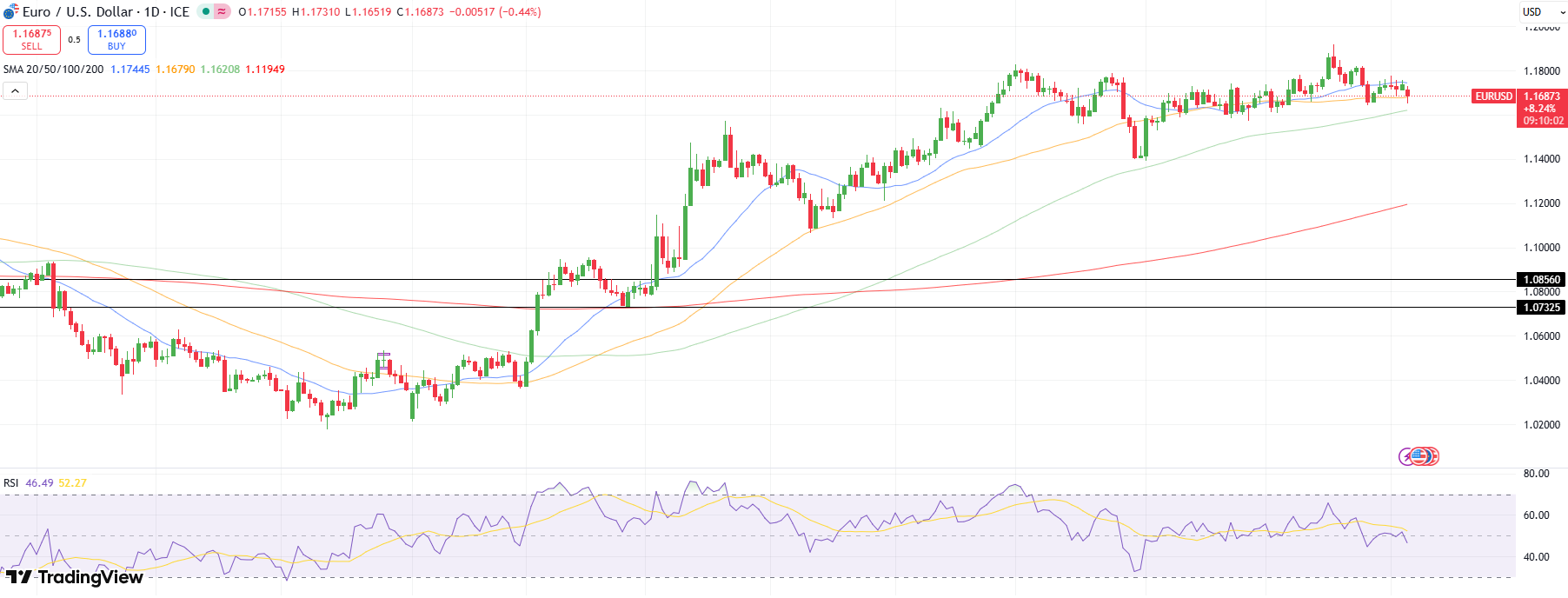
The euro has gone back and forth during the trading session here on Thursday as traders continue to look to try to sort out where we’re going to go with the US dollar longer term.
That being said, the market is basically stuck in a range at the moment. And I do think that makes a lot of sense considering that the non-farm payroll announcement comes out on Friday, the Thursday session will probably be very quiet.
Therefore you cannot read too much into the price action as we are just sitting in the middle of the same consolidation that we have been in for quite some time.
Interestingly enough, we have seen the 50 day EMA come into the fold, offering support right along with the 1.16 level. To the upside, the 1.1750 level is resistance that extends all the way to the one point one eight level.
More Sideways Action?
All things being equal, this is a market that has gone sideways after a nice uptrend. And I think traders are starting to wonder whether or not the Federal Reserve possibly cutting interest rates, supposedly cutting interest rates that is in September, isn’t the sign of something a little bit more ominous for the global economy. If it does end up being that way, then the US dollar will get a bit of a bid in a simple safety trade type of situation. Ultimately, I think this is a market that has a lot of decisions that will have to be made soon.
But ultimately, we are currently looking at this through the prism of trying to sort out where to go next. If we can break down below the 1.16 level, then the 1.14 level could be your target. A break above 1.18 opens up the possibility of 1.20.
Christopher Lewis has been trading Forex and has over 20 years experience in financial markets. Chris has been a regular contributor to Daily Forex since the early days of the site. He writes about Forex for several online publications, including FX Empire, Investing.com, and his own site, aptly named The Trader Guy. Chris favours technical analysis methods to identify his trades and likes to trade equity indices and commodities as well as Forex. He favours a longer-term trading style, and his trades often last for days or weeks.
The GBPJPY pair attempted to face the attempts of activating the bearish correctional track, taking advantage of providing positive momentum by stochastic, but it didn’t make it surpass the barrier at 200.40, to keep providing mixed sideways trading by its stability near 199.50.
The expected trend depends on the strength of the mentioned barrier, the continuation of the price stability below it will increase the chances of activating the negative attempts that might target 198.60 level, reaching the support at 197.85, while breaching the barrier and holding above it will activate the bullish track, to reach 200.90 followed by the next positive target at 202.45.
The expected trading range for today is between 197.85 and 199.80
The GBPJPY pair attempted to face the attempts of activating the bearish correctional track, taking advantage of providing positive momentum by stochastic, but it didn’t make it surpass the barrier at 200.40, to keep providing mixed sideways trading by its stability near 199.50.
The expected trend depends on the strength of the mentioned barrier, the continuation of the price stability below it will increase the chances of activating the negative attempts that might target 198.60 level, reaching the support at 197.85, while breaching the barrier and holding above it will activate the bullish track, to reach 200.90 followed by the next positive target at 202.45.
The expected trading range for today is between 197.85 and 199.80
The British pound has gone back and forth during the trading session on Thursday as we wait for the Non-Foreign Payroll announcement on Friday.
After all, that will have a major influence on where markets go, as traders are trying to figure out what to do with the US dollar in general.
Ultimately, the British pound is a currency that has done fairly well against the US dollar over the last several months, but recently, we have seen more of a sideways action than anything else.
Technical Analysis
The technical analysis for this market is relatively flat over the last couple of weeks, but there are a couple of levels that I will be looking at very closely. The first one would be the 1.34 level, which has offered support over the last couple weeks, and previously has been significant resistance previously. If we were to break down below the last couple of candlesticks, then we could see the British pound drop down to the 1.32 level. That’s an area that’s been support, but we also have the 200 Day EMA, so ultimately this is a situation where we have a lot of interest.
If we were to break to the upside, and break above the 50 Day EMA, the market is likely to go looking at the 1.36 level. The 1.36 level is a major resistance barrier, and is a bit important going forward, if we can break above there, then it’s likely that we really could see the US dollar fall, and the British pound really started to take off.
I think at this point we need to be very cautious, as there is a lot of back and forth noise. In general, this is a market that I think continues to see a lot of volatility, but as things stand right now, we are basically in the middle of the larger 400 pip trading range.
Christopher Lewis has been trading Forex and has over 20 years experience in financial markets. Chris has been a regular contributor to Daily Forex since the early days of the site. He writes about Forex for several online publications, including FX Empire, Investing.com, and his own site, aptly named The Trader Guy. Chris favours technical analysis methods to identify his trades and likes to trade equity indices and commodities as well as Forex. He favours a longer-term trading style, and his trades often last for days or weeks.
The USD/JPY pair has stabilized above the 148 handle, climbing to 148.75 with a 0.30% daily gain after wiping out yesterday’s decline. The rebound comes as U.S. data eased concerns about a stalling economy highlighted in the Beige Book, with traders repositioning ahead of Friday’s nonfarm payrolls. The pair’s price action since mid-August continues to confirm a sequence of higher lows and higher highs, reinforcing the short-term bullish channel that targets 149.00 and 150.75 if momentum persists.
Labor Market Signals Pressure the Fed Outlook
U.S. economic data shows clear signs of cracks in the labor market. Job openings fell to 7.18 million in July from 7.36 million in June, the lowest in nearly a year. ADP reported private sector hiring of just 54,000 in August, down from July’s 104,000, while layoffs are ticking higher. The ISM Services survey showed employment stuck in contraction even as new orders remained firm. These signals highlight a cooling jobs market, bolstering expectations that the Federal Reserve will proceed with its widely anticipated 25 bps rate cut at the September 16–17 meeting. CME FedWatch places probability of the move above 95%, with a 53% chance of another cut on October 29. Fed’s John Williams reinforced the cautious easing stance, calling policy only “modestly restrictive” and leaving the door open for gradual rate reductions if inflation cools further.
BoJ Policy and Political Turmoil Keep Yen Heavy
The Bank of Japan remains cautious despite its first steps toward normalization earlier this year. Governor Kazuo Ueda has reiterated a gradual pace of rate hikes, contingent on inflation and growth alignment, but recent comments from Deputy Governor Ryuzo Himino stressed that uncertainty is too high to justify urgency. Current pricing assigns less than a 30% probability of a September hike. At the same time, Japan’s political backdrop is weakening the yen. Ruling party secretary-general Hiroshi Moriyama’s resignation, combined with speculation that Prime Minister Shigeru Ishiba may also step down, has fueled expectations that Sanae Takaichi—known for supporting ultra-low rates—could emerge as a successor. Political risk and the likelihood of continued accommodative BoJ policy underpin yen softness, helping drive USD/JPY back toward five-week highs near 149.14.
Technical Outlook: Bulls Defend 147.85, Resistance at 149.10
Technically, USD/JPY has been consolidating between the 147.85 support—coinciding with the 200-day EMA—and resistance near 149.10. A close above 149.12 would extend the rebound from 146.20 and retest the 150.90 zone, which represents both the prior high and the 61.8% Fibonacci retracement of the January–April downtrend. If bulls clear this hurdle, the path opens toward 151.22 and possibly 154.60. Momentum indicators support the bullish case: the MACD on the daily chart is preparing for a bullish crossover, and RSI remains in neutral territory with room to climb. On the downside, a break under 146.65 would end the bullish sequence, exposing 145.35 and the 23.6% Fibonacci retracement at 144.35 as deeper supports.
Market Balance Ahead of Nonfarm Payrolls
With USD/JPY pinned at 148.65–148.75 into Thursday’s U.S. close, traders are balancing Fed dovish expectations with BoJ’s cautious stance. Friday’s NFP will be decisive: consensus stands at 75,000 jobs added, barely above last month’s 73,000. A miss would accelerate dollar selling and test 147.85, while a stronger print could price out aggressive Fed cuts and propel the pair toward 151.00. Japanese household spending and labor earnings data due the same day will also provide insight into domestic demand, influencing how much leeway the BoJ has for policy shifts.
GBP/USD Holds 1.3430 as U.S. Labor Weakness Collides with BoE Hawkish Tilt
The GBP/USD pair trades around 1.3430, largely unchanged on the day, as market attention remains locked on diverging policy paths between the Federal Reserve and the Bank of England. U.S. labor data triggered volatility when August ADP numbers showed only 54,000 jobs added, far below July’s 104,000 and short of forecasts at 65,000. That miss deepened expectations that the Fed will be forced into multiple rate cuts, with CME FedWatch assigning a 95% probability of a September 17th cut and a 53% chance of another in October.
Sterling Gains Support from Bond Market Relief and BoE Signals
Sterling has found breathing space after the recent gilt turmoil eased. Yields on UK 30-year bonds dropped from a 27-year high of 5.75% to 5.58%, calming fears of a fiscal crunch that might have forced the Chancellor into harsher tax hikes and spending cuts. More importantly, BoE Governor Andrew Bailey reiterated that persistent inflation remains a concern, with CPI moving from 2.6% in March to 3.8% in July and possibly near 4% in August, well above the 2% target. This cautious tone reduced the likelihood of another immediate cut from the current 4.00% base rate, reinforcing GBP demand in contrast to a Fed leaning dovish.
U.S. Data Mix Clouds Dollar’s Direction
Beyond ADP, U.S. ISM Services PMI rose to 50.9 in August from 50.1 in July, showing some resilience in the service sector. However, weekly jobless claims and Challenger job cuts highlight fragility in employment. The July trade deficit is expected to widen to $77.7 billion from $60.2 billion, underscoring external imbalances. Dollar flows remain mixed, with the greenback stabilizing after its sharp selloff earlier in the week. This left GBP/USD consolidating rather than breaking decisively higher, even with Fed cuts largely priced.
Technical Outlook for GBP/USD
Cable remains in a narrow channel with support at 1.3350–1.3380, levels tested earlier in the week before buyers reclaimed 1.3400. Resistance emerges at 1.3458 intra-day highs and more significantly at 1.3579, a level that if breached would erase the bearish formation since July. Indicators are turning cautiously bullish: RSI has rebounded toward 50, MACD is near neutral, and price action continues to cling to the 50-day EMA around 1.3460. A sustained push above 1.3460 could open the way toward 1.36, while failure to hold 1.34 risks another slide toward 1.32, a floor last seen in early August.
Seasonality and Fiscal Clouds Temper Sterling Upside
Markets also factor in seasonality, as September often brings weaker performance for GBP/USD, similar to the “red September” effect observed in other assets. UK retail sales due Friday are expected to show contraction, potentially exposing consumer fragility. Fiscal risks remain a cap on upside; losses on UK debt from the BoE’s QE program are estimated at £100 billion, making future bond purchases contentious. These concerns limit Sterling’s ability to fully capitalize on dollar weakness.
Verdict on GBP/USD
With GBP/USD at 1.3430, fundamentals tilt in favor of Sterling in the near term given Fed cut probabilities above 95% and BoE caution against easing. Technicals show resilience above 1.34 but resistance at 1.3460–1.3579 looms. Fiscal pressures and weak UK consumer data could offset gains, but the policy divergence remains supportive. Based on current data, GBP/USD is positioned bullish in the short term, targeting 1.35–1.36, while a break under 1.3350 would shift bias back to bearish.
GBP/USD stays in a consolidation phase at around 1.3450 on Thursday.
Long-dated UK gilt yields continue to push lower following Wednesday’s decline.
The US economic calendar will offer employment-related data releases.
Following Tuesday’s sharp decline, GBP/USD staged a rebound and closed in positive territory on Wednesday. The pair trades in a narrow band at around 1.3450 in the European session on Thursday as market focus shifts to the next batch of macroeconomic data releases from the US.
Pound Sterling Price This week
The table below shows the percentage change of British Pound (GBP) against listed major currencies this week. British Pound was the weakest against the US Dollar.
USD
EUR
GBP
JPY
CAD
AUD
NZD
CHF
USD
0.37%
0.37%
0.86%
0.61%
0.40%
0.51%
0.63%
EUR
-0.37%
-0.00%
0.41%
0.24%
0.03%
0.13%
0.26%
GBP
-0.37%
0.00%
0.32%
0.24%
0.03%
0.14%
0.31%
JPY
-0.86%
-0.41%
-0.32%
-0.20%
-0.45%
-0.32%
-0.20%
CAD
-0.61%
-0.24%
-0.24%
0.20%
-0.19%
-0.12%
0.07%
AUD
-0.40%
-0.03%
-0.03%
0.45%
0.19%
0.11%
0.28%
NZD
-0.51%
-0.13%
-0.14%
0.32%
0.12%
-0.11%
0.17%
CHF
-0.63%
-0.26%
-0.31%
0.20%
-0.07%
-0.28%
-0.17%
The heat map shows percentage changes of major currencies against each other. The base currency is picked from the left column, while the quote currency is picked from the top row. For example, if you pick the British Pound from the left column and move along the horizontal line to the US Dollar, the percentage change displayed in the box will represent GBP (base)/USD (quote).
Yields on the long-dated UK gilts turned south on Wednesday and supported Pound Sterling’s recovery. In the second half of the day, the US Dollar (USD) came under bearish pressure and allowed GBP/USD to stretch higher.
The US Bureau of Labor Statistics (BLS) reported that JOLTS Job Openings declined to 7.18 million in July from 7.35 million in June., missing the market expectation of 7.4 million.
Early Thursday, the yield on the 30-year UK gilt declines nearly 1% after falling 1.7% on Wednesday, helping GBP/USD keep its footing. Chancellor of the Exchequer Rachel Reeves dismissed concerns from Britain’s National Institute of Economic and Social Research (NIESR) late Wednesday. The NIESR noted that the UK faces a £50 billion budget gap and that the government may need to dip into International Monetary Fund (IMF) funding pools in the future if Parliament can’t sort out its budget issues.
The US ADP Employment Change and the Institute for Supply Management’s (ISM) Services Purchasing Managers’ Index (PMI) data for August will be featured in the US economic calendar on Thursday.
Markets expect employment in the private sector to rise by 65,000 in August. A disappointing print at or below 50,000 could be seen as a sign of a weak Nonfarm Payrolls data on Friday and weigh on the USD with the immediate reaction. On the other hand, a reading above 75,000 could be supportive for the currency and limit GBP/USD’s potential gains.
Later in the session, the Institute for Supply Management will publish the Services Purchasing Managers’ Index (PMI) report for August. If the headline PMI drops below 50 unexpectedly, the USD could come under renewed selling pressure. Conversely, a print above 50, especially if combined with an increase in the Employment Index of the survey, could cause GBP/USD to edge lower.
GBP/USD Technical Analysis
The Relative Strength Index (RSI) indicator on the 4-hour chart recovered to 50, reflecting sellers’ hesitancy.
On the upside, 1.3440-1.3460, where the 200-period SMA, Fibonacci 50% retracement of the latest downtrend and the 100-day SMA are located, remains intact as resistance. In case GBP/USD clears that hurdle, 1.3490-1.3500 (round level, 100-period SMA) could be seen as the next resistance level before 1.3535 (Fibonacci 61.8% retracement).
Looking south, support levels could be seen at 1.3390-1.3400 (Fibonacci 38.2% retracement, round level), 1.3330 (static level) and 1.3300 (Fibonacci 23.6% retracement).
Pound Sterling FAQs
The Pound Sterling (GBP) is the oldest currency in the world (886 AD) and the official currency of the United Kingdom. It is the fourth most traded unit for foreign exchange (FX) in the world, accounting for 12% of all transactions, averaging $630 billion a day, according to 2022 data.
Its key trading pairs are GBP/USD, also known as ‘Cable’, which accounts for 11% of FX, GBP/JPY, or the ‘Dragon’ as it is known by traders (3%), and EUR/GBP (2%). The Pound Sterling is issued by the Bank of England (BoE).
The single most important factor influencing the value of the Pound Sterling is monetary policy decided by the Bank of England. The BoE bases its decisions on whether it has achieved its primary goal of “price stability” – a steady inflation rate of around 2%. Its primary tool for achieving this is the adjustment of interest rates.
When inflation is too high, the BoE will try to rein it in by raising interest rates, making it more expensive for people and businesses to access credit. This is generally positive for GBP, as higher interest rates make the UK a more attractive place for global investors to park their money.
When inflation falls too low it is a sign economic growth is slowing. In this scenario, the BoE will consider lowering interest rates to cheapen credit so businesses will borrow more to invest in growth-generating projects.
Data releases gauge the health of the economy and can impact the value of the Pound Sterling. Indicators such as GDP, Manufacturing and Services PMIs, and employment can all influence the direction of the GBP.
A strong economy is good for Sterling. Not only does it attract more foreign investment but it may encourage the BoE to put up interest rates, which will directly strengthen GBP. Otherwise, if economic data is weak, the Pound Sterling is likely to fall.
Another significant data release for the Pound Sterling is the Trade Balance. This indicator measures the difference between what a country earns from its exports and what it spends on imports over a given period.
If a country produces highly sought-after exports, its currency will benefit purely from the extra demand created from foreign buyers seeking to purchase these goods. Therefore, a positive net Trade Balance strengthens a currency and vice versa for a negative balance.
Buy EUR/USD from the 1.1540 support level, with a target of 1.1800 and a stop-loss at 1.1500.
Sell EUR/USD from the 1.1770 resistance level, with a target of 1.1600 and a stop-loss at 1.1820.
Technical Analysis of EUR/USD Today:
As expected, the EUR/USD pair will remain in a very tight range until financial markets and investors react to the US jobs data announced tomorrow, Friday. This data will heavily shape the future of the Federal Reserve’s decisions on interest rates this month. The EUR/USD is trading around 1.1660 at the time of writing, attempting to avoid a collapse below the 1.1600 support level to prevent a surge in sell orders for the most popular currency pair in the forex market.
Today’s EUR/USD Forecast:
Recently, according to reliable trading platforms, the EUR/USD exchange rate forecast has improved after the pair broke the 1.1700 resistance level, trading at around 1.1735, approaching its highest level in a month. However, the EUR/USD pair failed to complete its upward rebound despite continued weak US dollar sentiment, as traders assess risks of Federal Reserve independence, legal challenges regarding tariffs, and upcoming US labor market data.
Meanwhile, gains in the Chinese yuan are providing additional support for the euro, keeping the focus on whether the EUR/USD can head toward 1.1750 and test the resistance level near 1.1830.
EUR/USD Bullish Scenario:
According to forex trading, the EUR/USD exchange rate made a more successful break above the resistance level of 1.1700, trading around 1.1735 at the beginning of the week’s trading, amid a weaker US dollar and further gains in the Chinese yuan. According to trading experts, there is enough negativity in the US dollar for the EUR/USD pair to trade through the resistance level of 1.1750 and test its high this year at 1.1830. Experts believe that a breakout of the 1.1780 resistance level is necessary to signal sustainable progress.
The movement of technical indicators confirms neutral performance. The 14-day RSI is around 51, not far from the neutral midline, and the MACD lines are also in a neutral path, awaiting strong factors for bulls and bears to quickly take control. On the fundamental analysis front, the EUR/USD will be affected today by the announcement of Eurozone retail sales figures at 12:00 PM Cairo time. The most important announcement will be the ADP US non-farm payrolls at 3:15 PM Cairo time. The weekly jobless claims and US trade balance figures will be released at 3:30 PM Cairo time, concluding with the announcement of the ISM US services PMI.
Keep in mind that the main catalysts for the EUR/USD this week are US jobs data and Fed policy risks. The US labor market data will be crucial, culminating in Friday’s main employment report. Last month’s weak report, especially the significant downward revisions, was a key factor that triggered frenzied speculation about a shift in the Fed’s policy. The concerns surrounding this week’s release were exacerbated after President Trump’s decision to fire the head of the Bureau of Labor Statistics (BLS) following last month’s data.
In the forex market, the Chinese yuan has also continued to gain in global markets, which will support the EUR/USD pair. Recently, we have seen a rebound in demand for the yuan-denominated in dollars overseas, especially from hedge fund clients. By allowing the yuan to appreciate slightly ahead of the US trade talks in the fall, it could help create a more supportive environment for reaching an agreement.
Trading Tips:
Traders are advised to await the market’s reaction to the US jobs data to determine the most suitable EUR/USD trading positions.
The GBPJPY pair formed more of the mixed sideways trading, due to its negative stability below the barrier at 200.40, announcing delaying the bullish attack in the current period, which increases the chances for activating the bearish correctional track, to expect attacking the support at 197.85, while breaking it will force it to suffer extra losses that might extend towards 197.20 reaching the next support at 197.85 and breaking it will force it to suffer extra losses that might extend to 197.20 reaching the next support at 196.20.
While the price success by breaching the barrier and holding above it will open the way for renewing the bullish attempts, to ease the way for achieving extra gains that might extend to 200.90 reaching 161.8%Fibonacci extension level at 202.45.
The expected trading range for today is between 197.85 and 199.80
The Euro initially did try to rally during the trading session on Wednesday but gave back gains near the 0.87 level.
The 0.87 level is a large round psychologically significant figure that a lot of people would be paying close attention to.
But when you look at the chart, you can see that we are basically in the middle of a larger consolidation area between 0.86 on the bottom and the 0.8750 level above as resistance.
As we are basically in the middle, I think this is a coin flip. But when you look at the longer term chart, we are most certainly bullish. We are testing an area that’s been important multiple times in the past. And of course, this is a market that does tend to be somewhat choppy. I suspect this is a situation where if we do pull back from here, there will be buyers underneath, especially near the 50 day EMA.
No Real Interest in Shorting. Yet.
I don’t have any interest in shorting this pair because quite frankly, I think we’re stuck in this range. But if we did break down to the 0.85550 level, then you have to somewhat at least entertain that thought. If we can break above 0.8750, then obviously that would be very bullish for the Euro. I think you’ve got a situation here where both of these currencies are starting to top out simultaneously, and it makes sense that we don’t have a whole lot of wiggle room here. 150 pips is a lot in this pair.
Remember the pip size is bigger than most other Forex pairs. And it does tend to be more of a grinder. However, once we figure out the direction we’re going, it will be explosive, because it always is in this pair, it seems. With that being said, I’m pretty neutral on this, but I am looking at pullbacks as potential buying opportunity especially near that 50-day EMA.
Christopher Lewis has been trading Forex and has over 20 years experience in financial markets. Chris has been a regular contributor to Daily Forex since the early days of the site. He writes about Forex for several online publications, including FX Empire, Investing.com, and his own site, aptly named The Trader Guy. Chris favours technical analysis methods to identify his trades and likes to trade equity indices and commodities as well as Forex. He favours a longer-term trading style, and his trades often last for days or weeks.