Copper price didn’t move any thing until this moment, announcing its surrender to the dominance of the sideways bias temporarily until ending the contradiction between the main indicators, reminding you that the bullish scenario will remain valid, depending on the stability of the bullish channel’s support at $4.0500, besides the continuation of forming extra support at $4.2600 level, reducing the chances for suffering any extra losses.
While the price success in gaining the positive momentum will provide chance to begin achieving some gains, to expect its rally to $4.6300 initially, attempting to step above 100%Fibonacci correction extension level at $4.7500, to open the way for recording more of the gains in the upcoming period trading.
The expected trading range for today is between $4.2600 and $4.6300
Copper price didn’t move any thing until this moment, announcing its surrender to the dominance of the sideways bias temporarily until ending the contradiction between the main indicators, reminding you that the bullish scenario will remain valid, depending on the stability of the bullish channel’s support at $4.0500, besides the continuation of forming extra support at $4.2600 level, reducing the chances for suffering any extra losses.
While the price success in gaining the positive momentum will provide chance to begin achieving some gains, to expect its rally to $4.6300 initially, attempting to step above 100%Fibonacci correction extension level at $4.7500, to open the way for recording more of the gains in the upcoming period trading.
The expected trading range for today is between $4.2600 and $4.6300
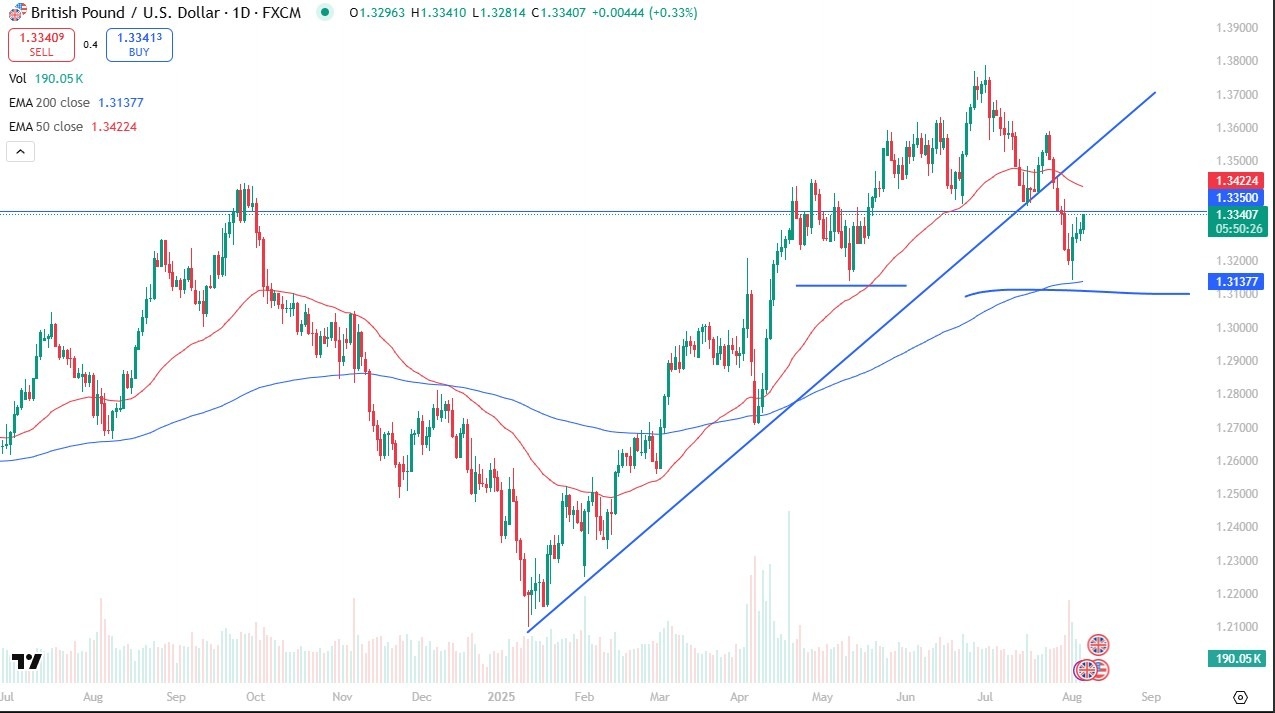
You can see that the British Pound has broken pretty significantly to the upside during the trading session.
And we are now looking at a potential break above the 1.3350 level.
This is an area that I will be watching very closely as it has been important multiple times.
With that being said, I also recognize that there is the possibility this is as far as we go.
So, in other words, what I’m watching is how this closes for the session. If this thing closes a little bit more to the downside, that could very well end up being a sign that the U S dollar is still fighting. It’s a very real possibility, although I’m the first to look at it and suggest that perhaps it might be a little bit on the back foot right now.
If We Break Lower
If we do break down, I would anticipate that the same support level comes into the picture offering support right around the 200 day EMA or the 1.3150 region. If we break higher, we have the 50 day EMA and the previous trend line coming into the picture offering resistance. So even on a break higher, I don’t know that we’ve got the “all clear” to start going crazy buying the British pound.
Ultimately, I think you have to look at this very closely, but I think you have a potential trade setting up here. We’ll just have to wait and see if we can break above that 50 day EMA, then I think that’s a very strong sign for the pound. But if we can’t and we start to pull back from somewhere in this general vicinity, that could be a whisper that something’s not quite right. It’ll be interesting to see how this plays out. Traders continue to bet on what the Fed may or may not do, and that’s what most of this noise is about at the moment.
Christopher Lewis has been trading Forex and has over 20 years experience in financial markets. Chris has been a regular contributor to Daily Forex since the early days of the site. He writes about Forex for several online publications, including FX Empire, Investing.com, and his own site, aptly named The Trader Guy. Chris favours technical analysis methods to identify his trades and likes to trade equity indices and commodities as well as Forex. He favours a longer-term trading style, and his trades often last for days or weeks.
The US dollar was a bit noisy against the Japanese yen during early Wednesday trading, but I wouldn’t read too much into the action. It just looks like we are trying to find some type of floor here. If we do, in fact, get that floor, then a break above the 148 yen level sends this market higher, perhaps as high as 151 yen. Pullbacks at this point still look at the 50-day EMA and possibly 146 yen as support.
AUD/USD Technical Analysis
The Australian dollar has rallied quite nicely, but it is coming into quite a bit of noise just above that, I think, will keep it somewhat muted, unfortunately, for those who are bullish on the Aussie. Given enough time, I would anticipate that the Australian dollar could very well sell off if we start to see US dollar strength in general, as the Australian dollar has been one of the weaker performing currencies against the greenback over the last several months, despite the fact that it has been positive.
I prefer to fade signs of exhaustion if and when we get them. I just don’t know if and when we will get them. The 0.6550 level remains a magnet for price. If we break down below the 0.6375 level, then I think the real selling begins.
For a look at all of today’s economic events, check out our economic calendar.
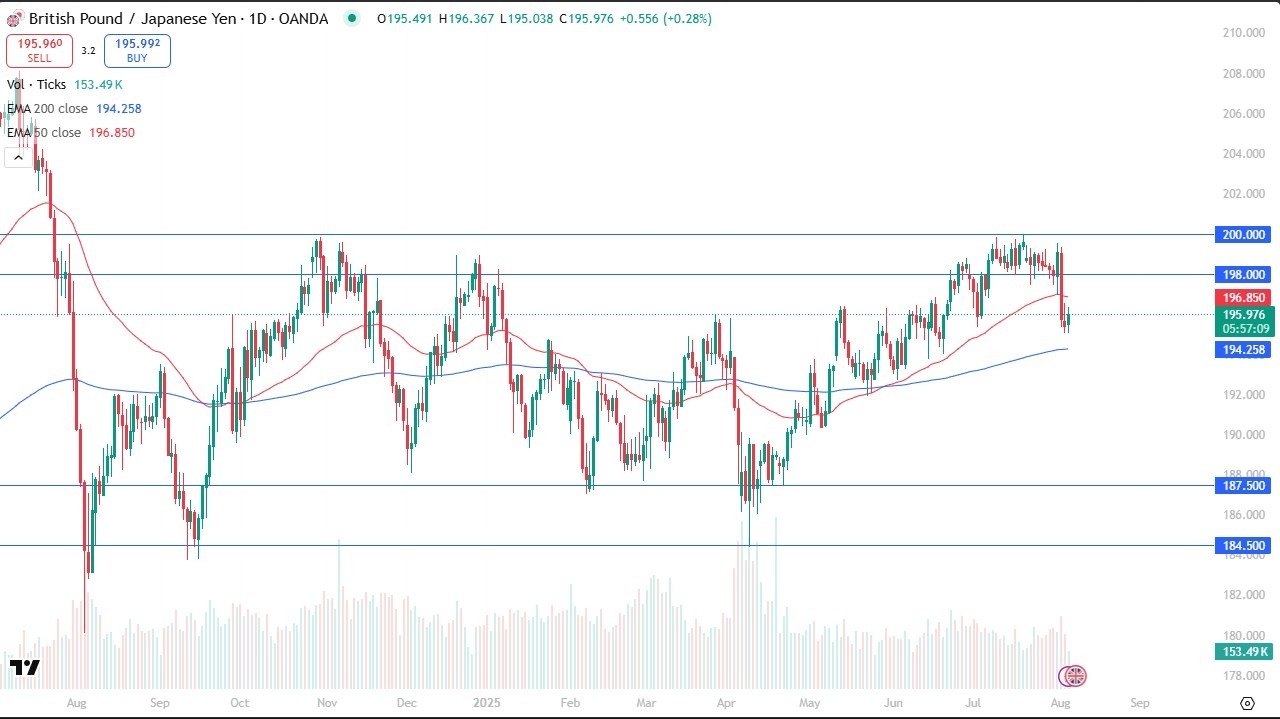
The British pound has rallied a bit during the early session on Tuesday as we continue to see a lot of noisy behavior.
With that being said, I’ll be watching the top of the inverted hammer from the session on Monday, and if we can break above that then we could challenge the 50 Day EMA.
At this point in time, then you would have a potential run toward the ¥198 level.
The ¥198 level was previous support that we broke through rather viciously, so I would anticipate a bit of trouble in that area.
Technical Analysis
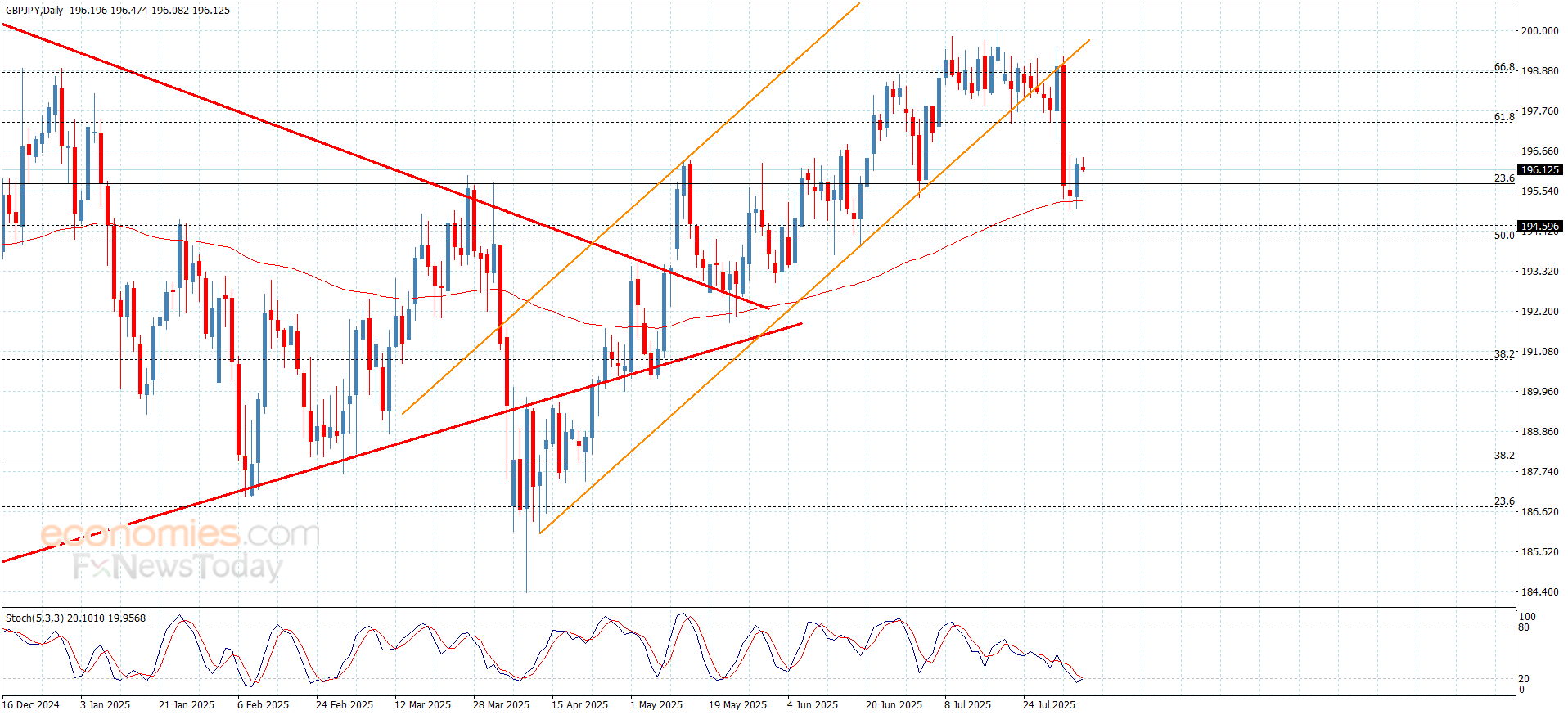
The technical analysis for this market is a bit dicey at the moment as the recent selling has put a lot of questions into whether or not the uptrend can continue. That being said, the 200 Day EMA currently sits at the ¥194.25 level, and should offer a certain amount of support. All things being equal, this is a market that I think if we can stay above the 200 Day EMA, then market participants will probably continue to look at this through the prism of trying to stay afloat.
However, if we break down below the 200 Day EMA, it’s likely that the British pound will continue much lower, perhaps down to the ¥187.50 level. On the other hand, if we recapture the 50 Day EMA to the upside, then I think we could even go as high as ¥200, but I recognize that it is swimming upstream as far as the recent action is concerned. Remember, this is a pair that is highly sensitive to risk appetite, so you need to be cautious as to what the rest of the world is doing when you trade this pair. After most of the indices are rallying, then it makes a certain amount of sense that the Japanese yen losing strength against the British pound and we rise. That being said, there’s a lot of fear out there at the moment, and it is causing a bit of a headache.
Christopher Lewis has been trading Forex and has over 20 years experience in financial markets. Chris has been a regular contributor to Daily Forex since the early days of the site. He writes about Forex for several online publications, including FX Empire, Investing.com, and his own site, aptly named The Trader Guy. Chris favours technical analysis methods to identify his trades and likes to trade equity indices and commodities as well as Forex. He favours a longer-term trading style, and his trades often last for days or weeks.
The GBP/USD forecast remains mildly positive ahead of BoE’s rate decision.
UK macroeconomics keep clouding the overall outlook of the pound.
MPC vote split is important to watch along with the BoE’s rate decision.
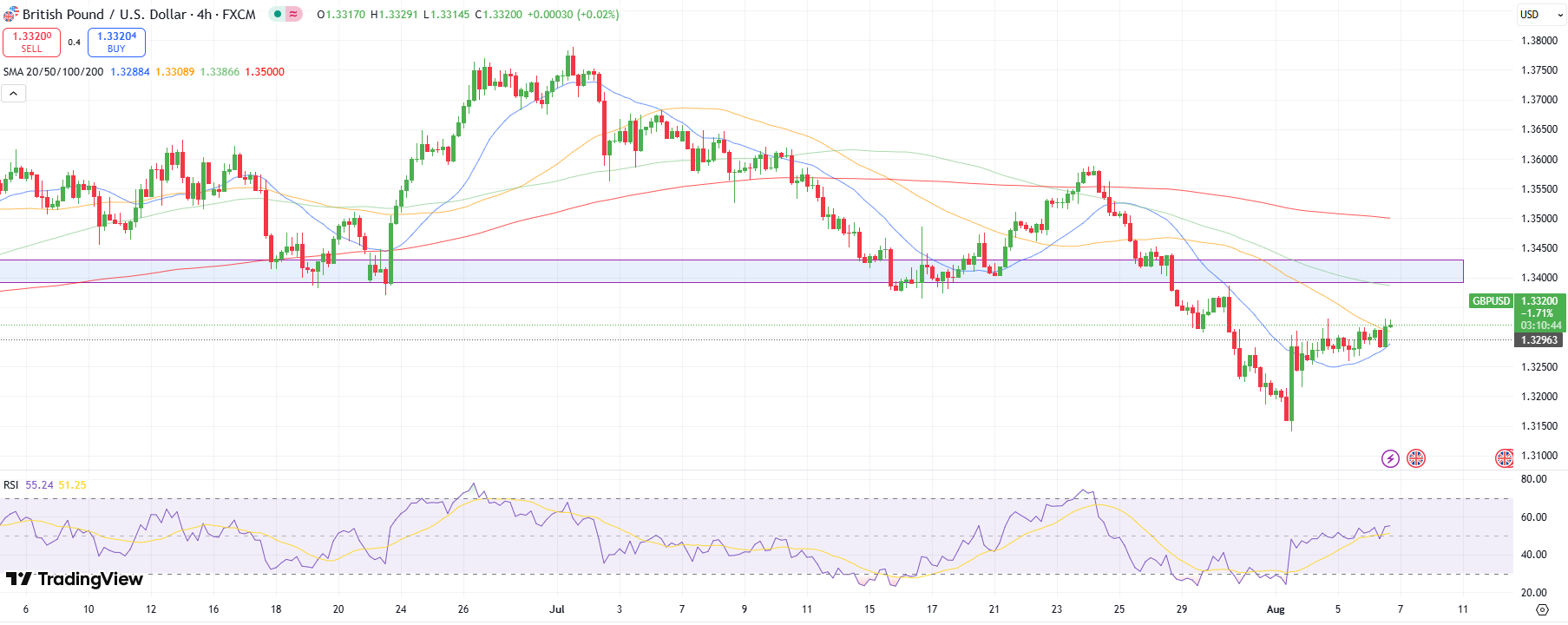
The GBP/USD forecast has turned slightly positive as the pair managed to reclaim the 1.3300 handle on Wednesday ahead of the Bank of England’s key rate decision on Thursday. Despite the mild gains, the sentiment remains cautious as traders weigh weaker UK data.
The UK’s central bank is widely expected to reduce the interest rates by 25 bps to 4.0%, with more rate cuts to follow later this year. The decision comes at a time when the inflation remains stubbornly high, around twice the 2% target of BoE. Meanwhile, the signs of economic slowdown are keeping policymakers under pressure to support growth.
A major concern is the UK’s construction sector, which showed the sharpest contraction in over five years. The construction PMI dropped to 44.3 in July, down from June’s 48.8. This is the lowest reading since May 2020, during the pandemic peak.
This, combined with softer economic data, has strengthened the odds of BoE’s rate cut. Though high inflation discourages central banks from cutting rates, the priority seems to be supporting growth in the short term. The recent move of the pound shows a complex balance of forces, including loose monetary policy, higher inflation, and downbeat economic data. Despite the short-term optimism, the overall outlook remains clouded by macroeconomics.
All eyes are now on Thursday’s BoE decision, which could set the tone for GBP/USD in the coming weeks. A dovish tone or deeper-than-expected cut may put further pressure on the pound, while a more cautious approach could offer temporary relief.
GBP/USD Technical Forecast: Bulls Aiming for 1.3370
GBP/USD 4-hour chart
The 4-hour chart for the GBP/USD pair shows a slight bullish momentum, staying above the 20-period SMA. The price is gradually moving up to test the previously broken support that acts as a resistance around 1.3370. The ultimate target lies at the 200-period MA near 1.3500. Above this level, the bias will be turned strongly bullish.
–Are you interested in learning more about forex basics? Check our detailed guide-
The RSI has also moved above the 50.0 mark, suggesting room for more gains. However, the momentum is not strong enough and lacks a catalyst to push beyond the cluster of resistance levels.
Looking to trade forex now? Invest at eToro!
68% of retail investor accounts lose money when trading CFDs with this provider. You should consider whether you can afford to take the high risk of losing your money.
EUR/USD stabilizes below 1.1600 in the European session on Wednesday.
The technical picture offers no signs of a buildup in directional momentum.
Several Fed policymakers will be delivering speeches later in the day.
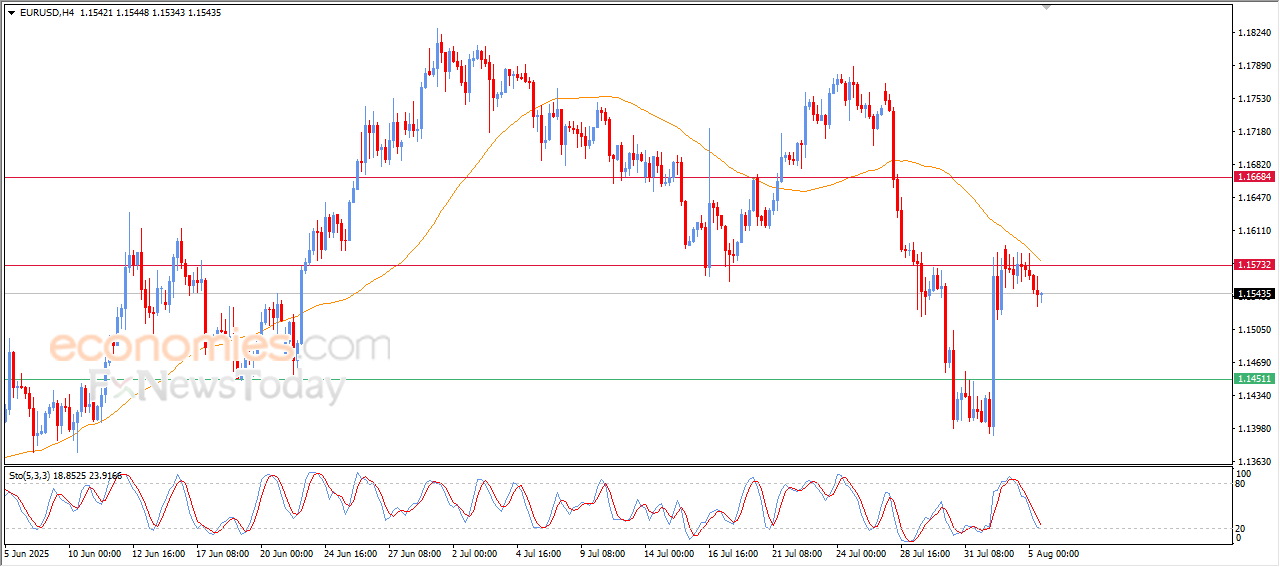
After failing to make a decisive move in either direction on Tuesday, EUR/USD extends its sideways grind early Wednesday and continues to move up and down in a very narrow channel below 1.1600. The technical outlook points to a neutral stance in the near term.
Euro PRICE This week
The table below shows the percentage change of Euro (EUR) against listed major currencies this week. Euro was the strongest against the Swiss Franc.
USD
EUR
GBP
JPY
CAD
AUD
NZD
CHF
USD
0.16%
0.00%
0.38%
-0.08%
-0.19%
-0.14%
0.45%
EUR
-0.16%
-0.10%
0.24%
-0.23%
-0.48%
-0.30%
0.29%
GBP
-0.01%
0.10%
0.37%
-0.13%
-0.38%
-0.20%
0.39%
JPY
-0.38%
-0.24%
-0.37%
-0.45%
-0.72%
-0.53%
0.24%
CAD
0.08%
0.23%
0.13%
0.45%
-0.27%
-0.06%
0.51%
AUD
0.19%
0.48%
0.38%
0.72%
0.27%
0.18%
0.77%
NZD
0.14%
0.30%
0.20%
0.53%
0.06%
-0.18%
0.57%
CHF
-0.45%
-0.29%
-0.39%
-0.24%
-0.51%
-0.77%
-0.57%
The heat map shows percentage changes of major currencies against each other. The base currency is picked from the left column, while the quote currency is picked from the top row. For example, if you pick the Euro from the left column and move along the horizontal line to the US Dollar, the percentage change displayed in the box will represent EUR (base)/USD (quote).
The Institute for Supply Management (ISM) reported on Tuesday that the Services Purchasing Managers’ Index (PMI) declined to 50.1 in July from 50.8 in June, showing a modest expansion in the US service sector’s economic activity. The Employment Index of the PMI survey fell to 46.4 from 47.2 in this period, highlighting a further decline in the sector’s payrolls. Finally, the Prices Paid Index, the inflation component, climbed to 69.9 from 67.5.
The mixed PMI report failed to trigger a noticeable market reaction and the US Dollar (USD) Index ended the day flat on Tuesday.
Early Wednesday, US stock index futures gain between 0.3% and 0.4%, making it difficult for the safe-haven USD to gather strength.
Earlier in the session, the data from Germany showed Factory Orders declined by 1% on a monthly basis in June. This reading followed the 1.4% contraction recorded in May and missed analysts’ estimate for an increase of 1%.
In the second half of the day, several Federal Reserve (Fed) policymakers will be delivering speeches.
According to the CME FedWatch Tool, markets are currently pricing in a nearly-90% probability of a 25 basis points Fed rate cut in September. In case Fed officials downplay the weak July employment data and push back against this market expectation, the USD could gain traction and cause EUR/USD to turn south. On the flip side, the market positioning suggests that the USD doesn’t have a lot of room left on the downside even if policymakers hint at a September cut.
EUR/USD Technical Analysis
The Relative Strength Index (RSI) indicator moves sideways slightly above 50 and EUR/USD continues to fluctuate near the 20-period and the 50-period Simple Moving Averages (SMAs), reflecting a neutral bias.
On the downside, 1.1540 (Fibonacci 38.2% retracement of the latest uptrend) aligns as the first support level before 1.1500 (static level, round level) and 1.1450 (Fibonacci 50% retracement of the latest uptrend).
Looking north, resistance levels could be spotted at 1.1620 (100-period SMA), 1.1660 (Fibonacci 23.6% retracement, 200-period SMA) and 1.1700 (static level, round level).
Euro FAQs
The Euro is the currency for the 19 European Union countries that belong to the Eurozone. It is the second most heavily traded currency in the world behind the US Dollar. In 2022, it accounted for 31% of all foreign exchange transactions, with an average daily turnover of over $2.2 trillion a day.
EUR/USD is the most heavily traded currency pair in the world, accounting for an estimated 30% off all transactions, followed by EUR/JPY (4%), EUR/GBP (3%) and EUR/AUD (2%).
The European Central Bank (ECB) in Frankfurt, Germany, is the reserve bank for the Eurozone. The ECB sets interest rates and manages monetary policy.
The ECB’s primary mandate is to maintain price stability, which means either controlling inflation or stimulating growth. Its primary tool is the raising or lowering of interest rates. Relatively high interest rates – or the expectation of higher rates – will usually benefit the Euro and vice versa.
The ECB Governing Council makes monetary policy decisions at meetings held eight times a year. Decisions are made by heads of the Eurozone national banks and six permanent members, including the President of the ECB, Christine Lagarde.
Eurozone inflation data, measured by the Harmonized Index of Consumer Prices (HICP), is an important econometric for the Euro. If inflation rises more than expected, especially if above the ECB’s 2% target, it obliges the ECB to raise interest rates to bring it back under control.
Relatively high interest rates compared to its counterparts will usually benefit the Euro, as it makes the region more attractive as a place for global investors to park their money.
Data releases gauge the health of the economy and can impact on the Euro. Indicators such as GDP, Manufacturing and Services PMIs, employment, and consumer sentiment surveys can all influence the direction of the single currency.
A strong economy is good for the Euro. Not only does it attract more foreign investment but it may encourage the ECB to put up interest rates, which will directly strengthen the Euro. Otherwise, if economic data is weak, the Euro is likely to fall.
Economic data for the four largest economies in the euro area (Germany, France, Italy and Spain) are especially significant, as they account for 75% of the Eurozone’s economy.
Another significant data release for the Euro is the Trade Balance. This indicator measures the difference between what a country earns from its exports and what it spends on imports over a given period.
If a country produces highly sought after exports then its currency will gain in value purely from the extra demand created from foreign buyers seeking to purchase these goods. Therefore, a positive net Trade Balance strengthens a currency and vice versa for a negative balance.
The (ETHUSD) price declined in its last intraday trading, due to the continuation of the negative pressure that comes from its trading below EMA50, forming a dynamic resistance that prevent the recovery on the near term basis, amid the dominance of the bearish correctional dominance on the short-term basis, and its trading alongside a supportive bias line for the trend, with the emergence of the negative signals on the (RSI), despite reaching oversold levels.
BestTradingSignal.com – Professional Trading Signals
Get high-accuracy trading signals delivered directly to your Telegram. Subscribe to specialized packages tailored for the world’s top markets:
VIP Trading Signals Performance – July 28 – August 1, 2025
To view the full performance report for this week, visit the following link:
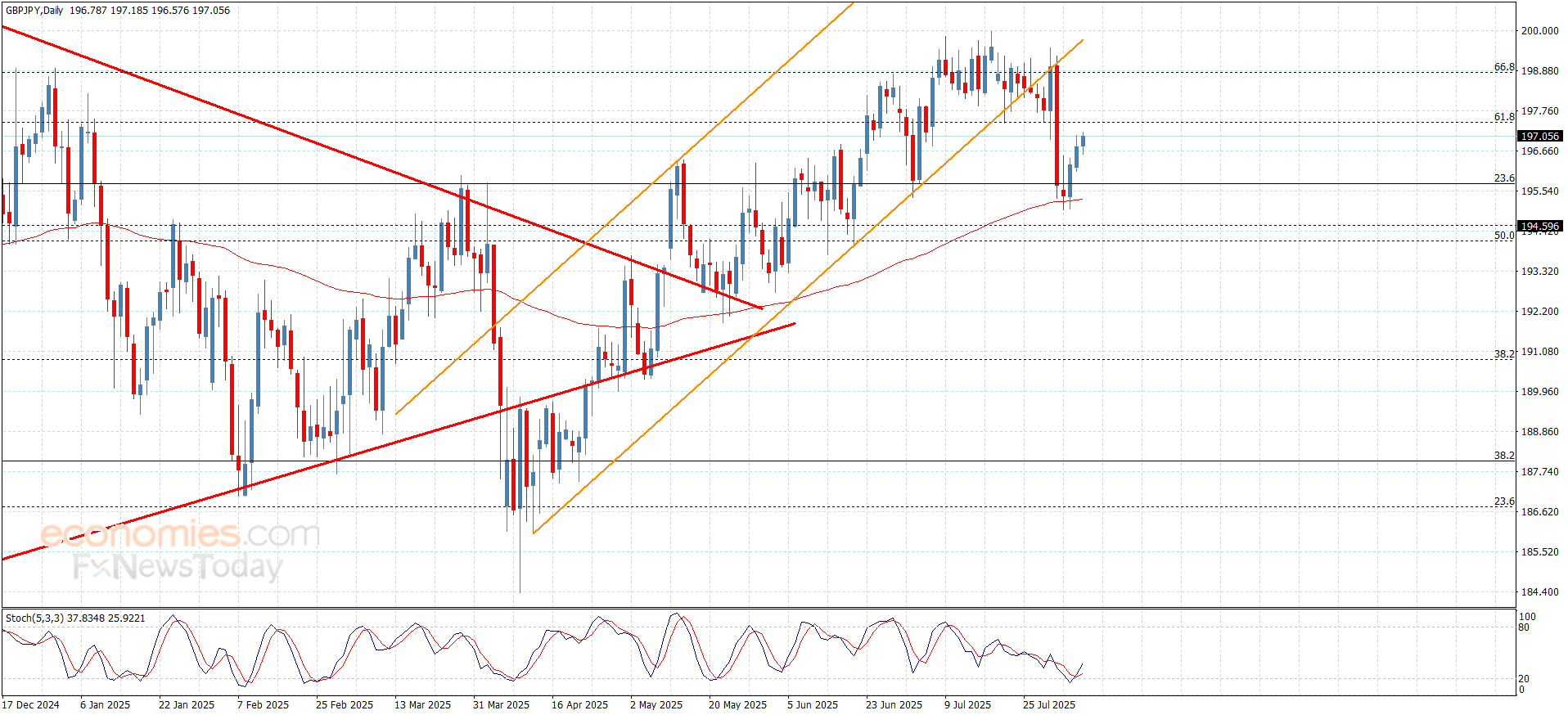
The GBPJPY pair repeated its fluctuation below the barrier at 196.60 level, forcing it to activate with stochastic negativity, forming new bearish waves to press on the moving average 55 at 195.35.
We expect forming sideways trading, but its repeated negative stability below 196.60 confirms its surrender to the bearish scenario, which forces it to suffer extra losses by reaching 194.55 followed by 50%Fibonacci correction level at 194.10.
The expected trading range for today is between 194.10 and 196.00
The GBPCHF price formed some bullish correctional trading, to approach from the moving average of 55 near 1.0765, taking advantage of providing positive momentum by stochastic, to retest an important barrier again.
The main stability within the bearish channel’s levels, which forms an extension for the main resistance at 1.0810 level besides forming an extra barrier at 1.0775 level, these factors make us wait for gathering the negative momentum, which allows it to renew the negative attempts that might target 1.0710 and 1.0660.
The expected trading range for today is between 1.0770 and 1.0710