From Trump to trade, FX to Brexit, ING’s global economists have it covered. Go to ING.com/THINK to stay a step ahead. We’re sorry we can’t reply to individuals’ comments.Content disclaimer: The information in the publication is not an investment recommendation and it is not investment, legal or tax advice or an offer or solicitation to purchase or sell any financial instrument.This publication has been prepared by ING solely for information purposes without regard to any particular user’s investment objectives, financial situation, or means. For our full disclaimer please click here.
EUR/USD lost more than 0.5% on Thursday and closed the fourth-consecutive day in negative territory. Although the pair edges higher in the European session on Friday, it shows no signs of a decisive recovery yet.
Euro Price This week
The table below shows the percentage change of Euro (EUR) against listed major currencies this week. Euro was the weakest against the US Dollar.
USD
EUR
GBP
JPY
CAD
AUD
NZD
CHF
USD
1.27%
1.09%
2.17%
0.44%
0.48%
1.12%
1.13%
EUR
-1.27%
-0.28%
0.81%
-0.86%
-0.82%
-0.19%
-0.17%
GBP
-1.09%
0.28%
1.20%
-0.57%
-0.54%
0.10%
0.11%
JPY
-2.17%
-0.81%
-1.20%
-1.64%
-1.70%
-1.09%
-1.06%
CAD
-0.44%
0.86%
0.57%
1.64%
0.08%
0.68%
0.69%
AUD
-0.48%
0.82%
0.54%
1.70%
-0.08%
0.65%
0.65%
NZD
-1.12%
0.19%
-0.10%
1.09%
-0.68%
-0.65%
0.00%
CHF
-1.13%
0.17%
-0.11%
1.06%
-0.69%
-0.65%
-0.01%
The heat map shows percentage changes of major currencies against each other. The base currency is picked from the left column, while the quote currency is picked from the top row. For example, if you pick the Euro from the left column and move along the horizontal line to the US Dollar, the percentage change displayed in the box will represent EUR (base)/USD (quote).
The persistent US Dollar (USD) strength forced EUR/USD to stay on the back foot on Thursday. Meanwhile, the Euro continues to have a difficult time attracting investors amid the ongoing political drama in France.
Nevertheless, European Central Bank (ECB) policymakers’ cautious comments on policy easing seems to be helping EUR/USD holds its ground. ECB policymaker Martins Kazaks said on Friday that it is appropriate for the key ECB rate to remain at 2%, while Governing Council member Jose Luis Escriva noted that inflation remains contained, adding negative risks to growth have not materialized.
In the second half of the day, the University of Michigan will publish the preliminary Consumer Sentiment Index data for October. In case there is a significant improvement in consumer confidence, the USD could gather strength heading into the weekend and weigh on the pair. Investors will also pay close attention to the 1-year Consumer Inflation Expectations component of the survey. A noticeable decline in this data could hurt the USD and help EUR/USD stretch higher.
EUR/USD Technical Analysis
The Relative Strength Index (RSI) indicator on the 4-hour chart remains below 40, suggesting that the latest recovery attempt is a technical correction, with the bearish bias staying unchanged. Moreover, EUR/USD trades well below the 100-day Simple Moving Average (SMA), after posting its first daily close below this level since February.
In case EUR/USD stays below 1.1580 (Fibonacci 61.8% retracement of the latest uptrend), technical sellers could remain interested. In this scenario, 1.1550 (static level) could be seen as an interim support level before 1.1500 (round level, Fibonacci 78.6% retracement). Looking north, resistance levels could be spotted at 1.1630-1.1640 (100-day SMA, Fibonacci 50% retracement) and 1.1700-1.1715 (Fibonacci 38.2% retracement, 200-period SMA).
Euro FAQs
The Euro is the currency for the 19 European Union countries that belong to the Eurozone. It is the second most heavily traded currency in the world behind the US Dollar. In 2022, it accounted for 31% of all foreign exchange transactions, with an average daily turnover of over $2.2 trillion a day.
EUR/USD is the most heavily traded currency pair in the world, accounting for an estimated 30% off all transactions, followed by EUR/JPY (4%), EUR/GBP (3%) and EUR/AUD (2%).
The European Central Bank (ECB) in Frankfurt, Germany, is the reserve bank for the Eurozone. The ECB sets interest rates and manages monetary policy.
The ECB’s primary mandate is to maintain price stability, which means either controlling inflation or stimulating growth. Its primary tool is the raising or lowering of interest rates. Relatively high interest rates – or the expectation of higher rates – will usually benefit the Euro and vice versa.
The ECB Governing Council makes monetary policy decisions at meetings held eight times a year. Decisions are made by heads of the Eurozone national banks and six permanent members, including the President of the ECB, Christine Lagarde.
Eurozone inflation data, measured by the Harmonized Index of Consumer Prices (HICP), is an important econometric for the Euro. If inflation rises more than expected, especially if above the ECB’s 2% target, it obliges the ECB to raise interest rates to bring it back under control.
Relatively high interest rates compared to its counterparts will usually benefit the Euro, as it makes the region more attractive as a place for global investors to park their money.
Data releases gauge the health of the economy and can impact on the Euro. Indicators such as GDP, Manufacturing and Services PMIs, employment, and consumer sentiment surveys can all influence the direction of the single currency.
A strong economy is good for the Euro. Not only does it attract more foreign investment but it may encourage the ECB to put up interest rates, which will directly strengthen the Euro. Otherwise, if economic data is weak, the Euro is likely to fall.
Economic data for the four largest economies in the euro area (Germany, France, Italy and Spain) are especially significant, as they account for 75% of the Eurozone’s economy.
Another significant data release for the Euro is the Trade Balance. This indicator measures the difference between what a country earns from its exports and what it spends on imports over a given period.
If a country produces highly sought after exports then its currency will gain in value purely from the extra demand created from foreign buyers seeking to purchase these goods. Therefore, a positive net Trade Balance strengthens a currency and vice versa for a negative balance.
The (ETHUSD) price rose in its last trading on the intraday basis, after its leaning on the support level of $4,275, gaining some bullish momentum that helped it to achieve these gains, this support was our suggested target in our previous analysis, to attempt to recover some of the previous losses, attempting to offload some of its clear oversold conditions on the relative strength indicators, especially with the emergence of the positive signals from there, amid the dominance of bearish corrective wave on the short-term basis, with the continuation of the negative pressure due to its trading below EMA50, which reduces the chances of the price recovery on the near-term basis.
VIP Trading Signals Performance by BestTradingSignal.com (Sept 29 – Oct 3, 2025)
Get high-accuracy trading signals delivered directly to your Telegram. Subscribe to specialized packages tailored for the world’s top markets:
Full VIP signals performance report for Sept 29 – Oct 3, 2025:
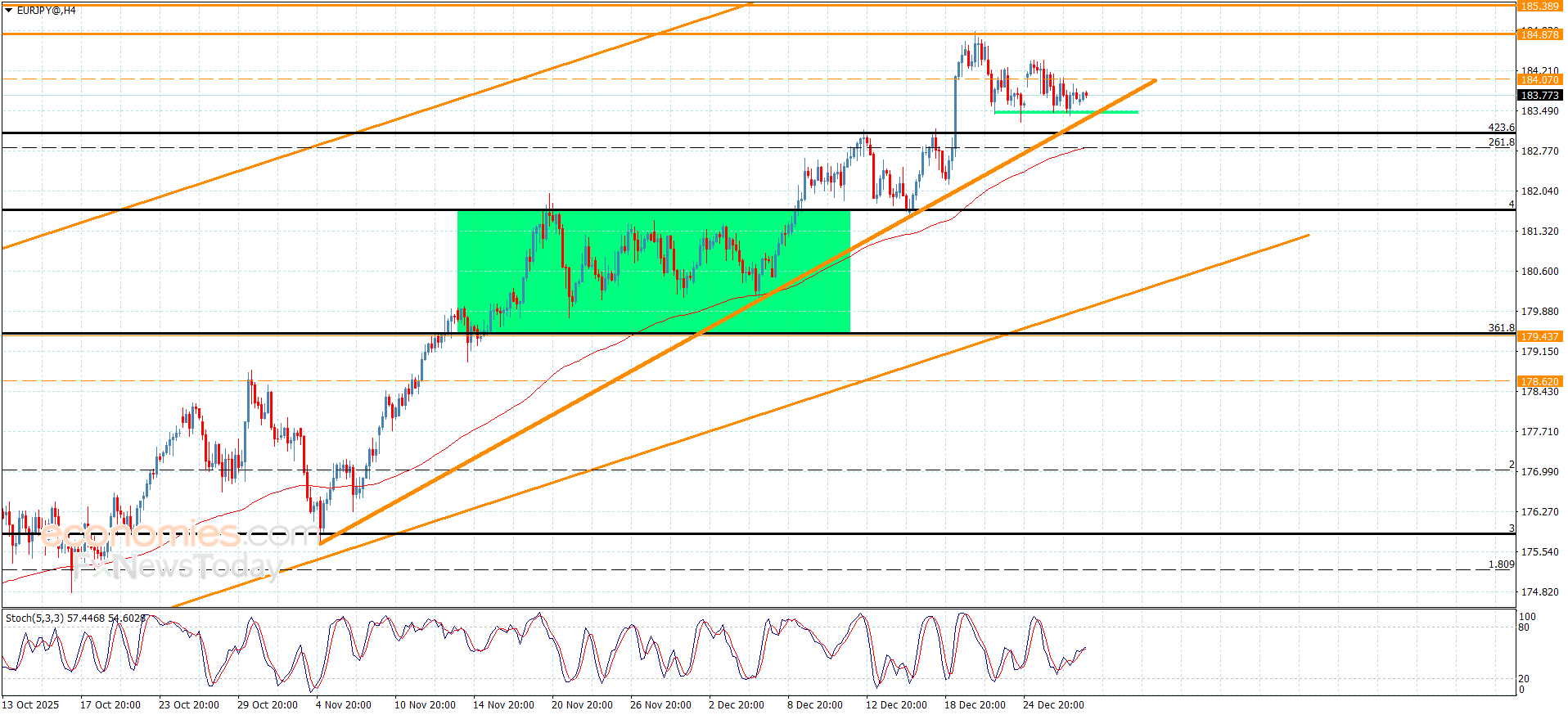
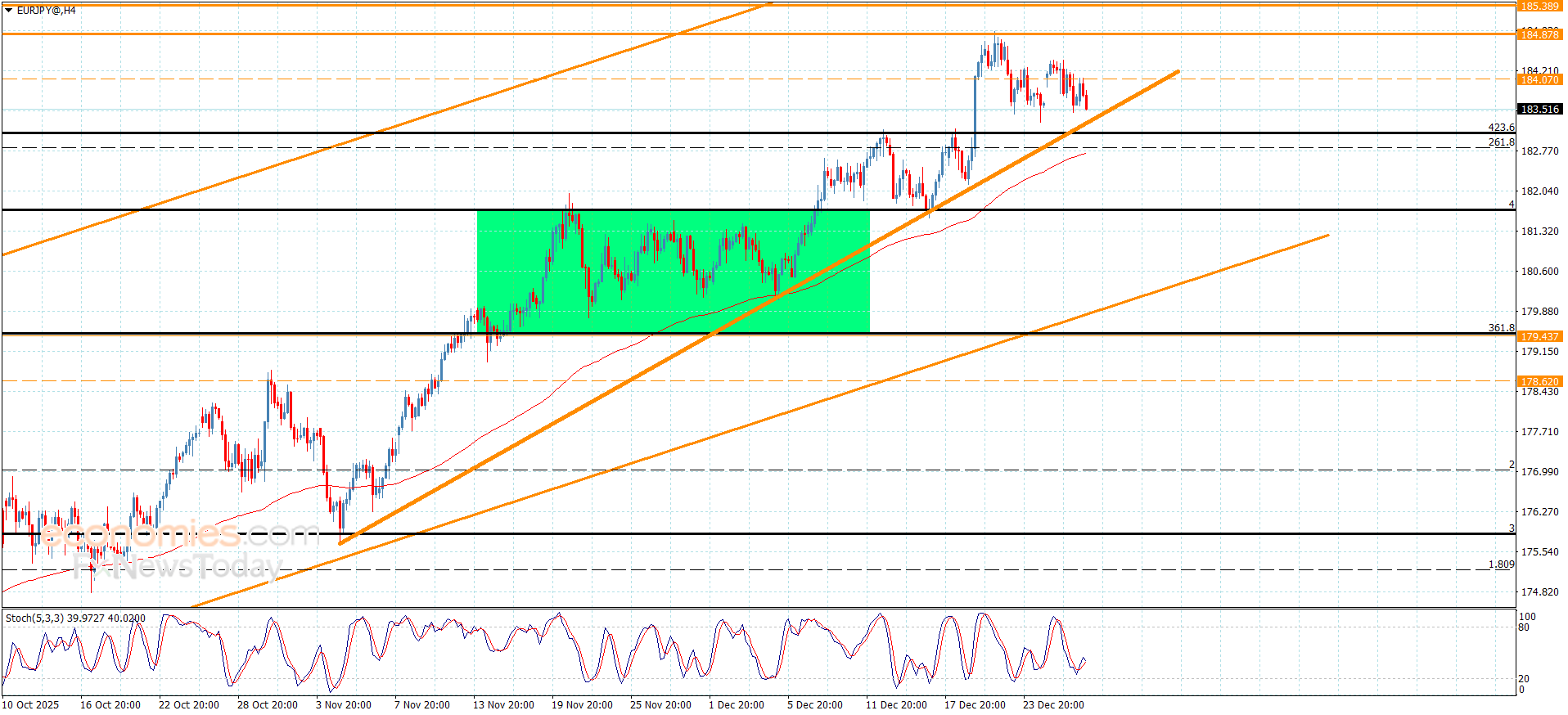
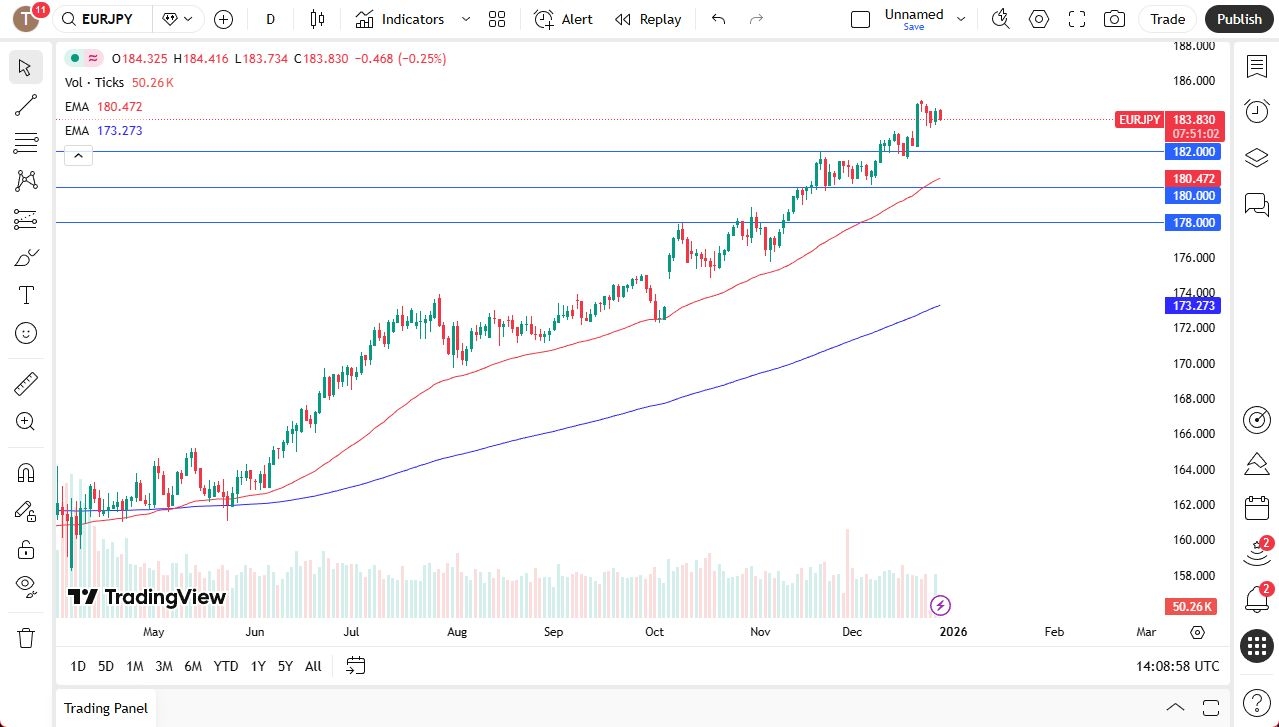
EUR/JPY loses ground for the second successive session, trading around 176.70 during the European hours on Friday. The technical analysis of the daily chart indicates that short-term price momentum is stronger as the currency cross remains above the nine-day Exponential Moving Average (EMA).
However, the 14-day Relative Strength Index (RSI) moves below the 70 mark, suggesting that bullish bias is weakening and the EUR/JPY cross is exiting overbought territory, signaling a price correction.
The EUR/JPY cross may find its primary support at the nine-day EMA of 175.84. A break below this level could weaken the short-term price momentum and lead the currency cross to test the 50-day EMA at 173.30, followed by the five-week low of 172.14, which was recorded on September 9.
On the upside, the EUR/JPY cross may target the new all-time high of 177.94, which was recorded on October 9. A break above this level would prompt the currency cross to test the upward trendline around 179.50. Further advances would strengthen the bullish bias and support the currency cross to explore the region around the psychological level of 180.00.
EUR/JPY: Daily Chart
Euro Price Today
The table below shows the percentage change of Euro (EUR) against listed major currencies today. Euro was the strongest against the Australian Dollar.
USD
EUR
GBP
JPY
CAD
AUD
NZD
CHF
USD
-0.09%
0.05%
-0.03%
0.02%
0.05%
0.21%
-0.18%
EUR
0.09%
0.17%
0.00%
0.10%
0.18%
0.06%
0.00%
GBP
-0.05%
-0.17%
-0.14%
-0.10%
0.00%
0.11%
-0.21%
JPY
0.03%
0.00%
0.14%
0.16%
0.16%
0.25%
-0.04%
CAD
-0.02%
-0.10%
0.10%
-0.16%
-0.02%
0.16%
-0.11%
AUD
-0.05%
-0.18%
-0.00%
-0.16%
0.02%
0.13%
-0.22%
NZD
-0.21%
-0.06%
-0.11%
-0.25%
-0.16%
-0.13%
-0.34%
CHF
0.18%
-0.00%
0.21%
0.04%
0.11%
0.22%
0.34%
The heat map shows percentage changes of major currencies against each other. The base currency is picked from the left column, while the quote currency is picked from the top row. For example, if you pick the Euro from the left column and move along the horizontal line to the US Dollar, the percentage change displayed in the box will represent EUR (base)/USD (quote).
The USD/JPY outlook remains broadly bullish with mild pullbacks amid intervention fears.
The US dollar gains safe-haven demand due to political chaos in Japan and Europe.
Investors are eying consumer sentiment data today for more impetus.
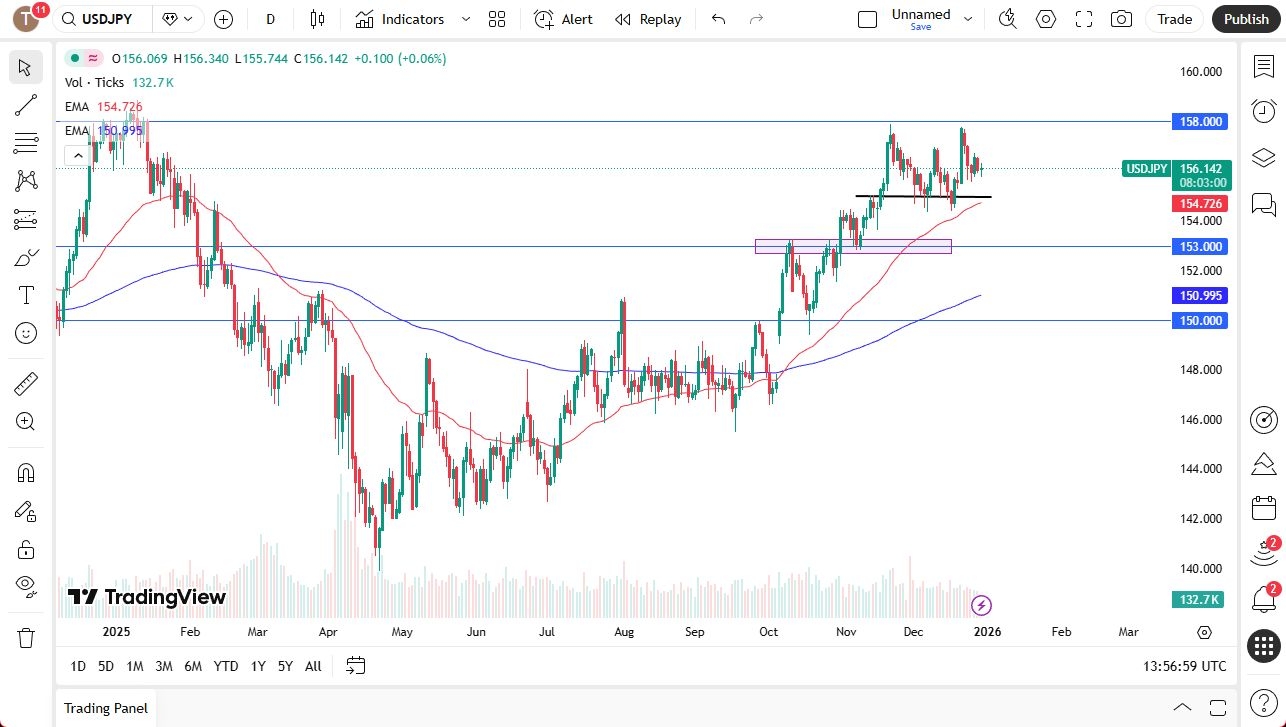
The US dollar trades mixed against the Japanese yen on Friday after marking a fresh eight-month top above the 153.00 level. FOMC September meeting minutes revealed that most policymakers urged a 25 bps rate cut with a cautious but dovish tone. Markets interpreted this as a confirmation for further easing before year-end, putting pressure on the US dollar.
However, Japan’s shifting political scenario dominated the yen’s trajectory following the surprise victory of Sanae Takaichi in the LDP leadership race. This sparked the odds of a more expansionary fiscal policy, like ex-Prime Minister Abe’s economic policies. As a result, the investors have trimmed the bets on near-term Bank of Japan tightening.
Takaichi’s policy stance suggests continuity of the existing agenda, with markets anticipating additional fiscal stimulus that could delay the BoJ’s rate normalization plans. Despite this, Japan’s inflation has remained stubbornly above 2% for three years, keeping hopes of a rate hike alive this year.
The dovish expectations of BoJ with a politically uncertain environment heavily weighed on the yen before posting a mild recovery in the Asian session on Friday. The Japanese currency found support from safe-haven demand as equities slid, while officials warned of intervention in case of an aggressive one-sided move of yen. Finance Minister Katsunobu Kato said on Friday, “We are currently seeing one-sided and rapid movements in the market… The government will carefully assess any excessive or disorderly movements.”
On the other hand, the US dollar remains broadly strong amid relative economic resilience and safe-haven demand from ongoing political turmoil in Japan and Europe. The Dollar Index (DXY) marked a fresh 2-month top on Thursday despite traders betting on two Fed rate cuts this year. The continued government shutdown for the second week adds more to the uncertainty. However, the Bureau of Labor Statistics recalled the staff to complete the September consumer inflation data, reassuring investors that the data will be released before the Fed’s October meeting.
The USD/JPY pair remains upward as the yen struggles with policy divergence and political instability. However, the bullish momentum could see a setback amid intervention risks as an ex-official said that the government intervention would become evident if the price hits 160.00.
USD/JPY Key Events Ahead
FOMC member Daly speaks
FOMC member Musalem speaks
Prelim UoM Consumer Sentiment
Prelim UoM Inflation Expectations
Consumer sentiment data remains essential today as investors are cautious when gauging business activity without primary data.
USD/JPY Technical Outlook: Correction Before Upside
USD/JPY 4-hour chart
The USD/JPY 4-hour chart shows signs of correction as the RSI remains in the extreme overbought region. The pair has been off the highs, looking to test the 20-period MA around 152.20. Finding acceptance below it could push the price down to the resistance-turned-support around 150.00. A big up gap formed last Friday shows the probability of a deeper correction towards 147.50 to fill the gap.
–Are you interested to learn more about forex signals? Check our detailed guide-
On the upside, immediate resistance lies at the recent top near 153.30 ahead of 12th Feb highs of 154.80. However, the bullish move could find many pullbacks due to profit-taking.
Looking to trade forex now? Invest at eToro!
67% of retail investor accounts lose money when trading CFDs with this provider. You should consider whether you can afford to take the high risk of losing your money.
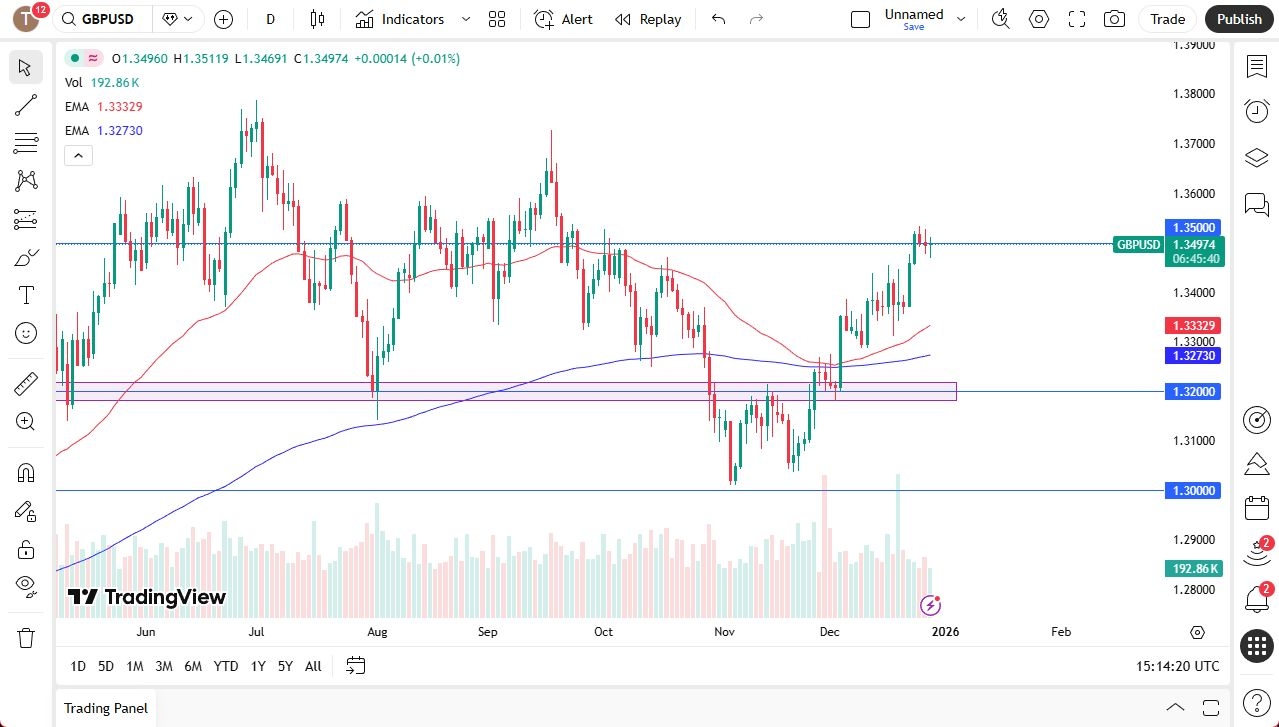
The Pound to US Dollar (GBP/USD) exchange rate fell to a two-week low on Thursday as renewed speculation over the UK’s upcoming autumn budget dragged on Sterling.
At the time of writing, GBP/USD was trading at around $1.3361, down around 0.3% from Thursday’s opening levels.
The Pound (GBP) came under pressure on Thursday as traders grew increasingly uneasy about what Chancellor Rachel Reeves’s autumn budget might contain.
With no major UK data releases to distract markets, investors focused on the looming fiscal statement, due at the end of November.
Much of the conversation continues to centre around how Reeves will reconcile her pro-growth pledges with the pressing need to repair public finances.
Market watchers largely agree that a combination of higher taxes and restrained public spending will be unavoidable.
Yet, the uncertainty over which sectors or households will bear the brunt of these changes has left Sterling vulnerable.
Save on Your GBP/USD Transfer
Get better rates and lower fees on your next international money transfer.
Compare TorFX with top UK banks in seconds and see how much you could save.
At the same time, the recent uptick in UK gilt yields is fuelling further concerns over borrowing costs, adding to the headwinds facing the Pound.
The US Dollar (USD) found modest support on Thursday following a rebound from the previous session’s Fed-driven selloff.
Minutes from the Federal Reserve’s September meeting confirmed a dovish tilt, showing broad support among policymakers for last month’s quarter-point cut and further easing through the rest of 2025.
Markets are now pricing in another 50bps of cuts by year-end, most likely via two additional 25bps reductions in October and December.
However, demand for the ‘Greenback’ ticked up again on Thursday as investors adopted a more cautious stance ahead of a speech by Fed Chair Jerome Powell, with some hoping he might strike a firmer note on inflation or the path of monetary policy.
GBP/USD Forecast: Weak US Confidence to Weigh on the Dollar?
Looking ahead, the Pound to US Dollar exchange rate could recover some ground on Friday if upcoming US consumer confidence data underwhelms.
The University of Michigan’s latest sentiment index is expected to show a further dip in optimism, with households feeling the strain from stubborn inflation, softening labour market conditions, and political uncertainty surrounding the ongoing government shutdown.
If the data disappoints, the US Dollar could come under renewed selling pressure.
Meanwhile, with no fresh UK data due before the weekend, Sterling’s direction will likely hinge on broader risk appetite and any shifts in global market sentiment.
Like this piece? Please share with your friends and colleagues:
International Money Transfer? Ask our resident FX expert a money transfer question or try John’s new, free, no-obligation personal service! ,where he helps every step of the way,
ensuring you get the best exchange rates on your currency requirements.
The Euro to Dollar (EUR/USD) exchange rate remains pinned near six-week lows around 1.1620 as dollar strength endures. ING warns that a break below 1.16 could trigger a fresh slide toward the 1.1500 area, with only limited rebound potential in the near term.
EUR/USD Forecasts: Under Pressure
EUR/USD found support close to 1.1600, but rally attempts have been limited with the pair trading around 1.1620 and still close to 6-week lows.
The lack of US data continued to dampen activity with the dollar holding a firm tone. For now, the US shutdown has not had a negative impact on the dollar.
ING commented; “We prefer the lower end of a two-month trading range holding at 1.1580/1600 for EUR/USD. If not, we could see another sharpish fall to the 1.1500 area.”
UoB also sees scope for a limited correction; “The rebound from oversold conditions suggests that instead of continuing to decline, EUR is more likely to trade in a range today, expected to be between 1.1600 and 1.1660.”
Scotiabank added; “We look to a near-term range bound between support at 1.16 and resistance at 1.1650.”
Save on Your EUR/USD Transfer
Get better rates and lower fees on your next international money transfer.
Compare TorFX with top UK banks in seconds and see how much you could save.
It did, however, add; “Support appears limited between 1.16 and the early August low under 1.14.”
Global political developments remained a key element for global markets.
As far as France is concerned, outgoing Prime Minister Lecornu stated on Wednesday that support for early elections had faded and that President Macron would nominate a new Prime Minister by the end of this week.
MUFG commented; “In what looks like a climbdown by President Macron, the suspension of pension reform has been put on the table as a way to reach a compromise. This would help break the gridlock although an estimated EUR 3bn-3.5bn of savings would have to be found over the coming two years to cover the cost.”
There was a rally in French bonds, although underlying pressure remained.
MUFG added; “Still, risks remain high and political uncertainty will persist curtailing euro buying. FX moves have been very modest.”
Federal Reserve minutes from the September meeting stated that a few members could have voted for no change in interest rates at that meeting and there were concerns over inflation.
Nevertheless, most members stated that it was likely to be appropriate to ease policy further this year.
Markets are still pricing in close to a 95% chance that rates will be cut again at the October meeting.
Scotiabank commented; “Wednesday’s FOMC minutes offered a mixed message as policymakers balanced concerns about downside risks to the labor market and upside risks to inflation, ultimately leaning dovish to confirm the market’s expectations for additional rate cuts this year.”
The US government shutdown is continuing with Republicans and Democrats unable to secure the necessary votes to break the deadlock.
The economic cost of the shutdown will gradually increase and HSBC commented; “Overall, the implications of the US government shutdown for the USD are uncertain, but most likely lean to the weak side, in our view.”
Like this piece? Please share with your friends and colleagues:
International Money Transfer? Ask our resident FX expert a money transfer question or try John’s new, free, no-obligation personal service! ,where he helps every step of the way,
ensuring you get the best exchange rates on your currency requirements.
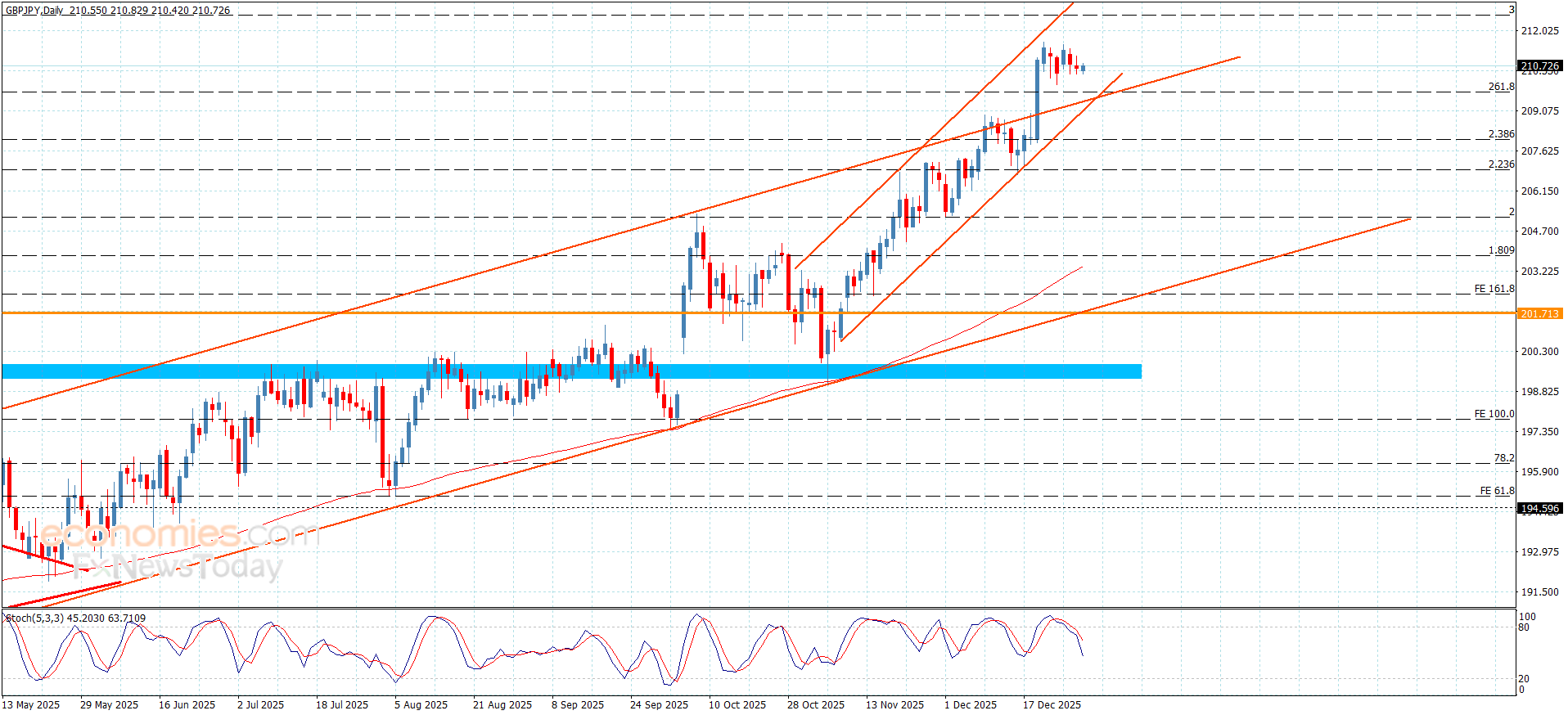
The British pound had rallied early during the trading session on Wednesday, but it looks like it is starting to discover the concept of gravity, after what has been in an explosive 5 days against the Japanese yen.
The ¥205 level is a large, round, psychologically significant figure that will attract a lot of attention, and it’s probably worth noting that the candlestick for the session looks to be a bit of a shooting star.
Technical Analysis
The technical analysis is obviously bullish for this market after the Japanese election, and of course the massive gap higher that jumped over the ¥200 level is a significant area of importance, and I think that’s an area where a lot of people would be looking at as a massive support level. The shooting star for the trading session, assuming that’s exactly how we close, will end up being assigned that perhaps we are finally seeing some profit-taking, and quite frankly it makes quite a bit of sense considering that many traders out there might have a 400 pip gain in just the last couple of trading sessions.
Ultimately, if we were to break out above the top of the shooting star, then the ¥206 level could be a resistance barrier, but at this point in time I think this is essentially going to be a “buy on the dips” type of scenario, and over the next couple of days we may actually have a chance to do just that. However, extreme patience will be needed because a trade will need to be confirmed via a bounce, and of course chasing the market all the way up here is a great way to lose money. Unfortunately, there are probably traders who bought this at ¥205, and may find themselves in serious trouble. By being a little bit patient, you can take advantage of what is clearly a shift to the bullish side.
Christopher Lewis has been trading Forex and has over 20 years experience in financial markets. Chris has been a regular contributor to Daily Forex since the early days of the site. He writes about Forex for several online publications, including FX Empire, Investing.com, and his own site, aptly named The Trader Guy. Chris favours technical analysis methods to identify his trades and likes to trade equity indices and commodities as well as Forex. He favours a longer-term trading style, and his trades often last for days or weeks.
Our forecast for the pound vs. dollar made two ten days ago was bang on the money.
The pound to dollar exchange rate has behaved exactly as we said it would in a short-term forecast set out ten days ago.
Our Week Ahead Forecast issued on Monday, September 29, looked for a slight GBP rebound, followed by a more concerted decline to a noted support area. Here is the chart overlay from that day:
Now, keeping that overlay and fast forwarding to today, here is where we are:
The call proved to be unusually accurate. Typically, the arrows are supposed to give an approximation of directionality, but this time, the target levels were also correct.
So, where to next? Clearly we are in a bullish setup for the dollar, even with the U.S. government shutdown underway.
Past shutdowns have tended to weigh on the dollar, but this time around, the currency is giving it a nonchalant shrug.
Get More From Your GBP/USD Transfer
Pound Sterling Live consistently delivers stronger rates than major UK banks.
In July, you could have saved up to $1,515 on a £50,000 transfer thanks to our competitive pricing.
i – Based on average GBP/USD rates observed in July.
The shutdown also brings a dearth of official data, and the Greenback looks to be treating this as a classic ‘no news is good news’ environment.
But, it’s also worth pointing out that ex-USD, there is a lot going on, and for some key currencies, the news is clearly not great:
The JPY is the big faller as new Prime Minister Sanae Takaichi is elected. She is a devout follower of the Abenomics faith: i.e. get the central bank to keep interest rates low and then buy up all the government debt you can issue. This kills expectations for further rate hikes and flattens the yen. As USD/JPY rises, all the other USD- crosses rise too.
The EUR rally has hit the buffers on the reality that France’s domestic political setup is an intractable mess. Sure, the government can muddle on, but in the big picture, it becomes more likely the ECB will have to step in to support French government bonds at some point.
This will effectively mean the ECB rescues a fiscally irresponsible country, and the rest of the Eurozone will ask why they have to behave and France gets away with whatever it likes. This isn’t good for Eurozone fiscal integration and points to the perennial weaknesses of the bloc.
Also, Germany’s economic data has really disappointed of late, indicating another poor quarter is underway.
The GBP is facing significant fiscal challenges too. Unlike France, the UK does not live in a big monetary union underpinned by Germany and where the ECB is poised to lend assistance. The bond market will come knocking on Number 11’s door before it does at the Bercy building in Paris. With Labour unwilling to cut spending, higher taxes are coming. Businesses are starting to struggle under the weight of the tax increases implemented this year, and anxiety is growing ahead of another big-tax budget in November.
So, with some big currencies under pressure, the USD has little choice but to rise.
Gains can continue into year-end, further pressuring GBP/USD, but come 2026, some fundamental weaknesses in the U.S. can come to the fore again, and the bigger USD selloff can resume.
GBP/EUR Investment Bank Consensus Forecasts Cut
The median and mean forecasts, that provide a consensus forecast for GBP/EUR, have fallen.
The US dollar initially did rally a bit during the early hours here on Wednesday but gave back those gains to show signs of life again. Ultimately, this is a market that I think is going to continue to be very noisy in general.
But I also recognize that we have a situation where we are basically hanging around between the 1.39 level on the bottom and the 1.40 level on the top. I do think that eventually the US dollar ends up outperforming the Canadian dollar and we do break above the 1.40 level. If and when we do that, I think we’ve got a situation where traders will really start to look towards the 1.4250 level.
On a Move Lower…
A breakdown below the 1.39 level opens up a potential move down to the 200 day EMA. But in general, I think you’ve got a situation where you’re still looking to buy dips. The interest rate differential still favors the uh US dollar over the Canadian dollar. And I think with this being the case, we look at any opportunity to buy on a dip as a gift. Now, keep in mind that Friday we have the Canadian employment numbers coming out. And that of course has a major influence on this pair and will continue to be important to keep in the back of our mind. With this, I like the idea of buying this pair. I do think eventually we will go much higher. But really at this point in time, we’re just looking for the next catalyst. And again, that catalyst could very well be the Friday session with that jobs number. Also, keep in mind that the US government is still shut down, and therefore we are without any significant US data at the moment, but this could change suddenly.
Christopher Lewis has been trading Forex and has over 20 years experience in financial markets. Chris has been a regular contributor to Daily Forex since the early days of the site. He writes about Forex for several online publications, including FX Empire, Investing.com, and his own site, aptly named The Trader Guy. Chris favours technical analysis methods to identify his trades and likes to trade equity indices and commodities as well as Forex. He favours a longer-term trading style, and his trades often last for days or weeks.