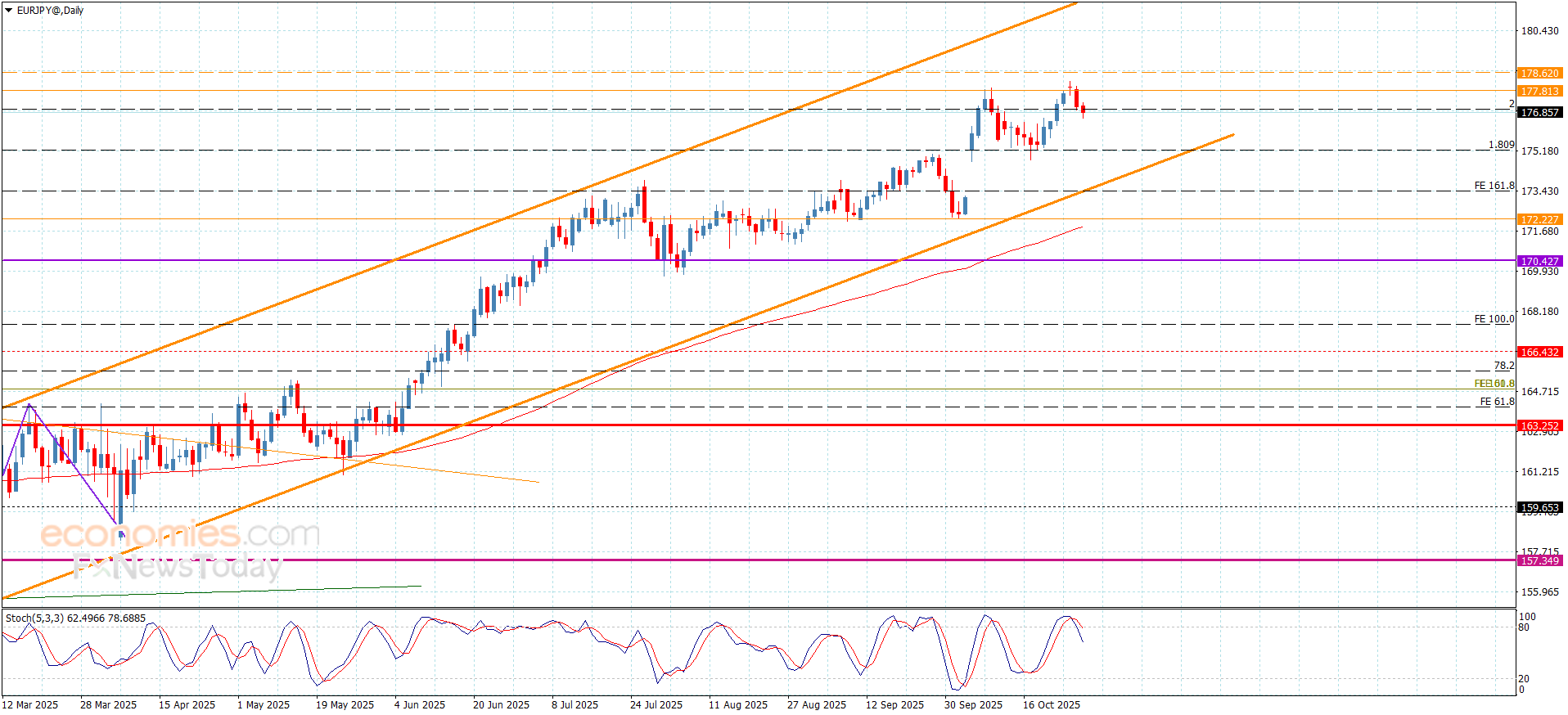
The GBPJPY pair activated the previously suggested bearish corrective track, putting it under strong negative pressure to achieve the previously suggested stations by reaching 201.15, then retesting the extra support at 201.75.
Forming extra barrier at 202.55 level and the continuation of providing negative momentum by stochastic will increase the efficiency of the bearish corrective track, to expect targeting 200.45 level, and surpassing it might extend the losses towards 199.20 directly.
The expected trading range for today is between 200.45 and 202.55
The Pound-to-Dollar exchange rate (GBP/USD) slipped sharply on Tuesday as investors turned cautious ahead of the UK government’s upcoming autumn budget.
At the time of writing, GBP/USD was trading at 1.32815, down around 0.44% from Tuesday’s opening levels.
The Pound (GBP) came under renewed pressure after the Office for Budget Responsibility (OBR) warned that the UK faces a £20bn fiscal shortfall, largely due to weak productivity and slowing growth.
The findings intensified speculation that Chancellor Rachel Reeves may be forced to introduce tax increases in next month’s budget to shore up the nation’s finances.
The prospect of tighter fiscal measures dampened market sentiment, with investors wary that higher taxes could weigh on household spending and slow the UK’s already fragile recovery.
As a result, Sterling struggled to find support through the European session, with the Pound weakening against a firming US Dollar.
The Greenback (USD) held steady ahead of the Federal Reserve’s interest rate decision on Wednesday, buoyed by safe-haven demand as global markets adopted a more cautious tone.
Save on Your GBP/USD Transfer
Get better rates and lower fees on your next international money transfer.
Compare TorFX with top UK banks in seconds and see how much you could save.
Investors widely expect the Fed to announce a 25-basis-point rate cut, but uncertainty over future policy guidance kept USD trading volatile.
GBP/USD Forecast: Fed Decision to Steer Mid-Week Direction
Looking ahead, attention will turn squarely to the Federal Reserve’s rate announcement, which is likely to set the tone for mid-week market movement.
If Chair Jerome Powell signals that further rate cuts are on the table before year-end, the Dollar may weaken, potentially giving GBP/USD scope to rebound.
However, a more measured tone — or hints that this could mark the final cut of the cycle — could strengthen the Greenback, pushing the pair lower still.
With the UK data calendar empty until the end of the week, the Pound will remain heavily influenced by global sentiment and speculation over both Fed policy and UK fiscal plans in the run-up to the November budget.
Like this piece? Please share with your friends and colleagues:
International Money Transfer? Ask our resident FX expert a money transfer question or try John’s new, free, no-obligation personal service! ,where he helps every step of the way,
ensuring you get the best exchange rates on your currency requirements.
Fed Interest Rate Decision and Powell’s Press Conference
While economists speculate about the timing of a BoJ rate hike, the Fed will take center stage later on Wednesday, October 29.
Economists expect the Fed to cut interest rates by 25 basis points. Unless there is a surprise 50-basis-point cut, Fed Chair Powell will set the tone for markets. Support for a December rate cut to bolster the labor market and acknowledgement that inflation has peaked could send USD/JPY toward 150 and the 50-day EMA. If breached, the 200-day EMA would be the next key technical support level.
The US government shutdown could extend to day 29, leaving the Fed flying blind on crucial labor market data. Fed Chair Powell had already taken a more dovish stance before the shutdown as labor market data signaled weaker conditions.
Beyond Fed Chair Powell’s views on interest rates, there is also the potential winding down of Quantitative Tightening (QT).
On October 14, 2025, Fed Chair Powell gave his strongest signal on QT, stating:
“Our long-stated plan is to stop balance sheet runoff when reserves are somewhat above the level we judge consistent with ample reserve conditions.”
He also noted that there were early signs of tightening liquidity conditions.
Notably, winding down QT would also narrow the US-Japan rate differential, favoring the yen, potentially being compounded by a hawkish BoJ policy stance. This scenario could trigger a market event similar to the yen carry trade unwind on July 31, 2024.
The Australian dollar to US dollar (AUD/USD) exchange rate is trading near 0.6578, up 0.3% on the day as the currency rebounds from recent lows.
Nomura has turned more optimistic on the Aussie, targeting a move to 0.6875 by the end of December as the dollar’s strength fades and domestic inflation data improve.
“We think AUD looks cheap relative to a range of cross-market indicators,” the bank said, adding that the recent pull-back “creates an opportunity to express a more bullish view on the currency.”
The easing of US–China trade tensions is a key factor. “Calmer trade relations leave a window of opportunity for volatility to remain low or drift lower, providing a healthier backdrop for AUD to rebound,” Nomura wrote.
Commodity prices are another support. “Elevated copper prices should help through the terms-of-trade channel,” it said, though the bank acknowledged that gold’s recent pull-back could pose a short-term risk.
Nomura also expects Australia’s Q3 CPI to surprise on the upside, with stronger non-tradables and services inflation reducing the likelihood of near-term RBA rate cuts.
“Our forecast CPI would mark a material miss versus the RBA’s earlier expectations,” the bank noted, “which could make the rates channel more supportive for AUD.”
Nomura’s bullish view is further reinforced by seasonal year-end inflows and a potentially softer US dollar, with the Fed likely to adopt a more dovish stance following weaker inflation data.
The GBP/JPY plunged sharply on Tuesday, close to 200 pips or 0.97% as the cross-pair slides below the 202.00 milestone, for the first time since last Friday. At the time of writing, the pair trades at 201.94 virtually unchanged, as Wednesday’s Asian session begins.
GBP/JPY Price Forecast: Technical outlook
The GBP/JPY technical picture shows that the uptrend remains in place, but the pair could test lower prices after it cleared the 20-day SMA at 202.43. A further extension lower looms if the cross clear September’s 18 high at 201.27, opening the door for further downside.
The next key support levels are the 50-day SMA at 200.63, followed by the 100-day SMA at 199.29 and October’s low at 197.49.
Conversely, if GBP/JPY reclaims 202.00, buyers could drive price action towards the 203.00 milestone, followed by the current week’s high at 204.24.
GBP/JPY Price Chart – Daily
Pound Sterling Price This week
The table below shows the percentage change of British Pound (GBP) against listed major currencies this week. British Pound was the strongest against the US Dollar.
USD
EUR
GBP
JPY
CAD
AUD
NZD
CHF
USD
-0.13%
0.38%
-0.55%
-0.45%
-0.64%
-0.04%
-0.39%
EUR
0.13%
0.53%
-0.35%
-0.32%
-0.41%
0.09%
-0.26%
GBP
-0.38%
-0.53%
-0.99%
-0.84%
-0.95%
-0.43%
-0.82%
JPY
0.55%
0.35%
0.99%
0.02%
-0.17%
0.40%
0.07%
CAD
0.45%
0.32%
0.84%
-0.02%
-0.24%
0.41%
0.02%
AUD
0.64%
0.41%
0.95%
0.17%
0.24%
0.52%
0.13%
NZD
0.04%
-0.09%
0.43%
-0.40%
-0.41%
-0.52%
-0.39%
CHF
0.39%
0.26%
0.82%
-0.07%
-0.02%
-0.13%
0.39%
The heat map shows percentage changes of major currencies against each other. The base currency is picked from the left column, while the quote currency is picked from the top row. For example, if you pick the British Pound from the left column and move along the horizontal line to the US Dollar, the percentage change displayed in the box will represent GBP (base)/USD (quote).
The Pound to US Dollar (GBP/USD) exchange rate slipped on Tuesday as renewed UK fiscal concerns weighed on Sterling ahead of the government’s autumn budget.
Latest — Exchange Rates: Pound to Dollar (GBP/USD): 1.32817 (-0.44%) Euro to Dollar (EUR/USD): 1.16636 (+0.11%) Dollar to Japanese Yen (USD/JPY): 152.0495 (-0.42%)
DAILY RECAP:
The Pound (GBP) came under pressure on Tuesday after the Office for Budget Responsibility (OBR) warned that the UK faces a £20bn fiscal gap due to weak productivity growth.
The assessment fuelled speculation that Chancellor Rachel Reeves may be forced to announce tax hikes in next month’s Autumn Budget to stabilise public finances.
The prospect of tighter fiscal policy dampened market confidence, keeping Sterling subdued throughout Tuesday’s European session.
Meanwhile, the US Dollar (USD) traded mixed as investors positioned cautiously ahead of Wednesday’s Federal Reserve interest rate decision.
The Greenback firmed modestly against risk-sensitive rivals amid a mildly risk-off backdrop, though gains were capped as traders awaited confirmation of the Fed’s expected 25bp rate cut.
As a result, GBP/USD drifted lower through the session, with broader sentiment providing little relief for either currency.
Near-Term GBP/USD Forecast: Fed Decision to Steer Dollar Moves
Looking ahead, the Federal Reserve’s policy announcement will dominate mid-week trade.
Markets have already priced in a quarter-point rate cut, which could see the Dollar weaken modestly if confirmed.
However, a larger cut — or a dovish signal on future easing — could spark a sharper Greenback selloff, potentially allowing the Pound to recover lost ground.
For Sterling, a quiet UK calendar leaves the currency vulnerable to external sentiment shifts.
Should risk appetite improve and markets turn optimistic, GBP/USD could rebound as investors rotate out of the Dollar and back into higher-yielding assets.
Baca juga:Toppin, Mathurin add to Pacers’ early injury woesGreenback falls to one-week lows ahead of Fed decision – ConveraWhat to expect from Wednesday’s Fed meeting
Christiane Amanpour
Redaktur
Christiane Amanpour is CNN’s Chief International Anchor and one of the world’s most respected journalists. Born in London in 1958, she graduated in Journalism from the University of Rhode Island. With over four decades of frontline reporting — from the Gulf War and Bosnia to the Arab Spring — she is renowned for interviewing global leaders and covering major conflicts. Amanpour has received multiple Emmy, Peabody, and Edward R. Murrow awards, and was honored as a Commander of the Order of the British Empire (CBE) for her services to journalism.
The Euro to Pound (EUR/GBP) exchange rate climbed to 0.8785 (+0.58%), its highest level since 2023, as the pound weakened ahead of the UK’s November 26 Budget.
Foreign exchange analysts at Rabobank note that the Pound Sterling has come under renewed pressure against the single currency, with EUR/GBP breaking above its July high, driven by softer UK data and growing fiscal concerns.
The latest BRC shop price index showed a modest 1.0% year-on-year rise, a weaker reading that “could be taken as an encouraging sign by BoE policy doves, which would be a negative factor for the pound.”
At the same time, a Financial Times report suggesting the OBR will sharply downgrade its UK productivity forecast added to the gloom.
Based on estimates from the IFS think tank, Rabobank calculates that “each 0.1ppt downgrade in productivity will increase the size of the UK’s fiscal black hole by GBP 7bn.”
The anticipated 0.3ppt downgrade, therefore, implies “even more tax hikes, spending cuts or gilt supply than many market participants had been preparing for.”
The bank argues that these developments reinforce its view for a slow grind higher in EUR/GBP into 2026.
“We continue to expect a slow creep higher in EUR/GBP to 0.89 by the middle of next year,” it said, while cautioning that the move is unlikely to be swift given already crowded euro-long positioning.
Rabobank expects two more Bank of England rate cuts next year, in February and April, compared with its forecast that the ECB has already completed its easing cycle.
The pound’s near-term fate, it added, will hinge on the credibility of Chancellor Reeves’s Budget and whether concerns over productivity and fiscal discipline ease in the weeks ahead.
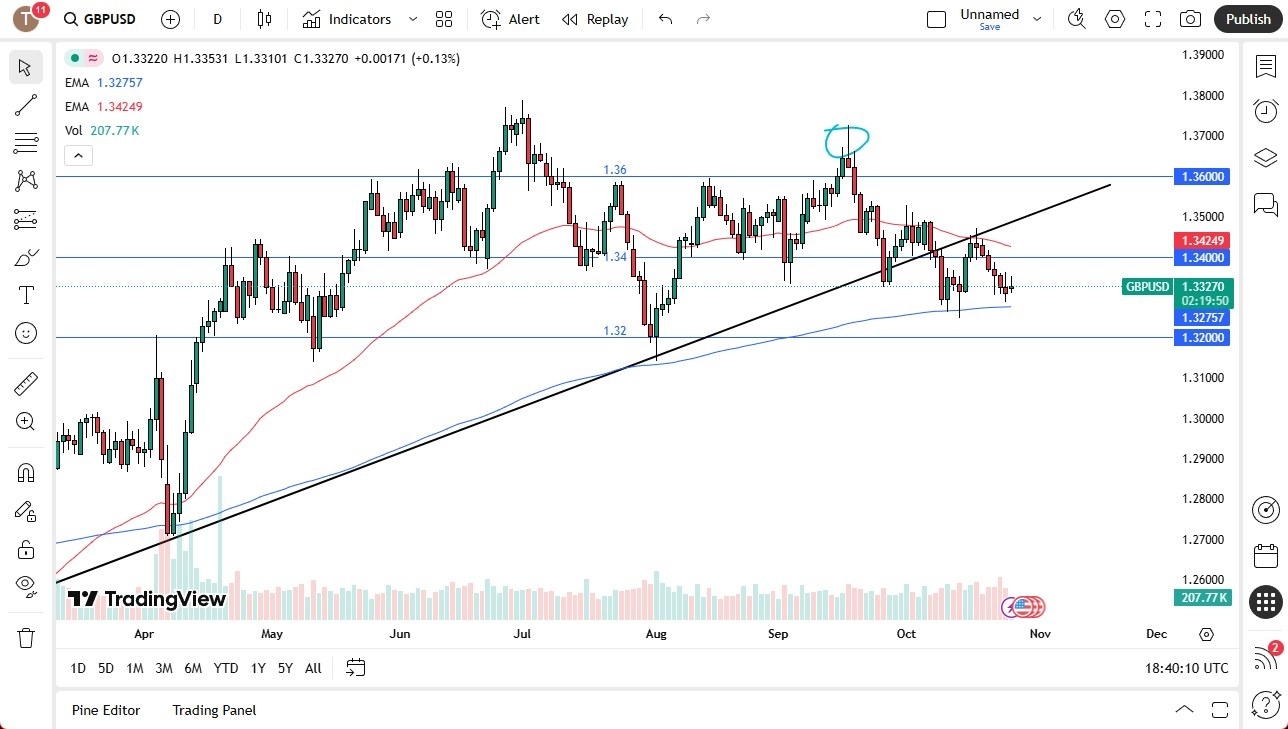
The British pound struggled to hold gains against the US dollar on Monday, with key technical barriers near $1.34 and support at $1.32.
Despite mixed sentiment, dollar strength persists ahead of the Fed’s interest rate decision.
The British pound was very noisy during trading on Monday as the market tried to rally, but it just didn’t seem able to hang on to gains. It’s worth noting that the 200-day EMA is in the same neighborhood, which will naturally attract attention as it has offered support a couple of different times. That being said, this is a situation where you have to view the market through the prism of trying to figure out where we are going next. The 200-day EMA offering support and the 50-day EMA offering resistance isn’t unusual, but it’s also notable that the 1.34 level is in the same area, providing an additional barrier.
This week features the Federal Reserve and its interest rate decision, and traders should be mindful of that. Ultimately, despite headline negativity surrounding the US dollar, it has strengthened against the British pound and many other currencies since the FOMC press conference. In other words, the market wasn’t behaving as many expected.
Massive Support Below
The 1.32 level below should act as significant support, and if we were to break down below that point, the British pound could start to fall apart, potentially reaching toward the 1.27 level. Rallies at this point should continue to pay attention to the 50-day EMA, the 1.35 level, and the previous uptrend line. Breaking above that would be very bullish, but for now, it’s important to note that the US dollar continues to show resilience despite all the challenges thrown at it; a trend is visible across multiple currency pairs.
Christopher Lewis has been trading Forex and has over 20 years experience in financial markets. Chris has been a regular contributor to Daily Forex since the early days of the site. He writes about Forex for several online publications, including FX Empire, Investing.com, and his own site, aptly named The Trader Guy. Chris favours technical analysis methods to identify his trades and likes to trade equity indices and commodities as well as Forex. He favours a longer-term trading style, and his trades often last for days or weeks.
The euro surged against the yen on Monday, hitting fresh highs as yen weakness spread across markets.
With risk appetite firm and central bank decisions ahead, traders continue to favor buying dips in this strong uptrend.
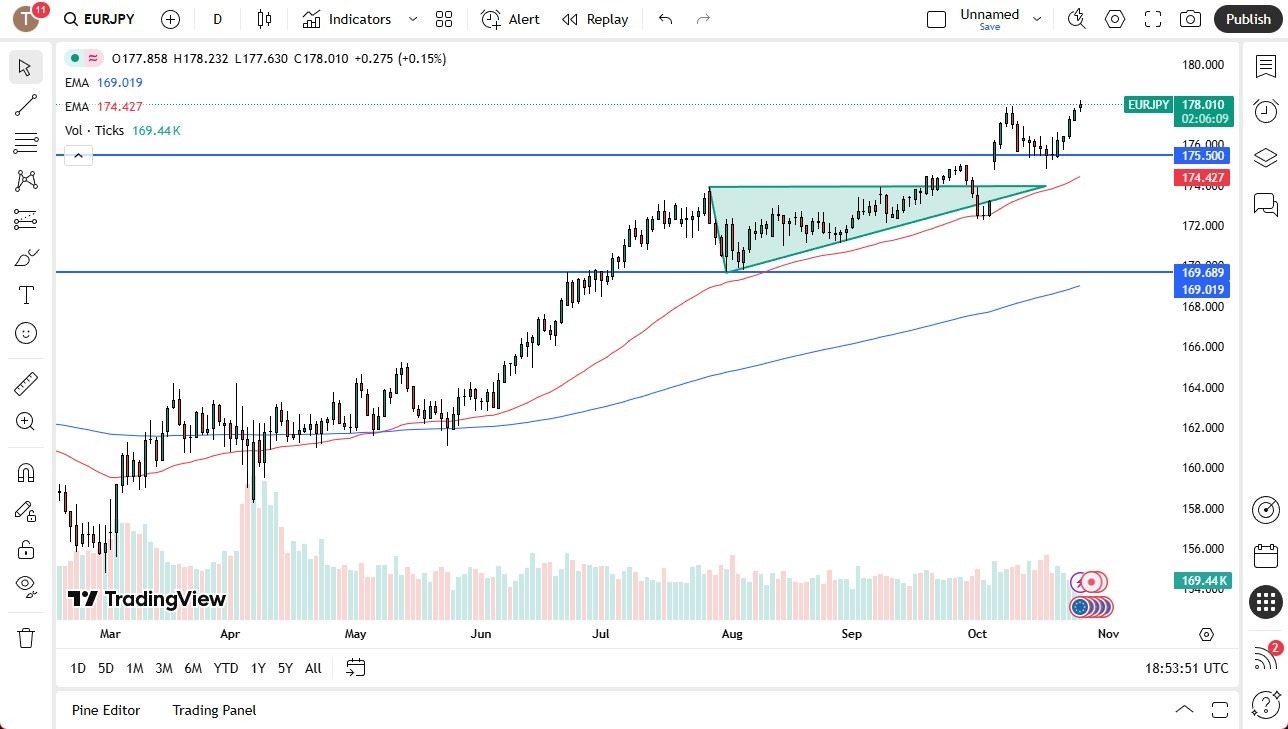
The euro rose against the Japanese yen during trading on Monday, or perhaps better put, the Japanese yen has fallen against almost everything on Monday. That being said, we are at a fresh new high, and it does look like the overall momentum still favors buying dips in this pair, as the euro clearly is the obvious winner at this juncture.
The 175.50 yen level underneath should continue to be massive support. And it looks to me like the euro may be trying to get to the 180 yen level before it’s all said and done. You should also keep in mind that there is a Bank of Japan as well as a European Central Bank decision for interest rates this week, and that will cause a lot of volatility. Nonetheless, as long as we have more of a “risk on” type of attitude around the world, it does make sense that we continue to see this one open up to the upside, given enough time.
I Can’t Short
And at this point in time, it’s almost impossible to get short. If we were to break down below the 172 yen level, then maybe we start to fall apart, but it’s going to take a lot to even get to that area. I expect to see a lot of noise. I expect to see a lot of questions asked about everything.
I also expect to see a lot of carry traders continuing to take advantage of the Japanese yen getting eviscerated. The situation between the Americans and the Chinese seems to be cooling off a bit. And if that does in fact end up being the case, then I think you have to look at this as a market that continues to rise as the Japanese yen is considered to be a safety currency.
That is being run from as people are looking for a higher rate of return in almost all assets. All things being equal, this is still an uptrend, and I think that continues to be the case going forward. With that, I think you have to look at this as a market that is long only at the moment.
Christopher Lewis has been trading Forex and has over 20 years experience in financial markets. Chris has been a regular contributor to Daily Forex since the early days of the site. He writes about Forex for several online publications, including FX Empire, Investing.com, and his own site, aptly named The Trader Guy. Chris favours technical analysis methods to identify his trades and likes to trade equity indices and commodities as well as Forex. He favours a longer-term trading style, and his trades often last for days or weeks.