The euro initially pulled back a bit from the 200 day EMA during the trading session on Thursday only to turn around and rally against the Japanese yen.
The 200 day EMA is currently sitting just below the 162 yen level which is an area that a lot of people will be paying close attention to.
If we were to break down blow there, then I think you have a very real possibility of a drop to the 160 yen level, which is also backed up by the 50 day EMA as well as the fact that we’ve seen a lot of noise back and forth in this market.
On a Move Higher
To the upside, have the 165 yen level, which offers a bit of a ceiling. But if we were to break above there, then I think you do see the Japanese yen get absolutely hammered, probably against multiple other currencies, not just this one. A breakdown below the 160 yen level means that the yen is starting to strengthen against probably most currencies. And we could drop down to the 155 yen level. This is an area that has been very important for some time and should continue to be.
The size of the candlestick is pretty impressive, but I do recognize that there is a lot of noise above that you will have to deal with. So therefore, I do think that waiting for short-term pullbacks could be a nice buying opportunity and probably the way to go with this market. I have no interest in shorting it, at least not until we break down below the 160 yen level, which is something that would be somewhat difficult to do in this short-term environment. This is a market that will continue to be very choppy to say the least.
The Pound was rangebound on Thursday following US President Donald Trump’s latest tariff announcement.
At the time of writing, the Pound Euro (GBP/EUR) exchange rate was trading at around €1.1992, virtually unchanged from Wednesday’s opening levels.
On Thursday, the Euro (EUR) wavered against most of its major counterparts.
While it strengthened against some currencies, it weakened against others, even though the economic calendar was relatively quiet.
Despite the lack of significant data releases, the Euro managed to gain ground against several of its peers following US President Donald Trump’s latest tariff announcement.
On Wednesday, Trump declared a 25% tariff on all non-American cars, which led to a weakening of the US Dollar (USD) on Thursday, allowing the Euro to benefit from its inverse relationship with USD.
However, concerns about potential additional tariffs on the Eurozone likely limited the Euro’s upward momentum and caused it to decline against several other currencies.
Advertisement
On Thursday, the Pound (GBP) traded within a narrow range against most of its major counterparts, following the Spring Statement on Wednesday.
The budget included several spending cuts and a substantial downgrade of the UK’s growth forecast by the Office for Budget Responsibility (OBR), which revised the projection from 2% to 1% for 2025.
Despite the Pound recovering most of its losses on Thursday, GBP exchange rates were unable to gain ground due to concerns over Trump’s tariff announcement on cars, which sparked fears about the future economic health of the UK.
Looking ahead to Friday, the primary driver of movement for the Pound Euro exchange rate will likely be several key economic releases from both the UK and the Eurozone.
For the Pound, the UK is set to release its February retail sales data, where the index is forecast to drop from a previous reading of 1.7% to -0.3%.
If the data meets these expectations, it could put downward pressure on GBP exchange rates, potentially closing the week on a weaker note.
On the Euro side, Germany, the largest economy in the Eurozone, will publish its latest GfK consumer confidence index and jobs data.
Additionally, the Eurozone is expected to release its latest economic sentiment reading.
Any negative surprises from these reports could introduce fresh headwinds for the Euro, impacting its performance against the Pound and other major currencies.
Like this piece? Please share with your friends and colleagues:
International Money Transfer? Ask our resident FX expert a money transfer question or try John’s new, free, no-obligation personal service! ,where he helps every step of the way,
ensuring you get the best exchange rates on your currency requirements.
GBP/USD trades in a tight range near 1.2950 after posting gains on Thursday.
Retail Sales in the UK rose at a stronger pace than expected in February.
February PCE inflation data from the US will be scrutinized by market participants.
GBP/USD gathered bullish momentum and closed in positive territory on Thursday. The pair stays in a consolidation phase near 1.2950 in the European session on Friday as markets await the next key data release from the US.
British Pound PRICE This week
The table below shows the percentage change of British Pound (GBP) against listed major currencies this week. British Pound was the strongest against the Japanese Yen.
USD
EUR
GBP
JPY
CAD
AUD
NZD
CHF
USD
0.45%
-0.22%
0.86%
-0.19%
-0.29%
0.33%
-0.03%
EUR
-0.45%
-0.77%
-0.10%
-0.59%
-0.76%
-0.07%
-0.43%
GBP
0.22%
0.77%
1.05%
-0.45%
-0.02%
0.71%
0.24%
JPY
-0.86%
0.10%
-1.05%
-1.03%
-1.16%
-0.50%
-0.89%
CAD
0.19%
0.59%
0.45%
1.03%
-0.05%
0.52%
0.16%
AUD
0.29%
0.76%
0.02%
1.16%
0.05%
0.71%
0.34%
NZD
-0.33%
0.07%
-0.71%
0.50%
-0.52%
-0.71%
-0.29%
CHF
0.03%
0.43%
-0.24%
0.89%
-0.16%
-0.34%
0.29%
The heat map shows percentage changes of major currencies against each other. The base currency is picked from the left column, while the quote currency is picked from the top row. For example, if you pick the British Pound from the left column and move along the horizontal line to the US Dollar, the percentage change displayed in the box will represent GBP (base)/USD (quote).
The broad-based US Dollar (USD) weakness helped GBP/USD gain traction on Thursday as the auto tariffs announcement by US President Donald Trump revived concerns over an economic slowdown.
Early Friday, the UK’s Office for National Statistics reported that Retail Sales rose by 1% on a monthly basis in February. This reading followed the 1.4% increase (revised from 1.7%) recorded in January and came in better than the market expectation for a decrease of 0.3%.
Although the upbeat UK data helped Pound Sterling find demand with the immediate reaction, the risk-averse market atmosphere seems to be making it difficult for the pair to stretch higher. As of writing, US stock index futures were losing between 0.2% and 0.4% on the day.
The US Bureau of Economic Analysis will publish the Personal Consumption Expenditures (PCE) Price Index data, the Federal Reserve’s preferred gauge of inflation, for February. On a monthly basis, the core PCE Price Index is forecast to rise by 0.3%. A stronger-than-expected increase could support the USD with the immediate reaction and cause GBP/USD to stretch lower heading into the weekend. On the flip side, a soft reading of 0.1%, or lower, could help the pair stretch higher. Unless the risk mood improves, however, the pair’s upside is likely to remain capped.
GBP/USD Technical Analysis
GBP/USD manages to hold above the 100-period Simple Moving Average (SMA) on the 4-hour chart and the Relative Strength Index (RSI) indicator stays slightly above 50, reflecting a lack of bearish momentum.
On the downside, 1.2930 (20-day SMA) aligns as immediate support before 1.2900 (lower limit of the ascending regression channel) and 1.2800 (200-day SMA). Looking north, resistances could be spotted at 1.3000 (static level, round level) and 1.3040 (mid-point of the ascending channel).
Pound Sterling FAQs
The Pound Sterling (GBP) is the oldest currency in the world (886 AD) and the official currency of the United Kingdom. It is the fourth most traded unit for foreign exchange (FX) in the world, accounting for 12% of all transactions, averaging $630 billion a day, according to 2022 data.
Its key trading pairs are GBP/USD, also known as ‘Cable’, which accounts for 11% of FX, GBP/JPY, or the ‘Dragon’ as it is known by traders (3%), and EUR/GBP (2%). The Pound Sterling is issued by the Bank of England (BoE).
The single most important factor influencing the value of the Pound Sterling is monetary policy decided by the Bank of England. The BoE bases its decisions on whether it has achieved its primary goal of “price stability” – a steady inflation rate of around 2%. Its primary tool for achieving this is the adjustment of interest rates.
When inflation is too high, the BoE will try to rein it in by raising interest rates, making it more expensive for people and businesses to access credit. This is generally positive for GBP, as higher interest rates make the UK a more attractive place for global investors to park their money.
When inflation falls too low it is a sign economic growth is slowing. In this scenario, the BoE will consider lowering interest rates to cheapen credit so businesses will borrow more to invest in growth-generating projects.
Data releases gauge the health of the economy and can impact the value of the Pound Sterling. Indicators such as GDP, Manufacturing and Services PMIs, and employment can all influence the direction of the GBP.
A strong economy is good for Sterling. Not only does it attract more foreign investment but it may encourage the BoE to put up interest rates, which will directly strengthen GBP. Otherwise, if economic data is weak, the Pound Sterling is likely to fall.
Another significant data release for the Pound Sterling is the Trade Balance. This indicator measures the difference between what a country earns from its exports and what it spends on imports over a given period.
If a country produces highly sought-after exports, its currency will benefit purely from the extra demand created from foreign buyers seeking to purchase these goods. Therefore, a positive net Trade Balance strengthens a currency and vice versa for a negative balance.
The USD/JPY pair edged lower in latest intraday trading, after the pivotal resistance of 150.95 held on, especially as the price finished a negative harmonic pattern there, the Gartley pattern, with negative signals emerging from the Stochastic after reaching overbought levels.
It comes as the price trades within an upward correctional price channel that guided recent short-term trading.
The EUR/USD pair settled higher in latest intraday trading and retested the pivotal resistance of $1.0820, which represents the neckline of a negative technical pattern that’s forming in the short term, the Double Top pattern, which is decisive in determining the upcoming direction.
Despite the latest gains, the price is still dominated by a downward correctional trend as it continues to trade below the 50-candle SMA, with selling pressures bolstered even further by a forming negative divergence in the Stochastic after reaching overbought levels compared to the price’s movements, sending out negative signals.
To get our more detailed analysis and 100% accurate signals provided by Best Trading Signal, subscribe to Economies.com VIP Club through the link below!
Risk Disclosure: Trading in financial instruments and/or cryptocurrencies involves high risks including the risk of losing some, or all, of your investment amount, and may not be suitable for all investors. Prices of cryptocurrencies are extremely volatile and may be affected by external factors such as financial, regulatory or political events. Trading on margin increases the financial risks.
Before deciding to trade in financial instrument or cryptocurrencies you should be fully informed of the risks and costs associated with trading the financial markets, carefully consider your investment objectives, level of experience, and risk appetite, and seek professional advice where needed.
Fusion Media would like to remind you that the data contained in this website is not necessarily real-time nor accurate. The data and prices on the website are not necessarily provided by any market or exchange, but may be provided by market makers, and so prices may not be accurate and may differ from the actual price at any given market, meaning prices are indicative and not appropriate for trading purposes. Fusion Media and any provider of the data contained in this website will not accept liability for any loss or damage as a result of your trading, or your reliance on the information contained within this website.
It is prohibited to use, store, reproduce, display, modify, transmit or distribute the data contained in this website without the explicit prior written permission of Fusion Media and/or the data provider. All intellectual property rights are reserved by the providers and/or the exchange providing the data contained in this website.
Fusion Media may be compensated by the advertisers that appear on the website, based on your interaction with the advertisements or advertisers.
The British pound is affected by UK inflation and budget announcements.
The Bank of England may be prepared to cut interest rates.
The US dollar is stronger ahead of economic growth readings.
Selling pressure on the British pound against other major currencies has increased after the Office for National Statistics announced a monthly rise in the UK Consumer Price Index (CPI) of 0.4% month-on-month, below the expected 0.5%. According to the economic calendar data, the annual CPI inflation in Britain fell to 2.8% from 3.0% in January 2025, while expectations were for a 2.9% increase. This decline is mainly attributed to a fall in clothing and footwear prices on an annual basis (-0.6%), marking the first negative rate since October 2021.
” dir=”auto” id=”content-1686574122635″>
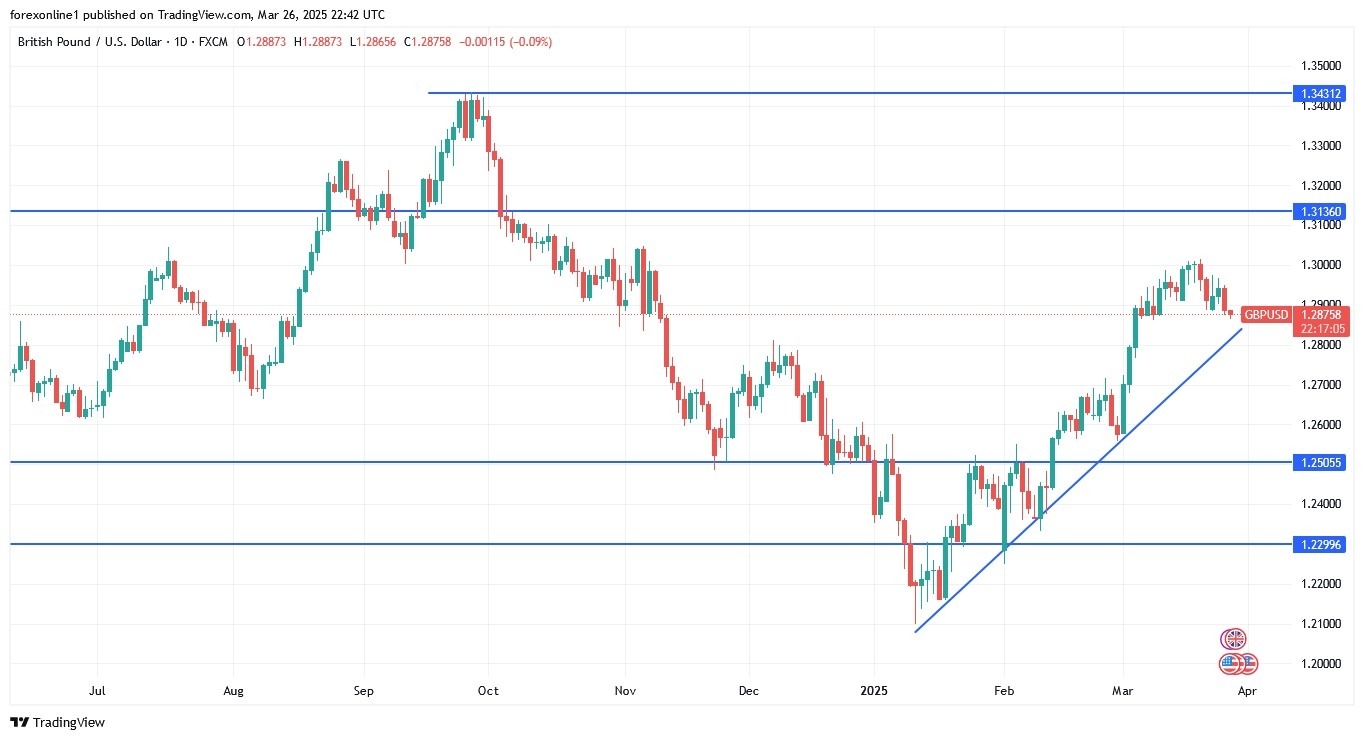
According to forex market trading, the GBP/USD pair fell to the 1.2873 support level, where it remained at the time of writing.
UK Inflation and Its Impact on Bank of England Policies
As officially announced, CPI inflation in the services sector, which the Bank of England closely monitors, remained stable at 5.0%. The core CPI inflation rate, another important measure for the bank, fell to 3.5% in February 2025, down from 3.7% in January, and below the expected 3.6%. While inflation remains significantly above the Bank of England’s 2.0% target, its fall below expectations has led to a decline in the currency’s value.
Overall, following the data release, traders raised their expectations for another Bank of England interest rate cut in May to 80%. The increased likelihood of a May rate cut reflects a slight decline in UK bond yields and a decline in the value of the pound. However, the Bank of England will remain limited in its ability to cut interest rates frequently, as inflation remains stubbornly high, and economists warn it will rise further.
On the monetary policy front, Andrew Sentance, a former member of the Bank of England’s Monetary Policy Committee, says that rising national insurance contributions and energy and water prices are likely to push CPI inflation to over 4%. He adds, “It is expected to reach 5% or more in the fall.” Therefore, inflationary pressures are high, which will limit the decline in UK bond yields and the British pound’s exchange rates. However, not all economists agree that inflationary pressures will continue to rise. Deutsche Bank, for example, believes that the rationale for consecutive interest rate cuts is increasing.
According to currency trading experts, a faster decline in bank interest rates is likely in the coming months, which will negatively impact the British pound next year. In fact, the accelerated decline in interest rates in the UK is a major reason why many leading foreign exchange experts expect the pound to decline in the coming quarters.
Trading Tips:
As predicted, the failure of sterling bulls to maintain the psychological peak of 1.30 will increase selling pressure. The downward shift is ongoing.
UK stock prices rebound after economic data.
According to recent trading on stock trading company platforms, the UK FTSE 100 index maintained its gains, closing at 8690 points, mainly driven by the weak British pound after the unexpected decline in UK inflation to 2.8%, which boosted the income of London residents from abroad. However, UK Finance Minister Rachel Reeves’ Spring statement added little new optimism for investors. Many key announcements, such as changes to social care and the National Health Service, were well-known, and their impact on the market was limited.
But the biggest disappointment came from the Office for Budget Responsibility’s revised growth forecast for the UK, which was cut from 2% to just 1% for 2024. This weighed on sentiment, particularly in the housing sector, where shares of major housebuilders fell before recovering. The UK government also admitted it would miss its target of building 1.5 million homes, revising its forecast to 1.3 million. Investors had hoped for bolder action on planning reforms to stimulate growth.
Meanwhile, defence shares, such as BAE Systems, rebounded after Reeves pledged to increase spending, while Shell continued its gains following its strategy update.
Technical Analysis for the GBP/USD pair today:
According to the daily chart performance, and as previously predicted, the GBP/USD bulls’ abandonment of the 1.3000 psychological resistance level will incentivize bears to move with sell orders to take profits downward. This is what happened, and currently, selling pressure on the GBP/USD will increase if the pair moves towards the 1.2800 support level. The technical indicators, led by the Relative Strength Index (RSI) and the Moving Average Convergence Divergence (MACD), have turned downward. Conversely, on the same timeframe, the 1.3000 psychological resistance level remains crucial for the bulls to control the GBP/USD trend.
Today’s economic calendar will be devoid of any significant UK economic releases. The focus will be on US releases, led by the GDP growth reading and the weekly US jobless claims. Additionally, the GBP/USD will react to investors’ risk appetite.
The Bank of Japan is prepared to raise interest rates.
US tariffs affect market performance.
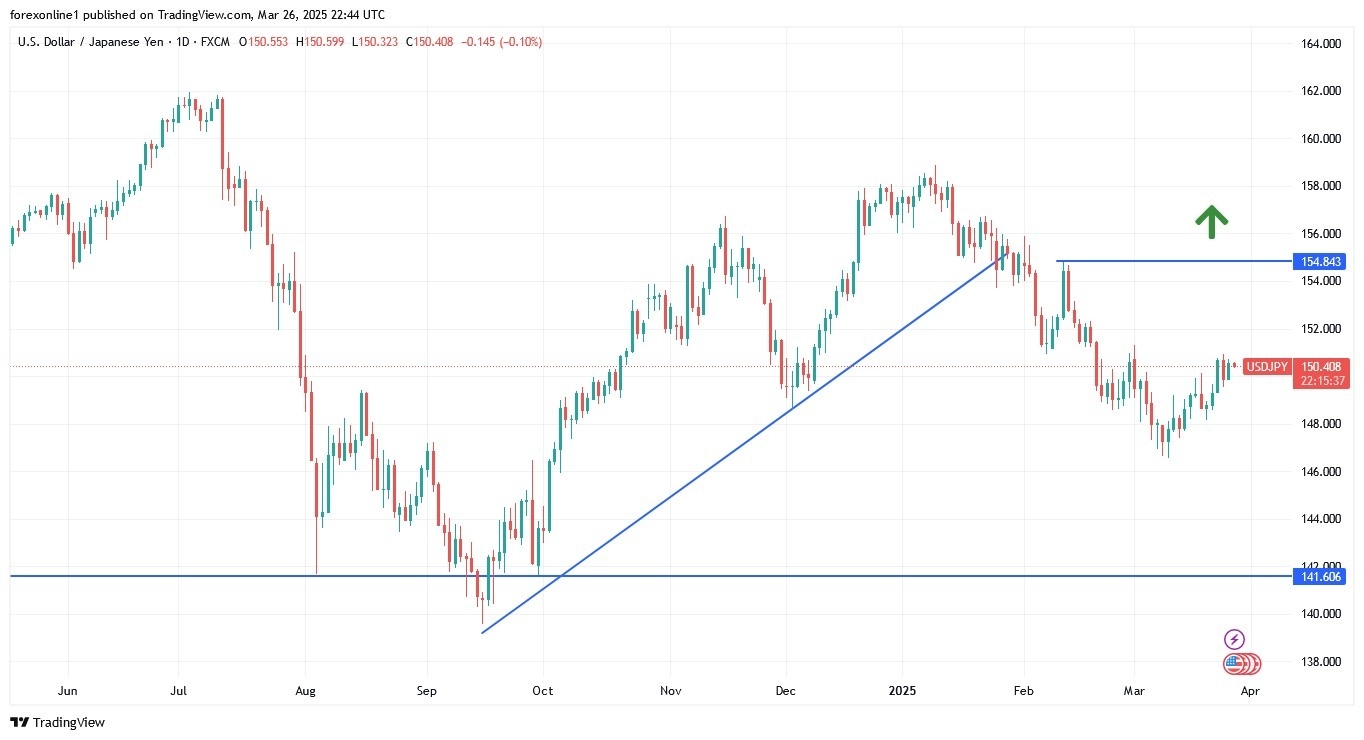
For three consecutive trading sessions, bulls have succeeded in stabilizing the USD/JPY pair around and above the psychological resistance of 150.00, which has often been noted as a potential starting point for a new upward channel for the pair. The USD/JPY pair’s upward rebound gains reached the 150.92 resistance level, the pair’s highest level in nearly three weeks, before stabilizing around 150.50 at the start of trading on Thursday.
Japanese Yen Affected by Bank of Japan Signals
According to forex market trading, the Japanese yen declined, giving up its gains as investors braced for the implementation of reciprocal US tariffs, which could impact key Japanese exports. A rebound in riskier assets, including stocks and commodities, also dampened demand for the Japanese yen as a safe haven. In Japan, Bank of Japan Governor Kazuo Ueda told parliament that he would continue raising interest rates if economic forecasts materialize. Ueda emphasized that economic growth has exceeded expectations, as a positive cycle of rising incomes has led to increased consumer spending.
In last week’s decision, the Bank of Japan kept its key interest rate steady at 0.5%, with officials maintaining a cautious stance while assessing global economic risks, particularly the potential repercussions of higher US tariffs.
Trading Tips:
The stabilization of USD/JPY above the 150 level stimulates an upward shift.
Japanese government bond yields reach their highest level in more than 16 years.
According to trading via reliable trading companies, the 10-year Japanese government bond yield rose to approximately 1.59%, marking its highest level in 16 and a half years, after Bank of Japan Governor Kazuo Ueda told parliament that he would continue to raise interest rates if economic forecasts materialize. Ueda stressed that economic growth had exceeded expectations, with a positive cycle of rising income leading to increased consumer spending. Additionally, the Bank of Japan governor revealed earlier this week that the Bank of Japan is gradually reducing its holdings of long-term Japanese government bonds, while emphasizing the impossibility of immediate sales.
US Dollar Ignores Weak Consumer Confidence
According to Forex market trading, the US dollar’s performance was affected by the announcement of weak consumer confidence, the primary driver of the US consumption-based economy. Without it, production will inevitably decline. According to economists, US households expected President Trump to unleash tax cuts and deregulations, but instead, there is austerity and the potential for significant trade tariffs. This raises concerns about household finances and job opportunities, with fears that this will translate into weak spending.
According to licensed trading platforms, the US dollar reached its highest level since 2022 on January 13, amid continued outperformance by the US economy and its associated assets, particularly the stock market. However, US exceptionalism has dissipated under US President Donald Trump’s erratic approach to tariffs and spending cuts. Policy uncertainty has led to a decline in US stock markets, negatively impacting consumer and business confidence, which inevitably weighs on the dollar. There’s more to come, as Trump is set to announce his largest tariff announcement yet on April 2.
USD/JPY Technical Analysis and Expectations Today:
According to daily chart performance, the stabilization of the USD/JPY pair around and above the psychological resistance of 150.00 will stimulate bulls’ control and support the formation of an ascending channel. The upward shift will be confirmed by movement towards the resistance levels of 151.20 and 152.00, respectively. Currently, the technical indicators MACD and RSI have turned upward. Conversely, on the same timeframe, the support level of 148.70 remains a threat to the current upward shift. Finally, we still prefer buying the USD/JPY pair from every downward level.
Copper price closed higher once again above $5.000, paving the way for more gains, especially as the Stochastic exited overbought saturation levels and held near 80, providing more positive signals and pushing the price towards $5.3200 then $5.4100.
A breach of the $5.000 barrier however would send the price towards lesser targets, including $4.9100 and $4.8100.
Expected trading range today is between $5.100 and $5.4100.
The EUR/JPY cross may face initial resistance around the psychological level of 165.00.
The 14-day Relative Strength Index (RSI) remains above 50, strengthening the bullish outlook.
Immediate support is seen at the nine-day EMA of 161.79, followed by the ascending channel’s lower boundary at 161.50.
EUR/JPY dips slightly after gaining in the previous session, hovering around 161.90 during Thursday’s Asian trading hours. Technical analysis of the daily chart indicates the currency cross is moving within an ascending channel, supporting a bullish outlook.
Additionally, the 14-day Relative Strength Index (RSI) remains above 50, reinforcing the bullish bias. The cross also stays above the nine-day Exponential Moving Average (EMA), signaling strong short-term momentum and the potential for further gains.
On the upside, the EUR/JPY cross could encounter initial resistance near the “pullback resistance” around the psychological level of 165.00. Beyond this, the next key hurdle lies at 166.69—an eight-month high last reached in October 2024—aligning with the upper boundary of the ascending channel.
The EUR/JPY cross may find initial support at the nine-day EMA of 161.79, followed by the ascending channel’s lower boundary at 161.50. A break below this critical support zone could weaken short-term momentum, potentially driving the cross toward the 50-day EMA at 160.49.
Further decline below the 50-day EMA could erode medium-term momentum, intensifying bearish pressure and dragging the cross toward its monthly low of 155.59, recorded on March 4, followed by 154.41, its lowest level since December 2023.
EUR/JPY: Daily Chart
Euro PRICE Today
The table below shows the percentage change of Euro (EUR) against listed major currencies today. Euro was the weakest against the Japanese Yen.
USD
EUR
GBP
JPY
CAD
AUD
NZD
CHF
USD
-0.25%
-0.18%
-0.27%
0.00%
-0.15%
-0.11%
-0.13%
EUR
0.25%
0.04%
-0.06%
0.23%
0.06%
0.12%
0.09%
GBP
0.18%
-0.04%
-0.10%
0.19%
0.02%
0.06%
0.05%
JPY
0.27%
0.06%
0.10%
0.27%
0.10%
0.14%
0.15%
CAD
-0.01%
-0.23%
-0.19%
-0.27%
-0.15%
-0.11%
-0.13%
AUD
0.15%
-0.06%
-0.02%
-0.10%
0.15%
0.05%
0.04%
NZD
0.11%
-0.12%
-0.06%
-0.14%
0.11%
-0.05%
-0.01%
CHF
0.13%
-0.09%
-0.05%
-0.15%
0.13%
-0.04%
0.01%
The heat map shows percentage changes of major currencies against each other. The base currency is picked from the left column, while the quote currency is picked from the top row. For example, if you pick the Euro from the left column and move along the horizontal line to the US Dollar, the percentage change displayed in the box will represent EUR (base)/USD (quote).