The main tag of Forex News Today Articles.
You can use the search box below to find what you need.
[wd_asp id=1]

11 04, 2026

EUR/USD Price Forecast: Critical Analysis Reveals Hesitant Bears as Breakout Above 1.1670 Remains in Play

By |2026-04-11T17:11:45+02:00April 11, 2026|Forex News, News|0 Comments

BitcoinWorld

EUR/USD Price Forecast: Critical Analysis Reveals Hesitant Bears as Breakout Above 1.1670 Remains in Play

Financial markets in London and New York observed cautious trading activity on Thursday, December 4, 2025, as the EUR/USD currency pair approached a critical technical juncture. Technical analysis reveals that bearish momentum appears hesitant despite recent pressure, with a potential breakout above the 1.1670 resistance level remaining firmly in play according to multiple chart patterns and indicators.

EUR/USD Price Forecast: Technical Landscape Analysis

Market analysts currently examine the EUR/USD pair through multiple technical frameworks. The currency pair recently tested support near 1.1620 before rebounding toward the 1.1650 region. Consequently, this price action suggests underlying strength despite apparent bearish pressure. Furthermore, the 50-day moving average provides dynamic support around 1.1635, creating a confluence zone with horizontal support levels.

Several key technical elements merit attention in the current EUR/USD forecast. First, the Relative Strength Index (RSI) currently reads 48, indicating neutral momentum without extreme overbought or oversold conditions. Second, trading volume patterns show declining volume during recent pullbacks, suggesting weak bearish conviction. Third, Fibonacci retracement levels from the October swing high to November low identify 1.1670 as the 61.8% retracement level, a historically significant technical barrier.

Recent price action reveals important characteristics for traders. Specifically, the pair has established higher lows since mid-November, forming a potential ascending triangle pattern. Meanwhile, daily candlestick patterns show rejection of lower prices near 1.1620 on three separate occasions. These technical developments collectively suggest that bears lack sufficient momentum to drive prices significantly lower at present.

Market Context and Fundamental Backdrop

The current EUR/USD price forecast operates within a complex fundamental environment. European Central Bank policy decisions continue to influence euro dynamics, particularly regarding interest rate differentials with the Federal Reserve. Additionally, economic data releases from both regions create intermittent volatility spikes that technical analysis must contextualize.

Recent economic indicators provide crucial background for the EUR/USD forecast. Eurozone inflation data showed modest improvement last week, reducing immediate pressure for aggressive ECB easing. Conversely, U.S. employment figures demonstrated resilience, supporting the dollar’s underlying strength. These competing fundamental forces create the technical indecision currently visible on price charts.

Expert Analysis and Institutional Perspectives

Major financial institutions offer nuanced views on the EUR/USD outlook. Goldman Sachs analysts note that positioning data reveals net short euro positions approaching extreme levels, potentially limiting further downside. Meanwhile, JPMorgan’s technical team identifies 1.1670 as a “make or break” level for near-term direction. Bloomberg Intelligence reports that options market pricing shows balanced risk perceptions around current levels.

Historical precedent provides additional context for the current EUR/USD forecast. During similar technical setups in 2023, the pair frequently experienced false breakdowns before resuming broader trends. Statistical analysis of past breakouts above the 1.1670 level reveals an average follow-through of approximately 150 pips over subsequent sessions. This historical data informs current risk-reward calculations for traders.

Technical Indicators and Chart Pattern Interpretation

Multiple technical indicators converge around the 1.1670 level in the EUR/USD forecast. Bollinger Bands show contraction, indicating reduced volatility and potential for an impending expansion. The Average Directional Index (ADX) reads 22, suggesting a non-trending market environment that favors range-bound strategies. Meanwhile, moving average convergence divergence (MACD) shows a bullish crossover on the four-hour chart, providing short-term momentum signals.

Key resistance and support levels structure the current trading range:

  • Immediate Resistance: 1.1670 (horizontal resistance and Fibonacci level)
  • Secondary Resistance: 1.1700 (psychological level and previous swing high)
  • Primary Support: 1.1620 (recent swing low and volume node)
  • Secondary Support: 1.1585 (200-day moving average and October low)

Chart patterns suggest several potential scenarios for the EUR/USD forecast. The ascending triangle formation would complete with a breakout above 1.1670, projecting measured moves toward 1.1750. Alternatively, a breakdown below 1.1620 would invalidate the bullish pattern structure. Volume profile analysis identifies high-volume nodes between 1.1640 and 1.1660, indicating price acceptance in this region.

Risk Factors and Market Sentiment Indicators

Several risk factors could alter the current EUR/USD forecast trajectory. Geopolitical developments in Eastern Europe continue to influence euro sentiment, particularly regarding energy market stability. Additionally, unexpected central bank communications from either the ECB or Fed could override technical considerations. Market sentiment indicators show retail traders maintaining net long positions, while institutional positioning appears more balanced.

The Commitment of Traders (COT) report provides positioning context for the EUR/USD forecast. Commercial hedgers increased long euro positions recently, while leveraged funds reduced net short exposure. This positioning shift suggests professional money flows may be anticipating euro strength. Open interest in EUR/USD futures contracts remains elevated near yearly highs, indicating sustained market participation.

Trading Implications and Strategy Considerations

The current EUR/USD forecast presents distinct trading implications across different timeframes. Swing traders monitor the 1.1670 breakout level for potential trend continuation signals. Day traders focus on intraday support and resistance reactions, particularly around European and U.S. session overlaps. Position traders consider broader fundamental developments while respecting technical boundaries.

Risk management parameters derive naturally from the technical landscape. Stop-loss placements below 1.1620 protect against pattern invalidation, while breakout scenarios above 1.1670 warrant trailing stop methodologies. Position sizing should account for the potential volatility expansion following a confirmed breakout or breakdown. Correlation analysis with other dollar pairs provides additional confirmation signals for directional bias.

Seasonal patterns offer supplementary context for the EUR/USD forecast. Historically, December trading often features reduced liquidity but increased volatility during year-end positioning adjustments. The pair has shown positive December returns in seven of the past ten years, though past performance never guarantees future results. This seasonal tendency may influence institutional behavior around current technical levels.

Conclusion

The EUR/USD price forecast reveals a market at a critical technical juncture with bears demonstrating hesitation despite apparent pressure. The 1.1670 resistance level represents a decisive barrier whose breach would signal renewed bullish momentum and potentially trigger algorithmic buying programs. Technical indicators suggest balanced conditions that favor breakout scenarios in either direction, though chart patterns lean cautiously bullish. Market participants should monitor price action around identified key levels while maintaining flexible risk parameters that acknowledge both breakout potential and false signal risks inherent in current market conditions.

FAQs

Q1: What makes the 1.1670 level particularly significant in the current EUR/USD forecast?
The 1.1670 level represents a confluence of technical factors including a key Fibonacci retracement level (61.8%), previous swing high resistance, and a psychological round number. Multiple tests of this level increase its technical significance for determining near-term direction.

Q2: How does current market volatility affect the EUR/USD breakout potential?
Reduced volatility, as indicated by contracting Bollinger Bands, typically precedes volatility expansion and directional moves. The current low-volatility environment suggests an impending resolution of the trading range, though the direction remains uncertain until confirmed by price action.

Q3: What fundamental factors could override the technical EUR/USD forecast?
Unexpected central bank policy shifts, particularly from the ECB or Federal Reserve, could override technical considerations. Additionally, significant geopolitical developments or extreme economic data surprises could drive price action outside technically defined ranges.

Q4: How reliable are chart patterns like the potential ascending triangle in current market conditions?
Chart patterns provide probabilistic frameworks rather than certain predictions. The potential ascending triangle pattern suggests bullish resolution but requires confirmation above 1.1670 with accompanying volume. False breakouts remain common in low-volatility environments.

Q5: What timeframes are most relevant for the current EUR/USD analysis?
The analysis applies across multiple timeframes but finds particular relevance on daily and four-hour charts for swing trading perspectives. Intraday traders might focus on hourly charts for entry precision, while longer-term investors should consider weekly charts for broader context.

This post EUR/USD Price Forecast: Critical Analysis Reveals Hesitant Bears as Breakout Above 1.1670 Remains in Play first appeared on BitcoinWorld.

Source link

11 04, 2026

GBP/JPY Forecast: Critical Bullish Breakout Looms Above Formidable 214.00-215.00 Resistance

By |2026-04-11T13:10:03+02:00April 11, 2026|Forex News, News|0 Comments


GBP/JPY Forecast: Critical Bullish Breakout Looms Above Formidable 214.00-215.00 Resistance


Skip to content


Source link

11 04, 2026

GBP/USD Forecast: Technicals turn slightly bullish for Pound Sterling amid Mideast drama

By |2026-04-11T09:09:08+02:00April 11, 2026|Forex News, News|0 Comments

The Pound Sterling (GBP) staged a stellar recovery from near four-month lows against the US Dollar (USD) and clinched two-month highs just shy of the 1.3500 threshold.

Pound Sterling bulls returned with a bang

The week started with the domination of safe-haven flows and the risk-sensitive Pound Sterling in multi-month troughs.

Markets remained nervous as they weighed US President Donald Trump’s social media threat posted on Sunday, in which he ratcheted up pressure on Iran, while extending the deadline to reopen the Strait of Hormuz to Tuesday at 8 PM Eastern Time or Wednesday 00:00 GMT.

On the other side, Iran mulled a “much more devastating” retaliation if civilian targets are hit.  Against the deepening escalation in the Middle East conflict, investors scurried for safety in the world’s reserve currency, the USD, once again, extending its recovery.

The Greenback also capitalized on the increased expectations about the US Federal Reserve’s (Fed) interest rate outlook, especially after a blockbuster February jobs report.

Data released by the Bureau of Labor Statistics (BLS) on Friday showed that US Nonfarm Payrolls jumped by 178K in March, against the consensus of +60K and a 133K drop recorded in February (revised down from -92K). The Unemployment Rate unexpectedly fell to 4.3%, vs. 4.4% consensus and 4.4% prior.

However, the GBP/USD showed some resilience and embarked upon a recovery as the USD failed to sustain at higher levels against its major counterparts. The tide entirely turned against the buck following Trump’s TACO trade early Wednesday, which provided legs to the GBP/USD rebound.

Risk-on flows returned with a bang after the United States (US) and Iran brokered a two-week ceasefire and agreed to enter negotiations on April 10, potentially paving the way for a lasting peace in the Middle East and resumption of Gulf oil and gas exports through the vital Strait of Hormuz.

In light of the de-escalation, the currency pair stretched higher and reached the highest levels in two months just below 1.3500.

However, GBP/USD sellers quickly jumped in and triggered a sharp retracement amid investors’ concerns over whether Trump would stick to the ceasefire agreement ahead of Friday’s negotiations on the ten-point proposal.

The Iranian proposal submitted to the US on Wednesday included maximalist demands that the Trump administration previously rejected.

The Greenback regained its safe-haven bid in the latter part of the week as doubts about the Mideast ceasefire countered the dovish Minutes of the Fed’s March monetary policy meeting.

Israel continued its attacks on the Iran-aligned militant group, Hezbollah, in Lebanon. Iranian Foreign Minister Abbas Araghchi noted that the announcement said that the ceasefire included Lebanon.

On Friday, Israeli Prime Minister Benjamin Netanyahu said that there is “no ceasefire in Lebanon” and Israel would continue “to strike Hezbollah with full force”. Late Thursday, Netanyahu had issued an instruction to start direct negotiations with Lebanon “as soon as possible,” per the Washington Post.

Also, sentiment remained fragile and kept the pair on the back foot ahead of the highly-anticipated US-Iran peace talks and the top-tier Consumer Price Index (CPI) report from the US.

The BLS reported ahead of the weekend that annual inflation in the US, as measured by the change in the CPI, climbed to 3.3% in March from 2.4% in February. This print came in line with the market expectation. Additionally, the core CPI, which excludes volatile food and energy prices, rose 0.2% on a monthly basis, compared to analysts’ estimate of 0.3%. The USD struggled to gather strength following these data and allowed GBP/USD to remain in the upper half of its weekly range.

Middle East updates and Bailey’s speech on tap

After an eventful week, the focus will continue to remain on any signs of de-escalation in the Middle East conflict following Friday’s US-Iran negotiations.

The economic calendar is relatively light in the US, while the UK docket has several appearances of the Bank of England (BoE) Governor Andrew Bailey throughout the week.

Monday is devoid of any high-impact macro releases, while Tuesday features the US ADP four-week Employment Change and Producer Price Index (PPI) data.

Bailey is scheduled to participate in a moderated discussion about the future of central banking at Columbia University, in New York, later on Tuesday. A bunch of Fed policymakers are also lined up that day.

Bailey will speak on Wednesday at two separate events. On Thursday, the UK monthly growth and industrial numbers will be reported, followed by the US weekly Jobless Claims data.

The Fed and BoE officials are set to deliver their speeches on Friday, filling up the data-dry calendar.

Beyond the statistics and speeches from the central bank officials, developments on the US-Iran war will remain the main market driver.

GBP/USD technical analysis

GBP/USD daily chart

In the daily chart, GBP/USD trades at 1.3468, holding a constructive bullish tone as spot sits above the 20-, 50-, 100- and 200-day simple moving averages clustered between roughly 1.3324 and 1.3435. This stacked moving average support suggests the recent recovery remains intact, while the Relative Strength Index (14) around 58 leans positive without yet flagging overbought conditions, hinting that buyers still retain control in the near term.

On the topside, initial resistance emerges at the horizontal barrier near 1.3555, ahead of a stronger cap at 1.3700, where sellers may look to fade extended advances. On the downside, immediate protection is provided by the tight cluster of the 50-day SMA at 1.3435, the 100-day SMA at 1.3434 and the 200-day SMA at 1.3413, with the 20-day SMA lower at 1.3324 before more substantial horizontal support at 1.3221, 1.3160 and 1.3034.

(The technical analysis of this story was written with the help of an AI tool.)

Risk sentiment FAQs

In the world of financial jargon the two widely used terms “risk-on” and “risk off” refer to the level of risk that investors are willing to stomach during the period referenced. In a “risk-on” market, investors are optimistic about the future and more willing to buy risky assets. In a “risk-off” market investors start to ‘play it safe’ because they are worried about the future, and therefore buy less risky assets that are more certain of bringing a return, even if it is relatively modest.

Typically, during periods of “risk-on”, stock markets will rise, most commodities – except Gold – will also gain in value, since they benefit from a positive growth outlook. The currencies of nations that are heavy commodity exporters strengthen because of increased demand, and Cryptocurrencies rise. In a “risk-off” market, Bonds go up – especially major government Bonds – Gold shines, and safe-haven currencies such as the Japanese Yen, Swiss Franc and US Dollar all benefit.

The Australian Dollar (AUD), the Canadian Dollar (CAD), the New Zealand Dollar (NZD) and minor FX like the Ruble (RUB) and the South African Rand (ZAR), all tend to rise in markets that are “risk-on”. This is because the economies of these currencies are heavily reliant on commodity exports for growth, and commodities tend to rise in price during risk-on periods. This is because investors foresee greater demand for raw materials in the future due to heightened economic activity.

The major currencies that tend to rise during periods of “risk-off” are the US Dollar (USD), the Japanese Yen (JPY) and the Swiss Franc (CHF). The US Dollar, because it is the world’s reserve currency, and because in times of crisis investors buy US government debt, which is seen as safe because the largest economy in the world is unlikely to default. The Yen, from increased demand for Japanese government bonds, because a high proportion are held by domestic investors who are unlikely to dump them – even in a crisis. The Swiss Franc, because strict Swiss banking laws offer investors enhanced capital protection.

Source link

11 04, 2026

USD/JPY Forex Forecast 10/04: Pressures 160 (Video&Chart)

By |2026-04-11T05:08:05+02:00April 11, 2026|Forex News, News|0 Comments

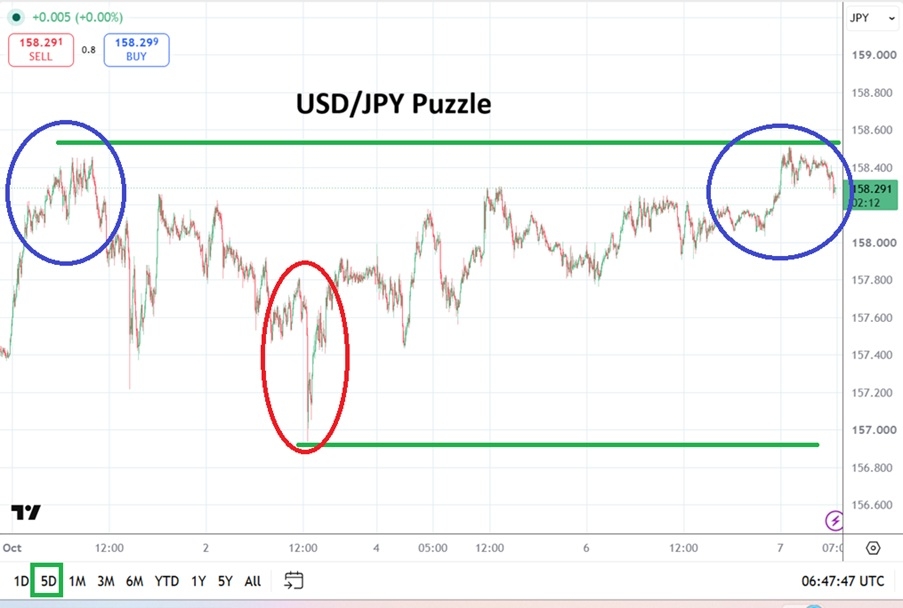
  • The US dollar continues to bounce against the yen, waiting to see if we can break higher.

  • The US dollar has rallied a bit against the Japanese yen during trading on Thursday as we continue to see a lot of noise in the interest rate environment.

  • The 158-yen level on the bottom of the range and the 160-yen level on the top is how I see the market right now.

Obviously, there is a lot going on that could greatly influence what happens next, not the least of which of course would be any ceasefire talks in the Middle East, but I would also watch very closely the 10-year yield in both countries, but specifically the United States.

The longer it stays above 4.3% the more likely it is the US dollar breaks out. It has fallen back below there during this session so we will see how that plays out. I suspect probably what you are going to see more than anything else is a lot of volatility over the next couple of days because we have those ceasefire talks on Friday in Islamabad, so we will have to see how that plays out.

Market Volatility and Key Resistance

It certainly looks like the USD/JPY market is pricing in some type of good news when I look at other assets. So, I anticipate that the US dollar may weaken a bit but ultimately this is a market that I also pay close attention to the 160.4-yen level because that would be an area that if we could break above it could really spell serious trouble for the Japanese yen.

That is a 1990 high that the US dollar made against the Japanese yen and if we were to break that, things could get ugly really fast. All things being equal, I do think this is a scenario where traders are going to have to be very patient, but I do think it also remains a buy-on-the-dip type of scenario as clearly the interest rate differential will continue to favor the US dollar.

Again, I think the 158-yen level continues to be a major support for the greenback right now and I do like the idea of buying closer to that, in fact I did overnight. But you can see just how noisy this market might end up being and with that being the case you do have to be somewhat cautious with your position sizing, but ultimately, I believe this is a market that will threaten that 160.4-yen level which is so important.

If we were to break down below the 50-day EMA then that obviously would be a major breakout just waiting to happen and, in that way, the Japanese yen probably strengthens across the board for not only moving against US dollar but maybe other currencies. The 156-yen level at that point for me would be the next support level.

Want to trade our USD/JPY forex analysis and predictions? Here’s a list of forex brokers in Japan to check out.

Christopher Lewis has been trading Forex and has over 20 years experience in financial markets. Chris has been a regular contributor to Daily Forex since the early days of the site. He writes about Forex for several online publications, including FX Empire, Investing.com, and his own site, aptly named The Trader Guy. Chris favours technical analysis methods to identify his trades and likes to trade equity indices and commodities as well as Forex. He favours a longer-term trading style, and his trades often last for days or weeks.

Source link

11 04, 2026

Forecast update for EURUSD -10-04-2026.

By |2026-04-11T01:07:01+02:00April 11, 2026|Forex News, News|0 Comments

The CADJPY ended the bullish corrective rally by facing a strong barrier at 210.65, as it represents %100 Fibonacci extension level, forcing it to form sideways trading by its stability near 201.40.


The stability below the current barrier and stochastic attempt to provide negative momentum will increase the chances of forming bearish waves, to attempt to reach 200.70 and 200.25, while breaching the barrier will ease the mission of recording extra gains that might extend towards 212.20 initially.


The expected trading range for today is between 200.70 and 201.60


Trend forecast: Bearish


Source link

10 04, 2026

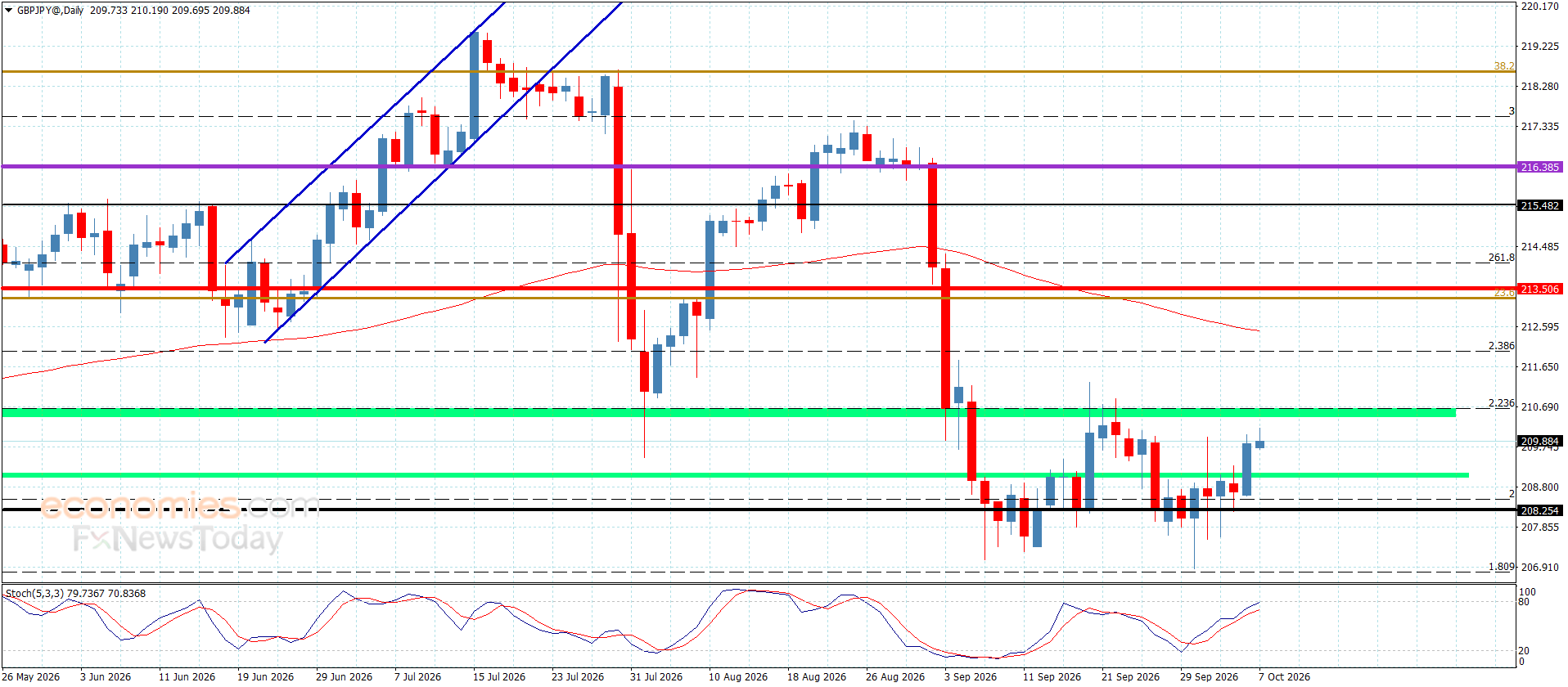
GBP/JPY Price Forecast: Bulls eye breakout above 214.00-215.00 resistance

By |2026-04-10T21:05:58+02:00April 10, 2026|Forex News, News|0 Comments

GBP/JPY edges higher on Friday, extending gains for a fifth straight day as the Japanese Yen (JPY) remains on the defensive against most of the major peers. Elevated Oil prices continue to weigh on the Yen, given Japan’s status as a major net importer.

Meanwhile, the British Pound (GBP), a cyclical currency, is drawing support from a modest improvement in risk sentiment as earlier concerns over the durability of the US-Iran ceasefire ease, with traders now looking ahead to upcoming negotiations in Pakistan over the weekend.

At the time of writing, the cross is trading around 214.12, its highest level since February 9. Apart from near-term price action, the wide interest rate differential between the UK and Japan remains a key driver supporting the cross.

From a technical perspective, GBP/JPY maintains a bullish bias, with shallow pullbacks within a broader uptrend. The latest leg higher follows a rebound from the 100-day Simple Moving Average (SMA) at 210.68, which acts as reliable support and continues to cushion the downside.

Price is now testing the 214.00-215.00 zone, which has capped upside attempts since mid-January. A sustained break above this area would strengthen bullish momentum and open the door for further gains.

The Relative Strength Index (RSI) near 63 points to strengthening bullish momentum without yet signaling overbought conditions. Meanwhile, the Moving Average Convergence Divergence (MACD) has turned positive again, suggesting that upside momentum is rebuilding after the recent consolidation phase.

On the downside, initial support is reinforced by the 100-day SMA at 210.68, which serves as the first line of defense should GBP/JPY correct lower. A deeper pullback would likely look toward the 200-day SMA at 205.52 as a more substantial structural floor, where longer-term buyers could re-emerge to protect the broader uptrend.

Japanese Yen Price Today

The table below shows the percentage change of Japanese Yen (JPY) against listed major currencies today. Japanese Yen was the strongest against the Australian Dollar.

USD EUR GBP JPY CAD AUD NZD CHF
USD -0.14% -0.15% 0.08% 0.08% 0.09% 0.13% -0.24%
EUR 0.14% -0.01% 0.24% 0.23% 0.23% 0.28% -0.11%
GBP 0.15% 0.00% 0.26% 0.25% 0.23% 0.29% -0.11%
JPY -0.08% -0.24% -0.26% -0.03% 0.01% 0.00% -0.37%
CAD -0.08% -0.23% -0.25% 0.03% 0.01% 0.06% -0.33%
AUD -0.09% -0.23% -0.23% -0.01% -0.01% 0.04% -0.34%
NZD -0.13% -0.28% -0.29% -0.01% -0.06% -0.04% -0.39%
CHF 0.24% 0.11% 0.11% 0.37% 0.33% 0.34% 0.39%

The heat map shows percentage changes of major currencies against each other. The base currency is picked from the left column, while the quote currency is picked from the top row. For example, if you pick the Japanese Yen from the left column and move along the horizontal line to the US Dollar, the percentage change displayed in the box will represent JPY (base)/USD (quote).

Source link

10 04, 2026

The EURJPY resumes the rise– Forecast today – 10-4-2026

By |2026-04-10T17:05:16+02:00April 10, 2026|Forex News, News|0 Comments

The GBPJPY pair is under strong positive pressures, pushing it to surpass the resistance at 213.30, to settle above it to confirm regaining the bullish bias by its stability within the minor bullish channel’s levels, recording 213.85 level.


The continuation of providing positive closes above 213.30 level will allow it to take advantage from the main indicators, to begin targeting new positive stations that might begin at 214.10 and 215.00, while the return to settle below 213.30 will force it to activate the bearish corrective scenario again, forming the initial negative targets at 211.90 level.


The expected trading range for today is between 213.30 and 215.00


Trend forecast: Bullish


Source link

10 04, 2026

EUR/GBP Forecast: Crucial Support Zone Expected to Hold Through 2025 – ING Analysis

By |2026-04-10T13:04:15+02:00April 10, 2026|Forex News, News|0 Comments

BitcoinWorld

EUR/GBP Forecast: Crucial Support Zone Expected to Hold Through 2025 – ING Analysis

Financial markets in London and Frankfurt are closely monitoring the EUR/GBP currency pair as ING analysts project a crucial support zone will hold through 2025, potentially stabilizing the cross-rate amid diverging monetary policies between the European Central Bank and Bank of England. The euro-pound exchange rate, currently trading around 0.8550, faces significant technical and fundamental tests as central banks navigate inflation challenges while economic growth patterns diverge across European economies.

EUR/GBP Technical Analysis and Support Zone Dynamics

Technical analysts at ING have identified a critical support zone between 0.8520 and 0.8480 for the EUR/GBP pair. This zone represents a confluence of multiple technical factors that historically provided substantial buying interest. The 200-day moving average currently intersects this region, creating additional technical significance. Furthermore, Fibonacci retracement levels from the 2024 rally align with these price points, strengthening the zone’s importance.

Market participants observe several key technical indicators suggesting potential stabilization. The Relative Strength Index (RSI) recently approached oversold territory near 30, typically preceding corrective bounces in trending markets. Additionally, trading volume patterns show increased activity near the support zone, indicating heightened institutional interest at these levels. Bollinger Band analysis reveals the pair testing the lower band boundary, a condition that often precedes mean reversion moves in currency markets.

Historical Context of EUR/GBP Support Levels

The identified support zone carries historical significance dating back to pre-Brexit trading ranges. Market memory often creates psychological barriers at price levels where previous reversals occurred. Technical analysts note that this zone previously acted as resistance during 2023’s downward trend before breaking higher in early 2024. Such role reversals between support and resistance frequently create stronger technical barriers, as multiple market participants establish positions around these levels.

Fundamental Drivers Behind EUR/GBP Movements

Monetary policy divergence represents the primary fundamental driver for EUR/GBP movements in 2025. The European Central Bank maintains a cautious approach toward interest rate adjustments, prioritizing inflation control over growth stimulation. Conversely, the Bank of England faces different economic pressures, particularly regarding consumer spending patterns and housing market stability. This policy divergence creates natural currency valuation pressures that technical levels must withstand.

Economic growth differentials further influence the currency pair’s trajectory. Eurozone economies demonstrate varying recovery paces, with Germany’s manufacturing sector showing signs of stabilization while Southern European nations experience stronger service sector growth. Meanwhile, UK economic indicators reveal persistent challenges in productivity growth and trade balance improvements. These fundamental factors create underlying currents that technical analysis must incorporate for accurate forecasting.

Key economic indicators affecting EUR/GBP:

  • Interest rate differentials between ECB and BoE
  • Inflation convergence or divergence patterns
  • Manufacturing PMI comparisons across regions
  • Trade balance developments and current account positions
  • Labor market strength and wage growth trends

Central Bank Policy Implications for Currency Markets

Central bank communications increasingly influence currency valuations beyond mere policy decisions. The European Central Bank’s forward guidance emphasizes data dependency, creating uncertainty about the timing and magnitude of future rate adjustments. This uncertainty typically increases currency volatility but may also strengthen support zones as markets price in various scenarios. The Bank of England faces similar communication challenges while managing market expectations about inflation persistence.

Quantitative tightening programs represent another crucial factor. Both central banks continue balance sheet reduction efforts, though at different paces and scales. The relative speed of these programs affects currency supply dynamics, potentially strengthening the currency of the central bank pursuing more aggressive balance sheet normalization. Market participants closely monitor these technical aspects of monetary policy implementation, as they directly impact currency valuation models.

Institutional Positioning and Market Sentiment

Commitments of Traders reports reveal changing institutional positioning around the EUR/GBP support zone. Hedge funds and asset managers adjusted their exposure throughout 2024, with recent data showing reduced net short positions as the pair approached technical support. This positioning shift suggests professional traders anticipate potential stabilization or reversal near current levels. Meanwhile, retail trader sentiment indicators show increased caution, typically a contrarian signal in currency markets.

Comparative Analysis of European Economic Conditions

The eurozone and United Kingdom face distinct economic challenges that influence their respective currencies. Eurozone integration efforts continue affecting currency stability, particularly regarding fiscal policy coordination and energy market reforms. These structural factors create longer-term currency valuation pressures that technical analysis must consider. Meanwhile, UK-specific factors including post-Brexit trade arrangements and financial services competitiveness create unique pound sterling dynamics.

Economic Indicator Comparison: Eurozone vs United Kingdom

Indicator Eurozone (Latest) United Kingdom (Latest) Impact on EUR/GBP
Core Inflation 2.8% 3.2% Moderate Sterling pressure
GDP Growth Forecast 1.2% 0.8% Euro supportive
Unemployment Rate 6.5% 4.2% Mixed implications
Manufacturing PMI 48.7 47.2 Neutral to Euro positive
Consumer Confidence -14.2 -21.5 Euro supportive

Risk Factors That Could Break EUR/GBP Support

Several risk factors threaten the integrity of the identified EUR/GBP support zone. Geopolitical developments in Eastern Europe continue affecting energy markets and European economic stability. Any escalation in regional conflicts could disproportionately impact eurozone economies through energy price channels. Additionally, political developments within European Union member states create uncertainty about fiscal policy coordination and structural reform implementation.

UK-specific risks include persistent inflation surprises that might force more aggressive Bank of England action than currently anticipated. Housing market vulnerabilities represent another concern, particularly if mortgage rate resets create consumer spending constraints. Furthermore, trade relationship developments with both European Union and non-EU partners could significantly impact pound sterling valuations through current account effects.

Primary risk scenarios for EUR/GBP:

  • Unexpected ECB policy pivot toward earlier easing
  • UK inflation persistence requiring additional rate hikes
  • European recession signals deepening beyond expectations
  • Significant divergence in energy price impacts between regions
  • Political instability affecting fiscal policy coordination

Market Structure and Liquidity Considerations

Currency market structure evolution affects how support zones function in modern trading environments. Algorithmic trading participation continues growing, potentially amplifying moves toward technical levels while also providing liquidity near those levels. The EUR/GBP pair benefits from deep liquidity pools during European trading hours, though Asian and American session liquidity varies significantly. This liquidity pattern creates potential for overnight gaps that technical analysts must consider when evaluating support zone reliability.

Market microstructure analysis reveals changing transaction patterns around key technical levels. Order book data shows concentrated liquidity accumulation near the 0.8520 support level, with both resting orders and algorithmic liquidity provision creating a buffer against rapid declines. This market structure development supports ING’s analysis that the zone should hold against normal market volatility, though exceptional events could overwhelm these technical defenses.

Conclusion

ING’s EUR/GBP analysis presents a technically grounded forecast suggesting the identified support zone between 0.8520 and 0.8480 should hold through 2025’s market conditions. This projection combines rigorous technical analysis with fundamental understanding of central bank policies and economic divergences. While risk factors exist that could challenge this support zone, the confluence of technical indicators, institutional positioning, and market structure developments creates substantial evidence for the zone’s durability. Currency traders and risk managers should monitor this EUR/GBP support zone closely, as its integrity will significantly influence cross-rate volatility and directional bias throughout the coming year.

FAQs

Q1: What specific price levels define the EUR/GBP support zone according to ING?
ING analysts identify the critical support zone between 0.8520 and 0.8480, representing a confluence of technical factors including the 200-day moving average and key Fibonacci retracement levels.

Q2: How does monetary policy divergence affect the EUR/GBP exchange rate?
Divergence between European Central Bank and Bank of England policies creates natural currency valuation pressures, with interest rate differentials and quantitative tightening pace differences directly impacting the exchange rate’s fundamental valuation.

Q3: What technical indicators support the analysis that this zone will hold?
Multiple technical indicators suggest potential stabilization, including RSI approaching oversold conditions, Bollinger Band positioning, historical support/resistance role reversal, and volume patterns showing increased activity near these levels.

Q4: What are the main risk factors that could break this EUR/GBP support?
Primary risks include unexpected central bank policy pivots, geopolitical developments affecting European energy markets, UK inflation persistence requiring additional rate hikes, and significant economic divergence beyond current expectations.

Q5: How does market structure affect support zone reliability in modern currency trading?
Algorithmic trading participation and order book liquidity concentration near technical levels can both amplify moves toward support zones and provide defensive liquidity, creating more defined technical barriers than in previous market eras.

This post EUR/GBP Forecast: Crucial Support Zone Expected to Hold Through 2025 – ING Analysis first appeared on BitcoinWorld.

Source link

10 04, 2026

Pound To Dollar Price Forecast: GBP Rangebound As Ceasefire Doubts Linger

By |2026-04-10T09:03:00+02:00April 10, 2026|Forex News, News|0 Comments

The Pound US Dollar (GBP/USD) exchange rate traded in a narrow range on Thursday as markets adopted a cautious tone amid uncertainty over the durability of the US-Iran ceasefire.

Latest — Exchange Rates:
Pound to Dollar (GBP/USD): 1.34466 (+0.4%)
Euro to Dollar (EUR/USD): 1.17103 (+0.44%)
Dollar to Japanese Yen (USD/JPY): 158.745 (+0.06%)

DAILY RECAP:

The US Dollar (USD) was relatively muted as investors weighed conflicting signals surrounding the US-Iran ceasefire.

While the agreement initially sparked a strong improvement in market sentiment, signs of strain quickly emerged, leaving traders cautious.

Markets appeared caught between optimism that the ceasefire would hold and concerns that tensions could escalate again.

This uncertainty kept demand for the safe-haven US Dollar contained, resulting in limited movement.

Meanwhile, the increasingly risk-sensitive Pound (GBP) was also subdued.

A lack of UK economic data left Sterling without a clear catalyst, while the cautious market mood discouraged strong directional positioning.

foreign exchange rates

As a result, GBP/USD remained rangebound through the session.

GBP/USD Exchange Rate Forecast: Jump in US Inflation to Boost the ‘Greenback’?

Looking forward, high-impact US economic data could influence the Pound US Dollar exchange rate.

The key release is the US consumer price index for March, which will provide insight into inflation dynamics.

Markets expect headline inflation to rise, which could support the US Dollar by dampening expectations for Federal Reserve interest rate cuts.

Attention will also turn to the University of Michigan’s preliminary consumer sentiment index.

Meanwhile, developments in the Middle East will remain a key driver, with shifts in risk appetite likely to influence the direction of GBP/USD.

Source link

10 04, 2026

U.S. Dollar Retreats As GDP Growth Rate Misses Estimates: Analysis For EUR/USD, GBP/USD, USD/CAD, USD/JPY

By |2026-04-10T05:02:23+02:00April 10, 2026|Forex News, News|0 Comments

Scan QR code to install app

Important DisclaimersFXEmpire is owned and operated by Empire Media Network LTD., Company Registration Number 514641786, registered at 7 Jabotinsky Road, Ramat Gan 5252007, Israel. The content provided on this website includes general news and publications, our personal analysis and opinions, and materials provided by third parties. This content is intended for educational and research purposes only. It does not constitute, and should not be interpreted as, a recommendation or advice to take any action, including making any investment or purchasing any product. Before making any financial decision, you should conduct your own due diligence, exercise your own discretion, and consult with competent advisors. The content on this website is not personally directed to you, and we do not take into account your individual financial situation or needs. The information contained on this website is not necessarily provided in real time, nor is it guaranteed to be accurate. Prices displayed may be provided by market makers and not by exchanges. Any trading or other financial decision you make is entirely your own responsibility, and you must not rely solely on any information provided through the website. FXEmpire does not provide any warranty regarding the accuracy, completeness, or reliability of any information contained on the website and shall bear no responsibility for any trading losses you may incur as a result of using such information. The website may include advertisements and other promotional content. FXEmpire may receive compensation from third parties in connection with such content. FXEmpire does not endorse, recommend, or assume responsibility for the use of any third-party services or websites. Empire Media Network LTD., its employees, officers, subsidiaries, and affiliates shall not be liable for any loss or damage resulting from your use of the website or reliance on the information provided herein.Risk DisclaimersThis website contains information about cryptocurrencies, contracts for difference (CFDs), and other financial instruments, as well as about brokers, exchanges, and other entities trading in such instruments. Both cryptocurrencies and CFDs are complex instruments and involve a high risk of losing money. You should carefully consider whether you understand how these instruments work and whether you can afford to take the high risk of losing your money. FX Empire encourages you to conduct your own research before making any investment decision and to avoid investing in any financial instrument unless you fully understand how it works and the risks involved.

Source link

Go to Top