The main tag of Forex News Today Articles.
You can use the search box below to find what you need.
[wd_asp id=1]

10 02, 2026

Pound to Dollar Rate Forecast: GBP Pressured by UK Bond Rout, US Jobs Data

By |2026-02-10T17:00:01+02:00February 10, 2026|Forex News, News|0 Comments


– Written by

The Pound to Dollar exchange rate (GBP/USD) is navigating a fragile balance as rising UK bond yields, mounting political pressure on Prime Minister Starmer and crucial US labour market data converge to drive near-term direction.

With gilt yields hitting fresh 2026 highs and investors bracing for delayed US jobs figures, Sterling is holding above 1.35 but remains vulnerable to sharp volatility on both sides of the Atlantic.

If you’re planning a Dollar-Pound transfer or want to protect against renewed GBP swings, compare specialist money transfer providers now to secure competitive exchange rates before key data hits.

GBP/USD Forecasts: Hold Above 1.35

The Pound to Dollar (GBP/USD) exchange rate dipped below 1.3600 in early Europe on Monday before trading just above this level as a weaker dollar helped spare the Pound from further punishment with a rebound to around 1.3650. Crucial support is in the 1.3500 area.

According to Scotiabank; “the GBP looks to have found nearterm support around 1.35, at levels roughly corresponding to the prior local high from early January. The RSI is neutral, and additional support is expected around the 50 day MA at 1.3477 as well as the 200 day MA at 1.3430. We look to a near-term range bound between 1.3550 and 1.3650.”

CIBC has a year-end GBP/USD forecast of 1.39.

Save on Your GBP/USD Transfer

Get better rates and lower fees on your next international money transfer.
Compare TorFX with top UK banks in seconds and see how much you could save.


Compare the Best GBP/USD Rates »

UK and US developments are both likely to have an important impact during the week with a focus on UK politics and US jobs data.

Political tensions have continued to rock the Pound with Prime Minister Starmer remaining under severe pressure over the Mandelson scandal.

Over the weekend, his chief of staff McSweeney resigned in an attempt to deflect pressure on Starmer, but his position remains perilous.

Markets remain concerned that if Starmer is forced to resign, Chancellor Reeves would also be likely to lose her job with markets fretting over the outlook for fiscal policy.

UK bonds lost ground on Monday with the 10-year yield increasing to a 2026 high of 4.58%. There will be further concerns over debt interest payments with the risk that bonds and the Pound will slide in tandem.

ING expects dollar vulnerability; “Barring a significant turn for the worse in risk appetite, it looks like we could see a down week for the dollar.”

It considers that solid risk appetite was curbing dollar demand.

The bank added; “US labour market data surprised on the downside last week, and markets are now bracing for the Federal Reserve to potentially re-apprise its view of the jobs market.”

The delayed US employment report is now due on Wednesday. Consensus forecasts are for an increase in non-farm payrolls of around 70,000 from 50,000 last month with the unemployment rate holding at 4.4%.

The latest retail sales data is due on Tuesday with the latest consumer prices data on Friday.

CNBC does see scope for a near-term dollar recovery; “For now, we are cognizant of near-term USD upside driven by very tactical catalysts. For one, the reshuffling of speculative positions in gold, silver, and bitcoin could still need more time to stabilize.”

The bank also sees the risk of a dip in risk appetite which would potentially support the US currency.

As far as UK data is concerned, the latest GDP data is due onThursday with consensus forecasts for a 0.1% increase for December from 0.3% previously.

Markets are also expecting GDP growth of 0.2% for the fourth quarter from 0.1% previously.

Like this piece? Please share with your friends and colleagues:


International Money Transfer? Ask our resident FX expert a money transfer question or try John’s new, free, no-obligation personal service! ,where he helps every step of the way,
ensuring you get the best exchange rates on your currency requirements.

TAGS: Pound Dollar Forecasts
Source link

10 02, 2026

USD/JPY Forecast Today 10/02: US Dollar Drops

By |2026-02-10T12:58:38+02:00February 10, 2026|Forex News, News|0 Comments

The US dollar plunged against the Japanese yen during the trading session on Monday, and it looks like we will be trying to find value on a dip yet again.

USD/JPY

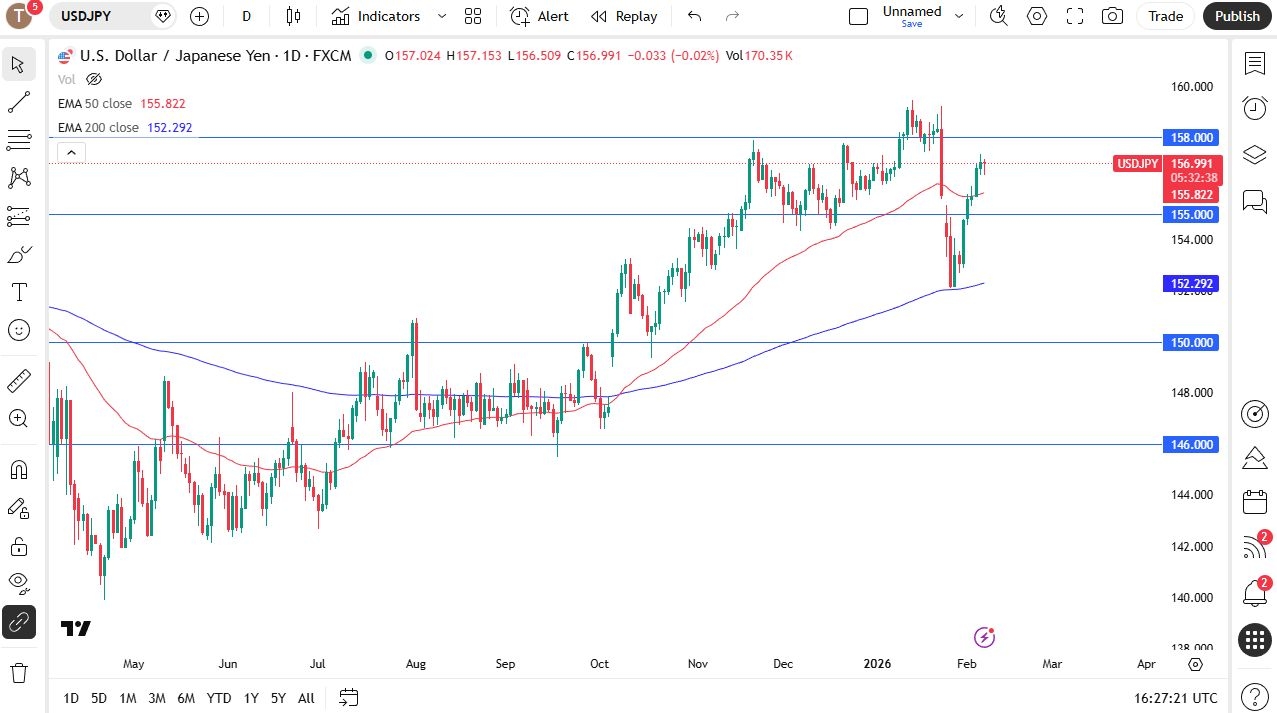
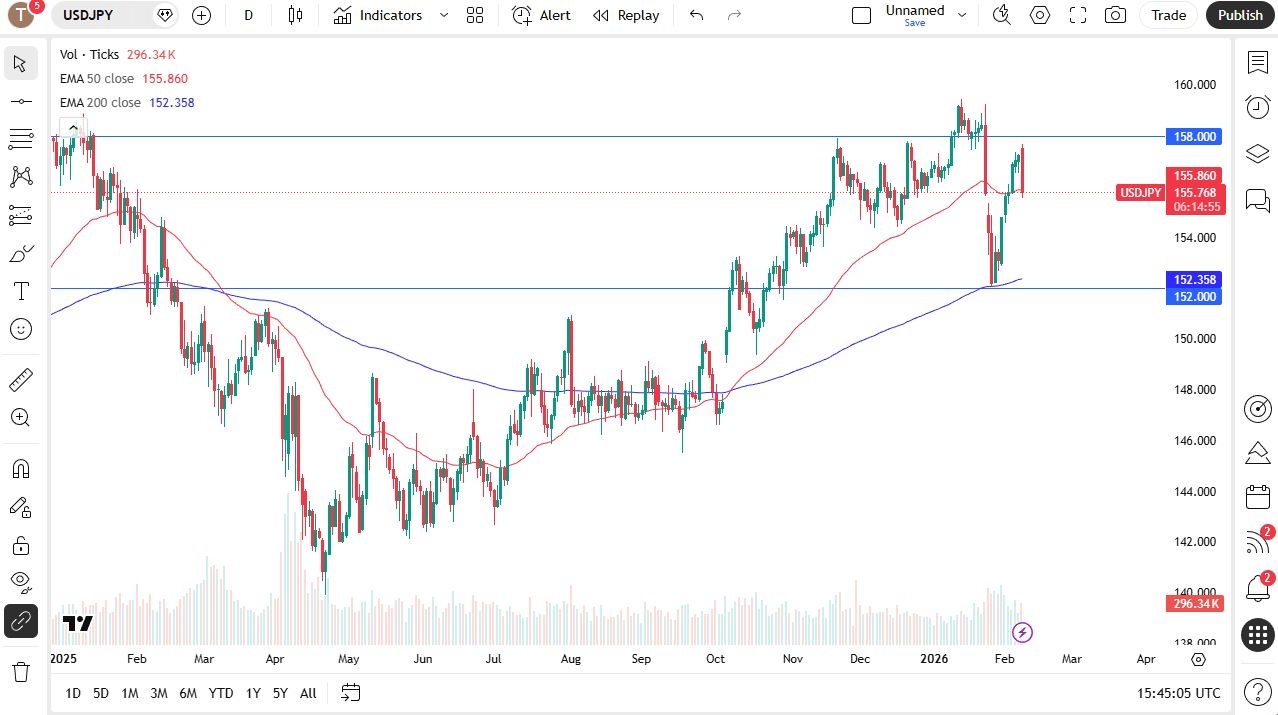
The US dollar plunged against the Japanese yen during the trading session on Monday as the 158 yen level continues to be a bit of a barrier. If we can break above the 158 yen level, then it is possible that the market could continue much higher. But I think ultimately at this point in time, we have a lot of questions asked about whether or not the Japanese yen can continue to sell off.

Quite frankly, with the election results over the weekend, I suspect that we will remain in a dovish type of situation when it comes to the Japanese yen. This pullback is probably simple profit taking and perhaps a little bit of a response to US dollar weakness on the whole. We are hanging around the 50-day EMA, which of course is a significant technical indicator that a lot of people will watch.

Support and Resistance Levels

Even if we do break down below here, it is likely that the market could go looking to the 154 yen level, maybe even the 200-day EMA. All things being equal, this is a situation where the 152 yen level is your absolute floor.

If we turn around and go to the upside, we could break above the 158 yen level, maybe go looking to the 160 yen level. I do believe that the carry trade will continue to be a major player in the forex world. While the US dollar should eventually bounce here and offer a buying opportunity, I think you also have to look at other Japanese yen denominated currency pairs such as the British pound against the Japanese yen and the Aussie dollar against the Japanese yen. I am still very bearish on the yen.

Christopher Lewis has been trading Forex and has over 20 years experience in financial markets. Chris has been a regular contributor to Daily Forex since the early days of the site. He writes about Forex for several online publications, including FX Empire, Investing.com, and his own site, aptly named The Trader Guy. Chris favours technical analysis methods to identify his trades and likes to trade equity indices and commodities as well as Forex. He favours a longer-term trading style, and his trades often last for days or weeks.

Source link

10 02, 2026

Euro to Dollar Forecast: EUR/USD Swings as Markets Reprice the Fed

By |2026-02-10T08:57:39+02:00February 10, 2026|Forex News, News|0 Comments


– Written by

The Euro to Dollar exchange rate (EUR/USD) is being driven almost entirely by Federal Reserve expectations, with investors reassessing the outlook for US rate cuts amid mixed labour-market signals, political uncertainty and growing scrutiny of the Fed’s next leadership.

After a sharp pullback from recent highs, EUR/USD has stabilised below 1.18 as markets weigh weakening US jobs data against the risk of a dollar rebound, leaving the pair highly sensitive to incoming payrolls and Fed rhetoric.

EUR/USD Forecasts: All about the Fed

MUFG forecasts that the Euro to Dollar (EUR/USD) exchange rate will strengthen to 1.25 at the end of 2026 as the dollar is subjected to further pressure.

SocGen, however, expects that any near-term gains will fade with a retreat to 1.14 by the end of this year as the dollar recovers and the Euro fades.

EUR/USD posted sharp losses to below 1.18 amid a wider dollar rebound and unwinding of long Euro positions, but stabilised later in the week.

SocGen commented on potential selling above 1.20; “Client conviction still low over a sustained move above 1.20.”

Save on Your EUR/USD Transfer

Get better rates and lower fees on your next international money transfer.
Compare TorFX with top UK banks in seconds and see how much you could save.


Compare the Best EUR/USD Rates »

A partial US shutdown delayed the latest US employment report. There was, however, an increase in jobless claims for the latest week and the JOLTS data also recorded a sharp decline in job openings to the lowest level since August 2020.

ING commented; “The Fed is becoming more relaxed about the US jobs market. Yet data this week makes that look complacent. And payroll numbers next week will be key.”

It added; “Major downward revisions to payrolls next week would add to the pressure to eventually resume rate cuts.”

Markets now see close to a 20% chance of a rate cut in March and close to a 75% chance of a move by June. Wider issues surrounding Fed policy remain crucial elements for the markets.

According to MUFG; “Further rates cuts and the predictable uncertainties associated with the Trump presidency points to further dollar depreciation this year. Trump described the dollar’s

performance as “great” in January and the Fed checking rates in USD/JPY will ensure investors continue to suspect the Trump administration wants a weaker Dollar.”

Any rhetoric from Fed Chair nominee Warsh will be watched closely.

Lloyds commented on the outlook; “How Warsh intends to reshape the Fed ought to become clearer during the Congressional confirmation hearings . The focus will be on how he could deliver rate cuts — which he must surely have promised to get the job.”

It added; “Whether Powell feels he needs to stay on as Governor, to help protect Fed independence, will be important too . It’ll become clear fairly soon whether the three rate cuts delivered at the end of last year have stabilised the labour market.”

The ECB held the deposit rate at 2.00%, in line with strong expectations. There was no formal guidance and President Lagarde played down the potential risks from a stronger Euro.

Rabobank commented; “We continue to see policy on hold through 2026.”

SocGen, however, sees scope for a looser ECB monetary policy; “We expect disinflation to dominate 2026, driven by moderating wage growth and supportive commodity dynamics, particularly in Brent and agricultural prices.”

Like this piece? Please share with your friends and colleagues:


International Money Transfer? Ask our resident FX expert a money transfer question or try John’s new, free, no-obligation personal service! ,where he helps every step of the way,
ensuring you get the best exchange rates on your currency requirements.

TAGS: Euro Dollar Forecasts

Source link

10 02, 2026

The GBPJPY tests the broken support– Forecast today – 9-2-2026

By |2026-02-10T04:57:11+02:00February 10, 2026|Forex News, News|0 Comments

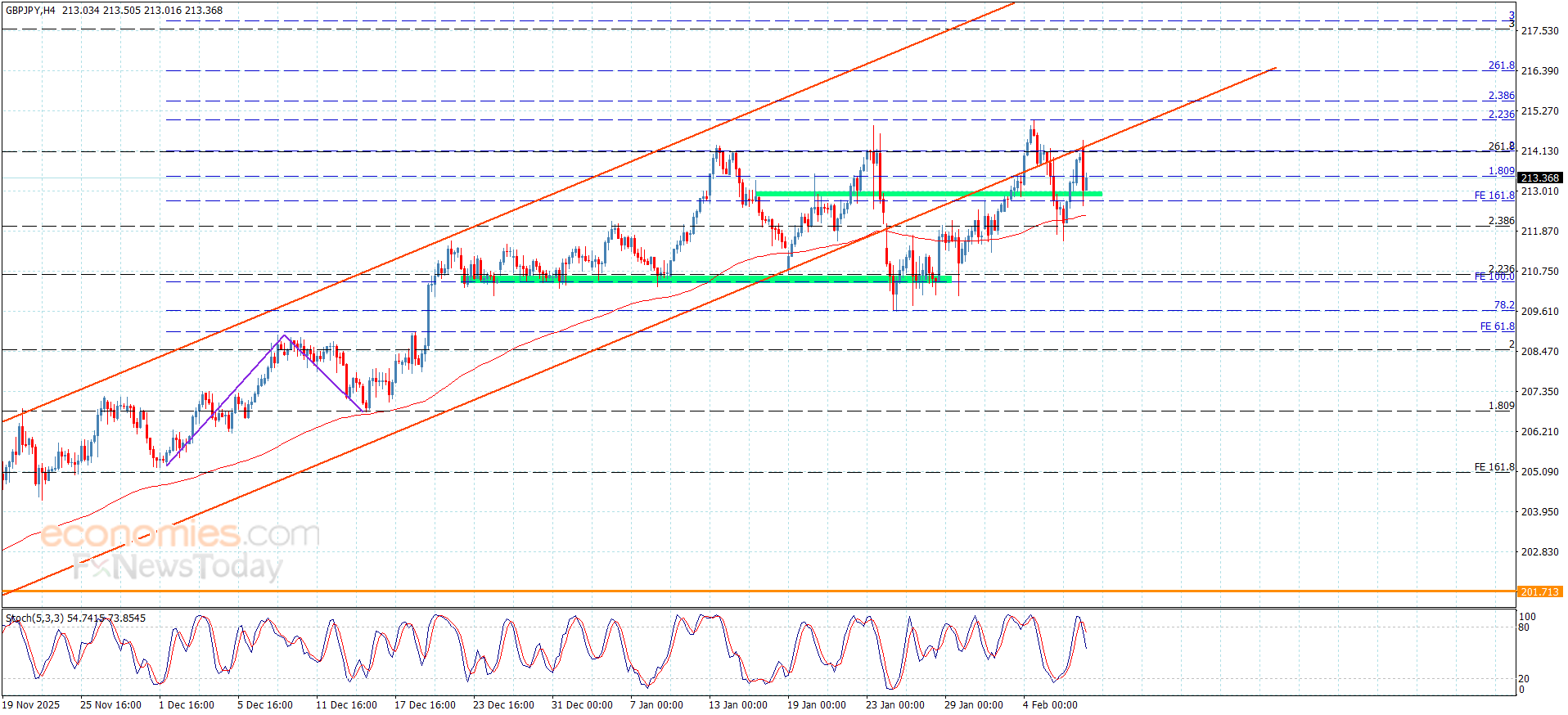
The GBPJPY pair failed to confirm breaking 212.85 level, which forces it to delay the previously suggested negative scenario, forming bullish waves to test the broken bullish channel’s support at 214.40 in this morning’s trading, forming a new bearish decline to settle near 213.40.


The contradiction between the main indicators might push the price to provide temporary trading, to keep waiting to confirm the negative scenario by reaching below 212.85, opening the way for targeting negative stations at 212.00 and 211.25, while breaching 214.40 and holding above it will confirm regaining the bullish track, providing strong chances to record new gains by its rally towards 215.50.


The expected trading range for today is between 211.25 and 213.85


Trend forecast: Sideways


Source link

10 02, 2026

GBP/USD Forecast: Pound Sterling Supported Amid Yen Strength, Jobs Doubts

By |2026-02-10T00:55:09+02:00February 10, 2026|Forex News, News|0 Comments


– Written by

The Pound to US Dollar exchange rate (GBP/USD) found modest support at the start of the week, with the pair steadying as doubts over the outlook for US employment weighed on the Dollar.

At the time of writing, GBP/USD was trading close to $1.3652, up around 0.3% from Monday’s opening levels as investors grew increasingly cautious ahead of key US labour market data.

The US Dollar struggled to find momentum as confidence in the resilience of the American jobs market continued to ebb.

A run of softer-than-expected employment indicators released last week has left markets wary ahead of January’s delayed non-farm payrolls report. Any disappointment could weigh heavily on the Greenback and further complicate expectations for Federal Reserve policy in the months ahead.

Adding to the Dollar’s woes was renewed strength in the Japanese Yen.

The Yen rallied after Japan’s ruling Liberal Democratic Party secured a decisive election victory, fuelling expectations of fresh fiscal stimulus and pushing Japanese government bond yields higher. The move encouraged capital flows away from the US Dollar, further pressuring USD exchange rates.

Sterling, meanwhile, struggled to build on its early gains as political uncertainty in the UK resurfaced.

Save on Your GBP/USD Transfer

Get better rates and lower fees on your next international money transfer.
Compare TorFX with top UK banks in seconds and see how much you could save.


Compare the Best GBP/USD Rates »

Confidence in the Pound took a knock following the resignation of Prime Minister Keir Starmer’s chief of staff, Morgan McSweeney, over the weekend. The departure has intensified scrutiny of Starmer’s leadership and unsettled investors.

The episode has also revived attention on Starmer’s decision to appoint Peter Mandelson as the UK’s ambassador to Washington, with renewed focus on Mandelson’s past links to Jeffrey Epstein adding to the unease.

For GBP investors, McSweeney’s exit has heightened concerns over instability within the government, particularly at a time when divisions inside the Labour Party appear to be becoming more visible.

GBP/USD Forecast: US Jobs Data to Drive Near-Term Direction

Looking ahead, the next major test for the Pound to US Dollar exchange rate will be Wednesday’s release of the US non-farm payrolls report.

Markets are forecasting job creation of around 70,000 in January, an improvement on December’s 50,000 gain. A result in line with expectations could offer the US Dollar some support.

However, another downside surprise would likely trigger renewed USD selling, especially given the recent run of underwhelming labour data.

With no significant UK economic releases scheduled, Sterling is likely to remain sensitive to domestic political developments. Any further pressure on Prime Minister Starmer’s leadership could leave the Pound vulnerable through the remainder of the week.

Like this piece? Please share with your friends and colleagues:


International Money Transfer? Ask our resident FX expert a money transfer question or try John’s new, free, no-obligation personal service! ,where he helps every step of the way,
ensuring you get the best exchange rates on your currency requirements.

TAGS: Pound Dollar Forecasts
Source link

9 02, 2026

US Dollar Continues to Levitat

By |2026-02-09T20:53:10+02:00February 9, 2026|Forex News, News|0 Comments

The interest rate differential continues to be a mainstay of this pair, as we are levitating into the weekend, looking bullish overall.

USD/JPY

The US dollar has been noisy against the Japanese yen during the trading session here on Friday as we are simply hanging around the 156-yen level. I think at this point in time we are probably due for a little bit of a pullback, but I do not want to buy the yen. What I want to do is buy cheaper US dollars.

The interest rate differential continues to favor the United States and that will play a major part in where we go next. Ultimately, I think this is a scenario that remains a buy-on-the-dip for some time, and I just don’t have any interest whatsoever in trying to fight the interest rate differential.

The Long-Term Problem for Japan

The 158-yen level followed by the 159-yen level, both I think are resistance and I think it’s going to be difficult to get above there. But if we can break above the dollar-yen reading of about 162, that’s the highest level since something like 1990.

So, we are on the precipice of something big. We could be talking about 100 yen before it’s all said and done. That doesn’t mean that you put all of your money in aiming for 250 yen, but I think you have to understand that this is a long-term problem for Japan, and I think it continues to be so.

Shorting the yen against a multitude of currencies might be the trade for the next several years, and this is the first place you do it, but there are other places: the Australian dollar, the New Zealand dollar, British pound, etc. I have no interest in shorting this pair. It would have to break down below the 150-yen level for me to rethink things. That doesn’t mean I chase it up here though, and that’s the point of the analysis.

Christopher Lewis has been trading Forex and has over 20 years experience in financial markets. Chris has been a regular contributor to Daily Forex since the early days of the site. He writes about Forex for several online publications, including FX Empire, Investing.com, and his own site, aptly named The Trader Guy. Chris favours technical analysis methods to identify his trades and likes to trade equity indices and commodities as well as Forex. He favours a longer-term trading style, and his trades often last for days or weeks.

Source link

9 02, 2026

Euro buyers show interest to start week

By |2026-02-09T16:51:47+02:00February 9, 2026|Forex News, News|0 Comments

After closing the previous week in negative territory, EUR/USD gains traction on Monday and trades above 1.1850. In the second half of the day, investors will pay close attention to comments from central bankers.

Euro Price Today

The table below shows the percentage change of Euro (EUR) against listed major currencies today. Euro was the strongest against the British Pound.

USD EUR GBP JPY CAD AUD NZD CHF
USD -0.33% 0.14% -0.25% -0.09% -0.26% 0.12% -0.32%
EUR 0.33% 0.47% 0.06% 0.25% 0.07% 0.45% 0.00%
GBP -0.14% -0.47% -0.40% -0.24% -0.40% -0.02% -0.46%
JPY 0.25% -0.06% 0.40% 0.16% -0.01% 0.37% -0.08%
CAD 0.09% -0.25% 0.24% -0.16% -0.17% 0.21% -0.24%
AUD 0.26% -0.07% 0.40% 0.00% 0.17% 0.38% -0.06%
NZD -0.12% -0.45% 0.02% -0.37% -0.21% -0.38% -0.45%
CHF 0.32% -0.00% 0.46% 0.08% 0.24% 0.06% 0.45%

The heat map shows percentage changes of major currencies against each other. The base currency is picked from the left column, while the quote currency is picked from the top row. For example, if you pick the Euro from the left column and move along the horizontal line to the US Dollar, the percentage change displayed in the box will represent EUR (base)/USD (quote).

The selling pressure surrounding the US Dollar (USD) seems to be helping EUR/USD edge higher at the beginning of the week. The positive shift seen in risk mood and the sharp decline in the USD/JPY pair following the verbal intervention by Japanese officials to offset the JPY weakness on the election outcome cause the USD to lose interest. At the time of press, the USD Index was down 0.3% on the day at 97.35.

Later in the day, European Central Bank (ECB) President Christine Lagarde will speak on the state of the EU economy and ECB activities in an event in France. In the American session, several policymakers from the Federal Reserve (Fed) will be delivering speeches.

The CME FedWatch Tool currently shows that markets are pricing in about a 16% probability of a 25 basis points (bps) rate cut next month. In case officials reiterate that they are willing to remain patient and watch the data before deciding on the next policy move, the USD could find a foothold and limit EUR/USD’s upside.

Nevertheless, investors could refrain from betting on a steady recoveryin the USD ahead of the critical Nonfarm Payrolls data for January, which is scheduled to be released on Friday.

EUR/USD Technical Analysis:

In the 4-hour chart, EUR/USD trades at 1.1858. The 20-period Simple Moving Average (SMA) has turned higher but remains below the 50-period SMA, which slopes gently lower. The 100- and 200-period SMAs trend upward, hinting at a firmer medium-term bias. The 14-period RSI at 61.8 rises above the midline, underscoring building bullish momentum.

Measured from the 1.1590 low to the 1.2025 high, the 38.2% retracement at 1.1860 aligns as a pivot point. If this level stays intact and EUR/USD failes to stabilize above it, the 50% retracement and the 100-period SMA in the 1.1810-1.1800 could act as the next support. On the upside, 1.1900 (static level) could be seen as an interim resistance level ahead of 1.1925 (Fibonacci 23.6% retracement).

(The technical analysis of this story was written with the help of an AI tool.)

Euro FAQs

The Euro is the currency for the 20 European Union countries that belong to the Eurozone. It is the second most heavily traded currency in the world behind the US Dollar. In 2022, it accounted for 31% of all foreign exchange transactions, with an average daily turnover of over $2.2 trillion a day.
EUR/USD is the most heavily traded currency pair in the world, accounting for an estimated 30% off all transactions, followed by EUR/JPY (4%), EUR/GBP (3%) and EUR/AUD (2%).

The European Central Bank (ECB) in Frankfurt, Germany, is the reserve bank for the Eurozone. The ECB sets interest rates and manages monetary policy.
The ECB’s primary mandate is to maintain price stability, which means either controlling inflation or stimulating growth. Its primary tool is the raising or lowering of interest rates. Relatively high interest rates – or the expectation of higher rates – will usually benefit the Euro and vice versa.
The ECB Governing Council makes monetary policy decisions at meetings held eight times a year. Decisions are made by heads of the Eurozone national banks and six permanent members, including the President of the ECB, Christine Lagarde.

Eurozone inflation data, measured by the Harmonized Index of Consumer Prices (HICP), is an important econometric for the Euro. If inflation rises more than expected, especially if above the ECB’s 2% target, it obliges the ECB to raise interest rates to bring it back under control.
Relatively high interest rates compared to its counterparts will usually benefit the Euro, as it makes the region more attractive as a place for global investors to park their money.

Data releases gauge the health of the economy and can impact on the Euro. Indicators such as GDP, Manufacturing and Services PMIs, employment, and consumer sentiment surveys can all influence the direction of the single currency.
A strong economy is good for the Euro. Not only does it attract more foreign investment but it may encourage the ECB to put up interest rates, which will directly strengthen the Euro. Otherwise, if economic data is weak, the Euro is likely to fall.
Economic data for the four largest economies in the euro area (Germany, France, Italy and Spain) are especially significant, as they account for 75% of the Eurozone’s economy.

Another significant data release for the Euro is the Trade Balance. This indicator measures the difference between what a country earns from its exports and what it spends on imports over a given period.
If a country produces highly sought after exports then its currency will gain in value purely from the extra demand created from foreign buyers seeking to purchase these goods. Therefore, a positive net Trade Balance strengthens a currency and vice versa for a negative balance.

Source link

9 02, 2026

The EURJPY remains positive– Forecast today – 9-2-2026

By |2026-02-09T12:50:39+02:00February 9, 2026|Forex News, News|0 Comments

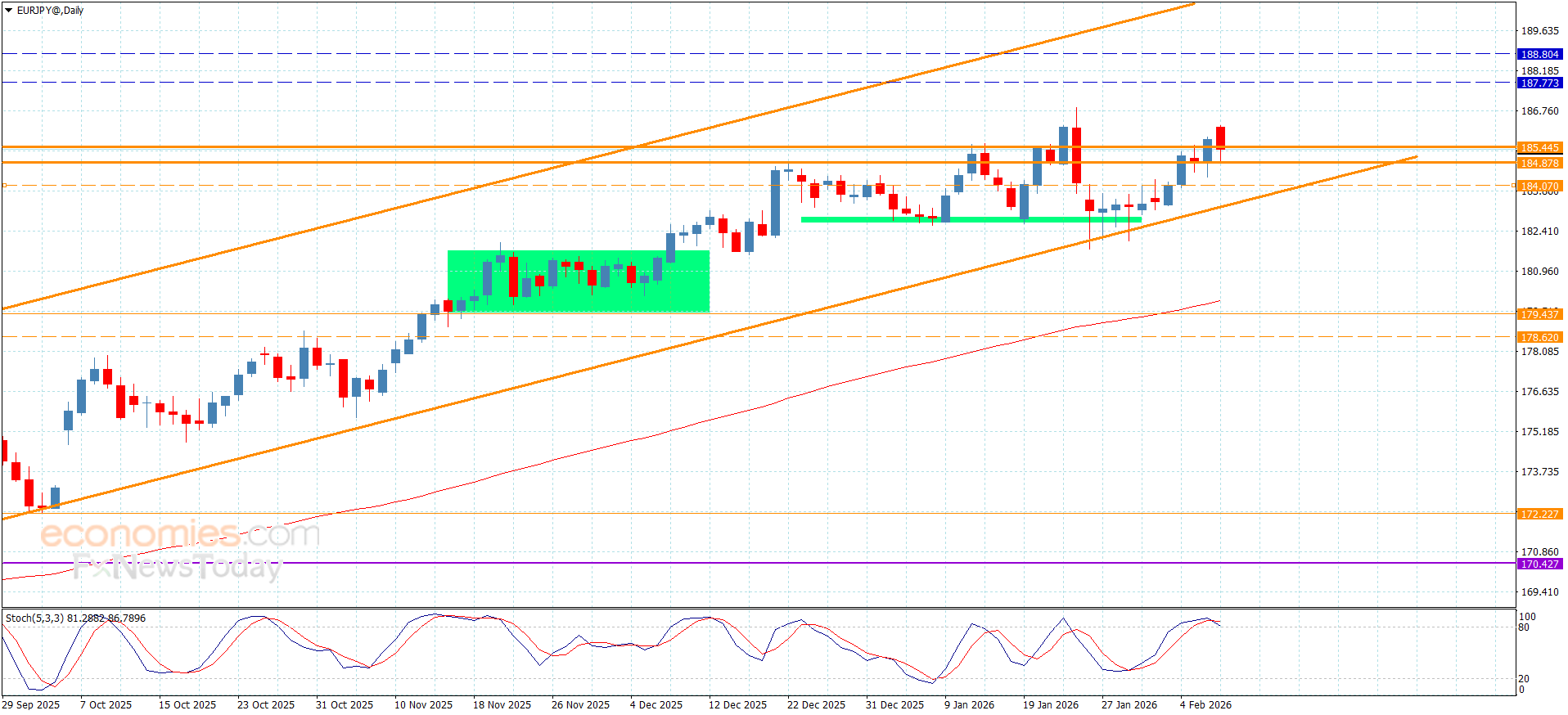
The EURJPY pair began new positivity this morning by its rally towards 186.22, but its neediness to negative momentum that pushed it to retest 184.85 level, to begin forming sideways waves as appears in the above image.


In general, we will keep preferring the bullish bias by the stability of the trading within the bullish channel’s levels and its main support settles near 183.40, therefore, we recommend waiting for gathering bullish momentum in the near period, reinforcing the chances of reaching 186.85, and surpassing it will form next main target at 187.75 in the upcoming trading.


The expected trading range for today is between 184.90 and 186.85


Trend forecast: Bullish


Source link

8 02, 2026

Japanese Yen Weekly Forecast: USD/JPY Tests 158 as Election Looms

By |2026-02-08T20:47:51+02:00February 8, 2026|Forex News, News|0 Comments

USDJPY – Daily Chart – 080226 – The Takaichi Effect

The prospect of an LDP-JIP supermajority in the Lower House supports the bullish short-term outlook for USD/JPY. However, yen intervention threats are likely to continue capping the upside below 160 as seen in January.

Meanwhile, a supermajority would remove the need for Prime Minister Takaichi to make concessions with smaller coalition parties. Over the longer term, this is likely to give the LDP greater control over legislation and ensure prudent fiscal spending, supporting a bearish medium-term outlook for USD/JPY.

Key Japanese Economic Indicators to Look Out For

While the election result will be key to near-term price trends, Japanese economic data will influence the BoJ’s policy stance. On Monday, February 9, wage growth will fuel speculation about a BoJ rate hike. Economists expect average cash earnings to rise 3% year-on-year in December, following a 0.5% increase in November.

A sharp upswing in wage growth would align with the BoJ’s outlook on wages and growing support for rate hikes.

For context, higher wages could boost households’ purchasing power, offsetting the effects of rising import prices. Increased purchasing power, coupled with improving consumer sentiment, would indicate a pickup in spending. Higher spending would fuel demand-driven inflation and bolster the economy, given that private consumption accounts for around 55% of GDP.

Crucially, these scenarios would align with the BoJ’s hawkish quarterly projections, which sent USD/JPY down 1.64% on January 23.

However, leading inflation indicators will also be key given Tokyo’s softer consumer prices in January. Economists expect producer prices to rise 2.3% year-on-year in January, down from 2.4% in December. Holding above the BoJ’s 2% target may revive bets on an H1 2026 rate hike, boosting demand for the yen. A stronger yen would send USD/JPY lower, supporting the bearish medium-term price outlook.

Follow real-time updates to stay ahead of USD/JPY market developments.

US Economic Calendar: Retail Sales, the Jobs Report, and the Fed in Focus

While Japan’s election and Japanese economic data will affect the yen, US economic indicators and Fed rhetoric will influence buying interest in the US dollar.

On Tuesday, February 10, retail sales data will reflect consumer sentiment and economic momentum. Economists forecast retail sales will rise 0.5% month-on-month in December, down from 0.6% in November.

While resilient consumer spending may ease immediate fears of a US recession, the jobs report will be key on Wednesday, February 11.

Economists expect unemployment to remain at 4.4% in January, and wage growth to slow from 3.8% YoY in December to 3.6% YoY in January. Softer wage growth would indicate a drop in consumer spending, dampening demand-driven inflation. A cooler inflation outlook would suggest a more dovish Fed rate path, reaffirming the bearish medium-term price outlook for USD/JPY.

Beyond the data, traders should closely monitor Fed chatter for clues on the timing of a rate cut.

According to the CME FedWatch Tool, the chances of a March 2026 Fed rate cut increased from 13.4% on January 30 to 23.2% on February 6. Additionally, the probability of a June cut rose from 67.3% to 75%. Shifts in the chances of March and June cuts will be key for US dollar trends.

Market View: Medium-Term Yen Strength

In my opinion, USD/JPY would likely fall toward 150 on market bets on multiple Fed rate cuts and a hawkish BoJ policy stance. Narrowing US-Japan rate differentials would affirm the bearish medium-term (4-8 weeks) outlook. A drop below 150 would reaffirm the longer-term (8-16 weeks) 145-140 range.

Counter-Trend Risks: What Could Send USD/JPY Toward 160?

Upside risks include:

  • LDP-JIP wins a landslide election and announces aggressive fiscal spending plans.
  • Upbeat US economic data and Fed rhetoric cool bets on an H1 2026 rate cut.
  • Weaker Japanese economic data temper BoJ rate hike expectations.

Despite the upside risks, yen intervention threats are likely to cap upside around 160. Given the upside risks, a breakout above 158 would pave the way toward January’s high of 159.453. A move toward 159.453 would invalidate the medium-term bearish structure.

Financial Analysis

Technical Outlook: Bearish Momentum Building

On the daily chart, USD/JPY traded above its 50-day and 200-day Exponential Moving Averages (EMAs). The EMA positions signaled a bullish bias. However, favorable yen fundamentals continue to counter technicals, supporting the negative outlook for USD/JPY.

A drop below the 50-day EMA would expose 155. If breached, the 200-day EMA would be the next key technical support level. Crucially, a sustained fall through the EMAs would indicate a bearish trend reversal, bringing the 150 support level into play. A break below 150 would enable the bears to target the 145-140 range, aligning with the longer-term price projection.

Source link

8 02, 2026

Weekly Forex Forecast – 08th to 13th February 2026 (Charts)

By |2026-02-08T16:47:11+02:00February 8, 2026|Forex News, News|0 Comments

I wrote on the 1st February that the best trades for the week would be:

  1. Long of the EUR/USD currency pair following a daily close above $1.2039. This did not set up.

A summary of last week’s most important data in the market:

  1. Preliminary UoM Inflation Expectations – fell from 4.0% to 3.5%.
  2. European Central Bank Main Refinancing Rate & Monetary Policy Statement – rates left on hold as expected.
  3. Bank of England Official Bank Rate, Votes, Monetary Policy Summary & Report – rates left on hold as expected, but there were a couple more abstentions on the vote than were expected, which was a minor dovish tilt, boosting chances of a rate cut in the near term.
  4. RBA Cash Rate, Rate Statement, and Monetary Policy Statement – the RBA hiked its interest rate by 0.25% as was expected, albeit with 73% probability, so the Australian Dollar rose following this news.
  5. US JOLTS Job Openings – this was a little worse than expected, which was slightly negative news on the US economy.
  6. Preliminary UoM Consumer Sentiment – stronger than expected, which was positive news on the US economy.
  7. US ISM Services PMI – approximately as expected.
  8. US ISM Manufacturing PMI– considerably stronger than expected, which was positive news on the US economy.
  9. New Zealand Unemployment Rate – unexpectedly ticked higher to 5.4%.
  10. Canada Unemployment Rate – unexpectedly fell from 6.8% to 6.5%.
  11. US Unemployment Claims – slightly higher than expected.

The only two elements here which really affected the markets last week was the continued bullish performance of the US economy, which keeps rate cut expectations low, and the RBA’s rate hike which kept the Australian Dollar performing as the strongest major currency.

The other two relevant issues are

  1. The continuing US military build up against Iran, although the USA and Iran began talks last Friday, with President Trump publicly saying they are going well. Prediction markets currently see a US attack on Iran before July as unlikely.
  2. An election to the more powerful Lower House of the Japanese Parliament is being held today (Sunday), and opinion polls suggest the new LDP administration will probably win a landslide. This may weaken the Japanese Yen further as the administration truly requires a weaker Yen, or it could be a case of “sell the fact”, which would present a Yen rebound recovery when results start to emerge.

The coming week’s most important data points, in order of likely importance, are:

  1. US CPI (inflation)
  2. US Average Hourly Earnings
  3. US Retail Sales
  4. US Non-Farm Employment Change
  5. Swiss CPI (inflation)
  6. UK GDP
  7. US Unemployment Rate
  8. US Unemployment Claims

Wednesday will be a public holiday in Japan.

Currency Price Changes and Interest Rates

For the month of February, I forecasted that the EUR/USD currency pair would rise in value.

Weekly Forex Forecast – 08th to 13th February 2026 (Charts)

February 2026 Monthly Forecast Performance to Date

Last week saw one cross with excessive volatility, so I made the following weekly forecast:

The Australian Dollar was the strongest major currency last week, while the Japanese Yen was the weakest. Directional volatility rose significantly last week, with one third of all major pairs and crosses changing in value by more than 1%.

Next week’s volatility is likely to be similar.

You can trade these forecasts in a real or demo Forex brokerage account.

Weekly Forex Forecast – 08th to 13th February 2026 (Charts)

Key Support and Resistance Levels

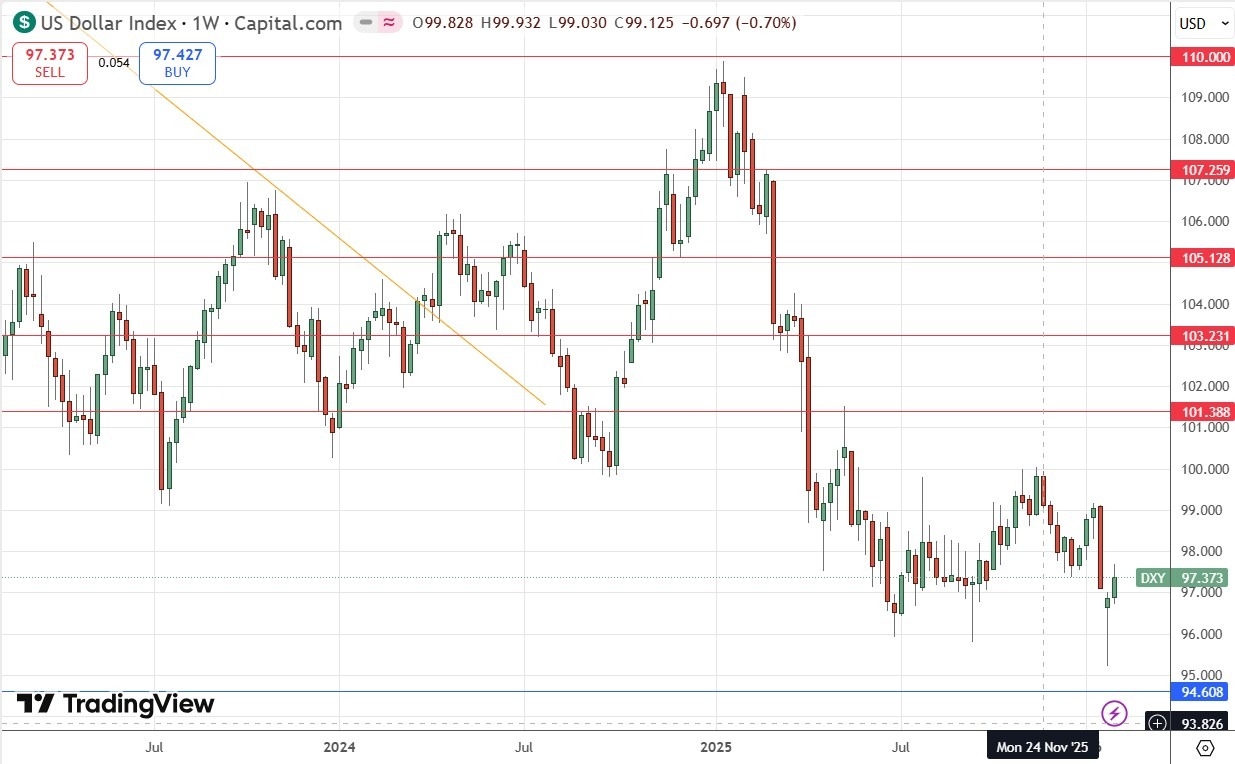
Last week, the US Dollar Index printed a bullish candlestick which closed higher but with a significant upper wick, signifying some indecision. This is weakly bullish by itself, but we also have a long-term bearish trend with the price below its levels of both 13 and 26 weeks ago. This gives us a conflicted technical picture about the US Dollar.

So, I see the outlook now as uncertain and the best market opportunities will probably not be US Dollar-dependent.

Weekly Forex Forecast – 08th to 13th February 2026 (Charts)

US Dollar Index Weekly Price Chart

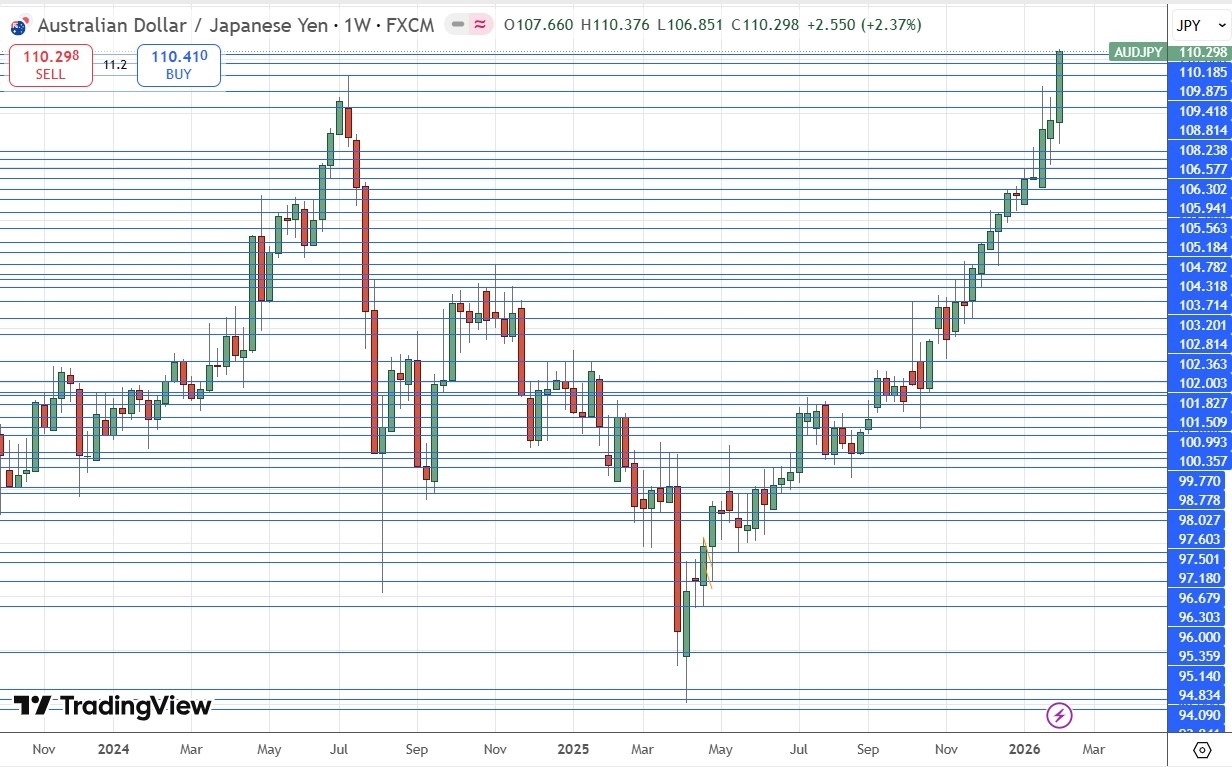
The AUD/JPY currency cross made a very strong upwards move, with the weekly close almost right at the high of the range, with unusually high volatility. The price made a bullish breakout to a new 30+ year high.

These are very bullish signs, as are the facts that the Australian Dollar was the strongest major currency last week, backed by an RBA rate hike, while the Japanese Yen continues to depreciate against most currencies as part of its long-term bearish trend, driven by the massive level of Japanese debt.

While this may look like the perfect bullish storm, an excessive weekly move like this is often followed by a retracement for at least a few days, so a drop in price over the next week would not surprise me.

This pair is likely to see the most action in the Forex market next week, at least until the US CPI data is released, so it might be interesting for swing traders on the long side or day traders on the short side.

Weekly Forex Forecast – 08th to 13th February 2026 (Charts)

AUD/JPY Weekly Price Chart

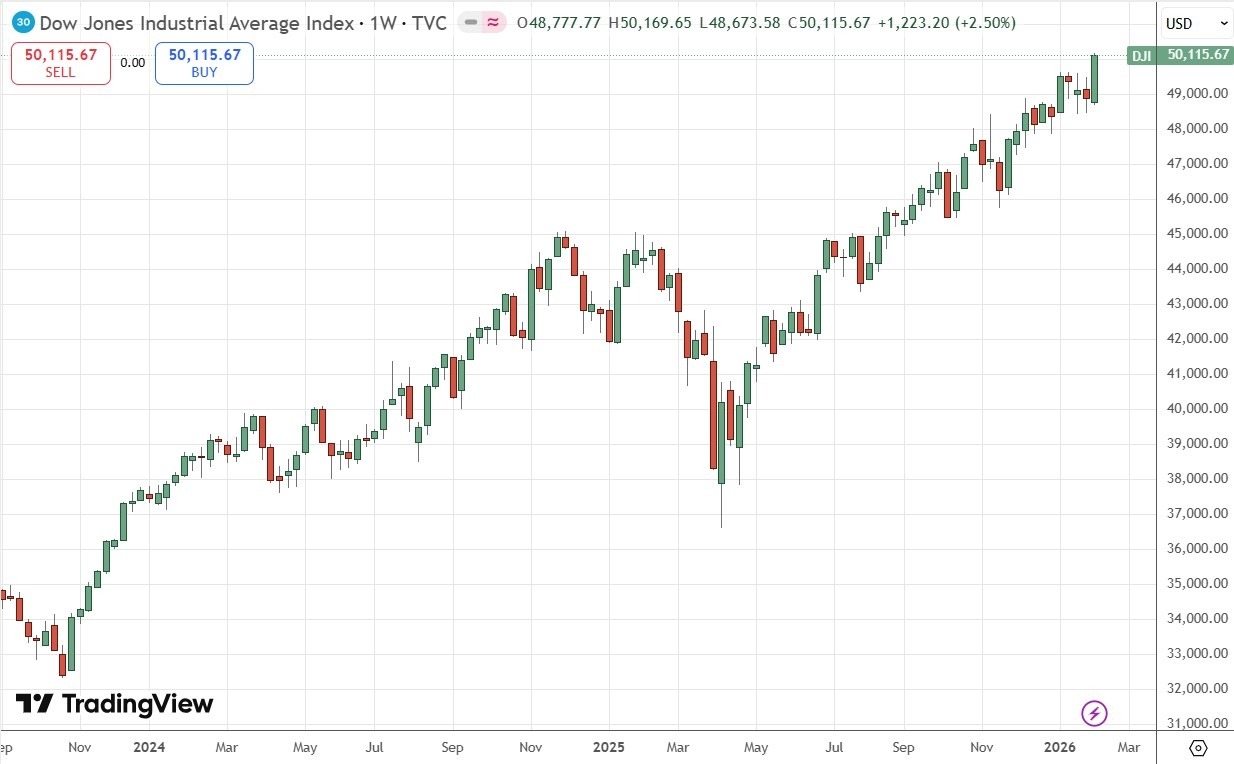
The major US equity indices like the S&P 500 Index and the tech-focused NASDAQ 100 Index are looking very choppy as they struggle to make new highs, showing swings with high volatility. This suggests an unstable market which, although bullish, may be about to reverse.

Yet, the old fashioned, old economy Dow Jones Industrial Average had a very strong week, closing right on its high at a new record, and breaking the big round number at 50,000 too. These are bullish signs, suggesting that it is the big tech firms which dominate the major indices which are causing poor price action. Away from the big tech giants, we see the basic sectors of the old economy doing well enough to make new record highs.

I am not strongly confident of this trade, but I think a long trade here with a trailing stop loss, due to the US economy’s historically strong track record, is worth taking. You might want to use a smaller than usual position size, like 50% for example.

Weekly Forex Forecast – 08th to 13th February 2026 (Charts)

Dow Jones Industrial Average Weekly Price Chart

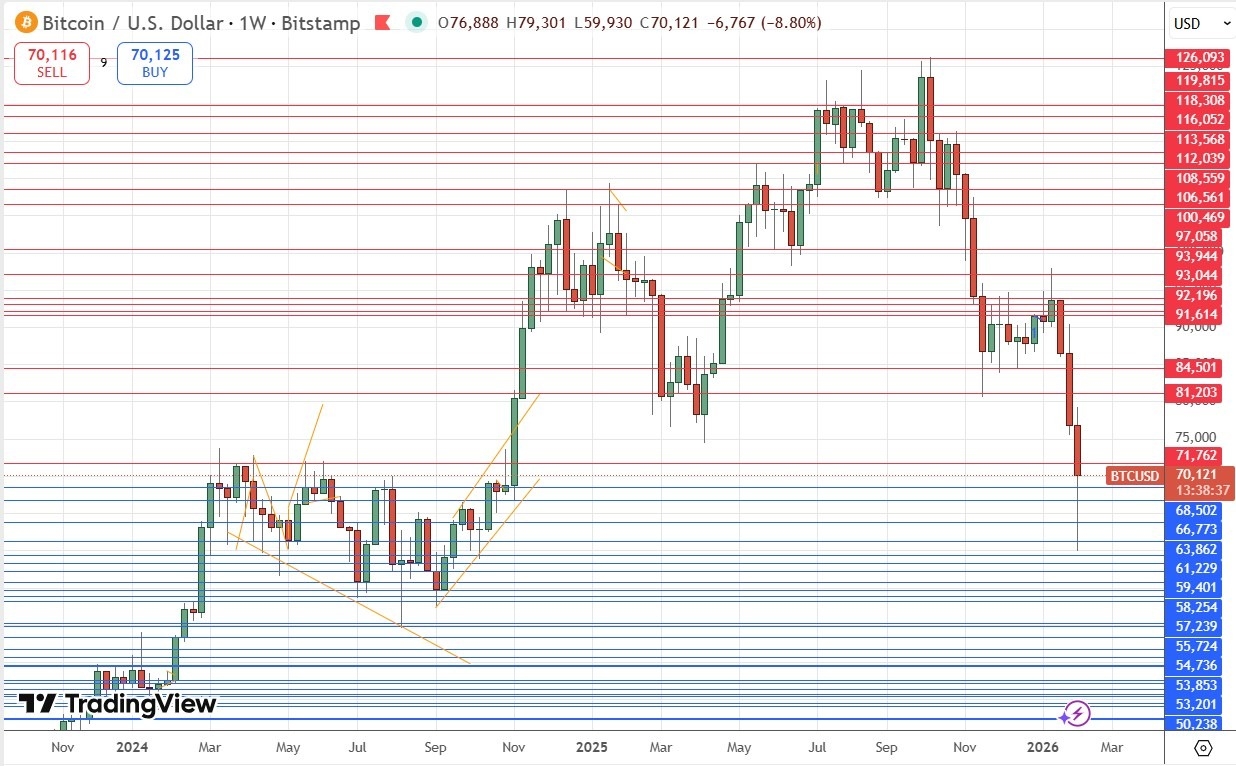
BTC/USD has continued to make significant bearish breakdowns below a few long-term support levels from just above $81,000 and has recently reached a new 16-month low. This is technically very significant in a bearish way.

While stocks and precious metals were rising strongly over recent months, Bitcoin fell from a record high a few months ago and continued to decline. It is clear the crypto sector is in decline, and that Bitcoin is in serious trouble. Bitcoin was meant to change the world, but outside of Africa, is just has not – you still can’t use it and it is unclear what value it really holds.

I do not like shorting assets, and Bitcoin now seems to be staging a recovery, with a significantly long lower wick now showing on the current weekly candlestick.

I think the price to watch is the support level at about $68,500. If the price action settles above this support, the fall will likely at least pause for a while. If the price action settles below this level, we will likely see a further drop towards the $50,000 area soon.

Weekly Forex Forecast – 08th to 13th February 2026 (Charts)

Bitcoin Weekly Price Chart

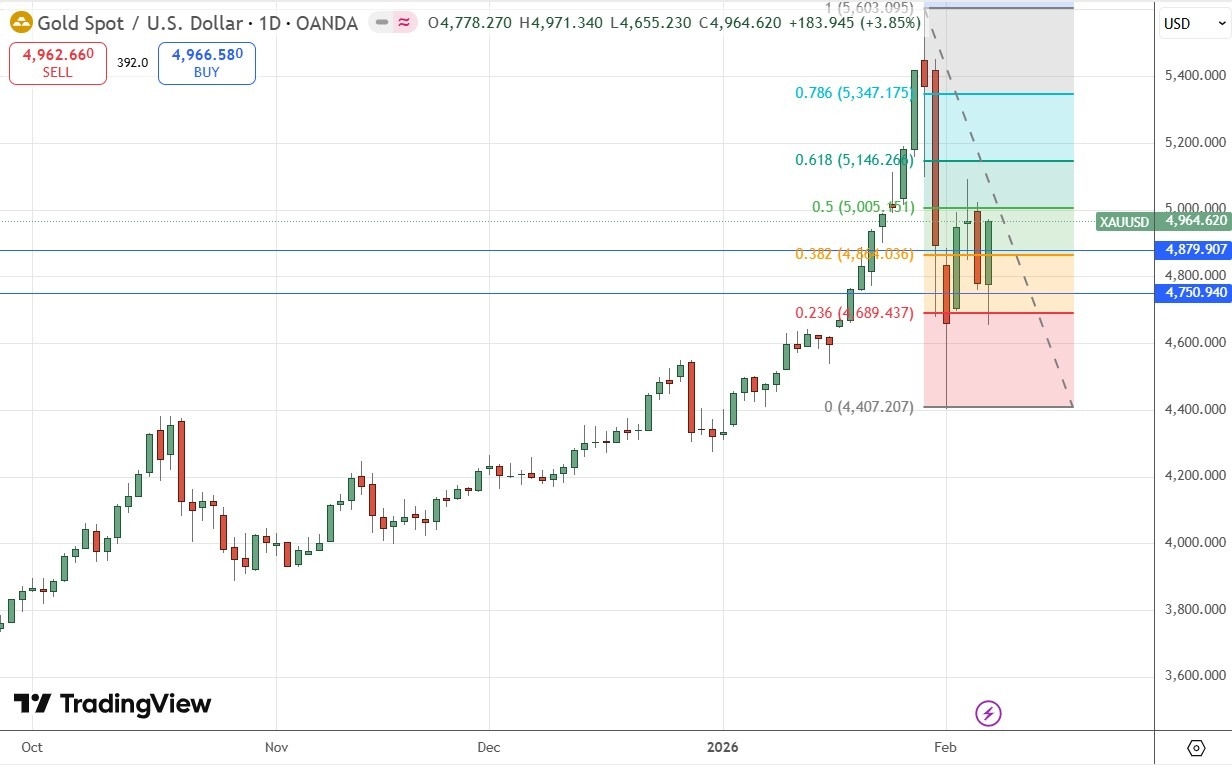
Gold, like Silver, saw a massive drop in just a day or two at the end of January. The drop is Silver was stronger, but Gold fell quickly from a record high at about $5,600 to a low at $4,400 by the end of the week, which is shown within the daily price chart below.

Applying a Fibonacci retracement study, we can see that the halfway level of this movement is very confluent with a major round number at $5,000 and this has held firmly as resistance.

The price action suggests we are going to get a consolidation now on gradually declining volatility, like a struck tuning fork playing itself out.

I think short trades from rejections of the $5,000 level as this plays out, provided they are handled skillfully as short-term trades on lower timeframes, is probably going to be the best strategy for trading Gold over the coming week.

If the price gets established above $5,000 that will be a contradictory bullish sign.

Weekly Forex Forecast – 08th to 13th February 2026 (Charts)

Gold Daily Price Chart

I see the best trades this week as:

  1. Long of the Dow Jones Industrial Average.

Ready to trade our Forex weekly forecast? Check out our list of the best Forex brokers.

Source link

Go to Top