The USD/JPY pair continues to face stiff resistance at the 20-day exponential moving average (EMA), a level that has repeatedly capped upside attempts over the past sessions, as of the latest trading data. Despite intermittent dollar bounces, the yen remains supported by growing expectations of a policy shift from the Bank of Japan, keeping the pair’s recovery momentum in check.
Why the 20-Day EMA Matters for USD/JPY
The 20-day EMA is a widely watched short-term trend indicator. In the current USD/JPY setup, it has acted as a dynamic ceiling, preventing the pair from extending any meaningful rebound. This technical barrier reflects a broader sentiment shift: traders are reluctant to push the dollar higher against the yen while the Bank of Japan signals a potential exit from its ultra-loose monetary policy.
As of this week, the pair has tested the 20-day EMA multiple times but has failed to close above it, suggesting that sellers are defending the level. A sustained break above this moving average could open the door for a move toward the next resistance zone, but until then, the bias remains tilted to the downside.
Fundamental Drivers Behind Yen Strength
The yen’s resilience is not just a technical phenomenon. Market participants are increasingly pricing in a possible policy normalization by the Bank of Japan, especially after recent comments from officials hinting at a shift away from negative interest rates. This has narrowed the yield differential between U.S. and Japanese bonds, reducing the dollar’s appeal.
Additionally, global risk sentiment has been fragile, with investors seeking safe-haven assets. The yen, despite its low yield, often benefits during periods of uncertainty. These fundamental factors align with the technical picture, creating a coherent narrative for the pair’s inability to rally.
What This Means for Traders
For traders, the 20-day EMA serves as a key level to watch. A daily close above it could signal a short-term bullish reversal, while a rejection from the level would confirm continued bearish pressure. Support levels below the current price are seen at recent swing lows, and a break below those could accelerate the decline.
The broader implications extend beyond intraday trading. If the Bank of Japan indeed tightens policy, the yen could strengthen further, potentially pushing USD/JPY to levels not seen in months. This would have ripple effects on Japanese exporters and global carry trades, making the pair a focal point for forex markets.
Conclusion
USD/JPY remains constrained by the 20-day EMA, with the technical barrier aligning with fundamental headwinds from Bank of Japan policy expectations. The pair’s direction hinges on whether buyers can overcome this resistance, but the prevailing sentiment suggests a cautious approach. As always, traders should monitor central bank communications and key economic data for further clues.
FAQs
Q1: What is the 20-day EMA and why is it important for USD/JPY? The 20-day EMA is a moving average that smooths price data over the past 20 days, giving more weight to recent prices. It is a key technical indicator used by traders to gauge short-term trends. In USD/JPY, it has recently acted as resistance, meaning the pair has struggled to rise above it, indicating bearish pressure.
Q2: How could Bank of Japan policy changes affect USD/JPY? If the Bank of Japan shifts away from its ultra-loose monetary policy, it would likely strengthen the yen as interest rate differentials narrow. This would make the dollar less attractive relative to the yen, potentially pushing USD/JPY lower.
Q3: What should traders watch for a potential breakout? Traders should watch for a daily close above the 20-day EMA, which could signal a bullish reversal. Additionally, monitoring U.S. economic data and Federal Reserve commentary, as well as any BoJ statements, will provide clues about the pair’s next move.
The Pound to Dollar exchange rate (GBP/USD) surged to a six-month high of 1.3675 as persistent concerns over US Treasury intervention and the outlook for long-term bond yields kept the Dollar under heavy pressure. Stronger-than-expected UK services data added to Sterling support, although the pair surrendered part of its advance after breaking above the May highs.
GBP/USD Forecasts: Six-Month High
The Pound to Dollar (GBP/USD) exchange rate extended its advance on Friday, reaching fresh six-month highs before giving back part of the move later in the session.
GBP/USD climbed as high as 1.3675, its strongest level since February 11, before retreating towards 1.3645.
The Dollar remained under pressure amid concerns that US Treasury efforts to suppress long-term bond yields could ultimately undermine confidence in the currency.
The Dollar index remained close to three-month lows, leaving Sterling on course for a fourth consecutive weekly gain against the US currency.
According to MUFG; “There appears to now be more avenues opening for US dollar weakness ahead rather than dollar strength.”
Save on Your GBP/USD Transfer
Get better rates and lower fees on your next international money transfer.
Compare TorFX with top UK banks in seconds and see how much you could save.
The Pound also benefited from continued expectations that the Bank of England could still raise interest rates before year-end, despite economists generally expecting policy to remain unchanged.
UoB had identified resistance just above 1.3650, with a sustained break potentially strengthening the case for a move towards the 1.3800 region.
That resistance was breached during Friday’s session, although GBP/USD was unable to maintain the move above 1.3670.
Friday’s UK business surveys provided further evidence that the economy retained momentum during the third quarter.
The S&P Global services PMI increased to 52.8 in August from 52.1 previously, reaching a six-month high and comfortably beating expectations for a slowdown.
The stronger services performance helped offset a modest easing in the manufacturing PMI to 51.5.
Business optimism in the services sector also rose to a seven-month high, while new orders improved.
The figures followed stronger-than-expected second-quarter GDP data and reinforced expectations that the UK economy could expand by around 0.3% during the third quarter.
There were less encouraging signals elsewhere.
Retail sales volumes excluding fuel fell 0.9% in July after a strong June performance, while government borrowing figures showed an unexpected budget deficit.
Nevertheless, the broader UK data flow has remained sufficiently resilient to keep expectations of another Bank of England rate increase alive.
US Treasury Policy Keeps Dollar under Pressure
The US Treasury’s decision to increase purchases of longer-dated bonds remained an important driver for currency markets.
The Treasury announced on Wednesday that it would at least double the size of buybacks of longer-dated securities in an attempt to improve liquidity and contain the surge in long-term yields.
Danske Bank commented; “The increased reliance on short-end issuance links the government’s financing costs more closely to the Fed’s monetary policy.”
The bank also suggested that renewed concern about Federal Reserve independence may have contributed to broad Dollar weakness.
ING commented; “Yesterday’s intervention in the Treasury market suggests the recent rise in longer-dated yields has touched a raw nerve.”
It added that a more activist Treasury reduced one potential risk to financial markets and was “slightly dollar negative”.
MUFG also warned that the policy could damage confidence in US assets.
The bank commented; “Even if the Treasury buy-back plan does contain yields, the US dollar now remains more vulnerable to the downside on the fact that yields are potentially lower.”
In practice, long-term Treasury yields have already started rising again despite the buyback announcement, suggesting investors remain concerned about the US fiscal outlook.
The 30-year yield had reached its highest level since 2007 earlier in the week, driven by concerns over debt sustainability, inflation and heavy issuance.
Jackson Hole Takes on Added Importance
MUFG also highlighted the implications for Federal Reserve policy.
The bank commented; “What this buyback announcement does mean is that the Jackson Hole speech next week by Fed Chair Warsh has now become more important.”
Fed Chair Kevin Warsh will face a difficult balancing act.
A strongly hawkish message could trigger another sell-off in Treasuries and undermine the Treasury’s attempts to stabilise long-term yields.
Conversely, a softer stance risks reinforcing concerns that monetary policy is becoming too accommodating or influenced by the administration’s preference for lower borrowing costs.
The minutes from July’s Federal Reserve meeting confirmed that policymakers had become more concerned about inflation, with several officials prepared to support another rate increase if price pressures failed to ease.
Capital Economics nevertheless commented; “The minutes of the Fed’s July meeting confirmed that the rate-setting committee had become more hawkish since the June meeting but, with the inflation, labour market and activity data since then all on the soft side, there is little to suggest that interest rate hikes are imminent.”
Markets currently place roughly a one-third probability on a September Fed increase.
Near-Term GBP/USD Forecast: 1.3675 Break Opens Route towards 1.38
GBP/USD’s move to 1.3675 has taken the pair beyond the May highs and strengthened the short-term technical picture.
A sustained break above the 1.3670-1.3680 area would bring 1.3700 into immediate focus, followed by the 1.3800 region highlighted by UoB.
Sterling could receive further support if resilient UK data keeps Bank of England tightening expectations alive while investors continue to scale back expectations for Federal Reserve action.
The Dollar remains vulnerable, however, for reasons that extend beyond interest-rate differentials.
Treasury intervention has revived wider concerns over the US fiscal outlook and the risk that attempts to suppress bond yields shift pressure from Treasuries onto the currency instead.
On the downside, 1.3600 should now provide initial support for GBP/USD.
A sustained retreat below this level would weaken the immediate bullish structure and bring the 1.3550 area back into focus.
For now, the combination of resilient UK economic data and persistent unease surrounding US fiscal and bond-market policy leaves Sterling with a firm underlying bias against the Dollar.
Like this piece? Please share with your friends and colleagues:
International Money Transfer? Ask our resident FX expert a money transfer question or try John’s new, free, no-obligation personal service! ,where he helps every step of the way,
ensuring you get the best exchange rates on your currency requirements.
2026.08.21 2026.08.21 USD/JPY: Elliott Wave Analysis and Forecast for 21.08.26–28.08.26
Alex Geutahttps://www.litefinance.org/blog/authors/alex-geuta/
The article covers the following subjects:
Major Takeaways
Main scenario: Once the correction has been completed, consider short positions below the level of 160.52 with a target of 151.76–148.92. A sell signal: the correction ends and the price holds below 160.52. Stop Loss: above 161.10, Take Profit: 151.76–148.92.
Alternative scenario: Breakout and consolidation above the level of 160.52 will allow the pair to continue rising to the levels of 163.90–166.50. A buy signal: the level of 160.52 is broken to the upside. Stop Loss: below 159.90, Take Profit: 163.90–166.50.
Main Scenario
Consider short positions below 160.52 with a target of 151.76–148.92 once the correction is completed.
Alternative Scenario
Breakout and consolidation above 160.52 will allow the pair to continue rising to the levels of 163.90–166.50.
Analysis
On the weekly time frame, an ascending third wave of larger degree 3 has formed, a downward correction has been completed as the fourth wave 4, and the fifth wave 5 is developing. Apparently, the first wave of smaller degree (1) of 5 has formed and a bearish correction (2) of 5 is developing on the daily chart. On the H4 time frame, wave A of (2) is developing, within which wave i of A has presumably been completed and a local correction ii of A is nearing completion. If the presumption is correct, USD/JPY will continue to decline to 151.76–148.92 after the correction ends. The level of 160.52 is critical in this scenario as a breakout above it will enable the pair to continue rising to the levels of 163.90–166.50.
This forecast is based on the Elliott Wave Theory. When developing trading strategies, it is essential to consider fundamental factors, as the market situation can change at any time.
Price chart of USDJPY in real time mode
The content of this article reflects the author’s opinion and does not necessarily reflect the official position of LiteFinance broker. The material published on this page is provided for informational purposes only and should not be considered as the provision of investment advice for the purposes of Directive 2014/65/EU.
According to copyright law, this article is considered intellectual property, which includes a prohibition on copying and distributing it without consent.
The US Dollar (USD) collapsed this week, helping EUR/USD reach a freshthree-month high just above the 1.1700 mark, heading into the weekly close a handful of pips below that level but still firmly up.
Unexpected boost to US liquidity
The USD sell-off was triggered by the United States (US) Department of the Treasury, which announced on Wednesday that it will increase the government debt repurchase size by at least double. According to the press release, the current maximum size of $2 billion per operation will be at least $4 billion per operation, and the change will become effective September 9.
The announcement, while aimed at taming long-term bond yields, was also a signal that the Treasury is sensitive to yield volatility. The Treasury made its move after the 30-year bond yield climbed to 5.327% on Tuesday, its highest level since June 2007, immediately falling afterward by roughly 9 basis points.
There are, however, a couple of things that are worth understanding. First, buybacks are just a rearrangement of the maturity schedule, as the Treasury will have to issue fresh bonds to replace those that it plans to buy back. Government debt and fiscal deficits will remain the same.
Second, the decision has an impact on the Federal Reserve’s (Fed) future monetary policy decisions. Given that the US Treasury will have to issue more bills to finance the planned removal, this would likely ease financial conditions, which would increase the odds of a tighter monetary policy.
The future looks cloudy for the USD, with precious metals likely to outpace the Greenback in a risk-averse environment. Neither Treasury buybacks nor higher rates will address the root of the problem, which is the fiscal deficit.
In any case, that means further USD weakness in a risk-averse environment. The Middle East war is in a stalemate, and neither side is willing to budge. Oil prices have already picked up a bullish pace, and it won’t take much longer until energy prices become embedded inflation.
Financial war
Meanwhile, the Middle East war adds pressure on financial markets. Tensions between the US and Iran remain in place, with neither willing to give in to the other party´s demands. Fire exchange around the Strait of Hormuz remains paused, as well as talks aimed at ending the conflict.
Market participants are clearly seeing a long-standing conflict ahead, and generally speaking, they are getting used to the idea. However, Oil prices have been picking up lately, reviving inflation-related concerns and also hinting at central banks opting for tighter monetary policies.
US President Donald Trump, however, is unwilling to give up. Trump posted on Truth Social that the next move is choking Tehran’s economy by levying major penalties against any country that provides “any type of lifeline” to Iran, calling it an “Economic D-Day.”
His comments were reinforced by US Treasury Secretary Scott Bessent, who noted on Thursday that President Trump’s plan to crush Iran’s economy will likely negate the need for major US military operations against the Islamic Republic.
Bessent also had some comments on the Treasury buyback. He declared that the Treasury could increase bond buybacks beyond $4 billion, partly to signal that current yields do not reflect underlying economic fundamentals.
ECB Lagarde worried about Europe growth
European Central Bank (ECB) President Christine Lagarde hit the wires on Wednesday and expressed concerns about Europe facing an erosion of the conditions that have historically driven the continent’s growth at the World Economic Forum’s International Business Council in Geneva, Switzerland. Growth rested on three pillars, according to Lagarde: expanding global trade, manufacturing supported by access to cheap energy, and “a stable, rules-based global order, underpinned by a US security umbrella.”
“Today, that global order is under pressure. Geopolitical tensions are bringing critical dependencies and choke points into sharper focus, while Europe faces growing security threats on its doorstep,” Lagarde added. Her speech aimed to warn about Europe’s ability to compete in the age of AI, but her comments about the US did not pass unnoticed. War, physical or financial, poses a major risk and no one can ignore it.
Macroeconomic clues
The macroeconomic calendar had little to offer in the last few days. The Federal Open Market Committee (FOMC) released the Minutes of the July meeting, which brought nothing of substance. Officials remain concerned about inflation, and support rate hikes would be required if price pressures persist. A note of color was added by Chair Kevin Warsh, as he proposed reducing annual meetings from the current eight to six, to allow collecting more data in between meetings. This year’s schedule, however, remains the same.
Other than that, the focus was on the S&P Global and local banks’ Purchasing Managers’ Indexes (PMIs) released on Friday. The August flash estimates showed that Eurozone business activity expanded more than anticipated, as the Manufacturing PMI improved to 52.8 from 51.9 in July, against expectations of 51.8. Services output remained unchanged at 51.7, beating the expected slowdown to 51.5. Finally, the Composite PMI printed at 52.1, better than the expected 51.7 and the previous 52.
US PMIs also showed encouraging results, despite the Manufacturing PMI ticking lower to 53.2 from 53.9 in July. The Services index jumped to 56.8 from 54.6, pushing the Composite PMI to 56 from 54.5 in July, surpassing the expected 54. The figures help the USD recover some modest ground, though it is still sharply down for the week.
In the upcoming days, the macroeconomic calendar will include the German Q2 Gross Domestic Product (GDP) and the US July Personal Consumption Expenditures (PCE) Price Index. The US will also publish the second estimate of its Q2 GDP.
Additionally, investors will keep an eye on this year’s Jackson Hole Economic Policy Symposium, hosted by the Fed Bank of Kansas. This year’s theme is “Financial Innovation: Implications for Payments and Policy.” Policymakers from around the globe will discuss the main topic and may provide hints on the future of monetary policy.
Finally, the US Bureau of Labor Statistics (BLS) will release the annual Nonfarm Payrolls (NFP) Benchmark Revisions on Friday, a revision of labor statistics for the twelve months to March.
EUR/USD Technical Outlook:
From a technical perspective, EUR/USD is bullish. The pair extends its advance well above the short- and medium-term moving averages, with the shorter one clearly bullish. The 20-day Simple Moving Average (SMA) at 1.1542, the 100-day SMA at 1.1573 and the 200-day SMA at 1.1631 all sit below spot, reinforcing a supportive backdrop as price pushes further into higher ground. The outlook stays constructive, with the 14-day Relative Strength Index (RSI) consolidating at 71 and the 14-period Momentum indicator also holding above its midline, hinting that buyers still dominate in the near term even as conditions look stretched.
On the weekly chart, EUR/USD holds a constructive bullish bias and trades above bullish moving averages. The 20-week SMA stands at 1.1576, while the 100-week SMA is at 1.1326 and the 200-week SMA is at 1.1059, reinforcing a broader underlying support structure. Weekly momentum is building up, as technical indicators head firmly north after crossing their midlines into positive ground.
On the downside, initial support emerges at the 200-day SMA around 1.1631, followed by the 100-day SMA and the 20-week SMA, which converge in the 1.1570 price zone, forming a strong dynamic support area. Further slides could see EUR/USD dropping towards 1.1470 before relevant buying interest reappears. Recent highs around 1.1710 establish the first resistance area ahead of the 1.1800 mark. Additional gains should lead to a test of the April monthly peak at 1.1850.
(The technical analysis of this story was written with the help of an AI tool. Know more.)
Risk sentiment FAQs
In the world of financial jargon the two widely used terms “risk-on” and “risk off” refer to the level of risk that investors are willing to stomach during the period referenced. In a “risk-on” market, investors are optimistic about the future and more willing to buy risky assets. In a “risk-off” market investors start to ‘play it safe’ because they are worried about the future, and therefore buy less risky assets that are more certain of bringing a return, even if it is relatively modest.
Typically, during periods of “risk-on”, stock markets will rise, most commodities – except Gold – will also gain in value, since they benefit from a positive growth outlook. The currencies of nations that are heavy commodity exporters strengthen because of increased demand, and Cryptocurrencies rise. In a “risk-off” market, Bonds go up – especially major government Bonds – Gold shines, and safe-haven currencies such as the Japanese Yen, Swiss Franc and US Dollar all benefit.
The Australian Dollar (AUD), the Canadian Dollar (CAD), the New Zealand Dollar (NZD) and minor FX like the Ruble (RUB) and the South African Rand (ZAR), all tend to rise in markets that are “risk-on”. This is because the economies of these currencies are heavily reliant on commodity exports for growth, and commodities tend to rise in price during risk-on periods. This is because investors foresee greater demand for raw materials in the future due to heightened economic activity.
The major currencies that tend to rise during periods of “risk-off” are the US Dollar (USD), the Japanese Yen (JPY) and the Swiss Franc (CHF). The US Dollar, because it is the world’s reserve currency, and because in times of crisis investors buy US government debt, which is seen as safe because the largest economy in the world is unlikely to default. The Yen, from increased demand for Japanese government bonds, because a high proportion are held by domestic investors who are unlikely to dump them – even in a crisis. The Swiss Franc, because strict Swiss banking laws offer investors enhanced capital protection.
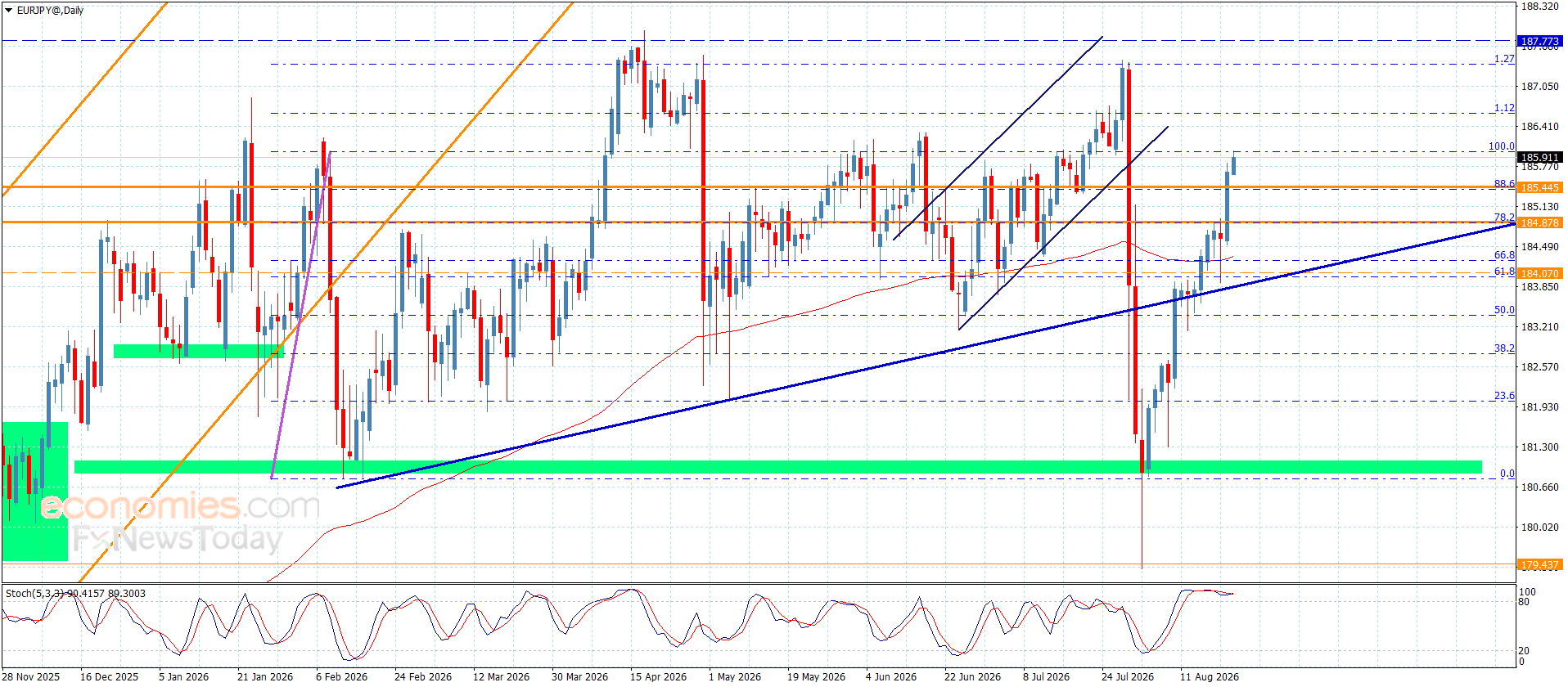
The EURJPY pair managed to confirm breaching the barrier at 184.90, reinforcing the bullish trend, to notice recording the suggested targets in the previous report by reaching 186.00 level.
The price might be forced to provide some sideways trading due to stochastic attempt to exit the overbought levels, however, it will not affect the main bullish trend that depends on the stability of the main support at 193.15, while breaching 186.00 level will provide a chance for recording extra gains that might begin at 186.55.
The expected trading range for today is between 185.20 and 186.25
Trend forecast: Fluctuated within the bullish trend
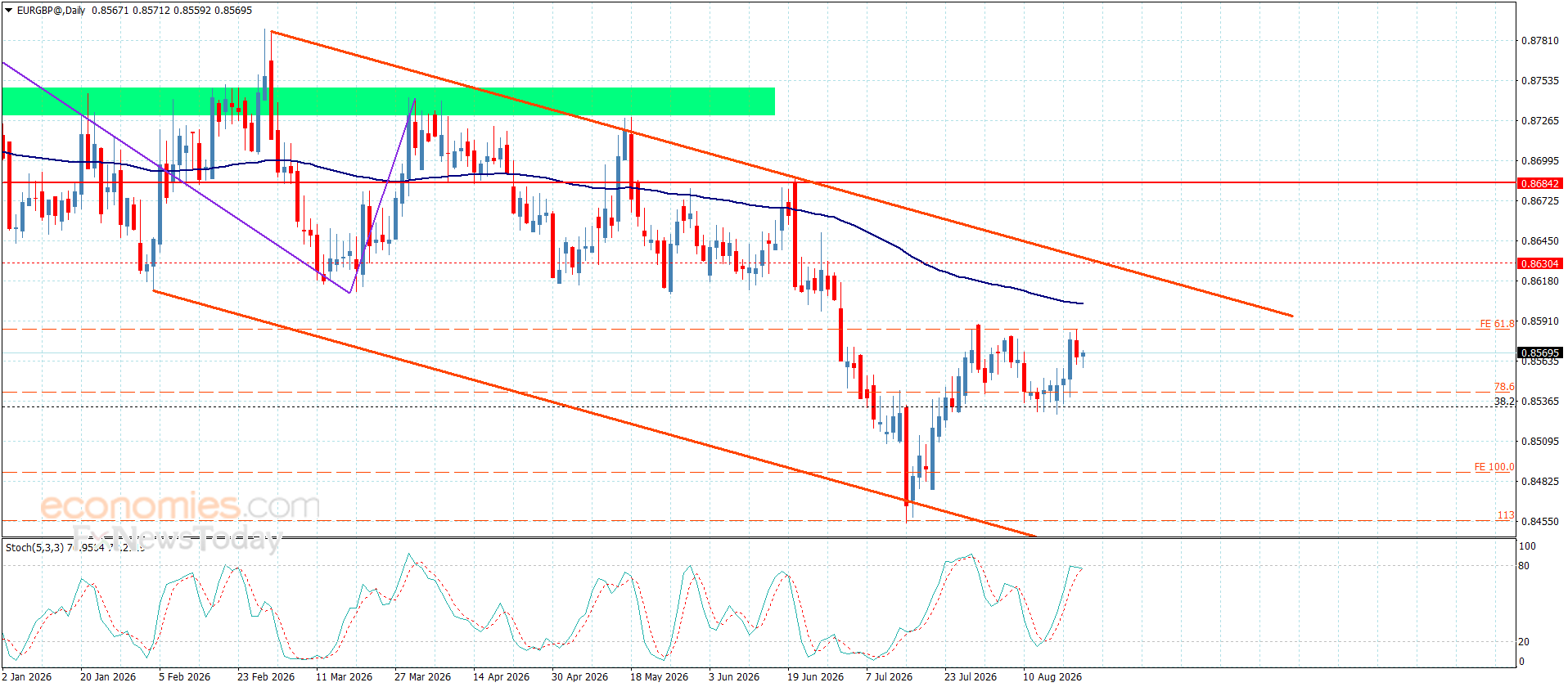
The EURGBP formed several bullish corrective waves, taking advantage of its stability above 0.8533 level, which represents a new extra support level, to notice recording some gains by reaching 0.5858 level.
Note that the stability within the main bearish channel’s levels that appears in the above image besides the strong barrier at 0.8610 level make us keep the main bearish scenario, to expect gathering the negative momentum, which allows it to put pressure at 0.8533 support, where surpassing it will extend the trading towards the negative stations at 0.8500 and 0.8480.
The expected trading range for today is between 0.8530 and 0.8580
USD/JPY rebounds as traders focus on rising Treasury yields. The yield of 2-year Treasuries climbed towards the 4.20% level, while the yield of 10-year Treasrueis settled above 4.70%. Treasury yields are moving higher despite Bessent’s efforts to push them lower as bond traders remain worried about long-term rate outlook.
If USD/JPY climbs above the 50 MA at 159.18, it will move towards the nearest resistance level at 159.50 – 160.00. A move above 160.00 will push USD/JPY towards the 162.00 level. It remains to be seen whether BoJ is ready to intervene in case USD/JPY climbs above the psychologically important 160.00 level.
If you’d like to know more about how to trade forex, please visit our educational area.
The Pound to Dollar exchange rate (GBP/USD) has surged to fresh three-month highs above 1.3630 as the US Dollar came under sustained pressure following Treasury action to calm the bond market.
A sharp initial retreat in long-term US yields undermined Dollar demand and propelled Sterling through 1.36, putting the May high around 1.3660 firmly within reach.
GBP/USD Forecasts: Three-Month Highs
The Dollar came under sustained pressure after the US Treasury moved to calm the bond market, allowing the Pound to Dollar (GBP/USD) exchange rate to surge to fresh three-month highs above 1.3630.
GBP/USD traded around 1.3632 on Thursday afternoon, extending Wednesday’s sharp advance and moving closer to the May highs around 1.3660.
Scotiabank commented; “Underlying trend signals remain constructive and keep the focus on a retest of the mid-1.36s.”
There was no significant Sterling reaction to the latest UK inflation data, with global bond-market developments continuing to dominate currency moves.
Save on Your GBP/USD Transfer
Get better rates and lower fees on your next international money transfer.
Compare TorFX with top UK banks in seconds and see how much you could save.
The Dollar suffered a sharp setback after the US Treasury announced that it would double the size of liquidity buyback operations for longer-dated government securities.
Buybacks for 10- to 30-year Treasury debt will increase from $2bn to at least $4bn per operation, in a move aimed at improving market liquidity after the surge in long-term borrowing costs.
The announcement triggered a sharp drop in yields, with the 10-year Treasury yield falling below 4.65% on Wednesday.
Lower US yields undermined Dollar demand and encouraged a broad recovery across major currencies.
CIBC head of G10 FX strategy Jeremy Stretch commented; “What we’ve seen in the course of recent days is that the long end of the bond market has obviously been selling off and potentially becoming somewhat problematic for the play through to other asset classes.”
He added; “Clearly, the Treasury Secretary has to be mindful of those risks and has made adjustments.”
Rene Albrecht, senior analyst at DZ Bank, also highlighted the political and economic implications of elevated borrowing costs; “I think they fear the pain of 5% or higher yields on the long-end, not only because it raises the interest rate costs for the government but also for the private sector.”
US economic data will remain important as markets assess underlying inflation pressures and the outlook for both bond yields and Federal Reserve policy.
ING commented; “Another batch of CPI and jobs data, plus the end-of-month Jackson Hole symposium, will have a bigger say in whether the Federal Reserve hikes in September.”
The bank’s base case remains that the Fed will leave rates unchanged and that the Dollar will weaken modestly.
The minutes from the Federal Reserve’s July meeting showed that policymakers had become increasingly concerned about inflation.
Several officials indicated that they would be prepared to support another rate increase if inflation failed to moderate, reinforcing the view that a September move has not been completely ruled out.
Markets nevertheless continue to see a hold as the more likely outcome, particularly after softer US inflation, retail sales and employment data during recent weeks.
The headline UK inflation rate increased to 2.9% in July from 2.6%, in line with consensus forecasts, while the core rate held at 2.6%.
Markets continue to price at least some risk of another Bank of England rate increase this year, although many investment banks remain unconvinced that further tightening will ultimately be required.
HSBC UK economist Elizabeth Martins commented; “A big rebound in energy prices would certainly change things. But the real game changer for the MPC, I think, is around second-round effects.”
GBP/USD has now cleared the 1.3600 resistance area and reached fresh three-month highs above 1.3630.
Scotiabank’s mid-1.36s objective is therefore coming into focus, with the May high around 1.3660 representing the next important technical barrier.
A sustained break above 1.3660 would strengthen the bullish short-term trend and expose 1.3700, followed by the January trading range above that level.
Initial support is now located around 1.3600, with a deeper correction potentially bringing 1.3550 back into focus.
The US Dollar outlook remains highly sensitive to the US bond market.
Wednesday’s Treasury intervention produced a substantial initial decline in long-term yields, but that relief has already begun to fade, with Treasury yields moving higher again on Thursday as investors questioned whether larger buybacks can address the underlying fiscal and inflation concerns.
Further increases in long-term yields could therefore restore some Dollar support.
On the other hand, renewed declines in US yields, combined with softer economic data and fading expectations of a September Fed hike, would leave GBP/USD well placed for another test of the 1.3660 area.
Like this piece? Please share with your friends and colleagues:
International Money Transfer? Ask our resident FX expert a money transfer question or try John’s new, free, no-obligation personal service! ,where he helps every step of the way,
ensuring you get the best exchange rates on your currency requirements.