The main tag of Forex News Today Articles.
You can use the search box below to find what you need.
[wd_asp id=1]

23 01, 2025

USD/JPY Forecast: Dollar Stalls as Traders Eye Key Central Banks

By |2025-01-23T15:48:27+02:00January 23, 2025|Forex News, News|0 Comments

  • The dollar recovered on Wednesday after Trump’s tariff policy plans became clearer.
  • Traders look forward to central bank meetings in the US and Japan.
  • Traders are pricing a 96% chance of a BoJ rate hike on Friday.

The USD/JPY forecast shows a pause in the dollar’s recent climb as market participants await key central bank decisions. Traders paused ahead of Friday’s Bank of Japan meeting, where the central bank might hike rates by 25-bps.

-Are you interested in learning about forex tips? Click here for details-

The dollar recovered on Wednesday after Trump’s tariff policy plans became clearer. Although not immediate, the US president plans to impose a 25% tariff on imports from Mexico and Canada. At the same time, the government has united at a 10% tariff on goods from China. All this might happen by next month. However, experts believe the government might reveal concrete tariff plans in April. 

Meanwhile, traders look forward to central bank meetings in the US and Japan. The Federal Reserve will meet next week, and economists expect a pause. Therefore, market participants will focus on the messaging for future policy moves. A hawkish outlook will boost the dollar. Meanwhile, a dovish one might lead to a pullback.

On the other hand, the Bank of Japan will meet on Friday, with traders pricing a 96% chance of a rate hike. Moreover, policymakers might signal more rate hikes to balance the impact of Trump’s policies on the global economy. At the same time, if the Fed remains hawkish, the dollar might pressure the yen lower. Therefore, the BoJ will have enough motivation to keep hiking rates.

USD/JPY key events today

  • US unemployment claims
  • President Trump speaks

USD/JPY technical forecast: Bulls take charge after RSI divergence
USD/JPY Forecast: Dollar Stalls as Traders Eye Key Central Banks
USD/JPY 4-hour chart

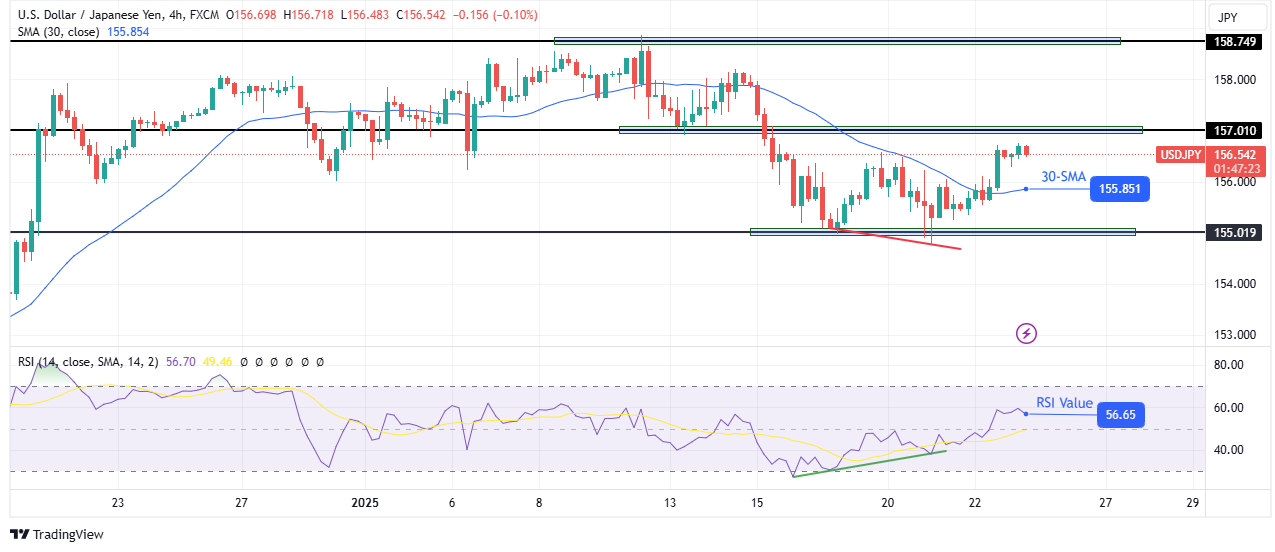
On the technical side, the USD/JPY price has broken above the 30-SMA resistance to indicate a bullish sentiment shift. This move came after the RSI made a bullish divergence, showing weak bearish momentum. 

-Are you interested in learning about the forex basics? Click here for details-

The previous downtrend paused at the 155.01 support level, where bulls emerged. Although bears made another attempt to break below this level, the price made a large wick, showing a strong rejection. This allowed bulls to breach the 30-SMA resistance. 

Currently, the price is eyeing the 157.01 resistance level. If it holds firm, USD/JPY will likely retest the 30-SMA as support before continuing higher. Meanwhile, if bulls are strong, they will break past the resistance to target the 158.74 key level.

Looking to trade forex now? Invest at eToro!

68% of retail investor accounts lose money when trading CFDs with this provider. You should consider whether you can afford to take the high risk of losing your money.

Source link

23 01, 2025

USD/TRY Forecast Today – 23/01: Euro Rallies in Thin Liquid

By |2025-01-23T13:47:06+02:00January 23, 2025|Forex News, News|0 Comments

Signals for the Lira Against the US Dollar Today

Bullish Entry Points:

  • Open a buy order at 35.49.
  • Set a stop-loss order below 35.30.
  • Move the stop-loss to the entry point and follow the profit with a price movement of 50 pips.
  • Close half the contracts at a profit of 70 pips and leave the rest until the strong resistance levels at 35.75.

Bearish Entry Points:

  • Place a sell order for 35.75.
  • Set a stop-loss order at or above 35.80.
  • Move the stop loss to the entry point and follow the profit with a price movement of 50 pips.
  • Close half the contracts at a profit of 70 pips and leave the rest until the support levels at 35.59.

This chart produced by the TradingView platform.

Turkish lira Analysis:

The Turkish Lira pair against the dollar stabilized in trading near its all-time low in early trading on Thursday morning. The pair’s trading stabilized amid anticipation of the Turkish Central Bank’s decision on interest rates, which is scheduled to be announced later today. Concurrently, Most estimates indicate that the interest rate will be held steady after the bank cut the interest rate by 250 basis points in the December meeting.

Previously, the Turkish Central Bank had announced new steps within the framework of its strategy to reduce the “protected deposit accounts against foreign exchange fluctuations” program, as part of the gradual shift towards more traditional economic policies. As of January 20, 2025, opening and renewing protected accounts with maturities of six and 12 months will be stopped, according to a statement by the central bank. The statement also explained that this step aims to reduce the protected deposit program, which was launched in December 2021 to support the stability of the Turkish lira and reduce dollarization. The program, which guaranteed depositors protection against exchange rate fluctuations, was criticized for its high cost and negative impact on the budget. With the government announcing a gradual reduction of the program in the summer of 2023, protected accounts have seen a continuous decline for more than 70 weeks.

Despite the decline in protected accounts, the share of the Turkish lira in total deposits increased to 58.7% at the beginning of this month, in a partial success for the central bank’s strategy to enhance the role of the local currency.

Meanwhile, investors followed the statements of Raghuram Rajan, former chief economist at the International Monetary Fund, during an interview at the Davos Summit on global economic trends and Turkey’s potential. Rajan expressed cautious optimism about the Turkish economy, noting that investments in the Middle East could open great opportunities for Turkey.

TRYUSD technical Analysis and Expectations Today:

Technically, the dollar/lira pair (USD/TRY) stabilized near an all-time high of 35.64 lira on Thursday morning. The pair continued to trade within the upward price channel, while the pair faces resistance in the form of an upward trend line shown by the chart. Furthermore, the pair is expected to continue rising as it receives support by moving above the 50 and 200-day moving averages, as well as by trading the 50-day moving average on the 4-hour timeframe, which represents a strong support level. The Turkish lira price forecast indicates that the pair will continue to rise, targeting levels of 35.70 and 35.75, respectively.

Ready to trade our daily Forex forecast? Here’s a list of some of the top forex brokers in Turkey to check out.

Source link

23 01, 2025

The GBPJPY touches the first target – Forecast today – 23-1-2025

By |2025-01-23T11:46:34+02:00January 23, 2025|Forex News, News|0 Comments

Platinum price failed to activate the bullish attack yesterday, affected by the MA55 that keeps forming additional barrier by settling near 955.00$, to notice forming some negative trades by fluctuating near 945.00$.


We expect to witness instability due to the continuous contradiction between the major indicators until achieving the required breach to manage to record new gains by rallying towards 983.00$ and 1005.00$ levels, noting that it is important to hold above 920.00$ support line to avoid any losses that might appear due to changing the bullish track.


The expected trading range for today is between 935.00$ and 955.00$


Trend forecast: Sideways


Source link

23 01, 2025

The cross keeps bullish vibe above 163.00 ahead of BoJ rate decision: Analytics and Market news from 23 January 2025 06:11

By |2025-01-23T09:45:23+02:00January 23, 2025|Forex News, News|0 Comments

  • EUR/JPY extends upside to around 163.05 in Thursday’s early European session. 
  • The positive outlook of the cross prevails above the 100-period EMA with a bullish RSI indicator. 
  • The immediate resistance level emerges at 163.55; the first downside target to watch is 162.32.

The EUR/JPY cross extends the rally to near 163.05 during the early European trading hours on Thursday. The uptick of the cross is bolstered by the risk-on mood in the financial markets. Investors will closely monitor the Bank of Japan (BoJ) interest rate decision on Friday for fresh catalysts. 

Traders have priced in a nearly 90% possibility that the Japanese central bank will raise interest rates from 0.25% to 0.50% at the end of the January 23-24 meeting, which would be the highest since the 2008 global financial crisis.

Technically, EUR/JPY keeps the bullish vibe on the 4-hour chart as the cross is well-supported above the key 100-period Exponential Moving Average (EMA). The upward momentum is supported by the Relative Strength Index (RSI), which stands above the midline near 58.05, indicating that the further upside looks favorable. 

The first upside barrier for EUR/JPY emerges near 163.55, the upper boundary of the Bollinger Band. The next potential resistance level is seen at the 164.00 psychological level. Further north, the next hurdle to watch is 164.55, the high of January 5.

On the flip side, the initial support level for the cross is located at 162.32, the high of January 20. Any follow-through selling below the mentioned level could see a drop to 161.87, the 100-period EMA. The next contention level is seen at 160.96, the low of January 21.  

EUR/JPY 4-hour chart

Euro FAQs

The Euro is the currency for the 19 European Union countries that belong to the Eurozone. It is the second most heavily traded currency in the world behind the US Dollar. In 2022, it accounted for 31% of all foreign exchange transactions, with an average daily turnover of over $2.2 trillion a day. EUR/USD is the most heavily traded currency pair in the world, accounting for an estimated 30% off all transactions, followed by EUR/JPY (4%), EUR/GBP (3%) and EUR/AUD (2%).

The European Central Bank (ECB) in Frankfurt, Germany, is the reserve bank for the Eurozone. The ECB sets interest rates and manages monetary policy. The ECB’s primary mandate is to maintain price stability, which means either controlling inflation or stimulating growth. Its primary tool is the raising or lowering of interest rates. Relatively high interest rates – or the expectation of higher rates – will usually benefit the Euro and vice versa. The ECB Governing Council makes monetary policy decisions at meetings held eight times a year. Decisions are made by heads of the Eurozone national banks and six permanent members, including the President of the ECB, Christine Lagarde.

Eurozone inflation data, measured by the Harmonized Index of Consumer Prices (HICP), is an important econometric for the Euro. If inflation rises more than expected, especially if above the ECB’s 2% target, it obliges the ECB to raise interest rates to bring it back under control. Relatively high interest rates compared to its counterparts will usually benefit the Euro, as it makes the region more attractive as a place for global investors to park their money.

Data releases gauge the health of the economy and can impact on the Euro. Indicators such as GDP, Manufacturing and Services PMIs, employment, and consumer sentiment surveys can all influence the direction of the single currency. A strong economy is good for the Euro. Not only does it attract more foreign investment but it may encourage the ECB to put up interest rates, which will directly strengthen the Euro. Otherwise, if economic data is weak, the Euro is likely to fall. Economic data for the four largest economies in the euro area (Germany, France, Italy and Spain) are especially significant, as they account for 75% of the Eurozone’s economy.

Another significant data release for the Euro is the Trade Balance. This indicator measures the difference between what a country earns from its exports and what it spends on imports over a given period. If a country produces highly sought after exports then its currency will gain in value purely from the extra demand created from foreign buyers seeking to purchase these goods. Therefore, a positive net Trade Balance strengthens a currency and vice versa for a negative balance.


Source link

23 01, 2025

The GBPUSD price begins to decline – Forecast today

By |2025-01-23T07:44:07+02:00January 23, 2025|Forex News, News|0 Comments

The GBPUSD price’s rise stopped at the minor bullish channel’s resistance line that appears on the chart, to rebound bearishly and head towards achieving expected decline in the upcoming sessions, targeting testing the mentioned channel’s support line around 1.2210$, noting that this channel forms potential bearish flag pattern that might push the price to resume the main bearish track within the main bearish channel that appears on the image.


Therefore, we expect to witness negative trades today, taking into consideration that the consolidation of 1.2300$ level against the negative attempts will lead the price to recover again and head to test 1.2440$ areas mainly.


The expected trading range for today is between 1.2230$ support and 1.2380$ resistance


Trend forecast: Bearish


Source link

23 01, 2025

The Yen Holds Ground as the BOJ Decision Approaches

By |2025-01-23T01:41:37+02:00January 23, 2025|Forex News, News|0 Comments

The USD/JPY has lost more than 1.5% of its value over the last six trading sessions, allowing the Japanese yen to regain ground against the prolonged bullish trend favoring the US dollar. This short-term bearish correction is driven by expectations that the Bank of Japan will raise interest rates in its upcoming decision this week.

Central Banks

In order to understand the behavior of the USD/JPY since mid-September 2024, it is important to evaluate the interest rate outlook in both the United States and Japan.

On one hand, the Federal Reserve (Fed) faces new economic uncertainties with the change in administration in the United States. The arrival of Donald Trump has introduced tariff proposals and tax cuts that could increase long-term inflation by strengthening domestic consumption. This scenario could pose a new challenge for the Fed, extending the pause in the current interest rate of 4.5%.

According to the CME Group, there is a 99.5% probability that the interest rate will remain at its current level (4.25% – 4.5%) for the January 29 decision. Following this trajectory, for the next decision on March 19, the probability of keeping rates unchanged has risen to 73.6% in recent days. This reflects a more aggressive stance by the central bank for the first quarter of 2025, primarily due to uncertainty surrounding inflation. It is important to note that these probabilities may change depending on economic conditions.

Interest Rate Probability Chart January – CME Group

 FEDPROBRATEJANUARY

Source: CMEGroup


Interest Rate Probability Chart March – CME Group

FEDPROBRATEMARCH

Source: CMEGroup

The neutral stance in the United States, reinforced by the probabilities mentioned, has fueled a wave of buying in the USD/JPY in recent weeks. This, combined with the lack of clarity in the Bank of Japan’s monetary policies, has consistently weakened the Japanese yen and sustained the bullish trend in USD/JPY.

On the other hand, on January 23, the Bank of Japan’s next official decision is expected to be announced. The latest inflation data published in Japan stands at 2.9% (November), above the 2% target. This has led the market to anticipate an interest rate hike from 0.25% to 0.5%, which has slightly strengthened the yen in the short term (due to higher expected returns on Japanese assets), driving the current bearish correction in USD/JPY.

BOJRateDesicion

Source: Data – FXSTREET

The critical factor moving forward will be to determine whether this new hawkish stance by the Bank of Japan will persist, something that could be confirmed by the comments following the rate decision. If the market is already accustomed to high rates in the United States but anticipates greater aggressiveness in Japan, the current bearish pressure could evolve into a more significant movement.


USD/JPY Technical Forecast

 USDJPY_2025-01-22_11-02-30

Source: StoneX, Tradingview


  • Bullish Trend: Currently, the pair maintains the bullish trend established since September 2024. So far, there have been no bearish corrections strong enough to break the trendline support. However, the latest correction in favor of the yen has brought the price very close to this line. If bearish pressure persists, it could jeopardize the long-standing bullish formation.


  • 157.927: The nearest resistance, corresponding to the most recent high. Oscillations above this level could strengthen bullish momentum and extend the upward trend.


  • 155.229: Key support where the trendline and the lower band of the Bollinger Bands converge. Oscillations below this level could cast doubt on the bullish trend and pave the way for increased bearish pressure.


  • 152.796: Final support, corresponding to a neutral zone from October 2024. Oscillations near this level would definitively break the current bullish formation.


Written by Julian Pineda, CFA – Market Analyst


Source link

22 01, 2025

GBP/USD Forecast: Pound to Dollar Rate Holds Near $1.23

By |2025-01-22T23:39:13+02:00January 22, 2025|Forex News, News|0 Comments

January 22, 2025 – Written by Tim Boyer

The Pound US Dollar exchange rate was mostly quiet on Wednesday amid an absence of both UK and US economic data releases.

At the time of writing, GBP/USD was trading at approximately $1.2354, virtually unchanged from the start of Thursday’s session.

On Wednesday, the Pound (GBP) experienced minimal fluctuation against most other currencies, as the lack of major economic data left the British currency directionless.

Nevertheless, Sterling managed to regain much of the ground it lost on Tuesday, after the country’s latest unemployment rate unexpectedly rose.

With no significant economic indicators or clear market sentiment to drive the currency, GBP exchange rates remained trapped in a narrow range throughout the day.

US Dollar (USD) Drifts Lower on Trump’s Third Day in Office

On Wednesday, the US Dollar (USD) failed to capture investor interest and declined against several of its major counterparts as newly inaugurated President Donald Trump entered his third day in office.

Advertisement


On Tuesday, USD exchange rates saw significant volatility, with a sharp rise in the morning followed by a retreat in the afternoon, after the President signed a series of executive orders on Monday.

However, on Wednesday, markets adopted a cautious stance, as new uncertainties surrounding US tax policies weighed on the ‘Greenback.’

In the absence of any economic data to influence trading, this uncertainty kept USD exchange rates under pressure throughout the European trading session.

GBP/USD Forecast: UK and US Data in the Spotlight

Looking ahead, the main driver of movement for the Pound US Dollar exchange rate on Thursday will likely be several economic releases from both the UK and the US.

For the Pound, the UK is scheduled to publish its latest CBI business optimism index and the CBI industrial trends orders survey.

The business optimism index is expected to show a slight improvement, potentially offering Sterling some modest support at the start of Thursday’s European session.

However, the industrial trends orders survey is forecast to decline again, which could temper any potential gains for the Pound.

On the US Dollar side, the US will release its latest initial jobless claims report for the week ending January 18th.

If the data indicates an increase in initial jobless claims as anticipated, this could weaken the ‘Greenback’ as the week progresses.

Like this piece? Please share with your friends and colleagues:


International Money Transfer? Ask our resident FX expert a money transfer question or try John’s new, free, no-obligation personal service! ,where he helps every step of the way,
ensuring you get the best exchange rates on your currency requirements.

TAGS: Pound Dollar Forecasts

Source link

22 01, 2025

The Yen Holds Ground as the BOJ Decision Approaches

By |2025-01-22T21:38:12+02:00January 22, 2025|Forex News, News|0 Comments

The USD/JPY has lost more than 1.5% of its value over the last six trading sessions, allowing the Japanese yen to regain ground against the prolonged bullish trend favoring the US dollar. This short-term bearish correction is driven by expectations that the Bank of Japan will raise interest rates in its upcoming decision this week.

Central Banks

In order to understand the behavior of the USD/JPY since mid-September 2024, it is important to evaluate the interest rate outlook in both the United States and Japan.

On one hand, the Federal Reserve (Fed) faces new economic uncertainties with the change in administration in the United States. The arrival of Donald Trump has introduced tariff proposals and tax cuts that could increase long-term inflation by strengthening domestic consumption. This scenario could pose a new challenge for the Fed, extending the pause in the current interest rate of 4.5%.

According to the CME Group, there is a 99.5% probability that the interest rate will remain at its current level (4.25% – 4.5%) for the January 29 decision. Following this trajectory, for the next decision on March 19, the probability of keeping rates unchanged has risen to 73.6% in recent days. This reflects a more aggressive stance by the central bank for the first quarter of 2025, primarily due to uncertainty surrounding inflation. It is important to note that these probabilities may change depending on economic conditions.

Interest Rate Probability Chart January – CME Group

 FEDPROBRATEJANUARY

Source: CMEGroup


Interest Rate Probability Chart March – CME Group

FEDPROBRATEMARCH

Source: CMEGroup

The neutral stance in the United States, reinforced by the probabilities mentioned, has fueled a wave of buying in the USD/JPY in recent weeks. This, combined with the lack of clarity in the Bank of Japan’s monetary policies, has consistently weakened the Japanese yen and sustained the bullish trend in USD/JPY.

On the other hand, on January 23, the Bank of Japan’s next official decision is expected to be announced. The latest inflation data published in Japan stands at 2.9% (November), above the 2% target. This has led the market to anticipate an interest rate hike from 0.25% to 0.5%, which has slightly strengthened the yen in the short term (due to higher expected returns on Japanese assets), driving the current bearish correction in USD/JPY.

BOJRateDesicion

Source: Data – FXSTREET

The critical factor moving forward will be to determine whether this new hawkish stance by the Bank of Japan will persist, something that could be confirmed by the comments following the rate decision. If the market is already accustomed to high rates in the United States but anticipates greater aggressiveness in Japan, the current bearish pressure could evolve into a more significant movement.


USD/JPY Technical Forecast

 USDJPY_2025-01-22_11-02-30

Source: StoneX, Tradingview


  • Bullish Trend: Currently, the pair maintains the bullish trend established since September 2024. So far, there have been no bearish corrections strong enough to break the trendline support. However, the latest correction in favor of the yen has brought the price very close to this line. If bearish pressure persists, it could jeopardize the long-standing bullish formation.


  • 157.927: The nearest resistance, corresponding to the most recent high. Oscillations above this level could strengthen bullish momentum and extend the upward trend.


  • 155.229: Key support where the trendline and the lower band of the Bollinger Bands converge. Oscillations below this level could cast doubt on the bullish trend and pave the way for increased bearish pressure.


  • 152.796: Final support, corresponding to a neutral zone from October 2024. Oscillations near this level would definitively break the current bullish formation.


Written by Julian Pineda, CFA – Market Analyst


Source link

22 01, 2025

Euro could push higher once it clears 1.0440

By |2025-01-22T19:36:50+02:00January 22, 2025|Forex News, News|0 Comments

  • EUR/USD moves up and down above 1.0440 on Wednesday. 
  • Dovish comments from ECB officials limit the Euro’s gains.
  • The pair could attract technical sellers if it manages to stabilize above 1.0440.

After rising to the 1.0450 area earlier in the session, EUR/USD lost its bullish momentum and erased its daily gains. Nevertheless, the pair holds comfortably above 1.0400, while the technical shows the bullish bias remains unchanged in the near term.

Euro PRICE This week

The table below shows the percentage change of Euro (EUR) against listed major currencies this week. Euro was the strongest against the US Dollar.

  USD EUR GBP JPY CAD AUD NZD CHF
USD   -1.50% -1.42% -0.22% -0.76% -1.47% -1.46% -0.76%
EUR 1.50%   0.02% 1.19% 0.65% 0.09% -0.07% 0.63%
GBP 1.42% -0.02%   1.12% 0.62% 0.08% -0.10% 0.61%
JPY 0.22% -1.19% -1.12%   -0.53% -1.20% -1.34% -0.71%
CAD 0.76% -0.65% -0.62% 0.53%   -0.66% -0.71% -0.01%
AUD 1.47% -0.09% -0.08% 1.20% 0.66%   -0.25% 0.47%
NZD 1.46% 0.07% 0.10% 1.34% 0.71% 0.25%   0.52%
CHF 0.76% -0.63% -0.61% 0.71% 0.01% -0.47% -0.52%  

The heat map shows percentage changes of major currencies against each other. The base currency is picked from the left column, while the quote currency is picked from the top row. For example, if you pick the Euro from the left column and move along the horizontal line to the US Dollar, the percentage change displayed in the box will represent EUR (base)/USD (quote).

The improving risk mood made it difficult for the US Dollar (USD) to find demand in the European session and helped EUR/USD hold its ground. Dovish comments from European Central Bank (ECB) officials, however, seem to be limiting the Euro’s upside ahead of next week’s policy meeting.

ECB policymaker José Luis Escrivá said on Wednesday that a 25 basis points (bps) cut next week is a likely scenario. “Incoming information points towards converging to 2% inflation goal,” Escrivá added. Moreover, ECB policymaker Francois Villeroy de Galhau noted that the disinflation process is still on track and said that there could be a decoupling between the ECB and the Federal Reserve on rates.

The US economic calendar will not offer any key data releases on Wednesday. Later in the day, ECB President Christine Lagarde will participate in the dialogue ‘Beyond Crisis: Unlocking Europe’s Potential’ at the World Economic Forum in Davos.

Meanwhile, US stock index futures were last seen rising between 0.3% and 1%. A bullish opening in Wall Street could cause the USD to stay under pressure and allow EUR/USD to regain its traction.

EUR/USD Technical Analysis

The Relative Strength Index (RSI) indicator on the 4-hour chart retreated slightly after touching 70, suggesting that the bullish bias remains intact, with a potential for a technical correction. On the upside, 1.0440 (Fibonacci 61.8% retracement of the latest downtrend, 50-day SMA) aligns as key resistance before 1.0500 (round level, Fibonacci 78.6% retracement) and 1.0545 (static level). 

Looking south, a strong support area seems to have formed at 1.0390-1.0400, where the 200-period Simple Moving Average (SMA) meets the Fibonacci 50% retracement, before 1.0350 (Fibonacci 38.2% retracement) and 1.0320 (100-period SMA).

Euro FAQs

The Euro is the currency for the 19 European Union countries that belong to the Eurozone. It is the second most heavily traded currency in the world behind the US Dollar. In 2022, it accounted for 31% of all foreign exchange transactions, with an average daily turnover of over $2.2 trillion a day. EUR/USD is the most heavily traded currency pair in the world, accounting for an estimated 30% off all transactions, followed by EUR/JPY (4%), EUR/GBP (3%) and EUR/AUD (2%).

The European Central Bank (ECB) in Frankfurt, Germany, is the reserve bank for the Eurozone. The ECB sets interest rates and manages monetary policy. The ECB’s primary mandate is to maintain price stability, which means either controlling inflation or stimulating growth. Its primary tool is the raising or lowering of interest rates. Relatively high interest rates – or the expectation of higher rates – will usually benefit the Euro and vice versa. The ECB Governing Council makes monetary policy decisions at meetings held eight times a year. Decisions are made by heads of the Eurozone national banks and six permanent members, including the President of the ECB, Christine Lagarde.

Eurozone inflation data, measured by the Harmonized Index of Consumer Prices (HICP), is an important econometric for the Euro. If inflation rises more than expected, especially if above the ECB’s 2% target, it obliges the ECB to raise interest rates to bring it back under control. Relatively high interest rates compared to its counterparts will usually benefit the Euro, as it makes the region more attractive as a place for global investors to park their money.

Data releases gauge the health of the economy and can impact on the Euro. Indicators such as GDP, Manufacturing and Services PMIs, employment, and consumer sentiment surveys can all influence the direction of the single currency. A strong economy is good for the Euro. Not only does it attract more foreign investment but it may encourage the ECB to put up interest rates, which will directly strengthen the Euro. Otherwise, if economic data is weak, the Euro is likely to fall. Economic data for the four largest economies in the euro area (Germany, France, Italy and Spain) are especially significant, as they account for 75% of the Eurozone’s economy.

Another significant data release for the Euro is the Trade Balance. This indicator measures the difference between what a country earns from its exports and what it spends on imports over a given period. If a country produces highly sought after exports then its currency will gain in value purely from the extra demand created from foreign buyers seeking to purchase these goods. Therefore, a positive net Trade Balance strengthens a currency and vice versa for a negative balance.


Source link

22 01, 2025

Cable finds relief but risks remain tilted to downside

By |2025-01-22T17:35:15+02:00January 22, 2025|Forex News, News|0 Comments

Risk-on has been a key theme in the markets from around mid-January and that trend continued after Trump’s inauguration, where a delay in tariff announcements fuelled further optimism. While the stock market has been the major beneficiary, we have also seen the likes of the euro, Canadian dollar and Mexican peso all staging a relief rally. The risk on trade has also benefited the pound, but it is far too early to say whether the GBP/USD forecast has turned bullish.


Market Sentiment dominated by Trump’s Tariff Talks


While markets are buoyed by Trump’s restraint in enforcing blanket trade tariffs on imports into the US, caution is palpable. The daily rhetoric from Trump continues to stir the waters, leaving investors on edge. His threats of imposing trade tariffs on China and the EU remain a cloud over potential market gains. The latest warning? A 10% tariff on Chinese imports, which he said is still under consideration. So, while there has been relief that there weren’t any immediate tariffs, celebrations might be cut short.   


UK fiscal woes keeping a lid on GBP/USD forecast


In Britain, December’s budget figures revealed a wider-than-expected deficit, driven by increased debt interest payments. Borrowing rose to £17.8 billion, far exceeding the forecasted £14.1 billion. These figures underscore the uphill battle for Chancellor Rachel Reeves as she navigates mounting fiscal pressures, leaving the pound vulnerable to further volatility. 


US Dollar weakens – for now


Investors have been trimming long USD positions amid the recent strong performance of US Treasuries, putting yields under pressure. and the temporary reprieve from immediate tariff announcements. Yet, the tariff situation remains fraught with complexity. 


The focus has shifted to Canada and Mexico, following Monday’s threat of 25% tariffs. Both currencies have seen a decent bounce since Friday, suggesting markets are still clinging to hopes of delayed measures.


Today’s US calendar is void of any major data. The question now is whether Treasury yields will fall further lower to put more pressure on the dollar’s momentum.


GBP/USD technical analysis


The technical GBP/USD forecast has improved along with all other USD pairs, but it is far too early to say whether rates have hit a bottom.


GBP/USD forecast

Source: TradingView.com


Indeed, the series of lower highs and lower lows since the GBP/USD peaked in September remain intact for now. The bearish trend line connecting those lower highs is also in place.


In fact, the GBP/USD was now testing the first important area of resistance starting at around 1.2360, which roughly marks the low from the start of the year. The bearish trend line itself comes in around 1.2450, while arguably the most important resistance is seen in or around the 1.25 handle.


So, there are lots of hurdles that need to give way for the tide to turn decisively bullish. Until that happens, we will have to treat this recovery as a normal retracement inside the larger bear trend.


A couple of short-term support levels to watch include 1.2300, 1.2250 and 1.2200. If we start to see the breakdown of these levels in the coming days, then that could be a sign that the prevailing bearish trend has resumed.


— Written by Fawad Razaqzada, Market Analyst

Follow Fawad on Twitter @Trader_F_R


Source link

Go to Top