The main tag of Forex News Today Articles.
You can use the search box below to find what you need.
[wd_asp id=1]

9 01, 2025
Pound Sterling under heavy pressure as UK gilt selloff continues

By |2025-01-09T12:40:21+02:00January 9, 2025|Forex News, News|0 Comments

  • GBP/USD dropped to its weakest level since November 2023 below 1.2250 on Thursday.
  • The 10-year UK gilt yield rose to its highest level in over 16 years.
  • The pair remains vulnerable despite turning technically oversold in the near term.

After losing nearly 1% on Wednesday, GBP/USD extended its slide and touched its lowest level since November 2023 below 1.2250 in the early European session on Thursday. The pair remains deep in negative territory below 1.2300 despite recovering slightly in the last hour.

British Pound PRICE This week

The table below shows the percentage change of British Pound (GBP) against listed major currencies this week. British Pound was the weakest against the Canadian Dollar.

  USD EUR GBP JPY CAD AUD NZD CHF
USD   0.08% 1.11% 0.63% -0.45% 0.42% 0.51% 0.24%
EUR -0.08%   1.02% 0.52% -0.46% 0.38% 0.47% 0.19%
GBP -1.11% -1.02%   -0.51% -1.46% -0.63% -0.54% -0.81%
JPY -0.63% -0.52% 0.51%   -1.06% -0.17% -0.08% -0.16%
CAD 0.45% 0.46% 1.46% 1.06%   0.80% 0.91% 0.66%
AUD -0.42% -0.38% 0.63% 0.17% -0.80%   0.09% -0.19%
NZD -0.51% -0.47% 0.54% 0.08% -0.91% -0.09%   -0.27%
CHF -0.24% -0.19% 0.81% 0.16% -0.66% 0.19% 0.27%  

The heat map shows percentage changes of major currencies against each other. The base currency is picked from the left column, while the quote currency is picked from the top row. For example, if you pick the British Pound from the left column and move along the horizontal line to the US Dollar, the percentage change displayed in the box will represent GBP (base)/USD (quote).

The broad-based US Dollar (USD) strength and a bout of selloff in British government bonds triggered a sharp decline in GBP/USD. The yield on the 10-year UK gilt climbed to its highest level in over 16 years and the yield on the 30-year reached its strongest level since 1998 early Thursday. 

Assessing the latest developments in the UK gilt market, “this is a global move but it’s being led by the UK,” said RBC Capital Markets’ fixed income strategist Megum Muhic.

“Potentially, a reason why is the technical break is more significant versus other jurisdictions. The UK is at highs of this cycle whereas in Europe and the US this isn’t the case. We’re in new uncharted territory,” Muhic added, per Reuters.

On the other hand, the US Dollar (USD) benefited from the risk-averse market atmosphere and put additional weight on GBP/USD’s shoulders. Citing four sources familiar with the matter, CNN reported on Wednesday that Trump is considering declaring a national economic emergency to allow for a new tariff program, reviving concerns over an aggressive tariff policy stoking inflation.

Stock markets in the US will remain closed and bond markets will close early on Thursday, in observance of a national day of mourning to honor the death of former President Jimmy Carter. 

Later in the day, several Federal Reserve (Fed) officials are scheduled to deliver speeches. In case policymakers underline the need for a slowdown in the pace of rate cuts amid the uncertainty surrounding the inflation outlook, the USD is likely to preserve its strength. On Friday, the US Bureau of Labor Statistics will release the December jobs report, which will include Nonfarm Payrolls and Unemployment Rate figures.

GBP/USD Technical Analysis

GBP/USD recovered after dipping below the lower limit of the descending regression channel coming from December 9. Meanwhile, the Relative Strength Index (RSI) indicator on the 4-hour chart rose slightly above 30, suggesting that the pair’s bearish bias remains intact after staging a technical correction from oversold levels.

On the downside, static support seems to have formed at 1.2250 ahead of 1.2200 (static level, round level) and 1.2140 (static level from November 2023). Looking north, first resistance could be spotted at 1.2350 (former support, static level) before 1.2400 (round level, mid-point of the descending channel).

UK gilt yields FAQs

UK Gilt Yields measure the annual return an investor can expect from holding UK government bonds, or Gilts. Like other bonds, Gilts pay interest to holders at regular intervals, the ‘coupon’, followed by the full value of the bond at maturity. The coupon is fixed but the Yield varies as it takes into account changes in the bond’s price. For example, a Gilt worth 100 Pounds Sterling might have a coupon of 5.0%. If the Gilt’s price were to fall to 98 Pounds, the coupon would still be 5.0%, but the Gilt Yield would rise to 5.102% to reflect the decline in price.

Many factors influence Gilt yields, but the main ones are interest rates, the strength of the British economy, the liquidity of the bond market and the value of the Pound Sterling. Rising inflation will generally weaken Gilt prices and lead to higher Gilt yields because Gilts are long-term investments susceptible to inflation, which erodes their value. Higher interest rates impact existing Gilt yields because newly-issued Gilts will carry a higher, more attractive coupon. Liquidity can be a risk when there is a lack of buyers or sellers due to panic or preference for riskier assets.

Probably the most important factor influencing the level of Gilt yields is interest rates. These are set by the Bank of England (BoE) to ensure price stability. Higher interest rates will raise yields and lower the price of Gilts because new Gilts issued will bear a higher, more attractive coupon, reducing demand for older Gilts, which will see a corresponding decline in price.

Inflation is a key factor affecting Gilt yields as it impacts the value of the principal received by the holder at the end of the term, as well as the relative value of the repayments. Higher inflation deteriorates the value of Gilts over time, reflected in a higher yield (lower price). The opposite is true of lower inflation. In rare cases of deflation, a Gilt may rise in price – represented by a negative yield.

Foreign holders of Gilts are exposed to exchange-rate risk since Gilts are denominated in Pound Sterling. If the currency strengthens investors will realize a higher return and vice versa if it weakens. In addition, Gilt yields are highly correlated to the Pound Sterling. This is because yields are a reflection of interest rates and interest rate expectations, a key driver of Pound Sterling. Higher interest rates, raise the coupon on newly-issued Gilts, attracting more global investors. Since they are priced in Pounds, this increases demand for Pound Sterling.
 

Source link

9 01, 2025

Euro remains vulnerable as markets turn cautious

By |2025-01-09T10:39:36+02:00January 9, 2025|Forex News, News|0 Comments

  • EUR/USD trades in negative territory slightly below 1.0300 on Thursday.
  • The US Dollar continues to benefit from the risk-averse market atmosphere.
  • The near-term technical outlook suggests that the bearish stance remains unchanged.

EUR/USD stays on the back foot and trades slightly below 1.0300 in the European morning on Thursday after closing the second consecutive day in negative territory on Wednesday. The risk-averse market atmosphere makes it difficult for the pair to stage a rebound, while the technical outlook suggests that the bearish bias remains intact.

Euro PRICE This week

The table below shows the percentage change of Euro (EUR) against listed major currencies this week. Euro was the weakest against the Canadian Dollar.

  USD EUR GBP JPY CAD AUD NZD CHF
USD   0.17% 1.30% 0.68% -0.36% 0.60% 0.71% 0.32%
EUR -0.17%   1.11% 0.49% -0.47% 0.46% 0.57% 0.19%
GBP -1.30% -1.11%   -0.64% -1.56% -0.64% -0.54% -0.91%
JPY -0.68% -0.49% 0.64%   -1.04% -0.07% 0.06% -0.14%
CAD 0.36% 0.47% 1.56% 1.04%   0.89% 1.02% 0.66%
AUD -0.60% -0.46% 0.64% 0.07% -0.89%   0.12% -0.27%
NZD -0.71% -0.57% 0.54% -0.06% -1.02% -0.12%   -0.38%
CHF -0.32% -0.19% 0.91% 0.14% -0.66% 0.27% 0.38%  

The heat map shows percentage changes of major currencies against each other. The base currency is picked from the left column, while the quote currency is picked from the top row. For example, if you pick the Euro from the left column and move along the horizontal line to the US Dollar, the percentage change displayed in the box will represent EUR (base)/USD (quote).

The US Dollar (USD) capitalized on safe-haven flows amid growing concerns over US President-elect Donald Trump introducing an aggressive tariff policy. Citing four sources familiar with the matter, CNN reported on Wednesday that Trump is considering declaring a national economic emergency to allow for a new tariff program.

Stock markets in the US will remain closed and bond markets will close early on Thursday, in observance of a national day of mourning to honor the death of former President Jimmy Carter. 

In the second half of the day, several Federal Reserve (Fed) policymakers will be delivering speeches. In case officials reiterate the need for a slowdown in policy easing amid the uncertainty surrounding the impact of tariffs on the inflation outlook, the USD is likely to preserve its strength. On Friday, the US Bureau of Labor Statistics will release the December jobs report, which will include Nonfarm Payrolls and Unemployment Rate figures.

In the meantime, Pound Sterling (GBP) remains under heavy selling pressure as the UK gilt selloff continues. EUR/GBP cross is up more than 0.5% on the day after rising 0.7% on Wednesday, suggesting that the Euro is able to capture some of the capital outflows out of the GBP. In case EUR/GBP continues to push higher, EUR/USD’s downside could remain limited.

EUR/USD Technical Analysis

The Relative Strength Index (RSI) indicator on the 4-hour chart declined below 40, reflecting a buildup in bearish momentum. In the downside, 1.0240 (end-point of the latest downtrend) aligns as next support before 1.0200 (round level, static level).

In case EUR/USD manages to stabilize above 1.0320 (Fibonacci 23.6% retracement of the latest downtrend), 1.0350 (20-period Simple Moving Average (SMA), 50-period SMA) and 1.0375 (Fibonacci 38.2% retracement) could be seen as next resistance levels.

Euro FAQs

The Euro is the currency for the 19 European Union countries that belong to the Eurozone. It is the second most heavily traded currency in the world behind the US Dollar. In 2022, it accounted for 31% of all foreign exchange transactions, with an average daily turnover of over $2.2 trillion a day. EUR/USD is the most heavily traded currency pair in the world, accounting for an estimated 30% off all transactions, followed by EUR/JPY (4%), EUR/GBP (3%) and EUR/AUD (2%).

The European Central Bank (ECB) in Frankfurt, Germany, is the reserve bank for the Eurozone. The ECB sets interest rates and manages monetary policy. The ECB’s primary mandate is to maintain price stability, which means either controlling inflation or stimulating growth. Its primary tool is the raising or lowering of interest rates. Relatively high interest rates – or the expectation of higher rates – will usually benefit the Euro and vice versa. The ECB Governing Council makes monetary policy decisions at meetings held eight times a year. Decisions are made by heads of the Eurozone national banks and six permanent members, including the President of the ECB, Christine Lagarde.

Eurozone inflation data, measured by the Harmonized Index of Consumer Prices (HICP), is an important econometric for the Euro. If inflation rises more than expected, especially if above the ECB’s 2% target, it obliges the ECB to raise interest rates to bring it back under control. Relatively high interest rates compared to its counterparts will usually benefit the Euro, as it makes the region more attractive as a place for global investors to park their money.

Data releases gauge the health of the economy and can impact on the Euro. Indicators such as GDP, Manufacturing and Services PMIs, employment, and consumer sentiment surveys can all influence the direction of the single currency. A strong economy is good for the Euro. Not only does it attract more foreign investment but it may encourage the ECB to put up interest rates, which will directly strengthen the Euro. Otherwise, if economic data is weak, the Euro is likely to fall. Economic data for the four largest economies in the euro area (Germany, France, Italy and Spain) are especially significant, as they account for 75% of the Eurozone’s economy.

Another significant data release for the Euro is the Trade Balance. This indicator measures the difference between what a country earns from its exports and what it spends on imports over a given period. If a country produces highly sought after exports then its currency will gain in value purely from the extra demand created from foreign buyers seeking to purchase these goods. Therefore, a positive net Trade Balance strengthens a currency and vice versa for a negative balance.


Source link

9 01, 2025

Trades near 1.2350 after rebounding from nine-month lows

By |2025-01-09T08:38:11+02:00January 9, 2025|Forex News, News|0 Comments

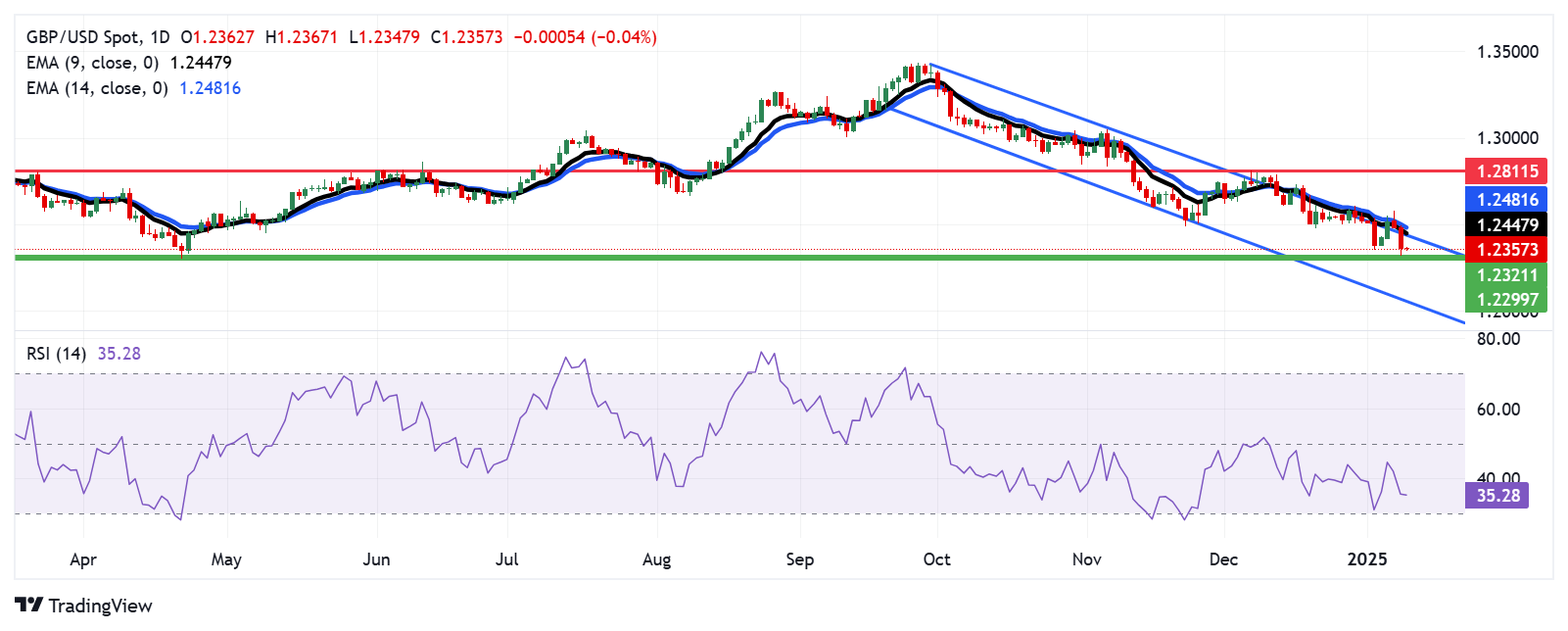
  • GBP/USD has retreated into the descending channel pattern, signaling a dominant bearish bias.

  • The pair could test the nine-month low at 1.2321, recorded on Wednesday.

  • The immediate resistance appears at the descending channel’s upper boundary, near the nine-day EMA at 1.2447.

The GBP/USD pair remains under pressure for the third consecutive session, hovering near 1.2360 during Thursday’s Asian trading hours. Technical analysis of the daily chart highlights a prevailing bearish bias, with the pair falling back to the descending channel pattern.

The 14-day Relative Strength Index (RSI) approaches the 30 mark, signaling intensified bearish momentum. Additionally, the GBP/USD pair trades below the nine- and 14-day Exponential Moving Averages (EMAs), reflecting weak short-term price dynamics.

On the downside, the GBP/USD pair could test the nine-month low of 1.2321, recorded on January 8, followed by the next support level at 1.2299, the lowest since November 2023, last observed on April 22. A break below this level could strengthen bearish sentiment, potentially driving the pair toward the lower boundary of the descending channel near 1.2050.

On the upside, the GBP/USD pair may encounter immediate resistance at the descending channel’s upper boundary, near the nine-day EMA at 1.2447, followed by the 14-day EMA at 1.2481. A decisive breakout above this critical resistance zone could enhance short-term price momentum, paving the way for a potential move toward the two-month high of 1.2811, reached on December 6.

GBP/USD: Daily Chart

British Pound PRICE Today

The table below shows the percentage change of British Pound (GBP) against listed major currencies today. British Pound was the weakest against the Japanese Yen.


  USD EUR GBP JPY CAD AUD NZD CHF
USD   -0.03% 0.04% -0.27% -0.12% 0.14% 0.06% -0.19%
EUR 0.03%   0.07% -0.23% -0.09% 0.18% 0.09% -0.16%
GBP -0.04% -0.07%   -0.33% -0.16% 0.10% 0.03% -0.21%
JPY 0.27% 0.23% 0.33%   0.14% 0.41% 0.29% 0.10%
CAD 0.12% 0.09% 0.16% -0.14%   0.27% 0.18% -0.05%
AUD -0.14% -0.18% -0.10% -0.41% -0.27%   -0.09% -0.31%
NZD -0.06% -0.09% -0.03% -0.29% -0.18% 0.09%   -0.22%
CHF 0.19% 0.16% 0.21% -0.10% 0.05% 0.31% 0.22%  

The heat map shows percentage changes of major currencies against each other. The base currency is picked from the left column, while the quote currency is picked from the top row. For example, if you pick the British Pound from the left column and move along the horizontal line to the US Dollar, the percentage change displayed in the box will represent GBP (base)/USD (quote).


Source link

9 01, 2025

GBP/JPY Forecast Today 08/01: Testing 200 Resistance (Video)

By |2025-01-09T04:36:21+02:00January 9, 2025|Forex News, News|0 Comments

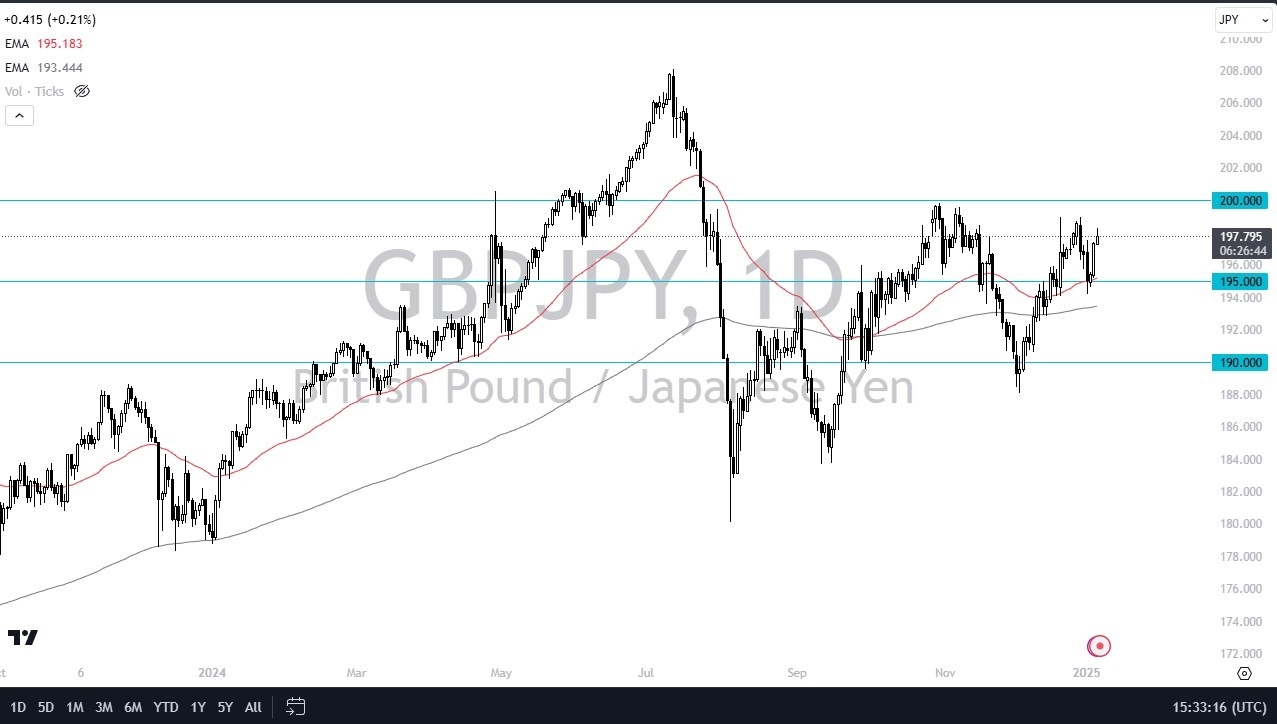
  • I’m taking a look at the British pound against the Japanese yen. You can see that the Tuesday session was positive right off the bat.
  • It looks like we are slamming into a bit of trouble near the 198.5 yen level or so that I do think extends all the way to the 200 yen level.
  • It is worth noting that I still believe that the US dollar is the strongest currency out there overall.

The British pound is essentially second place, so this is a market that should continue to favor the upside, given enough time, but that 200 barrier is extraordinarily resistant. The question is, possibly is somebody interfering here? Bank of Japan, for example.

Bank of Japan, Is That You?

They have been known to do this, so we’ll have to wait and see, but it does look like we are giving back a little bit of those gains, and now I think it is probably a dip waiting to happen. The 50-day EMA finds itself near the 195 yen level and rising. I think that is a short-term floor in the market. As long as we can stay above there, I think we’re probably still buying on the dip overall.

If we can get above the crucial 200 yen level, then it’s likely that this market goes screaming toward the 207 yen level given enough time. I’m not a huge fan of throwing a ton of money into this until we break above the 200 yen level, but I do recognize you get paid at the end of every day and that generally will drive the yen related pairs as the carry trade comes and goes, but ultimately everybody loves it. If we were to turn around and break down below the 195 yen level, then we have to start thinking about the 200-day EMA as the next support level. Anything underneath there, then we’re probably going to open up the trap door and fall towards the 190 yen level.

Begin trading the daily forecasts and analysis. Here is a list of Forex brokers in Japan to work with. 

Source link

9 01, 2025

USD/JPY Forecast Today 08/01: USD Threatens Yen (Video)

By |2025-01-09T02:35:14+02:00January 9, 2025|Forex News, News|0 Comments

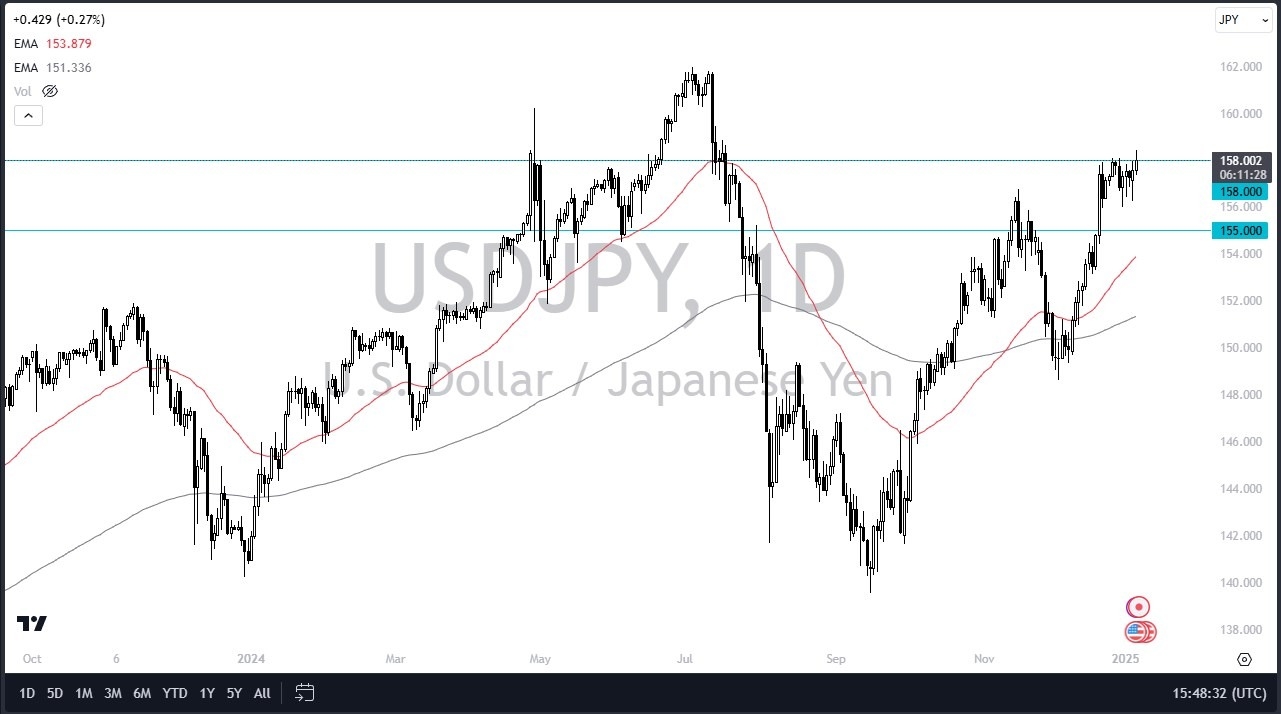
  • The US dollar rallied significantly during the early hours on Tuesday in what has been insane trading, especially as we watch the 10-year yield really start to rip to the upside in America.
  • That is going to have a major influence on how the US dollar trades.

Ultimately, I do think we break above the 158 yen level regardless, but with rising yields and the volatility that we are seeing in the bond market, this makes the dollar even stronger. Add to that the fact that the Bank of Japan, who might begin to normalize is probably looking at less than half a percent, you’re still going to get paid to own this USD/JPY pair, and there’s not a lot the Japanese can do about it. They basically need the Federal Reserve to step in and start cutting rates and then somehow convince the market to go along with it, which so far Jerome Powell hasn’t been able to do. On a break above the 158.50 level, I think you could see the US dollar go racing toward the 162 yen level.

Pullbacks Offer Opportunity

Short-term pullbacks continue to offer buying opportunities, especially near the 157 yen level, and most certainly at the 155 yen level where I see previous action and the 50 day EMA racing toward it. I have no interest in shorting this pair. I do not wish to fight the trend and trying to pick the top is a game for losers. The market continues to see fundamental reasons for the US dollar to strengthen. And while it has had a very strong run against the Japanese yen, that doesn’t mean that it can’t continue. With non-farm payrolls on Friday, that could be the next catalyst, we don’t know. But really, I’m just looking at a market that’s consolidating, building up pressure to try to go to the upside yet again.

Want to trade our USD/JPY forex analysis and predictions? Here’s a list of forex brokers in Japan to check out. 

Source link

9 01, 2025

EUR/USD Forecast Today 08/01: Struggles Against USD (Video)

By |2025-01-09T00:34:12+02:00January 9, 2025|Forex News, News|0 Comments

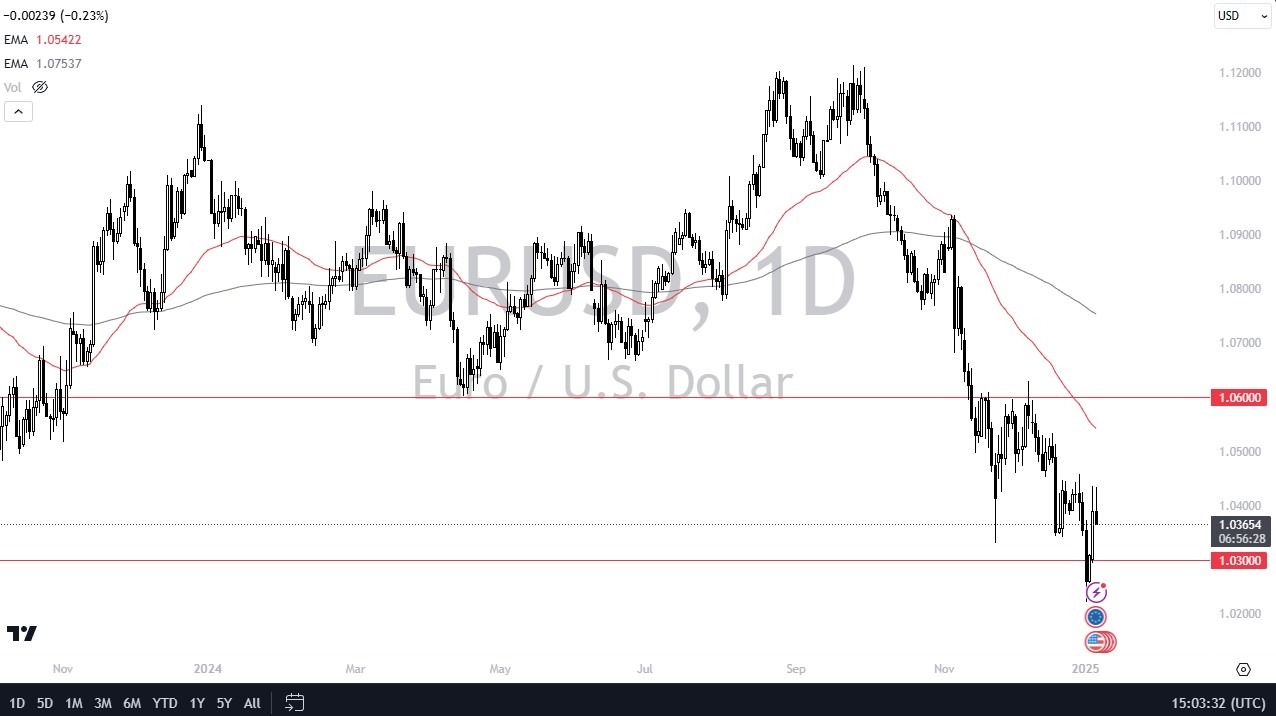
  • You can see that we initially did rally to break above the 1.04 level only to turn around and show signs of weakness again.
  • It’s ridiculous to think that the Euro is going to suddenly turn things around for no apparent reason.
  • Just because the Euro’s cheap doesn’t mean it has to turn around. In fact, cheap things typically become cheaper.

Now there will come a point in time when we turn around, but there’s no fundamental reason for that right now. The European economy is very weak and at the same time we have the US economy which is very strong and inflation in America is stronger than most people would like to think.

So, with that being the case I do think you have a situation where the US dollar continues to beat up on anything it can, and the euro is one of the particularly weakest currencies as far as majors are concerned. I believe this is the “epicenter” of all things Forex at the moment, as it typically is.

Parity is Likely

I do think eventually we will get to the parity level, but we do have a jobs number on Friday, so there might be a little bit of noise here and there this week, only to see things continue to the downside. If we did rally though, I would be looking at the 1.05 level, the 50-day EMA, and the 1.06 level for signs of exhaustion that I could start shorting again, because quite frankly this is a pair that I want to be aggressively bearish of when I get the opportunity to pick up cheap dollars. That’s the caveat.

Ready to trade our EUR/USD daily forecast? Here’s a list of some of the top forex brokers in Europe to check out. 

Source link

8 01, 2025

Is Now A Good Time To Buy US Dollars?

By |2025-01-08T22:33:12+02:00January 8, 2025|Forex News, News|0 Comments

GBPUSD Forecast Highlights

  • Sterling price has weakened further into the New Year
  • Subdued UK economic prospects and strong Dollar are weighing on Cable
  • Bearish momentum may lessen GBPUSD at around 1.240-1.250 on technical buying

How has the Pound performed against the Dollar recently?

The New Year appears to be bringing some respite to the bearish GBPUSD.

Cable was swinging upwards in fine form until the tax-raising Budget was announced by the Chancellor in late autumn, which promptly checked its advance. Since then, the rate has been haemorrhaging strength. GBPUSD dipped to a six-month low in early 2025, on low volume, to probe the 52-week lows of 1.230 (see below).

What now? What is the market trying to say about the future of GBPUSD? Trendwise, the current slide remains in motion. The pattern of lower lows and lower highs is intact.

But its recent v-shaped drop-and-recovery suggests some tentative buying at 1.230-1.240. Perhaps the market is seeing some value after a ten-week drop from 1.300. Even the Financial Times remarked last week (££) that “Britain’s economic outlook in fact looks quite robust compared to other advanced economies.”

But to overcome GBPUSD’s bearish posture requires more than just technical buying. Macro catalysts with bullish leanings are needed to revise the market’s downbeat view of the UK exchange rate. For now, these catalysts are critically absent. UK’s economic growth is uninspiring, inflation looks ready to rebound, and interest rates remain at elevated levels.

What’s more, the dollar is holding on to its strength. The financial market is eagerly awaiting for the new Trump administration this month (inauguration on January 20). What Trump 2.0 will do to the economy is a big unknown, although the stock market is already loving Donald (see Nasdaq’s relentless rise since Nov 5).

For now, the rate may bounce around 1.250, until a new market consensus is formed.


Is it a good time to buy US Dollars with pounds?

Given that Pound Sterling has weakened against the Dollar, should we sell GBP to buy USD before it drops further?

If you need dollars now, watch to sell some Pound Sterling on any bounce to buy dollars.

But if you can wait, perhaps look for a rebound above 1.260 to let go of some Sterling for Dollars. The decline from 1.300 is ‘oversold’ in technical terms and may be due for a further bounce. There is risk in waiting though, as the rate could stay in a sideways-negative trend longer than anticipated.

Will the pound get stronger against the USD in the first quarter of 2025?

There are many serious macro factors weighing on the GBP rates these days. However, extrapolating the current GBPUSD downtrend may not necessarily work due to the complexity of the economic trends.

For one, the market is eagerly eyeing new policy guidance from the incoming Trump administration. Tariffs, budgets, and geopolitical decisions are all on the table waiting to be deliberated by the new cabinet. These issues may impact the dollar, however tangentially.  For instance, the dollar weakens this week (Jan 6) when rumours of lower tariffs swirled in the FX market.

What is more, the economic outlook of the US is far stronger than anticipated. Listen to the recent speech by Lisa Cook, a serving member of the Federal Reserve Board, on January 6:

I continue to view the risks to achieving the two sides of the Federal Reserve’s dual mandate of price stability and maximum employment as being roughly in balance……the 100 basis points of rate cuts since September have notably reduced the restrictiveness of monetary policy. All along, I envisioned moving more quickly in the early stages of our easing campaign and then easing more gradually as the policy rate came closer to neutral…….since September, the labor market has been somewhat more resilient, while inflation has been stickier than I assumed at that time. Thus, I think we can afford to proceed more cautiously with further cuts.

In other words, all the big rate cuts envisioned by investors a year ago have been thrown out of the window.

In light of the robustness of the American economy, no wonder US interest rates are climbing steeply. Rates are definitely staying ‘higher for longer’.

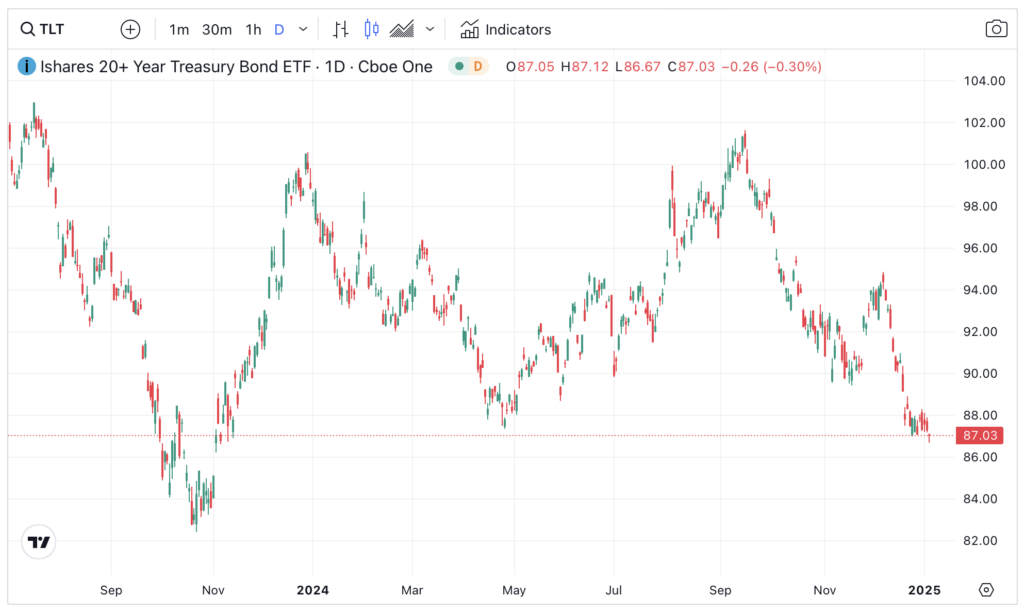
In the past six weeks, the 10-year US Treasury Yield surged to 4.6 percent, a level which is only a short distance from the 2023 peak of 5 percent. If we view this trend via bond prices (bond price and yield move inversely), the breakdown of US Treasury prices is very worrying indeed.

The iShares Treasury Bond ETF (ticker:TLT) tentatively slipped to new 52-week lows this week. The correction from September now exceeds 13 points (see below). Many bondholders could be in the red. If further inflationary economic data appears, another bond rout is quite possible.

In sum, the above discussions points towards a firm Dollar that is backed by a strong American economy and high bond yields. To get GBPUSD back to, say 1.350, requires perhaps a marked reversal of these macro tidings. Not easy, given current set of factors.

However, expectations of GBP are low – and possibly baked in current low prices. This, in turn, means that better-than-expected economic data may set GBPUSD up for a tidy rally since the sentiment is so negative.

In a nutshell, to predict where GBPUSD will be at the end of this quarter is near impossible since there are so many paths it could take. Hence I will just opine that the rate will probable trade at a level not too far from where it is now.

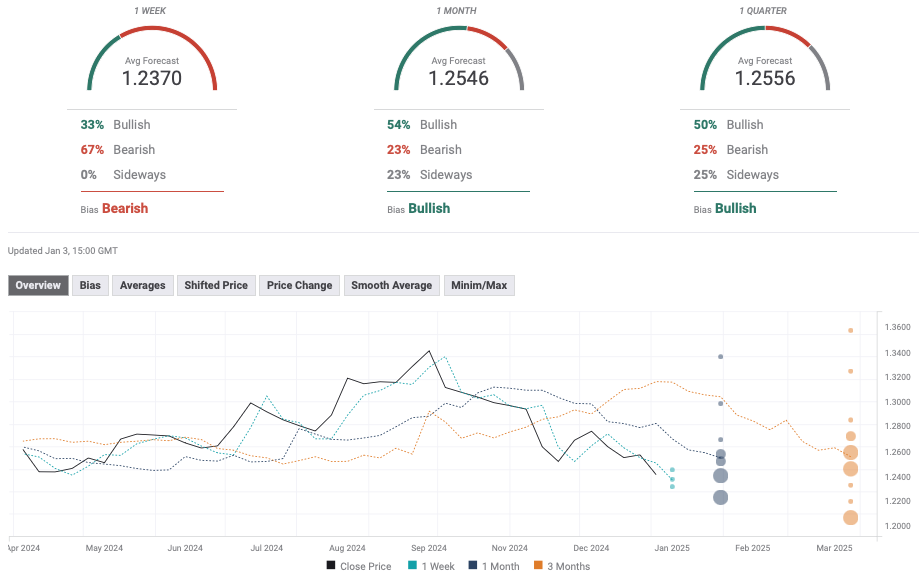
Is Now A Good Time To Buy US Dollars?

What is the GBPUSD forecast in weeks, months, and years?

GBPUSD’s weak trend is being extrapolated by the market. Many brokers are expecting a further dip in the weeks ahead. Who dares to fight an entrenched trend? Very few.

If we look three months ahead, the interesting part of the predictions is the bifurcation of the predictions. Some anticipate a further decline (1.200-1.21) while a few expect a bounce (to 1.260-1.270). The range of the forecast tells you how volatile the market is at the moment.

Therefore, we just have to see where the market is willing to take the GBPUSD rate. Watch for a tussle between supply and demand around 1.250.

Source: fxstreet.com (Jan 2025)

Source link

8 01, 2025

DAX, USD/JPY Forecast: Two trades to watch

By |2025-01-08T16:30:34+02:00January 8, 2025|Forex News, News|0 Comments

DAX rises for a third session despite weak data

  • Factory orders slump -5.4%
  • Retail sales fall  0.6% MoM in November
  • DAX rises towards 20,500

The DAX is rising for a third straight day despite a weaker close in the US and softer than forecast data from Germany. SAP is leading the rise, up over 1%, while Siemens, Airbus, and Allianz also saw modest gains.

German factory orders plunged -5.4% in November compared to the previous month, far worse than the 0.2% decline economists had predicted.

This marked the sharpest drop in factory orders in three months, highlighting the industry’s weakness just weeks ahead of the German election. Following the data, automakers are the worst-performing sector.

Meanwhile, German retail sales fell unexpectedly in November, dropping by 0.6% despite hopes for a recovery based on pre-Christmas promotions.

The soft data comes after German inflation rose by more than expected 2.6% year on year, raising concerns surrounding the economy, which appears to be in recessionary territory but with rising inflation.

Still, the ECB is widely expected to cut rates this month and continue cutting rates across the year to support the economy. The prospect of further rate cuts is keeping the DAX supported even when the data is weak; in a bad news is good news scenario.

Attention will now turn to eurozone PPI figures and economic sentiment PPI is expected to rise 1.5% MoM after rising 0.4% in October. Meanwhile, economic confidence is expected to dip to 95.6 from 95.8

DAX forecast – technical analysis

The DAX has recovered from the 19,700 zone, rising above 20,000 as it heads towards 20,500 and fresh all-time highs. The RSI supports further upside while it remains out of overbought territory.

Support is at 20k and 19700, with a break below the latter creating a lower low.


USD/JPY rises ahead of Fed minutes & ADP payrolls

  • USD tracks treasury yields higher
  • Strong US data revives inflation concerns
  • ADP payrolls are forecast to slip to 140k vs 146k
  • USD/JPY trades at a 6-month high

The US dollar is heading higher on Wednesday, extending gains from yesterday as investors digest stronger-than-expected data and look ahead to the Fed minutes as well as ADP payrolls later today.

ADP payrolls are expected to show 140,000 jobs added in the private sector in December. The data comes after jolts jobs openings were stronger than expected at 8.08 million up from 7.79 million in the previous month, suggesting the US labour market remains solid.

US ISM services PMI was also stronger than expected at 54.1 up from 52.2. However, the costs subcomponent showed that cost pressures were at the highest since 2023, raising concerns of a revival in inflation

Attention will now be on the minutes of the December Fed meeting, where the Fed cut rates by 25 basis points but surprised the market by signalling just two rate cuts in 2025. Still after yesterday’s strong data, the market is now only pricing in one rate cut this year.

The yen continues to struggle after the BoJ keeps quiet about the timing of a possible rate hike. BoJ governor Ueda said in a press conference earlier this week that officials were looking to raise interest rates further only if the economy allows it.

Get our exclusive guide to USD/JPY trading in 2025

USD/JPY forecast – technical analysis

USD/JPY has extended its recovery from the December 3 low of 148.64, rising above the 200 SMA, the rising trendline dating back to 2022 and the 78.6% fib retracement of the 162 high and 139.50 low. This combined with the RSI above 50 could support further gains.

Buyers will look to extend gains towards the 160.00 round number before bringing 162.00, the 2024 high, into focus.

Immediate support can be seen at 157.1 the 78.6% retracement. A break below here and the 155.00 round number exposes the rising trendline support at 154.00.

usd/jpy forecast chart

Source link

8 01, 2025

Ahead of Fed Minutes (Chart)

By |2025-01-08T14:30:18+02:00January 8, 2025|Forex News, News|0 Comments

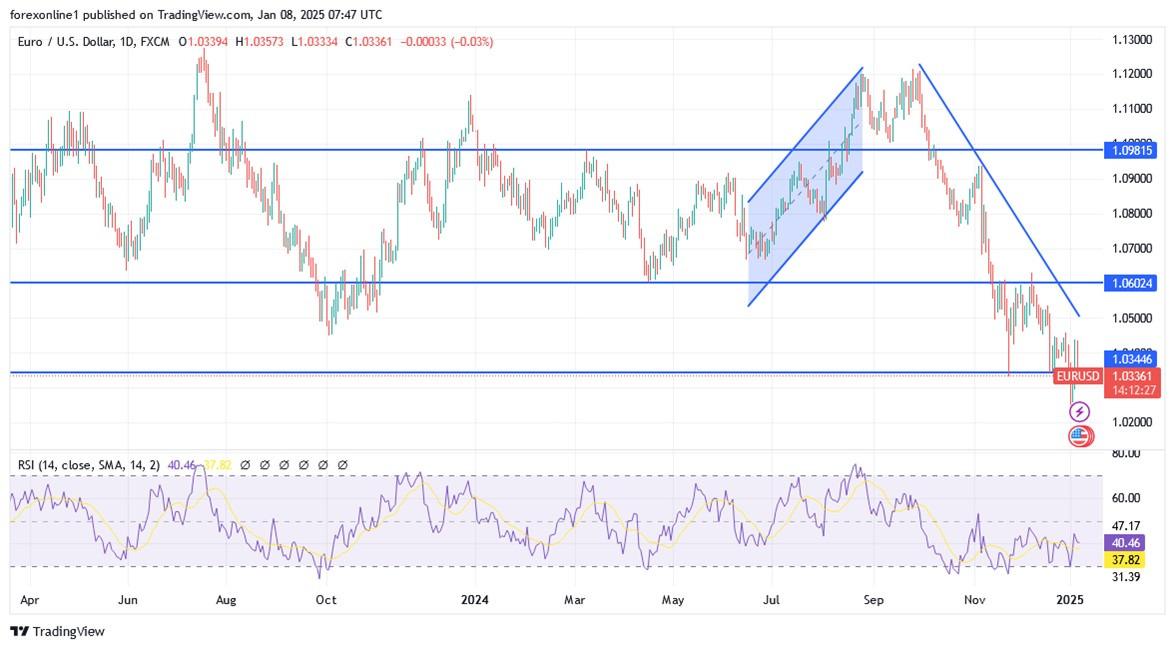
  • During yesterday’s trading session, the EUR/USD pair attempted to rebound upwards, but its gains did not exceed the 1.0435 level before settling back down around 1.0335 at the time of writing this analysis.
  • This comes ahead of the release of the minutes of the latest US Federal Reserve meeting, during which the bank changed the market’s outlook for future US interest rate cuts in the new year.

Eurozone Inflation Stronger Than Expected

According to reliable trading company platforms, the Euro received a positive boost from stronger-than-expected inflation data in the Eurozone. According to economic calendar data, annual inflation in the Eurozone accelerated to 2.4% in December, its highest level since July, up from 2.2% in November, in line with market expectations. This was the third consecutive monthly rise, reinforcing the view that the European Central Bank will take a cautious approach to cutting interest rates.

In the same context, higher-than-expected inflation figures in Germany and Spain reinforced this sentiment, even as France and Italy reported weaker inflation figures. Meanwhile, the market remained focused on US President Trump’s tariff plans, as he rejected claims that his administration might adopt more moderate trade measures.

Trading Tips:

Dear follower, the performance of the euro dollar will remain bearish until Trump is inaugurated and his policy towards the US and global economy becomes clear.

US stock indices stabilize

In today’s session, and through stock trading platforms, US stock futures stabilized after a sharp sell-off in yesterday’s trading session, following a rise in Treasury yields. Yesterday, the Dow Jones index fell by 0.42%, the S&P 500 index fell by 1.11%, and the Nasdaq Composite fell by 1.89%. These losses came after the latest ISM services data showed an acceleration in activity and a rise in prices, raising concerns about persistent inflation and reducing expectations for further US interest rate cuts by the Federal Reserve.

According to trading, the US 10-year Treasury yield rose by about 6 basis points to 4.68%, reflecting inflation expectations and revised prices. According to stock performance, Nvidia shares led the decline, falling by 6.2% and erasing the gains driven by CEO Jensen Huang’s keynote speech at CES on new artificial intelligence and technological advancements. Other large-cap tech stocks, AI-focused companies and cryptocurrency-related stocks also saw significant declines.

The US dollar is stronger ahead of important events

According to forex trading. The US dollar, which is linked to US economic data, recovered better than expected. US bond yields and the dollar had risen after new data confirmed continued inflationary pressures in the US economy, reducing the chances of a US interest rate cut by the Federal Reserve. Obviously, this came after the Institute for Supply Management’s services PMI survey showed that prices paid by businesses reached their highest level since February 2023. Overall, the market now believes that the Federal Reserve will not cut US interest rates again before July, confirming the “higher for longer” interest rate thesis that has supported the dollar’s ​​rise that has been in place since October 2024.

On the other hand, US JOLTS job vacancies rose to a six-month high of 8.098 million in November, easily beating expectations of 7.740 million and 7.744 million in the previous month. Overall, the US dollar will also remain supported amid market uncertainty related to US President Donald Trump’s tariff plans.

EUR/USD Technical Analysis Today:

Dear reader, the performance is moving according to our expectations that selling the EUR/USD from any upward level is the best trading strategy and that the factors weakening the Euro are stronger and may last for a while. The return of the bears to the EUR/USD pair towards support levels of 1.0300, 1.0245, and 1.0180 will bring the EUR/USD parity closer and at the same time will move all technical indicators towards oversold levels, led by the Relative Strength Index and the MACD. Conversely, and over the same timeframe, the daily chart will have a level of 1.06 as the first target to break the current downtrend barrier.

Ready to trade our Forex daily analysis and predictions? Here are the best European brokers to choose from.

Source link

8 01, 2025

Euro buyers hesitate as focus shifts to US data

By |2025-01-08T10:27:16+02:00January 8, 2025|Forex News, News|0 Comments

  • EUR/USD trades slightly below 1.0350 after closing in negative territory on Tuesday.
  • The technical outlook highlights buyers’ hesitancy in the near term.
  • Investors await employment-related US data and FOMC Minutes.

Following Monday’s upsurge, EUR/USD reversed its direction on Tuesday and closed in negative territory. The pair stays relatively quiet below 1.0350 in the European morning on Wednesday. 

Euro PRICE Today

The table below shows the percentage change of Euro (EUR) against listed major currencies today. Euro was the weakest against the US Dollar.

  USD EUR GBP JPY CAD AUD NZD CHF
USD   0.11% 0.12% 0.13% 0.03% 0.13% 0.13% 0.12%
EUR -0.11%   0.01% 0.00% -0.08% 0.03% 0.03% 0.02%
GBP -0.12% -0.01%   0.02% -0.09% 0.02% 0.02% 0.00%
JPY -0.13% 0.00% -0.02%   -0.10% 0.00% -0.01% -0.00%
CAD -0.03% 0.08% 0.09% 0.10%   0.10% 0.10% 0.09%
AUD -0.13% -0.03% -0.02% -0.01% -0.10%   -0.00% -0.01%
NZD -0.13% -0.03% -0.02% 0.00% -0.10% 0.00%   -0.01%
CHF -0.12% -0.02% -0.01% 0.00% -0.09% 0.01% 0.00%  

The heat map shows percentage changes of major currencies against each other. The base currency is picked from the left column, while the quote currency is picked from the top row. For example, if you pick the Euro from the left column and move along the horizontal line to the US Dollar, the percentage change displayed in the box will represent EUR (base)/USD (quote).

The US Dollar (USD) benefited from the negative shift seen in risk mood and upbeat macroeconomic data releases on Tuesday, forcing EUR/USD to push lower. The ISM Services PMI improved to 54.1 in December from 52.1 in November, pointing to an ongoing expansion in the services sector’s activity at an accelerating pace. Additionally, JOLTS Job Openings rose to 8.09 million in November from 7.84 million in October. Both of these figures came in better than analysts’ estimates.

On Wednesday, ADP Employment Change data from the US will be watched closely by investors. The market expectation is for private sector payrolls to rise 140,000 in December following the 146,000 increase recorded in November. A reading above 150,000 could support the USD, while a disappointing print below 130,000 could have the opposite effect on the currency’s valuation.

Later in the American session, the Federal Reserve will publish the minutes of the December policy meeting. Unless there is a dovish surprise in the publication, the USD is likely to stay resilient against its rivals.

EUR/USD Technical Analysis

The Relative Strength Index (RSI) indicator on the 4-hour retreated slightly below 50, reflecting buyers’ hesitancy. Additionally, EUR/USD closed the last three 4-hour candles below the 20-period and the 50-period Simple Moving Averages (SMA).

On the downside, 1.0320 (Fibonacci 23.66% retracement level of the latest downtrend) aligns as first support before 1.0300 (round level, static level) and 1.0240 (end-point of the downtrend). Looking north, resistances could be spotted at 1.0370 (50-period SMA, Fibonacci 38.2% retracement), 1.0400 (100-period SMA) and 1.0420 (Fibonacci 50% retracement).

Euro FAQs

The Euro is the currency for the 19 European Union countries that belong to the Eurozone. It is the second most heavily traded currency in the world behind the US Dollar. In 2022, it accounted for 31% of all foreign exchange transactions, with an average daily turnover of over $2.2 trillion a day. EUR/USD is the most heavily traded currency pair in the world, accounting for an estimated 30% off all transactions, followed by EUR/JPY (4%), EUR/GBP (3%) and EUR/AUD (2%).

The European Central Bank (ECB) in Frankfurt, Germany, is the reserve bank for the Eurozone. The ECB sets interest rates and manages monetary policy. The ECB’s primary mandate is to maintain price stability, which means either controlling inflation or stimulating growth. Its primary tool is the raising or lowering of interest rates. Relatively high interest rates – or the expectation of higher rates – will usually benefit the Euro and vice versa. The ECB Governing Council makes monetary policy decisions at meetings held eight times a year. Decisions are made by heads of the Eurozone national banks and six permanent members, including the President of the ECB, Christine Lagarde.

Eurozone inflation data, measured by the Harmonized Index of Consumer Prices (HICP), is an important econometric for the Euro. If inflation rises more than expected, especially if above the ECB’s 2% target, it obliges the ECB to raise interest rates to bring it back under control. Relatively high interest rates compared to its counterparts will usually benefit the Euro, as it makes the region more attractive as a place for global investors to park their money.

Data releases gauge the health of the economy and can impact on the Euro. Indicators such as GDP, Manufacturing and Services PMIs, employment, and consumer sentiment surveys can all influence the direction of the single currency. A strong economy is good for the Euro. Not only does it attract more foreign investment but it may encourage the ECB to put up interest rates, which will directly strengthen the Euro. Otherwise, if economic data is weak, the Euro is likely to fall. Economic data for the four largest economies in the euro area (Germany, France, Italy and Spain) are especially significant, as they account for 75% of the Eurozone’s economy.

Another significant data release for the Euro is the Trade Balance. This indicator measures the difference between what a country earns from its exports and what it spends on imports over a given period. If a country produces highly sought after exports then its currency will gain in value purely from the extra demand created from foreign buyers seeking to purchase these goods. Therefore, a positive net Trade Balance strengthens a currency and vice versa for a negative balance.


Source link

Go to Top