The main tag of Forex News Today Articles.
You can use the search box below to find what you need.
[wd_asp id=1]

20 11, 2024

USD/CAD Price Analysis: Canada Inflation Exceeds Projections

By |2024-11-20T16:38:34+02:00November 20, 2024|Forex News, News|0 Comments

  • Canada’s inflation prices increased by 2.0% in October.
  • The greenback eased after a rally early on Tuesday due to safe-haven demand. 
  • Markets await more clues on the outlook for Fed rate cuts. 

The USD/CAD price analysis shows a bearish shift in sentiment after data revealed that inflation in Canada was higher than expected. Meanwhile, the dollar eased as safe-haven demand caused by Putin’s nuclear announcement faded.

Are you interested in learning more about Canadian forex brokers? Check our detailed guide-

Data on Tuesday revealed that Canada’s inflation prices increased by 2.0% in October, above estimates of 1.9%. Moreover, it was well above the previous reading of 1.6%. Consequently, traders lowered bets for another super-sized rate cut in December.

Initially, low inflation and poor growth in Canada pushed the Bank of Canada to cut rates by 50-bps in October. Furthermore, markets were pricing a 38% chance of another such move in December. However, after the inflation report, this likelihood fell to 23%. As a result, the Canadian dollar rallied against the dollar. 

On the other hand, the greenback eased after a rally early on Tuesday due to safe-haven demand. Traders rushed for safety after Putin announced a lower threshold for using nuclear power against Ukraine. This change came after Ukraine used US missiles to attack Russia. However, the US made no response, easing fears of a nuclear war and an escalation in the Russia-Ukraine war.  

Meanwhile, markets await more clues on the outlook for Fed rate cuts. Policymakers have maintained a slightly hawkish tone, leading to a decline in bets for a December rate cut. Moreover, looming policy changes under Trump’s administration have changed the outlook for future Fed moves. Upbeat economic data will further support a pause in December. On the other hand, if data comes in line with forecasts or is slightly below, the Fed will cut rates by 25-bps in December.

USD/CAD key events today

USD/CAD technical price analysis: Bears plunge to 1.3951 support
USD/CAD Price Analysis: Canada Inflation Exceeds Projections
USD/CAD 4-hour chart

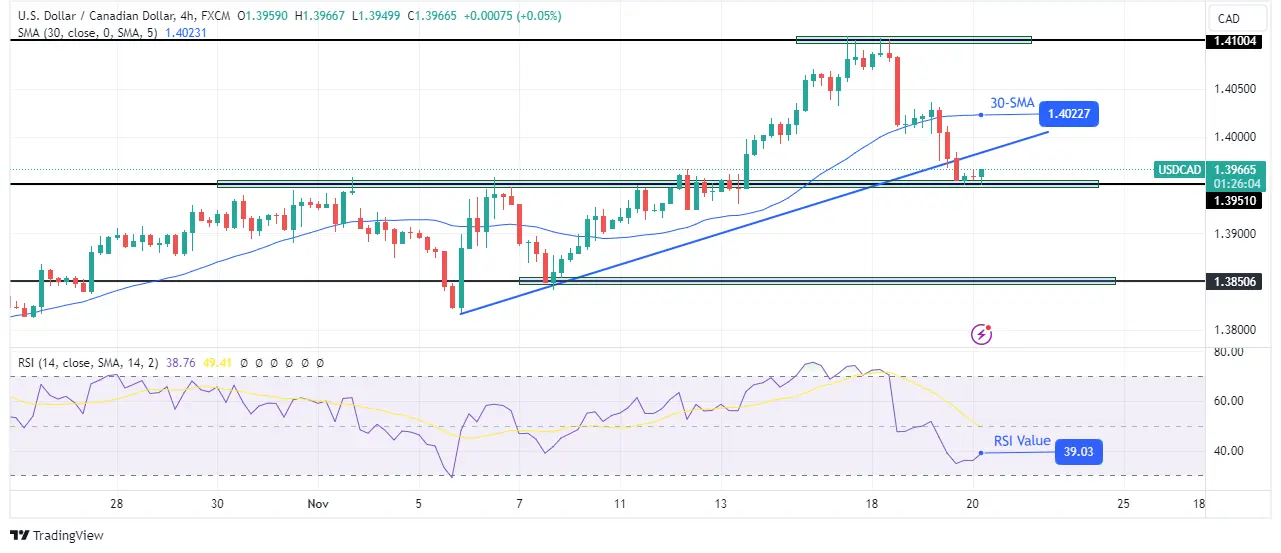
On the technical side, the USD/CAD price has broken below its bullish trendline, indicating a shift in sentiment. At the same time, the price trades far below the 30-SMA, showing a solid lead by bears. Meanwhile, the RSI trades near the oversold region, suggesting solid bearish momentum. 

Are you interested in learning more about high leveraged brokers? Check our detailed guide-

However, bears are facing the 1.3951 support level. A break below this level will allow bears to revisit the 1.3850 level. However, before that, the price might retest the recently broken trendline.

Looking to trade forex now? Invest at eToro!

68% of retail investor accounts lose money when trading CFDs with this provider. You should consider whether you can afford to take the high risk of losing your money


Source link

20 11, 2024

1.0600 proves to be a tough resistance to crack

By |2024-11-20T14:37:43+02:00November 20, 2024|Forex News, News|0 Comments

  • EUR/USD trades below 1.0600 in the European session on Wednesday.
  • The ECB will release Negotiated Wage Rates data for the third quarter. 
  • The technical outlook points to a bearish tilt in the near term.

After falling toward 1.0520 in the European session on Tuesday, EUR/USD staged a rebound and closed the day virtually unchanged. The pair, however, lost its traction after meeting resistance near 1.0600 and started to edge lower toward 1.0550.

Euro PRICE This week

The table below shows the percentage change of Euro (EUR) against listed major currencies this week. Euro was the weakest against the Canadian Dollar.

  USD EUR GBP JPY CAD AUD NZD CHF
USD   -0.21% -0.43% 0.93% -0.82% -0.81% -0.36% -0.39%
EUR 0.21%   -0.05% 1.25% -0.50% -0.46% -0.03% -0.07%
GBP 0.43% 0.05%   1.32% -0.45% -0.41% 0.02% -0.02%
JPY -0.93% -1.25% -1.32%   -1.74% -1.66% -1.21% -1.24%
CAD 0.82% 0.50% 0.45% 1.74%   0.03% 0.46% 0.43%
AUD 0.81% 0.46% 0.41% 1.66% -0.03%   0.43% 0.39%
NZD 0.36% 0.03% -0.02% 1.21% -0.46% -0.43%   -0.03%
CHF 0.39% 0.07% 0.02% 1.24% -0.43% -0.39% 0.03%  

The heat map shows percentage changes of major currencies against each other. The base currency is picked from the left column, while the quote currency is picked from the top row. For example, if you pick the Euro from the left column and move along the horizontal line to the US Dollar, the percentage change displayed in the box will represent EUR (base)/USD (quote).

The pullback seen in the US Treasury bond yields made it difficult for the US Dollar (USD) to gather strength on Tuesday and helped EUR/USD find a foothold. Nevertheless, the risk-averse market atmosphere on a further escalation of the Russia-Ukraine conflict didn’t allow the pair to extend its recovery.

Later in the session, the European Central Bank (ECB) will release the Negotiated Wage Rates data for the third quarter. In the second quarter, this data came in at 3.53%. A bigger increase in Q3 could help the Euro stay resilient against its major rivals with the immediate reaction. Additionally, ECB President Christine Lagarde will deliver a welcome address at the ECB Conference on Financial Stability and Macroprudential Policy in Frankfurt, Germany.

In the absence of high-tier data releases, the risk perception could drive EUR/USD’s action in the second half of the day. At the time of press, US stock index futures were up between 0.2% and 0.3%. A bullish opening in Wall Street could limit the USD’s gains but investors could refrain from moving towards risk-sensitive assets amid the uncertainty surrounding geopolitics.

EUR/USD Technical Analysis

The Relative Strength Index (RSI) indicator on the 4-hour chart retreated below 50, reflecting a lack of buyer interest. On the downside, immediate support is located at 1.0550 (static level) before 1.0500 (round level).

In case EUR/USD rises above 1.0600 (50-period Simple Moving Average (SMA), Fibonacci 23.6% retracement of the latest downtrend), it could meet next resistances at 1.0670 (Fibonacci 38.2% retracement) and 1.0715-1.0720 (100-period SMA, Fibonacci 50% retracement).

Euro FAQs

The Euro is the currency for the 19 European Union countries that belong to the Eurozone. It is the second most heavily traded currency in the world behind the US Dollar. In 2022, it accounted for 31% of all foreign exchange transactions, with an average daily turnover of over $2.2 trillion a day. EUR/USD is the most heavily traded currency pair in the world, accounting for an estimated 30% off all transactions, followed by EUR/JPY (4%), EUR/GBP (3%) and EUR/AUD (2%).

The European Central Bank (ECB) in Frankfurt, Germany, is the reserve bank for the Eurozone. The ECB sets interest rates and manages monetary policy. The ECB’s primary mandate is to maintain price stability, which means either controlling inflation or stimulating growth. Its primary tool is the raising or lowering of interest rates. Relatively high interest rates – or the expectation of higher rates – will usually benefit the Euro and vice versa. The ECB Governing Council makes monetary policy decisions at meetings held eight times a year. Decisions are made by heads of the Eurozone national banks and six permanent members, including the President of the ECB, Christine Lagarde.

Eurozone inflation data, measured by the Harmonized Index of Consumer Prices (HICP), is an important econometric for the Euro. If inflation rises more than expected, especially if above the ECB’s 2% target, it obliges the ECB to raise interest rates to bring it back under control. Relatively high interest rates compared to its counterparts will usually benefit the Euro, as it makes the region more attractive as a place for global investors to park their money.

Data releases gauge the health of the economy and can impact on the Euro. Indicators such as GDP, Manufacturing and Services PMIs, employment, and consumer sentiment surveys can all influence the direction of the single currency. A strong economy is good for the Euro. Not only does it attract more foreign investment but it may encourage the ECB to put up interest rates, which will directly strengthen the Euro. Otherwise, if economic data is weak, the Euro is likely to fall. Economic data for the four largest economies in the euro area (Germany, France, Italy and Spain) are especially significant, as they account for 75% of the Eurozone’s economy.

Another significant data release for the Euro is the Trade Balance. This indicator measures the difference between what a country earns from its exports and what it spends on imports over a given period. If a country produces highly sought after exports then its currency will gain in value purely from the extra demand created from foreign buyers seeking to purchase these goods. Therefore, a positive net Trade Balance strengthens a currency and vice versa for a negative balance.


Source link

20 11, 2024

EUR/JPY Forecast Today 20/11: Falls, Bounces Later (Video)

By |2024-11-20T12:35:21+02:00November 20, 2024|Forex News, News|0 Comments

Date


(MENAFN– Daily Forex)

  • The euro tumbled against the Japanese yen on Tuesday, driven by heightened market anxiety over reports of Russia easing nuclear weapon restrictions following Ukraine’s launch of six NATO-provided missiles into Russian territory.

  • Because of this, there was a rush to safety and Europe wasn’t exactly the place people wanted to run to.

  • So, it all sets up for an obvious trade here.

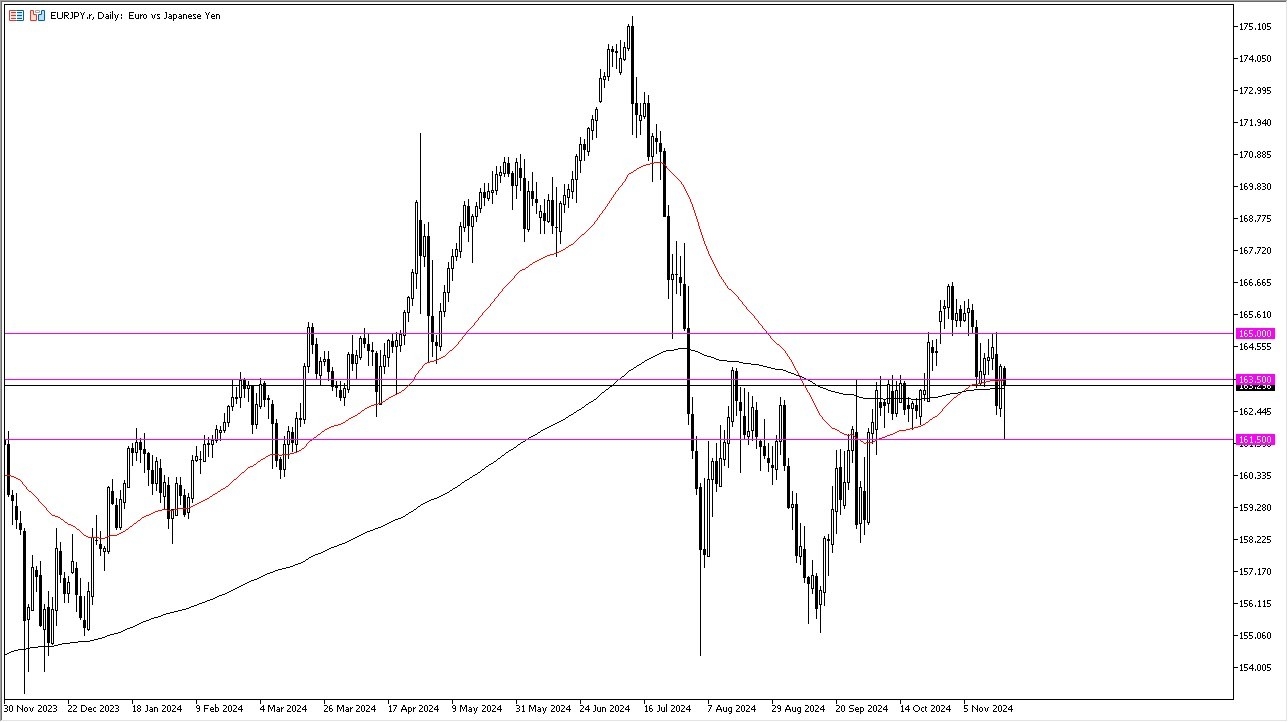
That being said, it looks like cooler heads have prevailed and the 161.50 yen level has offered enough support to turn things around and form a bit of a hammer. The 163.50 level is an area that’s been like a bit of a magnet for price and previously it had been major resistance. So, the fact that we’re there again does make me very interested in this EUR/JPY pair, as this could be some kind of signal on where we go overall.Top Forex Brokers1 Get Started 74% of retail CFD accounts lose money If We Can Break HigherIf we can turn around and break above the highs of the trading session on Monday, then we may have the juice to go looking to the 165 yen level, possibly even the 166.50 yen level. Longer term, I still think this pair goes higher, mainly due to the fact that the Japanese have absolutely no way whatsoever to tighten monetary policy in any meaningful manner otherwise, they will trash the Japanese economy. If there is a run to safety for whatever reason, if we break down below the 161 yen level, then I think the bottom in this pair falls apart. And you probably then start to see Japanese yen strength against pretty much everything. All things being equal though, the Japanese are somewhat stuck. And I think that even the lowly euro will continue to find buyers against it although it might be a choppy road on the way higher.EURUSD Chart by TradingViewWant to trade our daily forex analysis and predictions? Here’s a list of forex brokers in Japan to check out.

MENAFN20112024000131011023ID1108905431


Daily Forex


Legal Disclaimer:
MENAFN provides the information “as is” without warranty of any kind. We do not accept any responsibility or liability for the accuracy, content, images, videos, licenses, completeness, legality, or reliability of the information contained in this article. If you have any complaints or copyright issues related to this article, kindly contact the provider above.

Source link

20 11, 2024

Pound Sterling looks to push higher after UK inflation data

By |2024-11-20T10:34:39+02:00November 20, 2024|Forex News, News|0 Comments

  • GBP/USD trades slightly above 1.2700 in the European morning on Wednesday.
  • October inflation figures from the UK came in above market expectations.
  • The technical outlook points to a bullish tilt in the near term.

GBP/USD trades in positive territory slightly above 1.2700 early Wednesday as markets assess latest inflation readings from the UK. The pair’s near-term technical picture highlights a buildup of recovery momentum.

British Pound PRICE Today

The table below shows the percentage change of British Pound (GBP) against listed major currencies today. British Pound was the strongest against the Japanese Yen.

  USD EUR GBP JPY CAD AUD NZD CHF
USD   0.12% -0.20% 0.59% 0.00% 0.16% 0.26% 0.24%
EUR -0.12%   -0.32% 0.48% -0.12% 0.03% 0.13% 0.11%
GBP 0.20% 0.32%   0.77% 0.20% 0.35% 0.45% 0.44%
JPY -0.59% -0.48% -0.77%   -0.60% -0.45% -0.36% -0.37%
CAD -0.00% 0.12% -0.20% 0.60%   0.16% 0.26% 0.24%
AUD -0.16% -0.03% -0.35% 0.45% -0.16%   0.10% 0.08%
NZD -0.26% -0.13% -0.45% 0.36% -0.26% -0.10%   -0.02%
CHF -0.24% -0.11% -0.44% 0.37% -0.24% -0.08% 0.02%  

The heat map shows percentage changes of major currencies against each other. The base currency is picked from the left column, while the quote currency is picked from the top row. For example, if you pick the British Pound from the left column and move along the horizontal line to the US Dollar, the percentage change displayed in the box will represent GBP (base)/USD (quote).

The UK’s Office for National Statistics reported that annual inflation in the UK, as measured by the change in the Consumer Price Index (CPI), climbed to 2.3% in October from 1.7% in September, surpassing the market expectation of 2.2%. Additionally, the Core CPI, which excludes volatile food and energy prices, rose 3.3% in the same period, up from 3.2% in September. On a monthly basis, the CPI increased 0.6% after staying unchanged in September. 

According to Reuters, UK rate futures point to 59 basis points (bps) of Bank of England (BoE) rate cuts by the end of 2025, vs 64 bps before stronger-than-forecast UK inflation data.

In the second half of the day, BoE Deputy Governor Sarah Breeden and Deputy Governor Dave Ramsden will be delivering speeches. While testifying before the UK Treasury Select Committee on Tuesday, BoE Governor Andrew Bailey noted that a gradual approach to removing monetary policy restraint will help them observe risks to the inflation outlook. In case BoE officials adopt a cautious tone regarding further policy easing, citing latest inflation readings, GBP/USD could continue to stretch higher.

The US economic calendar will not offer any high-impact macroeconomic data releases on Wednesday. Meanwhile, investors will keep a close eye on headlines surrounding the Russia-Ukraine conflict. A further escalation of geopolitical tensions could help the US Dollar (USD) stay resilient against its rivals and limit GBP/USD’s upside.

GBP/USD Technical Analysis

The Relative Strength Index (RSI) indicator on the 4-hour chart climbed above 50 early Wednesday, highlighting an increasing buyer interest. GBP/USD was last seen trading slightly above 1.2700, where the Fibonacci 23.6% retracement level of the latest downtrend is located. In case the pair confirms this level as support, it could face next resistance at 1.2740-1.2750 (50-period Simple Moving Average (SMA), Fibonacci 38.2% retracement) before 1.2800 (Fibonacci 50% retracement).

If GBP/USD fails to stabilize above 1.2700 and retreats below this level, the 20-period SMA at 1.2650 could be seen as next support ahead of 1.2600 (static level).

Inflation FAQs

Inflation measures the rise in the price of a representative basket of goods and services. Headline inflation is usually expressed as a percentage change on a month-on-month (MoM) and year-on-year (YoY) basis. Core inflation excludes more volatile elements such as food and fuel which can fluctuate because of geopolitical and seasonal factors. Core inflation is the figure economists focus on and is the level targeted by central banks, which are mandated to keep inflation at a manageable level, usually around 2%.

The Consumer Price Index (CPI) measures the change in prices of a basket of goods and services over a period of time. It is usually expressed as a percentage change on a month-on-month (MoM) and year-on-year (YoY) basis. Core CPI is the figure targeted by central banks as it excludes volatile food and fuel inputs. When Core CPI rises above 2% it usually results in higher interest rates and vice versa when it falls below 2%. Since higher interest rates are positive for a currency, higher inflation usually results in a stronger currency. The opposite is true when inflation falls.

Although it may seem counter-intuitive, high inflation in a country pushes up the value of its currency and vice versa for lower inflation. This is because the central bank will normally raise interest rates to combat the higher inflation, which attract more global capital inflows from investors looking for a lucrative place to park their money.

Formerly, Gold was the asset investors turned to in times of high inflation because it preserved its value, and whilst investors will often still buy Gold for its safe-haven properties in times of extreme market turmoil, this is not the case most of the time. This is because when inflation is high, central banks will put up interest rates to combat it. Higher interest rates are negative for Gold because they increase the opportunity-cost of holding Gold vis-a-vis an interest-bearing asset or placing the money in a cash deposit account. On the flipside, lower inflation tends to be positive for Gold as it brings interest rates down, making the bright metal a more viable investment alternative.


Source link

20 11, 2024

USD Rebounds vs JPY (Chart)

By |2024-11-20T08:34:01+02:00November 20, 2024|Forex News, News|0 Comments

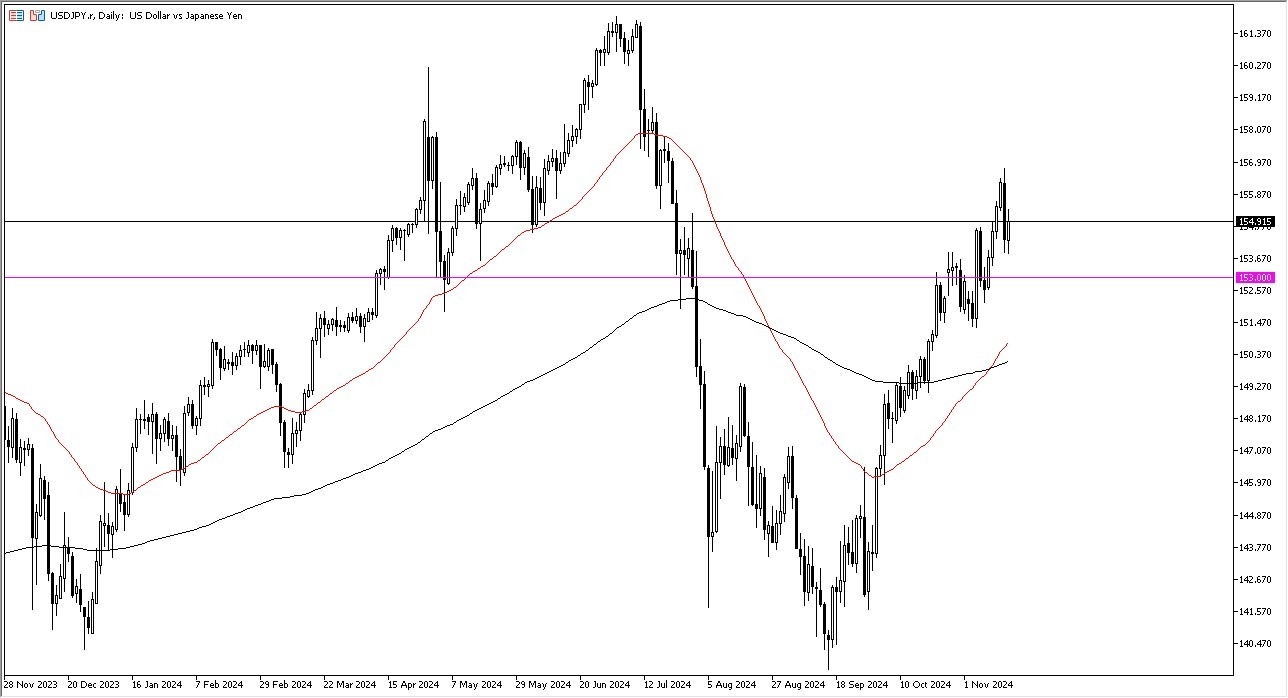
  • During my daily analysis of the USD/JPY pair, the first thing I notice is that we did recover about half of the losses from the previous session, which of course is a very bullish turn of events.
  • Furthermore, it’s probably worth noting that a lot of people were worried about the idea of the Governor of the Bank of Japan suggesting that the interest rate policy in Japan was about to get tighter.
  • He chose not to say anything about this, and therefore it makes a lot of sense that we have seen things turn right back around.

Carry Trade

Do not forget the carry trade. This of course has a major influence on what happens next, and it’s probably worth noting that most traders are very well aware of the fact that they get paid at the end of every day when they hold this pair. In fact, I think that will continue to be the story here, despite the fact that the Federal Reserve has tried to do everything it can to bring down the rates. Quite frankly, traders in the bond market don’t want to hear about it, and it has made interest rates rise. If that’s going to be the case, then the US dollar will be much more preferable than the Japanese yen going forward, which of course is settled by extraordinarily loose monetary policy.

Further bolstering the carry trade will be the technical analysis, which of course is very bullish. The 50 Day EMA has recently broken above the 200 Day EMA, kicking off the so-called “golden cross.” Furthermore, I think that the ¥153 level is an area that people will be paying close attention to, as it is a large, round, psychologically significant figure. This area should offer support, and I think that if we were to drop below it, it could change a lot of things but right now it just doesn’t look very likely to happen. Yes, we did get a massive bearish engulfing candlestick for the Friday session, but I think in the big scheme of things it won’t really matter.

Ready to trade our daily forex forecast? Here are Japan’s Best Forex Brokers to choose from. 

Source link

20 11, 2024

EUR/JPY Forecast Today 20/11: Falls, Bounces Later (Video)

By |2024-11-20T06:33:05+02:00November 20, 2024|Forex News, News|0 Comments

  • The euro tumbled against the Japanese yen on Tuesday, driven by heightened market anxiety over reports of Russia easing nuclear weapon restrictions following Ukraine’s launch of six NATO-provided missiles into Russian territory. 
  • Because of this, there was a rush to safety and Europe wasn’t exactly the place people wanted to run to.
  • So, it all sets up for an obvious trade here.

That being said, it looks like cooler heads have prevailed and the 161.50 yen level has offered enough support to turn things around and form a bit of a hammer. The 163.50 level is an area that’s been like a bit of a magnet for price and previously it had been major resistance. So, the fact that we’re there again does make me very interested in this EUR/JPY pair, as this could be some kind of signal on where we go overall.

If We Can Break Higher

If we can turn around and break above the highs of the trading session on Monday, then we may have the juice to go looking to the 165 yen level, possibly even the 166.50 yen level. Longer term, I still think this pair goes higher, mainly due to the fact that the Japanese have absolutely no way whatsoever to tighten monetary policy in any meaningful manner otherwise, they will trash the Japanese economy.

If there is a run to safety for whatever reason, if we break down below the 161 yen level, then I think the bottom in this pair falls apart. And you probably then start to see Japanese yen strength against pretty much everything. All things being equal though, the Japanese are somewhat stuck. And I think that even the lowly euro will continue to find buyers against it although it might be a choppy road on the way higher.

Want to trade our daily forex analysis and predictions? Here’s a list of forex brokers in Japan to check out. 

Source link

19 11, 2024

Extends gains past the 50-day SMA and 0.8300: Analytics and Market news from 19 November 2024 15:08

By |2024-11-19T22:29:08+02:00November 19, 2024|Forex News, News|0 Comments

Euro PRICE Today

The table below shows the percentage change of Euro (EUR) against listed major currencies today. Euro was the strongest against the British Pound.

  USD EUR GBP JPY CAD AUD NZD CHF
USD   0.23% 0.33% -0.39% -0.10% 0.05% 0.03% -0.12%
EUR -0.23%   0.11% -0.57% -0.32% -0.19% -0.18% -0.35%
GBP -0.33% -0.11%   -0.68% -0.43% -0.29% -0.29% -0.44%
JPY 0.39% 0.57% 0.68%   0.28% 0.42% 0.40% 0.25%
CAD 0.10% 0.32% 0.43% -0.28%   0.14% 0.13% -0.02%
AUD -0.05% 0.19% 0.29% -0.42% -0.14%   -0.01% -0.16%
NZD -0.03% 0.18% 0.29% -0.40% -0.13% 0.00%   -0.15%
CHF 0.12% 0.35% 0.44% -0.25% 0.02% 0.16% 0.15%  

The heat map shows percentage changes of major currencies against each other. The base currency is picked from the left column, while the quote currency is picked from the top row. For example, if you pick the Euro from the left column and move along the horizontal line to the US Dollar, the percentage change displayed in the box will represent EUR (base)/USD (quote).


Source link

19 11, 2024

GBP/USD Price Analysis: Dollar Gains Amid Risk-off Sentiment

By |2024-11-19T20:28:23+02:00November 19, 2024|Forex News, News|0 Comments

  • Putin warned the US of a lower threshold for a nuclear strike.
  • Economists expect UK inflation to increase by 2.2% in October.
  • The dollar remained steady after gaining over 1.6% last week.

The GBP/USD price analysis indicates a sudden rush to safe-haven assets that weakened the pound against the dollar. Meanwhile, the Trump trade kept the dollar near recent peaks as markets awaited economic data for clues on Fed rate cuts.

Are you interested in learning more about Canadian forex brokers? Check our detailed guide-

There was some panic in the markets on Tuesday after Russian President Vladimir Putin warned the US of a lower threshold for a nuclear strike. This news came in response to Ukraine’s recent attack on Russia with US missiles. If Russia starts using nuclear power, it could escalate the war in Ukraine and impact the global economy. 

After Putin’s warning, investors dumped risky assets like the pound and bought the yen and the dollar. Meanwhile, market participants awaited the UK inflation report due on Wednesday, which might give clues on future BoE policy moves. Economists expect inflation to increase by 2.2% after a 1.7% increase in the previous month.

Meanwhile, service inflation might ease further to 4.3%. Lower service inflation might rekindle bets for a rate cut at the December meeting. On the other hand, if inflation is higher than expected, the pound will rally as rate-cut bets drop.

Meanwhile, the dollar remained steady after gaining over 1.6% last week amid the Trump trade. The looming policy changes in the US have shifted the outlook for Fed rate cuts. At the same time, policymakers have assumed a more hawkish tone, boosting the greenback. There is an increasing likelihood that the Fed will pause in December. 

GBP/USD key events today

There will be no key reports from the US or the UK. Therefore, traders will monitor developments in the Ukraine war.

GBP/USD technical price analysis: Downtrend continues after SMA retest 

GBP/USD Price Analysis: Dollar Gains Amid Risk-off Sentiment
GBP/USD 4-hour chart

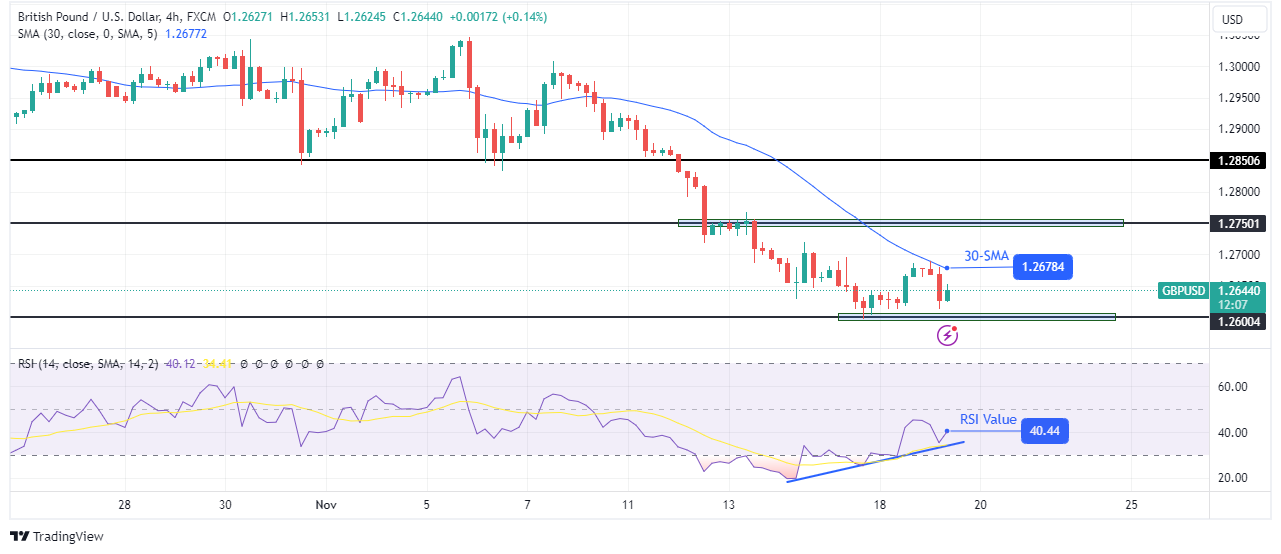
On the technical side, the GBP/USD price has bounced lower after retesting the 30-SMA resistance. After consolidation, bears took charge by breaching the 1.2850 key support level. Moreover, the price made a sharp swing below the SMA, indicating a steep downtrend. 

Are you interested in learning more about high leveraged brokers? Check our detailed guide-

At the same time, the RSI entered the oversold region, suggesting solid bearish momentum. However, it has made a bullish divergence that could lead to a deeper pullback or a reversal. On the other hand, if bearish momentum surges, the price will break below 1.2600.

Looking to trade forex now? Invest at eToro!

68% of retail investor accounts lose money when trading CFDs with this provider. You should consider whether you can afford to take the high risk of losing your money

Source link

19 11, 2024

Drops below 154.00 as traders flock to safety on Ukraine-Russia conflict: Analytics and Market news from 19 November 2024 14:06

By |2024-11-19T18:27:38+02:00November 19, 2024|Forex News, News|0 Comments

  • USD/JPY falls to a six-day low, breaking through key support levels amidst heightened risk aversion.
  • Technical indicators suggest potential further declines, with next targets set at Kijun-sen and 200-day SMA at 151.88.
  • Immediate resistance for USD/JPY is located at the 154.00 level, with significant upper resistance at the recent peak of 156.75.

The Japanese Yen registered solid gains versus the US Dollar in early trading on Tuesday, exchanging hands at 153.83 at the time of writing. Risk aversion sponsored by the escalation of the Ukraine-Russia conflict keeps traders seeking the safety of haven currencies, like the Yen and the Swiss Franc.

USD/JPY Price Forecast: Technical outlook

The USD/JPY cleared support at the November 7 high at 154.71, opening the door for further losses. The pair achieved a lower low, falling to a six-day bottom of 153.28, which could pave the way to testing the 200-day Simple Moving Average (SMA) at 151.88.

On its way to the 200-day SMA, the USD/JPY must clear the Kijun-sen at 152.80, followed by the 152.00 mark. If cleared up, next would be the 200-day SMA, followed by the 100-day SMA at 151.94.

On the other hand, the USD/JPY first resistance would be the 154.00 figure. Once cleared, the next resistance would be the November 15 peak at 156.75.

USD/JPY Price Chart – Daily

Japanese Yen FAQs

The Japanese Yen (JPY) is one of the world’s most traded currencies. Its value is broadly determined by the performance of the Japanese economy, but more specifically by the Bank of Japan’s policy, the differential between Japanese and US bond yields, or risk sentiment among traders, among other factors.

One of the Bank of Japan’s mandates is currency control, so its moves are key for the Yen. The BoJ has directly intervened in currency markets sometimes, generally to lower the value of the Yen, although it refrains from doing it often due to political concerns of its main trading partners. The BoJ ultra-loose monetary policy between 2013 and 2024 caused the Yen to depreciate against its main currency peers due to an increasing policy divergence between the Bank of Japan and other main central banks. More recently, the gradually unwinding of this ultra-loose policy has given some support to the Yen.

Over the last decade, the BoJ’s stance of sticking to ultra-loose monetary policy has led to a widening policy divergence with other central banks, particularly with the US Federal Reserve. This supported a widening of the differential between the 10-year US and Japanese bonds, which favored the US Dollar against the Japanese Yen. The BoJ decision in 2024 to gradually abandon the ultra-loose policy, coupled with interest-rate cuts in other major central banks, is narrowing this differential.

The Japanese Yen is often seen as a safe-haven investment. This means that in times of market stress, investors are more likely to put their money in the Japanese currency due to its supposed reliability and stability. Turbulent times are likely to strengthen the Yen’s value against other currencies seen as more risky to invest in.


Source link

19 11, 2024

Euro could extend recovery once it reclaims 1.0600

By |2024-11-19T16:25:15+02:00November 19, 2024|Forex News, News|0 Comments

  • EUR/USD edges lower after closing in positive territory on Monday.
  • Technical buyers could show interest once the pair stabilizes above 1.0600.
  • Risk perception could impact the pair’s action in the absence of high-tier data releases.

EUR/USD started the week on a firm footing and climbed above 1.0600 on Monday. In the European morning on Tuesday, the pair struggles to preserve its recovery momentum and trades below this level.

Euro PRICE This week

The table below shows the percentage change of Euro (EUR) against listed major currencies this week. Euro was the strongest against the Japanese Yen.

  USD EUR GBP JPY CAD AUD NZD CHF
USD   -0.42% -0.42% 0.23% -0.50% -0.80% -0.51% -0.48%
EUR 0.42%   0.17% 0.77% 0.04% -0.23% 0.03% 0.05%
GBP 0.42% -0.17%   0.61% -0.14% -0.41% -0.14% -0.13%
JPY -0.23% -0.77% -0.61%   -0.75% -0.97% -0.69% -0.65%
CAD 0.50% -0.04% 0.14% 0.75%   -0.27% -0.01% 0.02%
AUD 0.80% 0.23% 0.41% 0.97% 0.27%   0.26% 0.29%
NZD 0.51% -0.03% 0.14% 0.69% 0.00% -0.26%   0.02%
CHF 0.48% -0.05% 0.13% 0.65% -0.02% -0.29% -0.02%  

The heat map shows percentage changes of major currencies against each other. The base currency is picked from the left column, while the quote currency is picked from the top row. For example, if you pick the Euro from the left column and move along the horizontal line to the US Dollar, the percentage change displayed in the box will represent EUR (base)/USD (quote).

The US Dollar (USD) came under selling pressure in the American trading hours on Monday and helped EUR/USD push higher. Falling US Treasury bond yields seemingly weighed on the USD, while the cautious market mood helped the currency limit its losses, capping the pair’s upside.

In the meantime, European Central Bank (ECB) Governing Council member and Central Bank of Ireland Governor Gabriel Makhlouf said on Monday that overwhelming evidence would be needed to consider a 50 basis points rate cut in December. “I believe in a cautious and prudent approach, believe the policy is working,” he added, further supporting the Euro.

Early Tuesday, US stock index futures trade marginally higher on the day. A bullish opening in Wall Street could make it difficult for the USD to find demand and open the door for an extended recovery in EUR/USD later in the day.

Eurostat will publish revisions to the October Harmonized Index of Consumer Prices (HICP) inflation data in the European session. The US economic calendar will offer Housing Starts and Building Permits figures for October. These data are unlikely to trigger a noticeable market reaction, allowing the risk perception to continue to influence EUR/USD’s action.

EUR/USD Technical Analysis

The upper limit of the descending regression channel and the Fibonacci 23.6% retracement of the two-week-old downtrend form important resistance at 1.0600. In case EUR/USD rises above this level and starts using it as support, the 20-period Simple Moving Average (SMA) on the 4-hour chart could act as interim resistance at 1.0630 ahead of 1.0670 (Fibonacci 38.2% retracement) and 1.0720 (Fibonacci 50% retracement).

On the downside, 1.0550 (20-period SMA) aligns as immediate support before 1.0500 (mid-point of the descending channel) and 1.0430 (lower limit of the descending channel).

Euro FAQs

The Euro is the currency for the 19 European Union countries that belong to the Eurozone. It is the second most heavily traded currency in the world behind the US Dollar. In 2022, it accounted for 31% of all foreign exchange transactions, with an average daily turnover of over $2.2 trillion a day. EUR/USD is the most heavily traded currency pair in the world, accounting for an estimated 30% off all transactions, followed by EUR/JPY (4%), EUR/GBP (3%) and EUR/AUD (2%).

The European Central Bank (ECB) in Frankfurt, Germany, is the reserve bank for the Eurozone. The ECB sets interest rates and manages monetary policy. The ECB’s primary mandate is to maintain price stability, which means either controlling inflation or stimulating growth. Its primary tool is the raising or lowering of interest rates. Relatively high interest rates – or the expectation of higher rates – will usually benefit the Euro and vice versa. The ECB Governing Council makes monetary policy decisions at meetings held eight times a year. Decisions are made by heads of the Eurozone national banks and six permanent members, including the President of the ECB, Christine Lagarde.

Eurozone inflation data, measured by the Harmonized Index of Consumer Prices (HICP), is an important econometric for the Euro. If inflation rises more than expected, especially if above the ECB’s 2% target, it obliges the ECB to raise interest rates to bring it back under control. Relatively high interest rates compared to its counterparts will usually benefit the Euro, as it makes the region more attractive as a place for global investors to park their money.

Data releases gauge the health of the economy and can impact on the Euro. Indicators such as GDP, Manufacturing and Services PMIs, employment, and consumer sentiment surveys can all influence the direction of the single currency. A strong economy is good for the Euro. Not only does it attract more foreign investment but it may encourage the ECB to put up interest rates, which will directly strengthen the Euro. Otherwise, if economic data is weak, the Euro is likely to fall. Economic data for the four largest economies in the euro area (Germany, France, Italy and Spain) are especially significant, as they account for 75% of the Eurozone’s economy.

Another significant data release for the Euro is the Trade Balance. This indicator measures the difference between what a country earns from its exports and what it spends on imports over a given period. If a country produces highly sought after exports then its currency will gain in value purely from the extra demand created from foreign buyers seeking to purchase these goods. Therefore, a positive net Trade Balance strengthens a currency and vice versa for a negative balance.


Source link

Go to Top