The main tag of Forex News Today Articles.
You can use the search box below to find what you need.
[wd_asp id=1]

3 01, 2025

USD/JPY Forex Signal Today 03/01: Looks Strong (Chart)

By |2025-01-03T15:14:09+02:00January 3, 2025|Forex News, News|0 Comments

Potential signal:

  • I am a buyer of the USD/JPY pair only.
  • I have no interest in shorting this pair, and as such am waiting patiently for a move above the ¥158 level.
  • At that point, I would put a stop loss at the ¥157 level and aim for the ¥161.25 level.

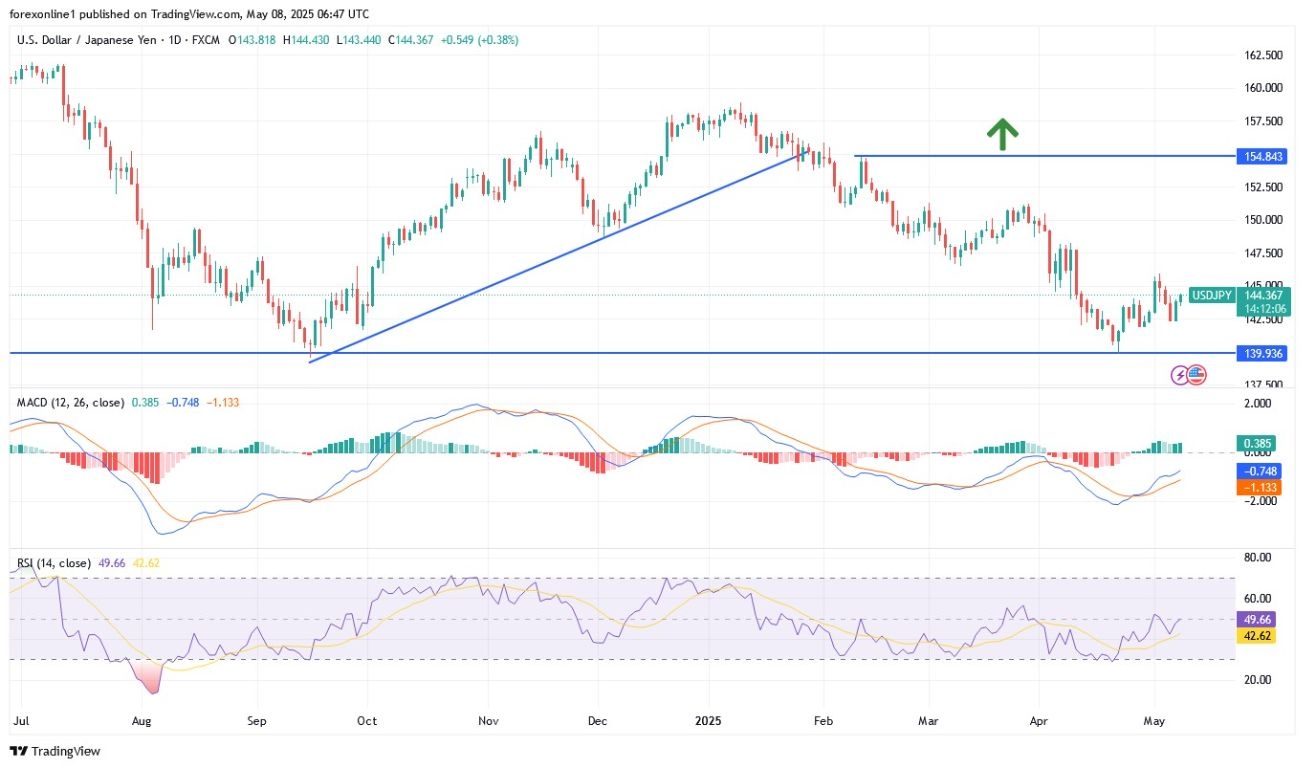
In my daily analysis of the US dollar, the first pair I have been looking at recently has of course been the USD/JPY pair, as it has been so important for so long, and it’s worth noting that the trajectory continues to favor the upside, despite the fact that we had rallied so viciously in the month of December. The Japanese yen has been like a punching bag for most currencies, and at this point time it looks like we are consolidating, perhaps trying to absorb some of that massive inertia to the upside that we had previously enjoyed.

Technical Analysis

The technical analysis for this pair obviously is very bullish, and that of course has not changed. In fact, it is probably worth noting that despite the fact there has been some selling over the last couple of days, the buyers have stepped in and bought the US dollar each time. Because of this, I suspect that it is probably only a matter of time before we take off to the upside, and at this point in time the most support level that I see on the chart is the ¥158 level, because it has been such stringent resistance. Furthermore, this is not the first time that has happened, so I think all in all, you have to assume that any move above there means something rather important.

On the downside, the ¥156 level is a short-term support level, with the ¥155 level being even more important. We were to break down below there, it would change a lot of things, but we also have the 50 Day EMA approaching that level as well, adding more support. With this being the case, I think you have to look at this through the prism of a market that has plenty of demand for the US dollar, but now it’s only a matter of time before we break out.

Want to trade our USD/JPY forex analysis and predictions? Here’s a list of forex brokers in Japan to check out. 

Source link

3 01, 2025

Euro not out of woods despite recent rebound

By |2025-01-03T13:12:14+02:00January 3, 2025|Forex News, News|0 Comments

  • EUR/USD recovers toward 1.0300 in the European session on Friday.
  • The pair remains technically bearish in the near term.
  • The US economic calendar will offer ISM Manufacturing PMI data for December.

EUR/USD came under heavy bearish pressure on the first trading day of 2025 and dropped to its weakest level in over two years at 1.0224. Although the pair stages a rebound toward 1.0300 in the European morning on Friday, the technical outlook suggests that the near-term bias remains bearish.

Euro PRICE This week

The table below shows the percentage change of Euro (EUR) against listed major currencies this week. Euro was the weakest against the Japanese Yen.

  USD EUR GBP JPY CAD AUD NZD CHF
USD   1.44% 1.46% -0.28% -0.13% 0.19% 0.59% 1.01%
EUR -1.44%   0.02% -1.73% -1.59% -1.30% -0.88% -0.48%
GBP -1.46% -0.02%   -1.75% -1.61% -1.31% -0.90% -0.49%
JPY 0.28% 1.73% 1.75%   0.15% 0.53% 1.03% 1.37%
CAD 0.13% 1.59% 1.61% -0.15%   0.31% 0.78% 1.13%
AUD -0.19% 1.30% 1.31% -0.53% -0.31%   0.42% 0.83%
NZD -0.59% 0.88% 0.90% -1.03% -0.78% -0.42%   0.41%
CHF -1.01% 0.48% 0.49% -1.37% -1.13% -0.83% -0.41%  

The heat map shows percentage changes of major currencies against each other. The base currency is picked from the left column, while the quote currency is picked from the top row. For example, if you pick the Euro from the left column and move along the horizontal line to the US Dollar, the percentage change displayed in the box will represent EUR (base)/USD (quote).

The broad-based US Dollar (USD) strength weighed heavily on EUR/USD on Thursday. The data published by the US Department of Labor showed that the weekly Initial Jobless Claims declined to 211,000 in the week ending December 28 from 220,000 in the previous week. This reading came in below the market expectation of 222,000 and helped the USD gather strength. Additionally, the cautious market stance put additional weight on EUR/USD’s shoulders.

In the American session on Friday, the ISM Manufacturing Purchasing Managers Index (PMI) data for December will be watched closely.

The headline Manufacturing PMI is expected to match November’s reading of 48.4. Investors will also pay close attention to the inflation component, the Prices Paid Index, which is forecast to rise to 51.7 from 50.3. A bigger increase than expected in the inflation component could support the USD and make it difficult for EUR/USD to hold its ground heading into the weekend. On the other hand, a disappointing headline PMI could have the opposite effect on the pair’s action.

EUR/USD Technical Analysis

The Relative Strength Index (RSI) indicator on the 4-hour chart recovered slightly above 30 from near-20 it touched on Thursday, suggesting that the bearish bias remains intact following a technical correction from oversold levels.

On the upside, 1.0300 (static level, round level) aligns as immediate resistance before 1.0350 (20-period Simple Moving Average (SMA), static level) and 1.0390-1.0400 (50-period SMA, static level). Looking south, first support could be seen at 1.0240 (static level) ahead of 1.0200 (static level, round level) and 1.0160 (static level from July 2022).

Euro FAQs

The Euro is the currency for the 19 European Union countries that belong to the Eurozone. It is the second most heavily traded currency in the world behind the US Dollar. In 2022, it accounted for 31% of all foreign exchange transactions, with an average daily turnover of over $2.2 trillion a day. EUR/USD is the most heavily traded currency pair in the world, accounting for an estimated 30% off all transactions, followed by EUR/JPY (4%), EUR/GBP (3%) and EUR/AUD (2%).

The European Central Bank (ECB) in Frankfurt, Germany, is the reserve bank for the Eurozone. The ECB sets interest rates and manages monetary policy. The ECB’s primary mandate is to maintain price stability, which means either controlling inflation or stimulating growth. Its primary tool is the raising or lowering of interest rates. Relatively high interest rates – or the expectation of higher rates – will usually benefit the Euro and vice versa. The ECB Governing Council makes monetary policy decisions at meetings held eight times a year. Decisions are made by heads of the Eurozone national banks and six permanent members, including the President of the ECB, Christine Lagarde.

Eurozone inflation data, measured by the Harmonized Index of Consumer Prices (HICP), is an important econometric for the Euro. If inflation rises more than expected, especially if above the ECB’s 2% target, it obliges the ECB to raise interest rates to bring it back under control. Relatively high interest rates compared to its counterparts will usually benefit the Euro, as it makes the region more attractive as a place for global investors to park their money.

Data releases gauge the health of the economy and can impact on the Euro. Indicators such as GDP, Manufacturing and Services PMIs, employment, and consumer sentiment surveys can all influence the direction of the single currency. A strong economy is good for the Euro. Not only does it attract more foreign investment but it may encourage the ECB to put up interest rates, which will directly strengthen the Euro. Otherwise, if economic data is weak, the Euro is likely to fall. Economic data for the four largest economies in the euro area (Germany, France, Italy and Spain) are especially significant, as they account for 75% of the Eurozone’s economy.

Another significant data release for the Euro is the Trade Balance. This indicator measures the difference between what a country earns from its exports and what it spends on imports over a given period. If a country produces highly sought after exports then its currency will gain in value purely from the extra demand created from foreign buyers seeking to purchase these goods. Therefore, a positive net Trade Balance strengthens a currency and vice versa for a negative balance.

 

Source link

3 01, 2025

US Dollar Forecast: DXY Gains After U.S. Jobs Data; Gold, GBP/USD, and EUR/USD Outlook

By |2025-01-03T11:10:57+02:00January 3, 2025|Forex News, News|0 Comments

GBP/USD Price Chart – Source: Tradingview

GBP/USD is trading at $1.23934, up 0.15%, as the pair builds momentum above the $1.23512 pivot point. Immediate resistance is seen at $1.24434, with the next target at $1.24976 if buying interest persists. On the downside, support is firm at $1.23067, with a deeper safety net at $1.22499.

Technical indicators reflect mixed sentiment. GBP/USD trades below its 50-day EMA at $1.25249 and its 200-day EMA at $1.26541, signaling broader bearish pressure. However, oversold conditions suggest the potential for a short-term bounce, particularly if prices remain above $1.23512.

A sustained move above $1.24434 could confirm bullish traction, while a dip below $1.23512 might expose the pair to renewed selling pressure.

Euro Slips as Manufacturing Data Stagnates Across Europe

Eurozone manufacturing data highlighted mixed trends, with Spain’s PMI at 53.3, slightly below the forecast of 53.6, and Italy’s surpassing expectations at 46.2. However, weak numbers from France (41.9) and Germany (42.5) reflect persistent industrial challenges.

The Eurozone Final Manufacturing PMI settled at 45.1, underscoring ongoing contraction. Meanwhile, M3 Money Supply grew by 3.8%, beating forecasts.

Upcoming German unemployment data and Spanish job statistics will provide further insight into labor market conditions impacting the euro’s trajectory.

EUR/USD Technical Forecast

Source link

3 01, 2025

Pound to Euro Forecasts for 2025: 8-Year Best Ahead for GBP/EUR

By |2025-01-03T09:08:59+02:00January 3, 2025|Forex News, News|0 Comments

December 30, 2024 – Written by David Woodsmith

The Pound to Euro exchange rate (GBP/EUR) hit a 33-month best around 1.2150 in 2024 as a notable shift in yields boosted Sterling.

After a limited correction, a key element in 2025 will be whether GBP/EUR can break above 1.2200, levels last seen before the 2026 Brexit referendum.

Goldman Sachs remains positive on Pound fundamentals and forecasts that GBP/EUR will strengthen to 1.2660 by the end of 2025.

RBC Capital Markets, however, expects early Pound strength will fade with GBP/EUR retreating to 1.1765 at year-end.

ING sees positive Pound fundamentals; “EUR/GBP is closing in on the 0.8200 low seen in 2022. Below there, we will all be discussing this pair returning to levels last seen on the day of the Brexit vote in 2016.

It added; “We think this trend is primarily being driven by the BoE versus ECB story. But warmer relations between the UK and the EU can’t hurt. Equally, the eurozone’s fiscal straitjacket should mean the UK economy does outperform in 2025.”

The bank does, however, see important risks from BoE policy; “The reason we are not more bearish EUR/GBP in our forecasts is that we think the BoE will crumble around February and open up to a more aggressive easing cycle.”

Advertisement


Many investment banks expect that the Pound will perform strongly early in the year, but face increased difficulties and potentially be more vulnerable later in the year.

Danske Bank commented; “GBP continues to benefit from a hawkish BoE, inflation and wage growth remaining elevated and underlying growth in the UK outperforming the Eurozone. We think these forces will continue to weigh on the cross also in the coming quarters.”

It did, however, add; “Longer-term some of these GBP tailwinds look set to fade and we expect not least a more dovish BoE to eventually weigh on GBP.”

It expects GBP/EUR will end 2025 just below 1.2200.

Monetary policy will remain a key focus during the year.

The Bank of England (BoE) cut interest rates only twice during 2024 amid persistent uncertainty surrounding inflation trends.

In contrast, the ECB cut interest rates four times amid a sharp decline in inflation and weak growth.

This shift in yields was crucial in supporting the Pound.

At this stage, markets are pricing in only two BoE interest rate cuts for 2025, but most investment banks expect a more dovish stance.

In December, there was a 6-3 vote to hold rates at 4.75% and ING expects a notable shift in the first quarter; “The apparent growing dovish front within the MPC in spite of the latest hawkish wage data potentially suggests a greater focus on slowing activity. That reinforces our dovish view on the Bank of England for next year – we expect 150bp of cuts, against market expectations for around 55bp.”

Ruth Gregory, deputy chief UK economist at Capital Economics commented; “The weakness of economic activity appears to be weighing increasingly on MPC members’ minds. The three MPC members who voted in December for a rate cut expressed concern that sluggish demand created a risk of inflation falling too far below the 2 per cent target in the medium term.”

According to Gregory; “As a result, we think the markets have gone too far in pricing in only a 45 per cent chance of a rate cut in February and then just two further 25 basis point rate cuts next year.”

ING expects six BoE rate cuts during 2025.

Barclays expects monetary policy trends will still be positive for the Pound; “we expect the BoE to take a more cautious approach to easing—which has been well telegraphed in recent BoE communication. In contrast, on the European mainland, the focus has shifted more decisively from inflation concerns to growth challenges, indicating a greater likelihood of further easing measures. This should eventually put pressure on EURGBP.”

RBC Capital Markets (RBC) also sees a firm near-term Pound tone; “Given the UK’s yield and its lower relative vulnerability to potential tariffs, we think the path of least resistance is the downtrend in EUR/GBP extending a bit further in the near-term.”

The bank does, however, remain cautious over the longer-term outlook; “the market’s short EUR/GBP positioning and any signs of weakness in economic data bear watching.”

RBC added; “Over the longer-run the bank considers that a lot of bad news has been priced in to the Euro while the Pound is overvalued. The hurdle is low for GBP weakness if there are any concerns about UK’s growth outlook or fiscal dynamics, and/or there is a risk-off shock. This will leave the currency vulnerable, especially if there is a slide in risk appetite.

Fiscal policy will continue to be important during the year.

The UK government announced a strong increase in spending for fiscal 2025/26, but also raised taxes with an increase in employer National Insurance Contributions the main focus.

There has been evidence that tax hikes have damaged confidence and the economy stagnated over the second half of 2024, but government spending will increase strongly.

Goldman expressed some reservations over the economic outlook; “While Sterling has traded well through the mix of data recently, going forward, a further capitulation in growth momentum stands as a key risk to our view that the Pound can be a regional European outperformer.”

Goldman is, however, still bullish on the Pound; “Broader global factors will be more important than any of this for Sterling, in our view. Namely, the Pound’s procyclical characteristics and its lower vulnerability to tariff risks and trade uncertainty should both support the currency over time, and these serve as the key underpinnings to our continued constructive view on the Pound.”

The ECB has cut the deposit rate to 3.00% and markets expect further cuts in 2025.

Nordea expects that rates will be cut to 2.25%, but added; “Risks remain tilted to the downside to our forecast. If continued political risks, geopolitical tensions and further weakness in the manufacturing sector start to depress the labour market and lead to worries of inflation undershooting the ECB’s 2% target, rates would most likely be returned to accommodative scenario. In this kind of a scenario, rate cuts could easily continue to somewhere around 1 – 1.5%.”

Aggressive rate cuts would undermine the Euro initially, but could underpin growth later in 2025.

Politically, German Chancellor Scholz lost a vote of confidence in December and there will be fresh elections on February 23rd.

The opposition CDU are poised to be the largest party, but strong vote for the right-wing AfD would complicate the process in securing a coalition government.

French Prime Minister Barnier also resigned late in 2024 after failing to get the budget approved and the three-way split in parliament will make it very difficult to achieve a stable government.

New elections can only be called from July and there is a risk that deadlock will persist.

ING commented; “the eurozone’s fiscal straitjacket should mean the UK economy does outperform in 2025.”

Markets are also braced for a more aggressive trade policy from the new US Trump Administration with the risks that tariffs will be imposed on Europe.

According to Barclays; “the Eurozone, with its greater reliance on goods trade, appears more exposed than the UK. That said, the UK would likely not emerge unscathed from a trade war, as it remains a highly open and trade-reliant economy.”

Like this piece? Please share with your friends and colleagues:


International Money Transfer? Ask our resident FX expert a money transfer question or try John’s new, free, no-obligation personal service! ,where he helps every step of the way,
ensuring you get the best exchange rates on your currency requirements.

TAGS: Currency Predictions Pound Euro Forecasts

Source link

2 01, 2025

Buyers aim to challenge the December high at 158.07

By |2025-01-02T21:03:31+02:00January 2, 2025|Forex News, News|0 Comments

  • Tepid Chinese data weighed on the market’s mood at the beginning of the day.
  • Expectations for higher US Treasury yields undermine demand for the JPY.
  • USD/JPY trades near the multi-month high posted in December and aims to break higher.

The USD/JPY pair traded as high as 157.84 on Thursday, holding not far from the December multi-month high of 158.07 by the end of the day. Market participants kept the focus on US political uncertainty as former President Donald Trump gears up to retake office while geopolitical tensions in the Middle East continue.

The Japanese yen suffered from mounting speculation that the upcoming Trump presidency will keep inflationary pressures up, resulting in the Federal Reserve keeping interest rates higher for longer. In its December statement, the US Central Bank has already hinted at just two potential rate cuts this year, halving the four cuts foreseen three months previously. Expectations of higher Treasury yields maintained the Greenback on the winning side.

Tepid Chinese data released at the beginning of the day spurred the sour mood. The country’s December Caixin Manufacturing PMI was confirmed at 50.5, down from the previous 51.7 and missing the 51.7 expected by market players.

USD/JPY Technical Outlook

USD/JPY posted a higher high and a higher low on a daily basis, supporting a bullish continuation, particularly if the pair overcomes the December high of 157.92 (December 20). Gains beyond the latter expose the weekly top of 158.85 (July 16). Further up, the 2024 peak of 161.95 (July 3) comes before the round level of 162.00.  The initial support lies at the aforementioned intraday low, followed by the key 200-day SMA at 152.29, which precedes the December low of 148.63 (December 3) and the weekly low of 141.64 (September 30). If this level is breached, the market may fall to the 2024 bottom of 139.57 (September 16).  In the 4-hour chart, the RSI aims north at around 56, indicating additional gains are likely in the near term.

Japanese Yen PRICE Today

The table below shows the percentage change of Japanese Yen (JPY) against listed major currencies today. Japanese Yen was the strongest against the British Pound.

  USD EUR GBP JPY CAD AUD NZD CHF
USD   0.90% 1.19% 0.14% 0.14% -0.18% 0.06% 0.67%
EUR -0.90%   0.22% -0.68% -0.77% -1.03% -0.87% -0.22%
GBP -1.19% -0.22%   -0.94% -1.03% -1.35% -1.11% -0.55%
JPY -0.14% 0.68% 0.94%   -0.08% -0.40% -0.22% 0.39%
CAD -0.14% 0.77% 1.03% 0.08%   -0.32% -0.12% 0.51%
AUD 0.18% 1.03% 1.35% 0.40% 0.32%   0.16% 0.63%
NZD -0.06% 0.87% 1.11% 0.22% 0.12% -0.16%   0.68%
CHF -0.67% 0.22% 0.55% -0.39% -0.51% -0.63% -0.68%  

The heat map shows percentage changes of major currencies against each other. The base currency is picked from the left column, while the quote currency is picked from the top row. For example, if you pick the Japanese Yen from the left column and move along the horizontal line to the US Dollar, the percentage change displayed in the box will represent JPY (base)/USD (quote).


Source link

2 01, 2025

2024 low at siege amid risk aversion

By |2025-01-02T19:02:24+02:00January 2, 2025|Forex News, News|0 Comments

  • UK manufacturing output contracted by more than anticipated in December.
  • Market players buy the Greenback as mounting uncertainty weighs.
  • GBP/USD pressures fresh multi-month lows with a firmly bearish stance.

The US Dollar (USD) resumed its advance after the New Year holiday, challenging multi-month highs against European rivals in the American session. The GBP/USD pair traded as low as 1.2351, bouncing just modestly from the level as the dismal mood prevails.

The Pound Sterling (GBP) fell following the release of the December United Kingdom (UK) Manufacturing Purchasing Managers’ Index (PMI), as the final version resulted at 47, below the previous estimate of 47.3, also missing expectations of a similar reading.

The faster-than-anticipated contraction in manufacturing output was attributed to “destocking at clients, subdued market confidence and operational restructuring in response to forthcoming legislative changes hit output and demand and reinforced ongoing efforts to achieve cost efficiencies,” according to the S&P Global report.

Meanwhile, financial markets are in risk-averse mode. Concerns about central banks’ hawkish shifts coupled with geopolitical tensions push speculative interest into safety.

The UK will publish minor money-related data on Friday, which usually has no relevant impact on GBP. The United States (US) will release the December ISM Manufacturing PMI, foreseen stable at 48.4. A  better-than-anticipated reading should provide additional support to the USD.

GBP/USD Technical Outlook

The GBP/USD pair trades at around 1.2370 without signs of changing course in the near term. The pair has fallen for a third consecutive trading day, and once the aforementioned intraday low gives up, the 2024 low at 1.2298 comes as the next relevant support level and a potential bearish target. A break below the latter exposes the 1.2200 threshold.

Potential GBP/USD gains would likely be corrective, with the initial resistance coming at around the 1.2400 area. December 20 low at 1.2474, is the next level to watch. 

British Pound PRICE Today

The table below shows the percentage change of British Pound (GBP) against listed major currencies today. British Pound was the strongest against the Euro.

  USD EUR GBP JPY CAD AUD NZD CHF
USD   0.89% 1.14% 0.19% 0.26% -0.29% -0.07% 0.67%
EUR -0.89%   0.17% -0.65% -0.65% -1.14% -0.99% -0.22%
GBP -1.14% -0.17%   -0.86% -0.87% -1.41% -1.18% -0.51%
JPY -0.19% 0.65% 0.86%   -0.01% -0.54% -0.38% 0.36%
CAD -0.26% 0.65% 0.87% 0.00%   -0.56% -0.36% 0.39%
AUD 0.29% 1.14% 1.41% 0.54% 0.56%   0.15% 0.75%
NZD 0.07% 0.99% 1.18% 0.38% 0.36% -0.15%   0.79%
CHF -0.67% 0.22% 0.51% -0.36% -0.39% -0.75% -0.79%  

The heat map shows percentage changes of major currencies against each other. The base currency is picked from the left column, while the quote currency is picked from the top row. For example, if you pick the British Pound from the left column and move along the horizontal line to the US Dollar, the percentage change displayed in the box will represent GBP (base)/USD (quote).


Source link

2 01, 2025

EUR/USD, USD/JPY and AUD/USD Forecast – US Dollar a Bit Mixed in Early Trading

By |2025-01-02T17:00:59+02:00January 2, 2025|Forex News, News|0 Comments

Important DisclaimersThe content provided on the website includes general news and publications, our personal analysis and opinions, and contents provided by third parties, which are intended for educational and research purposes only. It does not constitute, and should not be read as, any recommendation or advice to take any action whatsoever, including to make any investment or buy any product. When making any financial decision, you should perform your own due diligence checks, apply your own discretion and consult your competent advisors. The content of the website is not personally directed to you, and we does not take into account your financial situation or needs.The information contained in this website is not necessarily provided in real-time nor is it necessarily accurate. Prices provided herein may be provided by market makers and not by exchanges.Any trading or other financial decision you make shall be at your full responsibility, and you must not rely on any information provided through the website. FX Empire does not provide any warranty regarding any of the information contained in the website, and shall bear no responsibility for any trading losses you might incur as a result of using any information contained in the website.The website may include advertisements and other promotional contents, and FX Empire may receive compensation from third parties in connection with the content. FX Empire does not endorse any third party or recommends using any third party’s services, and does not assume responsibility for your use of any such third party’s website or services.FX Empire and its employees, officers, subsidiaries and associates, are not liable nor shall they be held liable for any loss or damage resulting from your use of the website or reliance on the information provided on this website.Risk DisclaimersThis website includes information about cryptocurrencies, contracts for difference (CFDs) and other financial instruments, and about brokers, exchanges and other entities trading in such instruments. Both cryptocurrencies and CFDs are complex instruments and come with a high risk of losing money. You should carefully consider whether you understand how these instruments work and whether you can afford to take the high risk of losing your money.FX Empire encourages you to perform your own research before making any investment decision, and to avoid investing in any financial instrument which you do not fully understand how it works and what are the risks involved.

Source link

2 01, 2025

Euro could try to rebound in case risk mood improves

By |2025-01-02T12:59:08+02:00January 2, 2025|Forex News, News|0 Comments

  • EUR/USD stays below 1.0400 to begin the new year.
  • US economic calendar will feature weekly Jobless Claims data.
  • A positive shift in risk sentiment can help the pair hold its ground.

After ending the year on the back foot, EUR/USD struggles to gain traction on the first trading day of 2025. The pair’s near-term technical outlook suggests that the bearish bias stays intact but an improving risk mood could help the pair limit its losses.

Euro PRICE This week

The table below shows the percentage change of Euro (EUR) against listed major currencies this week. Euro was the weakest against the Japanese Yen.

  USD EUR GBP JPY CAD AUD NZD CHF
USD   0.55% 0.36% -0.66% -0.24% 0.05% 0.26% 0.32%
EUR -0.55%   -0.19% -1.23% -0.83% -0.57% -0.33% -0.29%
GBP -0.36% 0.19%   -1.04% -0.65% -0.38% -0.14% -0.09%
JPY 0.66% 1.23% 1.04%   0.42% 0.77% 1.09% 1.05%
CAD 0.24% 0.83% 0.65% -0.42%   0.28% 0.57% 0.55%
AUD -0.05% 0.57% 0.38% -0.77% -0.28%   0.24% 0.29%
NZD -0.26% 0.33% 0.14% -1.09% -0.57% -0.24%   0.05%
CHF -0.32% 0.29% 0.09% -1.05% -0.55% -0.29% -0.05%  

The heat map shows percentage changes of major currencies against each other. The base currency is picked from the left column, while the quote currency is picked from the top row. For example, if you pick the Euro from the left column and move along the horizontal line to the US Dollar, the percentage change displayed in the box will represent EUR (base)/USD (quote).

The US Dollar (USD) benefited from the risk-averse market atmosphere and weighed on EUR/USD heading into the New Year break. Early Thursday, US stock index futures rise between 0.4% and 0.8%. In case risk flows dominate the action after Wall Street’s opening bell, the USD could have a hard time preserving its strength.

The US economic calendar will feature weekly Initial Jobless Claims data. Markets expect the number of first-time applications for unemployment benefits to rise to 224,000 from 219,000 in the previous week. A bigger-than-forecast increase in this data could hurt the USD in the second half of the day.

Meanwhile, European Central Bank (ECB) President Christine Lagarde reiterated that they have made significant progress in 2024 in bringing down inflation. “Hopefully, 2025 is the year when we are on target as expected and as planned in our strategy,” Lagarde added. These comments, however, failed to trigger a market reaction.

EUR/USD Technical Analysis

The Relative Strength Index (RSI) indicator on the 4-hour chart stays below 50 and EUR/USD continues to trade below the 20-period and the 50-period Simple Moving Averages (SMA), reflecting the bearish bias.

On the upside, 1.0400 (20-period SMA, 50-period SMA, static level) aligns as first resistance level before 1.0440-1.0450 (static level, 100-period SMA) and 1.0490 (200-period SMA). Looking south, supports could be spotted at 1.0350 (static level), 1.0300 (static level, round level) and 1.0250 (static level).

Euro FAQs

The Euro is the currency for the 19 European Union countries that belong to the Eurozone. It is the second most heavily traded currency in the world behind the US Dollar. In 2022, it accounted for 31% of all foreign exchange transactions, with an average daily turnover of over $2.2 trillion a day. EUR/USD is the most heavily traded currency pair in the world, accounting for an estimated 30% off all transactions, followed by EUR/JPY (4%), EUR/GBP (3%) and EUR/AUD (2%).

The European Central Bank (ECB) in Frankfurt, Germany, is the reserve bank for the Eurozone. The ECB sets interest rates and manages monetary policy. The ECB’s primary mandate is to maintain price stability, which means either controlling inflation or stimulating growth. Its primary tool is the raising or lowering of interest rates. Relatively high interest rates – or the expectation of higher rates – will usually benefit the Euro and vice versa. The ECB Governing Council makes monetary policy decisions at meetings held eight times a year. Decisions are made by heads of the Eurozone national banks and six permanent members, including the President of the ECB, Christine Lagarde.

Eurozone inflation data, measured by the Harmonized Index of Consumer Prices (HICP), is an important econometric for the Euro. If inflation rises more than expected, especially if above the ECB’s 2% target, it obliges the ECB to raise interest rates to bring it back under control. Relatively high interest rates compared to its counterparts will usually benefit the Euro, as it makes the region more attractive as a place for global investors to park their money.

Data releases gauge the health of the economy and can impact on the Euro. Indicators such as GDP, Manufacturing and Services PMIs, employment, and consumer sentiment surveys can all influence the direction of the single currency. A strong economy is good for the Euro. Not only does it attract more foreign investment but it may encourage the ECB to put up interest rates, which will directly strengthen the Euro. Otherwise, if economic data is weak, the Euro is likely to fall. Economic data for the four largest economies in the euro area (Germany, France, Italy and Spain) are especially significant, as they account for 75% of the Eurozone’s economy.

Another significant data release for the Euro is the Trade Balance. This indicator measures the difference between what a country earns from its exports and what it spends on imports over a given period. If a country produces highly sought after exports then its currency will gain in value purely from the extra demand created from foreign buyers seeking to purchase these goods. Therefore, a positive net Trade Balance strengthens a currency and vice versa for a negative balance.

 

Source link

2 01, 2025

US Dollar Forecast: Will FOMC Commentary Shift Dollar Momentum? – Gold, GBP/USD and EUR/USD Outlook

By |2025-01-02T10:58:00+02:00January 2, 2025|Forex News, News|0 Comments

Gold – Chart

Gold (XAU/USD) trades at $2,633.83, up 0.36%, showing steady buying interest. Immediate resistance lies at $2,652.90, with support at $2,628.47. Gold remains above its 50 EMA of $2,620.80, signaling bullish momentum, but testing the 200 EMA at $2,632.78 may cap gains. A sustained break above $2,652.90 could extend the rally, while a drop below $2,628.47 may turn sentiment bearish. Traders should monitor $2,628 for directional clarity.

Sterling Holds Steady as Manufacturing PMI Matches Forecast

The British Pound (GBP) remained stable as the Nationwide HPI m/m surged by 0.7%, exceeding the 0.1% forecast but below the prior 1.2%. Meanwhile, the Final Manufacturing PMI met expectations at 47.3, reflecting ongoing sectoral challenges.

The mixed data highlights limited upward momentum for the Pound as investors eye upcoming economic indicators to assess the broader recovery path for the UK economy.

GBP/USD Technical Analysis

Source link

1 01, 2025

GBP/USD Analysis: Forecast for 2025 (Chart)

By |2025-01-01T14:48:04+02:00January 1, 2025|Forex News, News|0 Comments

  • The GBP/USD pair struggled to withstand the strength of the US dollar throughout 2024.
  • However, the sterling’s resilience crumbled rapidly following the announcement of Trump’s victory in the US presidential election.
  • As a result, the GBP/USD pair plummeted towards the support level of 1.2475, its lowest level in seven months, before stabilizing around 1.2510 in the final hours of trading in 2024.
  • The highest level for the GBP/USD pair throughout the year was the resistance level of 1.3434, recorded at the beginning of trading in September 2024, which was the highest level for the pair in two years.

GBP Forecast for 2025

According to licensed trading platforms, despite the recent selling pressure on the pound, Goldman Sachs remains optimistic about the fundamentals of the pound. However, RBC Capital Markets expects the strength of the pound to fade quickly if it happens. Many investment banks expect the pound to perform strongly in early 2025, but it faces increasing difficulties and may be more vulnerable later in the year. However, Forex analysts at Danske Bank believe that in the long term, some of these favourable winds for the pound appear to be fading and we expect a more accommodative Bank of England to weigh on the pound eventually.

The future of Bank of England policies in 2025

You should note that monetary policy will remain a major focus in 2025. In this regard, the Bank of England has cut interest rates only twice in 2024 amid ongoing uncertainty surrounding inflation trends. Obviously, this shift in yields has been crucial in supporting the pound. At this stage, markets are expecting only two rate cuts by the BoE in 2025, but most investment banks are expecting a more dovish stance.

At the last meeting in 2024, there was a 6-3 vote to keep UK interest rates at 4.75% and ING is expecting a significant shift in this regard in Q1 2025; the growing dovish front evident within the Monetary Policy Committee despite the latest hawkish wage data suggests a greater focus on the slowdown in activity. This reinforces our dovish view on the BoE in 2025 – we expect 150bp cuts, versus market expectations of around 55bp.

But what about the US Federal Reserve?

Expectations about US monetary policy have changed significantly in the past few weeks of 2024. In its latest meeting of 2024, the Federal Reserve suggested that it would only cut US interest rates twice in 2025. In the updated economic projections for September, the Federal Reserve showed the possibility of making four cuts in US interest rates.

Analysts note that the Fed’s shift in monetary policy, which would see a slower easing cycle, makes sense as the U.S. economy is expected to remain relatively healthy at least through the first half of 2025. Overall, most major banks have trimmed their interest rate forecasts. Furthermore, Bank of America analysts were expecting only two U.S. rate cuts next year. Wells Fargo appears to be a bit more hawkish, seeing just one rate cut in 2025.

However, not all financial market analysts are convinced that the U.S. economy will be able to withstand the geopolitical uncertainty and unintended consequences of President Donald Trump’s proposed policies.

GBP/USD May See a Volatile Trading Year

The pound is likely to see a volatile year, with initial weakness followed by a potential recovery. This is according to Corbyn, the global payments company, which has released its 2025 outlook for major currencies. The firm sees the pound set for a turbulent 2025 due to a combination of domestic economic challenges, a potential interest rate cut. International factors, including changes in US policy. Meanwhile, the start of the year could be tough, there are factors that could support a recovery later in the year and the GBP/USD pair could break the 1.30 threshold by the end of 2025.

The firm sees the pound as likely to see a turbulent start to 2025, with weakness likely against the US dollar amid a loss of economic momentum. According to the economic calendar data, the UK economy slowed sharply during the second half of 2024, leading to weaker labour markets, wage pressures, and lower inflation expectations. The Bank of England is expected to cut interest rates more aggressively than the markets expect. Consequently, this will limit the extent to which interest differentials can support the currency against the euro.

The company’s forecast for the GBP/USD pair is 1.27 in the first quarter, 1.28 in the second quarter, 1.29 in the third quarter, and 1.30 in the fourth quarter.

Trading Tips:

The performance of the GBP/USD in the new year will not be stable as it awaits the reaction to factors that move prices strongly. Therefore, caution and good observation of what Trump decides in the US and globally are necessary.

Technical Analysis for the GBP/USD pair today:

According to recent trades, the movements of the GBP/USD pair support the psychological support level of 1.25 as a temporary floor for the GBP/USD pair, and while it is now in the process of breaking above the nine-day exponential moving average (EMA). Therefore, a successful close above this technical indicator – currently at 1.2579 – would strengthen the improved tone in the near term and open the door to further gains in the first part of January 2025.

However, it should be considered that the US dollar has risen for most of December after the Federal Reserve cut US interest rates but indicated that it has become more cautious about cutting interest rates, which will help maintain US bond yields afloat. For the dollar, this means a stronger trade for a longer period that could extend into 2025. Given the underlying background, GBP/USD gains are likely to be temporary, and the first quarter of 2025 may bring new declines with the minimum of 1.2330. And from there, all technical indicators move towards oversold levels.

Ready to trade our daily Forex forecast? Here’s some of the best forex broker UK reviews to check out. 

Source link

Go to Top