The main tag of Forex News Today Articles.
You can use the search box below to find what you need.
[wd_asp id=1]

13 08, 2024

Tepid buying keeps defending the 1.0900 mark

By |2024-08-13T20:06:24+03:00August 13, 2024|Forex News, News|0 Comments

EUR/USD Current price: 1.0942

  • The German ZEW survey on Economic Sentiment surprised with quite discouraging figures.
  • The United States Producer Price Index rose by less than anticipated in July.
  • EUR/USD trades with a modest bullish bias, needs to clearly surpass the 1.0950 resistance area.

The EUR/USD pair remains stuck on Tuesday, trading within a well-limited range around the 1.0920 mark since the day started. The absence of relevant data and upcoming first-tier United States (US) first-tier headlines keeps investors in cautious mode, with little action across the FX board.

Stock markets, however, tell a different story. Speculative interest is still worried and moving away from high-yielding equities, as most European indexes trade in the red and weigh on US futures. Other than that, weaker government bond yields limit US Dollar’s demand. The 10-year Treasury note offers 3.89% after flirting with the 4% level a couple of days ago.

Data-wise, Germany published the August ZEW Survey on Economic Sentiment, which fell by more than anticipated. The country’s index printed at 19.2 following a reading of 41.8 in July, while the Eurozone Economic Sentiment shrank to 17.9 from the previous 43.7. Additionally, the assessment of the current situation in Germany fell to -77.3, worse than the -68.9 posted in July. Across the pond, the US published the NFIB Business Optimism Index, which rose in July to 93.7, beating expectations.

Finally, the US Producer Price Index (PPI) rose 0.1% MoM in July as expected, while the annual increase was 2.2%, below the anticipated 2.3% and the previous 2.7%. Core annual inflation at wholesale levels eased from 3% in June to 2.4%. The encouraging figures put some pressure on the USD, with EUR/USD hovering around 1.0940 ahead of Wall Street’s opening.

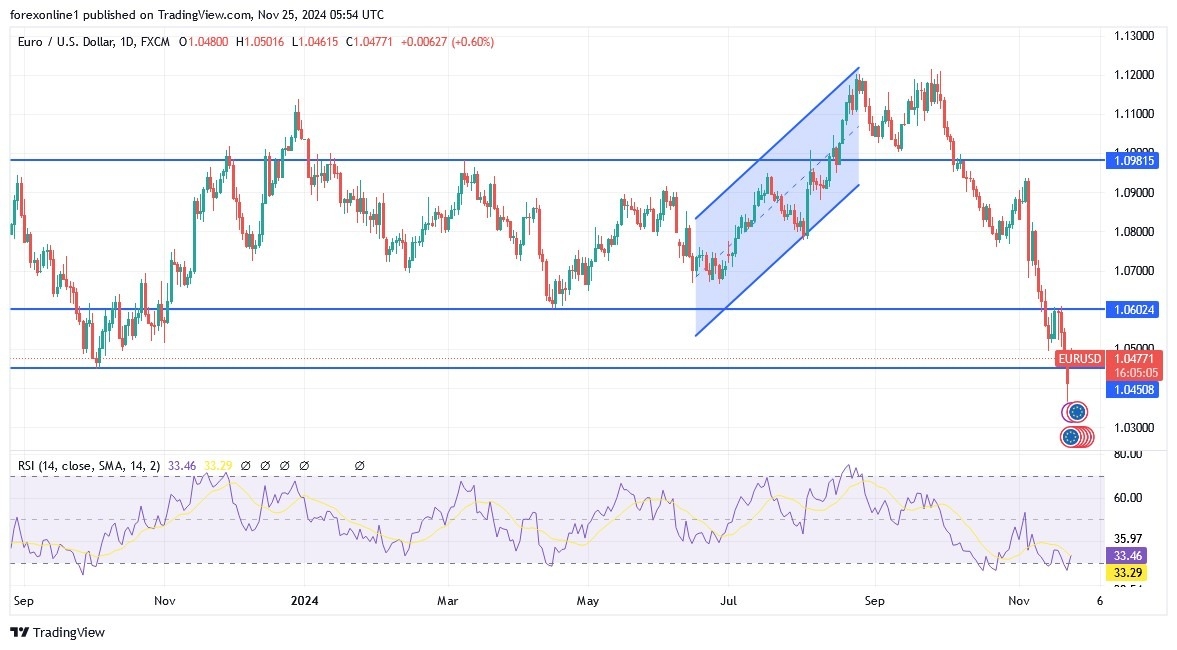
EUR/USD short-term technical outlook

Technically, the daily chart for the EUR/USD pair shows the risk skews to the upside, although the momentum is missing. The pair keeps developing above all its moving averages, with the 20 Simple Moving Average (SMA) gaining upward traction well above the 100 and 200 SMAs. At the same time, technical indicators gyrated north within positive levels, although with tepid slopes.

In the near term, and according to the 4-hour chart, the pair has room to extend its advance. Buyers are defending the downside around a flat 20 SMA while, despite the prevalent range, EUR/USD manages to post sporadic higher highs. At the same time, technical indicators remain within positive levels, although with uneven upward strength.

Support levels: 1.0890 1.0845 1.0800

Resistance levels: 1.0950 1.1005 1.1045

(This story was corrected on August 13 at 14:06 GMT to say that the ZEW’s indicator about the current situation in Germany was -68.9 in July, not 68.9.)

Source link

13 08, 2024

USD/JPY Analysis Today – 13/08: Neutral Performance (Chart)

By |2024-08-13T18:05:07+03:00August 13, 2024|Forex News, News|0 Comments

  • At the beginning of this week, the USD/JPY currency pair rose, surpassing the 148.00 resistance level amid thin trading volumes as Japanese markets were closed due to a holiday.
  • The Japanese yen hovered near its one-week low as the dollar strengthened on the back of better-than-expected US economic data, prompting traders to reduce bets on interest rate cuts by the Federal Reserve.

Last week, the Japanese yen rose to a seven-month high against the dollar as the Bank of Japan’s hawkish shift led to a rapid unwinding of yen-denominated carry trades. Furthermore, the move fueled fears of a US recession and bets on further rate cuts by the Fed. However, sentiment has since stabilized, with Bank of Japan Deputy Governor Shinichi Uchida saying the BOJ would not raise interest rates when the market is unstable. Meanwhile, a summary of views from the Bank of Japan’s July policy meeting revealed that some members called for interest rate hikes to continue, with one suggesting they should eventually be raised to at least 1%.

According to Forex Markets, the US Dollar steadies ahead of inflation data. On Monday, the US dollar index DXY held steady at 103.1 as investors look ahead to key inflation data this week for confirmation that price growth is continuing to stabilize. Today “Tuesday”, US producer inflation data is due, followed by consumer inflation on Wednesday. Additionally, US retail sales figures are due on Thursday.

Last week, the US dollar fell to a seven-month low after a weak July jobs report sparked recession fears in the US, with markets speculating on an emergency cut by the Federal Reserve. Also, a stronger yen fueled by government intervention and interest rate hikes by the Bank of Japan exacerbated the dollar’s ​​slide. However, sentiment has since stabilized as subsequent US economic data eased fears of a slowdown, causing the dollar to recover most of the losses it suffered last week.

Also, markets have eased bets on a Fed rate cut. Although, the expectations for more than 100 basis points of rate cuts this year remain intact.

USD/JPY Technical analysis and Expectations Today

Based on the daily chart below, the USD/JPY currency pair is attempting to break out of a steep downtrend that pushed it towards its 2024 low. Technically, a successful break above the psychological resistance of 150.00 will be crucial for initiating a reversal of the recent bearish trend. Clearly, the price of the US dollar against the Japanese yen will continue to react to the course of global central bank policies and investor risk appetite. Overall, the most prominent support levels for the currency pair are currently 143.65 and 142.00, respectively.

Ready to trade our daily forex forecast? Here are the best forex brokers in Japan to choose from.

Source link

13 08, 2024

Euro struggles to clear technical resistance level

By |2024-08-13T16:04:12+03:00August 13, 2024|Forex News, News|0 Comments

  • EUR/USD edges lower after closing in positive territory on Monday.
  • The technical outlook is yet to point to a buildup of directional momentum.
  • The US economic calendar will feature producer inflation data.

EUR/USD closed the first trading day of the week marginally higher but failed to gather further bullish momentum. The pair holds above 1.0900 and continues to trade within its week-old range.

Euro PRICE Last 7 days

The table below shows the percentage change of Euro (EUR) against listed major currencies last 7 days. Euro was the weakest against the New Zealand Dollar.

  USD EUR GBP JPY CAD AUD NZD CHF
USD   0.28% -0.17% 2.56% -0.66% -1.58% -1.59% 1.81%
EUR -0.28%   -0.42% 2.26% -0.95% -1.87% -1.93% 1.53%
GBP 0.17% 0.42%   2.71% -0.51% -1.45% -1.50% 1.91%
JPY -2.56% -2.26% -2.71%   -3.15% -4.02% -4.11% -0.60%
CAD 0.66% 0.95% 0.51% 3.15%   -0.93% -1.00% 2.44%
AUD 1.58% 1.87% 1.45% 4.02% 0.93%   -0.04% 3.42%
NZD 1.59% 1.93% 1.50% 4.11% 1.00% 0.04%   3.52%
CHF -1.81% -1.53% -1.91% 0.60% -2.44% -3.42% -3.52%  

The heat map shows percentage changes of major currencies against each other. The base currency is picked from the left column, while the quote currency is picked from the top row. For example, if you pick the Euro from the left column and move along the horizontal line to the US Dollar, the percentage change displayed in the box will represent EUR (base)/USD (quote).

The pullback seen in the US Treasury bond yields limited the US Dollar’s (USD) gains on Monday and helped EUR/USD edge higher. Early Tuesday, the benchmark 10-year US T-bond yield clings to small gains above 3.9% and allows the USD to stay resilient against its major rivals, capping the pair’s upside.

The US Bureau of Labor Statistics will release the Producer Price Index (PPI) data for July later in the day. On a monthly basis, the PPI is forecast to rise 0.1% following the 0.2% increase recorded in June, while the core PPI is seen rising 0.2%. In case the monthly core PPI increases more than expected, the immediate reaction could provide a boost to the USD. Investors, however, could refrain from taking large positions ahead of the July Consumer Price Index, which will be released on Wednesday.

Meanwhile, the data from Germany showed that the ZEW Survey – Economic Sentiment declined sharply to 17.9 in August from 41.8 in July. Similarly, the Economic Sentiment for the Eurozone dropped to 17.9 from 43.7 in the same period, making it hard for the Euro to find demand.

“The economic outlook for Germany is breaking down,” the ZEW Institute said. “In the current survey, we observe the strongest decline of the economic expectations over the past two years.”

EUR/USD Technical Analysis

EUR/USD continues to trade in the one-week-old horizontal range between 1.0900 and 1.0940. Additionally, the Relative Strength Index (RSI) indicator on the 4-hour chart retreats toward 50 early Tuesday, reflecting a lack of directional momentum.

In case EUR/USD breaks below 1.0900, 1.0880-1.0870, where the 100-period and the 20-day Simple Moving Averages (SMA) are located, could be seen as next support before 1.0850 (200-period SMA).

On the upside, resistances are located at 1.0940 (static level), 1.0960 (static level) and 1.1000 (psychological level, static level).

Euro FAQs

The Euro is the currency for the 20 European Union countries that belong to the Eurozone. It is the second most heavily traded currency in the world behind the US Dollar. In 2022, it accounted for 31% of all foreign exchange transactions, with an average daily turnover of over $2.2 trillion a day. EUR/USD is the most heavily traded currency pair in the world, accounting for an estimated 30% off all transactions, followed by EUR/JPY (4%), EUR/GBP (3%) and EUR/AUD (2%).

The European Central Bank (ECB) in Frankfurt, Germany, is the reserve bank for the Eurozone. The ECB sets interest rates and manages monetary policy. The ECB’s primary mandate is to maintain price stability, which means either controlling inflation or stimulating growth. Its primary tool is the raising or lowering of interest rates. Relatively high interest rates – or the expectation of higher rates – will usually benefit the Euro and vice versa. The ECB Governing Council makes monetary policy decisions at meetings held eight times a year. Decisions are made by heads of the Eurozone national banks and six permanent members, including the President of the ECB, Christine Lagarde.

Eurozone inflation data, measured by the Harmonized Index of Consumer Prices (HICP), is an important econometric for the Euro. If inflation rises more than expected, especially if above the ECB’s 2% target, it obliges the ECB to raise interest rates to bring it back under control. Relatively high interest rates compared to its counterparts will usually benefit the Euro, as it makes the region more attractive as a place for global investors to park their money.

Data releases gauge the health of the economy and can impact on the Euro. Indicators such as GDP, Manufacturing and Services PMIs, employment, and consumer sentiment surveys can all influence the direction of the single currency. A strong economy is good for the Euro. Not only does it attract more foreign investment but it may encourage the ECB to put up interest rates, which will directly strengthen the Euro. Otherwise, if economic data is weak, the Euro is likely to fall. Economic data for the four largest economies in the euro area (Germany, France, Italy and Spain) are especially significant, as they account for 75% of the Eurozone’s economy.

Another significant data release for the Euro is the Trade Balance. This indicator measures the difference between what a country earns from its exports and what it spends on imports over a given period. If a country produces highly sought after exports then its currency will gain in value purely from the extra demand created from foreign buyers seeking to purchase these goods. Therefore, a positive net Trade Balance strengthens a currency and vice versa for a negative balance.


Source link

13 08, 2024

Pound Sterling needs to clear 1.2810-1.2820 to stretch higher

By |2024-08-13T14:03:18+03:00August 13, 2024|Forex News, News|0 Comments

  • GBP/USD rose to a fresh weekly high above 1.2800 on Tuesday.
  • Labor market data from the UK helped Pound Sterling find demand in the European morning.
  • Technical buyers could take action if the pair clears the 1.2810-1.2820 resistance area.

GBP/USD gained traction in the early European session on Tuesday and climbed above 1.2800 for the first time in a week. The pair could stretch higher if it manages to clear the resistance area located at 1.2810-1.2820.

British Pound PRICE Today

The table below shows the percentage change of British Pound (GBP) against listed major currencies today. British Pound was the strongest against the Japanese Yen.

  USD EUR GBP JPY CAD AUD NZD CHF
USD   0.07% -0.28% 0.37% -0.08% -0.22% 0.13% 0.21%
EUR -0.07%   -0.36% 0.29% -0.18% -0.31% -0.45% 0.14%
GBP 0.28% 0.36%   0.64% 0.19% 0.05% -0.07% 0.52%
JPY -0.37% -0.29% -0.64%   -0.48% -0.59% -0.74% -0.15%
CAD 0.08% 0.18% -0.19% 0.48%   -0.14% -0.29% 0.31%
AUD 0.22% 0.31% -0.05% 0.59% 0.14%   -0.13% 0.51%
NZD -0.13% 0.45% 0.07% 0.74% 0.29% 0.13%   0.60%
CHF -0.21% -0.14% -0.52% 0.15% -0.31% -0.51% -0.60%  

The heat map shows percentage changes of major currencies against each other. The base currency is picked from the left column, while the quote currency is picked from the top row. For example, if you pick the British Pound from the left column and move along the horizontal line to the US Dollar, the percentage change displayed in the box will represent GBP (base)/USD (quote).

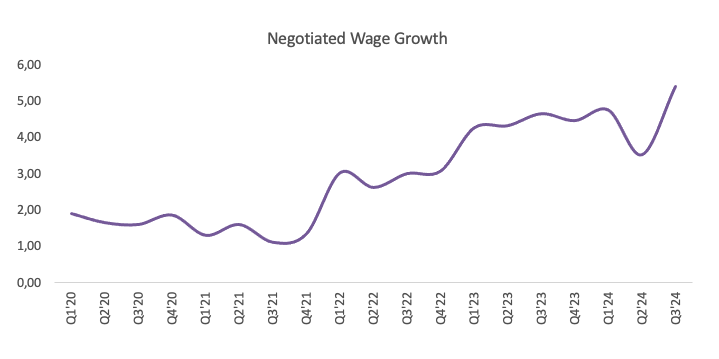
The UK’s Office for national Statistics reported on Tuesday that the ILO Unemployment Rate declined to 4.2% in the three months to June from 4.4%. This reading came in below the market expectation of 4.5%. Additionally, the annual wage inflation, as measured by the change in the Average Earnings Excluding Bonus, edged lower to 5.4% in the same period from 5.7%, coming in above analysts’ estimate of 4.6%. With the immediate reaction, Pound Sterling gathered strength against its major rivals.

In the second half of the day, the US Bureau of Labor Statistics will release Producer Price Index (PPI) data for July. The immediate reaction to producer inflation data could be straightforward, with a stronger-than-forecast increase in the monthly PPI supporting the USD.

Nevertheless, investors could refrain from taking large positions ahead of the Consumer Price Index data from the UK and the US, which will be released on Wednesday.

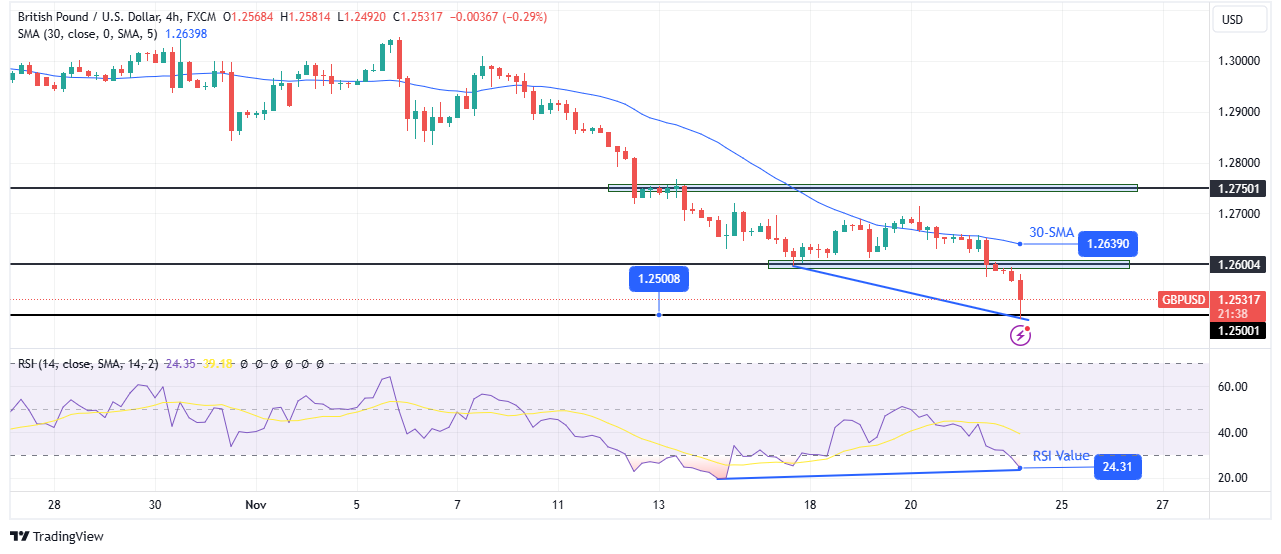
GBP/USD Technical Analysis

The Relative Strength Index (RSI) indicator on the 4-hour chart stays above 60, highlighting a bullish bias in the near term. The Fibonacci 38.2% retracement level of the latest downtrend, the 100-period Simple Moving Average (SMA) and the 200-SMA form a stiff resistance area 1.2810-1.2820. In case GBP/USD rises above this area and starts using it as support, 1.2850 (Fibonacci 50% retracement) and 1.2900 (Fibonacci 61.8% retracement) could be seen as next resistance levels.

On the downside, supports are located at 1.2750 (Fibonacci 23.6% retracement, 50 period SMA), 1.2700 (psychological level, static level) and 1.2660 (end point of downtrend).

Pound Sterling FAQs

The Pound Sterling (GBP) is the oldest currency in the world (886 AD) and the official currency of the United Kingdom. It is the fourth most traded unit for foreign exchange (FX) in the world, accounting for 12% of all transactions, averaging $630 billion a day, according to 2022 data. Its key trading pairs are GBP/USD, aka ‘Cable’, which accounts for 11% of FX, GBP/JPY, or the ‘Dragon’ as it is known by traders (3%), and EUR/GBP (2%). The Pound Sterling is issued by the Bank of England (BoE).

The single most important factor influencing the value of the Pound Sterling is monetary policy decided by the Bank of England. The BoE bases its decisions on whether it has achieved its primary goal of “price stability” – a steady inflation rate of around 2%. Its primary tool for achieving this is the adjustment of interest rates. When inflation is too high, the BoE will try to rein it in by raising interest rates, making it more expensive for people and businesses to access credit. This is generally positive for GBP, as higher interest rates make the UK a more attractive place for global investors to park their money. When inflation falls too low it is a sign economic growth is slowing. In this scenario, the BoE will consider lowering interest rates to cheapen credit so businesses will borrow more to invest in growth-generating projects.

Data releases gauge the health of the economy and can impact the value of the Pound Sterling. Indicators such as GDP, Manufacturing and Services PMIs, and employment can all influence the direction of the GBP. A strong economy is good for Sterling. Not only does it attract more foreign investment but it may encourage the BoE to put up interest rates, which will directly strengthen GBP. Otherwise, if economic data is weak, the Pound Sterling is likely to fall.

Another significant data release for the Pound Sterling is the Trade Balance. This indicator measures the difference between what a country earns from its exports and what it spends on imports over a given period. If a country produces highly sought-after exports, its currency will benefit purely from the extra demand created from foreign buyers seeking to purchase these goods. Therefore, a positive net Trade Balance strengthens a currency and vice versa for a negative balance.


Source link

13 08, 2024

190 Yen Signal a Rally? (Video)

By |2024-08-13T07:59:11+03:00August 13, 2024|Forex News, News|0 Comments

  • The British pound has gone back and forth during the course of the trading session on Friday, showing a little bit of hesitation, which of course is not a huge surprise considering that the market has been so noisy.
  • All things being equal, the market had recently sold off quite drastically as there was a major risk off type of scenario from the 180 yen level.
  • For what it is worth, the weekly candlestick looks as if it is going to be a hammer. So that does suggest that we are ready to go higher.

That being said though, if we can break above the 190 yen level, that could be a very bullish sign. At that point, we could go look into the 200 day EMA, perhaps even towards the previous uptrend line.

The other scenario

On the other hand, if the market were to fall from here, I think we could go looking to the 182 yen level. This is all about risk appetite and that will continue to be the case going forward. Looking at the chart, it’s obvious that volatility has been a major factor in this market, and I think we also have to keep an eye on whether or not the Bank of Japan has to give up its idea of doing everything it can to tighten monetary policy and save the end in the short term they’ve done a really good job but the question then becomes how long can they continue to tighten monetary policy without damaging their own economy which is essentially a bug looking for a windshield I do think eventually we get a bounce but in the meantime I expect to see a lot of noisy behavior

Ultimately, this is a market that is highly sensitive to risk parameters of the interest rate markets, and as a result, I think you will have to watch multiple markets at the same time, as the global markets continue to show a lot of concerns in general.

Want to begin trading our daily Forex forecasts? Get our most recommended Forex brokers to open a demo account with.

Source link

13 08, 2024

USD/JPY Forecast: Will Diverging Producer Prices Trigger a Drop Below 145?

By |2024-08-13T05:58:28+03:00August 13, 2024|Forex News, News|0 Comments

FX Empire – US Producer Prices
In July, Arch Capital Global Chief Economist Parker Ross commented on the June producer price data, saying,

“June producer price inflation was a bit stronger than expected, but most of the strength came from a jump in trade services prices (i.e., wholesaler margins). Still not likely enough for a Fed rate cut in a couple weeks, but it certainly should be enough to get the Fed to start setting the stage at the July FOMC meeting for the first rate cut of this cycle in Sept.”

Producer prices were up 0.2% in June after stalling in May.

Short-term Forecast: Bearish

USD/JPY trends will hinge on the producer price data from Japan and the US. Diverging trends favoring the Yen could signal a USD/JPY drop toward 145. However, central bank comments may influence the USD/JPY pairing more. The USD/JPY may fall toward the August 5 low of 141.648 if support increases for multiple Fed rate cuts or recession fears intensify.

Investors should remain alert. Monitor real-time data, central bank insights, and expert commentary to adjust your trading strategies accordingly. Stay updated with our latest news and analysis to manage USD/JPY volatility.

USD/JPY Price Action

Daily Chart

The USD/JPY hovered below the 50-day and 200-day EMAs, confirming the bearish price trends.

A USD/JPY breakout from the 148.529 resistance level and the top trend line could signal a move toward 150. Furthermore, a break above 150 could bring the 151.685 resistance level into play.

Producer prices and central bank commentary require consideration on Tuesday.

Conversely, a drop below 147 could give the bears a run at the 145.891 support level. A fall through the 145.891 support level may bring the 143.495 support level into play.

The 14-day RSI at 31.37 indicates a USD/JPY drop below 147 before entering oversold territory.

Source link

13 08, 2024

Bulls paused ahead of key macro headlines

By |2024-08-13T03:57:28+03:00August 13, 2024|Forex News, News|0 Comments

EUR/USD Current price: 1.0923

  • Financial markets looking stable at the beginning of a new week as concerns recede.
  • The United States will publish the July Consumer Price Index next Wednesday.
  • EUR/USD is technically neutral in the near term, but bulls hold the grip.

The EUR/USD pair trades uneventfully around the 1.0920 level on Monday, unable to attract investors one way or the other. Financial markets started the week with a calmer mood, as solid gains among US equities on Friday partially offset concerns about the United States´s (US) economic health. A batch of tepid US data fueled speculation about an upcoming recession and triggered bets about larger and sooner interest rate cuts from the Federal Reserve (Fed).

Speculative interest, however, stepped back ahead of key macroeconomic data to be released this week, as the US will publish an update on the Consumer Price Index (CPI) on Wednesday. According to the market forecast, the CPI is forecasted to be 2.9% YoY in July, while the core annual figure is expected to be 3.2% for the same month, both ticking marginally lower from June’s readings. On the same day, the Eurozone will release the second estimate of the Q2 Gross Domestic Product (GDP), estimated at 0.3% QoQ.

Meanwhile, the macroeconomic calendar has little to offer. Germany released the July Wholesale Price Index, which rose 0.3% MoM, improving from -0.3% the previous month. The American session will not bring relevant macroeconomic figures, which means sentiment will likely continue to lead markets’ movements.

EUR/USD short-term technical outlook

From a technical perspective, the EUR/USD pair seems poised to extend its latest cautious advance. In the daily chart, the pair develops above all its moving averages, with the 20 Simple Moving Average (SMA) grinding higher above the longer ones. At the same time, technical indicators hold within positive levels, with modest upward strength. EUR/USD needs to extend gains past 1.0950 to gain bullish traction and retest its recent highs in the 1.1000 region.

EUR/USD is neutral in the near term. In the 4-hour chart, the pair hovers around a flat 20 SMA, while the longer moving averages provide support far below the current level. Finally, technical indicators head nowhere around their midlines, reflecting the absence of speculative interest.

 Support levels: 1.0890 1.0845 1.0800

Resistance levels: 1.0950 1.1005 1.1045

Source link

12 08, 2024

AUD/USD Forecast – Aussie Dollar Continues to Bounce Around in The Same Range

By |2024-08-12T21:52:27+03:00August 12, 2024|Forex News, News|0 Comments

Australian Dollar vs US Dollar Technical Analysis

The Australian dollar gapped lower to kick off the trading session on Monday, but then turned around the show signs of life again, as we have rallied quite significantly. We have slammed into the 200 day EMA, which of course is an indicator that a lot of people pay attention to, so it’ll be interesting to see if this holds as resistance again. If we do break above here, then the 0.6650 level is the most likely target that we will be looking for in the short term. On the other hand, if we do pull back, then the 0.6550 level is support. Anything below there opens up a move down to the 0.65 level.

Keep in mind that there are a lot of questions about what the Federal Reserve is going to do and with that being the case, it’ll be interesting to see how the greenback affects this pair. Furthermore, you have to keep in mind that the Australian dollar is highly sensitive to the commodities markets and that of course in and of itself will cause a lot of volatility as commodities are all over the place right now.

With all of that being said, we are basically in the middle of a consolidation phase. And because of this, I don’t know that anybody has a huge advantage. Any advantage probably comes externally, maybe based on some type of economic announcement in the United States or something. But right now, I think we’re just meandering around this area yet again.

For a look at all of today’s economic events, check out our economic calendar.

This article was originally posted on FX Empire

More From FXEMPIRE:

Source link

12 08, 2024

USD/JPY Analysis Today 12/8: Resistance at 150.00? (Chart)

By |2024-08-12T19:51:15+03:00August 12, 2024|Forex News, News|0 Comments

  • The USD/JPY currency pair has stabilized modestly in recent days as some traders continued to buy the dip.
  • According to reliable trading platforms, the dollar/yen reached its lowest level at 141.77 last Monday and pared some losses, moving to a high of 147.
  • However, the pair remains well below its last month’s high of 161.87.

Trading the Japanese Yen

The USD/JPY exchange rate has suffered a sharp reversal as investors focused on the actions of the Bank of Japan and the US Federal Reserve. For a long time, interest rates between the US and Japan were vastly divergent. Recently, US interest rates were 5.50% while in Japan they were at -0.10%. This gap created an exciting carry trade opportunity as many investors borrowed heavily to invest in other countries, especially the US. Now, the pendulum has swung, and the Bank of Japan has moved out of negative interest rates and raised interest rates to 25 basis points. It has done so in an attempt to combat inflation, which has remained above 2% for the past few months.

US Federal Reserve Rate Cuts

On the other hand, the US Federal Reserve has hinted that it will start cutting US interest rates, joining other central banks such as the Bank of England (BoE), the European Central Bank (ECB), and the Swiss National Bank (SNB). Overall, the chances of the US cutting interest rates have increased in recent weeks after the US released mixed economic data. According to the Bureau of Labor Statistics (BLS), inflation in the country has declined for the past three consecutive months. According to the economic calendar, the headline Consumer Price Index (CPI) rose to 3.0% while the Personal Consumption Expenditure (PCE) inflation figure fell to 2.5%. Meanwhile, these numbers are higher than the Fed’s 2% target, they are moving in the right direction.

The Labor market, the other part of the Fed’s dual mandate, is weakening, with the unemployment rate rising to 4.3%. Historically, the economy has entered a recession whenever the unemployment rate has risen for five consecutive months. Other economic figures related to Labor productivity, manufacturing output, and industrial production were also weaker than expected.

Therefore, the US Federal Reserve is in an unpredictable position. Failure to cut interest rates now could push the US economy into a deep recession. On the other hand, aggressively cutting interest rates would fuel inflation. Overall, analysts have mixed views on what to expect when the Fed meets in September and when Jerome Powell speaks at the Jackson Hole symposium. Some analysts expect the bank to deliver a hefty 0.50% hike at this meeting followed by smaller 0.25% cuts. On the other hand, other analysts believe that the cut should start at 0.25% to prevent inflation risks.

The Unwinding of the Yen Trade is Not Over

Therefore, the continuous rise of the USD/JPY pair has led some analysts to expect that the unwinding of the Japanese yen trade is over. However, we believe that this trade is still entrenched in the market and that it will take time and cause more damage for a while. Furthermore, the size of the Japanese yen trade remains unclear. Analysts at Deutsche Bank believe it could be worth over $20 trillion, a figure equal to about 505% of Japan’s GDP and even larger than China’s GDP. Ultimately, we believe this view is grossly exaggerated.

Taking a look at the Bank for International Settlements (BIS) data estimates the Japanese yen trade to be worth around $1 trillion while other figures suggest it is 3.4 trillion yen. These figures mean that the yen trade is huge, and it will take some time to unwind.

USD/JPY Technical Analysis and Expectations Today

The daily chart shows that the USD/JPY exchange rate peaked at 161.87 in July and has collapsed sharply in the past few weeks. Clearly, this decline occurred when the Bank of Japan started raising interest rates and intervening in the Forex market. According to the trades, the pair has fallen below the 50-day and 200-day EMAs, and the pair is about to make a bearish crossover. In most cases, this pattern is one of the most bearish patterns in the market.

After the sharp decline on Bloody Monday, the pair rebounded from 141 to 147. This rebound occurred after the pair formed a hammer candle, which is a sign of a bullish reversal.

The pair retested the 38.2% Fibonacci retracement point. At the same time, the Relative Strength Index (RSI) and Stochastic have indicated a rise and have exited the oversold level. Therefore, we believe that the USD/JPY pair is going through an unexpected rebound period and will resume the downtrend in the near term. If this happens, the next point to watch will be at 141.77, its low this week. A break below this level will take the pair to 140.

Ready to trade our daily forex forecast? Here are the best forex brokers in Japan to choose from. 

Source link

12 08, 2024

GBP/USD Analysis Today 12/8: Significant Events Ahead -Chart

By |2024-08-12T17:49:35+03:00August 12, 2024|Forex News, News|0 Comments

  • As of this writing, the GBP/USD currency pair was trading at $1.2756.
  • Last Friday, it attempted to rebound upwards, but its gains did not exceed the resistance level of 1.2773.
  • It had recovered previously from significant losses during the same week, reaching a low of 1.2662, its lowest level in over a month.
  • Furthermore, the recent attempts at upward rebound have stalled as the US dollar regained some of its recent losses on Thursday following the release of better-than-expected jobs data.

While the range of the US dollar’s ​​rise remained largely limited, the “US dollar” received support from a larger-than-expected decline in the latest initial jobless claims report. According to the results of the economic calendar, the number of Americans filing for unemployment benefits fell to 233,000 for the week ended August 3, missing market expectations of 240,000 and down from an upwardly revised 250,000 the week before. Coming on the heels of last week’s bleak US employment data, signs that the US labor market may be stronger than expected helped keep the US dollar afloat on Thursday afternoon.

Commenting on the US jobs data, Joe Brusuelas, chief economist at RSM US LLP, commented on the X online platform: “A big drop in US initial jobless claims to 233,000. Anything in that range tends to indicate a fairly healthy labor market. Furthermore, non-seasonally adjusted to 203,000. Also, a big drop in Texas to 7,000. This tends to point to doubts that weather played a role in the July jobs report, particularly around those who are not working – whether full-time or part-time – which is justified”

After undergoing significant selling earlier in the week amid fears of a US economic recession that gripped global markets, the US dollar appeared to end the week quietly. However, strong expectations that the Federal Reserve will begin an aggressive monetary tightening cycle next month put additional pressure on US dollar exchange rates, preventing a strong rebound for the greenback.

The Pound Sterling (GBP) Under Pressure Amidst Data Slumps

Conversely, the Pound Sterling (GBP) was largely subdued on Thursday as the UK calendar remained light. In the absence of new UK data, investors remained hesitant to place any aggressive bets on the pound sterling as continued civil unrest continued to dampen sterling sentiment. Right-wing extremist riots across British cities throughout the week have undermined hopes for renewed political stability under a new Labor government, thus deterring investor interest in the pound sterling.

Somewhere else, growing bets on a Bank of England rate cut have added to the pressure on the pound. After fears of a global recession rattled markets earlier in the week, markets are now expecting two more rate cuts by the central bank this year.

Looking ahead, a data-free weekend in both the UK and the US could leave the GBP/USD exchange rate trading sideways. With the lack of data, global risk dynamics could continue to drive movement in the currency pair. Meanwhile, cheerful trading conditions could provide support for the increasingly risk-sensitive pound against its safer rivals. Alternatively, a return to nervous trading could see the US dollar take priority.

Elsewhere, the easing of interest rate cut speculation could weigh on currency movement. As markets continue to price in multiple rate cuts from the Fed and the Bank of England in the coming months, each currency may face additional pressure amid a lack of supportive data.

Technical forecasts for the GBP/USD pair today:

This week, GBP/USD may react heavily to the release of US and UK inflation figures, along with investor sentiment towards risk appetite and the future of global central bank policies. Meanwhile, the overall outlook for GBP/USD is bearish and will strengthen if it moves back towards the support levels of 1.2645 and 1.2580 respectively. On the other hand, the psychological resistance of 1.3000 will remain the most important for the general trend to turn to the upside.

Ready to trade our daily Forex forecast? Here’s some of the best forex broker UK reviews to check out. 

Source link

Go to Top