The main tag of Forex News Today Articles.
You can use the search box below to find what you need.
[wd_asp id=1]

12 08, 2024

USD/JPY Forecast: Dollar Remains Firm After Jobless Claims Data

By |2024-08-12T15:46:48+03:00August 12, 2024|Forex News, News|0 Comments

  • US unemployment claims data on Thursday showed a bigger-than-expected drop.
  • Investors expect the Fed to lower borrowing costs by 100 bps this year.
  • Economists expect US inflation to hold steady at 3.0% in July.

The USD/JPY forecast leans bullish as dollar gains continue after last week’s stronger-than-expected employment figures. Meanwhile, the yen remained vulnerable due to uncertainty about a near-term Bank of Japan rate hike. 

Are you interested in learning more about STP brokers? Check our detailed guide-

The dollar edged higher as Fed rate cut expectations eased. This shift comes after unemployment claims data on Thursday showed a bigger-than-expected drop. The US labor market has been the reason behind recent market volatility. The last monthly report raised fears that the economy was experiencing a rapid slowdown. As a result, markets raised the chances of a 50 bps cut in September. 

However, as last week ended, recession fears eased as jobless claims data showed continued strength in the sector. Nevertheless, investors expect the Fed to lower borrowing costs by 100 bps this year. At the same time, policymakers have acknowledged recent signs of weakness by assuming a more dovish stance.

This week, the focus will be on the US Consumer Price Index report. Economists expect inflation to hold steady at 3.0% in July. Meanwhile, the monthly rate might increase by 0.2%. If the figures meet expectations, rate-cut bets will remain intact. On the other hand, lower or higher figures could cause a lot of volatility.

Meanwhile, the yen fell on Monday after policymaker comments last week reduced the likelihood of a near-term BoJ hike. A slower-than-expected hiking cycle might hurt the yen by keeping the US-Japan rate gap wide. 

USD/JPY key events today

It will be a slow start to the week as investors await US inflation data on Tuesday and Wednesday.

USD/JPY technical forecast: Bulls lack enthusiasm above the 30-SMA

USD/JPY Forecast: Dollar Remains Firm After Jobless Claims Data
USD/JPY 4-hour chart

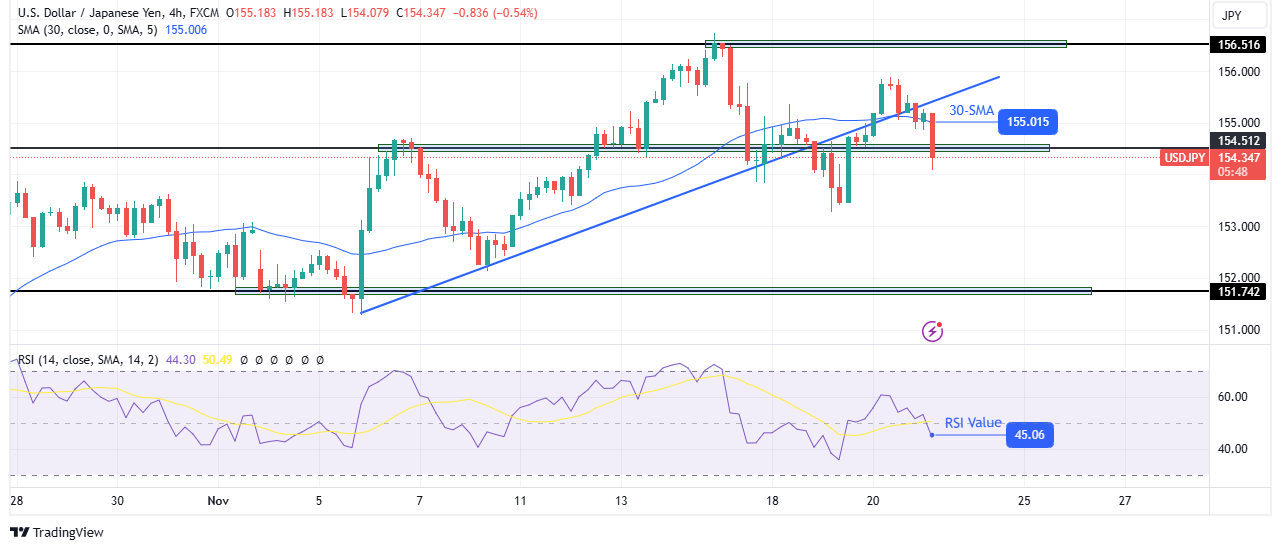
On the technical side, the USD/JPY price trades above the 30-SMA after a recent reversal. At the same time, the RSI trades above 50, supporting bullish momentum. Bulls took charge at the 142.56 key level. However, they are yet to find their feet above the SMA. 

Are you interested in learning more about making money with forex? Check our detailed guide-

Price action shows small-bodied candles, a sign of weak enthusiasm. Moreover, the price stays close to the SMA in a shallow move. If bulls regain momentum, USD/JPY will retest the 150.03 key level; otherwise, bears will trigger a decline in support to 142.56.

Looking to trade forex now? Invest at eToro!

67% of retail investor accounts lose money when trading CFDs with this provider. You should consider whether you can afford to take the high risk of losing your money.

Source link

12 08, 2024

Euro remains in range as markets await next catalyst

By |2024-08-12T13:46:13+03:00August 12, 2024|Forex News, News|0 Comments

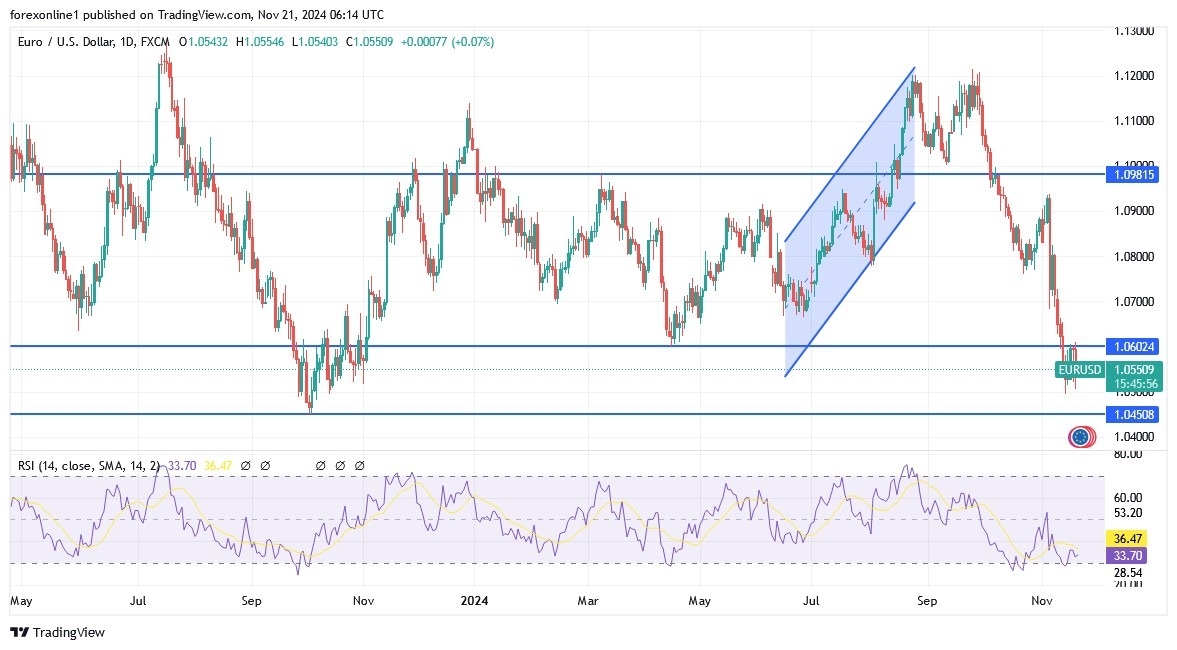
  • EUR/USD extends sideways grind above 1.0900 to start the new week.
  • Investors keep a close eye on headlines surrounding Iran-Israel conflict.
  • The economic calendar will not feature any high-tier data releases on Monday.

EUR/USD continues to move up and down in a narrow range above 1.0900 after closing the previous week virtually unchanged. The pair’s technical outlook does not offer any directional clues as investors remain on the sidelines while keeping a close eye on geopolitical headlines.

Euro PRICE Last 7 days

The table below shows the percentage change of Euro (EUR) against listed major currencies last 7 days. Euro was the weakest against the New Zealand Dollar.

  USD EUR GBP JPY CAD AUD NZD CHF
USD   -0.06% 0.31% 0.50% -1.07% -1.27% -1.17% 1.23%
EUR 0.06%   0.29% 0.40% -1.13% -1.20% -1.22% 1.19%
GBP -0.31% -0.29%   0.17% -1.40% -1.48% -1.50% 0.89%
JPY -0.50% -0.40% -0.17%   -1.52% -1.80% -1.64% 0.77%
CAD 1.07% 1.13% 1.40% 1.52%   -0.17% -0.10% 2.14%
AUD 1.27% 1.20% 1.48% 1.80% 0.17%   -0.02% 2.41%
NZD 1.17% 1.22% 1.50% 1.64% 0.10% 0.02%   2.43%
CHF -1.23% -1.19% -0.89% -0.77% -2.14% -2.41% -2.43%  

The heat map shows percentage changes of major currencies against each other. The base currency is picked from the left column, while the quote currency is picked from the top row. For example, if you pick the Euro from the left column and move along the horizontal line to the US Dollar, the percentage change displayed in the box will represent EUR (base)/USD (quote).

Markets turn cautious at the beginning of the week on growing fears over the Iran-Israel conflict turning into a deepening crisis in the Middle East. Although Euro Stoxx 50 Index is modestly higher in the first trading session of the week, US stock index futures struggle to gain traction.

The economic calendar will not offer any high-impact macroeconomic data releases on Monday. On Wednesday, the US Bureau of Labor Statistics will publish the Consumer Price Index (CPI) data for July. 

In case geopolitical tensions escalate further in the second half of the day, major equity indexes in the US could turn south. In this scenario, the US Dollar (USD) could hold its ground against its major rivals and make it difficult for EUR/USD to gain traction. On the other hand, the pair could stretch higher if risk flows return to markets following Wall Street’s opening bell.

EUR/USD Technical Analysis

The Relative Strength Index (RSI) indicator on the 4-hour chart continues to move sideways near 50, reflecting EUR/USD’s indecisiveness. 

First support could be seen at 1.0900 (psychological level, static level) ahead of 1.0880-1.0870, where the 100-period and the 20-day Simple Moving Averages (SMA) are located, and 1.0845 (200-period SMA).

In case the pair breaks above 1.0940 (static level), it could encounter next resistance levels at 1.0960 (static level) and 1.1000 (psychological level, static level).

Euro FAQs

The Euro is the currency for the 20 European Union countries that belong to the Eurozone. It is the second most heavily traded currency in the world behind the US Dollar. In 2022, it accounted for 31% of all foreign exchange transactions, with an average daily turnover of over $2.2 trillion a day. EUR/USD is the most heavily traded currency pair in the world, accounting for an estimated 30% off all transactions, followed by EUR/JPY (4%), EUR/GBP (3%) and EUR/AUD (2%).

The European Central Bank (ECB) in Frankfurt, Germany, is the reserve bank for the Eurozone. The ECB sets interest rates and manages monetary policy. The ECB’s primary mandate is to maintain price stability, which means either controlling inflation or stimulating growth. Its primary tool is the raising or lowering of interest rates. Relatively high interest rates – or the expectation of higher rates – will usually benefit the Euro and vice versa. The ECB Governing Council makes monetary policy decisions at meetings held eight times a year. Decisions are made by heads of the Eurozone national banks and six permanent members, including the President of the ECB, Christine Lagarde.

Eurozone inflation data, measured by the Harmonized Index of Consumer Prices (HICP), is an important econometric for the Euro. If inflation rises more than expected, especially if above the ECB’s 2% target, it obliges the ECB to raise interest rates to bring it back under control. Relatively high interest rates compared to its counterparts will usually benefit the Euro, as it makes the region more attractive as a place for global investors to park their money.

Data releases gauge the health of the economy and can impact on the Euro. Indicators such as GDP, Manufacturing and Services PMIs, employment, and consumer sentiment surveys can all influence the direction of the single currency. A strong economy is good for the Euro. Not only does it attract more foreign investment but it may encourage the ECB to put up interest rates, which will directly strengthen the Euro. Otherwise, if economic data is weak, the Euro is likely to fall. Economic data for the four largest economies in the euro area (Germany, France, Italy and Spain) are especially significant, as they account for 75% of the Eurozone’s economy.

Another significant data release for the Euro is the Trade Balance. This indicator measures the difference between what a country earns from its exports and what it spends on imports over a given period. If a country produces highly sought after exports then its currency will gain in value purely from the extra demand created from foreign buyers seeking to purchase these goods. Therefore, a positive net Trade Balance strengthens a currency and vice versa for a negative balance.
 

Source link

12 08, 2024

GBP/USD Forecast Today 12/8: Continues Grind Higher (Video)

By |2024-08-12T11:45:20+03:00August 12, 2024|Forex News, News|0 Comments

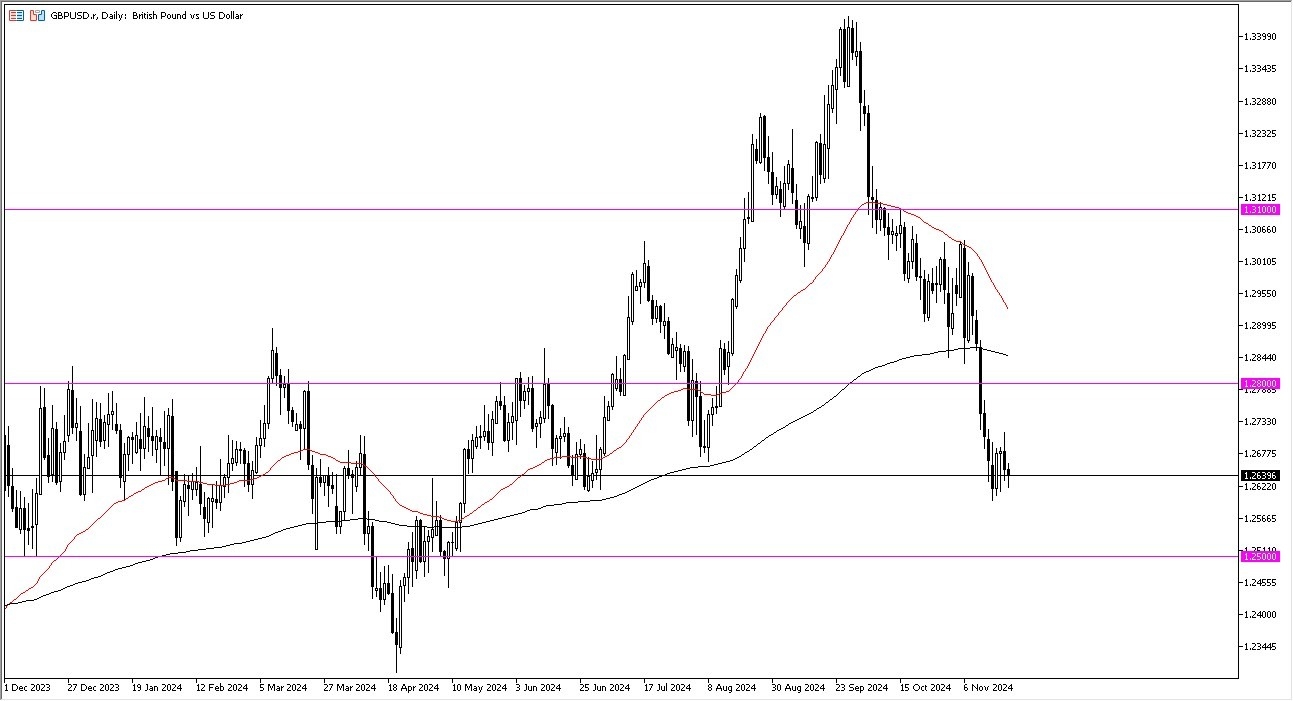
  • The British pound has risen slightly against the US dollar during Friday trading as we continue to see a lot of noisy behavior.
  • That being said, the market is likely to continue to see a lot of volatility.
  • It’s probably worth noting that the market has been bouncing around between the 200 day EMA and the 50 day EMA indicators, which of course causes a lot of chaos for technical traders sometimes.

If we can break above the 50 day EMA, then it’s likely that this market will continue to go much higher, perhaps reaching the 1.2850 level.

Anything above there then really gets things going. But what I would point out is that the 200 day EMA has held as support. And from a technical analysis standpoint, that’s a very bullish and positive turn of events. The candlestick size itself during the trading session on Friday isn’t necessarily anything special, but the candlestick on Thursday most certainly was. It looks as if we are ready to continue to grind higher and that might be the main feature here. The fact that we are grinding and not necessarily shooting straight up in the air. That does make a certain amount of sense.


Dips Could Bring in Buyers

So, I think ultimately, you’ve got a scenario where traders will continue to look at dips as potential buying opportunities, at least until we break down below the 200 day EMA, which ostensibly means the 1.2650 level below. I do expect a lot of choppy volatility, but that’s not necessarily an indictment on this pair. It’s just the way things have been in most financial markets. I don’t know that much will change as far as the way we are seeing more caution in a lot of markets. GBP/USD is a pair that favors the US Dollar on safety concerns, but the British Pound certainly won’t be as susceptible to few selling as many of the other currencies that I cover.

Ready to trade our Forex daily analysis and predictions? Here’s the best forex trading company in UK to trade with. 

Source link

11 08, 2024

Weekly Forex Forecast – 11/08 (Charts)

By |2024-08-11T23:39:12+03:00August 11, 2024|Forex News, News|0 Comments

I wrote on 4th August that the best trade opportunities for the week were likely to be going long of the following currency crosses; here are the results:

  1. EUR/JPY – a win of 0.13%.
  2. EUR/CHF – a win of 0.93%.
  3. GBP/JPY – a loss of 0.30%.
  4. CAD/JPY – a win of 1.13%.
  5. CHF/JPY – a loss of 0.75%.
  6. AUD/JPY – a win of 1.02%.
  7. GBP/CHF – a win of 0.60%.
  8. NZD/JPY – a win of 0.77%.
  9. CAD/CHF – a win of 2.04%.

These trades gave a total win of 5.57%, averaging a win of 0.62% per asset.

Last week’s key takeaways were:

  1. Last week saw a wild ride in financial markets, but the excessive swings up and down did not seem to be driven by any fundamental data. It looked to be more of a case of trends unwinding and causing a large spike in volatility, as often happens at the end of a trend. One of the most dramatic shocks was seen in the Japanese stock market, with the Nikkei 225 Index falling by more than 10% one day and then rising by more than 10% the next! The Japanese Yen also saw a huge swing higher, followed by a swing back as the Yen began to be sold again. The market started in a kind of risk-off swing before swinging back into risk-on as the week advanced, ending on a risk-on note. However, it seems that the volatility shock is over by now, so we will likely not see wild swings over the coming week. However, any US CPI (inflation) data surprises could trigger substantial market movements.
  2. US ISM Services PMI came in more or less as expected, so there was no surprise regarding the US economy.
  3. Reserve Bank of Australia Cash Rate, Rate Statement, and Monetary Policy Rate. The RBA maintained its Cash Rate at 4.35%, as was widely expected. However, the Bank did state that rates would not be cut for at least six months and that a rate hike had been considered. This boosted the AUD over the remainder of the week after it had sold off massively.
  4. New Zealand Inflation Expectations were slightly lower than expected, suggesting declining inflationary pressures.
  5. The Canadian and New Zealand Unemployment Rates were slightly lower than expected, suggesting more buoyant economic conditions.

It will be a busier week ahead in terms of data, with the most important items this coming week expected to be:

  1. US CPI
  2. US PPI
  3. US Retail Sales
  4. UK CPI
  5. UK Retail Sales
  6. UK GDP
  7. Australian Wage Price Index
  8. NZD Official Cash Rate, Rate Statement, and Monetary Policy Statement
  9. US Unemployment Claims
  10. UK Claimant Count Change
  11. Australian Unemployment Rate

I forecast that the EUR/USD currency pair will rise in value for August. The performance of my forecast so far is as follows:

Weekly Forex Forecast – 11/08 (Charts)

Last week, I forecasted that the following currency crosses would rise in value:

  • EUR/JPY
  • EUR/CHF
  • GBP/JPY
  • CAD/JPY
  • CHF/JPY
  • AUD/JPY
  • GBP/CHF
  • NZD/JPY
  • CAD/CHF

This was a good, profitable forecast.

This week, I gave no weekly forecast, as only one major currency pair or cross fluctuated in value by more than 2%. The odds of profitable reversals are better when several crosses have abnormally large price movements.

Directional volatility in the Forex market fell dramatically last week following a very volatile period. Only 30% of the most important currency pairs and crosses fluctuated by more than 1%.

Last week, the Canadian Dollar was the strongest major currency, while the Swiss Franc was the weakest.

You can trade these forecasts in a real or demo Forex brokerage account.

Weekly Forex Forecast – 11/08 (Charts)

The US Dollar Index printed a weakly bullish pin bar last week, rejecting both the lower ascending trend line of the consolidating triangle chart pattern, which has been holding the Dollar for almost two years, and the horizontal support level at 102.25. These are bullish signs, although the bounce was not particularly strong. On the other hand, the price is below its levels three months ago and six months ago, indicating a long-term bearish trend in the greenback.

The US Dollar was not the main factor in the markets last week, with several other assets seeing much more dramatic swings, such as the Japanese Yen and Australian Dollar. However, that could probably change this week, as we will get the release of US CPI, which can cause big moves if it is surprising.

This week, I am cautiously bearish on the US Dollar due to the bearish trend. However, it is likely much will depend upon the US CPI data release to determine where the greenback ends this coming week.

Weekly Forex Forecast – 11/08 (Charts)

I expected the EUR/USD currency pair to have potential resistance at $1.0998.

The H1 price chart below shows how the price action rejected this resistance level with a large bearish inside bar, marked by the down arrow within the price chart below, rejecting this resistance level shortly after the start of last Monday’s London / New York session overlap, signalling the timing of this bearish rejection.

This trade could still be open, but it has been nicely profitable so far, with a maximum reward-to-risk ratio of slightly more than 2 to 1.

Despite this bearish play setting up, I am bullish on this currency pair. It has recently made a new long-term high without making an overly deep bearish retracement, suggesting a valid long-term trend exists. That is why I hold a long position open here right now. I cannot say I am very optimistic about this trade, though, so maybe a smaller position is suitable.

Weekly Forex Forecast – 11/08 (Charts)

I expected the USD/CHF currency pair to have potential support at $0.8435.

The H1 price chart below shows how the price action rejected this support level with a large bullish engulfing candlestick, marked by the up arrow within the price chart below, rejecting this support level shortly after the start of last Monday’s London / New York session overlap, signalling the timing of this bearish rejection.

This trade could still be open, but it has been nicely profitable so far, giving a maximum reward-to-risk ratio of more than 3 to 1.

The Swiss Franc made a very strong advance over the previous week, and the price bounced back this week.

Weekly Forex Forecast – 11/08 (Charts)

Gold fell slightly in US Dollar terms last week. It initially dropped during the large risk-off swing early in the week before making a strong recovery. The precious metal ended the week not far from a new record all-time high closing price, which would be a bullish entry signal for trend or breakout traders.

I do not think Gold is looking bullish enough to justify a new long trade entry, but it threatens to make a technically significant bullish breakout, so it is worth watching.

The US Dollar is in a long-term bearish trend, which may help the price of Gold advance.

Bulls will look for a daily close above $2,470 or, even better, the big quarter-number at $2,500 before entering a new long trade here.

However, price action is choppy, with many recent deep retracements within the long, slow, bullish movement we have seen in Gold over recent months.

Weekly Forex Forecast – 11/08 (Charts)

The S&P 500 Index, like several other risky assets, fell sharply at the start of the week before rebounding strongly enough to close higher, printing quite a large bullish pin bar,

This was the first bullish weekly candlestick we have seen after three consecutive weeks of declines, suggesting that this may be a significant bullish reversal candlestick.

The long-term trend remains bullish, although the decline from the recent record high made only a few weeks ago was deep enough to know out most trend traders.

Over the past few weeks, the S&P 500 Index has begun to outperform the NASDAQ 100 index.

Anyone who sees this as an important supportive bounce in stock markets might prove their conviction with a long trade entry upon a break of last week’s high. I personally prefer to wait for a new all-time high, as we only recently had one a few weeks ago, before entering a new long trade here.

Weekly Forex Forecast – 11/08 (Charts)

I see the best trading opportunities this week as:

  • Long of the EUR/USD currency pair.
  • Long of Gold in USD terms following a daily close at $2,471 or higher.

Ready to trade our  Forex weekly forecast? We’ve made a list of the best Forex brokers worth reviewing.

Source link

11 08, 2024

USD/JPY Forecast: BoJ Rate Hike Boosts Yen to New Highs

By |2024-08-11T11:30:35+03:00August 11, 2024|Forex News, News|0 Comments

  • The yen is heading for a monthly gain of 5%.
  • The Bank of Japan raised rates by 25bps.
  • Investors are cautious ahead of the Fed policy meeting.

The USD/JPY forecast shows increased bearish sentiment as the yen surged after the Bank of Japan raised interest rates. At the same time, Japan’s central bank announced plans to reduce its massive economic stimulus. Meanwhile, investors were preparing for the Fed policy meeting.

Are you interested in learning more about Forex robots? Check our detailed guide-

The yen is heading for a monthly gain of 5%. The recent rally came after the BoJ hiked rates on Wednesday, tightening its monetary policy. Japan’s rates are now at 0.25%, meaning the policy divergence between the BoJ and the Fed is shrinking. 

The yen’s rally in July was caused by several factors. First, the Bank of Japan intervened in the markets by buying the yen and selling the dollar, resulting in a brief increase in demand for the yen.

Second, there was more speculation about a possible rate hike at the end of the month. Consequently, investors started pricing in higher rates even before the policy meeting. As it turns out, the BoJ did not disappoint. 

Third, markets hoped the BoJ would announce plans to reduce its bond purchases. However, the actual figures came in lower than expected. The central bank expects to halve its bond purchases by the first quarter of 2026.

Elsewhere, there was caution ahead of the Fed policy meeting. The US central bank will likely keep interest rates unchanged. However, traders hope policymakers will signal the first rate cut in September. 

USD/JPY key events today

  • BOJ Press Conference
  • US ADP non-farm employment change
  • US Employment Cost Index q/q
  • US pending home sales m/m
  • FOMC policy meeting

USD/JPY technical forecast: Bears take charge after bearish engulfing candle

USD/JPY Forecast: BoJ Rate Hike Boosts Yen to New Highs
USD/JPY 4-hour chart

On the technical side, the USD/JPY price has suddenly shifted from bullish to bearish. Initially, bulls took charge by breaking above the 30-SMA. However, they failed to breach the 154.80 key level. Here, the price made a bearish engulfing candle, indicating a looming reversal. 

Are you interested in learning more about XRP price prediction? Check our detailed guide-

The price fell back below the 30-SMA, and the RSI entered the oversold region. After the reversal pattern, bears took over and broke below the 152.01 support level. As a result, the price has made a lower low. If this bearish trend continues, the price will soon take out the 150.02 level. 

Looking to trade forex now? Invest at eToro!

68% of retail investor accounts lose money when trading CFDs with this provider. You should consider whether you can afford to take the high risk of losing your money.

Source link

11 08, 2024

USD/JPY Forecast: Yen Volatility with Japan’s GDP and US Inflation in Focus

By |2024-08-11T09:30:08+03:00August 11, 2024|Forex News, News|0 Comments

FX Empire – US Retail Sales

Michigan Consumer Sentiment and Consumption

On Friday, August 16, US consumer confidence will spotlight the US economy. Economists expect the Michigan Consumer Sentiment Index to increase from 66.4 in July to 66.7 in August.

A larger-than-expected increase could also support bets on the US avoiding a recession. Rising consumer confidence could boost spending and the US economy. However, investors should also consider subcomponents, including inflation expectations.

Consumers could delay purchases if they think inflation will soften in the near term, impacting consumer spending and the US economy. The Fed could signal a more dovish Fed rate path, lowering borrowing costs and increasing disposable income. Higher disposable income trends could boost spending.

Expert Views on the US Economy and the Fed Rate Path

FOMC member Michelle Bowman commented on inflation, the labor market, and the Fed rate path, stating,

“I am not confident that inflation will decline in the same way as in the second half of last year. Should the incoming data continue to show that inflation is moving sustainably toward our 2% goal, it will become appropriate to gradually lower the federal funds rate to prevent monetary policy from becoming overly restrictive on economic activity and employment.”

While leaving the door open to a Fed rate cut, Bowman also said,

“But we need to be patient and avoid undermining continued progress on lowering inflation by overreacting to any single data point.”

Softer US inflation and labor market data could bolster the case for multiple 2024 Fed rate cuts. A more dovish Fed rate path may also influence interest rate differentials and support a USD/JPY drop toward 140.

Short-term Forecast: Bearish

Near-term USD/JPY trends hinge on inflation numbers from Japan and the US, and US labor market data. Softer US inflation and labor market data could fuel bets on multiple 2024 Fed rate cuts and push the USD/JPY below 145. Moreover, higher producer prices and private consumption numbers from Japan could raise bets on a Q4 2024 BoJ rate hike and signal a USD/JPY drop toward 140.

Investors should remain alert in another crucial week for the USD/JPY pairing. Monitor real-time data, central bank views, and expert commentary to adjust your trading strategies accordingly. Stay informed with our latest analysis and news to navigate the FX markets.

USD/JPY Price Action

Daily Chart

The USD/JPY remained well below the 50-day and 200-day EMAs, confirming the bearish price trends.

A USD/JPY break above the 148.529 resistance level and trend line could give the bulls a run at 150. Furthermore, a return to 150 could signal a move toward the 151.684 resistance level and the 200-day EMA. Selling pressure could intensify at the 151.685 resistance level. The 200-day EMA is confluent with the resistance level.

Economic data from Japan and the US and central bank chatter require consideration.

Conversely, a drop below the 145.891 support level could bring the 143.495 support level into play. A fall through the 143.495 support level could signal a drop toward the 141.032 support level.

The 14-day RSI at 28.51 shows the USD/JPY in oversold territory. Buying pressure may increase at the 145.891 support level.

Source link

10 08, 2024

GBP/USD Weekly Forecast: BoE Confident to Cut Rates Further

By |2024-08-10T23:24:39+03:00August 10, 2024|Forex News, News|0 Comments

  • US services sector PMI data showed expansion.
  • US jobless claims fell, indicating a still-tight labor market.
  • The pound fell as markets contemplated the Bank of England’s first rate cut.

The GBP/USD weekly forecast is slightly bearish despite the recent rally, as the Bank of England appears more confident about cutting rates further. 

Ups and downs of GBP/USD

The pound had a bearish week but closed far above its lows. The pair started the week down as investors dumped risky assets amid fears of a US recession. Data in the previous week showed weaker-than-expected economic performance. 

Are you interested in learning more about STP brokers? Check our detailed guide-

However, this changed with the US services sector PMI data, which showed expansion. Meanwhile, jobless claims fell, indicating a still-tight labor market. Nevertheless, investors were already pricing a more significant 50 bps Fed rate cut in September.

Additionally, the pound fell as markets contemplated the Bank of England’s first rate cut. 

Next week’s key events for GBP/USD

GBP/USD Weekly Forecast: BoE Confident to Cut Rates Further

Next week, the pound might experience significant volatility due to US and UK inflation and retail sales data. Additionally, the UK will release data on employment, GDP, and manufacturing production. Markets will focus on the consumer inflation reports, shaping the outlook for monetary policy in the UK and the US. 

The Fed is looking to start its rate-cutting cycle in September. Inflation in the US has been on a downtrend, and the economy is beginning to crack. Therefore, further easing inflation will give policymakers enough confidence to cut interest rates. 

Meanwhile, the Bank of England recently implemented its first rate cut. However, most policymakers believe underlying inflation remains high. Still, they have gained enough confidence to start lowering borrowing costs.

GBP/USD weekly technical forecast: Bears eying 1.2620 support

GBP/USD weekly forecastGBP/USD weekly forecast
GBP/USD daily chart

On the technical side, the GBP/USD price trades below the 22-SMA with the RSI below 50. Therefore, bears are in control. However, the price has made higher highs and lows on a larger scale, indicating a bullish trend. 

Are you interested in learning more about making money with forex? Check our detailed guide-

After puncturing the 1.2800 support, bears are now eyeing the 1.2620 level. Initially, GBP/USD reached a higher low at this level. Therefore, it is a strong barrier. However, if bears breach this level, the price will make a lower low, breaking the bullish trend pattern. In this case, GBP/USD would confirm a new bearish trend. On the other hand, if the level holds firm as support, bulls might resurface to make a new high.

Looking to trade forex now? Invest at eToro!

67% of retail investor accounts lose money when trading CFDs with this provider. You should consider whether you can afford to take the high risk of losing your money.

Source link

10 08, 2024

USD/JPY Forecast – US Dollar Continues to Look Soft Against The Yen

By |2024-08-10T21:24:02+03:00August 10, 2024|Forex News, News|0 Comments

US Dollar vs Japanese Yen Technical Analysis

The U.S. dollar initially did try to rally a bit against the Japanese yen during the trading session on Friday, as it looks like we are going to continue to see a lot of back and forth behavior. Ultimately, I think this is a scenario where you look at this through the prism of trying to see whether or not we can break above the 148.50 yen level, which could kick off a deeper move to the upside. That being said, we are currently struggling with the overall a longer term uptrend. And if we can’t get above there, that shows a massive risk of this type of situation.

With that being said, the market is likely to remain somewhat range bound in this area. But if we were to break down below the swing low on Monday, that would be horrific sign for the dollar. And it would show that the Japanese yen should continue to strengthen. A lot of this comes down to deleveraging and the risk of trading. And at this point, we have seen a little bit of a bounce, but really not a lot to get excited about. So, I’m definitely watching this pair, as it can gives us a sign of where risk appetite is going. Ultimately, this is a market that I think will continue to be closely watched by traders in all markets, not just this one.

For a look at all of today’s economic events, check out our economic calendar.

This article was originally posted on FX Empire

More From FXEMPIRE:

Source link

9 08, 2024

Inches higher, yet struggles at 1.2785

By |2024-08-09T21:12:11+03:00August 9, 2024|Forex News, News|0 Comments

  • GBP/USD trades at 1.2760, up 0.11%, as it nears key resistance at 1.2785.
  • Range-bound movement persists between 1.2680 and 1.2785, with mixed momentum signals.
  • A break above 1.2785 targets 1.2800 and 1.2888, while a drop below 1.2657 could see a test of 1.2600 and 1.2445.

The Pound Sterling continued to register gains on Friday yet found some resistance at 1.2773, shy of hitting the 50-day moving average (DMA) at 1.2785, which, if cleared, could pave the way for further upside. However, the GBP/USD retreats somewhat and registers modest gains of 0.11%, trading at 1.2760.

GBP/USD Price Forecast: Technical outlook

After seesawing through most of the week, the GBP/USD pair has been range-bound, capped within the 1.2680-1.2785 range for the last four days, with key daily moving averages (DMAs) acting as support/resistance.

Momentum is also mixed, with the Relative Strength Index (RSI) standing bearish yet aiming slightly up.

Hence if GBP/USD clears the top of the range, that could pave the way for higher prices. The first resistance would be the 1.2800 figure. Despite that, buyers need to reclaim the July 29 peak at 1.2888, before challenging the 1.2900 figure.

Conversely, if sellers stepped in, they would test the 200-DMA at 1.2657. Once cleared, the pair would shift bearish, and it can challenge the 1.2600 mark. Underneath this level, bears could drag the spot price to test the latest cycle low of 1.2445, the May 9 low.

GBP/USD Price Action – Daily Chart

British Pound PRICE Today

The table below shows the percentage change of British Pound (GBP) against listed major currencies today. British Pound was the strongest against the Australian Dollar.

  USD EUR GBP JPY CAD AUD NZD CHF
USD   -0.01% -0.07% -0.47% -0.04% 0.32% 0.13% -0.30%
EUR 0.00%   -0.04% -0.40% -0.03% 0.33% 0.14% -0.29%
GBP 0.07% 0.04%   -0.37% -0.01% 0.37% 0.17% -0.22%
JPY 0.47% 0.40% 0.37%   0.37% 0.76% 0.55% 0.16%
CAD 0.04% 0.03% 0.00% -0.37%   0.35% 0.17% -0.23%
AUD -0.32% -0.33% -0.37% -0.76% -0.35%   -0.19% -0.59%
NZD -0.13% -0.14% -0.17% -0.55% -0.17% 0.19%   -0.40%
CHF 0.30% 0.29% 0.22% -0.16% 0.23% 0.59% 0.40%  

The heat map shows percentage changes of major currencies against each other. The base currency is picked from the left column, while the quote currency is picked from the top row. For example, if you pick the British Pound from the left column and move along the horizontal line to the US Dollar, the percentage change displayed in the box will represent GBP (base)/USD (quote).


Source link

9 08, 2024

Euro defines near-term range before next breakout

By |2024-08-09T17:10:33+03:00August 9, 2024|Forex News, News|0 Comments

  • EUR/USD extends sideways grind above 1.0900 on Friday.
  • Euro needs to break out of 1.0900-1.0940 range to determine next direction.
  • The economic calendar will not feature any high-impact data releases.

EUR/USD closed the second consecutive day virtually unchanged on Thursday. The pair continues to fluctuate in a tight channel above 1.0900 early Friday as investors await the next catalyst.

Euro PRICE This week

The table below shows the percentage change of Euro (EUR) against listed major currencies this week. Euro was the strongest against the Swiss Franc.

  USD EUR GBP JPY CAD AUD NZD CHF
USD   -0.07% 0.31% 0.44% -0.98% -1.25% -1.14% 0.85%
EUR 0.07%   0.31% 0.35% -1.03% -1.17% -1.18% 0.81%
GBP -0.31% -0.31%   0.11% -1.31% -1.47% -1.48% 0.51%
JPY -0.44% -0.35% -0.11%   -1.37% -1.72% -1.55% 0.44%
CAD 0.98% 1.03% 1.31% 1.37%   -0.24% -0.16% 1.66%
AUD 1.25% 1.17% 1.47% 1.72% 0.24%   -0.01% 2.00%
NZD 1.14% 1.18% 1.48% 1.55% 0.16% 0.00%   2.01%
CHF -0.85% -0.81% -0.51% -0.44% -1.66% -2.00% -2.01%  

The heat map shows percentage changes of major currencies against each other. The base currency is picked from the left column, while the quote currency is picked from the top row. For example, if you pick the Euro from the left column and move along the horizontal line to the US Dollar, the percentage change displayed in the box will represent EUR (base)/USD (quote).

EUR/USD edged lower in the early American session on Thursday after the data from the US showed that the weekly Initial Jobless Claims declined to 233,000 from 250,000. Later in the day, the US Dollar (USD) lost its strength as risk flows started to dominate the action in financial markets, allowing the pair to erase its daily losses.

The economic calendar will not offer any high-tier data releases that could influence EUR/USD’s action ahead of the weekend.

Hence, investors are likely to react to changes in risk perception. At the time of press, the Euro Stoxx 50 Index was up 0.25% on the day and US stock index futures were trading marginally higher.

In case market participants start moving away from risk-sensitive assets to avoid getting caught on the back foot over the weekend, the USD could stay resilient against its rivals and make it difficult for EUR/USD to stretch higher. On the other hand, a bullish opening in Wall Street and a continuation of the risk rally could help the pair hold its ground heading into the weekend.

EUR/USD Technical Analysis

The Relative Strength Index (RSI) indicator on the 4-hour chart moves sideways slightly above 50, reflecting a lack of directional momentum. On the downside, first support is located at 1.0900 (psychological level, static level) ahead of 1.0870, where the 100-period and the 50-period Simple Moving Averages (SMA) meet the 20-day SMA, and 1.0840 (200-period SMA).

In case the pair breaks above 1.0940 (static level), technical buyers could show interest. In this scenario, 1.0960 (static level) could be seen as interim resistance before 1.1000 (psychological level, static level).

Euro FAQs

The Euro is the currency for the 20 European Union countries that belong to the Eurozone. It is the second most heavily traded currency in the world behind the US Dollar. In 2022, it accounted for 31% of all foreign exchange transactions, with an average daily turnover of over $2.2 trillion a day. EUR/USD is the most heavily traded currency pair in the world, accounting for an estimated 30% off all transactions, followed by EUR/JPY (4%), EUR/GBP (3%) and EUR/AUD (2%).

The European Central Bank (ECB) in Frankfurt, Germany, is the reserve bank for the Eurozone. The ECB sets interest rates and manages monetary policy. The ECB’s primary mandate is to maintain price stability, which means either controlling inflation or stimulating growth. Its primary tool is the raising or lowering of interest rates. Relatively high interest rates – or the expectation of higher rates – will usually benefit the Euro and vice versa. The ECB Governing Council makes monetary policy decisions at meetings held eight times a year. Decisions are made by heads of the Eurozone national banks and six permanent members, including the President of the ECB, Christine Lagarde.

Eurozone inflation data, measured by the Harmonized Index of Consumer Prices (HICP), is an important econometric for the Euro. If inflation rises more than expected, especially if above the ECB’s 2% target, it obliges the ECB to raise interest rates to bring it back under control. Relatively high interest rates compared to its counterparts will usually benefit the Euro, as it makes the region more attractive as a place for global investors to park their money.

Data releases gauge the health of the economy and can impact on the Euro. Indicators such as GDP, Manufacturing and Services PMIs, employment, and consumer sentiment surveys can all influence the direction of the single currency. A strong economy is good for the Euro. Not only does it attract more foreign investment but it may encourage the ECB to put up interest rates, which will directly strengthen the Euro. Otherwise, if economic data is weak, the Euro is likely to fall. Economic data for the four largest economies in the euro area (Germany, France, Italy and Spain) are especially significant, as they account for 75% of the Eurozone’s economy.

Another significant data release for the Euro is the Trade Balance. This indicator measures the difference between what a country earns from its exports and what it spends on imports over a given period. If a country produces highly sought after exports then its currency will gain in value purely from the extra demand created from foreign buyers seeking to purchase these goods. Therefore, a positive net Trade Balance strengthens a currency and vice versa for a negative balance.
 

Source link

Go to Top