The main tag of Forex News Today Articles.
You can use the search box below to find what you need.
[wd_asp id=1]

5 08, 2024

Bulls struggle to take control despite broad USD weakness

By |2024-08-05T16:12:19+03:00August 5, 2024|Forex News, News|0 Comments

  • GBP/USD stays below 1.2800 in the European session on Monday.
  • Escalating geopolitical tensions force investors to seek refuge at the beginning of the week.
  • US economic docket will feature ISM Services PMI data for July.

GBP/USD closed in positive territory on Friday but failed to build preserve its recovery momentum at the beginning of the week. At the time of press, the pair was trading in the red slightly above 1.2750.

British Pound PRICE Last 7 days

The table below shows the percentage change of British Pound (GBP) against listed major currencies last 7 days. British Pound was the weakest against the Japanese Yen.

  USD EUR GBP JPY CAD AUD NZD CHF
USD   -0.87% 0.77% -7.48% 0.33% 1.48% -0.66% -3.75%
EUR 0.87%   1.64% -6.65% 1.25% 2.43% 0.21% -2.89%
GBP -0.77% -1.64%   -8.19% -0.41% 0.76% -1.40% -4.49%
JPY 7.48% 6.65% 8.19%   8.40% 9.70% 7.37% 4.02%
CAD -0.33% -1.25% 0.41% -8.40%   1.18% -1.00% -4.08%
AUD -1.48% -2.43% -0.76% -9.70% -1.18%   -2.12% -5.20%
NZD 0.66% -0.21% 1.40% -7.37% 1.00% 2.12%   -3.14%
CHF 3.75% 2.89% 4.49% -4.02% 4.08% 5.20% 3.14%  

The heat map shows percentage changes of major currencies against each other. The base currency is picked from the left column, while the quote currency is picked from the top row. For example, if you pick the British Pound from the left column and move along the horizontal line to the US Dollar, the percentage change displayed in the box will represent GBP (base)/USD (quote).

The selling pressure surrounding the US Dollar (USD) helped GBP/USD erase a portion of its weekly losses in the American session on Friday.

The US Bureau of Labor Statistics (BLS) reported that Nonfarm Payrolls rose 114,000 in July. This reading missed the market expectation for an increase of 175,000 by a wide margin. Other details of the jobs report showed that the Unemployment Rate climbed to 4.3% from 4.1% in June and the annual wage inflation softened to 3.6% from 3.8% in the same period. Following these labor market figures, markets started to price in a 50 basis points Federal Reserve (Fed) rate cut in September and caused the USD to weaken.

Over the weekend, several news outlets reported that Iran was preparing to attack Israel. Investors grow increasingly worried about a deepening conflict in the Middle East and it’s potential negative impact on markets. Early Monday, the UK’s FTSE 100 Index is down more than 2% on the day and US stock index futures lose between 1.6% and 4%, reflecting the intense flight to safety.

In the second half of the day, the ISM Services PMI data for July will be featured in the US economic docket. Investors see the headline PMI rising into the expansion territory above 51 from 48.8 in June. A disappointing PMI print could make it difficult for the USD to find demand and help GBP/USD find support. Nevertheless, the pair could struggle to gain traction unless risk mood improves in a noticeable way.

GBP/USD Technical Analysis

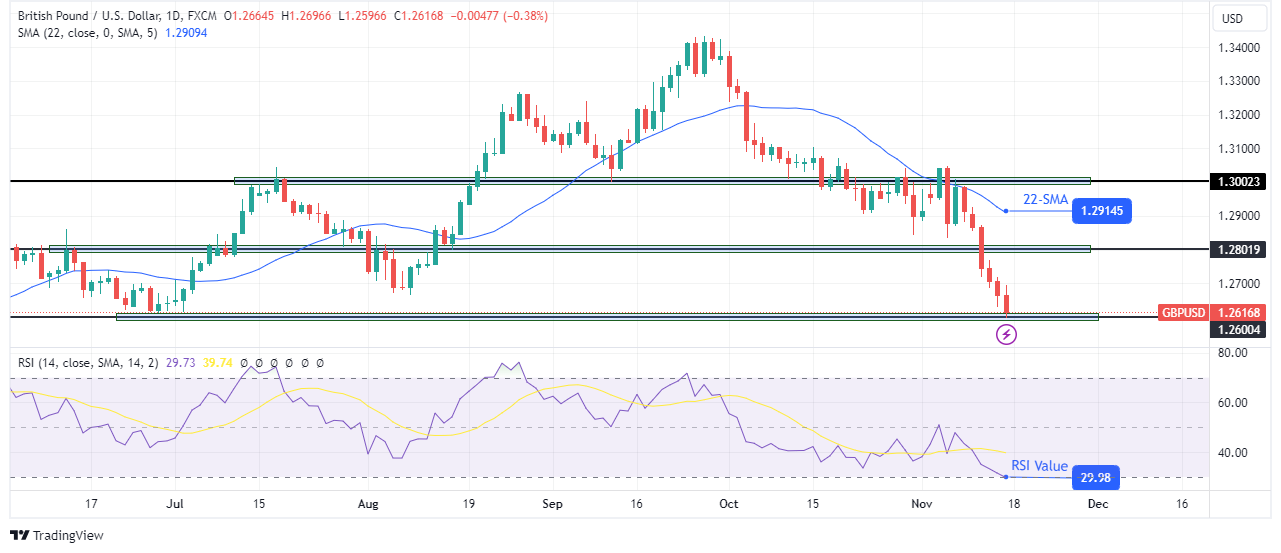
The Relative Strength Index (RSI) indicator turned south and declined below 40 after rising to 50 on Friday, suggesting that sellers look to retain control of GBP/USD’s action. A break below 1.2710-1.2700 support area, where the Fibonacci 78.6% retracement of the latest uptrend, could open the door for an extended decline toward 1.2620 (static level, beginning point of the uptrend).

On the upside, 1.2780 (Fibonacci 61.8% retracement) and 1.2800 (200-period Simple Moving Average, descending trend line) align as immediate resistance levels before 1.2830 (Fibonacci 50% retracement).

Risk sentiment FAQs

In the world of financial jargon the two widely used terms “risk-on” and “risk off” refer to the level of risk that investors are willing to stomach during the period referenced. In a “risk-on” market, investors are optimistic about the future and more willing to buy risky assets. In a “risk-off” market investors start to ‘play it safe’ because they are worried about the future, and therefore buy less risky assets that are more certain of bringing a return, even if it is relatively modest.

Typically, during periods of “risk-on”, stock markets will rise, most commodities – except Gold – will also gain in value, since they benefit from a positive growth outlook. The currencies of nations that are heavy commodity exporters strengthen because of increased demand, and Cryptocurrencies rise. In a “risk-off” market, Bonds go up – especially major government Bonds – Gold shines, and safe-haven currencies such as the Japanese Yen, Swiss Franc and US Dollar all benefit.

The Australian Dollar (AUD), the Canadian Dollar (CAD), the New Zealand Dollar (NZD) and minor FX like the Ruble (RUB) and the South African Rand (ZAR), all tend to rise in markets that are “risk-on”. This is because the economies of these currencies are heavily reliant on commodity exports for growth, and commodities tend to rise in price during risk-on periods. This is because investors foresee greater demand for raw materials in the future due to heightened economic activity.

The major currencies that tend to rise during periods of “risk-off” are the US Dollar (USD), the Japanese Yen (JPY) and the Swiss Franc (CHF). The US Dollar, because it is the world’s reserve currency, and because in times of crisis investors buy US government debt, which is seen as safe because the largest economy in the world is unlikely to default. The Yen, from increased demand for Japanese government bonds, because a high proportion are held by domestic investors who are unlikely to dump them – even in a crisis. The Swiss Franc, because strict Swiss banking laws offer investors enhanced capital protection.


Source link

5 08, 2024

USD/JPY Analysis Today 05/08: Channel Formation (Chart)

By |2024-08-05T14:10:27+03:00August 5, 2024|Forex News, News|0 Comments

  • The Japanese yen extended its rally to above 146.50 yen against the US dollar, its strongest level since last March, after the latest economic data widened the divergence between the monetary policy expectations of the US Federal Reserve and the Bank of Japan.
  • Recently, the weak US jobs report had prompted financial markets to prepare for further interest rate cuts by the Fed this year in response to growing signs of a slowing economy.
  • Meanwhile, the Bank of Japan raised its interest rate to a 16-year high of 0.25% and indicated the will to raise interest rates further if the economy merits it.
  • Financial markets are betting on two more rate hikes this fiscal year ending in March 2025, with another hike in December.

According to the economic calendar, recent data also showed that Japanese authorities spent 5.53 trillion yen to support the currency through intervention in July. Meanwhile, the Japanese government said a weaker yen could erode household purchasing power by pushing inflation higher than wage growth, highlighting the urgent need for officials to support the currency.

According to forex trading, the Japanese yen continued to strengthen against the US dollar, (USD/JPY) but it may have come at the expense of Japanese financial markets. The yen had fallen to a four-decade low before authorities intervened to support the currency. However, officials may have triggered a bear market for the country’s stock market. To end the trading week, Japan’s benchmark Nikkei 225 index fell about 6% to close Friday’s session at 35,909.70. Japan’s consumer price index recorded its worst single-day performance in March 2020, falling below 36,000 for the first time since January.

Also, Japanese government bond yields fell, with the benchmark 10-year yield falling below 1%, its lowest level in two months.

Meanwhile, financial markets in Tokyo weakened, the yen staged a dramatic reversal. Moreover, this was driven by the Bank of Japan surprising most economists by raising interest rates and planning to buy fewer bonds over the coming years. Furthermore, the decision was made after BoJ Governor Kazuo Ueda suggested that a weaker yen could raise inflationary threats and force struggling Japanese households to bear the brunt of higher prices.

Generally, investors are expecting another rate hike before the end of the year. “Today’s move supports USD/JPY’s return below 150.00. There could be further declines ahead as the BoJ supports a stronger yen to combat inflation, and as the yield spread between the US and Japan narrows further,” analysts at XTB said.

Whether this translates into further yen support remains to be seen. The US dollar has weakened amid the Federal Reserve’s signal of a September rate cut. According to electronic trading platforms, US financial markets have been falling over the past two sessions, with the technology-based Nasdaq Composite sliding into correction territory.

Meanwhile, the Japanese yen has fallen 4% against the US dollar since the start of the year. Global demand concerns for crude oil have recently outweighed supply risks from rising geopolitical tensions in the Middle East.

According to the economic calendar, data released on Friday showed that job growth in the United States slowed sharply, the unemployment rate rose to 4.3% and wage growth slowed. This comes on top of weak manufacturing data. The ISM manufacturing purchasing managers’ index revealed a larger-than-expected contraction in factory activity in the United States, while factory activity in China unexpectedly contracted, the first decline since last October.

Meanwhile, markets are closely watching Iran’s response to the assassination of Hamas leader Ismail Haniyeh, which followed the killing of Hezbollah’s top commander in an airstrike in Beirut.

USD/JPY Technical Analysis and Expectations Today

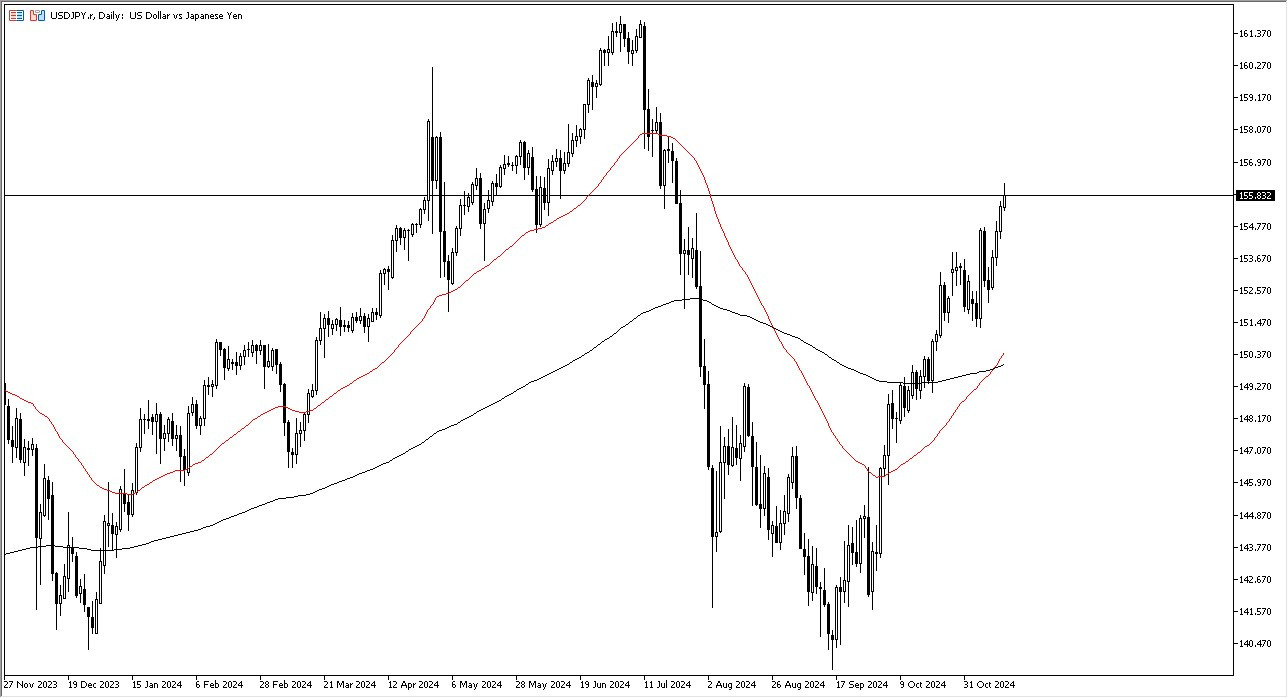
According to the performance on the daily chart below, the USD/JPY is in a downward channel path and the support of 146.00 confirms the bears’ control, while at the same time moving the technical indicators towards strong oversold levels. You can buy without risk from the support levels of 145.45 and 144.00 respectively. On the other hand, over the same period of time, stability above the resistance of 152.85 will give bulls a new opportunity to control. The USD/JPY price will continue to be affected by the future policies of global central banks, in addition to the extent of investors’ appetite for risk or not.

Ready to trade our daily forex forecast? Here are the best forex brokers in Japan to choose from. 

Source link

5 08, 2024

Tepid US data and potential rate cuts to keep weighing on the USD

By |2024-08-05T12:08:21+03:00August 5, 2024|Forex News, News|0 Comments

  • Tepid United States data fueled concerns about the country’s economic health.
  • Market players are increasing bets on a Fed 50 bps rate cut in September.
  • EUR/USD turned sharply higher and could test the 1.1000 in the upcoming sessions.

The EUR/USD pair fell to a fresh three-week low of 1.0776 on Thursday but managed to finish the week in the green above the 1.0900 threshold. Market players had loads to digest throughout the week, but in the end, mounting speculation that the Federal Reserve (Fed) will trim interest rates aggressively and tepid United States (US) data fueling recession fears weighed more.

Trouble in the Eurozone

The Euro had the chance to rally mid-week, but local data undermined its strength. Macroeconomic figures highlighted softer growth extended into the third quarter of the year, as the final Hamburg Commercial Bank (HCOB) Manufacturing PMI was confirmed at 45.8 in July, matching June’s reading. “The eurozone’s manufacturing sector suffered yet another setback at the start of the third quarter as a steeper reduction in new orders led contractions in output and employment to accelerate,” the official report reads.

Furthermore, Germany reported that the economy contracted in the second quarter of the year, as the Gross Domestic Product (GDP) fell 0.1% in the three months to June, according to preliminary estimates. The EU economy, however, expanded a modest 0.3% in the same period, slightly better than the 0.2% anticipated by market participants.

Finally, both economies reported the preliminary estimates of the July Harmonized Index of Consumer Prices (HICP). The German annual index was up by 2.6%, higher than the previous 2.5% and above the 2.4% anticipated. In Europe, the core annual HICP rose by 2.9%, also above the market’s expectations.

Federal Reserve paves the way for a September cut

As widely anticipated, the Fed left the federal funds rate unchanged at 5.25%- 5.5% in its July policy meeting.

The Fed introduced some changes to its statement, which grabbed investors’ attention. On the one hand, policymakers acknowledged that job gains have moderated, while inflation is now seen as “somewhat elevated.” Additionally, the Fed noted that it is attentive to risks on both sides of its dual mandate, a change from the June statement, in which it said it was “highly attentive” to inflation risks. Finally, the Committee judged that the risks to achieving its employment and inflation goals continued to move into better balance.

The US Dollar came under selling pressure as Chairman Jerome Powell delivered a speech and said that a September rate cut is on the table, particularly if macroeconomic data keeps moving in the current direction. However, he clearly remarked that policymakers have made no future decision on monetary policy, and that they will remain data-dependant. As a result, financial markets moved into pricing in at least two rate cuts before year-end, while there are mounting expectations the Fed will deliver three cuts in 2024.

Central banks in the eye of the storm

However, USD’s weakness was short-lived. The Greenback quickly trimmed losses and extended gains against major rivals as markets turned risk-averse. The reason behind the latter was a mixture of central banks’ announcements and tepid US data, fueling concerns about the health of the world’s largest economy.

On the one hand, the Bank of Japan (BoJ) and the Bank of England (BoE) announced their decisions on monetary policy. The first hiked interest rates by 15 basis points (bps), while the second trimmed its benchmark rate by 25 bps. Both decisions were widely anticipated, although only the BoJ is seen continuing its recent policy, putting local stocks in sell-off mode and spurring demand for the safe-haven USD. Meanwhile, tepid earnings reports also weighed on stock markets, fueling USD demand.

Concerns about US economic health

Stock markets tumbled after the US released the ISM Manufacturing PMI on Thursday. The index fell in July to 46.8 from 48.5 in the previous month, missing expectations of 48.8. The ISM report also showed a concerning uptick in Prices Paid, as the sub-index jumped to 52.9, higher than the 51.8 anticipated.

US employment-related data supported the case for rate cuts. The ADP report showed that the private sector added 122K new jobs in July, missing the 150K expected. Also, Initial Jobless Claims for the week ended July 26 unexpectedly rose to 249K, worse than anticipated. Additionally, US-based employers announced 25,885 job cuts in July, a 47% decrease from the 48,786 cuts announced one month prior, according to the Challenger Job Cuts report, while hiring fell to its lowest point in over a decade. Finally, Nonfarm Productivity rose 2.3% in the second quarter of the year, while Unit Labor Cost in the same period printed at 0.9%, much lower than the previous 3.8%.

Finally, the US released the July Nonfarm Payrolls (NFP) report on Friday. The report showed the country added 114,000 new jobs in July, missing the 175,000 expected. Furthermore,  the Unemployment Rate rose to 4.3% from 4.1% in the previous month, while the Labor Force Participation Rate ticked up to 62.7% from 62.6%. Finally, Average Hourly Earnings declined to 3.6% from 3.8% in the same period, indicating easing inflationary pressures from that side. Also, Factory Orders fell 3.3% MoM in June, worse than anticipated.

By the end of the week, speculative interest believed the Fed could cut up to 50 bps at the September meeting, while the odds for three rate cuts before year-end continued to increase. Before the NFP release, the chances of a 50 bps cut in September stood at 30%, soaring to roughly 90% afterwards.

Next in the macroeconomic front

The upcoming week will bring some interesting economic indicators, but for the most, financial markets are expected to trade on sentiment, with the Fed’s future actions in the eye of the storm.

On Monday, the US will publish the July ISM Services PMI, foreseen at 51.0, improving from 48.8 in June. Other than that, HCOB and S&P Global will release the final estimates of the Services and Composite PMIs for most major economies.

Germany will report June Factory Orders and Industrial Production for the same month. By the end of the week, the country will publish the final calculation of July inflation figures.  The Eurozone will offer June Retail Sales and August Sentix Investor Confidence.

The scheduled data has a limited potential to impact their respective currencies but would be a good barometer of economic health on both shores of the Atlantic.  

EUR/USD technical outlook  

From a technical point of view, the weekly chart for EUR/USD offers a neutral-to-bullish stance. The pair met buyers around a flat 20 Simple Moving Average (SMA), while the 100 SMA grinds higher below the shorter one. Technical indicators, in the meantime, tick higher within positive levels but lack clear directional strength. Finally, a mildly bearish 200 SMA stands at around 1.1080, a critical level to overcome to anticipate a sustained advance in the long term.

Technical readings in the daily chart support a bullish extension, particularly if the pair closes the week above the 1.0900 threshold. EUR/USD has accelerated above all its moving averages after meeting buyers around a mildly bearish 100 SMA and currently stands roughly 50 pips above a mildly bullish 20 SMA. At the same time, technical indicators head north almost vertically, with the Relative Strength Index (RSI) indicator currently standing at 59 but the Momentum indicator battling to overcome its 100 line.

July monthly high provides immediate resistance at 1.0947, with gains beyond this level aiming to test the 1.1000 psychological level. A break above the latter exposes the 1.1080 area.  Near-term support can be found at 1.0880, with a more relevant one at 1.0800. A downward acceleration through the latter opens the door for a test of 1.0720.

Fed FAQs

Monetary policy in the US is shaped by the Federal Reserve (Fed). The Fed has two mandates: to achieve price stability and foster full employment. Its primary tool to achieve these goals is by adjusting interest rates. When prices are rising too quickly and inflation is above the Fed’s 2% target, it raises interest rates, increasing borrowing costs throughout the economy. This results in a stronger US Dollar (USD) as it makes the US a more attractive place for international investors to park their money. When inflation falls below 2% or the Unemployment Rate is too high, the Fed may lower interest rates to encourage borrowing, which weighs on the Greenback.

The Federal Reserve (Fed) holds eight policy meetings a year, where the Federal Open Market Committee (FOMC) assesses economic conditions and makes monetary policy decisions. The FOMC is attended by twelve Fed officials – the seven members of the Board of Governors, the president of the Federal Reserve Bank of New York, and four of the remaining eleven regional Reserve Bank presidents, who serve one-year terms on a rotating basis.

In extreme situations, the Federal Reserve may resort to a policy named Quantitative Easing (QE). QE is the process by which the Fed substantially increases the flow of credit in a stuck financial system. It is a non-standard policy measure used during crises or when inflation is extremely low. It was the Fed’s weapon of choice during the Great Financial Crisis in 2008. It involves the Fed printing more Dollars and using them to buy high grade bonds from financial institutions. QE usually weakens the US Dollar.

Quantitative tightening (QT) is the reverse process of QE, whereby the Federal Reserve stops buying bonds from financial institutions and does not reinvest the principal from the bonds it holds maturing, to purchase new bonds. It is usually positive for the value of the US Dollar.

GDP FAQs

A country’s Gross Domestic Product (GDP) measures the rate of growth of its economy over a given period of time, usually a quarter. The most reliable figures are those that compare GDP to the previous quarter e.g Q2 of 2023 vs Q1 of 2023, or to the same period in the previous year, e.g Q2 of 2023 vs Q2 of 2022. Annualized quarterly GDP figures extrapolate the growth rate of the quarter as if it were constant for the rest of the year. These can be misleading, however, if temporary shocks impact growth in one quarter but are unlikely to last all year – such as happened in the first quarter of 2020 at the outbreak of the covid pandemic, when growth plummeted.

A higher GDP result is generally positive for a nation’s currency as it reflects a growing economy, which is more likely to produce goods and services that can be exported, as well as attracting higher foreign investment. By the same token, when GDP falls it is usually negative for the currency. When an economy grows people tend to spend more, which leads to inflation. The country’s central bank then has to put up interest rates to combat the inflation with the side effect of attracting more capital inflows from global investors, thus helping the local currency appreciate.

When an economy grows and GDP is rising, people tend to spend more which leads to inflation. The country’s central bank then has to put up interest rates to combat the inflation. Higher interest rates are negative for Gold because they increase the opportunity-cost of holding Gold versus placing the money in a cash deposit account. Therefore, a higher GDP growth rate is usually a bearish factor for Gold price.


Source link

5 08, 2024

GBP/JPY Forecast Today 02/08: Looking to Bounce (Video)

By |2024-08-05T10:05:28+03:00August 5, 2024|Forex News, News|0 Comments

  • In my daily analysis of the British pound against the Japanese yen, I find the price action somewhat interesting.
  • The Bank of England cut rates during the session and while the British pound did fall, as you would expect, the reality is that perhaps we’ve seen the worst of it.
  • We started to turn things around later in the day as the interest rate differential still heavily favors Great Britain.

After all, the Japanese barely offer any interest in, even with the interest rate cut coming out of the Bank of England, the market will still see the overnight rate at 5%. So, you’re earning well over 4.5% to simply hang on to this pair, and traders will be paying close attention to that. And of course, the pair is oversold.

Its Been Due for a Few Days

So, I think it’s probably due to bounce anyway. If we can recapture the 200 day EMA, I think a lot of traders will jump in based on FOMO and we’ll have to see how things work out from there. The other side of the equation of course is that we break down below the crucial 190 yen level. And I think at that point in time, you probably have a scenario where you end up just completely retracing the entire move, basically from Christmas of last year. The 190 yen level is also the 61.8% Fibonacci retracement level, so that comes into play as well, as a lot of traders will look at that as some type of guidepost.

Another factor that you need to pay close attention to is risk appetite. After all, the interest rate differential does favor more of a “risk on move”, as traders try to look for stable currency markets to pay swap at the end of each day. After all, even if you do get a little bit of a swap and at the same time the currency moves 300 pips against you, that doesn’t do much good. Stabilization will begin more buying before it is all said and done.

Ready to trade our Forex daily analysis and predictions? Here are the top UK forex trading platforms to choose from. 

Source link

5 08, 2024

Weekly Forex Forecast – 04/08 (Charts)

By |2024-08-05T08:04:38+03:00August 5, 2024|Forex News, News|0 Comments

I wrote on 28th July that the best trade opportunities for the week were likely to be:

  1. Long of the AUD/JPY currency cross. This produced a loss of 5.25%.
  2. Long of the CAD/JPY currency cross. This produced a loss of 4.96%.
  3. Long of the EUR/JPY currency cross. This produced a loss of 4.24%.
  4. Long of the GBP/JPY currency cross. This produced a loss of 5.18%.
  5. Long of the NZD/JPY currency cross. This produced a loss of 3.55%.

These trades gave a total loss of 23.18%, averaging a loss of 4.64% per asset.

Last week’s key takeaways were:

  1. Possibly the most important event was the US Federal Reserve’s policy meeting. There was an overwhelming expectation that interest rates would be left unchanged despite evidence of declining inflationary pressures and a slowing economy. This was proven correct, but it was the Statement and comments from Fed officials that moved markets and created a more dovish tilt on the US Dollar policy outlook. Fed President Jerome Powell made clear that rate cuts are about to begin as there is a risk of the labour market. Markets were already strongly expecting a rate cut at the September Fed meeting, but these comments had an immediate dovish effect, and sent the US Dollar lower, while US treasury yields fell very sharply very quickly. Both the 2-year and 10-year yields are trading well below 4%, with the 2-year yield falling by more than 0.50% in just 3 days.  The dovish outlook on the Dollar and rates was reinforced Friday with lower-than-expected average hourly earnings and non-farm payrolls data.
  2. The Japanese Yen made extremely strong gains again last week, as the Bank of Japan hiked rates by 0.15% to 0.25% and announcing a halving of its bond purchases. Traders pushed the Yen higher by close to 5% over the past week alone, which is an enormous advance in a very short time for a major currency which can act as a safe haven for investors. The Yen is now trading at long-term highs against some major currencies after trading at record lows just a few short weeks ago.
  3. The Bank of England cuts its interest rate by 0.25% to 5%. The vote was slightly less convincing than was expected, but the cut was widely expected to happen.
  4. Global equity markets generally fell significantly last week, especially technology stocks, continuing a recent trend. However, it is far from clear that the bull market in stocks in over.
  5. Inflation data released last week from a few countries gave the following results:
    1. Eurozone CPI Flash Estimate came in just a fraction higher than expected.
    2. German Preliminary CPI – as expected.
    3. Swiss CPI – as expected.
    4. Australia CPI – as expected.
  6. Canadian GDP data showed very slightly stronger economic growth than expected.

It will be a relatively quiet week in terms of data, with the most important items this coming week expected to be:

  1. US ISM Services PMI.
  2. Reserve Bank of Australia Cash Rate, Rate Statement, and Monetary Policy Rate.
  3. New Zealand Inflation Expectations.
  4. Canada Unemployment Rate.
  5. New Zealand Unemployment Rate.

Last month, I forecasted that the USD/JPY currency pair would increase in value. The performance of this forecast is as follows:

Weekly Forex Forecast – 04/08 (Charts)

For the month of August, I forecast that the EUR/USD currency pair will rise in value.

Last week, I forecasted that the following Japanese Yen crosses would rise in value:

  • AUD/JPY
  • CAD/JPY
  • EUR/JPY
  • GBP/JPY
  • NZD/JPY

I was wrong, as all decreased in value.

This week, I forecast that the following currency crosses will rise in value:

Directional volatility in the Forex market rose again last week, with 67% of the most important currency pairs and crosses fluctuating by more than 1%.

Last week, the Japanese Yen was again the strongest major currency, and the Australian Dollar was again the weakest.

You can trade these forecasts in a real or demo Forex brokerage account.

Weekly Forex Forecast – 04/08 (Charts)

The US Dollar Index printed a large bearish engulfing candlestick last week, which closed right near its low, at the lowest price seen in almost 5 months. The price is now below its levels of both 3 months ago and 6 months ago, indicating a new long-term bearish trend in the greenback. These are all bearish signs.

The technical slip matches the dovish change in fundamentals, with the Federal Reserve making clear that it will soon begin cutting interest rates, and with US treasury yields falling very quickly and sharply after the Fed’s meeting last week. There was also economic data released Friday which clearly indicated that the US economy is slowing significantly.

I am bearish on the US Dollar this week. However, it is worth noting that technically, the price is not very far from both a horizontal support level, and an ascending trend line marking the lower edge of the narrowing triangle chart pattern that has contained the US Dollar for about the past year.

Weekly Forex Forecast – 04/08 (Charts)

The EUR/USD currency pair rose strongly last week to print a fairly large engulfing candlestick which closed near its high. This is the highest weekly close seen in this currency pair in almost 5 months. These are bullish signs, but bulls should not that according to the price chart below, the price action over the past several months has been rather consolidative.

The Euro tends to trend quite reliably, but often does so slowly, with deep retracements. Nevertheless, I see the current technical situation as justifying entering a new long trade, it just might well take a long time to pay off.

A long position here is supported by the bearish picture both technically and fundamentally in the US Dollar, it is more the Euro which needs to start moving.

Weekly Forex Forecast – 04/08 (Charts)

I expected the USD/CHF currency pair to have potential resistance at $0.8875.

The H1 price chart below shows how the price action rejected this resistance level with a large bearish engulfing candlestick, marked by the down arrow within the price chart below, rejecting this resistance level during last Tuesday’s London session, signaling the timing of this bearish rejection.

This trade could still be open, but it has been extremely profitable so far, giving a maximum reward-to-risk ratio of approximately 14 to 1.

Along with the Japanese Yen, the Swiss Franc is a very strong currency, gaining firmly in value over the past week.

Weekly Forex Forecast – 04/08 (Charts)

The AUD/JPY currency cross fell extremely strongly last week for the second consecutive week to close lower by more than 4%. In fact, the week’s decline was greater than 5%. This is an unusually large price movement that has not been seen for years. It was a very bearish weekly candle, with the price closing right on its low.

Although the Australian Dollar traded significantly lower last week on declining risk appetite, the Japanese Yen remains the real story. It enjoyed yet another week of dramatic strengthening but by even more than the previous week’s strong advance. This was driven by the Bank of Japan’s divergent rate hike, and tighter monetary policy of halving its bond purchase program.

The Yen and Aussie are the two biggest movers in the Forex market, putting this currency cross in focus.

Technically, the drop shown in the price chart is fascinating – the move looks like a knife cutting through hot butter, as it overcomes months of grinding, advancing price action. This is a sign of fundamental change.

Although we can say that there is strong bearish momentum, I expect that with the price so oversold and trading near a cluster of key support levels, and with so many currency crosses having outsized movements last week, the price of this currency cross will advance over the coming week, at least by a little.

Therefore, I expect this currency pair’s price to rise over the coming week, along with several other Yen crosses.

Weekly Forex Forecast – 04/08 (Charts)

Gold rose last week to print a normally sized bullish candlestick which made the highest ever weekly close. However, it must be noted that the candlestick has a large upper wick which has rejected two key resistance levels, and the price action last week did not make a new record high.

I do not think Gold is looking bullish enough to justify a new long trade entry, but it is threatening to make a technically significant bullish breakout, so it is worth watching.

The US Dollar is looking bearish, which may help the price of Gold to advance.

Bulls will be looking for a daily close above $2,466 or, even better, the big quarter-number at $2,500.

Weekly Forex Forecast – 04/08 (Charts)

The S&P 500 Index fell again last week, after the previous two weeks when the major stock market index posted its biggest loss in months.

The move down was reasonably strong, but nothing out of the ordinary. Most trend traders won’t be in a long trade here any longer despite the recent strong bullish run, as the price has retraced by more than three times the long-term daily average true range.

Technology stock indices like the NASDAQ 100 have performed even more bearishly over the past week, suggesting that the stock market has made a rotational shift. Broader market investments now look likely to outperform leading technology stocks.

Despite the recent bearishness, it cannot yet be said that the bull market is over here. The price area that stands out as most likely to be pivotal is the big quarter-number at 5,250. If we see a strong daily or weekly close below that level, we will likely be in for an even deeper retracement, and maybe also a technical end to the bull market that comes when the price is more than 20% off its peak.

Weekly Forex Forecast – 04/08 (Charts)

US Treasury Yields fell very dramatically and strongly last week. The weekly drop was the largest seen in over one year. Treasury yields had already been falling in recent days, but the Fed meeting which resulted in a dovish tilt really sent the yields tumbling. It is notable that both the 2-year and the 10-year yields tumbled and ended up well below 4%, suggesting a major shift in the market’s expectation towards a deeper path of rate cuts going forward.

It may be a bit too late to enter a new short trade here, however. Nevertheless, traders should remember that US Treasury Yields have an excellent record of trending reliably, the problem is whether you have access to futures and the differential of that price which can make it difficult to find a way to profit.

Weekly Forex Forecast – 04/08 (Charts)

US Treasury Yields fell very dramatically and strongly last week. The weekly drop was the largest seen in years. Treasury yields had already been falling in recent days, but the Fed meeting which resulted in a dovish tilt really sent the yields tumbling. It is notable that both the 2-year and the 10-year yields tumbled and ended up well below 4%, suggesting a major shift in the market’s expectation towards a deeper path of rate cuts going forward.

It may be a bit too late to enter a new short trade here, however. Nevertheless, traders should remember that US Treasury Yields have an excellent record of trending reliably, the problem is whether you have access to futures and the differential of that price which can make it difficult to find a way to profit.

Weekly Forex Forecast – 04/08 (Charts)

I see the best trading opportunities this week as long of the following currency crosses.

  • EUR/JPY
  • EUR/CHF
  • GBP/JPY
  • CAD/JPY
  • CHF/JPY
  • AUD/JPY
  • GBP/CHF
  • NZD/JPY
  • CAD/CHF

I also think a long trade in the EUR/USD currency pair could work out well.

Ready to trade our weekly Forex analysis? We’ve made a list of the top Forex brokers worth checking out.

Source link

5 08, 2024

EUR/GBP remains on the front foot following BoE interest rate decision This is

By |2024-08-05T05:59:24+03:00August 5, 2024|Forex News, News|0 Comments

EUR/GBP exchange continues to firm following BoE rate cut

The euro pound (EUR/GBP) exchange rate is continuing on its upward trajectory this morning following the Bank of England’s (BoE) latest interest rate decision yesterday afternoon.

At the time of writing, the EUR/GBP exchange rate is trading at around €0.8496, up roughly 0.2% from this morning’s opening rate.

Pound (GBP) undermined by BoE rate cut

The pound (GBP) has remained on the back foot against the majority of its peers this morning following the BoE’s decision to cut interest rates yesterday afternoon.

The central bank voted to loosen monetary policy from its 16-year high of 5.25%, with five of the nine monetary policy members voting for a 25-basis point cut.

BoE Governor Andrew Bailey, who was one of the five MPC members who voted for the cut, commented:

‘Inflationary pressures have eased enough that we’ve been able to cut interest rates today, but we need to make sure inflation stays low, and be careful not to cut interest rates too quickly or by too much.’

Following the release, Sterling experienced a sharp selloff, with the currency reaching some of its lowest levels this morning.

Also applying pressure onto GBP exchange rates is this morning’s risk-off mood. As an increasingly risk-sensitive currency, the pound is further stymied by the downbeat market mood.

Euro (EUR) flat amid lull in data

The euro (EUR) is trading in a narrow range against the majority of its peers this morning amid an absence of macroeconomic data releases from within the Eurozone, leaving the common currency largely directionless.  

However, the euro has managed to recoup some of its losses from yesterday, following a duo of disappointing data releases.

The Eurozone’s finalised manufacturing index for July printed at 45.8, remaining in the contraction zone (a reading below 50), while the bloc’s latest unemployment rate unexpectedly rose from its historic lows of 6.4%.  

EUR/GBP forecast: BoE speech to drive movement?

Looking ahead, the primary catalyst of movement for the EUR/GBP exchange rate for the remainder of the day will likely be a speech from BoE official Huw Pill.

As Pill was one of the four policymakers who voted to hold interest rates at 5.25%, could any hawkish comments from the rate-setter see the pound claw back some of its losses?

Turning to the euro, a continued absence of market moving data will likely see EUR exchange rates remain trading without a clear trajectory.

However, as a safe-haven currency, should markets remain cautious, the euro could close the week firming against its peers.

Source link

30 07, 2024

AUD/USD Forecast – Australian Dollar Continues to Go Sideways

By |2024-07-30T22:48:54+03:00July 30, 2024|Forex News, News|0 Comments

Australian Dollar vs US Dollar Technical Analysis

The Australian dollar has gone back and forth during the last couple of days and as we currently stand, it looks like the 0.6550 level remains a bit of a magnet for price. Quite frankly, the market is taking a break after a severe beating over the last couple of trading sessions, going back really about two and a half weeks where we plunged from the 0.6790 region. At this point, we have to question whether or not the market is able to continue this type of downward pressure, or will we get a relief rally?

As things stand right now, it looks like we’re just content to go sideways. We could be forming a little bit of a basing pattern, but we would need to see the 0.6575 level taken to the upside to even start to think about that. Furthermore, we have a Federal Reserve meeting on Wednesday, which will probably be the catalyst, regardless of which direction we go.

Once we get a read on the Federal Reserve monetary policy, that will affect the dollar, and of course the Australian dollar will react in kind against that greenback. So, we’ll just have to wait and see. I suspect we probably have another 24 hours or so of this sideways action. After that, I would hope that things become much clearer. This is a market that also has a lot of input from risk appetite, so make sure you understand that as well.

For a look at all of today’s economic events, check out our economic calendar.

This article was originally posted on FX Empire

More From FXEMPIRE:

Source link

30 07, 2024

EUR/USD Analysis Today 30/7: Downward Momentum (Chart)

By |2024-07-30T20:47:58+03:00July 30, 2024|Forex News, News|0 Comments

  • The EUR/USD exchange rate is expected to remain under moderate pressure in the coming days, with focus on Eurozone inflation figures ahead of the Fed decision and US wage figures.
  • According to reliable trading platforms, the EUR/USD rate has retreated from its July highs of 1.0948 and has now recorded three consecutive weeks of declines, consistent with a soft tone.
  • Weakness is likely to be limited, with selling interspersed with upside days.

As for the outlook for the currency pair, we look for a gentle pullback to the 50-day moving average at 1.0811 in the coming days. Also, note that this is the approximate location of the 38.2% Fibonacci retracement from the 2024 high to low. Technically, a break of the EUR/USD support level of 1.0780 would reinforce the bears’ position of control over the trend.

We expect potential volatility in the euro exchange rate from Tuesday when the eurozone CPI inflation figures start to come in, with the initial focus on the German figure. According to the economic calendar, the state-level figures are released from 7am German time, which could give early guidance for the full German figure due later in the day. This, along with the Spanish CPI release, could give some direction for how the eurozone inflation figure will turn out mid-week. The eurozone is expected to post a 2.3% year-on-year figure, which is consistent with an ongoing process of deflation. The European Central Bank is expected to cut interest rates again in September, meaning it would take a big surprise in the data to have a lasting impact on the euro. Instead, it is the US dollar side of the equation that will provide the volatility this week. The Federal Reserve is due to release its policy decision on Wednesday. Moreover, there will be no change in US interest rates. We expect dovish guidance in line with expectations for the first interest rate in September. Now, the market is “fully priced in” for such an outcome, meaning the US dollar will rally if the Fed casts any doubt on the shot at starting its rate-cutting cycle in September. Furthermore, we expect the Fed to continue its new strategy of highlighting concerns that keeping interest rates unchanged for too long could negatively impact the labor market.

Concurrently, this is consistent with the Fed saying it believes it can afford to cut US interest rates before inflation falls to its 2.0% target. On Friday, the most important event for the US dollar comes when the US jobs report is released. If the data comes in below expectations, the market will price in more policy easing from the US Federal Reserve in the coming months, which will weigh on the dollar.

The US non-farm payrolls data for July is expected to show an increase of +178K jobs, with the unemployment rate remaining at 4.1%. This comes after a stronger-than-expected reading of +206K jobs in June.

EUR/USD Technical analysis and forecast:

There is no change in my technical view of the performance of the Euro against the US Dollar EUR/USD as the general trend will remain bearish and breaking the support 1.0800 is possible and will strengthen the bears’ control of the trend and thus prepare for stronger losses. Furthermore, the technical indicators will move towards strong oversold levels on the daily chart if the Euro Dollar price moves towards the support levels 1.0735 and 1.0600 respectively. On the other hand, and for the same time period, the psychological resistance 1.1000 will remain the most important for the upward shift of the general trend.

Ready to start trading the EUR/USD daily forecasts? Get our top Forex brokers list we recommend here.

Source link

30 07, 2024

GBP/USD Analysis Today 30/7: Under Pressure (Chart)

By |2024-07-30T18:46:53+03:00July 30, 2024|Forex News, News|0 Comments

  • The GBP/USD exchange rate may remain under pressure amid a potential UK interest rate cut and Friday’s US jobs report.
  • Ahead of these important and influential events, the GBP/USD rate is holding around 1.2810 at the time of writing, its lowest in over two weeks.

According to the economic calendar, the Bank of England decision this week will be the main focus for the pound, and the market is currently split 50/50 on whether the bank will go ahead with a rate cut. The heightened uncertainty means that markets will be sensitive to the outcome, and as such, we could see some high volatility this week.

Our general outlook for this week is for weakness in the near term as traders position themselves for potential volatility. Thus, this caution could reflect GBP/USD weakness, and a pullback towards 1.28 cannot be ruled out in the near term. A pullback to this level is likely to be more likely if global equity markets continue to struggle; last week we saw the pound come under pressure amid a broad sell-off in equity markets, a reminder that the exchange rate is sensitive to broader sentiment.

Currently, financial markets are pricing in just over a 50% chance of a rate cut on Thursday. Sterling’s weakness last week certainly reflects a rebuilding of this expectation, with the odds of a cut now closer to 40%. Also, the market has built up a record long position in sterling over recent weeks as investors look for further outperformance. Meanwhile, the risk is that this crowded positioning will be eroded by any disappointment, exposing sterling to a deeper pullback. Even in the case of a hawkish cut, we tend to think that markets will continue to sell sterling on a cut as positions are pared back, a “hawkish cut” being when the Bank cuts interest rates but signals to the markets that further cuts are not guaranteed and are dependent on upcoming economic data.

But what if the Bank does not cut rates?

This could provide some upward relief for the GBP, which could rebound towards the end of the week, especially if the US jobs report on Friday falls short of expectations. However, the rise in GBP/USD is likely to be limited as the bank will surely “pave the way” for a rate cut in September. According to analysts at Oxford Economics, “the conditions are ripe for the MPC to cut, but we think it will wait until September to avoid surprising the markets.” A strong commitment to a rate cut in September would make this a “dovish hold,” which does not entirely align with a GBP recovery.

Beyond short-term weakness prospects, Bank of America sees the structural backdrop still supportive for the GBP: “Excluding event risks and with the new government in a hurry to announce policy, we look for further GBP appreciation in the coming months. Asset investment remains supportive, but near-term positioning is crowded.”

Furthermore, this fits into the broader theme of near-term weakness before a resumption of the rally sometime in the coming weeks.

A big week for the US Federal Reserve

Turning to the US dollar, the Federal Reserve is expected to release its policy decision on Wednesday. No change in US interest rates will be made. Instead, we expect a dovish tone in line with expectations for the first rate cut in September. Concurrently, the market is now “fully priced in” for such an outcome, meaning the US dollar will rally if the Fed casts any doubt on the launch of a rate-cutting cycle in September. Moreover, we expect the Fed to continue its new strategy of highlighting concerns that keeping rates on hold for too long could be detrimental to the labor market.

This aligns with the Fed’s statement that it believes it can afford to cut interest rates before inflation falls back to its 2.0% target. Decisively, the most important event for the US dollar comes on Friday when the US jobs report is released. If the data comes in below expectations, the market will price in further policy easing from the Fed in the coming months, which will weigh on the dollar.

Technical forecasts for the GBP/USD pair today:

We believe that any weakness in the GBP/USD from here could lead to a decline in the exchange rate back to the 1.2760 area. Technically, this aligns with the 38.2% Fibonacci retracement of the April to July rise and considers the 50-day moving average (DMA) at 1.2780. The 50-day moving average halted the decline in June, where the uptrend was confirmed again.

Get ready to trade the GBP/USD daily forecasts. Open a Forex account with a broker that works for UK traders here.

Source link

30 07, 2024

USD/JPY Outlook: Recovering as Investors Eye BoJ, Fed

By |2024-07-30T16:45:15+03:00July 30, 2024|Forex News, News|0 Comments

  • Last week, the yen gained over 2% against the US dollar.
  • The BoJ might hike rates by 10bps.
  • The Fed will likely keep rates unchanged.

The USD/JPY outlook shows a mild bullish move as the pair recovers ahead of monetary policy meetings in Japan and the US. Investors are eyeing a potential rate hike from the Bank of Japan on Wednesday. Meanwhile, expectations suggest the Fed will maintain its current rates.

Are you interested in learning more about Forex robots? Check our detailed guide-

Last week, the yen gained over 2% against the US dollar amid increased expectations for a BoJ rate hike. Investors have gained confidence in a hike because of increased pressure to support the weak yen. As a result, there is a 63% chance that Japan’s central bank will announce a 10bps rate hike tomorrow. 

However, experts have warned that there is a risk the central bank might disappoint. The BoJ has surprised markets many times before. If there is no rate hike tomorrow, it might be a dark day for the yen. 

Meanwhile, traders also anticipate the BoJ’s announcement of plans to reduce its bond purchases. Such an outcome would show confidence that Japan’s economy is on steadier ground, which could propel the yen higher.

On the Fed’s side, investors will focus on economic projections and Powell’s message. At the last meeting, the Fed projected one rate cut in December, which led to a decline in September’s rate cut expectations. If policymakers maintain this outlook, rate-cut bets will fall again, boosting the dollar. However, market participants expect a more dovish outlook given the recent cooler inflation. Notably, policymakers could signal the first cut in September.

USD/JPY key events today

  • US CB consumer confidence
  • US JOLTS Job Openings

USD/JPY technical outlook: Morning Star pattern ignites buyers

USD/JPY Outlook: Recovering as Investors Eye BoJ, Fed
USD/JPY 4-hour chart

On the technical side, the USD/JPY price has broken above the 30-SMA, indicating a shift in control from bears to bulls. The RSI also shows a shift in sentiment, having broken above 50. This new move comes after the downtrend paused at the 152.01 support level. 

Are you interested in learning more about XRP price prediction? Check our detailed guide-

At this point, the price made a Morning Star candlestick pattern, signaling a looming bullish reversal. Since then, bulls have taken charge and broken above the 30-SMA. However, they face a solid barrier at the 154.80 key level. A break above would clear the path to the next resistance at 158.02.

Looking to trade forex now? Invest at eToro!

68% of retail investor accounts lose money when trading CFDs with this provider. You should consider whether you can afford to take the high risk of losing your money.

Source link

Go to Top