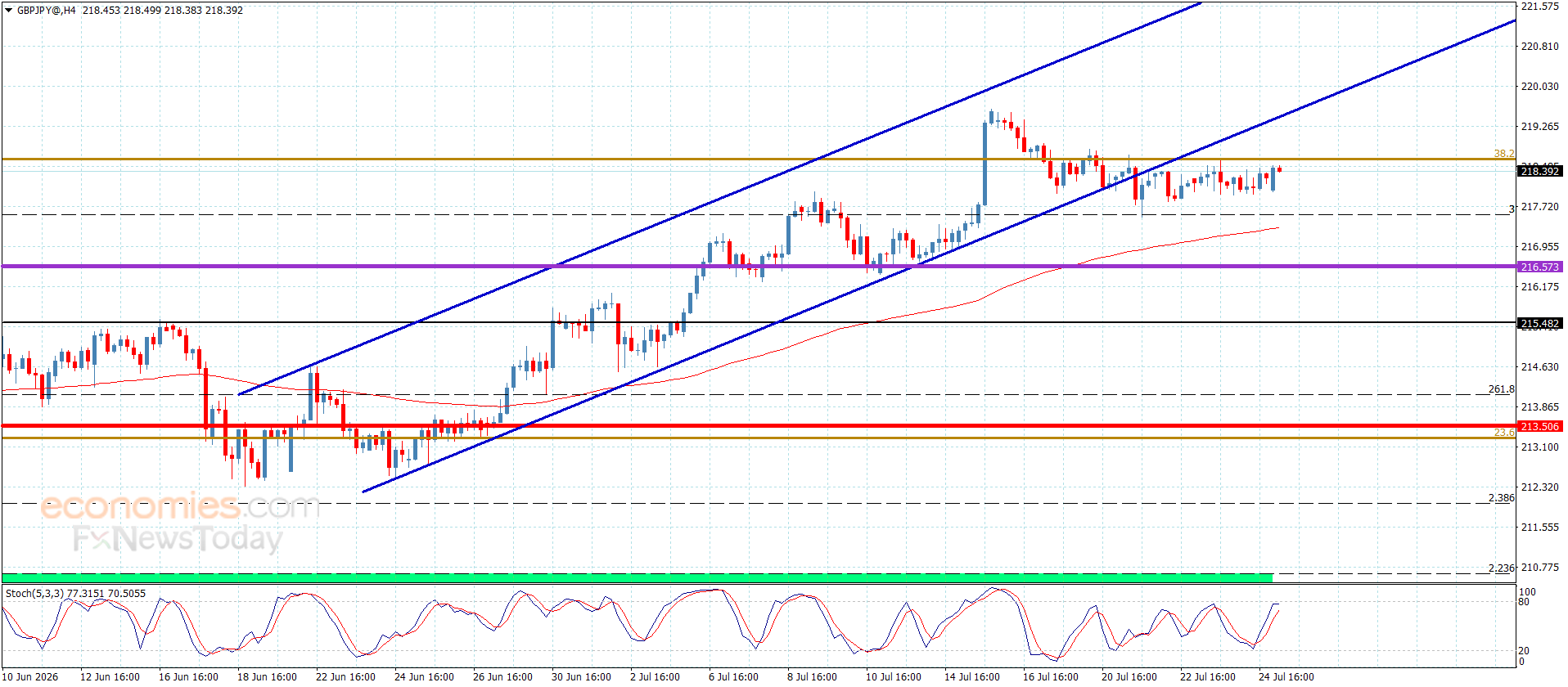
The GBPJPY pair continued forming sideways trading, to notice its continued fluctuations near 218.40 level without recording any new positive target due to the contradiction between its stability below 218.65 barriers against the attempt of providing positive momentum by the main indicators, specifically by stochastic reach to 80 level.
In general, the main scenario remains bullish, depending on the stability of the initial main support at 216.55, which makes us wait for breaching the current barrier, to begin targeting the positive stations and expect reaching 219.40 initially, putting a pressure on the psychological barrier at 220.00.
The expected trading range for today is between 217.85 and 219.40
Break above 187.00 exposes YTD high and 190.00 resistance.
The EUR/JPY consolidates around 186.00, edges down by 0.06% amid a souring of risk appetite amid the escalation of the US-Iran war, and strengthens safe-haven assets like the Japanese Yen.
EUR/JPY Price Forecast: Technical outlook
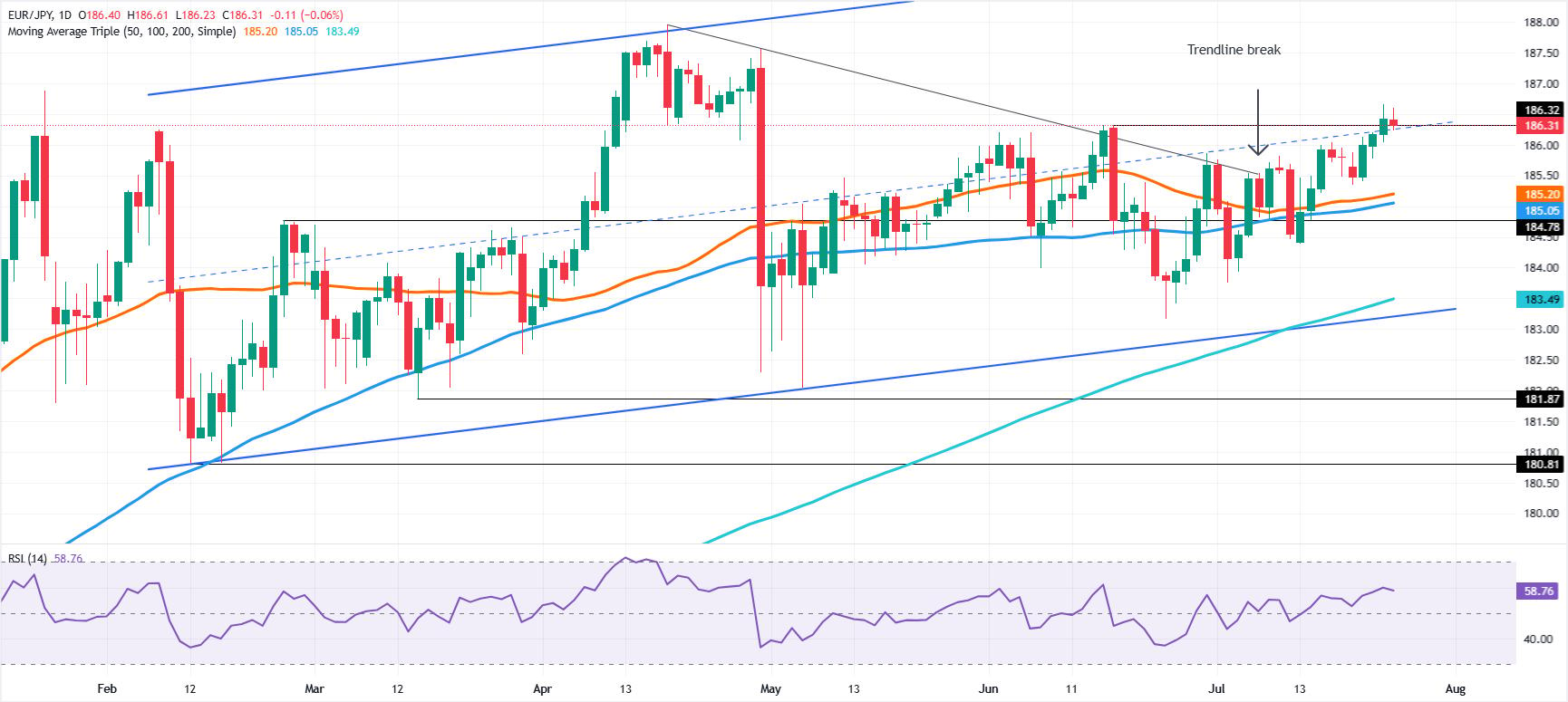
The EUR/JPY trades sideways, after reaching the year-to-date (YTD) high of 187.95. The cross-pair dipped towards the 183.00 area following the BoJ’s last intervention, and since then, buyers have reclaimed key resistance levels to reach the 186.00 mark.
At the time of writing, the EUR/JPY remains capped within the 186.00-187.00 range, amid fears that Japanese authorities could intervene in the foreign exchange markets. But bulls seem to be gaining momentum, as indicated by the Relative Strength Index (RSI), which is in bullish territory.
Buyers need to clear 187.00 to challenge the YTD high at 187.95. Once those levels are taken out, the next resistance would be the 189.00 mark ahead of the 190.00 psychological level.
On the other hand, if sellers push the EUR/JPY below the July 20 low of 185.35, it exacerbates a move towards the 50-day Simple Moving Average (SMA) at 185.20, followed by the 100-day SMA at 185.05. Downwards lies the 200-day SMA at 183.29.
EUR/JPY Price Chart – Daily
EUR/JPY daily chart
Japanese Yen Price Today
The table below shows the percentage change of Japanese Yen (JPY) against listed major currencies today. Japanese Yen was the strongest against the Swiss Franc.
USD
EUR
GBP
JPY
CAD
AUD
NZD
CHF
USD
0.02%
-0.04%
0.00%
0.07%
-0.17%
-0.25%
0.19%
EUR
-0.02%
-0.08%
-0.06%
0.00%
-0.25%
-0.34%
0.12%
GBP
0.04%
0.08%
0.04%
0.11%
-0.16%
-0.22%
0.22%
JPY
0.00%
0.06%
-0.04%
0.08%
-0.19%
-0.27%
0.17%
CAD
-0.07%
-0.01%
-0.11%
-0.08%
-0.27%
-0.35%
0.10%
AUD
0.17%
0.25%
0.16%
0.19%
0.27%
-0.07%
0.35%
NZD
0.25%
0.34%
0.22%
0.27%
0.35%
0.07%
0.43%
CHF
-0.19%
-0.12%
-0.22%
-0.17%
-0.10%
-0.35%
-0.43%
The heat map shows percentage changes of major currencies against each other. The base currency is picked from the left column, while the quote currency is picked from the top row. For example, if you pick the Japanese Yen from the left column and move along the horizontal line to the US Dollar, the percentage change displayed in the box will represent JPY (base)/USD (quote).
Analysts forecast the pound to euro and dollar exchange rates to weaken as UK fiscal concerns and excessive Bank of England rate-hike pricing undermine the GBP.
The bank forecasts the Pound-to-Dollar exchange rate at 1.32 by September and 1.31 by the end of 2026, while EUR/GBP is expected to rise to 0.86.
That EUR/GBP forecast equates to a Pound-to-Euro rate of approximately 1.1630, compared with current levels around 1.1702.
GBP/USD was trading near 1.3334 at the latest update, having recovered modestly from July’s low at 1.3221 but remaining more than two cents below the monthly high at 1.3558.
The Pound-to-Euro rate has also retreated from July’s 1.1827 peak, although it remains approximately 0.8% higher for the month and 2.1% stronger since the beginning of the year.
Crédit Agricole says investors have concentrated too heavily on Sterling’s attractive yield and have paid insufficient attention to the fiscal risks embedded in elevated UK government bond yields.
“For some time now, FX investors have focused almost exclusively on one feature of the GBP – its superior carry appeal which, in turn, reflected the fact that gilt yields remain the highest in G10,” says Valentin Marinov, Head of G10 FX Research and Strategy at Crédit Agricole.
“This has been a very imbalanced view.”
The bank argues that high gilt yields do not simply reflect expectations for Bank of England policy.
They also contain compensation for UK sovereign credit risk, which Crédit Agricole expects to become increasingly important during the opening months of Prime Minister Andy Burnham’s government.
The concern is that proposed cost-of-living measures and other policy commitments could consume the government’s already limited fiscal headroom.
Crédit Agricole identifies removing VAT from energy bills, raising the personal income-tax allowance and increasing military expenditure as examples of policies that could add to the pressure.
The potential use of new revenue-raising measures, including a higher top rate of income tax or a land tax, could create further uncertainty if they weaken business confidence and damage the economic outlook.
“Attempts by the Burnham government to use ‘fiscal flexibility’ to push for off-balance investment projects with limited to no positive growth impact in the near term could rankle gilt vigilantes,” the bank says.
“To the extent that UK sovereign credit risks rise as a result, the GBP should relinquish its recent gains.”
Markets Price Too Much BoE Tightening
The Bank of England meeting will provide the next major test for the Pound.
Crédit Agricole and the market both expect policymakers to leave Bank Rate unchanged at 3.75%, but the bank sees a significant risk that the accompanying guidance disappoints investors expecting further tightening.
UK rate markets were pricing around 65 basis points of BoE increases when the report was produced.
Crédit Agricole describes that outlook as “very hawkish”, particularly given the challenging UK growth backdrop.
“We further think that the MPC could remain non-committal with respect to future hikes, notwithstanding the latest increase in global energy prices,” says Marinov.
“This could deal a blow to the current market rate expectations and thus to the GBP’s relative rate appeal.”
The bank’s own interest-rate forecasts show Bank Rate remaining at 3.75% through the middle of 2027, before falling to 3.50% in September and 3.25% by the end of next year.
That is materially less hawkish than current market pricing and helps explain the bank’s cautious near-term Sterling view.
A reduction in expected BoE tightening would be particularly important because the Pound’s recent resilience has depended heavily on the UK’s yield advantage.
Should markets conclude that the central bank is unwilling to deliver the increases currently priced, Sterling would lose an important pillar of support at the same time that investors are scrutinising the government’s fiscal plans.
Sending a Large Sum Abroad?
Speak to TorFX about competitive rates and personal support for your international transfer.
Crédit Agricole forecasts GBP/USD at 1.32 in September before a further decline to 1.31 in December.
The pair is expected to recover gradually thereafter, reaching 1.32 in March 2027, 1.34 in June, 1.37 in September and 1.39 by the end of next year.
The forecast therefore separates a bearish near-term phase from a more constructive longer-term outlook.
From the latest rate near 1.3334, the September forecast implies a decline of roughly 1%, while the December target would represent a fall of approximately 1.8%.
The immediate downside reference is July’s low at 1.3221.
A move through that level would bring Crédit Agricole’s 1.32 September target into view and strengthen the case for a deeper decline towards 1.31.
On the upside, the recent closes show resistance emerging around 1.3380-1.3430, while the mid-July highs around 1.3540-1.3560 represent the more substantial barrier.
GBP/USD would need to recover through that upper zone to show that the correction from July’s peak has run its course.
The Dollar view is not entirely straightforward.
Crédit Agricole believes current expectations for two additional Federal Reserve rate increases are too hawkish and says softer guidance or data could offer the Dollar limited support in the near term.
The bank also argues that changes in the way foreign investors finance the US current-account deficit may be weakening the Dollar’s traditional safe-haven response during periods of market stress.
Even so, it retains an above-consensus view on the Dollar and describes its GBP/USD outlook as cautious.
The US economy is expected to outperform many European and Asian economies, while persistent inflation and the continued strength of the artificial-intelligence investment cycle should maintain demand for US assets.
Image: GBP/EUR exchange rate – 1 year chart
Euro Gains May Be More Limited
Crédit Agricole forecasts EUR/GBP at 0.86 in September, December and March 2027.
Converted into GBP/EUR terms, that implies a rate near 1.1630.
The bank then expects EUR/GBP to ease to 0.85 by June 2027 and 0.84 by the end of next year, equivalent to GBP/EUR recovering towards approximately 1.1765 and 1.1905 respectively.
Although the near-term forecast favours the Euro, Crédit Agricole believes some of the negative UK outlook is already reflected in Sterling’s valuation against the single currency.
“We believe, however, that some negatives are already priced into the GBP especially versus the EUR, given that the Eurozone would have to deal with the consequences from the negative oil supply shock in the wake of the Iran war as well.”
The bank also notes that Sterling already looks oversold and that global investors appear underinvested in UK assets.
Those factors may limit the extent of losses against the Euro even as political and fiscal risks remain elevated.
The current Pound-to-Euro rate near 1.1702 is already much closer to Crédit Agricole’s implied 1.1630 target than July’s high at 1.1827.
A break below 1.1690 would expose the 1.1600-1.1630 area, while a recovery above 1.1760 would be needed to improve the near-term picture.
Positioning Offers Some Protection
Crédit Agricole’s positioning data provide one counterweight to its bearish forecast.
The Pound attracted buying interest during the latest reporting week, led primarily by futures-market flows.
Banks, hedge funds and real-money investors were buyers, while corporate accounts sold Sterling.
Despite those inflows, the bank’s broader positioning measure still shows the Pound among the more lightly held G10 currencies and below its medium-term average.
This is consistent with the view that Sterling is already oversold and global investors remain underexposed to UK assets.
Light positioning could limit the speed of further declines or produce a sharper rebound should the BoE sound unexpectedly hawkish or the government provide credible fiscal reassurance.
It does not, however, remove the underlying risk identified by Crédit Agricole: that high gilt yields are increasingly a warning about sovereign risk rather than an uncomplicated source of support for the currency.
Pound Sterling Forecast: Short and Medium Term
Crédit Agricole maintains a bearish view on Sterling against both the Dollar and the Euro from current levels.
Its GBP/USD forecasts point to 1.32 in September and 1.31 in December, while EUR/GBP at 0.86 implies GBP/EUR near 1.1630.
The bank expects the BoE to leave rates unchanged and remain non-committal about further increases, potentially challenging the approximately 65 basis points of tightening priced by investors.
At the same time, Prime Minister Burnham’s fiscal programme could force markets to reassess whether the UK’s high bond yields represent attractive carry or growing sovereign risk.
Some bad news is already reflected in the Pound, particularly against the Euro, and light investor positioning should provide a degree of protection.
Nevertheless, the near-term balance of risk remains negative while GBP/USD trades below 1.3430 and GBP/EUR remains unable to regain the 1.1760 area.
Lloyds expects EUR/USD to retreat towards 1.1214 this summer as persistent US inflation risks restore the Dollar’s interest-rate advantage.
At Friday’s market close, the Euro to Dollar (EUR/USD) exchange rate was quoted at $1.1371, down 0.05% on the day and from $1.1438 the previous Friday.
EUR/USD fell in four of the five sessions and finished just above July’s low at 1.1362, leaving the Euro on the defensive heading into the new week.
Lloyds Bank says the latest rise in energy and wider commodity prices has revived inflation concerns, but the policy consequences are likely to be more challenging for the United States than the Eurozone.
“The Fed faces a more challenging mix than slow Europe, the USD ought to benefit from that,” says Nicholas Kennedy, FX strategist at Lloyds Bank.
The US economy has absorbed the latest energy shock with relatively little damage to domestic demand.
Lloyds points to resilient household consumption, a steadier labour market, rising equity-market wealth and the continuing AI investment boom. Tariffs, tight inventories and wider supply constraints are adding to the underlying price pressure.
Europe faces a less supportive combination.
The European Central Bank may still raise interest rates further, but higher input costs and tighter monetary policy are also likely to weigh more heavily on the Eurozone’s already-fragile demand and confidence.
Sending a Large Sum Abroad?
Speak to TorFX about competitive rates and personal support for your international transfer.
“One soft month for inflation data does not alter those underlying influences,” Kennedy says.
At the time of Lloyds’ 23 July report, markets had almost two Federal Reserve rate increases priced by the end of 2026.
“While the market now has almost two Fed hikes priced in by year-end, there is not much after that,” the bank says, noting that only another 13 basis points of tightening was priced through to the middle of 2027.
Lloyds believes that may prove too cautious if strong demand continues to collide with limited supply, accommodative financial conditions and rising business costs.
“If ECB assumptions are too hawkish, we’d still see the Fed curve as too low,” Kennedy adds.
The implication for EUR/USD is that US-Eurozone rate differentials could move back in the Dollar’s favour even if the ECB retains a hawkish policy stance.
With Eurozone growth fragile and investors reluctant to revive the broader anti-Dollar trade, Lloyds says the Dollar’s carry advantage is beginning to reassert itself.
“A further drift down towards EUR/USD 1.1214, if not a bit below… remains our expectation over the summer,” the bank concludes.
Image: EUR/USD 15-minute technical chart at Friday’s market close
EUR/USD Technical Outlook Remains Soft
The short-term chart also points to a continued downside bias.
EUR/USD ended Friday below the session VWAP at approximately 1.1381 and the 200-period moving average near 1.1392.
The 14-period RSI stood at 44.3, below the neutral 50 level but not yet signalling oversold conditions.
Initial support is located at July’s 1.1362 low.
A sustained break below that area would strengthen the case for another move lower and keep Lloyds’ 1.1214 target in view. That level is approximately 1.4% below Friday’s close.
Lloyds identifies 1.1065 as the next technical support should EUR/USD fall below the 1.12 region.
On the upside, the pair would need to recover the 1.1381–1.1392 area to ease immediate selling pressure.
Until then, the approaching Federal Reserve meeting and any further evidence of persistent US inflation will remain important tests of the bank’s bearish summer forecast.
The USD to JPY exchange rate crashed to a five-week low after Federal Reserve rate hike bets were significantly reduced following jobs data. Yellen’s speech is now in greater focus this week, will the US dollar see a recovery?
Although the Japanese Coincident and Leading Indexes showed some improvement on the month in April this failed to encourage particular confidence in the Yen (JPY).
Consequently, in spite of the eliminated odds of a June interest rate hike from the Fed, the US Dollar to Japanese Yen (USD/JPY) exchange rate trended higher.
Having seen a steady recovery earlier in the day, the US dollar to yen exchange rate fell after FED Yellen’s dovish speech late afternoon.
Japanese officials were fast to talk down the strength of the Yen exchange rates following Friday’s sharp decrease in value of the US Dollar (USD).
As markets await direction from Fed Chair Janet Yellen the US Dollar strengthened against many of the majors, with some of the currency’s recent slump being considered oversold.
Going into the weekend, the US dollar to yen exchange rate ended the week over 400 pips lower following particularly dismal US labour market data.
Meanwhile, safe-haven demand caused the JPY exchange rates to advance, especially after domestic services output surprised to the upside.
Forex traders will pay close attention to Federal Reserve Chairwoman Janet Yellen’s speech amid concerns of long-term delays to a cash rate increase.
Latest Dollar/Yen Exchange Rates
Other Foreign Exchange News
How will the Federal Reserve respond to weak labour market data?
As explained above, the disappointing results from Friday’s Non-Farm Payrolls, which saw just 38,000 newly employed, caused the US Dollar to dive significantly.
Rate hawks were forced to reduce bets regarding the timing of a cash rate increase, with the better-than-expected drop in unemployment little comfort given the reduced participation rate.
The primary focus for traders this week will be a speech from Fed Chair Janet Yellen on Monday. Yellen will likely give a good indication as to how the latest labour market figures will impact on Federal Open Market Committee (FOMC) outlook.
Volatility Forecast for Japanese Yen (JPY) Exchange Rates on Market Sentiment
With increased uncertainty as to the effectiveness of the Bank of Japan’s (BOJ) negative interest rates, there is a high chance that the Japanese Yen will decline over the coming week.
With that said, US dollar exchange rate weakness is supportive of Yen gains as foreign currency traders seek safe-haven assets amid damp sentiment.
Japanese ecostats are unlikely to be hugely impactful this week, with US Dollar positioning and market sentiment far more likely to dictate movement.
The USD has made considerable gains against the JPY of late, owing to Japanese shortcomings and occasional Fed optimism.
In the former case, the value of Japan’s currency has taken a hit due to a multitude of factors, one of which is the fact that plans to equalise pay in the workplace could leave employers reeling.
The US Dollar has been making generally positive movement against peers, thanks to the occasional hint that a June interest rate hike may still be on the cards.
US dollar to Yen Exchange Rate Forecast
The USD/JPY exchange rate could dip tomorrow morning, due to a large number of impactful Japanese ecostats coming out.
These Japanese announcements will primarily consist of the finalised Q1 GDP, which is generally expected to rise on the quarter and the year.
Also due will be the bank lending stats including trusts, which previously printed at 2.2%.
Exchange Rates UK Research
Our currency coverage draws on live market data, official economic releases and published bank research.
The Euro remains supported by expectations of further ECB tightening, but EUR/USD is still struggling to escape the lower end of its July range.
EUR/USD traded close to 1.1371 at the end of the latest session, leaving the pair near July’s low after a subdued week for the single currency.
The Euro has fallen in six of the past eight completed sessions and is down around 0.4% for July, having retreated from a monthly high near 1.1481 to within one cent of June’s 1.1325 low.
Both ING and Nordea expect the European Central Bank to maintain a hawkish bias, with further interest-rate increases still likely.
However, neither the rate outlook nor the latest ECB meeting has generated enough momentum to push EUR/USD out of its narrow trading range.
ING expects the pair to remain supported by higher Eurozone rates, but retains a near-term downside bias towards 1.1380.
Nordea goes further, forecasting three additional 25-basis-point rate increases that would lift the ECB deposit rate from 2.25% to 3.00% by March 2027.
ING had expected the ECB to leave rates unchanged while preserving the hawkish market pricing already embedded in Eurozone interest rates.
Its baseline was for a hawkish hold, with policymakers attempting to prevent inflation expectations from becoming unanchored as European gas and global energy prices remain elevated.
“The aim today could be – once again – to preserve market pricing to limit the risk of inflation expectations de-anchoring,” says ING FX strategist Francesco Pesole.
ING argued that achieving this might require a clear indication that a September rate increase remained possible, either through the press conference or subsequent guidance.
The bank noted that the market had already priced approximately 45 basis points of tightening by the end of 2026, setting a relatively high hurdle for the ECB to deliver an additional Euro-positive surprise.
“The hawkish bar set by the market via pricing isn’t low,” says Pesole.
ING nevertheless expected a firm ECB stance to limit the downside for short-dated Eurozone rates and, by extension, the Euro.
The difficulty is that supportive rate differentials have not translated into a decisive EUR/USD advance.
“A central bank meeting would normally be a prime catalyst for EUR/USD to break out of its tight trading range, but we do not expect that to happen,” ING says.
The bank retained a near-term downside bias, arguing that currency markets remained too relaxed about the potential consequences of further escalation in the Gulf.
“Unless the newsflow becomes more constructive, we look for EUR/USD to slip towards 1.1380 in the coming days.”
That target has already been reached, with the pair ending the latest session near 1.1371.
Nordea Forecasts Three More ECB Rate Increases
Nordea believes the ECB remains in a genuine tightening cycle rather than delivering one or two isolated increases.
The bank forecasts 25-basis-point hikes in September, December and March 2027, which would raise the deposit rate to 3.00%.
“The ECB did not touch rates today, but the message was in line with more rate hikes to come,” Nordea says.
“Our updated forecast still sees three more rate increases, but at a quarterly pace as opposed to a faster speed before.”
Nordea says the ECB’s latest communication left the door “wide open” to a September increase.
It highlights the central bank’s assessment that energy prices remained close to the assumptions used in its June forecast, which showed core inflation staying above 2% throughout the projection period even with two further rate increases already included.
The bank’s conviction does not depend on another major escalation in the Middle East or a renewed surge in oil.
Instead, Nordea expects broader price pressures and a relatively resilient Eurozone economy to keep the ECB tightening for longer.
“We think that we are amidst a hiking cycle rather than one or two isolated rate moves, and continue to expect the ECB to raise rates three more times.”
The bank has slowed the expected pace of tightening because oil prices have fallen from their earlier highs and the growth outlook has become less certain.
A rapid improvement in the geopolitical backdrop could reduce the need for further action, while a prolonged conflict and renewed energy-price increase could produce faster or additional rate increases.
Image: Nordea chart showing 25-basis-point ECB hikes in September, December and March 2027, taking the deposit rate to 3.00% – Courtesy of Nordea.
Energy Inflation May Take Time to Spread
Nordea argues that markets and policymakers may still be underestimating the delayed second-round effects of higher energy costs.
Its research notes that during the previous inflation cycle it took several months for rising energy prices to feed into food, goods and services inflation.
It also took considerably longer for forward inflation expectations to peak than for spot inflation itself.
“We still see risks biased towards more second-round impact on inflation than what markets and the ECB expect,” Nordea says.
This possibility supports the case for further tightening even if the immediate increase in oil and gas prices begins to reverse.
The bank also points to inflation expectations that remain above the ECB’s target across several measures.
Its report shows five-year market inflation expectations around 2.26%, while household and large-company measures remain closer to 2.9%.
Nordea expects Eurozone growth of approximately 1% in 2026, although it acknowledges that the risks are tilted to the downside.
The bank nevertheless says the economy has remained more resilient than weak purchasing managers’ surveys would suggest.
Manufacturing output and retail sales increased in the available April and May data, while second-quarter growth may have been around 0.3%.
Nordea expects household consumption to remain the primary source of positive growth, supplemented by investment in technology and defence.
EUR/USD Technical Outlook
Despite the increasingly hawkish ECB outlook, the EUR/USD chart shows little evidence of sustained buying momentum.
The pair is trading close to 1.1371, below its 20-period moving average near 1.1372 and beneath session VWAP around 1.1381.
It also remains below the 200-period moving average near 1.1392, leaving the immediate intraday structure tilted to the downside.
EUR/USD attempted to recover towards 1.1390 during the latest session but failed to sustain the move.
The retreat confirms a band of resistance between approximately 1.1380 and 1.1392, with the 1.1400 level providing the next major barrier.
RSI stands around 44, having recovered from levels close to 30.
This indicates that selling pressure has eased and the pair is no longer oversold, but momentum remains below the neutral 50 threshold.
The technical picture is therefore consistent with consolidation near the lows rather than the start of a convincing Euro recovery.
Initial support is located around 1.1368, followed by July’s low near 1.1362.
A sustained break below that area would expose the June low around 1.1325.
On the upside, EUR/USD must first recover above 1.1375 and 1.1381.
A move through the 1.1390-1.1400 region would provide the first meaningful evidence that the Euro is developing greater breakout power.
Image: EUR/USD 15-minute chart showing support at 1.1362, resistance at 1.1380 and the 1.1390-1.1400 breakout zone
Why ECB Hikes Have Not Lifted the Euro
The lack of a stronger EUR/USD response reflects the fact that much of the hawkish ECB outlook is already priced into the market.
Nordea notes that almost a full rate increase is priced by September, another is largely priced by December and part of a further hike is reflected in March 2027 contracts.
This leaves limited room for interest-rate expectations to move further in the Euro’s favour without a fresh inflation shock or more forceful ECB guidance.
The US Dollar also retains support from higher US rates, geopolitical uncertainty and the risk that elevated energy prices eventually damage global risk appetite.
ING says the current low-volatility environment may be underestimating how quickly Dollar demand could return if financial markets lose their tolerance for higher oil and gas prices.
The Euro is therefore receiving support from ECB tightening expectations, but not enough to overcome simultaneous demand for the Dollar.
Euro Forecast 2026: Latest Bank Projections
ING and Nordea both see a hawkish ECB, but the implications for EUR/USD remain restrained.
Nordea expects three further rate increases and a 3.00% deposit rate by March 2027, while ING believes policymakers will keep a September hike in play and defend current market pricing.
These forecasts should limit the risk of an immediate collapse in the Euro.
However, the rate outlook is already heavily reflected in market prices, while geopolitical and energy risks continue to favour the Dollar.
EUR/USD therefore remains vulnerable while below 1.1390-1.1400.
A break beneath 1.1362 would expose the June low near 1.1325, while only a sustained recovery above 1.1400 would suggest that hawkish ECB expectations are finally generating a meaningful upside breakout.
The Pound to Dollar exchange rate held near 1.3325 on Friday, having retreated more than two cents from July’s high around 1.3558.
GBP/USD is still around 0.6% higher this month, but Sterling has struggled to respond to a stronger run of UK economic data.
Over the past year, the pair has traded between approximately 1.3010 and 1.3858.
Scotiabank noted that June retail sales were far stronger than expected, while the preliminary July business surveys also surprised positively.
The manufacturing PMI rose to 52.8, signalling a solid expansion, while the services index recovered from contraction territory to 51.8.
Despite the upbeat figures, the bank said “market participants are clearly not responding to fundamentals”, with political uncertainty and concerns over the UK’s fiscal position continuing to weigh on the Pound.
Attention now turns to next Thursday’s Bank of England meeting. Rates are expected to remain unchanged, but Scotiabank anticipates a hawkish hold alongside updated economic forecasts.
Markets currently price around 16 basis points of tightening by September and 32 basis points by November.
Pound Sterling could gain if policymakers strengthen the case for a rate rise at the following meeting.
The options market is sending a more cautious signal, however, with demand increasing for protection against renewed GBP weakness.
Scotiabank linked the shift to geopolitical risks and domestic political concerns, both of which have pushed gilt yields higher.
The bank’s technical outlook remains neutral.
GBP/USD has slipped below the support previously expected near 1.3350, leaving 1.3300 as the immediate level to watch.
Stronger support is located at 1.3150, with resistance around 1.3550.
Exchange Rates UK Research
Our currency coverage draws on live market data, official economic releases and published bank research.
Rabobank expects renewed pressure on Pound exchange rates as concerns over Prime Minister Andy Burnham’s spending plans unsettle the gilt market.
The British Pound concluded this trading week facing a difficult combination of political uncertainty, elevated UK bond yields and doubts over how the new government intends to fund its policy agenda.
UK economists at Rabobank say the initial market response to Burnham’s cabinet and early policy announcements has been notably cautious.
The UK 10-year gilt yield has moved above 5.0%, while Pound Sterling has ranked as the weakest G10 currency over the latest one-day period.
Although the appointment of an experienced Chancellor has offered some reassurance, the bank warns that uncertainty surrounding the government’s fiscal strategy could keep both gilts and the Pound under pressure.
Rabobank analysts expect EUR/GBP to rise to 0.8650 over the next three months and sees scope for GBP/USD to fall back towards 1.3200.
At current rates, those forecasts imply a weaker Pound against both the Euro and the US Dollar.
Rabobank Warns Burnham’s Honeymoon Could Be Brief
Rabobank says the appointment of Healey as Chancellor is a stabilising factor because the country’s finances have been placed in the hands of an experienced politician with previous Treasury exposure and respect across Parliament.
However, the larger question is how Burnham plans to finance his agenda.
The Prime Minister has said he intends to use “flexibility” within the fiscal rules, which Rabobank says could point towards placing some infrastructure-related debt on the balance sheets of public financial institutions.
Although such borrowing might sit outside the most closely watched fiscal measures, it would still need to be absorbed by the bond market.
“The market will be wary about whether this constitutes ‘back door’ funding,” Rabobank says.
The government’s first cost-of-living measure is a reduction in VAT on household electricity bills from October.
Officials have indicated that the measure will be funded by cancelling the previous government’s digital identity programme, although reports have raised doubts over whether that scheme was fully funded in the first place.
Rabobank notes that use of greater flexibility within the fiscal rules could potentially mobilise an additional £16 billion for infrastructure projects over the remainder of the decade.
Infrastructure investment could improve productivity in parts of the UK outside London and the South East, but those benefits may take years to materialise.
Burnam, by contrast, faces a general election in less than three years.
That leaves the government under pressure to deliver visible improvements quickly, increasing the risk that spending commitments expand before the economic benefits become apparent.
“The market is now bracing itself for a list of further announcements,” Rabobank says.
“This suggests that funding issues will remain at the fore of the market’s mind and hints that Burnham’s honeymoon may be short-lived.”
Gilt Market Particularly Sensitive
The latest UK borrowing figures were slightly better than expected for June, but borrowing over the first three months of the fiscal year remains above projections from the Office for Budget Responsibility.
At an early stage of the financial year, that overshoot might ordinarily attract limited attention.
Rabobank argues that the political backdrop makes investors more sensitive than usual.
Burnham is associated with the softer left of the Labour Party and has said he wants government to become less reliant on what he described as the “imperial” Treasury.
Against this backdrop, the bond market is likely to demand clear reassurance that new spending plans will remain compatible with the fiscal rules.
Rabobank also highlights structural vulnerabilities in the UK economy.
The country has a low household savings ratio and a substantial current-account deficit, increasing its dependence on overseas capital.
These characteristics can amplify market reactions when confidence deteriorates.
“The UK may not have the largest debt-to-GDP ratio in the developed world, but arguably it has one of the most sensitive debt markets,” Rabobank says.
Lower BoE Expectations Are Another Pound Risk
The reduction in VAT on household electricity bills should mechanically lower inflation.
Rabobank also expects headline UK CPI inflation to ease to 2.7% year on year, offering some short-term reassurance to the gilt market.
The inflation outlook remains complicated by higher spot energy prices following the escalation in the US-Iran conflict, but Rabobank believes current Bank of England pricing is too aggressive.
Markets are pricing approximately 43 basis points of BoE tightening over the next six months.
Rabobank expects the central bank to avoid raising rates this year.
“On our view, this is overdone and a reduction in market expectations for BoE policy tightening is another headwind for the pound,” the bank says.
This is important because elevated UK interest-rate expectations have provided Sterling with some protection against fiscal and political concerns.
Were investors to remove those expected rate increases, the Pound would lose part of its yield advantage at the same time as the gilt market remains uneasy about government borrowing.
Image: Exchange Rates UK Research polling shows GBP/USD median bank forecast chart showing the live rate near 1.3325, a Q3 median near 1.32 and the longer-term forecast path
GBP/USD Forecast: 1.3200 Comes Back Into View
GBP/USD ended the latest session around 1.3325, recording a modest daily gain after Thursday’s 0.47% decline.
The pair has nevertheless fallen by more than two cents from the 15 July close near 1.3540 and remains well below July’s high of 1.3558.
The short-term chart shows Sterling attempting to stabilise around 1.3320 after repeated failures to sustain advances above 1.3340.
GBP/USD is trading close to the 20-period moving average at 1.3327 and session VWAP near 1.3323.
That positioning suggests the pair is currently balanced around its immediate fair-value area rather than developing a strong recovery.
The 200-period moving average near 1.3340 remains the more important overhead barrier.
A recent rebound failed close to that level, confirming the 1.3340-1.3350 region as the first substantial resistance zone.
RSI has recovered to approximately 48 from below 40, showing that downside momentum has eased.
However, the indicator remains below 50 and does not yet signal that buyers have regained control.
Initial support is located around 1.3310, followed by 1.3290.
Rabobank’s 1.3200 objective would come into clearer view following a break below these levels, while July’s low at 1.3221 represents a significant intermediate support area.
On the upside, a sustained move above 1.3340 would reduce immediate downside pressure, although GBP/USD would still need to recover through 1.3400 to suggest the broader July correction has ended.
Image: GBP/USD 15-minute chart with 1.3310 support, 1.3340 resistance and Rabobank’s 1.3200 forecast marked
The median bank forecast path also points to near-term weakness before a later recovery.
The Q3 2026 median projection is close to 1.3200, broadly matching Rabobank’s three-month forecast, while the consensus path then rises towards 1.35 in early 2027 and approximately 1.38 by the end of that year.
Rabobank’s view is therefore consistent with the wider consensus in anticipating near-term pressure, although it does not rule out a longer-term recovery.
Image: EUR/GBP survey poll forecasts July 2026
EUR/GBP Forecast: Rabobank Targets 0.8650
EUR/GBP closed around 0.8534 after falling 0.14% in the latest session.
The cross has recovered from July’s low near 0.8455, but remains almost 1% lower for the month and below the July opening level near 0.8614.
The 15-minute chart shows that EUR/GBP has surrendered part of its recent rebound after failing above 0.8550.
The cross is trading close to its 20-period moving average near 0.8533, but remains below session VWAP around 0.8541 and beneath the 200-period moving average near 0.8539.
This leaves the immediate technical picture mixed.
The latest recovery from below 0.8530 shows that selling pressure has moderated, while RSI near 46 has moved above its signal line.
However, the cross remains below the neutral 50 level and has yet to overcome the main intraday resistance cluster.
Initial resistance is located around 0.8539-0.8542, followed by 0.8547 and the recent highs around 0.8550-0.8555.
A break through that area would strengthen the case for a return towards 0.8600.
Rabobank’s 0.8650 forecast lies above the current technical range and would require a more decisive deterioration in Sterling sentiment.
On the downside, support is located around 0.8530, followed by 0.8525.
A break below these levels would weaken the immediate recovery and raise the risk of a renewed move towards 0.8500.
Image: EUR/GBP 15-minute chart with 0.8530 support, 0.8550 resistance
The wider bank consensus also leans towards a higher EUR/GBP rate over the coming quarters.
The median forecast stands close to 0.8700 from the third quarter of 2026 through early 2028, before easing towards 0.8600 and then 0.8450 by the end of 2028.
Rabobank’s 0.8650 target is therefore slightly below the near-term consensus median but still implies a meaningful Sterling decline from current levels.
Pound Sterling: Rabobank’s forecasts leave GBP exposed on two fronts
Against the Euro, the bank expects EUR/GBP to rise towards 0.8650 as investors question the government’s fiscal plans and reassess the likelihood of Bank of England tightening.
Against the Dollar, it sees GBP/USD falling towards 1.3200 as political uncertainty, gilt-market sensitivity and lower UK rate expectations weigh on the Pound.
The technical charts show that neither move has yet been fully confirmed.
GBP/USD is attempting to stabilise around 1.3320, while EUR/GBP remains below resistance around 0.8550.
However, the fundamental risks identified by Rabobank remain unresolved.
A reduction in expected BoE tightening would remove an important source of Sterling support, while further spending announcements without a convincing funding plan could renew pressure on gilts.
The base case is therefore for Pound Sterling to remain vulnerable, with a GBP/USD break below 1.3290 strengthening the path towards 1.3200 and an EUR/GBP move above 0.8550 opening the way towards Rabobank’s 0.8650 target.
The US Dollar to Yen exchange rate is trading around 163.85 after reaching a July high near 163.98, its strongest level since 1986. The pair is up around 0.75% this month and has risen from roughly 147 in August 2025.
Scotiabank says the Yen is showing tentative signs of stabilisation, although it continues to underperform most other G10 currencies.
The latest pause has been driven more by softness in the broader US Dollar than by Japanese official commentary.
Finance Minister Katayama has continued to warn of “bold action” to counter excessive currency moves, but Scotiabank notes that intervention threats have produced little meaningful reaction in the Yen.
Attention now turns to the Bank of Japan’s July 31 meeting. Markets are pricing almost no chance of an immediate rate move and only around 10 basis points of tightening by September.
Scotiabank believes this leaves scope for a hawkish surprise if policymakers signal that the tightening cycle could proceed faster than investors currently expect.
According to the bank, “a hawkish hold next week could deliver an important surprise and deliver fundamentally-driven yen strength.”
Until then, Scotiabank sees little meaningful technical resistance for USD/JPY as the pair continues to trade at fresh multi-decade highs.
Exchange Rates UK Research
Our currency coverage draws on live market data, official economic releases and published bank research.
ING’s forecast for EUR/USD to retreat towards 1.1380 has already been realised, with the pair now testing its lowest levels of July as higher energy prices support the US Dollar.
The Euro-to-Dollar exchange rate traded close to 1.1371 late on Friday, extending its retreat from the mid-July peak near 1.1470.
EUR/USD fell 0.30% on Thursday and has now declined in seven of the past eight completed sessions.
The pair is also down by around 0.3% for July, having traded between 1.1362 and 1.1481 during the month.
ING had expected EUR/USD to drift back towards 1.1380 as elevated energy prices continued to favour the Dollar.
That objective has now been reached and modestly exceeded, leaving the market focused on whether support around 1.1360 can prevent a deeper Euro decline.
ING Sees US Dollar Support from Higher Energy Prices
ING describes a global investment environment in which equity-market sentiment remains relatively resilient even as higher energy prices push interest rates upwards.
According to the bank, investors are favouring currencies that provide both attractive yields and some protection against a further escalation in energy costs.
“The dollar and the Norwegian krone remain the go-to currencies here,” says Chris Turner, ING’s Global Head of Markets and Regional Head of Research for the UK and Central and Eastern Europe.
The Dollar’s yield advantage and the relative resilience of the US economy leave it better positioned than lower-yielding currencies during a period of elevated oil and gas prices.
ING expects the Dollar Index to remain supported within its 100.35-101.80 range and continues to favour the upside over the short term.
Higher energy prices are particularly relevant for EUR/USD because the Eurozone is a major net energy importer.
An extended increase in oil and natural gas costs can weaken the region’s terms of trade, squeeze household spending and raise costs for European businesses, while simultaneously supporting the Dollar through higher US yields and safe-haven demand.
Image: EUR/USD 15-minute technical chart showing support around 1.1360 and resistance between 1.1380 and 1.1392
EUR/USD Reaches ING’s 1.1380 Target
Analysts at ING noted that EUR/USD had initially held up relatively well despite the rebound in energy prices and a rise in European natural gas towards €60 per megawatt hour.
Interest-rate expectations helped explain that resilience.
Higher energy costs encouraged investors to price a more aggressive tightening response from the European Central Bank than from the Federal Reserve, temporarily supporting Eurozone yields and the single currency.
However, ING questioned how much further ECB expectations could move in a hawkish direction.
“It is hard to see the market pricing in even higher ECB rates, regardless of the language delivered at tomorrow’s ECB meeting and press conference,” says Turner.
“Barring a near-term move towards another cease-fire between the US and Iran, our bias remains for EUR/USD to drift back to 1.1380.”
That forecast has proved accurate, with EUR/USD falling through 1.1380 and approaching July’s low around 1.1362.
The question now is whether the retreat represents the completion of the corrective move or the beginning of a more sustained decline.
EUR/USD Technical Outlook Remains Fragile
The short-term chart continues to favour the US Dollar, although the Euro is attempting to stabilise near the bottom of its recent range.
EUR/USD trades below its 20-period moving average near 1.1372 and beneath session VWAP around 1.1381.
The pair is also well below the 200-period moving average near 1.1392, confirming that the immediate intraday trend remains bearish.
Repeated failures between 1.1390 and 1.1400 have established this region as significant resistance. The Euro would need to recover above this area to suggest that the sequence of lower short-term highs has been broken.
RSI has recovered to approximately 44 after previously approaching oversold territory.
The indicator remains below the neutral 50 level, showing that bearish momentum is still present, but the recovery from its lows suggests selling pressure is no longer accelerating.
This is consistent with a market consolidating after a decline rather than one already embarking on a convincing rebound.
Initial resistance is located around 1.1374, followed by ING’s former target at 1.1380.
A recovery above 1.1380 would allow EUR/USD to challenge 1.1387 and the 200-period moving average close to 1.1392.
The 1.1400 area then represents the more important technical barrier. A sustained break above it would weaken the immediate bearish case and suggest the pair is returning to a broader range.
On the downside, July’s low at 1.1362 is the key near-term support.
A decisive break beneath that level would confirm that the decline has extended beyond ING’s original objective and expose the lower portion of June’s range.
Energy Market Remains the Key Risk
ING’s EUR/USD assessment was conditional on the geopolitical and energy-market backdrop.
A ceasefire or meaningful de-escalation between the US and Iran would reduce the energy-price premium supporting the Dollar and could allow the Euro to recover.
The opposite scenario presents the larger downside risk.
A renewed rise in oil or European gas prices would probably reinforce demand for the Dollar while increasing concerns over the Eurozone growth outlook.
The policy implications are also complicated.
Higher energy prices can raise headline inflation and encourage expectations of tighter ECB policy, but they simultaneously weaken real incomes and economic activity.
ING’s argument is that the market has limited capacity to price substantially more ECB tightening, reducing the potential support available to the Euro from interest-rate expectations.
The Federal Reserve, meanwhile, benefits from a stronger US growth backdrop and a currency that tends to attract demand when geopolitical uncertainty increases.
EUR/USD Technical Forecast
ING’s move towards 1.1380 has been completed, but the short-term technical picture does not yet provide a convincing signal that the decline is over.
EUR/USD remains below its main intraday moving averages and continues to trade near the bottom of July’s range.
The 1.1362 monthly low is now the immediate dividing line.
Holding above this level could produce a corrective recovery towards 1.1380 and potentially 1.1390, particularly if energy prices ease or geopolitical tensions subside.
A break below 1.1362 would instead strengthen the Dollar’s advantage and leave EUR/USD vulnerable to a deeper extension lower.
The base case is therefore for the Euro to remain under pressure while below 1.1390-1.1400, with energy prices and developments in the Gulf determining whether the pair stabilises or resumes its decline.