Platinum price confirmed its surrender to the bullish scenario by its stability yesterday above $2070.00 level, to form a new bullish rally and recording some previously suggested gains by reaching $2145.00 level.
The repeated stability above the moving average 55 near 1995.00, by the continuation of providing positive momentum by the main indicators will increase the chances of recording new gains, to reach $2205.00, which might form a new obstacle against the bullish rally, while surpassing this obstacle will ease the mission of achieving extra gains that might extend towards $2290.00 initially.
The expected trading range for today is between $2070.00 and 22205.00
The Pound to Dollar exchange rate (GBP/USD) held firm above 1.3400 despite a dip to 1.3380, as renewed Iran tensions and a surge in oil prices tested market confidence.
With geopolitical risks intensifying and volatility rising, Sterling remains range-bound, with traders watching whether GBP/USD can hold support or push back towards the 1.3460 resistance zone.
GBP/USD Forecasts: Survives Initial Retreat
The Pound to Dollar (GBP/USD) exchange rate dipped to 1.3380 in Asian trading on Monday before a recovery to 1.3425 with market resilience again a key issue.
The dollar gained a lift from renewed fears surrounding the Iran situation. The weekend talks between US and Iranian officials failed to make a breakthrough, increasing concerns that the ceasefire would not hold.
According to UoB; “the price action suggests that GBP has likely entered a rangetrading phase. For the time being, we expect GBP to trade between 1.3270 and 1.3460.”
UBS still expects the dollar will slide later in the year with an end-2026 GBP/USD forecast of 1.40.
Save on Your GBP/USD Transfer
Get better rates and lower fees on your next international money transfer.
Compare TorFX with top UK banks in seconds and see how much you could save.
After the talks failed to make a breakthrough, President Trump announced that the US would instigate a blockade to stop Iranian ships passing through the Strait of Hormuz.
There was a fresh jump in oil prices on supply fears with Brent jumping close to 8% and just below $100 p/b.
Danske Bank commented on Brent; “It traded above USD110/bbl before the ceasefire announcement last week and there is a clear possibility it will rise back to this level if the sides do not restart talks in the coming days.”
Overall risk appetite was less confident with weaker equities, although the overall impact was limited.
ING commented; “The focus now shifts to whether the naval blockade encourages another round of negotiations, whether the Iranian-backed Houthis in Yemen try to block the southern end of the Red Sea and what the likes of China make of interference in their oil imports.”
BNP Paribas noted that risks have increased; “We did expect negotiations to be difficult and lengthy but assumed that this weekend’s talks would be the beginning of a process which would, at least, result in a degree of situational stabilisation. This view was clearly misplaced.”
According to Rabobank; “On one hand, US escalation might work. Yet unless Iran were to crumble quickly, the prospect is of an even deeper global energy crisis ahead first.”
BNP did note the political pressure; “we would not be surprised if the negotiations are restarted relatively quickly given the current ceasefire timeline.”
The reaction of central banks will also be an important underlying element for markets, especially with upward pressure on headline inflation.
ING commented; “Away from the geopolitical headlines which will bounce the dollar around this week, the market focus will likely be on central bank reaction functions.”
The UK inflation data for March will not be released until next week, but Bank of England comments will be watched closely.
Like this piece? Please share with your friends and colleagues:
International Money Transfer? Ask our resident FX expert a money transfer question or try John’s new, free, no-obligation personal service! ,where he helps every step of the way,
ensuring you get the best exchange rates on your currency requirements.
2026.04.14 2026.04.14 Japan’s Verbal Intervention Supports Yen. Forecast as of 14.04.2026
Dmitri Demidenkohttps://www.litefinance.org/blog/authors/dmitri-demidenko/
Japan had no need to intervene in currency markets to force USD/JPY bulls to retreat. Verbal interventions were enough. The government bought itself some time and is now reaping the benefits of the US dollar’s weakness. Let’s discuss this topic and make a trading plan.
The article covers the following subjects:
Major Takeaways
USD/JPY quotes decline due to a weaker dollar.
The Bank of Japan does not plan to raise interest rates in April.
The yen is not being used as a funding currency.
Short trades can be considered as long as the USD/JPY pair remains below 159.5.
Weekly Fundamental Forecast for Yen
Investors are increasingly driven by sentiment, reacting to reports of a potential new round of US–Iran negotiations. As a result, the greenback is facing some pressure as a safe-haven asset. On the other hand, oil prices remain high, which is hampering USD/JPY bears. Japan is heavily dependent on energy exports, and its economy will suffer more from geopolitical tensions than the US economy.
The bullish oil market has prompted Japanese analysts to lower earnings forecasts for 113 TOPIX-listed companies. The outlook for US companies looks much better, and capital flows from Asia to the US could become a key driver of the USDJPY rally.
Performance of Carry Trade Strategy
Source: Bloomberg.
Meanwhile, the yen is no longer being used as a funding currency in carry trades. Japanese bond yields are at high levels amid expectations of tighter monetary policy. However, carry trades require low volatility to generate profits properly. Volatility, on the other hand, remains high due to geopolitical tensions.
At the same time, Kazuo Ueda’s dovish rhetoric has disappointed USD/JPY bears. The Bank of Japan governor stated that the regulator would closely monitor developments in the Middle East. However, he did not signal an overnight rate hike at the upcoming BoJ meeting, despite having previously hinted at a tightening of monetary policy. Markets interpreted this as a setback to tightening expectations, with the perceived probability of an April rate hike falling from 55% to 32%.
Probability of Monetary Tightening by BoJ in April
Source: Bloomberg.
Kazuo Ueda has chosen the right moment for his remarks. The US dollar is weakening amid hopes for a resumption of talks between Washington and Tehran. With this in mind, bears could be deprived of an important advantage, and USD/JPY quotes will continue to fall.
The Bank of Japan’s reluctance to continue its cycle of monetary tightening is good news for the Japanese government. Prime Minister Sanae Takaichi criticized her staff for saying that lower import prices could be achieved by tightening monetary policy.
The authorities got what they wanted. Through verbal interventions, they tempered USD/JPY bulls without spending a single penny. The government bought time and is now reaping the benefits of the US dollar’s weakness amid the de-escalation of the conflict in the Middle East and the resulting decline in demand for the greenback as a safe-haven asset. Another issue is that oil prices remain elevated, which will slow down the Japanese economy.
Weekly USDJPY Trading Plan
The USD/JPY pair is likely to consolidate within the 158.5–160 range. Only a breakout above or below this range will allow the pair to define its further direction. As long as quotes remain below 159.5, short trades can be opened.
This forecast is based on the analysis of fundamental factors, including official statements from financial institutions and regulators, various geopolitical and economic developments, and statistical data. Historical market data are also considered.
Price chart of USDJPY in real time mode
The content of this article reflects the author’s opinion and does not necessarily reflect the official position of LiteFinance broker. The material published on this page is provided for informational purposes only and should not be considered as the provision of investment advice for the purposes of Directive 2014/65/EU.
According to copyright law, this article is considered intellectual property, which includes a prohibition on copying and distributing it without consent.
The Euro to Dollar (EUR/USD) exchange rate strengthened to 5-week highs at 1.1740 last week before dipping back below the 1.17 level as Middle East developments dominated.
Brent crude dipped sharply after the US and Iran announced a cease-fire, but there was renewed upward pressure on prices on Monday as peace talks failed to secure a breakthrough.
Credit Agricole still sees downward risks for the Euro due to energy stresses and has an end-2026 EUR/USD forecast of 1.13.
Events surrounding the Iran conflict will remain a key short-term market influence. The bank still considers that the Euro will remain vulnerable in the short term amid risks of fresh escalation surrounding the Iran conflict. Crucially, the bank notes that the Euro-Zone economy remains vulnerable from an energy shock, especially if prices increase further.
From a longer-term perspective, Credit Agricole calculates that fair value for EUR/USD based on underlying fundamentals is currently around 1.11 which will tend to act as a barrier to Euro gains.
Even with an element of unease surrounding investor appetite for US assets, Credit Agricole still expects that the dollar will remain the dominant reserve currency.
Copper price resumed the bullish trend, taking advantage of the continuation of providing positive momentum by the main indicators, to reach $5.9700 barrier, followed by recording the suggested target in the previous report.
The price attempt to support this barrier supports the chances of targeting new positive stations confirms the importance of waiting for confirming the breach, to avoid any unexpected corrective rebound, while the extra positive stations that are located at $6.0850 reaching $6.2300 level.
The expected trading range for today is between $5.8800 and $6.0850
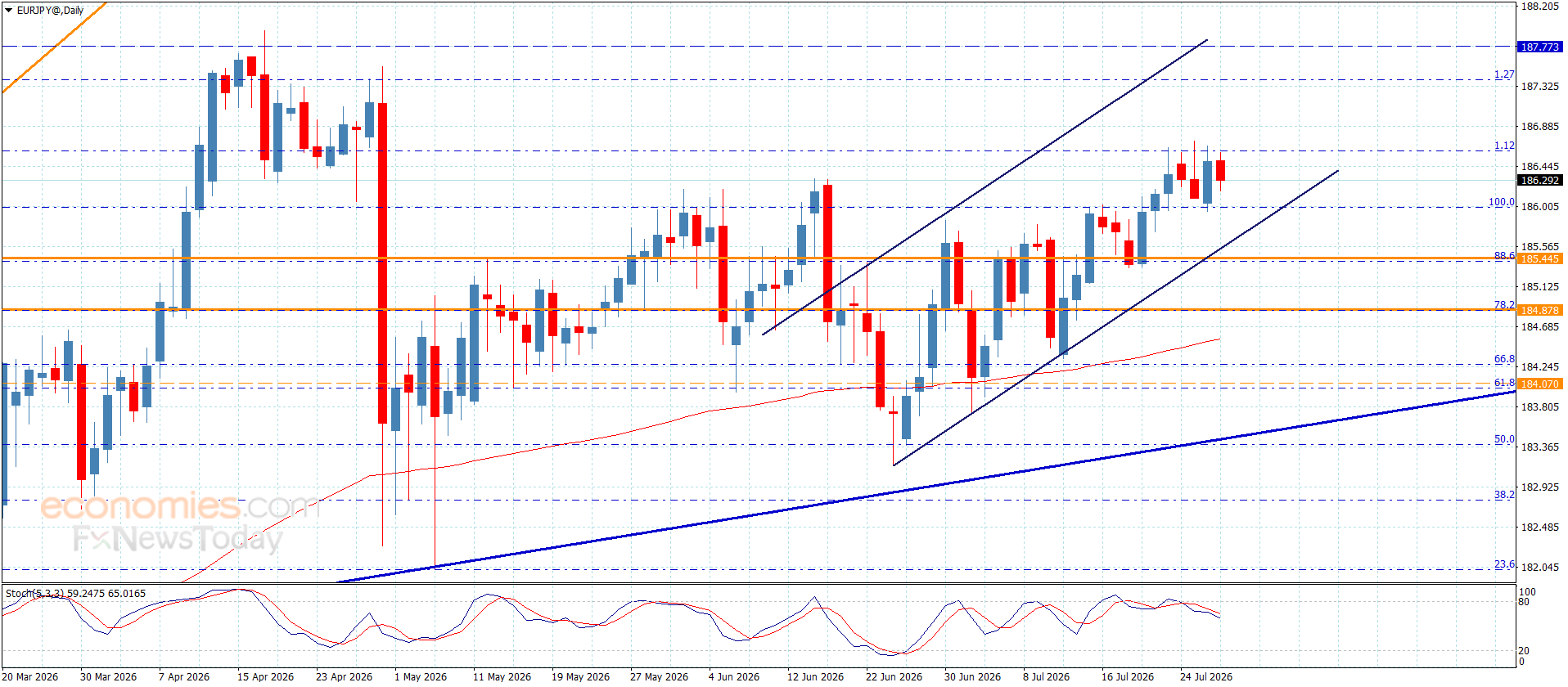
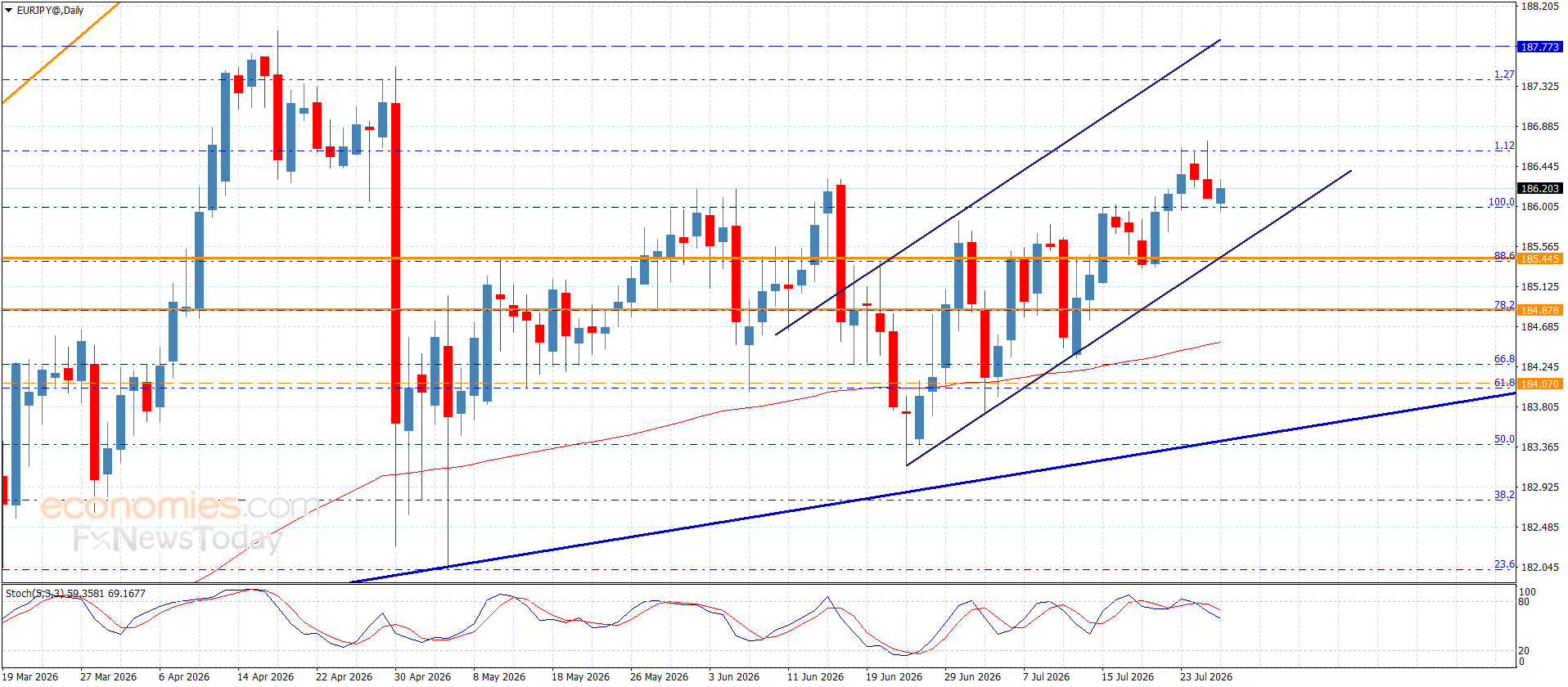
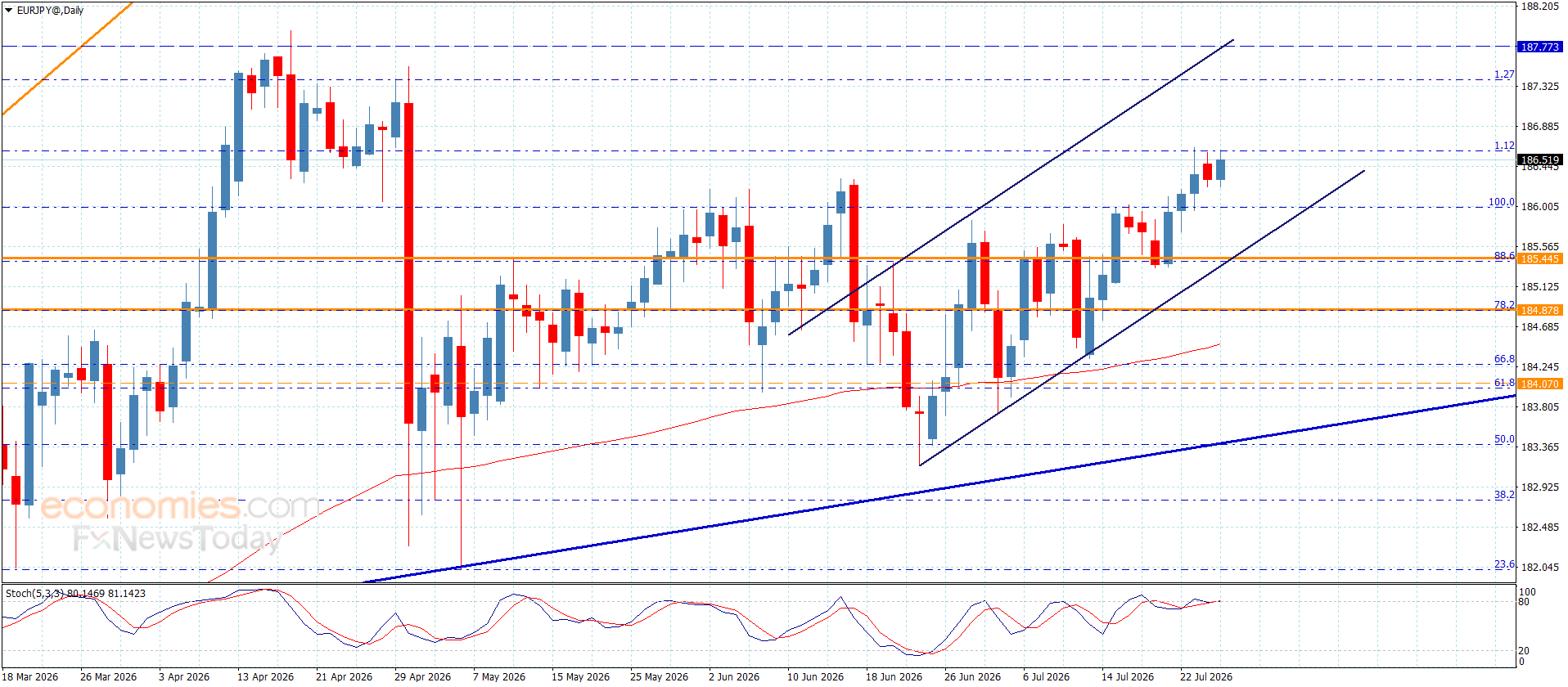
EUR/JPY halts its three-day winning streak, inching lower after reaching all-time highs and trading around 187.40 during the European hours on Tuesday. The technical analysis of the daily chart indicates the currency cross is trending higher within an ascending channel, signaling a persistent bullish bias.
The EUR/JPY cross maintains a bullish near-term bias as it holds above both the nine-day and 50-day Exponential Moving Averages (EMAs). The alignment of the short-term above the long-term EMA suggests persistent upward pressure.
The Relative Strength Index (14) at 70.10 shows overbought conditions, hinting that upside momentum is strong but vulnerable to a corrective pause.
The EUR/JPY cross may target the immediate resistance at the all-time high of 187.54, recorded on April 14, followed by the upper boundary of the ascending channel around 187.80.
On the downside, the primary support lies at the nine-day EMA of 185.92. A move below this level could weaken the short-term price momentum, exposing the lower ascending channel boundary around 185.00, followed by the 50-day EMA at 184.07.
EUR/JPY: Daily Chart
(The technical analysis of this story was written with the help of an AI tool.)
Euro Price Today
The table below shows the percentage change of Euro (EUR) against listed major currencies today. Euro was the weakest against the New Zealand Dollar.
USD
EUR
GBP
JPY
CAD
AUD
NZD
CHF
USD
-0.15%
-0.17%
-0.21%
-0.15%
-0.04%
-0.35%
-0.28%
EUR
0.15%
-0.02%
-0.04%
0.00%
0.11%
-0.21%
-0.14%
GBP
0.17%
0.02%
-0.02%
0.06%
0.12%
-0.18%
-0.13%
JPY
0.21%
0.04%
0.02%
0.06%
0.17%
-0.14%
-0.09%
CAD
0.15%
-0.00%
-0.06%
-0.06%
0.11%
-0.18%
-0.14%
AUD
0.04%
-0.11%
-0.12%
-0.17%
-0.11%
-0.30%
-0.26%
NZD
0.35%
0.21%
0.18%
0.14%
0.18%
0.30%
0.05%
CHF
0.28%
0.14%
0.13%
0.09%
0.14%
0.26%
-0.05%
The heat map shows percentage changes of major currencies against each other. The base currency is picked from the left column, while the quote currency is picked from the top row. For example, if you pick the Euro from the left column and move along the horizontal line to the US Dollar, the percentage change displayed in the box will represent EUR (base)/USD (quote).
The GBP/USD pair is seen building on the previous day’s strong move up of around 125-pips and gaining some follow-through traction on Tuesday. This marks the seventh straight day of a positive move and lifts spot prices to the 1.3535-1.3540 region, or the highest since February 26, during the first half of the European session. Despite failed US-Iran peace talks over the weekend, investors continue to move towards riskier assets amid hopes that the door for diplomacy remains open and that negotiations would continue. This, in turn, undermines the safe-haven US Dollar (USD) and acts as a tailwind for the currency pair.
US Vice President JD Vance struck a cautiously optimistic tone on negotiations with Iran and suggested during an interview on Fox News that meaningful progress has been made even as talks have yet to deliver a breakthrough. Vance further added that the framework for a comprehensive agreement is achievable if Iran is willing to take the next step. Moreover, Reuters reported that negotiating teams from the US and Iran could return to Islamabad for another round of peace talks this week. The optimism, along with the uncertainty over future interest rate moves by the US Federal Reserve (Fed), drag the USD to its lowest level since early March and remains supportive of the bid tone surrounding the GBP/USD pair.
Signs of de-escalation of tensions in the Middle East keep Crude Oil prices depressed, easing inflationary fears and reviving bets for a potential interest rate cut by the Fed this year. Investors, however, remain worried about external energy shocks stemming from the instability in the Strait of Hormuz. In fact, US President Donald Trump said that the US Navy blockade on the strategic waterway has officially started, while Iran responded with threats on all ports in the Persian Gulf and the Gulf of Oman. This limits the downside for the black liquid, fueling worries about a possible spike in inflation. This, in turn, keeps the USD bulls on the sidelines and backs the case for a further appreciating move for the GBP/USD pair.
Meanwhile, market participants have ramped up bets on the Bank of England (BoE) tightening and are pricing in roughly three 25 basis points (bps) rate hikes in 2026, potentially starting in April, amid renewed inflation concerns. This marks a significant divergence in comparison to Fed expectations and validates the near-term positive outlook for the GBP/USD pair. Traders now look forward to the release of the US Producer Price Index (PPI), which, along with speeches from a slew of influential FOMC members, will drive the USD demand and provide some impetus to the currency pair. Nevertheless, the fundamental backdrop seems tilted in favor of bulls, suggesting that any corrective slide is likely to be bought into.
GBP/USD 4-hour chart
Technical Analysis:
The overnight move beyond the 1.3500 psychological mark comes on top of the recent breakout through the 200-period Simple Moving Average (SMA) on the 4-hour chart and favors the GBP/USD bulls. Adding to this, a positive Moving Average Convergence Divergence (MACD) reading suggests firm upside momentum. However, the Relative Strength Index (RSI) near 70 indicates that conditions are edging toward overbought, which could slow the advance rather than immediately reverse it.
On the topside, initial resistance is aligned with the 61.8% Fibonacci retracement level of the January-March fall, at 1.3867. On the downside, immediate support is seen at the 50% retracement at 1.3512, followed by the 38.2% level at 1.3429, while the 200-period SMA is near 1.3351 and the 23.6% Fibo. retracement at 1.3325 underpins the broader bullish structure ahead of stronger backing at 1.3158.
(The technical analysis of this story was written with the help of an AI tool.)
The US dollar has jumped against the Japanese yen yet again during the trading session here on Monday as we are threatening the 160-yen level. I do believe it is probably only a matter of time before we do breakout, and this breakout is going to be a big deal.
It will have traders looking at the market through the prism of a breakout that goes all the way back to 1990. This could lead to a multi-year move. In the short term, though, it is probably more likely than not that we would see a little bit of a pullback. That pullback for me opens up a lot of value, especially if we see a drop and a bounce near the 158-yen level.
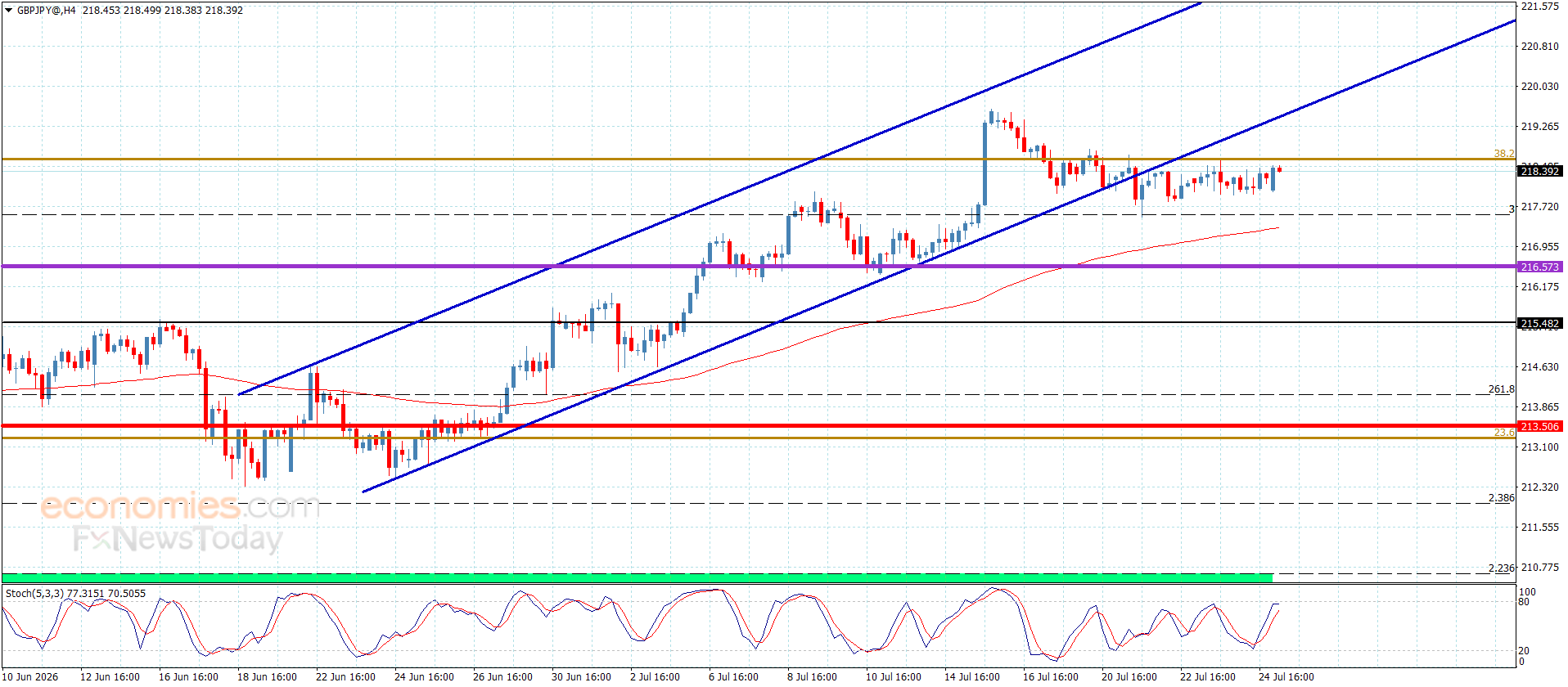
No change for GBPJPY pair’s bullish track, due to its stability above 213.30 level, keeping its stability within the minor bullish channel levels, to notice recording 214.55 level on Friday, which forces it to provide mixed trading to reinforce the chances of gathering extra positive momentum.
Stochastic stability within the overbought level will reinforce the chances of targeting extra positive stations, to reach 215.00 to attempt to reach the next main target near 215.72, while the decline below 213.30 and providing negative close will force it to provide bearish corrective trading by reaching 212.60 and 212.05.
The expected trading range for today is between 213.50 and 215.00