The main tag of Forex News Today Articles.
You can use the search box below to find what you need.
[wd_asp id=1]

18 07, 2024

EUR/USD, GBP/USD, DXY Price Forecast: DXY Hits $103.75; Buy Now?

By |2024-07-18T11:41:59+03:00July 18, 2024|Forex News, News|0 Comments

The Dollar Index (DXY) is currently at $103.756, up 0.05%. The pivot point is $103.658. Key resistance levels are at $103.892, $104.129, and $104.455. Immediate support levels are $103.383, $103.195, and $103.019.

The 50-day Exponential Moving Average (EMA) is $104.439, while the 200-day EMA is $104.952. These indicators point to a bullish trend above $103.658.

A break below this level could trigger a significant selling trend, potentially driving the price towards lower support levels. Monitoring these key levels will be crucial for future movements.

EUR/USD Technical Forecast

EUR/USD Price Chart - Source: Tradingview
EUR/USD Price Chart – Source: Tradingview

The EUR/USD currently trades at $1.09358, slightly down by 0.05%. Key levels to watch include the pivot point at $1.09242. Immediate resistance levels are identified at $1.09598, $1.09778, and $1.09955, which may cap any upside movement. On the downside, immediate support levels are $1.09059, $1.08752, and $1.08594.

Technical indicators are noteworthy, with the 50-day Exponential Moving Average (EMA) at $1.09029 and the 200-day EMA at $1.08351. These moving averages highlight the current trend dynamics.

A bullish outlook persists above the pivot point of $1.09242. However, a break below this level could trigger a sharp selling trend, leading to further declines.

GBP/USD Technical Forecast

Source link

18 07, 2024

1.30 Key Level- Bulls (Chart)

By |2024-07-18T07:38:35+03:00July 18, 2024|Forex News, News|0 Comments

GBP/USD Analysis: Breaking the 1.30 high is still difficult 

  • The recent trades show that the progress of GBP/USD exchange rate has temporarily halted near the psychological resistance barrier of 1.30 after the release of U.S. retail sales numbers, which exceeded consensus.
  • Profit-taking could extend if UK inflation numbers fall below the desired level tomorrow.
  • Concurrently, the pound had fallen from its recent highs against the US dollar after the US retail sales report exceeded consensus. 

According to reliable trading platforms, the GBP/USD pair fell by 0.20% during the day to 1.2940 after retail sales recorded a flat reading of 0% on a monthly basis in June, while expectations indicated a reading of -0.3%. also, Core retail sales rose by 0.4%. Clearly, this exceeded estimates by 0.1% and represents a supportive surprise for the US dollar. 

Commenting on the event and the impact. “Today’s data is another reminder that you can never write off the US consumer,” said Ali Jafari, an economist at CIBC Capital Markets. 

According to forex trading, the pound rose 2.50% against the dollar in July, on the cusp of levels last seen at this time a year ago, supported by rising expectations of a September rate cut. It will likely take a series of strong convincing data to reverse the course of a September cut. Furthermore, analysts say “will stronger consumption change the balance of evidence for the Fed and signal that demand in the economy could be picking up? We don’t think so. The accumulation of evidence showing inflation and a slowing labor market would be more than enough to convince the Fed to cut rates in September.” 

Overall, the data shows that the exchange rate’s advance has stalled just six points short of the psychological resistance level of 1.30, which would be consistent with sell orders being placed ahead of the big mark. The July 2023 high is at 1.3142, but the pound was unable to hold these levels for very long. 

In fact, what followed this high was a three-month decline that took the pair back to 1.2037. “The 1.3000 level is acting as resistance and keeping GBP/USD lower,” says Dukascopy’s technical analysis note. 

The question now is: Will we see a repeat of the fall of 2023, or will the pound’s rally have the ability to hold on and build on recent gains?  

For now, analysts believe that any setbacks are likely to be shallow. Dukascopy’s analysis shows that the 50-hour simple moving average could provide the support needed for the price to move above 1.3000. Added, “Above 1.3000, we could face resistance at the weekly R1 level at 1.3058 and the 1.3050 level.” 

Looking ahead, the next moves in GBP/USD are likely to be driven by UK data. The risks to sterling are also asymmetric: after a strong rally, we see the GBP and other GBP-based exchange rates now in overbought territory as markets see less chance of a BoE rate cut in August this year than they did at the start of July. 

Overall, if UK inflation is below expectations, the odds of a cut on 1 August will increase again, taking more heat off the GBP rally. For now, we expect weakness to be relatively contained and consistent with easing overbought conditions. 

Furthermore, services inflation is forecast at 5.6% and CPI inflation is forecast at 2.0%. Any depreciation would increase the odds of a rate cut on 1 August and lead to a sharp drop in the GBP value from overbought territory. Meanwhile, analysts at Oxford Economics believe that the headline CPI inflation rate will be 1.8%, which would be lower than expected and would lead to a sell-off in the pound. 

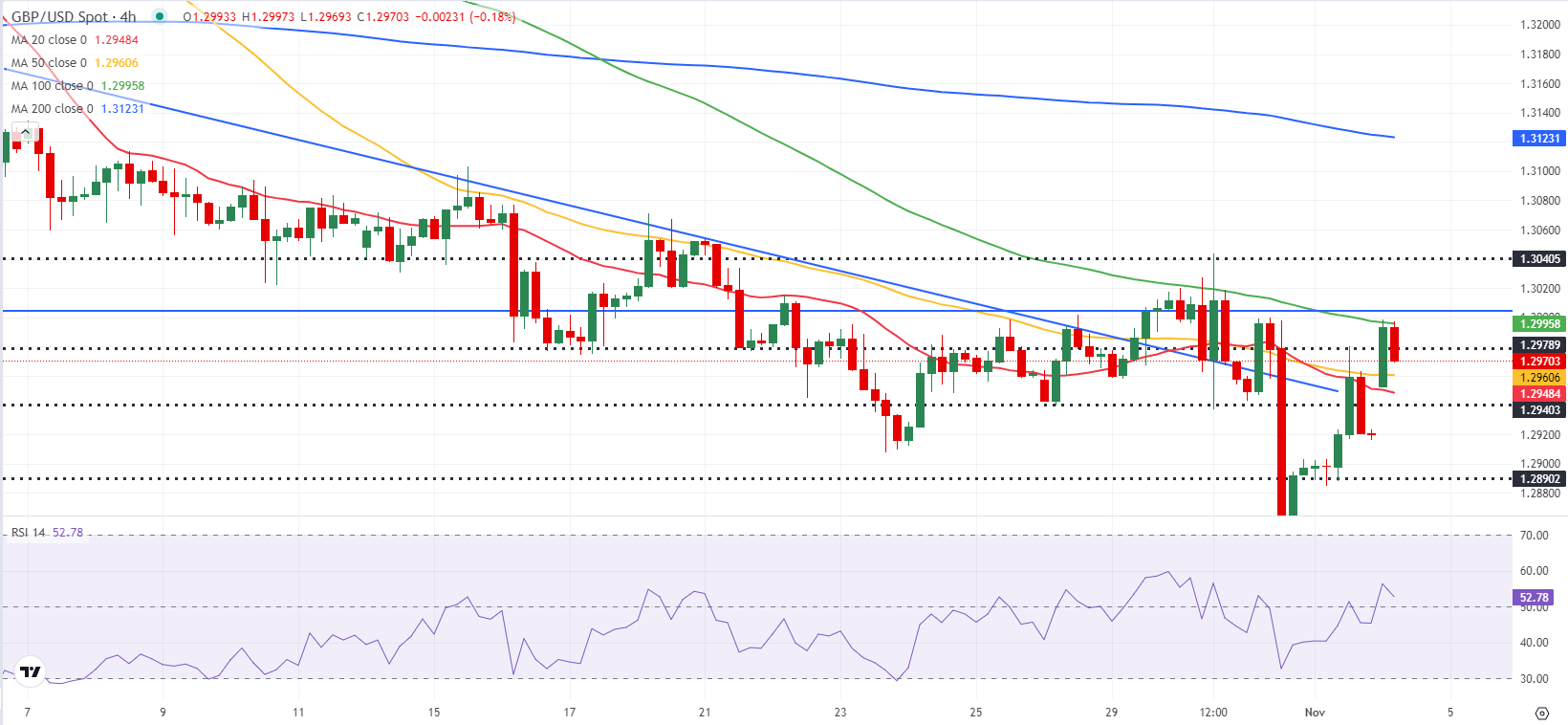
Technical forecasts for the GPB/USD pair today: 

The GBP/USD exchange rate continued its strong upward march after the relatively dovish Fed statement and ahead of the upcoming UK inflation data. It has risen for three consecutive days and moved to the psychological level of 1.300, its highest swing since July 2023. The GBP/USD pair continued its strong rise after Monday’s statement by Jerome Powell, the Fed Chairman. In his statement, Powell welcomed the US inflation figures over the past three months, which showed stable prices. Powell is comfortable cutting interest rates this year if inflation continues to decline, although it is still above 2.0%. Now, the Fed seems more concerned about the labor market, which has weakened in the past few months. 

The daily chart shows that the GBP/USD pair has been moving in a strong uptrend for the past few weeks. Recently, it flipped the crucial resistance point at 1.2830, which is the neckline of the inverse head and shoulders pattern. Also, it rose above the 78.6% Fibonacci retracement point at 1.2905. The pair also moved above the upper side of the XABCD pattern, which is a bullish signal. Technically, the price remains above the 50-day and 100-day moving averages. At the same time, the Relative Strength Index (RSI) has moved into overbought territory. Therefore, it is likely to the pair will review and retest the support at 1.2893 and then resume the uptrend. If this happens, it will eventually retest the resistance level at 1.3100. 

Ready to trade our daily Forex analysis? We’ve made this UK forex brokers list for you to check out. 
Source link

18 07, 2024

GBP/USD Price Analysis: Pound Jumps Amid Hotter Inflation

By |2024-07-18T05:37:47+03:00July 18, 2024|Forex News, News|0 Comments

  • Inflation in the UK remained at an annual rate of 2% in June.
  • UK services inflation came in at 5.7%.
  • US sales were unchanged in June, better than economist expectations for a 0.3% decline. 

The GBP/USD price analysis shows solid bullish sentiment as the pound rallies after a higher-than-expected reading on UK inflation. Meanwhile, the dollar retreated from Tuesday’s highs as the effects of an upbeat retail sales report wore off. 

Are you interested in learning more about Forex brokers? Check our detailed guide-

Inflation in the UK remained at an annual rate of 2% in June, higher than expectations of a 1.9% increase. At the same time, services inflation came in at 5.7%, which was higher than the forecast of 5.6%. The upbeat figures might cause Bank of England policymakers to be more cautious. Moreover, the numbers lowered the likelihood of a rate cut in August, boosting the pound.Meanwhile, the US dollar fell after rallying on upbeat retail sales data in the previous session. Sales were unchanged in June, better than economist expectations for a 0.3% decline. The report showed that the economy was doing fairly well, and the risks of a recession were low. 

However, inflation is also in a downtrend, meaning the Fed is getting closer to its first rate cut. Last week’s soft inflation figures pushed investors to fully price in the first rate cut by September, putting significant downward pressure on the dollar. As long as inflation continues falling, policymakers will be confident enough to cut rates even if the economy remains resilient. However, if inflation pauses or spikes while the economy is strong, the Fed will delay rate cuts.

GBP/USD key events today

Neither the US nor the UK will release more key reports today. Therefore, investors will keep digesting Britain’s inflation figures.

GBP/USD technical price analysis: Bulls breach 1.3000 barrier

GBP/USD Price Analysis: Pound Jumps Amid Hotter Inflation
GBP/USD 4-hour chart

On the technical side, the GBP/USD price is breaking above the 1.3000 barrier with a solid bullish candle. However, it must close well above this level to confirm this break. Notably, the price has made consistent higher highs and lows, indicating a bullish trend. At the same time, it has respected the 30-SMA as support, trading above the line. 

Are you interested in learning more about crypto signals Telegram groups? Check our detailed guide-

However, the RSI tells a different story. The indicator has made a bearish divergence with the price, which might indicate fading bullish momentum. If the bulls are exhausted, they might fail to sustain a move above 1.3000 and pull back. 

Looking to trade forex now? Invest at eToro!

68% of retail investor accounts lose money when trading CFDs with this provider. You should consider whether you can afford to take the high risk of losing your money.

Source link

18 07, 2024

USD/JPY Forecast: US Labor Data and Japanese Trade Terms Influence Yen’s Path

By |2024-07-18T03:36:26+03:00July 18, 2024|Forex News, News|0 Comments

FX Empire – US Continuing Jobless Claims
A July Fed rate cut would significantly impact buyer demand for the USD/JPY. Narrowing interest rate differentials on diverging monetary policies may signal a USD/JPY drop below 150.

Could the Fed Cut Interest Rates in July?

On Monday, Wall Street Journal Chief Economics Correspondent Nick Timiraos reacted to Powell’s speech:

“Fed Chair Jay Powell passed on an opportunity to change expectations that the central bank will hold rates steady at its next meeting. The Q2 inflation data “do add somewhat to confidence” that inflation is returning to 2%.”

Timiraos also reported that Goldman Sachs’s Jan Hatzius considered the chances of a July Fed rate cut, stating,

“While September remains our baseline, we see a solid rationale for already cutting in July. If the case for a cut is clear, why wait another seven weeks before delivering it?”

Short-term Forecast: Bearish

USD/JPY trends depend on the US labor market data and inflation numbers from Japan (Fri). Higher US continuous jobless claims could raise bets on multiple 2024 Fed rate cuts. Conversely, inflation figures from Japan could signal a July BoJ rate hike. The BoJ may also cut JGB purchases more than expected.

Narrower interest rate differentials could signal a USD/JPY break below 150.

Investors should remain alert. Monitor real-time data, central bank commentary, and expert commentary to adjust your trading strategies accordingly. Stay updated with our latest news and analysis to manage USD/JPY volatility.

USD/JPY Price Action

Daily Chart

The USD/JPY sat below the 50-day EMA while holding above the 200-day EMA. The EMAs sent bearish near-term but bullish longer-term price signals.

A USD/JPY break above the 50-day EMA could support a return to 160. A return to 160 could give the bulls a run at the July 3 high of 161.951.

Trade data from Japan, the continuous jobless claims, and central bank commentary require monitoring.

Conversely, a break below the 155 handle could bring the 200-day EMA and the 151.685 support level into play.

The 14-day RSI at 33.44 indicates a USD/JPY decline to 155 before entering oversold territory.

Source link

18 07, 2024

Next on the upside comes 1.1000

By |2024-07-18T01:35:51+03:00July 18, 2024|Forex News, News|0 Comments

You have reached your limit of 5 free articles for this month.

Get Premium without limits for only $479.76 for the first month

Access all our articles, insights, and analysts.

Your coupon code


UNLOCK OFFER

  • EUR/USD advanced to fresh tops past 1.0900 the figure.
  • The US Dollar accelerated its decline following the BoJ’s intervention.
  • The EBC is anticipated to keep its rates on hold on Thursday.

The offered stance in the US Dollar (USD) picked up extra pace on Wednesday on the back of another suspected intervention by the BoJ to support the Japanese yen early in the session.

In this context, the USD Index breached the 104.00 support quite convincingly, while EUR/USD marched further north to fresh four-month highs near 1.0950.

The mixed price action occurred amidst persistent demand for bonds in the US and German money markets, leading to a further decline in yields across various maturities on both sides of the ocean.

Meanwhile, the macroeconomic landscape remained stable. Investors generally expect the European Central Bank (ECB) to keep its policy rate unchanged at its meeting on Thursday, though markets still anticipate two additional cuts by the end of the year.

In contrast, there is ongoing debate among investors about whether the Fed will implement one, two (or three?) rate cuts this year, despite the Fed’s current projection of a single cut, likely in December.

On this, the CME Group’s FedWatch Tool sees the probability of lower rates at the September 18 meeting around 98%, while another rate cut is fully priced in by year-end.

Underpinning the above, some Federal Reserve (Fed) rate setters, including New York’s John Williams and Board Governor Christopher Waller, said the central bank is “getting closer” to decreasing interest rates, while Richmond’s Thomas Barkin stated that the United States is on the “back end” of inflation.

Meanwhile, economic recovery prospects in the Eurozone, along with signs of cooling in key US economic indicators, may mitigate the ongoing disparity regarding monetary policy between the Fed and the ECB, and occasionally support the pair in the near future. This view has regained momentum amid rising expectations of rate cuts by the Fed.

Looking ahead, upcoming US data, Fedspeak, and the ECB meeting will likely be key drivers of the pair’s price action in the short term.

EUR/USD daily chart

EUR/USD short-term technical outlook

EUR/USD seen facing the next upward obstacle at 1.0948 (July 17), followed by the March top of 1.0981 (March 8) and the psychological 1.1000 level.

If bears grab control, spot may test the 200-day SMA of 1.0808 before falling to the June low of 1.0666 (June 26). The loss of the May low of 1.0649 (May 1) leads to the 2024 bottom of 1.0601 (April 16).

Looking at the bigger picture, it appears that additional gains are on the way if the critical 200-day SMA is consistently surpassed.

So far, on the 4-hour chart, the uptrend appears quite solid for the time being. That said, the initial resistance is 1.0948, before 1.0981 and 1.1000. On the other side, the 55-SMA at 1.0861 is first, followed by the 200-SMA at 1.0791, and finally 1.0709. The relative strength index (RSI) climbed to approximately 68.

  • EUR/USD advanced to fresh tops past 1.0900 the figure.
  • The US Dollar accelerated its decline following the BoJ’s intervention.
  • The EBC is anticipated to keep its rates on hold on Thursday.

The offered stance in the US Dollar (USD) picked up extra pace on Wednesday on the back of another suspected intervention by the BoJ to support the Japanese yen early in the session.

In this context, the USD Index breached the 104.00 support quite convincingly, while EUR/USD marched further north to fresh four-month highs near 1.0950.

The mixed price action occurred amidst persistent demand for bonds in the US and German money markets, leading to a further decline in yields across various maturities on both sides of the ocean.

Meanwhile, the macroeconomic landscape remained stable. Investors generally expect the European Central Bank (ECB) to keep its policy rate unchanged at its meeting on Thursday, though markets still anticipate two additional cuts by the end of the year.

In contrast, there is ongoing debate among investors about whether the Fed will implement one, two (or three?) rate cuts this year, despite the Fed’s current projection of a single cut, likely in December.

On this, the CME Group’s FedWatch Tool sees the probability of lower rates at the September 18 meeting around 98%, while another rate cut is fully priced in by year-end.

Underpinning the above, some Federal Reserve (Fed) rate setters, including New York’s John Williams and Board Governor Christopher Waller, said the central bank is “getting closer” to decreasing interest rates, while Richmond’s Thomas Barkin stated that the United States is on the “back end” of inflation.

Meanwhile, economic recovery prospects in the Eurozone, along with signs of cooling in key US economic indicators, may mitigate the ongoing disparity regarding monetary policy between the Fed and the ECB, and occasionally support the pair in the near future. This view has regained momentum amid rising expectations of rate cuts by the Fed.

Looking ahead, upcoming US data, Fedspeak, and the ECB meeting will likely be key drivers of the pair’s price action in the short term.

EUR/USD daily chart

EUR/USD short-term technical outlook

EUR/USD seen facing the next upward obstacle at 1.0948 (July 17), followed by the March top of 1.0981 (March 8) and the psychological 1.1000 level.

If bears grab control, spot may test the 200-day SMA of 1.0808 before falling to the June low of 1.0666 (June 26). The loss of the May low of 1.0649 (May 1) leads to the 2024 bottom of 1.0601 (April 16).

Looking at the bigger picture, it appears that additional gains are on the way if the critical 200-day SMA is consistently surpassed.

So far, on the 4-hour chart, the uptrend appears quite solid for the time being. That said, the initial resistance is 1.0948, before 1.0981 and 1.1000. On the other side, the 55-SMA at 1.0861 is first, followed by the 200-SMA at 1.0791, and finally 1.0709. The relative strength index (RSI) climbed to approximately 68.

Source link

17 07, 2024

GBP/JPY Forecast Today – 17/07: Pound Finds Buyers (Chart)

By |2024-07-17T23:34:37+03:00July 17, 2024|Forex News, News|0 Comments

  • The British pound has rallied a bit during the trading session on Tuesday.
  • I continue to monitor the ¥205 level as a potential support barrier, as it has held true for some time.
  • Furthermore, we have also seen the market try to push back against any selling, and it’s probably worth noting that the Bank of Japan continues to see a lot of resistance against its interventions.

Central Bank

The central bank will continue to drive this market in one direction or the other, and it’s obvious at this point in time that the Bank of Japan can do nothing to stem the flow. After all, the market is likely to continue to see the interest rate differential and was the reason to hang on to this pair, and the fact that we ended up forming a couple of hammers in a row does suggest that people are becoming more and more comfortable with buying this market. This asset will continue to pay off at the end of every day, and therefore I think you’ve got a situation where eventually we will try to get back to the highs.

Underneath, the 200 for yen level is a support barrier as well, and if we were to break down below there, then we could see this market go looking to the 50-Day EMA, which is sitting just above the ¥200 level. The ¥200 level is for me the bottom of the overall trend, and as long as we can stay above there, the market is likely to continue to go much higher. In fact, I would love to see a pullback to that area so I could buy “cheap British pound.”

That being said, it certainly looks like this is a market that is not afraid anymore, and the Bank of Japan probably understands that there is only so much you can do. At this point, it is probably more or less all about the idea of trying to slow down the destruction of its own currency as it cannot raise interest rates.

Ready to trade our daily analysis & predictions? Here are the best brokers for beginners to choose from. 

Source link

17 07, 2024

UBS raises EUR/USD forecast amid US data and Fed rate cut prospects By Investing.com

By |2024-07-17T17:28:56+03:00July 17, 2024|Forex News, News|0 Comments

UBS revised its forecast for the exchange rate, citing a lack of strength in the US dollar despite expectations that certain political events would bolster it. Contrary to these expectations, gold prices and bitcoin have experienced a surge rather than the greenback.

The revision by UBS reflects a complex interplay of factors, including recent soft US economic data and a decrease in Treasury yields, which have not supported the dollar as anticipated.

The bank has adjusted its end-Q3 and end-2024 forecasts for the EUR/USD pair to 1.08, up from the previous 1.05 prediction. This change comes amid market speculation that the Federal Reserve might consider a 50 basis point rate cut in 2024, with discussions of rate reductions potentially beginning as early as September.

These expectations have become a more dominant influence on currency valuations than potential USD-related policies from the Trump administration should he win the upcoming election.

UBS’s revised forecast aligns with its new outlook on the Federal Reserve’s monetary policy, which now includes the possibility of two rate cuts in 2024. Meanwhile, the European Central Bank (ECB) has maintained a cautious stance on future rate cuts.

While these developments weaken the case for the EUR to hit new lows in 2024, UBS still anticipates a modest decline in the euro’s value, considering the potential for economic growth indicators to soften in significant economies such as France.

This article was generated with the support of AI and reviewed by an editor. For more information see our T&C.


Source link

17 07, 2024

USD/JPY Analysis Today – 17/07: Above 160 Again? (Chart)

By |2024-07-17T15:27:01+03:00July 17, 2024|Forex News, News|0 Comments

  • The Japanese yen has failed to maintain momentum despite intervention by authorities to stem its weakness.
  • The yen has fallen sharply, and policymakers have repeatedly indicated that they are prepared to intervene to support the currency.
  • But is it too little, or too late?  

According to data compiled by Bloomberg News, Tokyo is likely to enter the forex markets for a second day in a row on Friday, pumping in about $13.5 billion. Clearly, this comes after Japanese officials may have intervened with close to $20 billion. According to forex trading, the US dollar against the Japanese yen USD/JPY stabilized around the 158.80 level, recovering from recent selling that pushed it towards the 157.15 support level. 

Commenting on the performance of the Japanese yen, Hirofumi Suzuki, Chief Forex Analyst at Sumitomo Mitsui Banking Corporation, said in an interview with a business news network, “This indicates that an intervention in the range of 2 trillion yen is very likely.” He added, “I believe the strategy aimed to prevent market participants from anticipating the move.” 

If this step is accurate, the latest intervention comes a month after currency regulators intervened in the forex markets with a $36 billion move. Experts claim that Tokyo leaders are using these measures simultaneously with the release of U.S. data and foreign speculators. However, market observers suggest that these actions signal to traders that the moves are too small, with observers calling for more substantial funds to support the yen. 

Obviously, this was evident in the weakness of the Japanese yen at the start of the trading week. The yen is down 12% year-to-date against the US dollar. 

However, U.S. officials have warned against excessive intervention, even though U.S. Treasury Secretary Janet Yellen and her counterparts in Europe and Asia have given the green light for intervention. What’s next? Japanese Chief Cabinet Secretary Yoshimasa Hayashi told reporters on Tuesday that the Japanese government is prepared to take all possible measures to prevent further deterioration of the yen. According to Reuters, he stated, “It is important for forex rates to move stably, reflecting fundamentals. Excessive volatility is undesirable. We will closely monitor exchange rate developments and stand ready to take all possible measures.” 

USD/JPY Technical analysis and Expectations Today 

Based on the daily chart attached, the USD/JPY is in a neutral position with a bearish bias if it moves further below the 158.00 level. On the other hand, and over the same time frame, the 160.00 psychological resistance level will remain the most important for bulls to regain control of the trend again. Technically, the Japanese yen price will continue to move according to whether Japan intervenes in the forex markets or not. Ultimately, The US dollar price is dependent on the future of the Federal Reserve’s policy and the reaction to the results of US data. 

Want to trade our daily forex analysis and predictions? Here’s a list of forex brokers in Japan to check out. 

Source link

17 07, 2024

EUR/USD Analysis Today – 17/07: Gains Halted (Chart)

By |2024-07-17T13:25:35+03:00July 17, 2024|Forex News, News|0 Comments

  • The EUR/USD price halted its gains at the 1.0922 resistance level and has returned to move down, settling around the 1.0875 level at the time of writing.
  • Despite Powell’s dovish appearance, the EUR/USD is unable to benefit. US Federal Reserve Chairman Jerome Powell made a “dovish” mark in his recent interview.
  • However, the EUR/USD price has failed to capitalize on these comments. 

The EUR/USD exchange rate is stuck below the 1.0900 resistance level, unable to rise even after Powell, the U.S. Federal Reserve Chair, made dovish comments, noting that the inflation outlook in the United States is improving amid a more balanced labor market. 

Powell was interviewed by the Economic Club in Washington DC, where he was able to reflect on last week’s weaker-than-expected US inflation figures. “Powell sounded dovish,” said Sam Hill, head of market insights at Lloyds Bank. Added, “The improvement in the data trajectory that the Fed has seen over the second quarter, particularly the last three inflation prints, has been reflected.” 

According to reliable trading platforms, the dollar fell after US inflation came in at -0.1% on a monthly basis in June, down from 0% in May and below expectations for a 0.1% increase. Powell believes that this data has added “somewhat” confidence that inflation is on its way back to target. Combined with a cooler labor market, this means that the US Federal Reserve will “consider both mandates” when setting policy. 

According to reliable trading platforms, the dollar weakened after U.S. inflation dropped to -0.1% month-on-month in June, down from 0% in May and below the expected increase of 0.1%. Powell believes this data has somewhat boosted confidence that inflation is on its way back to the target. Alongside a cooler labor market, this means the Fed will consider both mandates when determining policy. 

Powell added, “We want to get that right,”. The dollar has proven less sensitive to such statements, dropping notably after Powell told the ECB Forum on Central Banking on July 3rd that significant progress on inflation had been made and that the process of reducing inflation was back on track. He stated in Sintra, Portugal, that if the labor market becomes “unexpectedly weak… this will also prompt us to respond.” Powell also reiterated his view that the neutral rate of interest might be higher than previously thought but repeated that policy remains restrictive. Analysts noted, “Market prices continued to shift towards more cuts this year after he spoke, with the easing cycle starting in September and delivering at least two cuts over the year, with about a 60% chance of three cuts.” 

According to forex trading, the euro against the US dollar (EUR/USD) exchange rate rose amid greater confidence that the Federal Reserve will cut US interest rates in September. However, the failure to break above the 1.09 level on a sustained basis suggests that a cut may already be “in price.” This could mean that the dollar is consolidating around current levels and those who want a stronger euro may have to wait for further catalysts. 

Overall, all eyes will be on the European Central Bank (ECB) tomorrow, Thursday, when it announces its next interest rate decision. Interest rates are expected to remain unchanged, but markets will be looking for hints of further rate cuts. A September rate cut by the ECB is almost fully priced in by the market, indicating that this might not significantly change the EUR/USD, potentially keeping the exchange rate stable below 1.09 and ready for a new breakout. 

EUR/USD Technical analysis and forecast: 

Based on the performance on the daily chart attached, the bulls are still in strong control of the EUR/USD price trend, with the need to break the psychological resistance at 1.1000 to confirm the general trend turning to the upside. Failure to do so could re-establish a head and shoulders pattern in that time frame, meaning selling pressures could return and a break of the support at 1.0790 could threaten the recent upward correction. The EUR/USD will remain in tight ranges until the reaction to the ECB decisions tomorrow, Thursday. 

Ready to trade Forex daily analysis and predictions? We’ve shortlisted the best European brokers in the industry for you. 

Source link

17 07, 2024

Pound Sterling looks to clear 1.3000 after UK inflation data

By |2024-07-17T11:24:11+03:00July 17, 2024|Forex News, News|0 Comments

You have reached your limit of 5 free articles for this month.

Get Premium without limits for only $479.76 for the first month

Access all our articles, insights, and analysts.

Your coupon code


UNLOCK OFFER

  • GBP/USD touched a new 2024-high above 1.3000 in the European morning.
  • Annual inflation in the UK held steady at 2% as expected in June.
  • Markets see a diminishing chance of a Bank of England rate cut in August.

Following Tuesday’s indecisive action, GBP/USD gained traction in the European morning and touched its highest level in a year above 1.3000. The pair could extend its uptrend once it confirms this level as support.

The data published by the UK’s Office for National Statistics showed early Wednesday that annual inflation, as measured by the change in the Consumer Price Index (CPI), remained unchanged at 2% in June as expected. In the same period, the core CPI rose 3.5%, matching analysts’ estimate and May’s increase. Services prices, which have been the sticky part of inflation, rose 5.7% on a yearly basis following the 5.6% increase recorded in May.

British Pound PRICE This week

The table below shows the percentage change of British Pound (GBP) against listed major currencies this week. British Pound was the strongest against the Australian Dollar.

  USD EUR GBP JPY CAD AUD NZD CHF
USD   0.02% -0.14% -0.66% 0.26% 0.76% 0.54% -0.28%
EUR -0.02%   -0.12% -0.48% 0.43% 0.77% 0.72% -0.11%
GBP 0.14% 0.12%   -0.27% 0.55% 0.89% 0.79% 0.01%
JPY 0.66% 0.48% 0.27%   0.90% 1.19% 1.15% 0.18%
CAD -0.26% -0.43% -0.55% -0.90%   0.43% 0.29% -0.54%
AUD -0.76% -0.77% -0.89% -1.19% -0.43%   -0.05% -0.89%
NZD -0.54% -0.72% -0.79% -1.15% -0.29% 0.05%   -0.83%
CHF 0.28% 0.11% -0.01% -0.18% 0.54% 0.89% 0.83%  

The heat map shows percentage changes of major currencies against each other. The base currency is picked from the left column, while the quote currency is picked from the top row. For example, if you pick the British Pound from the left column and move along the horizontal line to the US Dollar, the percentage change displayed in the box will represent GBP (base)/USD (quote).

According to Reuters, UK interest rate futures are now pricing a roughly 33% probability of the Bank of England (BoE) lowering the policy rate by 25 basis points in August, down from nearly 50% before the data release. This change in market positioning supports Pound Sterling.

In the second half of the day, the US economic docket will feature Housing Starts, Building Permits and Industrial Production data for June. With markets already fully pricing in a September Federal Reserve rate cut, these data releases are unlikely to have a noticeable impact on the US Dollar’s (USD) valuation.

GBP/USD Technical Analysis

The Relative Strength Index (RSI) indicator on the 4-hour chart climbed back above 70 in the European morning on Wednesday, suggesting GBP/USD is technically overbought. In case the pair goes into a consolidation phase and starts using 1.3000 as support, the upper limit of the channel could act as next resistance at 1.3020 ahead of 1.3040 (static level from July 2023) and 1.3100 (psychological level, static level).

On the downside, supports could be seen at 1.2950 (static level) and 1.2900 (psychological level, static level), if 1.3000 fails to hold as support.

Inflation FAQs

Inflation measures the rise in the price of a representative basket of goods and services. Headline inflation is usually expressed as a percentage change on a month-on-month (MoM) and year-on-year (YoY) basis. Core inflation excludes more volatile elements such as food and fuel which can fluctuate because of geopolitical and seasonal factors. Core inflation is the figure economists focus on and is the level targeted by central banks, which are mandated to keep inflation at a manageable level, usually around 2%.

The Consumer Price Index (CPI) measures the change in prices of a basket of goods and services over a period of time. It is usually expressed as a percentage change on a month-on-month (MoM) and year-on-year (YoY) basis. Core CPI is the figure targeted by central banks as it excludes volatile food and fuel inputs. When Core CPI rises above 2% it usually results in higher interest rates and vice versa when it falls below 2%. Since higher interest rates are positive for a currency, higher inflation usually results in a stronger currency. The opposite is true when inflation falls.

Although it may seem counter-intuitive, high inflation in a country pushes up the value of its currency and vice versa for lower inflation. This is because the central bank will normally raise interest rates to combat the higher inflation, which attract more global capital inflows from investors looking for a lucrative place to park their money.

Formerly, Gold was the asset investors turned to in times of high inflation because it preserved its value, and whilst investors will often still buy Gold for its safe-haven properties in times of extreme market turmoil, this is not the case most of the time. This is because when inflation is high, central banks will put up interest rates to combat it. Higher interest rates are negative for Gold because they increase the opportunity-cost of holding Gold vis-a-vis an interest-bearing asset or placing the money in a cash deposit account. On the flipside, lower inflation tends to be positive for Gold as it brings interest rates down, making the bright metal a more viable investment alternative.


  • GBP/USD touched a new 2024-high above 1.3000 in the European morning.
  • Annual inflation in the UK held steady at 2% as expected in June.
  • Markets see a diminishing chance of a Bank of England rate cut in August.

Following Tuesday’s indecisive action, GBP/USD gained traction in the European morning and touched its highest level in a year above 1.3000. The pair could extend its uptrend once it confirms this level as support.

The data published by the UK’s Office for National Statistics showed early Wednesday that annual inflation, as measured by the change in the Consumer Price Index (CPI), remained unchanged at 2% in June as expected. In the same period, the core CPI rose 3.5%, matching analysts’ estimate and May’s increase. Services prices, which have been the sticky part of inflation, rose 5.7% on a yearly basis following the 5.6% increase recorded in May.

British Pound PRICE This week

The table below shows the percentage change of British Pound (GBP) against listed major currencies this week. British Pound was the strongest against the Australian Dollar.

  USD EUR GBP JPY CAD AUD NZD CHF
USD   0.02% -0.14% -0.66% 0.26% 0.76% 0.54% -0.28%
EUR -0.02%   -0.12% -0.48% 0.43% 0.77% 0.72% -0.11%
GBP 0.14% 0.12%   -0.27% 0.55% 0.89% 0.79% 0.01%
JPY 0.66% 0.48% 0.27%   0.90% 1.19% 1.15% 0.18%
CAD -0.26% -0.43% -0.55% -0.90%   0.43% 0.29% -0.54%
AUD -0.76% -0.77% -0.89% -1.19% -0.43%   -0.05% -0.89%
NZD -0.54% -0.72% -0.79% -1.15% -0.29% 0.05%   -0.83%
CHF 0.28% 0.11% -0.01% -0.18% 0.54% 0.89% 0.83%  

The heat map shows percentage changes of major currencies against each other. The base currency is picked from the left column, while the quote currency is picked from the top row. For example, if you pick the British Pound from the left column and move along the horizontal line to the US Dollar, the percentage change displayed in the box will represent GBP (base)/USD (quote).

According to Reuters, UK interest rate futures are now pricing a roughly 33% probability of the Bank of England (BoE) lowering the policy rate by 25 basis points in August, down from nearly 50% before the data release. This change in market positioning supports Pound Sterling.

In the second half of the day, the US economic docket will feature Housing Starts, Building Permits and Industrial Production data for June. With markets already fully pricing in a September Federal Reserve rate cut, these data releases are unlikely to have a noticeable impact on the US Dollar’s (USD) valuation.

GBP/USD Technical Analysis

The Relative Strength Index (RSI) indicator on the 4-hour chart climbed back above 70 in the European morning on Wednesday, suggesting GBP/USD is technically overbought. In case the pair goes into a consolidation phase and starts using 1.3000 as support, the upper limit of the channel could act as next resistance at 1.3020 ahead of 1.3040 (static level from July 2023) and 1.3100 (psychological level, static level).

On the downside, supports could be seen at 1.2950 (static level) and 1.2900 (psychological level, static level), if 1.3000 fails to hold as support.

Inflation FAQs

Inflation measures the rise in the price of a representative basket of goods and services. Headline inflation is usually expressed as a percentage change on a month-on-month (MoM) and year-on-year (YoY) basis. Core inflation excludes more volatile elements such as food and fuel which can fluctuate because of geopolitical and seasonal factors. Core inflation is the figure economists focus on and is the level targeted by central banks, which are mandated to keep inflation at a manageable level, usually around 2%.

The Consumer Price Index (CPI) measures the change in prices of a basket of goods and services over a period of time. It is usually expressed as a percentage change on a month-on-month (MoM) and year-on-year (YoY) basis. Core CPI is the figure targeted by central banks as it excludes volatile food and fuel inputs. When Core CPI rises above 2% it usually results in higher interest rates and vice versa when it falls below 2%. Since higher interest rates are positive for a currency, higher inflation usually results in a stronger currency. The opposite is true when inflation falls.

Although it may seem counter-intuitive, high inflation in a country pushes up the value of its currency and vice versa for lower inflation. This is because the central bank will normally raise interest rates to combat the higher inflation, which attract more global capital inflows from investors looking for a lucrative place to park their money.

Formerly, Gold was the asset investors turned to in times of high inflation because it preserved its value, and whilst investors will often still buy Gold for its safe-haven properties in times of extreme market turmoil, this is not the case most of the time. This is because when inflation is high, central banks will put up interest rates to combat it. Higher interest rates are negative for Gold because they increase the opportunity-cost of holding Gold vis-a-vis an interest-bearing asset or placing the money in a cash deposit account. On the flipside, lower inflation tends to be positive for Gold as it brings interest rates down, making the bright metal a more viable investment alternative.


Source link

Go to Top