The main tag of Forex News Today Articles.
You can use the search box below to find what you need.
[wd_asp id=1]

13 09, 2024

USD/JPY Outlook: Super-Sized Fed Rate Cut Bets Reemerge

By |2024-09-13T17:52:40+03:00September 13, 2024|Forex News, News|0 Comments

  • Former Fed official Bill Dudley said that there was a strong case for a 50 bps rate cut.
  • The likelihood of a 50 bps rate cut shot up from 28% to 45%.
  • BoJ board member Naoki Tamura noted that the upside risk to inflation was increasing. 

The USD/JPY outlook shows a free-falling dollar as markets move to price in a higher likelihood of a super-sized Fed rate cut next week. At the same time, the yen strengthened as more Bank of Japan policymakers took on a hawkish tone. 

Are you interested to learn more about forex options trading? Check our detailed guide-

On Thursday, the dollar fell to a fresh low for the year after reports that the Fed might consider a 50 bps rate cut at next week’s meeting. Moreover, former Fed official Bill Dudley said that there was a strong case for a 50 bps rate cut. As a result, the likelihood of a 50 bps rate cut shot up from 28% to 45%. Data on Wednesday showed that core consumer inflation beat expectations in August. Therefore, market participants increased the likelihood of a 25 bps rate cut, boosting the dollar.

Furthermore, data on Friday revealed that wholesale inflation was higher than expected. Recent data has pointed to a gradual pace for rate cuts. However, the reports on Friday showed that policymakers might consider a bigger cut.

Meanwhile, the yen was strong after another policymaker supported more rate hikes. BoJ board member Naoki Tamura noted that the upside risk to inflation was increasing. Higher inflation creates the best conditions for the Bank of Japan to hike interest rates.

USD/JPY key events today

Investors do not expect any key economic reports from the US or Japan. Therefore, the pair might extend Thursday’s move.

USD/JPY technical outlook: Bearish momentum eases near the 141.02 support

USD/JPY Outlook: Super-Sized Fed Rate Cut Bets Reemerge
USD/JPY 4-hour chart

On the technical side, the USD/JPY price is on the brink of falling below the 141.02 support level. The bias is bearish as the price has made a series of lower highs and lows, indicating a downtrend. However, the decline has slowed near the 141.02 key level. It is becoming harder for the price to make lower lows.

Are you interested to learn about forex robots? Check our detailed guide-  

At the same time, the RSI has made a bullish divergence, indicating fading bearish momentum. If this is the end of the road for bears, the price might bounce higher from 14.02 to challenge the 30-SMA resistance. A break above the SMA would confirm a shift in sentiment. On the other hand, if bears remain in charge, the price will stay below the SMA.

Looking to trade forex now? Invest at eToro!

67% of retail investor accounts lose money when trading CFDs with this provider. You should consider whether you can afford to take the high risk of losing your money.

Source link

13 09, 2024

Euro turns bullish, closes in on key resistance

By |2024-09-13T15:51:29+03:00September 13, 2024|Forex News, News|0 Comments

  • EUR/USD continues to push higher after posting strong gains on Thursday.
  • Technical buyers could take action in case the pair flips 1.1100 into support.
  • European Central Bank lowered the benchmark interest rate by 25 basis points.

After closing the first three days of the week in negative territory, EUR/USD gathered bullish momentum on Thursday and registered strong gains. The pair continues to edge higher toward 1.1100 in the European morning on Friday.

Euro PRICE This week

The table below shows the percentage change of Euro (EUR) against listed major currencies this week. Euro was the strongest against the Swiss Franc.

  USD EUR GBP JPY CAD AUD NZD CHF
USD   -0.05% -0.11% -1.24% 0.06% -0.73% -0.18% 0.36%
EUR 0.05%   -0.11% -1.12% 0.11% -0.72% -0.11% 0.40%
GBP 0.11% 0.11%   -1.13% 0.23% -0.61% -0.02% 0.50%
JPY 1.24% 1.12% 1.13%   1.30% 0.52% 1.04% 1.79%
CAD -0.06% -0.11% -0.23% -1.30%   -0.75% -0.26% 0.46%
AUD 0.73% 0.72% 0.61% -0.52% 0.75%   0.59% 1.09%
NZD 0.18% 0.11% 0.02% -1.04% 0.26% -0.59%   0.53%
CHF -0.36% -0.40% -0.50% -1.79% -0.46% -1.09% -0.53%  

The heat map shows percentage changes of major currencies against each other. The base currency is picked from the left column, while the quote currency is picked from the top row. For example, if you pick the Euro from the left column and move along the horizontal line to the US Dollar, the percentage change displayed in the box will represent EUR (base)/USD (quote).

The European Central Bank (ECB) lowered the benchmark interest rate, the deposit facility, by 25 basis points (bps) to 3.5% as expected. The ECB also lowered interest rates on the marginal lending facility and the main refinancing operations by 60 bps. “The Governing Council will continue to follow a data-dependent and meeting-by-meeting approach to determining the appropriate level and duration of restriction,” the ECB noted in the policy statement. In the post-meeting press conference, ECB President Christine Lagarde refrained from hinting at the timing of the next rate cut.

Although the ECB event failed to provide a boost to the Euro, the renewed selling pressure surrounding the US Dollar (USD) helped EUR/USD turn north.

On a yearly basis, the Producer Price Index (PPI) rose 1.7% in August in the US, down from 2.1% in July and below the market expectation of 1.8%. The probability of a 50 bps Federal Reserve (Fed) rate cut in September climbed above 40% after this data, per CME FedWatch Tool, and triggered a USD selloff.

The US economic calendar will feature the University of Michigan’s Consumer Sentiment Survey for September, which is unlikely to influence the USD’s valuation.

EUR/USD Technical Analysis

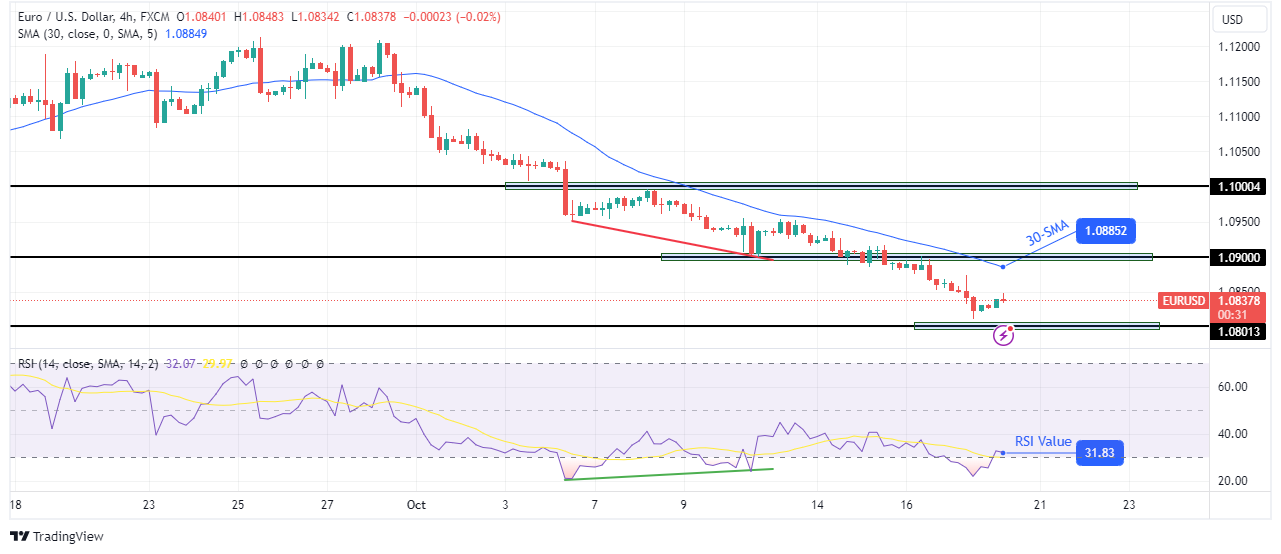
The Relative Strength Index (RSI) indicator on the 4-hour chart climbed above 60 and EUR/USD rose slightly above the 100-period Simple Moving Average (SMA), reflecting a buildup of bullish momentum. In case the pair clears 1.1090-1.1100 resistance area (100-period SMA, Fibonacci 23.6% retracement of the latest uptrend), it could target 1.1160 (static level) and 1.1200 (end-point of the uptrend) next.

On the downside, 1.1060 (50-period SMA) aligns as first support before 1.1040 (Fibonacci 38.2% retracement) and 1.1020 (200-period SMA).

Euro FAQs

The Euro is the currency for the 20 European Union countries that belong to the Eurozone. It is the second most heavily traded currency in the world behind the US Dollar. In 2022, it accounted for 31% of all foreign exchange transactions, with an average daily turnover of over $2.2 trillion a day. EUR/USD is the most heavily traded currency pair in the world, accounting for an estimated 30% off all transactions, followed by EUR/JPY (4%), EUR/GBP (3%) and EUR/AUD (2%).

The European Central Bank (ECB) in Frankfurt, Germany, is the reserve bank for the Eurozone. The ECB sets interest rates and manages monetary policy. The ECB’s primary mandate is to maintain price stability, which means either controlling inflation or stimulating growth. Its primary tool is the raising or lowering of interest rates. Relatively high interest rates – or the expectation of higher rates – will usually benefit the Euro and vice versa. The ECB Governing Council makes monetary policy decisions at meetings held eight times a year. Decisions are made by heads of the Eurozone national banks and six permanent members, including the President of the ECB, Christine Lagarde.

Eurozone inflation data, measured by the Harmonized Index of Consumer Prices (HICP), is an important econometric for the Euro. If inflation rises more than expected, especially if above the ECB’s 2% target, it obliges the ECB to raise interest rates to bring it back under control. Relatively high interest rates compared to its counterparts will usually benefit the Euro, as it makes the region more attractive as a place for global investors to park their money.

Data releases gauge the health of the economy and can impact on the Euro. Indicators such as GDP, Manufacturing and Services PMIs, employment, and consumer sentiment surveys can all influence the direction of the single currency. A strong economy is good for the Euro. Not only does it attract more foreign investment but it may encourage the ECB to put up interest rates, which will directly strengthen the Euro. Otherwise, if economic data is weak, the Euro is likely to fall. Economic data for the four largest economies in the euro area (Germany, France, Italy and Spain) are especially significant, as they account for 75% of the Eurozone’s economy.

Another significant data release for the Euro is the Trade Balance. This indicator measures the difference between what a country earns from its exports and what it spends on imports over a given period. If a country produces highly sought after exports then its currency will gain in value purely from the extra demand created from foreign buyers seeking to purchase these goods. Therefore, a positive net Trade Balance strengthens a currency and vice versa for a negative balance.


Source link

13 09, 2024

Holds Support at ¥185 (Chart)

By |2024-09-13T13:50:24+03:00September 13, 2024|Forex News, News|0 Comments

  • In my daily analysis of the Forex world, the GBP/JPY pair has caught my attention.
  • All things being equal, this is a pair that is highly sensitive to risk appetite, and therefore you need to pay close attention to the market in general, as the ¥185 level is very important from a support standpoint.
  • Ultimately, the market had formed a massive hammer during the trading session on Wednesday, only to turn around and show signs of strength during the Thursday session.

Is this a floor?

The question at this point in time will be whether or not there is going to be a bit of a floor in the market in this general vicinity, but there are a lot of questions asked of the markets as to whether or not we are going to see people be willing to jump in and take advantage of any type of “risk on behavior” that could come into the psyche.

Ultimately, this is a market that I think continues to see a lot of noise and it, which is typical of “The Dragon”, which is obviously one of the premier carry trade markets. If we can go higher, the market could send the British pound to the ¥190 level, perhaps even the 200-Day EMA indicator. On the other hand, if we were to turn around and break down below the bottom of the hammer from the Wednesday session, the market could really start to fall at that point in time, perhaps initially reaching the ¥180 level. Anything below there could send this market plunging much lower and it would probably have a lot to do with the risk out there falling apart, that could send a lot of panic into the market, which will be supercharged buy this market.

I think this is a situation where we continue to see a lot of instability, and therefore you need to be cautious with your position size, but it certainly looks like we are at least trying to turn around and go higher.

Ready to trade our daily Forex analysis? We’ve made a list of the best forex demo accounts worth trading with

Source link

13 09, 2024

US Dollar Forecast: Consumer Sentiment Eyed; GBP/USD and EUR/USD Outlook

By |2024-09-13T11:49:18+03:00September 13, 2024|Forex News, News|0 Comments

For now, the pair is in a consolidation phase, waiting for clearer direction from economic data or market catalysts.

Euro Faces Pressure Amid ECB Decision

The Euro (EUR) faces renewed pressure following the European Central Bank’s (ECB) decision to maintain its Main Refinancing Rate at 3.65%, as widely expected. However, the French Final CPI released earlier showed a slight miss, reinforcing concerns over inflation dynamics.

Meanwhile, industrial production data, due later today, is expected to decline by -0.6%, further weighing on economic sentiment.

Traders will also focus on the ECOFIN and Eurogroup meetings for policy insights. The outlook for the Euro remains uncertain, with any surprises in the upcoming data or statements likely to impact the currency’s short-term trajectory.

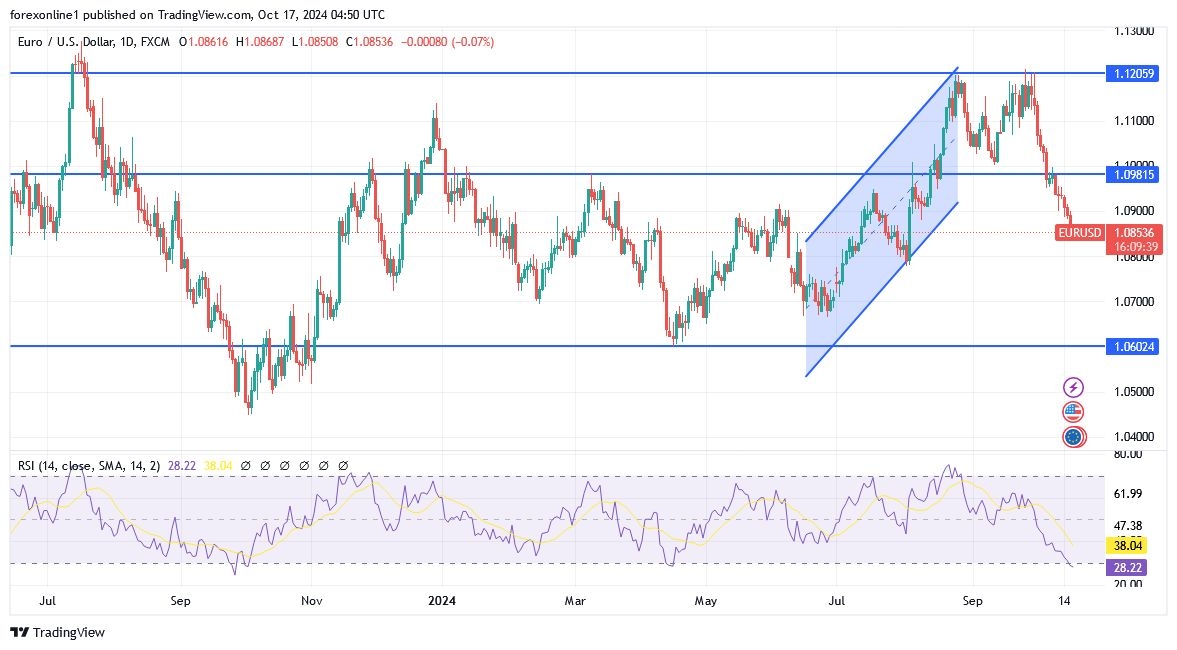
EUR/USD Technical Forecast

The EUR/USD is trading at $1.10775, up 0.11%, but facing resistance near $1.10910, a crucial pivot point. If the pair breaks above this level, we could see more bullish momentum toward the next resistance at $1.11201 and beyond.

Source link

13 09, 2024

Japanese Yen Forecast: Will USD/JPY Break 140? Japan’s Production Data Holds the Key

By |2024-09-13T05:42:07+03:00September 13, 2024|Forex News, News|0 Comments

FX Empire – Michigan Consumer Sentiment

Short-term Forecast for USD/JPY

USD/JPY trends will likely hinge on the Michigan numbers. Upward trends in the Michigan data could temper bets on Q4 2024 Fed rate cuts, possibly pushing the USD/JPY toward 143. However, investors should also consider Bank of Japan commentary and support for Q4 rate hikes.

Investors should remain alert. US consumer sentiment and central bank chatter will likely influence the BoJ and the Fed’s rate paths. Monitor real-time data, central bank insights, and expert commentary to adjust your trading strategies accordingly. Stay updated with our latest news and analysis to manage USD/JPY volatility.

USD/JPY Price Action

Daily Chart

The USD/JPY hovered below the 50-day and 200-day EMAs, confirming bearish price trends.

A USD/JPY breakout from the 142.500 level could indicate a move toward the 143.495 resistance level. Furthermore, a break above the 143.495 resistance level may give the bulls a run at 145 and the 145.891 resistance level.

Bank of Japan commentary and the Michigan Consumer Sentiment numbers require consideration.

Conversely, a break below the 141.032 support level and the September 11 low of 140.706 could indicate a fall through 140.

The 14-day RSI at 31.52 indicates a USD/JPY break below the 141.032 support level before entering oversold territory.

Source link

13 09, 2024

USD/JPY Forecast – US Dollar Continues to Stabilize Against The Yen

By |2024-09-13T03:41:07+03:00September 13, 2024|Forex News, News|0 Comments

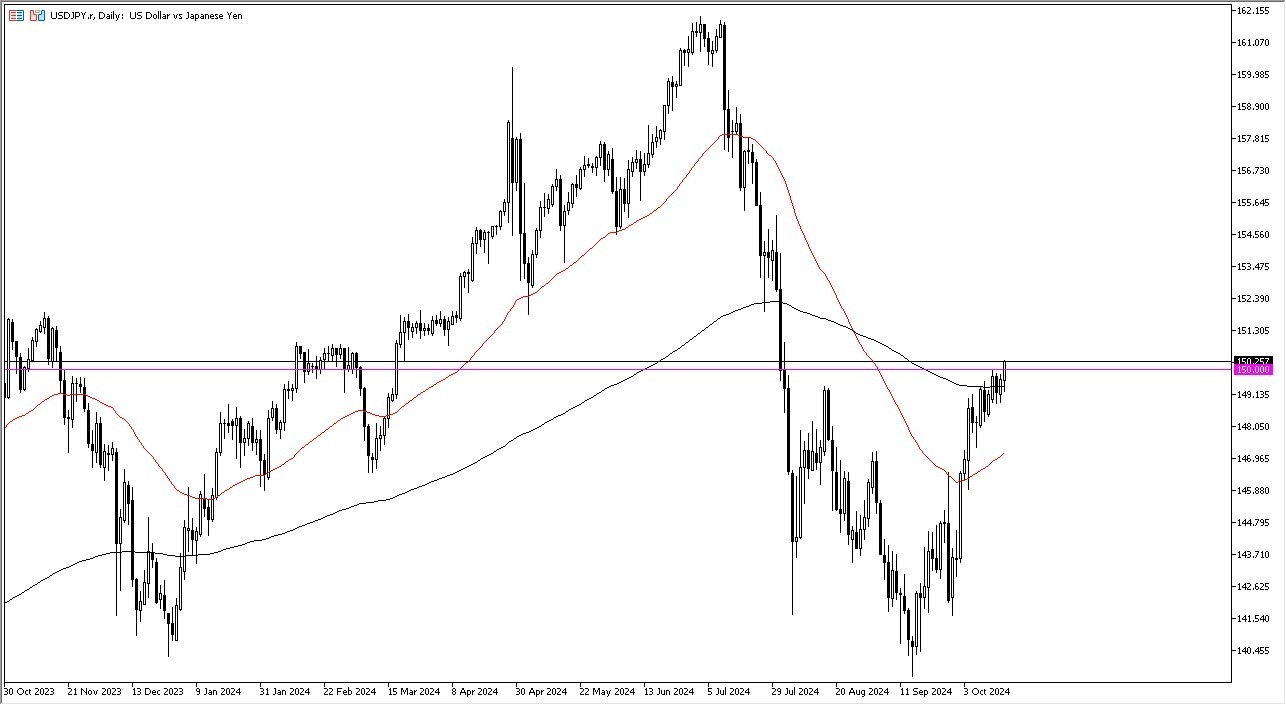
US Dollar vs Japanese Yen Technical Analysis

The US dollar has stabilized a bit in the early hours on Thursday against the Japanese yen as we continue to hang around the 142 yen level. This is an area that’s been important multiple times, so it’s not a huge surprise to see that it has come back into the psyche of the market. The question now is whether or not the hammer that we formed on Wednesday leads to gains on Thursday, but so far it has been slightly positive.

We get the PPI number, so that of course will have its own influence, but ultimately the market seemingly is okay with the idea of inflation still being a little bit sticky, so we’ll have to wait and see. But the 18th features the Federal Reserve interest rate decision, which should be a 25 basis point cut. And at this point, I think it’s pretty obvious that has been priced into the market in spades, as it were.

The question now is what will the Bank of Japan do just two days later? I think they are somewhat limited in their ability to hike rates, so the interest rate differential should continue to favor the US dollar, and I do think that sooner or later that will attract inflows.

If we can break above the 145 yen level above, then we could really start to take off, but right now it looks like we’re doing the thing that we need to do to get things turned around initially, and that’s just simply stop falling. If we were to break down below the 141 yen level, it would be an extraordinarily negative turn of events, perhaps opening up a trap door, as if it were in this pair, allowing it to drop much farther.

For a look at all of today’s economic events, check out our economic calendar.

This article was originally posted on FX Empire

More From FXEMPIRE:

Source link

12 09, 2024

GBP/USD Analysis Today 12/9: Imminent Strong Break (Chart)

By |2024-09-12T23:38:14+03:00September 12, 2024|Forex News, News|0 Comments

  • The GBP/USD exchange rate recorded an increase in mid-week trading, with some analysts attributing the weakness of the US dollar to the strong performance of US presidential candidate Kamala Harris.
  • However, its gains that reached the resistance level of 1.3111 evaporated quickly with the US dollar’s gains against other major currencies following the announcement of US inflation figures through the Consumer Price Index.
  • As a result, the GBP/USD pair plummeted to the psychological support level of 1.3000 and is currently stabilizing around the 1.3045 level.

Commenting on the performance of the forex market, Francesco Pisol, a forex market analyst at ING N.V., said: “The weakness of the dollar (and bitcoin) across the board, the outperformance of Asian emerging market currencies, and the weakness of US equity futures are consistent with polls suggesting that Harris outperformed Trump in the first presidential debate.”

Registered voters who watched Tuesday’s presidential debate between Trump and Harris “overwhelmingly” agreed that Kamala Harris outperformed Donald Trump, according to a CNN poll of debate watchers conducted by SSRS. The vice president also exceeded the expectations of debate watchers for her performance and Joe Biden’s performance on the stage against the former president earlier this year, according to the poll. According to analysts, “The US dollar has weakened by about 0.3% after the US presidential debate,” and “Based on the reaction of financial markets, Vice President Harris is the winner of the presidential debate.”

Overall, the PredictIt betting market shows that US Vice President Harris now has a 10-point lead over President Trump compared to nearly equal odds before the debate. Regarding the debate, the position among forex analysts is that a Trump presidency would, on the whole, be supportive of US dollar exchange rates. Harris’ strong performance is pushing back against this outcome and the dollar.

Meanwhile, financial markets appear to have given Harris a point victory. In the forex market, a Trump win is linked to the strength of the US dollar, which is trading on the weak side across the board.

The GBP/USD exchange rate was under pressure in September, with the strong rally seen in late August tapering off. Analysts say that September is a seasonally strong month for the US dollar, but it could weaken later in the year amid a number of interest rate cuts by the Federal Reserve.

However, one area of ​​uncertainty is the outcome of the presidential election, meaning the debate was closely watched by markets.

According to Forex trading, the conversion of the British pound to the US dollar fell to 1.3000 on Tuesday before recovering to 1.3111 on Wednesday, although the release of disappointing UK GDP had a negative impact.

What happened to the US inflation figures?

The rise in US inflation after the pandemic slowed further last month as annual price increases hit a three-year low, paving the way for the Federal Reserve to cut US interest rates and likely shape the economic debate in the final weeks of the presidential race. A Wednesday report from the Labor Department showed that US consumer prices rose 2.5% in August compared to a year ago, down from 2.9% in July. This was the fifth consecutive annual decline and the smallest since February 2021. From July to August, prices rose by just 0.2%.

Excluding volatile food and energy costs, so-called core prices rose 3.2% in August compared to a year ago, the same as in July. On a monthly basis, core prices rose 0.3%, a slight rebound from July’s 0.2% increase. Economists are closely watching core prices, which typically provide a better reading of future inflation trends.

For months, the slowdown in inflation has provided gradual relief to American consumers, who have been hit by rising prices that began three years ago, especially for food, gas, rent, and other necessities. Historically, Inflation peaked in mid-2022 at 9.1%, the highest rate in four decades. American wages have been rising steadily over the past three years. Even total incomes have outpaced inflation for nearly 18 months, helping more families cope with higher prices. On Tuesday, the Bureau of Statistics reported that the median US family income, adjusted for inflation, rose 4% last year to more than $80,000, which is essentially in line with the 2019 peak.

Wednesday’s inflation figures came on the heels of a Tuesday night presidential debate in which former US President Donald Trump attacked Vice President Kamala Harris over the rise in prices that began a few months after the Biden-Harris administration took office, when global supply chains were disrupted and caused a severe shortage of parts and Labor.

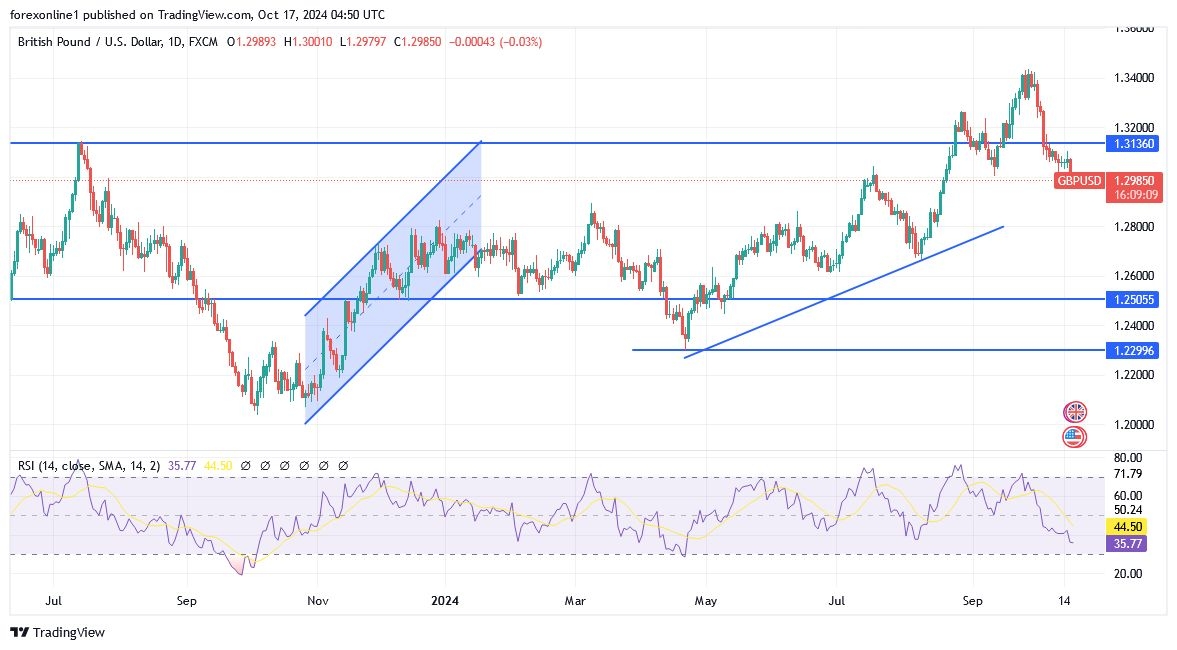
Technical forecasts for the GBP/USD pair today:

The formation of the downward channel for the GBP/USD is still clear and strong, and breaking below 1.3000 could be an easy target for bears. Also, after which the next important support will be 1.2880, which is the beginning of the technical indicators moving towards strong oversold levels. Conversely, based on the daily chart performance, a return to the 1.3200 resistance will be important to predict the strength of the upward trend again. Technically, we still prefer selling GBP/USD from any upward level. Today, GBP/USD will be affected by the announcement of the rest of the US inflation figures, the Producer Price Index, as well as the weekly US unemployment claims.

Ready to trade our GBP/USD Forex analysis? We’ve made this UK forex brokers list for you to check out. 

Source link

12 09, 2024

Lagarde comments on policy outlook after cutting key rate by 25 bps

By |2024-09-12T21:35:28+03:00September 12, 2024|Forex News, News|0 Comments

Christine Lagarde, President of the European Central Bank (ECB), explains the ECB’s decision to lower the benchmark interest rate by 25 basis points at the September policy meeting and responds to questions from the press.

Join our ECB Live Coverage here

ECB press conference key quotes

“The recovery if facing headwinds, based on surveys.”

“Recovery is expected to strengthen.”

“Fading monetary policy restriction should support the economy.”

“The labor market is resilient.”

“Surveys point to further moderation in demand for labor.”

“Negotiated wage growth will remain high and volatile for the rest of 2024.”

“Overall labor cost growth is moderating.”

“Unit labor costs expected to continue to decline.”

“Risks to growth are skewed to the downside.”

“Wages, profits, trade tensions potential upside risks for inflation.”

“We have reinforced confidence in solidity, robustness of projections.”

“Declining path for rates is pretty obvious.”

“September will deliver low inflation reading.”

“Inflation to rise again in Q4.”

“Relatively short time to October meeting.”

“No commitment of any kind about October.”

“We need to be attentive to risk of below target inflation.”

“Services inflation requires attention, monitoring.”

“Expecting services inflation to decline in 2025.”


This section below was published at 12:15 GMT to cover the European Central Bank’s policy statement and the immediate market reaction.

The European Central Bank (ECB) announced on Thursday that it lowered the interest rate on the marginal lending facility to 3.9% from 4.5% and the deposit facility, also known as the benchmark interest rate, by 25 basis points (bps) to 3.5% as expected. The ECB also cut the interest rate on the main refinancing operations by 60 bps to 3.65%.

In its monetary policy statement, the ECB noted that it is now appropriate to take another step in moderating the degree of monetary policy restriction, based on the Governing Council’s updated assessment of the inflation outlook, the dynamics of underlying inflation and the strength of monetary policy transmission.

ECB policy statement key takeaways

“Governing Council is determined to ensure that inflation returns to its 2% medium-term target in a timely manner.”

“Inflation is expected to rise again in the latter part of this year.”

“Will keep policy rates sufficiently restrictive for as long as necessary to achieve this aim.”

“Governing Council will continue to follow a data-dependent and meeting-by-meeting approach to determining the appropriate level and duration of restriction.”

“Domestic inflation remains high as wages are still rising at an elevated pace.”

“In particular, its interest rate decisions will be based on its assessment of the inflation outlook in light of the incoming economic and financial data, the dynamics of underlying inflation and the strength of monetary policy transmission.”

“Labour cost pressures are moderating, and profits are partially buffering the impact of higher wages on inflation.”

“Governing Council is not pre-committing to a particular rate path.”

“Financing conditions remain restrictive, and economic activity is still subdued.”

ECB projections

“Staff project that the economy will grow by 0.8% in 2024, rising to 1.3% in 2025 and 1.5% in 2026.”

“Inflation forecast: 2.5% in 2024, 2.2% in 2025 and 1.9% in 2026, as in the June projections.”

“New core inflation forecast: 2.3% in 2025 and 2.0% in 2026.”

Market reaction to ECB policy decisions

The ECB’s policy announcements failed to trigger a noticeable reaction in the Euro. At the time of press, EUR/USD was trading virtually unchanged on the day at 1.1015.

Euro PRICE This week

The table below shows the percentage change of Euro (EUR) against listed major currencies this week. Euro was the weakest against the Australian Dollar.

  USD EUR GBP JPY CAD AUD NZD CHF
USD   0.57% 0.64% 0.00% 0.16% -0.18% 0.61% 1.03%
EUR -0.57%   0.01% -0.53% -0.41% -0.80% 0.04% 0.44%
GBP -0.64% -0.01%   -1.44% -0.42% -0.81% 0.01% 0.42%
JPY 0.00% 0.53% 1.44%   0.14% -0.17% 0.59% 1.21%
CAD -0.16% 0.41% 0.42% -0.14%   -0.29% 0.44% 1.04%
AUD 0.18% 0.80% 0.81% 0.17% 0.29%   0.84% 1.23%
NZD -0.61% -0.04% -0.01% -0.59% -0.44% -0.84%   0.41%
CHF -1.03% -0.44% -0.42% -1.21% -1.04% -1.23% -0.41%  

The heat map shows percentage changes of major currencies against each other. The base currency is picked from the left column, while the quote currency is picked from the top row. For example, if you pick the Euro from the left column and move along the horizontal line to the US Dollar, the percentage change displayed in the box will represent EUR (base)/USD (quote).


This section below was published as a preview of the European Central Bank’s (ECB) policy decisions at 07:00 GMT.

  • The European Central Bank is expected to cut key rates by 25 bps at the September policy meeting.
  • ECB President Christine Lagarde’s presser and updated economic forecasts will be closely scrutinized for fresh policy cues.
  • The ECB policy announcements are set to inject volatility around the EUR/USD pair.

The European Central Bank (ECB) interest rate decision will be announced alongside the publication of the staff’s updated economic projections following the September monetary policy meeting due on Thursday at 12:15 GMT.

ECB President Christine Lagarde’s press conference will follow, beginning at 12:45 GMT, where she will deliver the prepared statement on monetary policy and respond to media questions. The ECB announcements are likely to rock the Euro (EUR) against the US Dollar (USD).

What to expect from the European Central Bank interest rate decision?

After standing pat on interest rates in July, the ECB is widely expected to reduce benchmark interest rate, the deposit facility, by 25 basis points (bps) to 3.50%. As for the marginal lending facility and the main refinancing operations rate, the consensus has changed to a 60-basis-points cut to 3.9% and 3.65%, respectively. This comes after the ECB’s review of the operational framework, which stated that the spread between the deposit rate and the main refinancing operations rate would be reduced to 15 basis points as from September 18.

In June’s post-policy meeting press conference, ECB President Christine Lagarde said that “we are determined not to have a predetermined rate path. September decision is wide open.” “September projections, plus other data, will be taken into account,” Lagarde added.

The accounts of the July ECB meeting showed that September “was widely seen as a good time to re-evaluate” the level of monetary policy restriction.

Since the July meeting, the Eurozone inflation cooled off significantly, returning closer to the central bank’s 2.0% target.

Eurostat’s preliminary data showed on August 30 that the Harmonised Index Of Consumer Prices (HICP) across the currency bloc rose 2.2% over the year in August, marking the lowest annual inflation rate since July 2021. Meanwhile, the Euro area negotiated wages increased at an annual pace of 3.55% in Q2 2024 after rising 4.74% in the first quarter of this year.

The ECB accounts combined with a sharp decline in the pace of wage growth, cooling inflation and weakening Euro area business activity indicate that a rate reduction is a given on Thursday. 

Therefore, the ECB’s communication on the path forward and its outlook on inflation and growth will hold the key for the market’s pricing of the future rate cuts and the Euro’s (EUR) next directional move.

Previewing the ECB meeting, TD Securities analysts said: “A 25bps cut is a near-certainty. What matters will be guidance beyond September, where there’s strong pressure on both sides. Wage growth and services inflation remain strong (emboldening the hawks), while growth indicators are flagging softer (emboldening the doves).” “Lagarde is unlikely to rule out an October cut, but quarterly cuts are likely more consistent with the new projections,” the analysts added.

How could the ECB meeting impact EUR/USD?

Heading into the ECB showdown, the Euro is clinging to recovery gains, with EUR/USD reversing from monthly lows of 1.1020. The pair’s fate hinges on the ECB’s outlook on interest rates beyond September.

ECB President Christine Lagarde is likely to stick to the bank’s data-dependent stance and refrain from giving a certain response on the next rate cut move. Unless the policy statement, or Lagarde, hints at more rate reduction coming in the final quarter of this year, the EUR/USD recovery is seen gathering further traction.

Conversely, the Euro could come under renewed selling pressure if the staff projections show downward revisions to both the inflation and economic growth outlook. Meanwhile, Lagarde’s increased confidence in the disinflation progress could also revive Euro sellers. These factors could double down on the dovish expectations, fuelling the resumption of the recent EUR/USD downtrend.

Dhwani Mehta, Asian Session Lead Analyst at FXStreet, offers a brief technical outlook for EUR/USD:

“EUR/USD maintains its bearish streak, especially after the Relative Strength Index (RSI) indicator returned below the 50 level on the daily chart. If sellers flex their muscles, the immediate support of the 50-day SMA at 1.0964 will be tested. Further south, the pair could aim for the strong demand area near 1.0870, where the 100-day SMA and the 200-day SMA coincide.”

“On the upside, the pair needs to find acceptance above the 21-day Simple Moving Average (SMA) at 1.1082 on a daily closing basis to sustain the recovery toward the September 6 high of 1.1155, above which the 1.1200 psychological level will challenge bearish commitments.”

ECB FAQs

The European Central Bank (ECB) in Frankfurt, Germany, is the reserve bank for the Eurozone. The ECB sets interest rates and manages monetary policy for the region. The ECB primary mandate is to maintain price stability, which means keeping inflation at around 2%. Its primary tool for achieving this is by raising or lowering interest rates. Relatively high interest rates will usually result in a stronger Euro and vice versa. The ECB Governing Council makes monetary policy decisions at meetings held eight times a year. Decisions are made by heads of the Eurozone national banks and six permanent members, including the President of the ECB, Christine Lagarde.

In extreme situations, the European Central Bank can enact a policy tool called Quantitative Easing. QE is the process by which the ECB prints Euros and uses them to buy assets – usually government or corporate bonds – from banks and other financial institutions. QE usually results in a weaker Euro. QE is a last resort when simply lowering interest rates is unlikely to achieve the objective of price stability. The ECB used it during the Great Financial Crisis in 2009-11, in 2015 when inflation remained stubbornly low, as well as during the covid pandemic.

Quantitative tightening (QT) is the reverse of QE. It is undertaken after QE when an economic recovery is underway and inflation starts rising. Whilst in QE the European Central Bank (ECB) purchases government and corporate bonds from financial institutions to provide them with liquidity, in QT the ECB stops buying more bonds, and stops reinvesting the principal maturing on the bonds it already holds. It is usually positive (or bullish) for the Euro.


Source link

12 09, 2024

EUR/JPY Forecast Today – 12/09: Euro Weakens vs Yen (Chart)

By |2024-09-12T19:34:54+03:00September 12, 2024|Forex News, News|0 Comments

  • The EUR/JPY pair is one I am watching very closely.
  • This is mainly due to the fact that the market is approaching a psychologically significant figure in the form of ¥155, and that we have seen quite a bit of noise in that area previously.
  • The question now will be whether or not the market can form some type of “double bottom”, and of course whether or not the so-called “death cross” comes into the picture and forces people to acknowledge that we might go much lower.

Risk Appetite

The carry trade has been absolutely slaughtered over the last several weeks, and quite frankly I’m a bit surprised at just how far out of control it’s gotten. We’ve seen the Japanese yen strengthen quite drastically, but it is worth noting that there is a Bank of Japan interest rate decision on September 20 that could greatly influence where we go next. After all, the Japanese can talk a tough game, but sooner or later higher interest rates will destroy the Japanese economy. Japan is one of the most indebted economies in the world, so this is like a massive game of chicken that they are playing, and somebody’s about to get ran over.

Having said that, you need risk appetite to come back into the market for this to be a viable long position. The interest rate differential does favor the euro, but I would also point out that we are approaching an area that there could be a bit of a “trapdoor” waiting, meaning that if we break down from here, it could get really ugly, and really quick. The Japanese yen has gained about 12% against the euro from the peak, which of course is a huge move to say the least.

I think the one thing you can count on is a lot of volatility here, and at this point in time it’s a bit like” catching a falling knife.” While I don’t necessarily want to buy the market, I don’t necessarily want to short it either. However, I am willing to have a go with a small position to the upside if we can break above the ¥157.50 level.

Ready to trade our daily Forex forecast? Here’s a list of some of the best regulated forex brokers to check out. 

Source link

12 09, 2024

EUR/GBP Forecast Today – 12/09: Euro Rallies Post-UK GDP

By |2024-09-12T17:34:08+03:00September 12, 2024|Forex News, News|0 Comments

  • The EUR/GBP pair has captured my attention, as market participants continue to see a lot of volatility in this market.
  • Ultimately, this is a market that is at extreme lows, and I think that’s part of what’s going on here.
  • Quite frankly, the market is just so oversold that sooner or later somebody has to close out their short position.

Furthermore, the market is paying close attention to the idea that the GDP in the United Kingdom came in flat, instead of the anticipated 0.2% month over month. This of course is a bit of a surprise, and therefore I think you will see the British pound continue to take it on the chin, at least in the short term. With that being said, we are still in a massive downtrend and of course there will be quite a bit of resistance to rallying in the short term.

Technical Analysis

I think at this point in time, the first thing that traders will be paying close attention to is the 50 Day EMA. This indicator of course is widely followed, and it is just above the candlestick that we are praying for the session. If we can break above the 50 Day EMA, then it’s possible that the market could go looking to the 0.85 level, perhaps even the 0.8530 level, which is roughly where the 200 Day EMA sits.

Underneath, we have the 0.84 level, an area that has been massive support more than once and therefore I think you have to look at it with a certain amount of suspicion as to whether or not we can break down below there. Quite frankly, we would need to see the euro fall apart, and the British pound really start to take off in order for that to happen. I also suspect that it is probably only a matter of time before we get a bigger bounds, especially if we find out that the Bank of England is going to have to start cutting rates aggressively, much like many of the other central banks around the world might be doing.

For additional & up-to-date info on brokers please see our Forex brokers list

Source link

Go to Top