The main tag of Forex News Today Articles.
You can use the search box below to find what you need.
[wd_asp id=1]

2 07, 2024

Further weakness not ruled out below 1.0790

By |2024-07-02T21:57:57+03:00July 2, 2024|Forex News, News|0 Comments

You have reached your limit of 5 free articles for this month.

Get Premium without limits for only $479.76 for the first month

Access all our articles, insights, and analysts.

Your coupon code


UNLOCK OFFER

  • EUR/USD kept the trade above the 1.0700 barrier on Tuesday.
  • Lagarde and Powell failed to surprise markets at the ECB Forum.
  • Investors’ attention now shifts to US data and FOMC Minutes.

The slight downtick in the US Dollar (USD) motivated the USD Index (DXY) to keep its business around 105.80 on Tuesday, extending the consolidative mood so far this week.

This modest increase in the Greenback also prompted EUR/USD to maintain its trade in the 1.0730-1.0740 band in the first half of the week, as investors continued to digest the outcomes of the French election on June 30 as well as the policy discussion between President Christine Lagarde and Chair Jerome Powell at the ECB Forum in Sintra (Portugal).

Regarding this, Lagarde asserted that the euro zone has made significant progress along its path of disinflation, though uncertainties remain about the economic growth outlook. Meanwhile, Powell suggested that the Fed needs additional data before considering interest rate cuts, aiming to confirm whether recent subdued inflation readings truly reflect ongoing price pressures.

On a broader scale, the macroeconomic situation on both sides of the Atlantic remained stable. The European Central Bank (ECB) is contemplating further rate cuts beyond the summer, with market expectations pointing to two additional cuts later in the year. Supporting further rate cuts, preliminary inflation figures in the euro area saw the CPI rising by 2.5% YoY in June, while the Core CPI challenged expectations and advanced by 2.9% over the last twelve months.

In contrast, market participants are still debating whether the Federal Reserve (Fed) will implement one or two rate cuts this year in spite of the Fed’s projection of just one cut, likely in December.

The recent improvement in the US Dollar is partly due to hawkish comments from Fed officials, while the widening monetary policy gap between the Fed and other major central banks has also contributed to the euro’s decline.

According to the CME Group’s FedWatch Tool, there is about a 69% probability of lower interest rates in September, compared to nearly a 95% chance at the December 18 meeting.

In the short term, the recent ECB rate cut, contrasted with the Fed’s decision to maintain rates, has widened the policy gap between the two central banks, potentially leading to further weakness in EUR/USD.

However, the Eurozone’s emerging economic recovery and the perceived weakening of US fundamentals are expected to narrow this disparity, possibly providing occasional support for the pair in the near future.

On the political front, the next risk event for the single currency comes from the upcoming second round of the French snap elections due on July 7.

EUR/USD daily chart

EUR/USD short-term technical outlook

If bears retake control, EUR/USD may retest its June low of 1.0666 (June 26), then the May low of 1.0649 (May 1), and lastly the 2024 low of 1.0601 (April 16).

Meanwhile, bouts of strength may put the pair on pace to revisit the 200-day SMA at 1.0791, prior to the weekly high of 1.0852 (June 12) and the June top of 1.0916 (June 4). The breakout of this level may put the March peak of 1.0981 (March 8) back into focus, ahead of the weekly high of 1.0998 (January 11) and the psychological 1.1000 mark.

So far, the 4-hour chart shows a loss of momentum in the initial bullish effort. The initial resistance level is 1.0776, followed by 1.0794. The initial support is at 1.0666, ahead of 1.0649 and 1.0601. The Relative Strength Index (RSI) climbed to about 56.

  • EUR/USD kept the trade above the 1.0700 barrier on Tuesday.
  • Lagarde and Powell failed to surprise markets at the ECB Forum.
  • Investors’ attention now shifts to US data and FOMC Minutes.

The slight downtick in the US Dollar (USD) motivated the USD Index (DXY) to keep its business around 105.80 on Tuesday, extending the consolidative mood so far this week.

This modest increase in the Greenback also prompted EUR/USD to maintain its trade in the 1.0730-1.0740 band in the first half of the week, as investors continued to digest the outcomes of the French election on June 30 as well as the policy discussion between President Christine Lagarde and Chair Jerome Powell at the ECB Forum in Sintra (Portugal).

Regarding this, Lagarde asserted that the euro zone has made significant progress along its path of disinflation, though uncertainties remain about the economic growth outlook. Meanwhile, Powell suggested that the Fed needs additional data before considering interest rate cuts, aiming to confirm whether recent subdued inflation readings truly reflect ongoing price pressures.

On a broader scale, the macroeconomic situation on both sides of the Atlantic remained stable. The European Central Bank (ECB) is contemplating further rate cuts beyond the summer, with market expectations pointing to two additional cuts later in the year. Supporting further rate cuts, preliminary inflation figures in the euro area saw the CPI rising by 2.5% YoY in June, while the Core CPI challenged expectations and advanced by 2.9% over the last twelve months.

In contrast, market participants are still debating whether the Federal Reserve (Fed) will implement one or two rate cuts this year in spite of the Fed’s projection of just one cut, likely in December.

The recent improvement in the US Dollar is partly due to hawkish comments from Fed officials, while the widening monetary policy gap between the Fed and other major central banks has also contributed to the euro’s decline.

According to the CME Group’s FedWatch Tool, there is about a 69% probability of lower interest rates in September, compared to nearly a 95% chance at the December 18 meeting.

In the short term, the recent ECB rate cut, contrasted with the Fed’s decision to maintain rates, has widened the policy gap between the two central banks, potentially leading to further weakness in EUR/USD.

However, the Eurozone’s emerging economic recovery and the perceived weakening of US fundamentals are expected to narrow this disparity, possibly providing occasional support for the pair in the near future.

On the political front, the next risk event for the single currency comes from the upcoming second round of the French snap elections due on July 7.

EUR/USD daily chart

EUR/USD short-term technical outlook

If bears retake control, EUR/USD may retest its June low of 1.0666 (June 26), then the May low of 1.0649 (May 1), and lastly the 2024 low of 1.0601 (April 16).

Meanwhile, bouts of strength may put the pair on pace to revisit the 200-day SMA at 1.0791, prior to the weekly high of 1.0852 (June 12) and the June top of 1.0916 (June 4). The breakout of this level may put the March peak of 1.0981 (March 8) back into focus, ahead of the weekly high of 1.0998 (January 11) and the psychological 1.1000 mark.

So far, the 4-hour chart shows a loss of momentum in the initial bullish effort. The initial resistance level is 1.0776, followed by 1.0794. The initial support is at 1.0666, ahead of 1.0649 and 1.0601. The Relative Strength Index (RSI) climbed to about 56.

Source link

2 07, 2024

Pound Sterling retreats below key technical level ahead of Powell

By |2024-07-02T19:56:58+03:00July 2, 2024|Forex News, News|0 Comments

You have reached your limit of 5 free articles for this month.

Get Premium without limits for only $479.76 for the first month

Access all our articles, insights, and analysts.

Your coupon code


UNLOCK OFFER

  • GBP/USD made a sharp U-turn after rising above 1.2700 on Monday.
  • Technical sellers could remain interested in case GBP/USD fails to reclaim 1.2640.
  • Fed Chairman Powell will speak on the policy outlook at the ECB Forum.

GBP/USD spike above 1.2700 and touched its highest level since June 20 in the American session on Monday. The pair lost its traction later in the day and closed virtually unchanged at 1.2650. The pair stays on the back foot on Tuesday and trades below the key technical level at 1.2640.

British Pound PRICE Today

The table below shows the percentage change of British Pound (GBP) against listed major currencies today. British Pound was the weakest against the Canadian Dollar.

  USD EUR GBP JPY CAD AUD NZD CHF
USD   0.21% 0.09% 0.11% -0.05% 0.10% 0.34% 0.15%
EUR -0.21%   -0.12% -0.09% -0.26% -0.11% 0.10% -0.06%
GBP -0.09% 0.12%   0.04% -0.14% -0.02% 0.23% 0.04%
JPY -0.11% 0.09% -0.04%   -0.18% -0.01% 0.19% 0.01%
CAD 0.05% 0.26% 0.14% 0.18%   0.15% 0.39% 0.17%
AUD -0.10% 0.11% 0.02% 0.00% -0.15%   0.23% 0.04%
NZD -0.34% -0.10% -0.23% -0.19% -0.39% -0.23%   -0.19%
CHF -0.15% 0.06% -0.04% -0.01% -0.17% -0.04% 0.19%  

The heat map shows percentage changes of major currencies against each other. The base currency is picked from the left column, while the quote currency is picked from the top row. For example, if you pick the British Pound from the left column and move along the horizontal line to the US Dollar, the percentage change displayed in the box will represent GBP (base)/USD (quote).

The negative shift seen in risk sentiment helps the US Dollar (USD) find demand on Tuesday and doesn’t allow GBP/USD to stage a rebound. Reflecting the souring mood, US stock index futures are down between 0.3% and 0.5%. 

In the second half of the day, Federal Reserve (Fed) Chairman Jerome Powell will speak on the policy outlook at the ECB Forum on Central Banking.

Markets currently price in a nearly 35% probability of the Fed leaving the policy rate unchanged in September, according to the CME FedWatch Tool. In case Powell acknowledges improving inflation outlook following last Friday’s Personal Consumption Expenditures (PCE) Price Index, the USD could have a hard time finding demand. On the other hand, the market positioning suggests that there is room for further USD strength if Powell pushes back against the market expectation for a rate reduction in September.

GBP/USD Technical Analysis

The 100-day and the 50-day Simple Moving Averages form a strong technical area at 1.2640. If this level stays intact, sellers could remain interested. On the downside, 1.2600 (psychological level, static level) could be seen as interim support before 1.2580 (Fibonacci 50% retracement of the latest uptrend) and 1.2520 (Fibonacci 61.8% retracement).

1.2640 aligns as first resistance. A daily close above this level could attract technical buyers. 1.2700 (20-day SMA, psychological level) and 1.2720 (Fibonacci 23.6% retracement) could be seen as next resistance levels.

Pound Sterling FAQs

The Pound Sterling (GBP) is the oldest currency in the world (886 AD) and the official currency of the United Kingdom. It is the fourth most traded unit for foreign exchange (FX) in the world, accounting for 12% of all transactions, averaging $630 billion a day, according to 2022 data. Its key trading pairs are GBP/USD, aka ‘Cable’, which accounts for 11% of FX, GBP/JPY, or the ‘Dragon’ as it is known by traders (3%), and EUR/GBP (2%). The Pound Sterling is issued by the Bank of England (BoE).

The single most important factor influencing the value of the Pound Sterling is monetary policy decided by the Bank of England. The BoE bases its decisions on whether it has achieved its primary goal of “price stability” – a steady inflation rate of around 2%. Its primary tool for achieving this is the adjustment of interest rates. When inflation is too high, the BoE will try to rein it in by raising interest rates, making it more expensive for people and businesses to access credit. This is generally positive for GBP, as higher interest rates make the UK a more attractive place for global investors to park their money. When inflation falls too low it is a sign economic growth is slowing. In this scenario, the BoE will consider lowering interest rates to cheapen credit so businesses will borrow more to invest in growth-generating projects.

Data releases gauge the health of the economy and can impact the value of the Pound Sterling. Indicators such as GDP, Manufacturing and Services PMIs, and employment can all influence the direction of the GBP. A strong economy is good for Sterling. Not only does it attract more foreign investment but it may encourage the BoE to put up interest rates, which will directly strengthen GBP. Otherwise, if economic data is weak, the Pound Sterling is likely to fall.

Another significant data release for the Pound Sterling is the Trade Balance. This indicator measures the difference between what a country earns from its exports and what it spends on imports over a given period. If a country produces highly sought-after exports, its currency will benefit purely from the extra demand created from foreign buyers seeking to purchase these goods. Therefore, a positive net Trade Balance strengthens a currency and vice versa for a negative balance.
 

  • GBP/USD made a sharp U-turn after rising above 1.2700 on Monday.
  • Technical sellers could remain interested in case GBP/USD fails to reclaim 1.2640.
  • Fed Chairman Powell will speak on the policy outlook at the ECB Forum.

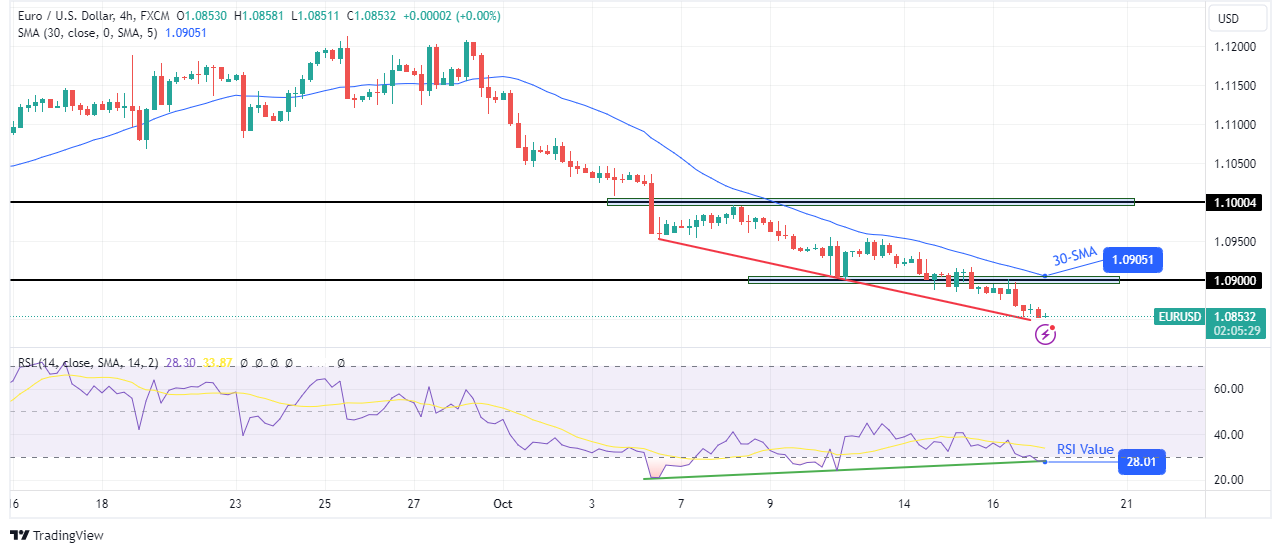
GBP/USD spike above 1.2700 and touched its highest level since June 20 in the American session on Monday. The pair lost its traction later in the day and closed virtually unchanged at 1.2650. The pair stays on the back foot on Tuesday and trades below the key technical level at 1.2640.

British Pound PRICE Today

The table below shows the percentage change of British Pound (GBP) against listed major currencies today. British Pound was the weakest against the Canadian Dollar.

  USD EUR GBP JPY CAD AUD NZD CHF
USD   0.21% 0.09% 0.11% -0.05% 0.10% 0.34% 0.15%
EUR -0.21%   -0.12% -0.09% -0.26% -0.11% 0.10% -0.06%
GBP -0.09% 0.12%   0.04% -0.14% -0.02% 0.23% 0.04%
JPY -0.11% 0.09% -0.04%   -0.18% -0.01% 0.19% 0.01%
CAD 0.05% 0.26% 0.14% 0.18%   0.15% 0.39% 0.17%
AUD -0.10% 0.11% 0.02% 0.00% -0.15%   0.23% 0.04%
NZD -0.34% -0.10% -0.23% -0.19% -0.39% -0.23%   -0.19%
CHF -0.15% 0.06% -0.04% -0.01% -0.17% -0.04% 0.19%  

The heat map shows percentage changes of major currencies against each other. The base currency is picked from the left column, while the quote currency is picked from the top row. For example, if you pick the British Pound from the left column and move along the horizontal line to the US Dollar, the percentage change displayed in the box will represent GBP (base)/USD (quote).

The negative shift seen in risk sentiment helps the US Dollar (USD) find demand on Tuesday and doesn’t allow GBP/USD to stage a rebound. Reflecting the souring mood, US stock index futures are down between 0.3% and 0.5%. 

In the second half of the day, Federal Reserve (Fed) Chairman Jerome Powell will speak on the policy outlook at the ECB Forum on Central Banking.

Markets currently price in a nearly 35% probability of the Fed leaving the policy rate unchanged in September, according to the CME FedWatch Tool. In case Powell acknowledges improving inflation outlook following last Friday’s Personal Consumption Expenditures (PCE) Price Index, the USD could have a hard time finding demand. On the other hand, the market positioning suggests that there is room for further USD strength if Powell pushes back against the market expectation for a rate reduction in September.

GBP/USD Technical Analysis

The 100-day and the 50-day Simple Moving Averages form a strong technical area at 1.2640. If this level stays intact, sellers could remain interested. On the downside, 1.2600 (psychological level, static level) could be seen as interim support before 1.2580 (Fibonacci 50% retracement of the latest uptrend) and 1.2520 (Fibonacci 61.8% retracement).

1.2640 aligns as first resistance. A daily close above this level could attract technical buyers. 1.2700 (20-day SMA, psychological level) and 1.2720 (Fibonacci 23.6% retracement) could be seen as next resistance levels.

Pound Sterling FAQs

The Pound Sterling (GBP) is the oldest currency in the world (886 AD) and the official currency of the United Kingdom. It is the fourth most traded unit for foreign exchange (FX) in the world, accounting for 12% of all transactions, averaging $630 billion a day, according to 2022 data. Its key trading pairs are GBP/USD, aka ‘Cable’, which accounts for 11% of FX, GBP/JPY, or the ‘Dragon’ as it is known by traders (3%), and EUR/GBP (2%). The Pound Sterling is issued by the Bank of England (BoE).

The single most important factor influencing the value of the Pound Sterling is monetary policy decided by the Bank of England. The BoE bases its decisions on whether it has achieved its primary goal of “price stability” – a steady inflation rate of around 2%. Its primary tool for achieving this is the adjustment of interest rates. When inflation is too high, the BoE will try to rein it in by raising interest rates, making it more expensive for people and businesses to access credit. This is generally positive for GBP, as higher interest rates make the UK a more attractive place for global investors to park their money. When inflation falls too low it is a sign economic growth is slowing. In this scenario, the BoE will consider lowering interest rates to cheapen credit so businesses will borrow more to invest in growth-generating projects.

Data releases gauge the health of the economy and can impact the value of the Pound Sterling. Indicators such as GDP, Manufacturing and Services PMIs, and employment can all influence the direction of the GBP. A strong economy is good for Sterling. Not only does it attract more foreign investment but it may encourage the BoE to put up interest rates, which will directly strengthen GBP. Otherwise, if economic data is weak, the Pound Sterling is likely to fall.

Another significant data release for the Pound Sterling is the Trade Balance. This indicator measures the difference between what a country earns from its exports and what it spends on imports over a given period. If a country produces highly sought-after exports, its currency will benefit purely from the extra demand created from foreign buyers seeking to purchase these goods. Therefore, a positive net Trade Balance strengthens a currency and vice versa for a negative balance.


Source link

2 07, 2024

USD/JPY Price Analysis: No Respite for Yen Amid Rate differential

By |2024-07-02T17:55:33+03:00July 2, 2024|Forex News, News|0 Comments

  • Japan downgraded its Q1 GDP figures to show that the economy shrank more than reported.
  • A rally in US Treasury yields weighed on the yen.
  • Investors are awaiting Fed Chair Powell’s speech.

The USD/JPY price analysis shows a strong uptrend as the yen continues its slide due to the interest rate differential between Japan and the US. At the same time, economic data from Japan shows a small chance that the Bank of Japan will hike rates at the next policy meeting.

Are you interested in learning more about forex conventions? Check our detailed guide-

The dollar continued its rally against the yen on Tuesday as the market focused on the wide interest rate gap between Japan and the US. Notably, data from Japan on Monday showed that the country downgraded its Q1 GDP figures, showing that the economy shrank more than reported. The economy contracted 2.9% annually, compared to the reported 1.8% decline.

These new figures complicate the outlook for rate hikes in Japan. A vulnerable economy could weaken further with high borrowing costs. However, if the Bank of Japan continues to delay rate hikes, the rate gap between Japan and the US will remain wide, hurting the yen.

At the same time, a rally in US Treasury yields weighed on the yen. Yields soared in the previous session, boosting the dollar as markets priced in the possibility of a Trump win. This came after last week’s debate, in which Trump came out stronger than Biden. A Trump government would likely lead to an increase in inflation, which would strengthen the dollar. 

Meanwhile, investors are awaiting Fed Chair Powell’s speech later today for clues on the rate cut outlook. A cautious tone could further boost the dollar.

USD/JPY key events today

  • Fed Chair Powell’s speech
  • US JOLTS job openings

USD/JPY technical price analysis: Bulls weaken as they approach the 162.01 level

USD/JPY Price Analysis: No Respite for Yen Amid Rate differential
USD/JPY 4-hour chart

On the technical side, USD/JPY is quickly approaching the 162.01 level. The price is in a steep bullish trend, well above the 30-SMA. At the same time, the RSI trades near the overbought region, supporting bullish momentum. 

Are you interested in learning more about Ethereum price prediction? Check our detailed guide-

However, it has made a lower high while the price has made a higher high. This indicates a bearish divergence due to fading bullish momentum. Therefore, there is a high chance that the price will soon reverse. If this happens, it might retest the 30-SMA or break below to the 160.00 support level.

Looking to trade forex now? Invest at eToro!

68% of retail investor accounts lose money when trading CFDs with this provider. You should consider whether you can afford to take the high risk of losing your money.

Source link

2 07, 2024

Euro loses bullish momentum as focus shifts to ECB Forum

By |2024-07-02T15:54:31+03:00July 2, 2024|Forex News, News|0 Comments

You have reached your limit of 5 free articles for this month.

Get Premium without limits for only $479.76 for the first month

Access all our articles, insights, and analysts.

Your coupon code


UNLOCK OFFER

  • EUR/USD declines toward 1.0700 in the European session on Thursday.
  • The technical outlook points to a loss of bullish momentum.
  • ECB President Lagarde and Fed Chairman Powell will speak on policy later in the day.

Following a bullish opening to the week, EUR/USD climbed to its highest level in over two weeks above 1.0770 on Monday. The pair, however, lost its momentum and declined below 1.0750.

Euro PRICE Today

The table below shows the percentage change of Euro (EUR) against listed major currencies today. Euro was the weakest against the Canadian Dollar.

  USD EUR GBP JPY CAD AUD NZD CHF
USD   0.25% 0.16% 0.10% -0.02% 0.18% 0.37% 0.18%
EUR -0.25%   -0.09% -0.14% -0.26% -0.07% 0.10% -0.06%
GBP -0.16% 0.09%   -0.04% -0.16% 0.00% 0.20% 0.01%
JPY -0.10% 0.14% 0.04%   -0.13% 0.09% 0.25% 0.07%
CAD 0.02% 0.26% 0.16% 0.13%   0.20% 0.39% 0.20%
AUD -0.18% 0.07% 0.00% -0.09% -0.20%   0.18% -0.01%
NZD -0.37% -0.10% -0.20% -0.25% -0.39% -0.18%   -0.19%
CHF -0.18% 0.06% -0.01% -0.07% -0.20% 0.00% 0.19%  

The heat map shows percentage changes of major currencies against each other. The base currency is picked from the left column, while the quote currency is picked from the top row. For example, if you pick the Euro from the left column and move along the horizontal line to the US Dollar, the percentage change displayed in the box will represent EUR (base)/USD (quote).

The Euro gathered strength to start the week as markets reacted to the outcome of the first round of France’s parliamentary election, as Marine Le Pen’s far-right National Rally (RN) party won by a smaller gap than initially projected. The positive impact of this development on the Euro’s valuation faded away later in the day, causing EUR/USD to erase its daily gains.

On Tuesday, the data published by Eurostat showed that the Harmonized Index of Consumer Prices, the European Central Bank’s (ECB) preferred gauge of inflation, rose 2.5% on a yearly basis in June, down from 2.6% in May. This reading came in line with the market expectation. In the same period, the core HICP, which excludes volatile food and energy prices, rose 2.9% to match May’s increase. These figures failed to trigger a noticeable market reaction.

Later in the day, ECB President Christine Lagarde and Federal Reserve (Fed) Chairman Jerome Powell will speak on policy outlook at the ECB Forum on Central Banking.

In case this event highlights the diverging monetary policies between the Fed and the ECB, EUR/USD could extend its slide in the American session. On the other hand, investors could continue to price in a September Fed rate cut and cause the USD could come under bearish pressure if Powell acknowledges improvements in inflation.

EUR/USD Technical Analysis

The Relative Strength Index (RSI) indicator on the 4-hour chart retreated below 50 in the European session on Tuesday, reflecting the loss of bullish momentum. On the downside, 1.0700 (static level, psychological level) aligns as immediate support before 1.0670 (Fibonacci 78.6% retracement of the latest uptrend) and 1.0600 (static level).

The 100-period Simple Moving Average (SMA) of the 4-hour chart could be seen as interim resistance at 1.0730 before 1.0780-1.0790 (100-day SMA, 200-day SMA).

Central banks FAQs

Central Banks have a key mandate which is making sure that there is price stability in a country or region. Economies are constantly facing inflation or deflation when prices for certain goods and services are fluctuating. Constant rising prices for the same goods means inflation, constant lowered prices for the same goods means deflation. It is the task of the central bank to keep the demand in line by tweaking its policy rate. For the biggest central banks like the US Federal Reserve (Fed), the European Central Bank (ECB) or the Bank of England (BoE), the mandate is to keep inflation close to 2%.

A central bank has one important tool at its disposal to get inflation higher or lower, and that is by tweaking its benchmark policy rate, commonly known as interest rate. On pre-communicated moments, the central bank will issue a statement with its policy rate and provide additional reasoning on why it is either remaining or changing (cutting or hiking) it. Local banks will adjust their savings and lending rates accordingly, which in turn will make it either harder or easier for people to earn on their savings or for companies to take out loans and make investments in their businesses. When the central bank hikes interest rates substantially, this is called monetary tightening. When it is cutting its benchmark rate, it is called monetary easing.

A central bank is often politically independent. Members of the central bank policy board are passing through a series of panels and hearings before being appointed to a policy board seat. Each member in that board often has a certain conviction on how the central bank should control inflation and the subsequent monetary policy. Members that want a very loose monetary policy, with low rates and cheap lending, to boost the economy substantially while being content to see inflation slightly above 2%, are called ‘doves’. Members that rather want to see higher rates to reward savings and want to keep a lit on inflation at all time are called ‘hawks’ and will not rest until inflation is at or just below 2%.

Normally, there is a chairman or president who leads each meeting, needs to create a consensus between the hawks or doves and has his or her final say when it would come down to a vote split to avoid a 50-50 tie on whether the current policy should be adjusted. The chairman will deliver speeches which often can be followed live, where the current monetary stance and outlook is being communicated. A central bank will try to push forward its monetary policy without triggering violent swings in rates, equities, or its currency. All members of the central bank will channel their stance toward the markets in advance of a policy meeting event. A few days before a policy meeting takes place until the new policy has been communicated, members are forbidden to talk publicly. This is called the blackout period.


  • EUR/USD declines toward 1.0700 in the European session on Thursday.
  • The technical outlook points to a loss of bullish momentum.
  • ECB President Lagarde and Fed Chairman Powell will speak on policy later in the day.

Following a bullish opening to the week, EUR/USD climbed to its highest level in over two weeks above 1.0770 on Monday. The pair, however, lost its momentum and declined below 1.0750.

Euro PRICE Today

The table below shows the percentage change of Euro (EUR) against listed major currencies today. Euro was the weakest against the Canadian Dollar.

  USD EUR GBP JPY CAD AUD NZD CHF
USD   0.25% 0.16% 0.10% -0.02% 0.18% 0.37% 0.18%
EUR -0.25%   -0.09% -0.14% -0.26% -0.07% 0.10% -0.06%
GBP -0.16% 0.09%   -0.04% -0.16% 0.00% 0.20% 0.01%
JPY -0.10% 0.14% 0.04%   -0.13% 0.09% 0.25% 0.07%
CAD 0.02% 0.26% 0.16% 0.13%   0.20% 0.39% 0.20%
AUD -0.18% 0.07% 0.00% -0.09% -0.20%   0.18% -0.01%
NZD -0.37% -0.10% -0.20% -0.25% -0.39% -0.18%   -0.19%
CHF -0.18% 0.06% -0.01% -0.07% -0.20% 0.00% 0.19%  

The heat map shows percentage changes of major currencies against each other. The base currency is picked from the left column, while the quote currency is picked from the top row. For example, if you pick the Euro from the left column and move along the horizontal line to the US Dollar, the percentage change displayed in the box will represent EUR (base)/USD (quote).

The Euro gathered strength to start the week as markets reacted to the outcome of the first round of France’s parliamentary election, as Marine Le Pen’s far-right National Rally (RN) party won by a smaller gap than initially projected. The positive impact of this development on the Euro’s valuation faded away later in the day, causing EUR/USD to erase its daily gains.

On Tuesday, the data published by Eurostat showed that the Harmonized Index of Consumer Prices, the European Central Bank’s (ECB) preferred gauge of inflation, rose 2.5% on a yearly basis in June, down from 2.6% in May. This reading came in line with the market expectation. In the same period, the core HICP, which excludes volatile food and energy prices, rose 2.9% to match May’s increase. These figures failed to trigger a noticeable market reaction.

Later in the day, ECB President Christine Lagarde and Federal Reserve (Fed) Chairman Jerome Powell will speak on policy outlook at the ECB Forum on Central Banking.

In case this event highlights the diverging monetary policies between the Fed and the ECB, EUR/USD could extend its slide in the American session. On the other hand, investors could continue to price in a September Fed rate cut and cause the USD could come under bearish pressure if Powell acknowledges improvements in inflation.

EUR/USD Technical Analysis

The Relative Strength Index (RSI) indicator on the 4-hour chart retreated below 50 in the European session on Tuesday, reflecting the loss of bullish momentum. On the downside, 1.0700 (static level, psychological level) aligns as immediate support before 1.0670 (Fibonacci 78.6% retracement of the latest uptrend) and 1.0600 (static level).

The 100-period Simple Moving Average (SMA) of the 4-hour chart could be seen as interim resistance at 1.0730 before 1.0780-1.0790 (100-day SMA, 200-day SMA).

Central banks FAQs

Central Banks have a key mandate which is making sure that there is price stability in a country or region. Economies are constantly facing inflation or deflation when prices for certain goods and services are fluctuating. Constant rising prices for the same goods means inflation, constant lowered prices for the same goods means deflation. It is the task of the central bank to keep the demand in line by tweaking its policy rate. For the biggest central banks like the US Federal Reserve (Fed), the European Central Bank (ECB) or the Bank of England (BoE), the mandate is to keep inflation close to 2%.

A central bank has one important tool at its disposal to get inflation higher or lower, and that is by tweaking its benchmark policy rate, commonly known as interest rate. On pre-communicated moments, the central bank will issue a statement with its policy rate and provide additional reasoning on why it is either remaining or changing (cutting or hiking) it. Local banks will adjust their savings and lending rates accordingly, which in turn will make it either harder or easier for people to earn on their savings or for companies to take out loans and make investments in their businesses. When the central bank hikes interest rates substantially, this is called monetary tightening. When it is cutting its benchmark rate, it is called monetary easing.

A central bank is often politically independent. Members of the central bank policy board are passing through a series of panels and hearings before being appointed to a policy board seat. Each member in that board often has a certain conviction on how the central bank should control inflation and the subsequent monetary policy. Members that want a very loose monetary policy, with low rates and cheap lending, to boost the economy substantially while being content to see inflation slightly above 2%, are called ‘doves’. Members that rather want to see higher rates to reward savings and want to keep a lit on inflation at all time are called ‘hawks’ and will not rest until inflation is at or just below 2%.

Normally, there is a chairman or president who leads each meeting, needs to create a consensus between the hawks or doves and has his or her final say when it would come down to a vote split to avoid a 50-50 tie on whether the current policy should be adjusted. The chairman will deliver speeches which often can be followed live, where the current monetary stance and outlook is being communicated. A central bank will try to push forward its monetary policy without triggering violent swings in rates, equities, or its currency. All members of the central bank will channel their stance toward the markets in advance of a policy meeting event. A few days before a policy meeting takes place until the new policy has been communicated, members are forbidden to talk publicly. This is called the blackout period.


Source link

2 07, 2024

GBP/JPY Forecast Today 02/07: Strong Rally (Video+Chart)

By |2024-07-02T13:53:41+03:00July 2, 2024|Forex News, News|0 Comments

  • The British pound has rallied pretty significantly against the Japanese yen during the Monday session as we continue to see upward trajectory play itself out.
  • That does make a certain amount of sense because the interest rate differential is wide enough to drive a truck through.
  • I think you’ve got a situation where enough people are interested in being paid at the end of every day that there will be plenty of people out there hanging on to this pair, simply collecting swap at the end of the session.

Short-term Pullbacks are Opportunities

Short-term pullbacks should end up being buying opportunities and I would be very interested closer to the 203.50 level and area that we had broken above early during the session. After that, you have the 202 yen level and then the 200 yen level, both offering support and with the 50 day EMA racing towards the 200 yen level then I think you’ve got a situation where it does end up being like the perfect floor, if you will, for market memory is concerned. The 205 yen level above is a major barrier and did cause a little bit of a headache during the session, but really at this point it’s just yet another psychological barrier. It’s not really anything of significant importance.

I do think that the Bank of Japan is stuck and even if they do intervene, that’s only going to attract a lot of inflows because you can just pick up cheap British pounds. Really what the Japanese yen needs is everybody else to start cutting aggressively. We just don’t see that happening quite yet with inflation still relatively high around the world. With all of this being the case, the GBP/JPY pair continues to be one of my favorite trades in the overall markets, and as long as we see the same kind of interest rate situation, then I like the idea of being long, and at this point just don’t have any evidence of something changing anytime soon.

Ready to trade our Forex daily forecast? We’ve shortlisted the best regulated forex brokers UK in the industry for you. 

Source link

2 07, 2024

EUR Strengthens vs GBP (Chart)

By |2024-07-02T11:53:03+03:00July 2, 2024|Forex News, News|0 Comments

  • I see that the EUR/GBP pair is starting to rise again, and perhaps threaten a major resistance barrier in the form of the 0.85 level furthermore, there are other technical analysis factor to take into account, but today has been very interesting to say the least.

EUR/GBP

The Euro rallied a bit during the course of the trading session on Monday to reach the crucial 0.85 level. The 0.85 level is an area that has been very important more than once, so therefore I think you need to be cognizant of the fact that it has a certain amount of “market memory” attached to it. Furthermore, we have the 50-Day EMA hanging around the same level, and that of course is a major influence on what happens next. We have pulled back from their rather aggressively, so it shows that there is quite a bit of selling pressure in that general vicinity.

That being said, if we can get a daily close above the 0.85 level, then I think we have an opportunity to pick up value on any short-term dip, and the main reason I say this is due to the fact that we had recently tested a major support level underneath, which is right around the 0.84 level. This is an area that people had paid attention to on longer-term charts via a monthly action, and perhaps even yearly. All things being equal, the idea that one of these currencies are actually going to suddenly take off against the other for a longer-term move is probably a bit of a stretch, mainly due to the fact that the US dollar is king at the moment, and I think it will continue to be so.

This brings me to the main reason to follow this pair, which of course is the fact that it can give you relative strength characterization of either the euro or the British pound, and then you can trade these currencies against the other ones using this information. In other words, both of them are weak against the US dollar, but the euro is weaker than the British pound, then the trade is to short the EUR/USD pair. This is a process called “triangulation”, that I have found to be very profitable over the longer term.

Ready to trade our EUR to GBP Forecast? We’ve made this forex brokers list for you to check out. 

Source link

2 07, 2024

GBP/USD Analysis Today 01/07: Bearish Dominance (Chart)

By |2024-07-02T07:50:40+03:00July 2, 2024|Forex News, News|0 Comments

  • At the beginning of this week’s trading, with the US dollar’s ​​gains halted slightly, the GBP/USD price is moving around 1.2685 at the time of writing.
  • It is recovering from last week’s close around 1.2644, a level not far from its lowest levels in six weeks, as investors assess new economic data and Britain’s political future.
  • According to the results of the economic calendar, the British economy grew by 0.7% in the first quarter, slightly more than the initial estimate of 0.6%, and the strongest growth in more than two years.
  • On the price front, the headline inflation rate fell to the Bank of England’s target of 2%. The Bank of England had kept interest rates unchanged, raising hopes for a rate cut in August based on comments from policymakers.

Politically, the UK is on the brink of a major reshuffle ahead of the July 4 elections, with polls predicting a landslide victory for the Labour Party led by Keir Starmer and a heavy defeat for the Conservative Party led by Rishi Sunak after 14 years in power.

According to market trading, the yield on the UK’s 10-year government bond rose to 4.14% on strong GDP figures, dampening expectations of interest rate cuts. Furthermore, the UK economy expanded by 0.7% in the first quarter of 2024, beating initial estimates of 0.6% and marking the strongest growth in more than two years. On the price front, the headline inflation rate fell to the Bank of England’s 2% target. Despite this, the Bank of England kept interest rates steady, leading to speculation of a possible rate cut in August.

With the July 4 election approaching, opinion polls are pointing to a landslide victory for Keir Starmer’s Labour Party and a major defeat for Rishi Sunak’s Conservatives after 14 years in power, signaling a major political realignment in Britain.

In contrast, the headline US inflation reading is helping advocates of a September rate cut. The Federal Reserve could consider cutting US interest rates in September, according to analysts reacting to the headline inflation reading that fell to a three-year low. According to an official announcement, the core personal consumption expenditures index in the US rose just 0.083% on a monthly basis in May, the BLS said, down from an upwardly revised 0.3% in April. Moreover, the figure was in line with the consensus (0.1%) and helped push the annual rate down to 2.6% from 2.8%, the lowest level in three years. Because the figure was in line with expectations, there was limited reaction in the bond and currency markets. Still, the data will help build the case for a Fed rate cut in September, some analysts say.

Meanwhile, Paul Ashworth, chief economist at Capital Economics says: “The return to the previous disinflationary trend and the renewed weakness in real activity are consistent with the Fed cutting rates in September,”

Particularly, the PCE is a important gauge of inflation for consumers and is therefore closely watched by the Fed. “Fed officials, who are responsible for managing inflation, prioritize the PCE over the CPI when setting the effective federal funds rate,” says Nigel Green, chief executive of DeVere Group.

Further refinement of the numbers shows the “super” measure — basic services excluding housing rents — slowing to 0.1% month-on-month, the slowest since August. Also, the data set includes figures showing consumption slowing as interest rates rise. recently, Real consumption rose 0.3% m/m in May, and Q2 consumption growth now trails at just 1.6%. Capital Economics estimates GDP growth has now slowed to 1.8% in Q2, “capping off a weak first half of the year. Like Biden, consumers appear to be stumbling at the wrong time, finally succumbing to the pressure of higher interest rates.”

Technical forecasts for the GBP/USD pair today:

Today’s bounce and based on the daily chart, GBP/USD has not broken out of the downtrend, which is supported by a move towards the 1.2600 support level. As we mentioned before, there will be no breakout from the downtrend without GBP/USD moving from the 1.2775 and 1.2830 resistance levels respectively. Technically, the move will remain in tight ranges until the reaction to the UK elections and the US jobs numbers are announced.

Begin trading the GBP/USD analysis and predictions. Get the best Forex brokers in the UK we recommend.

Source link

2 07, 2024

EUR/USD Forecast Today – 01/07: Euro Holds Support (Chart)

By |2024-07-02T05:49:42+03:00July 2, 2024|Forex News, News|0 Comments

(MENAFN– Daily Forex)

  • The euro has initially fell a bit during the trading session on Friday, to dip down below the 1.07 level yet again.

  • This is an area that has been important more than once, so I think it makes a certain amount of sense that we pay close attention to what happens when we drop below there.

  • During the Friday session, we have seen a lot of buyers step back into the market, and it suggests to me that we are not ready to truly break down. In other words, we unfortunately are still stuck in the same noisy sideways nonsense that we have been in for some time.

Technical AnalysisThe technical analysis for this pair is somewhat messy, just like the pair itself. It’s worth noting that the 1.07 level has been significant support, although it’s not the“be all end all” of support. Because of this, the market is likely to continue to see a lot of noisy behavior in this general vicinity, but at this point in time it looks like we could turn around. If we do continue to rally, I suspect that there are several areas that we will be paying close attention to.Top Forex Brokers

  • 1 Get Started 74% of retail CFD accounts lose money

The 50-Day EMA sits right around the 1.0775 level and is dropping. I think at this point, most traders will be looking at this for clues as to whether or not the target gets hit, or if it even holds as resistance. If it does hold as resistance, it will just continue to squeeze this market in very tight trading. After all, it is summer and that would not be a huge surprise. If we do rally from here, the 1.08 level is also an area that people will be paying close attention to as it is crucial time and time again.On the other hand, if we break down below the 1.0650 level, it opens up a move down to the 1.06 level underneath. Quite frankly, this is a market that continues to see a lot of back and forth between every 100 point level, and that should continue to be the case for moral we have seen.Ready to trade Euro to US Dollar ? We’ve shortlisted the best European brokers in the industry for you.MENAFN01072024000131011023ID1108395081


Daily Forex


Legal Disclaimer:
MENAFN provides the information “as is” without warranty of any kind. We do not accept any responsibility or liability for the accuracy, content, images, videos, licenses, completeness, legality, or reliability of the information contained in this article. If you have any complaints or copyright issues related to this article, kindly contact the provider above.

Source link

2 07, 2024

USD/JPY Forecast: Market Eyes 10-Year JGB Auction for Yen Price Cues

By |2024-07-02T03:48:36+03:00July 2, 2024|Forex News, News|0 Comments

Could the BoJ hold an unscheduled meeting?

On Wednesday, June 26, Bruegel Senior Fellow Alicia Garcia Herrero shared her views on effective measures to bolster the Yen, saying,

“Bank of Japan to start quantitative tightening, which could support the Yen more than intervention.”

While the BoJ and Japanese government grapple with weakness in the Yen, investor attention will also turn to upcoming US economic data. The stats could affect buyer demand for the US dollar. Labor market stats will be the focal point, which could ease selling pressure on the Yen if there are signs of cooling.

Will the US JOLTs Job Openings Report Raise Bets on a September Fed Rate Cut?

Investors will eye the US JOLTs Job Openings Report with keen interest later in the session on Tuesday.

Economists forecast JOLTs to report job openings to fall from 8.059 million in April to 7.900 million in May.

A significant drop in openings could indicate a weakening labor market. This, in turn, might impact wage growth and disposable income, potentially dampening consumer spending and demand-driven inflation.

Economists also anticipate a slight dip in job quits from 3.507 million to 3.500 million. In uncertain job markets, workers tend to hold on to their current positions, leading to fewer quits.

For perspective, job openings have fallen for four consecutive months to April. May 2023 saw openings at 9.824 million.

Source link

1 07, 2024

Next on the upside comes the 200-day SMA

By |2024-07-01T23:45:35+03:00July 1, 2024|Forex News, News|0 Comments

  • EUR/USD started the week on a positive note.
  • The focus now shifts to Powell and key US data releases.
  • Attention will also be on the second round of French elections.

The small uptick in the US Dollar (USD) caused the USD Index (DXY) to print humble gains and remain close to the 106.00 zone at the beginning of the week.

That said, the modest advance in the Greenback prompted EUR/USD to give away part of the strong earlier advance to multi-day peaks near 1.0780 as investors continued to digest the results from the French election on June 30.

Looking at the broader picture, the macroeconomic situation on both sides of the Atlantic remained stable, with the European Central Bank (ECB) considering further rate cuts beyond the summer amidst market expectations of two more rate cuts later in the year.

In contrast, market participants maintained their debate on whether the Federal Reserve (Fed) would implement one or two rate cuts this year, despite the Committee predicting just one cut, likely in December, at the June 12 meeting.

It’s worth noting that the ongoing move higher in the US Dollar is partly in response to hawkish comments from Fed officials, while the widening monetary policy gap between the Fed and other major central banks also contributed to the euro’s decline.

The CME Group’s FedWatch Tool indicates a probability of around 65% for lower interest rates in September versus a nearly 93% chance at the December 18 meeting.

In the short term, the recent ECB rate cut, compared to the Fed’s decision to maintain rates, has widened the policy gap between the two central banks, potentially leading to further weakness in EUR/USD.

However, the Eurozone’s emerging economic recovery and perceived weakening of US fundamentals are expected to reduce this disparity, potentially providing occasional support for the pair in the near future.

EUR/USD daily chart

EUR/USD short-term technical outlook

If bears hold control, EUR/USD may retest its June low of 1.0666 (June 26), then the May low of 1.0649 (May 1), and finally the 2024 bottom of 1.0601 (April 16).

Meanwhile, bouts of strength may put the pair on track to revisit the 200-day SMA at 1.0790, prior to the weekly high of 1.0852 (June 12) and the June top of 1.0916 (June 4). The breakout of this level might bring the March peak of 1.0981 (March 8) back into focus, ahead of the weekly high of 1.0998 (January 11) and the psychological 1.1000 yardstick.

So far, the 4-hour chart indicates some loss of impetus in the early bullish attempt. The initial resistance is 1.0776, followed by 1.0794. The initial support is at 1.0666, ahead of 1.0649 and 1.0601. The Relative Strength Index (RSI) slipped back to around 52.

Source link

Go to Top