The main tag of Forex News Today Articles.
You can use the search box below to find what you need.
[wd_asp id=1]

28 06, 2024

USD/JPY Weekly Price Forecast – US Dollar Continues to Punish The Yen With Another Positive Week

By |2024-06-28T23:07:47+03:00June 28, 2024|Forex News, News|0 Comments

US Dollar vs Japanese Yen Weekly Technical Analysis

The US dollar initially pulled back just a bit against the Japanese yen, but then since has broken above the 160 yen level. The 160 yen level of course is a large round psychologically significant figure and an area that I think a lot of people are going to pay attention to it. Market memory comes into picture, and we could see buyers there, but even if we pull back from there, the market I think has plenty of support near the 158 yen level, possibly even the 155 yen level.

All things being equal, this is a market that I do think continues to go higher, but we are a little stretched, so don’t be surprised with a little bit of a give back. That give back should be thought of as a buying opportunity due to the fact that the interest rate differential will continue to be quite wide between the two central banks. Remember, Japan really can’t do anything with its monetary policy at the moment, while the Federal Reserve, looks very likely to hang out at this level.

So, with that being said, I think you’ve got a situation where you continue to buy dips. And I do think that given enough time, we continue to see the Japanese yen lose strength against most currencies, not just the green bank, but with interest rates high in the United States. I think this is strong. If you enjoyed the video, give me a thumbs up and make sure to subscribe.

For a look at all of today’s economic events, check out our economic calendar.

This article was originally posted on FX Empire

More From FXEMPIRE:

Source link

28 06, 2024

GBP/JPY Forecast – British Pound Consolidates Against the Japanese Yen

By |2024-06-28T21:06:02+03:00June 28, 2024|Forex News, News|0 Comments

GBP/JPY Forecast Video for 17.04.23

British Pound vs Japanese Yen Technical Analysis

The British pound has gone back and forth during the trading session on Friday, as it looks like we are a little bit stretched against the Japanese yen. That being said, this is a market that does tend to be very noisy, so it should not be overly surprising if we see some type of hesitation in this area. After all, we are at the top of a major range, and it does make a certain amount of sense that we would have some work to do in order to settle all of what is going on at the moment.

Furthermore, keep in mind that the pair is very sensitive to risk appetite in general, so that of course has a major part to play. Ultimately, I think this is a situation where you have more than enough reason to believe that a pullback is probably coming, but quite frankly that doesn’t necessarily mean that you should be a seller of this pair. I think if you wait long enough, you could get an opportunity to buy a dip in what has been a very strong market. The 50-Day EMA sits near the ¥163 level, an area that of course will attract a lot of attention. All of that being said, the 50-Day EMA is just now starting to turn higher, so it will remain to be seen whether or not he can truly offer technical support. Underneath there, then we have the 200-Day EMA which sits right around the ¥162 level.

Looking at the chart, you can see that we are in an area that features a major negative candlestick from last winter that has yet to be taken out. This is why I think this area is going to be very difficult to get beyond. I’m not saying that it cannot happen, just that it may not happen very quickly. It may take a significant amount of effort to make that happen, and therefore a significant amount of caution would probably be needed at the moment, with an eye on value after dips.

For a look at all of today’s economic events, check out our economic calendar.

This article was originally posted on FX Empire

More From FXEMPIRE:

Source link

28 06, 2024

USD/JPY Price Analysis: Testing 38-Year Top Ahead of US PCE

By |2024-06-28T19:05:09+03:00June 28, 2024|Forex News, News|0 Comments

  • The dollar has risen since the start of the year due to a decline in Fed rate cut expectations. 
  • The US economy expanded at a 1.4% rate in the first quarter.
  • Tokyo’s core CPI rose 2.1% in June after last month’s 1.9% increase.

The USD/JPY price analysis is bullish as the dollar trades at a 38-year high against the yen ahead of US inflation data. Investors fear a possible intervention as the yen trades at its weakest level since 1986.

Are you interested in learning more about next crypto to explode? Check our detailed guide-

The dollar has risen since the start of the year due to a decline in Fed rate cut expectations. Currently, it is heading for its second quarter of gains, with the Fed forecasting just one rate cut this year. Meanwhile, investors are expecting at least two. Nevertheless, the outlook will largely depend on incoming data. 

Notably, data on Thursday showed the US economy expanded at a 1.4% rate in the first quarter, an increase from the previous 1.3% increase. At the same time, unemployment claims dropped last week from 239K to 233K, indicating labor market strength. Markets are now awaiting the PCE report, which might show inflation easing to 2.6% in May. Lower inflation would raise bets for rate cuts and weaken the dollar. This would give the yen some relief after its recent plunge.

Meanwhile, core inflation in Japan’s capital, Tokyo, increased in June as a weak yen drove import costs higher. The core CPI rose by 2.1% after last month’s 1.9% increase. 

Furthermore, data revealed an increase of 2.8% in Japan’s factory output in May. This was a more significant number than the forecast of 2.0%. These reports increased the chances that the Bank of Japan will cut rates in July. Still, this was not enough to stem the yen’s decline.

USD/JPY key events 

USD/JPY technical price analysis: Bulls eying 162.01 after breaching the 160.00 resistance

USD/JPY Price Analysis: Testing 38-Year Top Ahead of US PCE
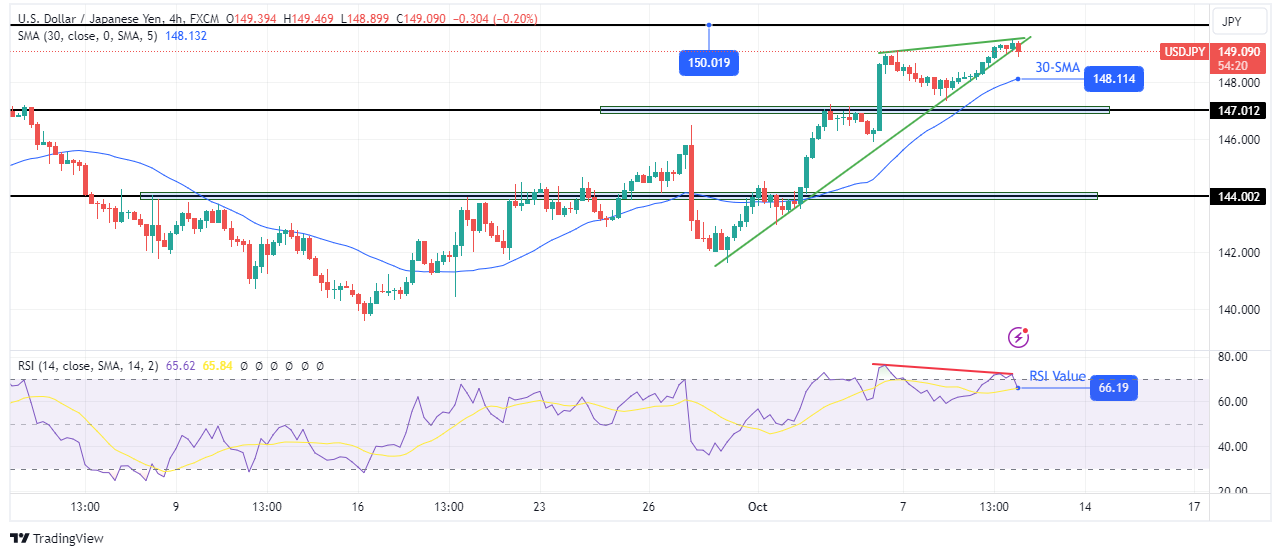
USD/JPY 4-hour chart

On the technical side, the USD/JPY price is on a solid bullish trend that recently broke above the 160.00 critical resistance level. Moreover, the price sits above the 30-SMA, and the RSI is going in and out of the overbought region, showing solid bullish momentum. 

Are you interested in learning more about forex tools? Check our detailed guide-

Furthermore, the uptrend is making such short pullbacks, a sign that bulls are much stronger than bears. Currently, the price has paused and is pulling back. It might retest the 30-SMA support before continuing higher. The next major resistance is at the 16.01 level.

Looking to trade forex now? Invest at eToro!

68% of retail investor accounts lose money when trading CFDs with this provider. You should consider whether you can afford to take the high risk of losing your money.

Source link

28 06, 2024

Euro could have a hard time staging a rebound

By |2024-06-28T17:04:10+03:00June 28, 2024|Forex News, News|0 Comments

You have reached your limit of 5 free articles for this month.

Get Premium without limits for only $479.76 for the first month

Access all our articles, insights, and analysts.

Your coupon code


UNLOCK OFFER

  • EUR/USD struggles to build on Thursday’s rebound, stays near 1.0700.
  • US data and quarter-end flows could camp up the pair’s volatility on Friday.
  • The first round of French presidential election will take place on Sunday.

EUR/USD stays in a consolidation phase at around 1.0700 on Friday after posting small gains on Thursday.

Euro PRICE This week

The table below shows the percentage change of Euro (EUR) against listed major currencies this week. Euro was the weakest against the Australian Dollar.

  USD EUR GBP JPY CAD AUD NZD CHF
USD   -0.02% 0.06% 0.72% 0.11% -0.03% 0.76% 0.68%
EUR 0.02%   0.10% 0.79% 0.18% 0.02% 0.85% 0.77%
GBP -0.06% -0.10%   0.63% 0.08% -0.09% 0.73% 0.67%
JPY -0.72% -0.79% -0.63%   -0.60% -0.71% 0.08% -0.05%
CAD -0.11% -0.18% -0.08% 0.60%   -0.13% 0.65% 0.59%
AUD 0.03% -0.02% 0.09% 0.71% 0.13%   0.82% 0.75%
NZD -0.76% -0.85% -0.73% -0.08% -0.65% -0.82%   -0.07%
CHF -0.68% -0.77% -0.67% 0.05% -0.59% -0.75% 0.07%  

The heat map shows percentage changes of major currencies against each other. The base currency is picked from the left column, while the quote currency is picked from the top row. For example, if you pick the Euro from the left column and move along the horizontal line to the US Dollar, the percentage change displayed in the box will represent EUR (base)/USD (quote).

The US Bureau of Economic Analysis will release the Personal Consumption Expenditures (PCE) Price Index data for May, the Federal Reserve’s preferred gauge of inflation, later in the day. Investors are likely to react to the monthly core PCE Price Index print, which is not distorted by base effects and excludes volatile food and energy prices.

Investors expect the monthly core PCE Price Index to rise 0.1% in May following the 0.2% increase recorded in April. A reading at or below the market expectation could make it difficult for the US Dollar (USD) to find demand in the American session. On the other hand, a print of 0.2% or higher could provide a boost to the USD and weigh on EUR/USD.

Even if the PCE inflation report hurts the USD, EUR/USD could struggle to stage a decisive rebound, with investors refraining from positioning themselves for an extended Euro strength ahead of the first round of election in France this weekend.

It’s also worth noting that this Friday is the last trading day of the second quarter. Quarter-end flows and position adjustments later in the day could ramp up market volatility and trigger irregular movements in major currency pairs.

EUR/USD Technical Analysis

1.0670, the Fibonacci 78.6% retracement of the latest uptrend, stays intact as strong support. In case EUR/USD drops below this level and confirms it as resistance, 1.0600 (psychological level, static level) could be set as the next bearish target.

On the upside, 1.0700 (psychological level, static level) aligns as interim resistance before 1.0730-1.0745 (Fibonacci 61.8% retracement, 100-period Simple Moving Average) and 1.0760 (Fibonacci 50% retracement).

  • EUR/USD struggles to build on Thursday’s rebound, stays near 1.0700.
  • US data and quarter-end flows could camp up the pair’s volatility on Friday.
  • The first round of French presidential election will take place on Sunday.

EUR/USD stays in a consolidation phase at around 1.0700 on Friday after posting small gains on Thursday.

Euro PRICE This week

The table below shows the percentage change of Euro (EUR) against listed major currencies this week. Euro was the weakest against the Australian Dollar.

  USD EUR GBP JPY CAD AUD NZD CHF
USD   -0.02% 0.06% 0.72% 0.11% -0.03% 0.76% 0.68%
EUR 0.02%   0.10% 0.79% 0.18% 0.02% 0.85% 0.77%
GBP -0.06% -0.10%   0.63% 0.08% -0.09% 0.73% 0.67%
JPY -0.72% -0.79% -0.63%   -0.60% -0.71% 0.08% -0.05%
CAD -0.11% -0.18% -0.08% 0.60%   -0.13% 0.65% 0.59%
AUD 0.03% -0.02% 0.09% 0.71% 0.13%   0.82% 0.75%
NZD -0.76% -0.85% -0.73% -0.08% -0.65% -0.82%   -0.07%
CHF -0.68% -0.77% -0.67% 0.05% -0.59% -0.75% 0.07%  

The heat map shows percentage changes of major currencies against each other. The base currency is picked from the left column, while the quote currency is picked from the top row. For example, if you pick the Euro from the left column and move along the horizontal line to the US Dollar, the percentage change displayed in the box will represent EUR (base)/USD (quote).

The US Bureau of Economic Analysis will release the Personal Consumption Expenditures (PCE) Price Index data for May, the Federal Reserve’s preferred gauge of inflation, later in the day. Investors are likely to react to the monthly core PCE Price Index print, which is not distorted by base effects and excludes volatile food and energy prices.

Investors expect the monthly core PCE Price Index to rise 0.1% in May following the 0.2% increase recorded in April. A reading at or below the market expectation could make it difficult for the US Dollar (USD) to find demand in the American session. On the other hand, a print of 0.2% or higher could provide a boost to the USD and weigh on EUR/USD.

Even if the PCE inflation report hurts the USD, EUR/USD could struggle to stage a decisive rebound, with investors refraining from positioning themselves for an extended Euro strength ahead of the first round of election in France this weekend.

It’s also worth noting that this Friday is the last trading day of the second quarter. Quarter-end flows and position adjustments later in the day could ramp up market volatility and trigger irregular movements in major currency pairs.

EUR/USD Technical Analysis

1.0670, the Fibonacci 78.6% retracement of the latest uptrend, stays intact as strong support. In case EUR/USD drops below this level and confirms it as resistance, 1.0600 (psychological level, static level) could be set as the next bearish target.

On the upside, 1.0700 (psychological level, static level) aligns as interim resistance before 1.0730-1.0745 (Fibonacci 61.8% retracement, 100-period Simple Moving Average) and 1.0760 (Fibonacci 50% retracement).

Source link

28 06, 2024

EUR/GBP Forecast Today 28/6: Major Inflection Point (Video)

By |2024-06-28T15:02:46+03:00June 28, 2024|Forex News, News|0 Comments

  • In my daily Euro/British pound forecast today, I see more sideways action, but I also recognize that we are in major inflection point.
  • After all, there is massive support underneath near the 0.84 level that I think a lot of people will be paying attention to.
  • You can see this clearly on the monthly chart, so it’s definitely something that’s going to attract longer term money.

On the upside, we have the 0.85 level, which has been massive resistance. We gapped down from there when they announced that there was going to be a snap election in the European Union parliamentary race in France and the local parliament as well. So really just a huge mess. I think at this point, there is a lot of concern and just hesitation to put a lot of money into play.

Resolution to the Upside? Maybe.

However, once things resolve themselves, I suspect that we probably see a return to the upside, at least for a while, not necessarily for a huge move, but for a move, nonetheless. If we can break above the 0.85 to zero level, then we have the possibility of more momentum coming into the market, perhaps sending the market to the 0.86 level. On the other hand, if we turn around and break down below the 0.84 level, that would be a massive negative sign, and at that point,

I’m not exactly sure what happens next, but it won’t be good for the euro. EUR/GBP is a pair that’s typically choppy under the best of circumstances, so I think that’s essentially what’s going to happen over the longer term. Whether or not we do it here or in one of the other ranges above remains to be seen, but right now I think this is probably best used as a gauge as to how to trade the euro or the British pound against other currencies. Right now, they seem to be fairly equal over the last two weeks but clearly the pound is stronger than the euro over the longer term.

Ready to trade our EUR/GBP Forex daily analysis and predictions? Here are the best European brokers to choose from. 

Source link

28 06, 2024

Pound Sterling struggles to clear key technical level

By |2024-06-28T13:01:49+03:00June 28, 2024|Forex News, News|0 Comments

  • GBP/USD stays below 1.2650 following Thursday’s modest recovery.
  • May PCE inflation data from the US could drive the USD’s valuation on Friday.
  • Quarter-end flows could trigger irregular movements in markets heading into the weekend.

Following Wednesday’s sharp decline, GBP/USD registered modest gains on Thursday. The pair, however, failed to pull away from the key 1.2640 level, reflecting the buyers’ hesitancy.

British Pound PRICE This week

The table below shows the percentage change of British Pound (GBP) against listed major currencies this week. British Pound was the weakest against the Australian Dollar.

  USD EUR GBP JPY CAD AUD NZD CHF
USD   -0.03% 0.05% 0.58% 0.08% -0.12% 0.71% 0.65%
EUR 0.03%   0.10% 0.65% 0.15% -0.06% 0.79% 0.76%
GBP -0.05% -0.10%   0.51% 0.06% -0.16% 0.69% 0.66%
JPY -0.58% -0.65% -0.51%   -0.48% -0.66% 0.17% 0.08%
CAD -0.08% -0.15% -0.06% 0.48%   -0.20% 0.63% 0.60%
AUD 0.12% 0.06% 0.16% 0.66% 0.20%   0.85% 0.82%
NZD -0.71% -0.79% -0.69% -0.17% -0.63% -0.85%   -0.04%
CHF -0.65% -0.76% -0.66% -0.08% -0.60% -0.82% 0.04%  

The heat map shows percentage changes of major currencies against each other. The base currency is picked from the left column, while the quote currency is picked from the top row. For example, if you pick the British Pound from the left column and move along the horizontal line to the US Dollar, the percentage change displayed in the box will represent GBP (base)/USD (quote).

Earlier in the day, the UK’s Office for National Statistics reported that the annualized Gross Domestic Product (GDP) growth for the first quarter got revised higher to 0.3% from the 0.2% announced in the flash estimate. This data failed to trigger a noticeable market reaction.

Early Friday, GBP/USD trades in a relatively tight range below 1.2650. In the second half of the day, the US Bureau of Economic Analysis will release the Personal Consumption Expenditures (PCE) Price Index data, the Federal Reserve’s (Fed) preferred gauge of inflation, for May.

On a monthly basis, the core PCE Price Index, which excludes volatile food and energy prices, is forecast to rise only 0.1% following the 0.2% increase recorded in April. A reading at or below the market expectation could feed into expectations for a Fed rate cut in September and hurt the USD. On the flip side, markets could turn reluctant to bet on a September policy pivot if the monthly core PCE Price Index rises 0.2% or more. In this scenario, GBP/USD could stay on the back foot.

Profit-taking and position adjustments on the last trading day of the second quarter could trigger sharp actions in currency pairs and distort the impact of the PCE inflation data on financial assets.

GBP/USD Technical Analysis

The 100-day and the 50-day Simple Moving Averages (SMA) form a key pivot level at 1.2640. If GBP/USD confirms this level as resistance, technical sellers could take action and open the door for an extended slide toward 1.2600 (psychological level, static level), 1.2580 (Fibonacci 50% retracement) and 1.2550 (200-day SMA).

On the upside, 1.2670 (50-period SMA on the 4-hour chart) aligns as interim resistance before 1.2710-1.2720 (200-period SMA, Fibonacci 23.6% retracement of the latest downtrend) in case GBP/USD starts using 1.2640 as support.

Pound Sterling FAQs

The Pound Sterling (GBP) is the oldest currency in the world (886 AD) and the official currency of the United Kingdom. It is the fourth most traded unit for foreign exchange (FX) in the world, accounting for 12% of all transactions, averaging $630 billion a day, according to 2022 data. Its key trading pairs are GBP/USD, aka ‘Cable’, which accounts for 11% of FX, GBP/JPY, or the ‘Dragon’ as it is known by traders (3%), and EUR/GBP (2%). The Pound Sterling is issued by the Bank of England (BoE).

The single most important factor influencing the value of the Pound Sterling is monetary policy decided by the Bank of England. The BoE bases its decisions on whether it has achieved its primary goal of “price stability” – a steady inflation rate of around 2%. Its primary tool for achieving this is the adjustment of interest rates. When inflation is too high, the BoE will try to rein it in by raising interest rates, making it more expensive for people and businesses to access credit. This is generally positive for GBP, as higher interest rates make the UK a more attractive place for global investors to park their money. When inflation falls too low it is a sign economic growth is slowing. In this scenario, the BoE will consider lowering interest rates to cheapen credit so businesses will borrow more to invest in growth-generating projects.

Data releases gauge the health of the economy and can impact the value of the Pound Sterling. Indicators such as GDP, Manufacturing and Services PMIs, and employment can all influence the direction of the GBP. A strong economy is good for Sterling. Not only does it attract more foreign investment but it may encourage the BoE to put up interest rates, which will directly strengthen GBP. Otherwise, if economic data is weak, the Pound Sterling is likely to fall.

Another significant data release for the Pound Sterling is the Trade Balance. This indicator measures the difference between what a country earns from its exports and what it spends on imports over a given period. If a country produces highly sought-after exports, its currency will benefit purely from the extra demand created from foreign buyers seeking to purchase these goods. Therefore, a positive net Trade Balance strengthens a currency and vice versa for a negative balance.


Source link

28 06, 2024

USD/JPY Forecast: Impact of Tokyo Inflation and US Fed Rate Cut Prospects

By |2024-06-28T04:58:35+03:00June 28, 2024|Forex News, News|0 Comments

USDJPY Intervention Zone
How will the US inflation numbers influence the Fed rate path?

US Personal Income and Outlays Report and the Fed in Focus

On Friday, the US Personal Income and Outlays report is crucial for September Fed rate cut prospects. Economists expect the Core PCE Price Index to rise 2.6% year-on-year, down from 2.8% in April.

Lower-than-expected figures could boost confidence in a rate cut, though higher personal income and spending trends could sustain demand-driven inflation, potentially requiring a prolonged high rate trajectory.

Forecasts suggest personal income and spending will climb by 0.4% and 0.3%, respectively. For context, April saw increases of 0.3% in personal income and 0.2% in spending.

With inflation taking center stage, investors should monitor FOMC member statements. Responses to the Personal Income and Outlays Report and perspectives on the timing of a Fed rate cut could sway market sentiment.

FOMC members Thomas Barkin and Michelle Bowman are on the calendar to speak, adding the potential for market-moving commentary.

Short-term Forecast: Bearish

USD/JPY trends hinge on intervention chatter, US inflation data, and Fed speeches. Higher US inflation could prompt a Japanese government intervention, with the BoJ possibly cutting JGB purchases more aggressively in July.

Considering the dynamics, the USD/JPY could face stern resistance to the upside. The USD/JPY could drop to 150 if the Japanese government intervenes and the BoJ signals plans to aggressively cut JGB purchases.

USD/JPY Price Action

Daily Chart

The USD/JPY hovered comfortably above the 50-day and 200-day EMAs, affirming the bullish price signals.

A break above the Wednesday, June 26, high of 160.872 could give the bulls a run at the 162 handle.

Interventions, Bank of Japan commentary, and US inflation numbers require investor attention on Friday.

Conversely, a USD/JPY break below the 160 handle could signal a drop to the 50-day EMA. A fall through the 50-day EMA could bring the $151.685 support level into play.

The 14-day RSI at 72.28 shows a USD/JPY in overbought territory. Selling pressure could intensify at the June 26 high of 160.872.

Source link

28 06, 2024

Future price action hinges on US PCE

By |2024-06-28T02:57:35+03:00June 28, 2024|Forex News, News|0 Comments

You have reached your limit of 5 free articles for this month.

Get Premium without limits for only $479.76 for the first month

Access all our articles, insights, and analysts.

Your coupon code


UNLOCK OFFER

  • EUR/USD reclaimed the area beyond 1.0700.
  • The US Dollar faced renewed downside pressure.
  • Markets now look at the release of US PCE.

The irruption of selling interest in the US Dollar (USD) prompted the USD Index (DXY) to give away part of the recent advance beyond the 106.00 level and refocus on the downside instead, allowing EUR/USD to regain balance and reclaim levels above 1.0700 the figure on Thursday.

In fact, the euro (EUR) managed to set aside some of the recent negative sentiment amidst reduced political concerns in France ahead of the June 30 snap elections.

The macroeconomic situation on both sides of the Atlantic remained steady, with the European Central Bank (ECB) contemplating further rate cuts beyond summer. Market expectations suggest two more ECB rate cuts later in the year.

On this, ECB’s rate-setter Peter Kazimir said the bank might consider another interest rate cut later this year after the reduction implemented this month, although not during the summer.

On the other side of the road, market participants were still debating whether the Federal Reserve (Fed) would implement one or two rate cuts this year, despite the Fed forecasting just one cut, likely in December.

It is worth recalling that part of the recent uptick in the US Dollar came in response to hawkish comments from Fed officials, while the widening monetary policy gap between the Fed and other major central banks also contributed to the euro’s decline.

On Wednesday, FOMC Governor Michelle Bowman reiterated that her primary view is that inflation will fall further if the policy rate remains unchanged. She stated that rate cuts would be necessary if inflation stabilised around 2%. Her colleague Raphael Bostic, President of the Atlanta Fed, argued that inflation in the US “seems to be decreasing,” potentially paving the way for the Fed to reduce interest rates later this year.

The CME Group’s FedWatch Tool maintains a probability of around 65% of lower interest rates in September vs. a nearly 93% chance at the December 18 gathering.

In the short term, the recent ECB rate cut, compared to the Fed’s decision to maintain rates, has widened the policy gap between the two central banks. This could lead to further weakness in EUR/USD.

However, the Eurozone’s emerging economic recovery and perceived weakening of US fundamentals are expected to reduce this disparity, potentially providing occasional support for the pair in the near future.

EUR/USD daily chart

EUR/USD short-term technical outlook

If bears maintain control, EUR/USD may revisit the June low of 1.0666 (June 26), then the May low of 1.0649 (May 1), and lastly the 2024 bottom of 1.0601 (April 16).

Meanwhile, occasional bouts of strength may put the pair on track to revisit the 200-day SMA at 1.0789, prior to the weekly high of 1.0852 (June 12) and the June top of 1.0916 (June 4). The breakout of this level could put the March peak of 1.0981 (March 8) back on the radar ahead of the weekly high of 1.0998 (January 11) and the psychological 1.1000 yardstick.

So far, the 4-hour chart shows some evidence of ongoing recovery. The initial resistance is at 1.0746, then 1.0761, and finally 1.0800. The initial support is at 1.0666, ahead of 1.0649 and 1.0601. The Relative Strength Index (RSI) rebounded to around 50.

  • EUR/USD reclaimed the area beyond 1.0700.
  • The US Dollar faced renewed downside pressure.
  • Markets now look at the release of US PCE.

The irruption of selling interest in the US Dollar (USD) prompted the USD Index (DXY) to give away part of the recent advance beyond the 106.00 level and refocus on the downside instead, allowing EUR/USD to regain balance and reclaim levels above 1.0700 the figure on Thursday.

In fact, the euro (EUR) managed to set aside some of the recent negative sentiment amidst reduced political concerns in France ahead of the June 30 snap elections.

The macroeconomic situation on both sides of the Atlantic remained steady, with the European Central Bank (ECB) contemplating further rate cuts beyond summer. Market expectations suggest two more ECB rate cuts later in the year.

On this, ECB’s rate-setter Peter Kazimir said the bank might consider another interest rate cut later this year after the reduction implemented this month, although not during the summer.

On the other side of the road, market participants were still debating whether the Federal Reserve (Fed) would implement one or two rate cuts this year, despite the Fed forecasting just one cut, likely in December.

It is worth recalling that part of the recent uptick in the US Dollar came in response to hawkish comments from Fed officials, while the widening monetary policy gap between the Fed and other major central banks also contributed to the euro’s decline.

On Wednesday, FOMC Governor Michelle Bowman reiterated that her primary view is that inflation will fall further if the policy rate remains unchanged. She stated that rate cuts would be necessary if inflation stabilised around 2%. Her colleague Raphael Bostic, President of the Atlanta Fed, argued that inflation in the US “seems to be decreasing,” potentially paving the way for the Fed to reduce interest rates later this year.

The CME Group’s FedWatch Tool maintains a probability of around 65% of lower interest rates in September vs. a nearly 93% chance at the December 18 gathering.

In the short term, the recent ECB rate cut, compared to the Fed’s decision to maintain rates, has widened the policy gap between the two central banks. This could lead to further weakness in EUR/USD.

However, the Eurozone’s emerging economic recovery and perceived weakening of US fundamentals are expected to reduce this disparity, potentially providing occasional support for the pair in the near future.

EUR/USD daily chart

EUR/USD short-term technical outlook

If bears maintain control, EUR/USD may revisit the June low of 1.0666 (June 26), then the May low of 1.0649 (May 1), and lastly the 2024 bottom of 1.0601 (April 16).

Meanwhile, occasional bouts of strength may put the pair on track to revisit the 200-day SMA at 1.0789, prior to the weekly high of 1.0852 (June 12) and the June top of 1.0916 (June 4). The breakout of this level could put the March peak of 1.0981 (March 8) back on the radar ahead of the weekly high of 1.0998 (January 11) and the psychological 1.1000 yardstick.

So far, the 4-hour chart shows some evidence of ongoing recovery. The initial resistance is at 1.0746, then 1.0761, and finally 1.0800. The initial support is at 1.0666, ahead of 1.0649 and 1.0601. The Relative Strength Index (RSI) rebounded to around 50.

Source link

28 06, 2024

GBP/JPY Forecast – British Pound Recovers Against Yen

By |2024-06-28T00:56:37+03:00June 28, 2024|Forex News, News|0 Comments

GBP/JPY Forecast Video for 07.04.23

British Pound vs Japanese Yen Technical Analysis

The British pound has found itself dipping a bit during the course of the trading session on Thursday, but then turned around as we found buyers step into the market yet again. Keep in mind that the Bank of Japan continues to see the need to keep interest rates down, and therefore they have been printing yen and buying bonds every time they start to rise. Furthermore, the British pound has been one of the better performers around the world, so it all lines up for a market that should be bullish.

However, you should also keep an eye on the ¥165.50 level, where we had seen significant selling pressure previously, or we had formed a bit of a shooting star, not only on Tuesday, but several weeks back. In other words, I think that’s an area that is in general going to be difficult. However, if we were to break above that area then it opens up a potential move to the ¥169 level. On the other hand, if we turn around and break down below the bottom of the candlesticks for the last couple of days, then you have the 50-Day EMA and the 200-Day EMA indicators sitting just below. In that area, you would have quite a bit of technical support so it will be interesting to see how that plays out. Anything below that area would obviously attract a lot of attention, and traders would probably be aiming for the ¥160 level.

Regardless, this is a market that will continue to be very noisy, and I think that’s something that you will just have to come to terms with. That is typically the case with this pair, but we also have a lot of volatility in general around the Forex world. Ultimately, you will have to be very flexible and keep your position size reasonable, as we could find ourselves in trouble rather quickly. The yields in Japan will have to be paid close attention to, as it will continue to cause major volatility at times and this pair and all other yen related pairs going forward. The yield curve control game is by far the biggest game in town at the moment.

For a look at all of today’s economic events, check out our economic calendar.

This article was originally posted on FX Empire

More From FXEMPIRE:

Source link

27 06, 2024

EUR/GBP Forecast Today 27/6: Choppy Trading (Video)

By |2024-06-27T22:55:40+03:00June 27, 2024|Forex News, News|0 Comments

Date


(MENAFN– Daily Forex)

  • The euro initially fell again during the early hours on Wednesday but has since recovered against the British pound to continue the overall noisy consolidation that we have been in for some time.

  • With that being the case, I think you have to look at this through the prism of a market that is trying to sort itself out and figure where we are going next.

  • But there is a gap above that still needs to be filled, although we came very close to doing so.

  • We could find this pair going back to the 0.85 level for no other reason than that gap.

However, it’s also worth noting that this is a market that has seen a lot of downer pressure over the last several months. I think the snap elections in France have really put a chill down the spine of most traders that would be willing to hold on to this market. So, I think we have a situation where traders continue to look at this through the prism of potential value play based on longer term charts. But we need to be honest here.Top Forex Brokers

  • 1 Get Started 74% of retail CFD accounts lose money

The EUR/GBP market is clearly one that is going to remain volatile and choppy and perhaps even very difficult overall to deal with. Because of this, I think you’ve got a situation where traders continue to favor buying the dips as they occur and trying to defend 0.84 level. The 0.84 level, of course, is an area that has caused a bit of support in the longer term charts. So, I think right now we may be setting up sideways action between 0.84 and 0.85 above. Current Environment is All NoiseIn this current environment, I expect to see a lot of noisy trading in multiple markets, not just this one. However, as this market does tend to be choppy under normal conditions, I expect it to be even more aggressive here. If we can break above the 0.8550 level, that might bring in a certain amount of FOMO trading.Want to trade the daily Forex analysis? Begin by checking out the top Forex brokers for beginners here.MENAFN27062024000131011023ID1108379320


Daily Forex


Legal Disclaimer:
MENAFN provides the information “as is” without warranty of any kind. We do not accept any responsibility or liability for the accuracy, content, images, videos, licenses, completeness, legality, or reliability of the information contained in this article. If you have any complaints or copyright issues related to this article, kindly contact the provider above.

Source link

Go to Top