Will the US dollar break free from consolidation next week or continue in a sideways range?
Watch today’s Forex forecast to see the key levels and setups for DXY, EURUSD, GBPUSD, USDJPY, and XAUUSD.
US Dollar Index (DXY) Forecast
The DXY continues to be a difficult market to read.
On Tuesday, the USD index closed below the 100.60 key support, only to reclaim it by Wednesday’s close.
Typically, this would suggest a local bottom and a move toward the range highs.
However, the DXY is once again losing the 100.60 support today, potentially exposing the confluence of support at 99.60 next week.
This creates a difficult market to read, making it even tougher to trade.
If the DXY loses 100.60 this week, it could open up 99.60 support heading into October.
On the flip side, a weekly close above 100.50/60 would keep the support level intact and could push the DXY toward the 102.00 range highs.
Weekly Forex Forecast For DXY, EURUSD, GBPUSD, USDJPY, and XAUUSD (September 30-October 4, 2024) 6
EURUSD Forecast
EURUSD has been a challenging market to trade, to say the least.
Since late August, the price action has not only been sideways but also incredibly choppy and indecisive.
While the euro remains above the 1.1110 mid-range I’ve mentioned recently, it has yet to break above the July channel resistance.
Until EURUSD breaks one of these levels, traders should expect continued choppy price action.
That said, I believe the DXY offers a clearer outlook on key levels to watch for next week.
Weekly Forex Forecast For DXY, EURUSD, GBPUSD, USDJPY, and XAUUSD (September 30-October 4, 2024) 7
GBPUSD Forecast
GBPUSD has been much stronger compared to EURUSD.
However, the pair is struggling to break above the ascending trend line from May and is currently just below the 1.3450 to 1.3500 key resistance area.
That said, I wouldn’t consider shorting GBPUSD, given the uptrend since May.
The only way GBPUSD becomes a favorable short is if it sustains a break below 1.3240.
Until then, buyers remain in control.
Weekly Forex Forecast For DXY, EURUSD, GBPUSD, USDJPY, and XAUUSD (September 30-October 4, 2024) 8
USDJPY Forecast
A few days ago, I mentioned that USDJPY was bullish toward 146.00 to 146.50.
I wasn’t wrong, despite Friday’s massive 430-pip drop.
Notice how Wednesday’s session closed above 144.00, Thursday’s session retested it, and Friday’s candle reached a high of 146.49.
However, predicting next week’s price action is more challenging.
Friday’s close below 144.00 turns the level back into resistance, but USDJPY shorts should be cautious while the pair remains above 141.80 on the daily time frame.
Weekly Forex Forecast For DXY, EURUSD, GBPUSD, USDJPY, and XAUUSD (September 30-October 4, 2024) 9
XAUUSD (Gold) Forecast
Gold has had an impressive run since June, especially after breaking above $2,527.
That breakout targeted the $2,600 channel resistance I’ve mentioned on this site and later went on to break that level as well.
However, I’m always cautious of upward breaks of ascending levels, as they often result in failed moves.
That said, XAUUSD is still above $2,590, so shorting here wouldn’t be advisable.
If gold breaks below $2,590 on the higher time frames, it could open up $2,527 as new support.
Alternatively, bullish price action from the $2,590 to $2,600 region next week could trigger the next leg higher for XAUUSD.
Weekly Forex Forecast For DXY, EURUSD, GBPUSD, USDJPY, and XAUUSD (September 30-October 4, 2024) 10
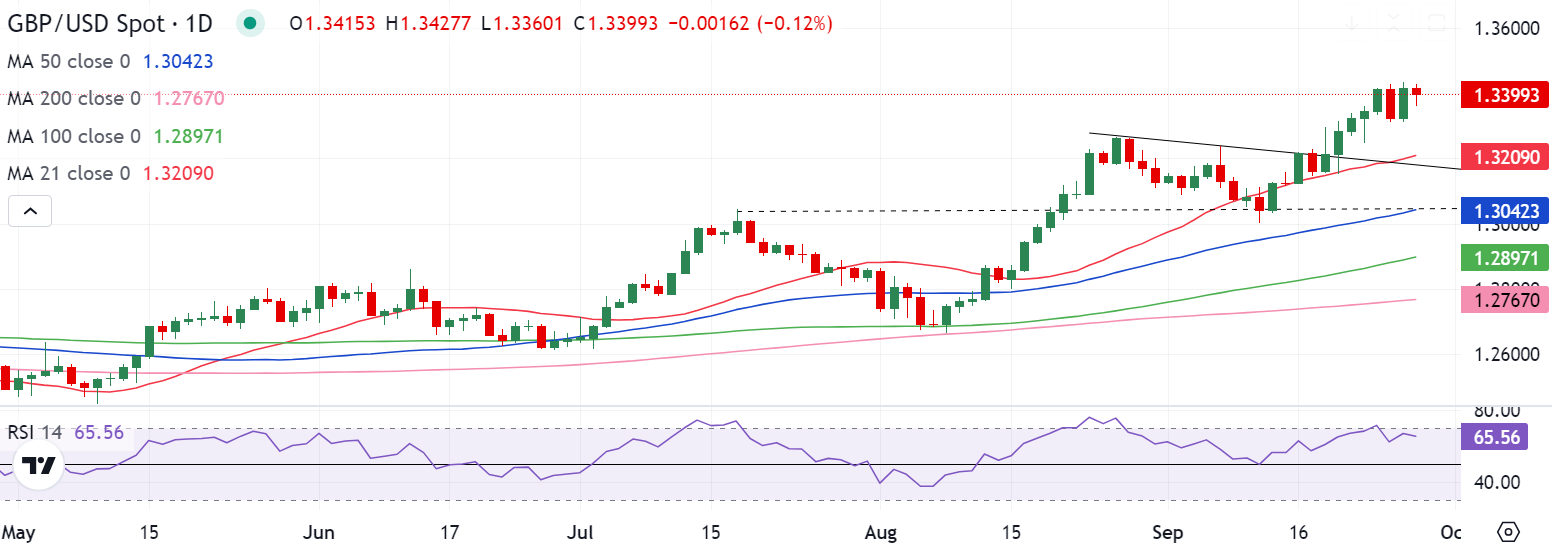
The Pound Sterling briefly recaptured 1.3400 versus the US Dollar.
GBP/USD looks to US labor data for a fresh directional impetus.
The daily technical setup continues to favor Pound Sterling buyers.
The Pound Sterling (GBP) secured three consecutive months of gains against the US Dollar (USD) in the past week as the GBP/USD pair recaptured the 1.3400 threshold to stay at the highest level since March 2022.
Pound Sterling extended its winning streak against the US Dollar
GBP/USD entered a bullish consolidation phase between 1.3435 and 1.3250, sitting at fresh 30-month highs as the monetary policy divergence between the Bank of England (BoE) and the US Federal Reserve (Fed) continued to support the Pound Sterling at the expense of the Greenback.
Cautious remarks from the BoE policymakers contrasted with a slew of explicitly dovish commentary from Fed officials, keeping hopes for 50 basis points (bps) of interest rate cuts by the Fed alive for November. Meanwhile, markets expect the BoE to reduce rates by 25 bps in November.
Several Fed policymakers took up the rostrum and supported their decisions for a 50 bps rate cut move in September, except for Fed Governor Michelle Bowman, who stuck to her hawkish rhetoric.
Meanwhile, BoE Governor Andrew Bailey said Tuesday, “I’m very encouraged that the path of inflation is downwards. Hence, “I do think the path for interest rates will be downwards as well, but gradually.” On the other hand, BoE policymaker Megan Greene said on Wednesday that a “cautious, steady-as-she-goes approach to monetary policy easing is appropriate.”
Apart from the central bank divergence, GBP/USD drew support from persistent risk flows, as risk appetite was boosted by a flurry of stimulus measures from China, such as lowering the key Reserve Requirement Ratio (RRR) by 50 bps.
China’s Politburo, the country’s top leadership, pledged on Thursday to support the struggling economy through “forceful” interest rate cuts and adjustments to fiscal and monetary policies, stoking expectations for more stimulus.
On the economic data front, there were no top-tier releases from the UK. Therefore, traders remained glued to Friday’s core Personal Consumption Expenditures (PCE) Price Index, the Fed’s most preferred inflation gauge, for fresh hints on the size of the next interest rate cut. Markets shrugged off mixed US Jobless Claims and Durable Goods Orders data published on Thursday.
Meanwhile, the Fed’s key inflation measure moved closer to the central bank’s 2% target in August on Friday, exacerbating the USD’s pain, sending the pair back toward the 30-month highs. The headline PCE price index rose 0.1% for the month, putting the annual inflation rate at 2.2%. The core PCE Price Index increased by 2.7% YoY, as expected while the monthly core inflation ticked down to 0.1%, against the previous reading of 0.2%.
US employment data to dominate the week ahead
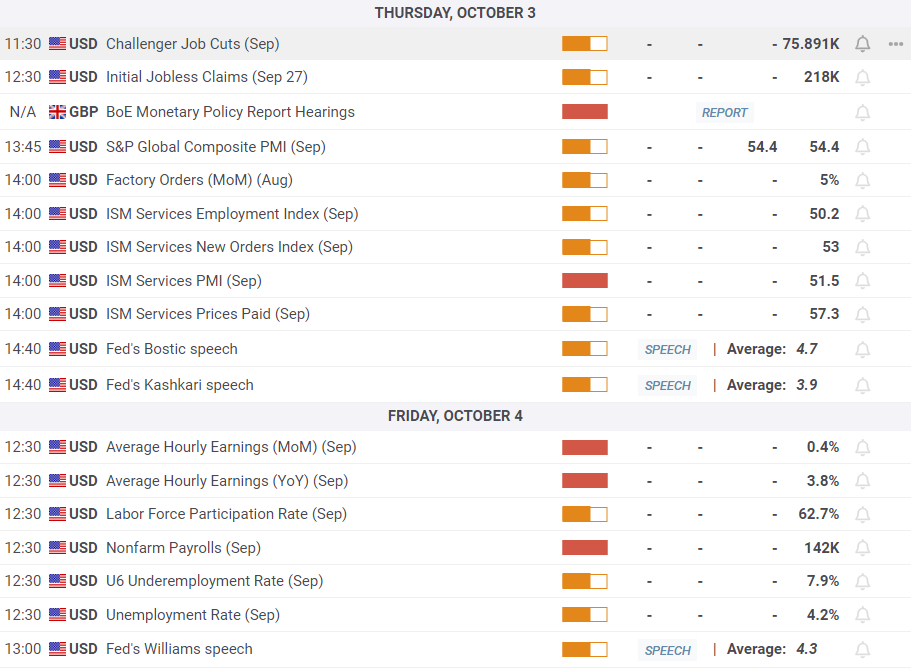
Following a mediocre week in terms of economic data releases, the upcoming week is a busy one, with plenty of top-tier statistics due from the United States. On the other side, the UK docket remains devoid of any relevant macro news.
Monday kicks off with a bang, as Fed Chair Jerome Powell is due to participate in a moderated discussion titled “A View from the Federal Reserve Board” at the National Association for Business Economics Annual Meeting in Nashville. BoE policymaker Megan Greene’s speech will follow.
The US ISM Manufacturing PMI and JOLTS Job Openings Survey will grab eyeballs on Tuesday, followed by speeches from Fed officials Raphael Bostic and Lisa Cook.
Early Wednesday will feature a bunch of other Fed policymakers speaking at the Technology-Enabled Disruption Conference hosted by the Federal Reserve Bank of Atlanta. Later that day, the ADP Employment Change data will hog the limelight in American trading alongside more Fedspeak.
The US ISM Services PMI will be reported on Thursday as traders’ focus shifts toward the all-important Nonfarm Payrolls (NFP) slated for release on Friday.
Speeches from Fed officials and the Middle East geopolitical developments will continue to drive the sentiment around the US Dollar, in turn, affecting the GBP/USD pair.
GBP/USD: Technical Outlook
As observed on the daily chart, the GBP/USD pair extended the upside break of the falling trendline resistance, then at 1.3199, to briefly regain the 1.3400 level.
The path of least resistance appears to the upside for the pair, in the absence of any firm resistance levels. Pound Sterling buyers could challenge the initial hurdle at the 1.3500 round level on their way to the February 24, 2022 high of 1.3550.
Acceptance above that level will open doors for a test of the February 2022 high of 1.3644. The next bullish bet aligns at 1.3700.
The 14-day Relative Strength Index (RSI) remains within bullish territory, well above the 50 level, suggesting that more gains remain in the offing.
Alternatively, any pullback could meet initial demand at the September 23 low of 1.3249, below which the falling trendline resistance now turned support at around 1.3200 will be challenged. At that level, the 21-day Simple Moving Average (SMA) coincides.
Additional declines could target the July 17 high of 1.3045, where the 50-day SMA hangs around. The 100-day SMA at 1.2897 will be the last line of defense for buyers.
Pound Sterling FAQs
The Pound Sterling (GBP) is the oldest currency in the world (886 AD) and the official currency of the United Kingdom. It is the fourth most traded unit for foreign exchange (FX) in the world, accounting for 12% of all transactions, averaging $630 billion a day, according to 2022 data. Its key trading pairs are GBP/USD, aka ‘Cable’, which accounts for 11% of FX, GBP/JPY, or the ‘Dragon’ as it is known by traders (3%), and EUR/GBP (2%). The Pound Sterling is issued by the Bank of England (BoE).
The single most important factor influencing the value of the Pound Sterling is monetary policy decided by the Bank of England. The BoE bases its decisions on whether it has achieved its primary goal of “price stability” – a steady inflation rate of around 2%. Its primary tool for achieving this is the adjustment of interest rates. When inflation is too high, the BoE will try to rein it in by raising interest rates, making it more expensive for people and businesses to access credit. This is generally positive for GBP, as higher interest rates make the UK a more attractive place for global investors to park their money. When inflation falls too low it is a sign economic growth is slowing. In this scenario, the BoE will consider lowering interest rates to cheapen credit so businesses will borrow more to invest in growth-generating projects.
Data releases gauge the health of the economy and can impact the value of the Pound Sterling. Indicators such as GDP, Manufacturing and Services PMIs, and employment can all influence the direction of the GBP. A strong economy is good for Sterling. Not only does it attract more foreign investment but it may encourage the BoE to put up interest rates, which will directly strengthen GBP. Otherwise, if economic data is weak, the Pound Sterling is likely to fall.
Another significant data release for the Pound Sterling is the Trade Balance. This indicator measures the difference between what a country earns from its exports and what it spends on imports over a given period. If a country produces highly sought-after exports, its currency will benefit purely from the extra demand created from foreign buyers seeking to purchase these goods. Therefore, a positive net Trade Balance strengthens a currency and vice versa for a negative balance.
Japan announced a new prime minister on Friday after a tight race.
Japan’s new prime minister, Ishiba, supports the current monetary policy moves.
US inflation rose by 0.1%, which is smaller than the forecast of 0.2%.
The USD/JPY price analysis supports further downside as the yen rallies after Japan’s former defense minister, Shigeru Ishiba, won the seat for the next prime minister. Meanwhile, cooler-than-expected US inflation data weighed on the dollar.
–Are you interested in learning more about buying NFT tokens? Check our detailed guide-
Japan announced a new prime minister on Friday after a tight race. The outcome boosted the yen since Ishiba supports the current monetary policy moves. Therefore, he might continue supporting the Bank of Japan as it raises borrowing costs.
Although the last meeting was slightly cautious, economists expect at least one BoJ rate hike before the end of the year. Higher borrowing costs reduce the gap in rates between Japan and the US.
Elsewhere, market focus remained trained on the US core PCE report. The Federal Reserve recently cut interest rates by a massive 50-bps. It was a clear indication of confidence that inflation was under control. Therefore, policymakers expect price pressure to continue declining to the target.
Consequently, an unexpected figure could shift the outlook for future moves. Currently, there is a 50% chance of another massive reduction in November. Data on Friday revealed that inflation rose by 0.1%, smaller than the forecast of 0.2%. Therefore, the Fed has every reason to continue lowering borrowing costs.
Moreover, a soft landing is more likely since the economy remains resilient. Notably, data on Thursday showed that US unemployment claims dropped to 218,000 compared to expectations of 225,000. Another report revealed that corporate profits increased at a faster-than-expected rate.
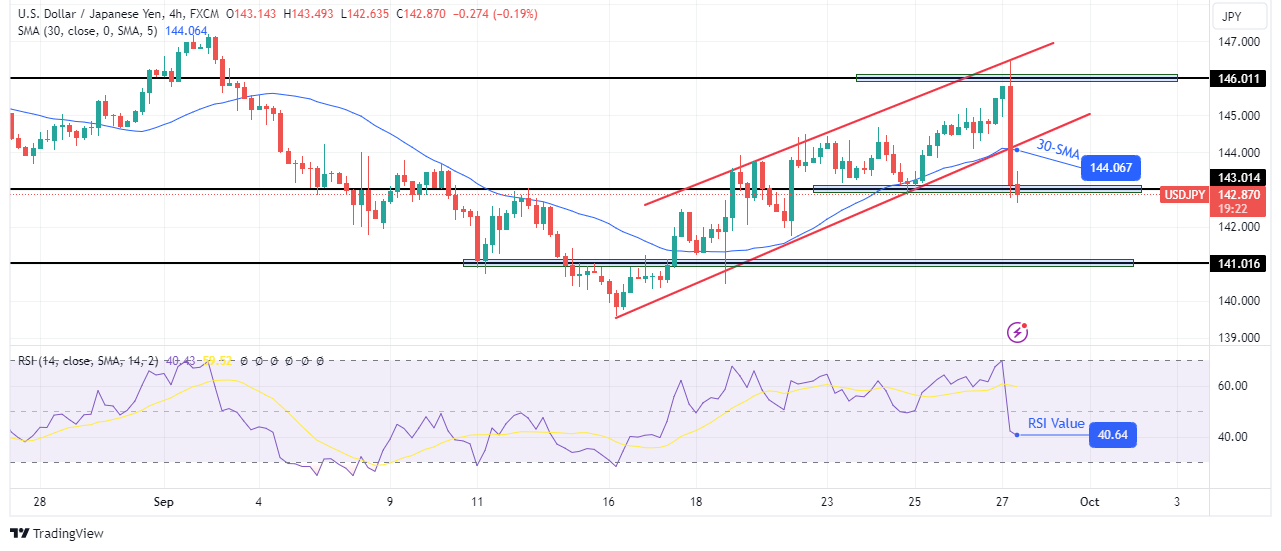
On the technical side, the USD/JPY price has broken out of its bullish channel with a bearish engulfing candle. At the same time, the price has broken below the 30-SMA, indicating a shift in sentiment. Meanwhile, the RSI has dropped below 50, into bearish territory.
-Are you looking for the best CFD broker? Check our detailed guide-
However, the decline has reached the 143.01 support level and might pause here before continuing lower. A pause could allow the price to retest the recently broken channel support. If bears remain in control, the price will likely break below 143.01 support to retest the 141.01 level.
Looking to trade forex now? Invest at eToro!
67% of retail investor accounts lose money when trading CFDs with this provider. You should consider whether you can afford to take the high risk of losing your money.
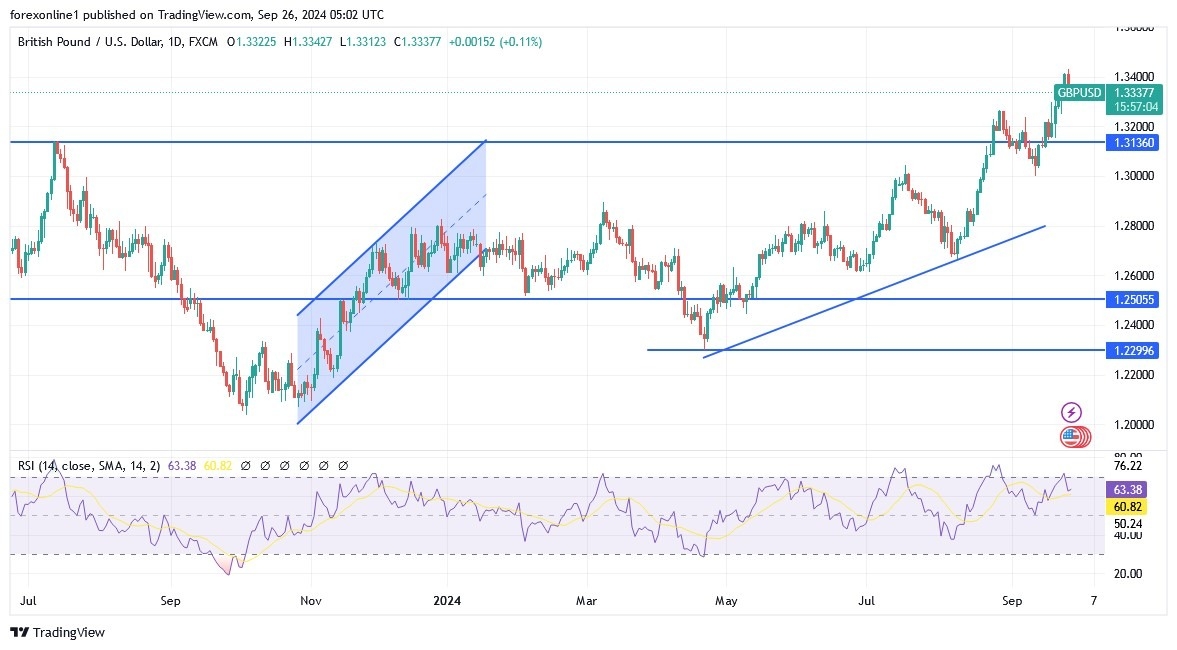
Currently, the 50-day EMA at $1.33586 offers some near-term support, while the 200-day EMA at $1.32425 provides a more substantial foundation. If GBP/USD breaks above $1.3389, it could shift momentum toward a bullish stance.
Conversely, a drop below $1.3360 may invite more selling pressure and extend losses.
Euro Eyes Mixed Inflation Data and German Jobs Report
The Euro trades cautiously as traders digest mixed French and Spanish inflation data. France’s Consumer Spending improved by 0.2%, but its Preliminary CPI fell to -1.2%. Meanwhile, Spain’s Flash CPI dropped to 1.5% YoY. German Unemployment Change jumped by 17K, indicating labor market weakness.
Investors are now focusing on the Italian 10-year bond auction and comments from German Buba President Nagel for further direction. Weaker employment data and softer inflation figures may keep the Euro under pressure.
EUR/USD Technical Forecast
The EUR/USD is trading at $1.11330, down 0.11%, and remains below the key pivot point of $1.11439. The pair is facing immediate resistance at $1.11573, with further upside barriers at $1.11730 and $1.11890.
On the downside, immediate support lies at $1.11221, with additional support at $1.11047 and $1.10921. The 50-day EMA sits at $1.11537, indicating that the pair is struggling to reclaim bullish momentum, while the 200-day EMA at $1.11181 offers some support.
Higher-than-expected inflation figures may reduce investor bets on a 50-basis point November Fed rate cut. However, investors should also consider personal income/spending trends. Weaker personal income and spending could signal a softer inflation look, possibly fueling bets on a 50-basis point November Fed rate cut.
According to the CME FedWatch Tool, the probability of a 50-basis point Fed rate cut was 60.8% on Thursday, September 26.
Weaker-than-expected US data could push the USD/JPY down toward 143.5.
Short-term Forecast for USD/JPY
USD/JPY trends will hinge on inflation numbers from Tokyo and the US and central bank commentary. Hotter-than-expected inflation numbers for Tokyo could strengthen expectations of a Q4 2024 BoJ rate hike, possibly pushing the USD/JPY toward 143.5. However, the US Personal Income and Outlays Report also needs consideration amidst rising bets on a 50-basis point September Fed rate cut.
Investors should remain vigilant, with economic indicators and central bank commentary to dictate demand for the USD/JPY pair. Monitor real-time data, central bank views, and expert commentary to adjust your trading strategies accordingly. Stay ahead of the market with our expert insights.
USD/JPY Technical Analysis
Daily Chart
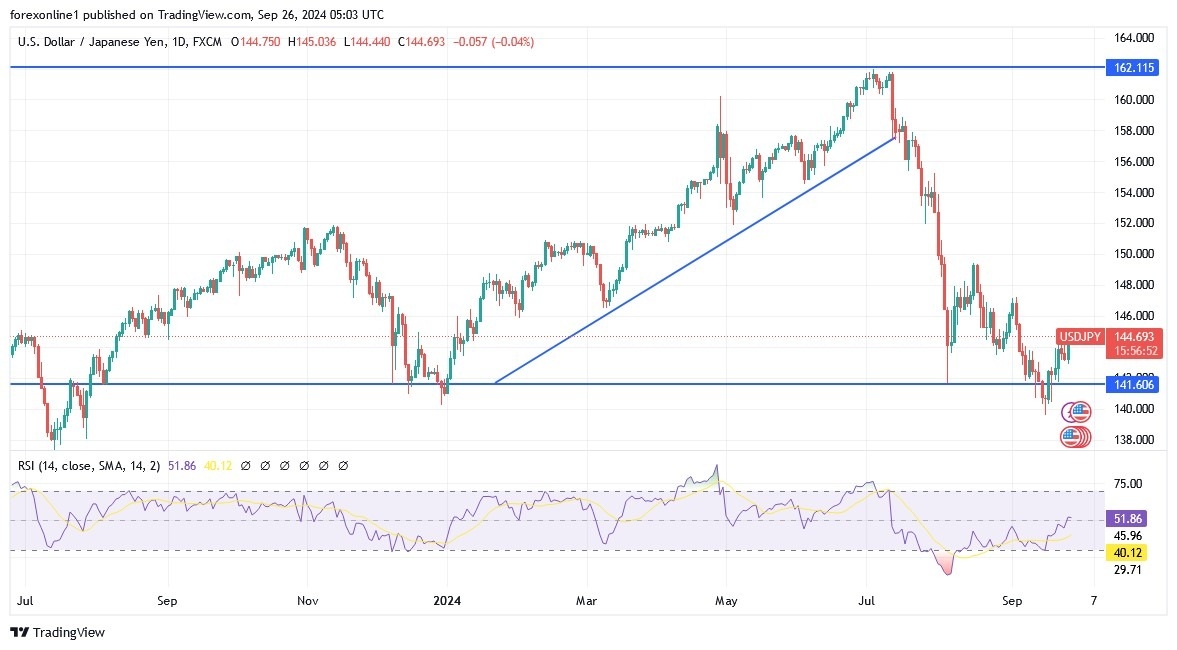
The USD/JPY hovers below the 50-day and 200-day EMAs, confirming bearish price trends.
A USD/JPY breakout from 145 could give the bulls a run at the 145.891 resistance level. Furthermore, a break above the 145.891 resistance level could bring the 50-day EMA into play.
Central bank commentary and inflation figures from Japan and the US require consideration.
Conversely, a drop below the 143.495 support level could signal a fall toward 142.5. A fall through 142.5 may give the bears a run at the 141.032 support level.
The 14-day RSI at 52.10 indicates a USD/JPY climb to 147.5 before entering overbought territory.
The Pound Sterling is relinquishing some of its recent gains against both the Euro and the US Dollar.
We believe that technical factors, weaker equity markets, and end-of-quarter flows are contributing to this trend.
According to reliable trading platforms, the GBP/EUR exchange rate is currently well below its Tuesday high of 1.2024, experiencing a 0.33% decline today to 1.1959.
Similarly, the GBP/USD pair reached a peak of 1.3429 yesterday but has since dropped by 0.26% to 1.3330.
According to Forex trading, the recent rise in the pound has meant that it has reached overbought conditions against both the euro and the US dollar, with the Relative Strength Index (RSI) readings on the daily charts crossing the 70 level. The RSI rarely spends time above 70 (which is overbought) or below 30 (which is oversold) and the RSI is usually expected to return to the mean once these extremes are reached.
A period of neutrality or decline in the exchange rate will therefore bring the RSI back into balance, and we are seeing this in mid-week trading.
However, there is no news to support the pound’s decline and, in this regard, analyst Brad W. Bechtel, an analyst at investment bank Jefferies, said that Wednesday is expected to see end-of-month and quarter flows that will lead to volatility in the forex markets. He said: “We are at the end of the quarter this week and that is likely to start to drive the forex market more in the London morning and New York morning.”
The end of the quarter and month are approaching, which will require global portfolio managers to adjust recent developments in the foreign exchange market. Rebalancing could lead to significant volatility in the near term. “The turbulent third quarter for asset prices opens the door to a significant rebalancing at the end of the quarter,” said Robert Vollem, a Reuters market analyst. Bechtel believes that the end of September and the third quarter of 2024 could be characterized by a stronger US dollar given the weakness seen in recent weeks. “I would be surprised if we end up selling enough US dollars at the end of the quarter to push us through the 100 supports in the US dollar index,” it said. “In general, quarter-ends have been positive for the US dollar, so if anything, we are likely to return above 101 towards 102.”
The recovery in the US dollar index (DXY) – a measure of the overall performance of the US dollar – means that GBP/USD is under pressure again and the current appreciation trend could extend for six days.
Global equity markets are also weaker on Wednesday, which would typically impact the high beta pairs of GBP/USD, GBP/CHF and to some extent GBP/EUR.
Overall, the combination of overbought conditions, end-of-quarter flows and weaker markets are all conspiring against sterling. However, in the medium term, the same factors that have pushed sterling to recent highs remain in place, namely the Bank of England, which will only cut interest rates cautiously due to UK service sector inflation amid continued economic growth. In its latest World Economic Outlook, the OECD said the UK economy is on track to expand by 1.1% this year, up 0.7 percentage points from its last forecast in May.
The UK was among a group of countries that recorded “strong” growth rates this year, she said, having rebounded strongly from a mild recession at the end of 2023.
Technical forecasts for the GBP/USD pair today:
There are also no major concerns about global stock markets, and the weakness should be short-lived now that the Federal Reserve has begun its easing cycle, which could help the pound. The GBP/USD price will be affected today by the announcement of the US economic growth reading, along with the number of weekly jobless claims and US durable goods orders, in addition to the most important statements from a number of US central bank policy officials led by Jerome Powell.
The USD/JPY pair rebounded in mid-week trading to reach the resistance level of 144.60, recovering from earlier losses that had taken it to the support level of 142.88.
According to recent trades, the USD/JPY exchange rate has risen above the psychologically significant 140 level last week and may extend in the near term.
According to analysts, although it is too early to say that the multi-week selling wave has ended.
Overall, the next few forex trading sessions could be volatile with end-of-month and end-of-quarter flows dominating.
According to licensed trading platforms, the end of the quarter and month is approaching, which will require global portfolio managers to adjust recent developments in the foreign exchange market. The rebalancing could lead to significant volatility in the near term. Brad Bechtel, an analyst at Jefferies said, “We’re approaching the end of the quarter this week and that’s likely to start driving the FX market more strongly tomorrow morning in London and New York,”
The US dollar had declined against most of its G10 peers in September, but the bigger and more important story for end-of-month flows is the significant rally in global equity markets. Commenting on this, Robert Vollem, a market analyst at Reuters, says, “The turbulent third quarter for asset prices opens the door for significant rebalancing at the end of the quarter.” Bechtel believes that the end of September and the third quarter of 2024 could be characterized by US dollar strength given the weakness seen in recent weeks. He stated, “I would be surprised if we ended up selling enough dollars at the end of the quarter to push us below the 100 level on the US Dollar Index, and generally, quarter-ends have been positive for the US dollar, so we’re likely to return to above 101 towards 102.”
The recovery in the US Dollar Index (DXY) – a measure of the overall performance of the US dollar – means that the USD/JPY pair may extend its current six-day appreciation trend. Looking ahead to October, the yen’s recovery against the US dollar is not necessarily over. Also, the analyst believes that a move in the USD/JPY below 141.75 would put its lowest level since the beginning of the year at 139.58 into consideration, while a close above 145.55 would target September’s high of 147.20.
The Japanese yen fell at the end of last week after the Bank of Japan appeared to waver in its commitment to further interest rate hikes and end its ultra-easy monetary policy. For its part, the Bank of Japan left its benchmark interest rate unchanged at 0.25%, and the guidance showed an upbeat outlook for the economy and a commitment to further rate hikes. However, “what is striking is the lack of explicit guidance in today’s statement. In July, it stated that the BOJ would continue to raise rates if inflation develops as expected. While the statement can still be read in this way, it is no longer explicit.” Added, “This confirms our view that the situation in Japan is not as clear-cut as the BOJ sometimes wants us to believe.”
The market reaction suggests that investors agree, believing that the BOJ may be softening its commitment to raising rates, which could deprive the yen of a major source of support. As a result, the Japanese currency fell against all of its G10 peers.
USD/JPY Technical Analysis and Expectations Today:
Despite the recent gains of the USD/JPY pair, the pair is still at the beginning of an upward trend-breaking phase. Moreover, this could succeed if it moves towards the resistance levels of 147.60 and 150.00, respectively. Conversely, and on the same timeframe, a move below the support level of 141.80 will be important for the continued strength of the bears’ control over the trend. The USD/JPY price today will be influenced by the announcement of a package of important US economic releases as well as statements by a number of US Federal Reserve policymakers, led by Governor Jerome Powell.
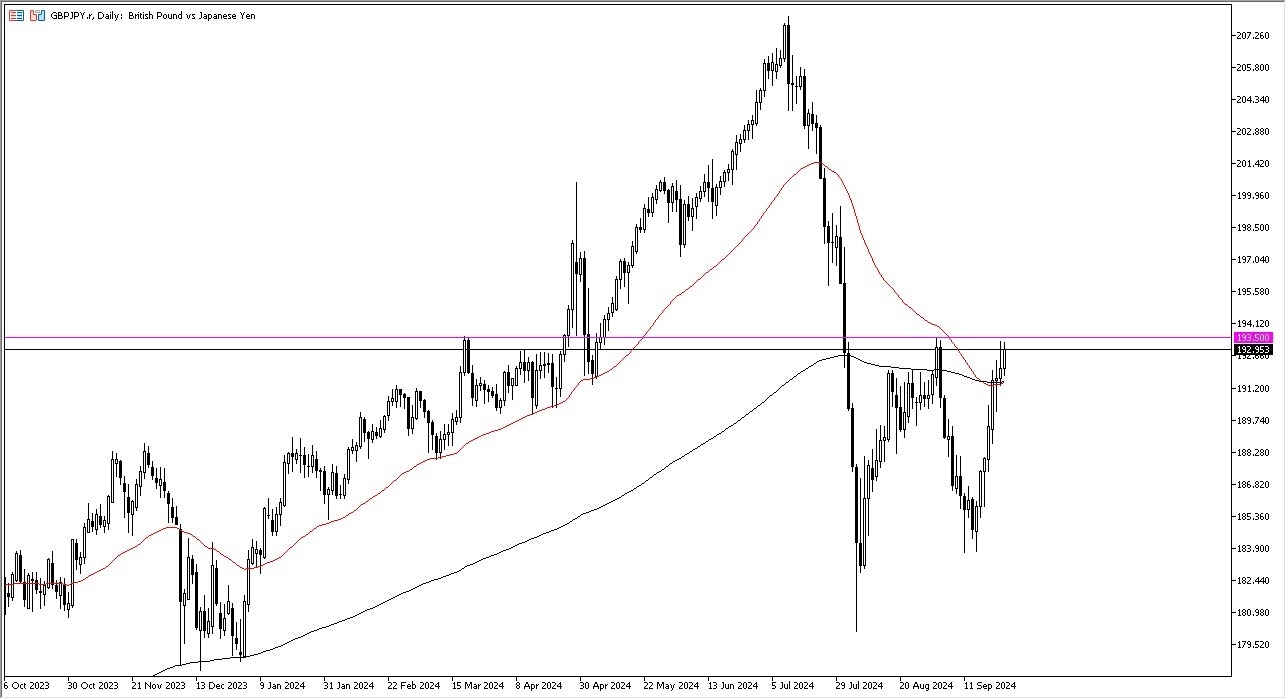
The first thing I see is that the British pound is doing everything it can to break out against the Japanese yen.
The 193.50 yen level is an area that I think a lot of people look at as a major barrier.
If we could break above that level and continue to go much higher, then I think you’ve got a situation where the yen just gets eviscerated against pretty much almost everything.
The 193.50 yen level is an area that’s been important multiple times in the past, and the fact that we find ourselves in that general vicinity at the moment does suggest that we are likely to continue to see more of a buy on the at least in the short term.
On a Breakout…
If the market truly takes off above that level, then I could see the British pound traveling all the way to the 198.50 yen level and possibly even higher than that. Keep in mind that the interest rate situation in Japan is very low and it more likely than not will stay there. Their last interest rate decision was to do nothing. And it’s very possible that you have a situation where traders continue to look at the massive amount of debt in Japan, keeping the Bank of Japan from raising rates.
So, all things being equal, the W pattern here, I think suggests that we are in the midst of a bottoming pattern as well. The measured move, if you will, is for about 5.5% on a breakout, and that could actually put us as high as 204 yen, but I think that’s a longer term grinding kind of just bouncing around and buying the dip on short term charts type of trend. I don’t have any interest in shorting this pair, at least not at the moment. If nothing else, I will be hanging on to this position in order to collect swap for the longer-term run.
The dollar recovered as investors sought safety amid rising Middle East tensions.
Market participants are pricing a 59% chance of another 50-bps rate cut in November.
Sterling has gained about 5.4% against the dollar this year.
The GBP/USD forecast shows a sudden shift in sentiment to bearish as the dollar recovers from a 14-month low. At the same time, the pound was weak as recent economic data pointed to a dimmer outlook.
–Are you interested in learning more about buying NFT tokens? Check our detailed guide-
The dollar recovered against most currencies on Wednesday and Thursday as investors sought safety amid rising Middle East tensions. The conflict between Hezbollah and Israel in Lebanon has escalated, with the two groups exchanging missiles. The US and other partners announced they were working tirelessly to avoid a full-blown war between the two.
Despite the dollar’s rebound, fundamentals point to more downside. The Fed recently cut interest rates by a massive 50-bps, starting a long-awaited easing cycle. The rate cut sent the greenback to fresh lows before it recovered. However, the US central bank flagged more rate cuts to come. As a result, market participants are pricing a 59% chance of another 50-bps rate cut in November.
Nevertheless, incoming data will continue to shape this outlook. The next major report is the core PCE index, which will show the state of inflation. Market participants will also watch GDP data later today.
On the other hand, the pound fell after data in the previous session revealed a significant drop in UK consumer sentiment. The figure fell from -8 to -21 in September. Moreover, it came after soft business activity data showed a slowdown in the economy. Still, sterling has gained about 5.4% against the dollar this year as the Bank of England delays rate cuts.
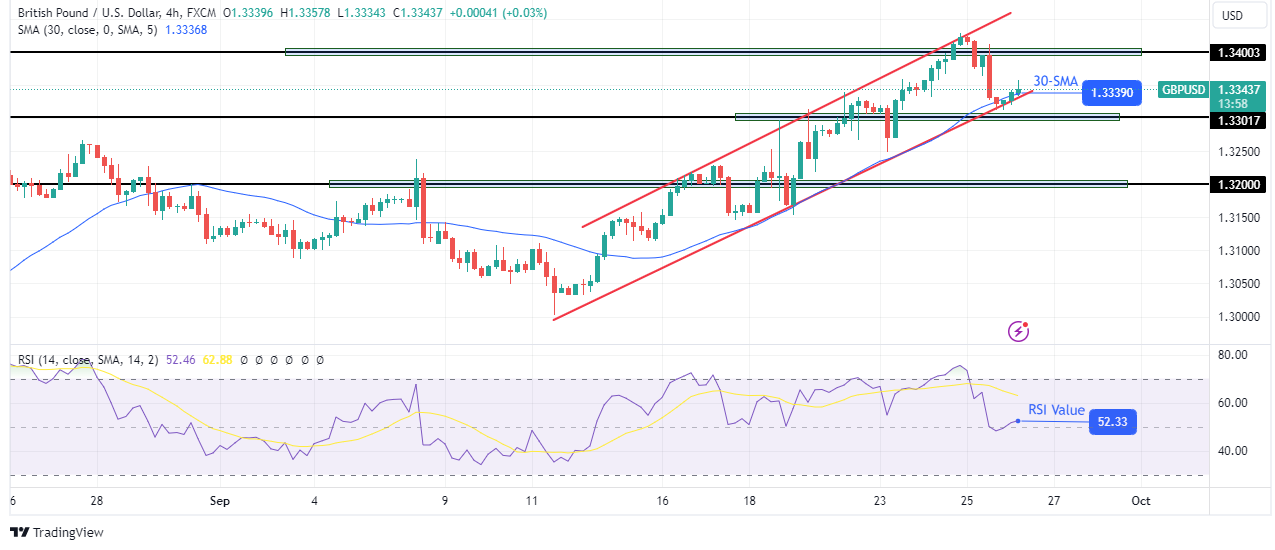
On the technical side, the GBP/USD price is trading in a tight, bullish channel with clear support and resistance lines. The price recently fell to the channel support after failing to sustain a move above the 1.3400 key level.
-Are you looking for the best CFD broker? Check our detailed guide-
The decline has paused at the support line, which coincides with the 30-SMA. Therefore, it might bounce higher to make a new high above 1.3400. However, if bears are strong enough to break below the support zone, the price might revisit the 1.3200 support level.
Looking to trade forex now? Invest at eToro!
67% of retail investor accounts lose money when trading CFDs with this provider. You should consider whether you can afford to take the high risk of losing your money.
However, a break below $1.33132 could see the pair retesting support at $1.32869, with additional downside targets at $1.32621 and $1.32349.
The 50-day EMA at $1.33547 acts as resistance, while the 200-day EMA at $1.32849 offers a strong support cushion.
For now, the outlook remains bullish above the pivot point, but a break lower could quickly shift sentiment.
Euro Steady as Lagarde Speaks; US Data in Focus
The euro (EUR) held steady after the German GfK Consumer Climate improved to -21.2, slightly better than the expected -22.4, signalling some stabilization in consumer sentiment.
The ECB Economic Bulletin highlighted ongoing economic challenges, while M3 Money Supply growth at 2.5% and Private Loans at 0.6% showed modest improvements.
Markets are now closely watching ECB President Lagarde’s speech for further insights into future monetary policy.
EUR/USD Technical Forecast
The EUR/USD is trading at $1.11392, up 0.07% during today’s session, but it’s facing key resistance near $1.11573. The pair has been struggling to gain traction, with the pivot point set at $1.11439.
A break above this level could signal further upward momentum, targeting immediate resistance levels at $1.11685 and $1.11792.