Commerzbank’s economists have revised their Fed forecast downwards very significantly – by more than they are lowering their US inflation forecast. Also, they’re slightly lowering ECB interest rate expectations and significantly lowering their inflation forecast, Commerzbank’s Head of FX and commodity research Ulrich Leuchtmann notes.
USD weakness in the medium term
“We have changed our EUR/USD forecast. As regular readers know, we believe that a good part of the USD strength seen so far was based on the impression of a structural US growth advantage and a particularly active US monetary policy. Since we now have to assume that this impression will be eroded by actual developments in the coming quarters, we now have to assume USD weakness in the medium term.”
“And because at the same time the EUR-negative argument of high eurozone inflation rates and a fairly relaxed ECB monetary policy is at least significantly weakened in view of our more moderate eurozone inflation forecast, some of the EUR-negative arguments also fall away. Both together mean that we now have to assume that EUR/USD will rise significantly. We consider levels around 1.14 to be possible by mid-2025.”
“In the second half of 2025, the picture could change again. If – as we expect – the US economy picks up again, the impression may arise that the Fed at least no longer has any scope for interest rate cuts, and perhaps even fantasies of interest rate hikes will make themselves felt again. And perhaps it will then be time again for the market to take a more skeptical view of the ECB’s monetary policy.”
The Pound Sterling hit a two-week high against the US Dollar, extending its recovery from five-week lows.
GBP/USD buyers to retain control as eyes turn to Fed Minutes, PMI data and Jackson Hole Symposium.
The path of least resistance appears to the upside for the Pound Sterling amid bullish technicals.
The Pound Sterling (GBP) sustained the rebound and hit a two-week high against US Dollar (USD), driving the GBP/USD pair to the 1.2900 mark amid a data-dominated week.
Pound Sterling cheered Fed-BoE policy divergence
GBP/USD rebounded strongly this week, helped by the return of risk flows and divergent monetary policy outlooks between the US Federal Reserve (Fed) and the Bank of England (BoE).
The high-impact economic data releases from both the US and the UK underscored the central bank’s imbalances regarding their potential policy action. Earlier in the week, strong UK employment data and hot Consumer Price Index (CPI) data prompted investors to dial down their expectations of the BoE lowering interest rate in September.
The annual UK inflation increased to 2.2%, rising back above the BoE’s 2.0% target, the Office for National Statistics (ONS) said, slightly less than the median forecast of 2.3%. Meanwhile, UK employment data was a positive surprise, with the Unemployment Rate falling from 4.4% to 4.2% in the quarter to June, beating market expectations of an increase to 4.5%. These figures were boosted by an increase in part-time jobs.
Data published by the ONS showed Friday that the UK Retail Sales rebounded 0.5% over the month in July after dropping 1.2% in June, aligning with the market forecast of a 0.5% increase in the reported month. The Core Retail Sales, stripping the auto motor fuel sales, jumped 0.7% MoM, against the previous decline of 1.3%, a tad softer than expectations.
On the other hand, strong US Retail Sales and Jobless Claims data combined with a benign inflation report suggested that a September rate cut from the Fed is very well on the table. Retail Sales in the US climbed 1% on the month, according to numbers adjusted for seasonality but not for inflation, beating the expectations of a 0.3% increase by a wide margin. Meanwhile, Initial Jobless claims for the week ended Aug. 10 came in at 227,000, a drop of 7,000 from the previous week and lower than the estimate for 235,000.
The annual US CPI inflation slowed for a fourth consecutive month to 2.9% in July 2024, the lowest since March 2021, compared to 3.0% in June and below forecasts of 3.0, the monthly CPI rebounded 0.2% last month after falling 0.1% in June, the Labor Department’s Bureau of Labor Statistics (BLS) said on Wednesday.
Markets are now pricing in just a 25% chance of a 50 basis points (bps) cut from the Fed next month, down from 55% a week ago, according to the CME Group’s FedWatch tool. However, the odds of a 25 bps September rate reduction still hold above 70%.
Other than policy divergence, risk sentiment remained in a sweeter spot almost throughout the week, following the previous week’s volatility that roiled it. No fresh signs of Middle East geopolitical escalation between Iran and Israel calmed nerves while encouraging US macro news alleviated recession fears.
Although Iran continued to issue warnings against an imminent attack on Israel, no such action was undertaken. Amongst the latest developments, the Israeli Defense Ministry reportedly imposed sanctions on 18 oil tankers transporting Iranian oil to cut down Iran’s vital fuel sale revenues. Iran’s Supreme Leader Ayatollah Ali Khamenei issued a warning on Thursday against any form of retreat or compromise, invoking the concept of “divine wrath”.
Fed Minutes to stand out in the Jackson Hole Symposium week
With the inflation reports from both sides of the Atlantic now out of the way, Pound Sterling traders eagerly await the Minutes of the Fed’s July policy meeting for fresh cues on the interest-rate outlook.
The Fed Minutes will be reported on Wednesday. The first two days of the week are devoid of any significant economic news from the UK and the US. However, Atlanta Fed President Raphael Bostic’s speech on Tuesday could offer some trading impetus.
Thursday will feature the UK and the US S&P Global preliminary Manufacturing and Services PMI data while the usual US weekly Jobless Claims and Existing Home Sales data will be also eyed.
The three-day annual Kansas City Fed’s Jackson Hole Symposium will be held on Thursday, with key central banks’ officials likely to speak.
Fed Chair Jerome Powell is due to speak at the Symposium on Friday at 14:00 GMT, followed by BoE Governor Andrew Bailey’s speech at 19:00 GMT. Ahead of that the US New Home Sales will be published.
Sentiment around the central banks’ policy expectations will remain a key driving force in the week ahead, with traders also focused on the Middle East geopolitical escalation between Iran and Israel.
GBP/USD: Technical Outlook
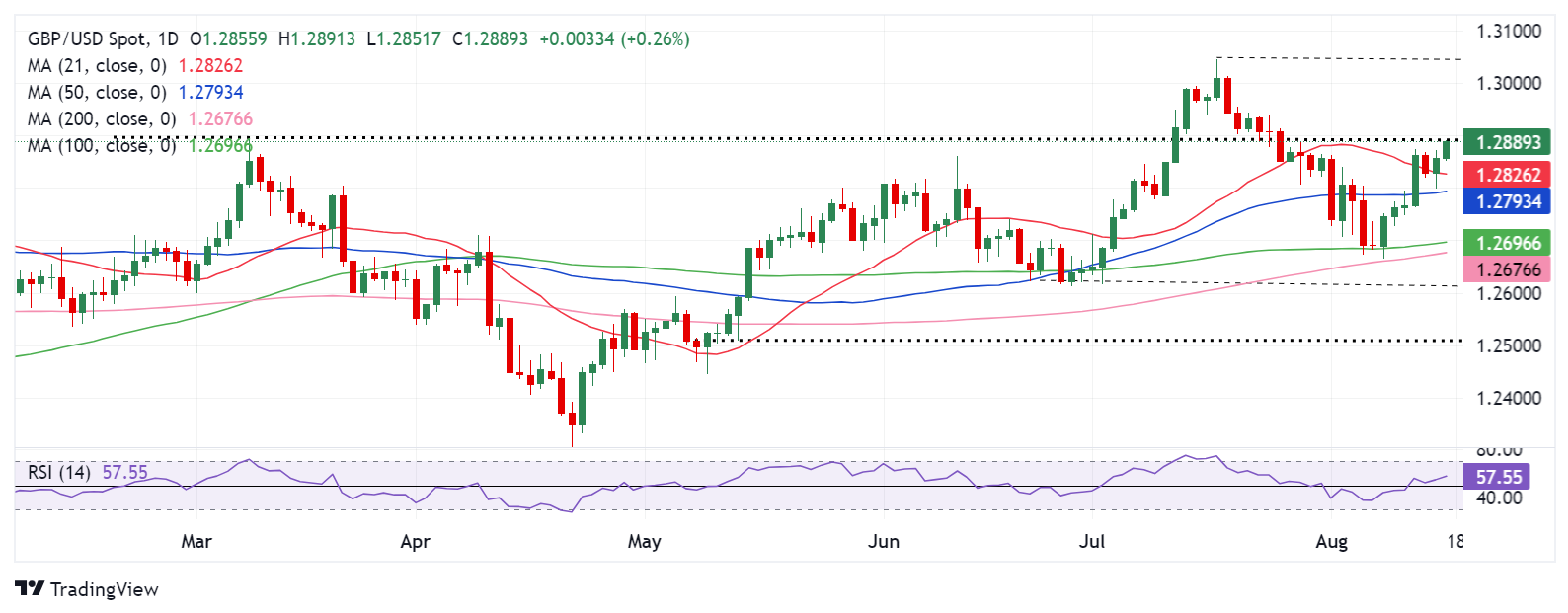
Having defended the crucial 200-day Simple Moving Average (SMA), now at 1.2676, GBP/USD built a solid recovery from five-week lows of 1.2665.
In doing so, Pound Sterling buyers recorded a fresh two-week high just shy of the March 8 high of 1.2893 after recapturing the key 21-day SMA resistance at 1.2825 on a sustained basis.
With the 14-day Relative Strength Index (RSI) pointing north above the 50 level, currently near 56.50, the bullish potential remains intact for the British Pound.
If buyers manage to yield a weekly closing above the March 8 high of 1.2893 or the 1.2900 round figure, a fresh uptrend toward the 1.3000 psychological level cannot be ruled.
Next, the July high of 1.3045 will come into the picture, as buyers would aim for further upside to the 1.3100 level.
On the downside, the 21-day SMA resistance-turned-support at 1.2825 could come to the immediate rescue of buyers, below which the 50-day SMA at 1.2793 will be challenged.
On a sustained break of the 50-day SMA cap, additional declines could be seen toward the 1.2680 demand area, where the 100-day SMA and the 200-day SMA close in.
Thereafter, the June low of 1.2613 and the mid-May low at around 1.2510 will be the next bearish targets.
Central banks FAQs
Central Banks have a key mandate which is making sure that there is price stability in a country or region. Economies are constantly facing inflation or deflation when prices for certain goods and services are fluctuating. Constant rising prices for the same goods means inflation, constant lowered prices for the same goods means deflation. It is the task of the central bank to keep the demand in line by tweaking its policy rate. For the biggest central banks like the US Federal Reserve (Fed), the European Central Bank (ECB) or the Bank of England (BoE), the mandate is to keep inflation close to 2%.
A central bank has one important tool at its disposal to get inflation higher or lower, and that is by tweaking its benchmark policy rate, commonly known as interest rate. On pre-communicated moments, the central bank will issue a statement with its policy rate and provide additional reasoning on why it is either remaining or changing (cutting or hiking) it. Local banks will adjust their savings and lending rates accordingly, which in turn will make it either harder or easier for people to earn on their savings or for companies to take out loans and make investments in their businesses. When the central bank hikes interest rates substantially, this is called monetary tightening. When it is cutting its benchmark rate, it is called monetary easing.
A central bank is often politically independent. Members of the central bank policy board are passing through a series of panels and hearings before being appointed to a policy board seat. Each member in that board often has a certain conviction on how the central bank should control inflation and the subsequent monetary policy. Members that want a very loose monetary policy, with low rates and cheap lending, to boost the economy substantially while being content to see inflation slightly above 2%, are called ‘doves’. Members that rather want to see higher rates to reward savings and want to keep a lit on inflation at all time are called ‘hawks’ and will not rest until inflation is at or just below 2%.
Normally, there is a chairman or president who leads each meeting, needs to create a consensus between the hawks or doves and has his or her final say when it would come down to a vote split to avoid a 50-50 tie on whether the current policy should be adjusted. The chairman will deliver speeches which often can be followed live, where the current monetary stance and outlook is being communicated. A central bank will try to push forward its monetary policy without triggering violent swings in rates, equities, or its currency. All members of the central bank will channel their stance toward the markets in advance of a policy meeting event. A few days before a policy meeting takes place until the new policy has been communicated, members are forbidden to talk publicly. This is called the blackout period.
The likelihood of a 50 bps Fed rate cut in September dropped to 25%.
US jobless claims fell last week to 227,000.
The USD/JPY outlook paints a bullish picture as the dollar trades near a two-week high against the yen after positive US sales data. Meanwhile, the rate-sensitive yen was weak as US Treasury yields rose amid a decline in Fed rate cut expectations. At the same time, the outlook for Bank of Japan rate hikes remained clouded due to political uncertainty.
–Are you interested in learning more about STP brokers? Check our detailed guide-
The US dollar made a solid bullish move on Thursday after US retail sales rose 1.0% in July. This increase was much bigger than the forecast of a 0.3% gain. Moreover, it showed that the US consumer was resilient. As a result, the likelihood of a 50 bps Fed rate cut in September dropped to 25%. Meanwhile, US Treasury yields rose, weighing on the yen.
Another report revealed that US jobless claims fell last week to 227,000, below forecasts for 235,000. The report reduced fears that the labor market was deteriorating. Low unemployment points to high demand and a tight market.
The upbeat US economic reports followed inflation data showing a moderate increase. As a result, the market is optimistic that the Fed might achieve a soft landing.
On the other hand, the yen was fragile on Friday amid political uncertainty in Japan. Prime Minister Fumio Kishida recently decided to step down, leaving a big gap. He greatly supported the Bank of Japan’s recent hiking cycle. Consequently, analysts believe the BoJ might pause until there is more political certainty before hiking interest rates.
USD/JPY key events today
There will be no key economic reports from the US or Japan, so investors will continue absorbing yesterday’s reports.
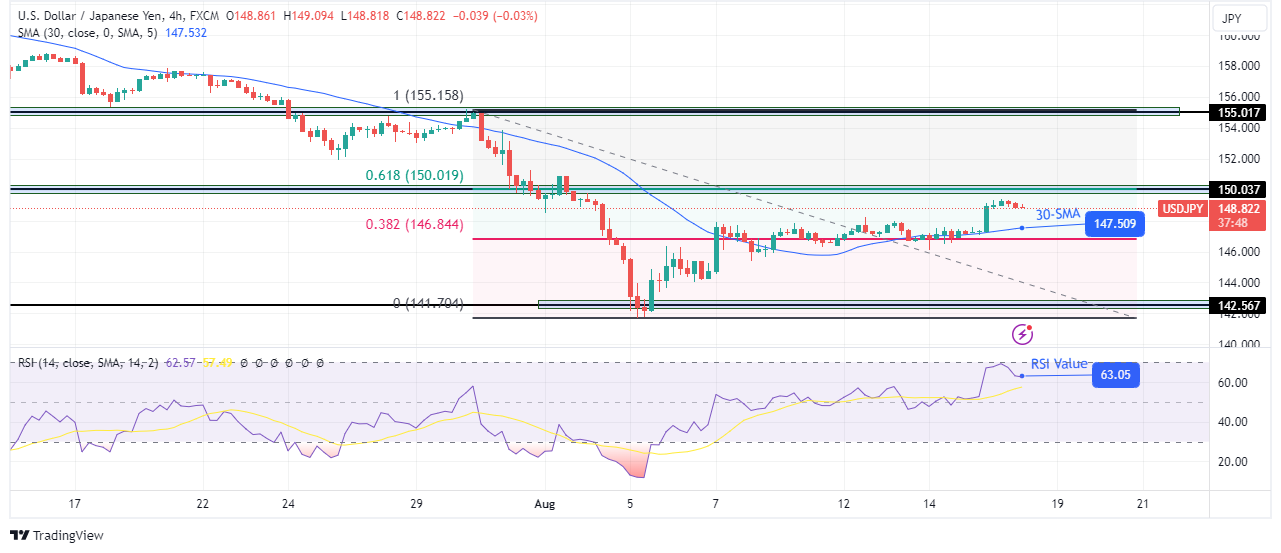
On the technical side, the USD/JPY price has made a sharp, bullish move, detaching from the 30-SMA and the 0.382 Fib level. At the same time, the RSI moved nearer the overbought territory, indicating solid bullish momentum.
–Are you interested in learning more about making money with forex? Check our detailed guide-
The price is approaching a solid barrier comprising the 150.03 resistance and the 0.618 Fib level. Since the bullish bias is strong, the price might soon breach this barrier to make new highs. Such a move would clear the path for bulls to revisit the 155.01 resistance.
Looking to trade forex now? Invest at eToro!
67% of retail investor accounts lose money when trading CFDs with this provider. You should consider whether you can afford to take the high risk of losing your money.
EUR/USD edges higher toward 1.1000 after posting losses on Thursday.
The pair could push higher in case risk flows dominate markets ahead of the weekend.
The US economic docket will feature consumer sentiment and housing data.
EUR/USD regains its traction and rises toward 1.1000 in the European session on Friday after snapping a three-day winning streak on Thursday.
Euro PRICE This week
The table below shows the percentage change of Euro (EUR) against listed major currencies this week. Euro was the strongest against the Japanese Yen.
USD
EUR
GBP
JPY
CAD
AUD
NZD
CHF
USD
-0.64%
-0.97%
1.41%
-0.09%
-0.81%
-0.25%
0.40%
EUR
0.64%
-0.30%
2.06%
0.55%
-0.29%
0.39%
1.06%
GBP
0.97%
0.30%
2.63%
0.86%
0.01%
0.69%
1.35%
JPY
-1.41%
-2.06%
-2.63%
-1.47%
-2.26%
-1.64%
-1.04%
CAD
0.09%
-0.55%
-0.86%
1.47%
-0.77%
-0.16%
0.50%
AUD
0.81%
0.29%
-0.01%
2.26%
0.77%
0.68%
1.34%
NZD
0.25%
-0.39%
-0.69%
1.64%
0.16%
-0.68%
0.65%
CHF
-0.40%
-1.06%
-1.35%
1.04%
-0.50%
-1.34%
-0.65%
The heat map shows percentage changes of major currencies against each other. The base currency is picked from the left column, while the quote currency is picked from the top row. For example, if you pick the Euro from the left column and move along the horizontal line to the US Dollar, the percentage change displayed in the box will represent EUR (base)/USD (quote).
The upbeat macroeconomic data releases from the US provided a boost to the US Dollar (USD) and caused EUR/USD to turn south. The US Department of Labor reported that the weekly Initial Jobless Claims declined by 7,000 to 227,000 in the week ending August 9. Other data from the US showed that Retail Sales rose 1% on a monthly basis in July, beating the market expectation for an increase of 0.3%.
Early Friday, the improving risk mood makes it difficult for the USD to build on Thursday’s gains and helps EUR/USD stretch higher.
The US economic docket will feature Housing Starts and Building Permits data for July. Additionally, the University of Michigan will release the preliminary Consumer Sentiment Index data for August. The market reaction to these data is likely to remain short-lived.
Meanwhile, US stock index futures are up between 0.2% and 0.3% in the European session. In case Wall Street’s main indexes open in positive territory and continue to push higher ahead of the weekend, the USD could stay on the back foot and open the door for another leg higher in the pair.
EUR/USD Technical Analysis
The Relative Strength Index (RSI) indicator on the 4-hour chart started to rise toward 60 after falling to 50 on Thursday, reflecting sellers’ hesitancy. On the upside, 1.1000 (psychological level, static level) aligns as immediate resistance ahead of 1.1050-1.1060 (static level) and 1.1100 (psychological level, static level).
Supports could be seen at 1.0960 (static level), 1.0940 (static level) and 1.0900 (psychological level, static level).
Euro FAQs
The Euro is the currency for the 20 European Union countries that belong to the Eurozone. It is the second most heavily traded currency in the world behind the US Dollar. In 2022, it accounted for 31% of all foreign exchange transactions, with an average daily turnover of over $2.2 trillion a day. EUR/USD is the most heavily traded currency pair in the world, accounting for an estimated 30% off all transactions, followed by EUR/JPY (4%), EUR/GBP (3%) and EUR/AUD (2%).
The European Central Bank (ECB) in Frankfurt, Germany, is the reserve bank for the Eurozone. The ECB sets interest rates and manages monetary policy. The ECB’s primary mandate is to maintain price stability, which means either controlling inflation or stimulating growth. Its primary tool is the raising or lowering of interest rates. Relatively high interest rates – or the expectation of higher rates – will usually benefit the Euro and vice versa. The ECB Governing Council makes monetary policy decisions at meetings held eight times a year. Decisions are made by heads of the Eurozone national banks and six permanent members, including the President of the ECB, Christine Lagarde.
Eurozone inflation data, measured by the Harmonized Index of Consumer Prices (HICP), is an important econometric for the Euro. If inflation rises more than expected, especially if above the ECB’s 2% target, it obliges the ECB to raise interest rates to bring it back under control. Relatively high interest rates compared to its counterparts will usually benefit the Euro, as it makes the region more attractive as a place for global investors to park their money.
Data releases gauge the health of the economy and can impact on the Euro. Indicators such as GDP, Manufacturing and Services PMIs, employment, and consumer sentiment surveys can all influence the direction of the single currency. A strong economy is good for the Euro. Not only does it attract more foreign investment but it may encourage the ECB to put up interest rates, which will directly strengthen the Euro. Otherwise, if economic data is weak, the Euro is likely to fall. Economic data for the four largest economies in the euro area (Germany, France, Italy and Spain) are especially significant, as they account for 75% of the Eurozone’s economy.
Another significant data release for the Euro is the Trade Balance. This indicator measures the difference between what a country earns from its exports and what it spends on imports over a given period. If a country produces highly sought after exports then its currency will gain in value purely from the extra demand created from foreign buyers seeking to purchase these goods. Therefore, a positive net Trade Balance strengthens a currency and vice versa for a negative balance.
GBP/USD trades at its highest level in three weeks on Friday.
Technical buyers could remain interested in case the pair clears 1.2900.
The risk perception could drive the US Dollar’s valuation in the absence of high-impact data releases.
GBP/USD preserves its bullish momentum and trades at its highest level in three weeks slightly below 1.2900 in the European session on Friday. In the absence of high-impact data releases, the risk perception could impact the pair’s action in the second half of the day.
British Pound PRICE This week
The table below shows the percentage change of British Pound (GBP) against listed major currencies this week. British Pound was the strongest against the Japanese Yen.
USD
EUR
GBP
JPY
CAD
AUD
NZD
CHF
USD
-0.63%
-1.04%
1.40%
-0.14%
-0.95%
-0.36%
0.47%
EUR
0.63%
-0.38%
2.03%
0.49%
-0.43%
0.27%
1.14%
GBP
1.04%
0.38%
2.68%
0.88%
-0.05%
0.65%
1.52%
JPY
-1.40%
-2.03%
-2.68%
-1.50%
-2.38%
-1.74%
-0.94%
CAD
0.14%
-0.49%
-0.88%
1.50%
-0.86%
-0.22%
0.62%
AUD
0.95%
0.43%
0.05%
2.38%
0.86%
0.70%
1.55%
NZD
0.36%
-0.27%
-0.65%
1.74%
0.22%
-0.70%
0.86%
CHF
-0.47%
-1.14%
-1.52%
0.94%
-0.62%
-1.55%
-0.86%
The heat map shows percentage changes of major currencies against each other. The base currency is picked from the left column, while the quote currency is picked from the top row. For example, if you pick the British Pound from the left column and move along the horizontal line to the US Dollar, the percentage change displayed in the box will represent GBP (base)/USD (quote).
On Thursday, the data from the US showed that the weekly Initial Jobless Claims declined by 7,000 to 227,000. Additionally, Retail Sales rose by 1% in July, surpassing the market expectation for an increase of 0.3%. Upbeat data releases provided a boost to the USD and caused GBP/USD to edge lower toward 1.2800.
As risk flows started to dominate the financial markets following the Wall Street’s opening bell on Thursday, however, GBP/USD regained its traction and closed the day in positive territory.
July Housing Starts and Building Permits data will be featured in the US economic calendar alongside the University of Michigan’s preliminary Consumer Sentiment Index for August. Investors are likely to ignore these figures and stay focused on the risk perception.
At the time of press, US stock index futures were up between 0.15% and 0.3%. A bullish opening in Wall Street could hurt the USD and allow GBP/USD to stretch higher. It’s also worth mentioning that profit-taking and week-end flows could cause inter-market correlations to weaken heading into the weekend.
GBP/USD Technical Analysis
1.2900 (Fibonacci 61.8% retracement of the latest downtrend) aligns as immediate resistance before 1.2950 (Fibonacci 78.6% retracement) and 1.3000 (psychological level, static level).
On the downside, first support is located at 1.2850-1.2840 (Fibonacci 50% retracement, 200-period Simple Moving Average (SMA)) ahead of 1.2800 (100-period SMA, Fibonacci 38.2% retracement) and 1.2760 (Fibonacci 23.6% retracement).
Pound Sterling FAQs
The Pound Sterling (GBP) is the oldest currency in the world (886 AD) and the official currency of the United Kingdom. It is the fourth most traded unit for foreign exchange (FX) in the world, accounting for 12% of all transactions, averaging $630 billion a day, according to 2022 data. Its key trading pairs are GBP/USD, aka ‘Cable’, which accounts for 11% of FX, GBP/JPY, or the ‘Dragon’ as it is known by traders (3%), and EUR/GBP (2%). The Pound Sterling is issued by the Bank of England (BoE).
The single most important factor influencing the value of the Pound Sterling is monetary policy decided by the Bank of England. The BoE bases its decisions on whether it has achieved its primary goal of “price stability” – a steady inflation rate of around 2%. Its primary tool for achieving this is the adjustment of interest rates. When inflation is too high, the BoE will try to rein it in by raising interest rates, making it more expensive for people and businesses to access credit. This is generally positive for GBP, as higher interest rates make the UK a more attractive place for global investors to park their money. When inflation falls too low it is a sign economic growth is slowing. In this scenario, the BoE will consider lowering interest rates to cheapen credit so businesses will borrow more to invest in growth-generating projects.
Data releases gauge the health of the economy and can impact the value of the Pound Sterling. Indicators such as GDP, Manufacturing and Services PMIs, and employment can all influence the direction of the GBP. A strong economy is good for Sterling. Not only does it attract more foreign investment but it may encourage the BoE to put up interest rates, which will directly strengthen GBP. Otherwise, if economic data is weak, the Pound Sterling is likely to fall.
Another significant data release for the Pound Sterling is the Trade Balance. This indicator measures the difference between what a country earns from its exports and what it spends on imports over a given period. If a country produces highly sought-after exports, its currency will benefit purely from the extra demand created from foreign buyers seeking to purchase these goods. Therefore, a positive net Trade Balance strengthens a currency and vice versa for a negative balance.
USD/JPY edges lower on Friday and erodes a part of the overnight gains to a two-week top.
The divergent Fed-BoJ policy expectations turn out to be a key factor exerting some pressure.
The risk-on mood could undermine the safe-haven JPY and help limit any meaningful decline.
The USD/JPY pair struggles to build on the previous day’s breakout momentum and attracts fresh sellers on Friday, snapping a two-day winning streak to a nearly two-week high. The downtick is sponsored by a modest US Dollar (USD) downtick, though the prevalent risk-on environment could undermine the safe-haven Japanese Yen (JPY) and help limit deeper losses.
Investors turned optimistic after the US macro data published on Thursday showed that Retail Sales rose more than expected in July and a still resilient labor market, which eased fears about a possible recession in the world’s largest economy. In fact, the US Census Bureau reported that the total value of sales at the retail level in the US rose 1% in July and sales ex Autos grew 0.4%, beating estimates for an increase of 0.3% and 0.1%, respectively. Another report published by the US Department of Labor (DOL) revealed that there were 227K Initial Jobless Claims in the week ending August 10, lower than the 235K expected and the 234K previous.
Traders were quick to react and scaled back expectations for more aggressive policy easing by the Federal Reserve (Fed). The markets, however, still see a greater chance that the US central bank will begin its rate-cutting cycle in September. This, in turn, triggers a fresh leg down in the US Treasury bond yields and acts as a headwind for the USD. The JPY, on the other hand, draws support from the stronger second-quarter Gross Domestic Product (GDP) print from Japan on Thursday. This could encourage the Bank of Japan (BoJ) to continue raising interest rates, which, in turn, is seen exerting some pressure on the USD/JPY pair.
Nevertheless, the lack of any meaningful selling warrants some caution for bearish traders and before confirming that the recent sharp recovery from the 141.70-141.65 region, or the YTD low touched in July has run its course. Traders now look to the second-tier US macro data – Building Starts and Housing Permits, along with the Preliminary Michigan Consumer Sentiment Index – short-term opportunities later during the early North American session. The market focus, however, will remain glued to the FOMC meeting minutes, due for release next Tuesday, and Fed Chair Jerome Powell’s appearance at the Jackson Hole Symposium.
Technical Outlook
From a technical perspective, the overnight strong move up falters a resistance marked by the 38.2% Fibonacci retracement level of the July-August slump. The said barrier is pegged near the 149.35-149.40 region, which should now act as a key pivotal point for traders. A sustained strength beyond might trigger a short-covering rally and allow the USD/JPY pair to reclaim the 150.00 psychological mark. The momentum could extend further towards an intermediate resistance near the 150.75-150.80 region en route to the 151.00 round figure and the 151.50-151.70 confluence – comprising the 200-day Simple Moving Average (SMA) and the 50% Fibo. level.
On the flip side, weakness below the Asian session low, around the 148.75-148.70 region, could find some support near the 148.20 area. This is closely followed by the 148.00 mark, below which the USD/JPY pair could accelerate the fall towards the 147.30-147.25 intermediate support en route to the 147.00 round figure and the 23.6% Fibo. level, around the 146.50-146.45 region. Failure to defend the said support levels might shift the near-term bias back in favor of bearish traders and prompt aggressive technical selling, paving the way for a slide towards the 146.00 mark, the 145.45 area and the 145.00 psychological mark.
Upbeat United States macroeconomic data brought relief to financial markets.
Resurgent risk appetite was not enough to underpin the Euro.
EUR/USD at risk of falling further, but buyers did not give up.
The EUR/USD pair settled in the 1.0970 region on Thursday after losing the 1.1000 mark to upbeat United States (US) macroeconomic figures. The pair held within a tight range throughout the first half of the day but made a decisive bearish movement following the release of July Retail Sales, which unexpectedly increased by 1%, beating the 0.3% advance anticipated by market participants. Initial Jobless Claims for the week ended August 9 were up by 227K, better than the 235K expected.
The news brought relief and sent US indexes sharply up as investors decreased their bets on a potential recession in the country. Later in the day, the US released not-that-encouraging figures: Capacity Utilization hit 77.8% in July, while Industrial Production in the same month was down 0.6%, missing expectations. Nevertheless, stocks maintained positive momentum, while EUR/USD trimmed part of its early losses.
By the end of the day, investors kept believing the Federal Reserve (Fed) would deliver its first rate cut during the September meeting, although it is still unclear whether it would be 25 or 50 basis points (bps).
On Friday, the Eurozone will publish the June Trade Balance, while the US will release the preliminary estimate of the August Michigan Consumer Sentiment Index and the Michigan Consumer Inflation Expectations for the same month.
EUR/USD short-term technical outlook
From a technical point of view, the daily chart for the EUR/USD pair shows it could extend its slide. Technical indicators retreated from near overbought readings, maintaining their downward slopes within positive levels ahead of the Asian opening. At the same time, the pair develops above all its moving averages, with the 20 Simple Moving Average (SMA) heading north at around 1.0890. Finally, the 100 and 200 SMAs offer modest upward slopes far below the shorter one, limiting the odds for a sustained slide, particularly if the 1.0950 support level holds.
The pair is neutral-to-bullish according to technical readings in the 4-hour chart. Technical indicators lack directional strength within positive levels, while EUR/USD battles to recover above a bullish 20 SMA after piercing it earlier in the day. The longer moving averages grind north below the 1.0900 mark, suggesting buyers moved to the sidelines but not yet abandoned the pair.
I recognize that this asset is testing the crucial 200-Day EMA, which of course a lot of people will pay close attention to, as it is one of the most widely followed technical indicators out there.
With this being the case, I think you get a situation where buyers could step back into the market, and we have already seen that during the early hours on Tuesday, they have at least tried to defend that moving averages.
Recent BreakoutThe recent breakout was rather brutal, and now it looks as if we are questioning whether or not there is going to be a continuation of the upward pressure. I think given enough time, the EUR/GBP pair almost certainly will see an attempt to go higher, but right now we’ve got a situation where a lot of people are looking at this through the prism of whether or not we can bounce hard enough to reach toward the 0.86 level again. That’s an area that previously had been resistant, so it’s not a huge surprise to see that the market has caused a bit in that general vicinity for short-term pullback.Top Forex Brokers1 Get Started 74% of retail CFD accounts lose money At this point in time, I look at the 0.85 level underneath as support as well, especially as the 50-Day EMA is starting to race toward that level. It’s also worth noting that the 0.84 level previously had been a massive support level on the monthly chart, so it’s not a huge surprise to see that we had bounce from there. In general, this is a market that I think continues to be very noisy, but that’s not a huge surprise considering that the two economies are so highly interlinked.On a break above the recent highs of the last week, then I think this is a pair that probably goes looking to the 0.8750 level, but it’s also a situation where the market is going to continue to be very noisy and choppy, so with that being said, the market is one that you will have to be very patient with as the moves tend to take quite a bit of time, generally speaking.Ready to trade our daily Forex analysis ? We’ve made a list of the best forex demo accounts worth trading with.MENAFN14082024000131011023ID1108553087
Legal Disclaimer: MENAFN provides the information “as is” without warranty of any kind. We do not accept any responsibility or liability for the accuracy, content, images, videos, licenses, completeness, legality, or reliability of the information contained in this article. If you have any complaints or copyright issues related to this article, kindly contact the provider above.
(MENAFN– Daily Forex) The first thing I see is that we had sold off early in the trading session, but we have turned around to show momentum yet again of this, it looks as if the market is going to continue to favor the upside in general, but I am aware that there are a few places that we need to pay close attention to on the chart first place that I am watching with great interest is the 1.2875 region, because we can break above there, then itu0026rsquo;s likely that more momentum will enter the market Sales and Unemployment ClaimsOn Thursday, we will get vital information coming from the United States that could greatly influence where this market goes. While the default scenario at this point in time is that the Federal Reserve cut rates in September, the Retail Sales figures and of course the Weekly Unemployment Claims number could give us a bit of a u0026ldquo;heads upu0026rdquo; as to whether or not the Federal Reserve will continue to cut rates beyond the September meeting. In other words, this is a situation where traders are more likely than not to continue to pay close attention to the directionality of the US economy. Top Forex Brokers 1 Get Started 74% of retail CFD accounts lose money Read Review BrokerGeoLists({ type: u0027MobileTopBrokersu0027, id: u0027mobile-top-5u0027, size: 5, getStartedText: u0060Get Startedu0060, readReviewText: u0060Read Reviewu0060, Logo: u0027broker_carrousel_iu0027, Button: u0027broker_carrousel_nu0027, });That being said, there does come a point where the US economy falling is actually a bad thing for all risk appetite, and you will more likely than not see money running back into the Treasury market, meaning that the US dollar could strengthen. Having said that, I donu0026rsquo;t think thatu0026rsquo;s the short term bias, and it looks as if we are going to eventually try to break to the upside, perhaps aiming for the crucial 1.30 level above 1.30 level of course is a large, round, psychologically significant figure, but itu0026rsquo;s also worth noting that it has been pierced previously over the last couple of months. Short-term pullbacks at this point in time should continue to see plenty of support near the 50-Day EMA, perhaps even down at the 200-Day EMA which is closer to the 1.2675 region.
Legal Disclaimer: MENAFN provides the information “as is” without warranty of any kind. We do not accept any responsibility or liability for the accuracy, content, images, videos, licenses, completeness, legality, or reliability of the information contained in this article. If you have any complaints or copyright issues related to this article, kindly contact the provider above.
The US dollar rallied rather significantly during the early hours on Thursday as we are threatening the 149 yen level. This is a market that has jumped back over a trend line that had been so important previously and had been a little bit resistant on the way back up. Retail sales in the United States came out much hotter than anticipated. In fact, it came out four times what was anticipated. Unemployment claims are still lower than anticipated, and some of the other economic numbers were a bit better than anticipated also.
So, with all of that being said, it’s interesting how the ball might be back in the court of the Bank of Japan as they have to deal with the idea of whether or not they are going to continue to fight the depreciation of the yen. Remember, even if the Federal Reserve cuts interest rates, we’re looking at a difference between the United States and Japan, that is still something along the lines of 4.75% interest rate differential, maybe 4.5 if the Fed gets aggressive. In other words, you still get paid to hold this pair, and I think that’s going to be a big driver longer term.
If we can clear the 150 yen level, that will almost certainly bring in more buyers and could in fact kick off the overall “carry trade” around the world. The markets are certainly missing the ability to get paid at the end of each session, so I think we are starting to see the markets “dip their toes back into the water.”
For a look at all of today’s economic events, check out our economic calendar.