The main tag of Forex News Today Articles.
You can use the search box below to find what you need.
[wd_asp id=1]

27 07, 2024

USD/JPY Weekly Forecast: Bearish Amid BoJ Rate Hike Odds

By |2024-07-27T12:03:21+03:00July 27, 2024|Forex News, News|0 Comments

  • Investors increased bets on a BoJ rate hike next week.
  • US GDP figures for Q2 came at 2.8%, well above the 2.0% forecast.
  • Investors await the Bank of Japan and Fed policy meetings.

The USD/JPY weekly forecast is bearish, with investors increasingly betting on a Bank of Japan rate hike at next week’s meeting.

Ups and downs of USD/JPY

The USD/JPY pair had a bearish week, where the yen found its feet against the dollar. The rally in the yen came as investors increased bets on a BoJ rate hike at next week’s policy meeting. The rate hike optimism kept the dollar at bay despite better-than-expected economic data. 

Are you interested in learning more about Forex robots? Check our detailed guide-

Notably, US business activity increased in June as the services sector expanded. Meanwhile, GDP figures for Q2 came in at 2.8%, well above the 2.0% forecast. Additionally, unemployment claims in the US fell last week, indicating a still robust labor market. Finally, the core PCE index came in line with expectations, rising by 0.2% m/m.

Next week’s key events for USD/JPY
USD/JPY Weekly Forecast: Bearish Amid BoJ Rate Hike Odds

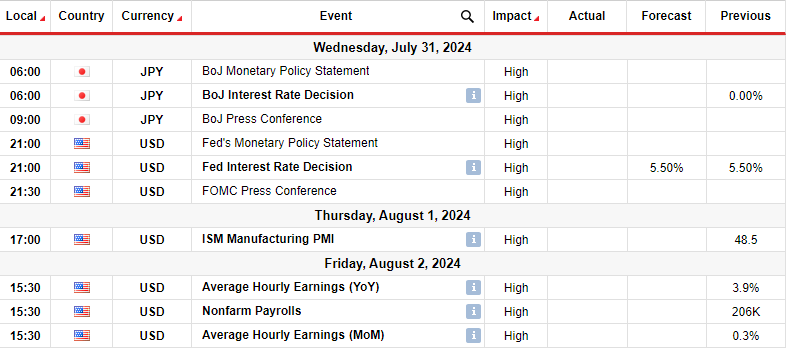
Next week, USD/JPY will experience a lot of volatility with the Bank of Japan and Fed policy meetings. At the same time, the US will release key manufacturing and employment data. Notably, there is a 67.2% chance that the BoJ will hike rates by 10bps next week. If this happens, the yen might strengthen, pushing USD/JPY lower. 

Meanwhile, the Fed will likely keep rates unchanged. However, given the recent decline in inflation, policymakers might take a more dovish stance. 

Elsewhere, the US nonfarm employment report will continue shaping the outlook for Fed rate cuts. Easing in the labor market will give policymakers more confidence to cut in September.

USD/JPY weekly technical forecast: Signaling a strong downtrend
USD/JPY weekly technical forecastUSD/JPY weekly technical forecast
USD/JPY daily chart

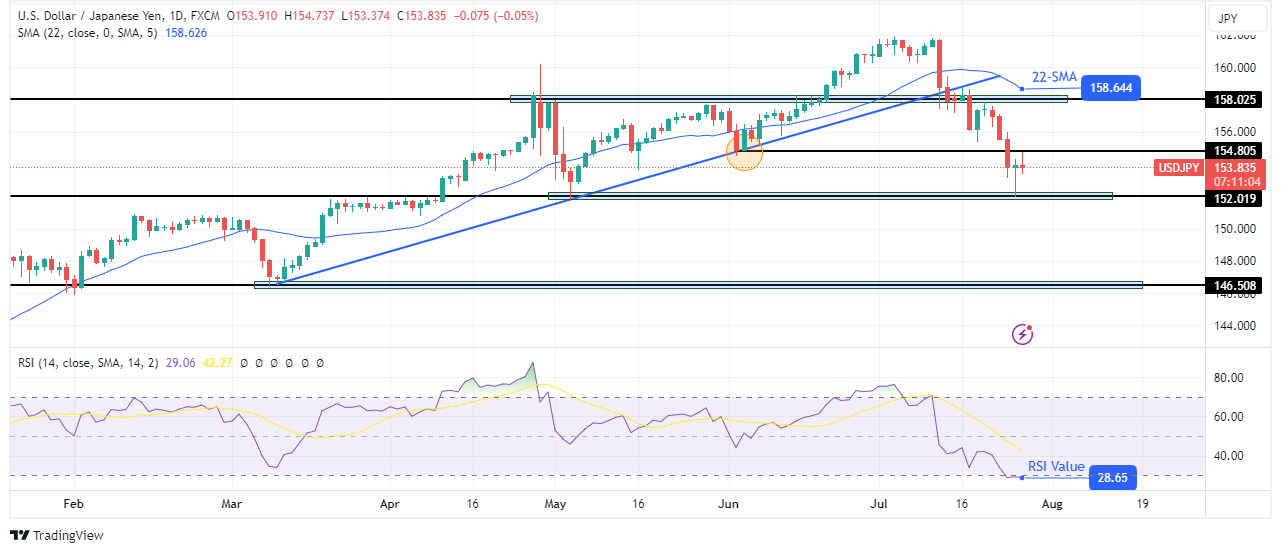
On the technical side, the USD/JPY price has broken below its bullish trendline and is approaching the 152.01 support level. Moreover, the RSI has crossed below 50, indicating a bearish sentiment shift. 

Are you interested in learning more about XRP price prediction? Check our detailed guide-

The price was in an uptrend with higher highs and lows for a long time. However, this changed when the price broke below the previous low to make a lower low. There is a high chance it will also make a lower high next week. A downtrend would allow bears to retest the 152.01 and 146.50 support levels.

Looking to trade forex now? Invest at eToro!

68% of retail investor accounts lose money when trading CFDs with this provider. You should consider whether you can afford to take the high risk of losing your money.

Source link

27 07, 2024

AUD/USD Weekly Price Forecast – Australian Dollar Plunges For The Week

By |2024-07-27T03:58:49+03:00July 27, 2024|Forex News, News|0 Comments

Australian Dollar vs US Dollar Weekly Technical Analysis

The Australian dollar has fallen rather significantly during the course of the week to break down below the 0.6650 level, an area that has been both support and resistance at multiple times. However, when you look at the overall market, it’s easy to see that we’re in basically a two and a half year consolidation range. This is very similar to how the euro is behaving. In this case, we have the 0.6850 level above offering resistance with the 200 week EMA sitting there. Underneath we have the 0.6450 level offering support, followed by the 0.63 level, which I think is a pretty hard floor.

A lot of noise is found in this pair, but quite frankly, if you wait for it to get a little extreme in one direction or the other, over the last couple of years, it has shown its proclivity to jump right back to about where we are now. With that being said, despite the fact that the candlestick is rather negative, I am rather neutral, at least from a longer term standpoint.

If we can drop a bit from here and then see a bit of a bounce, I might be a buyer. But quite frankly, unless you are a longer term rangebound trader, the Aussie dollar probably doesn’t offer a whole lot as we are just showing a lot of choppy behavior time and time again. Because of this, I think you have to look at this market as one that is sideways overall, and therefore you will have to look at short term charts for guidance.

For a look at all of today’s economic events, check out our economic calendar.

This article was originally posted on FX Empire

More From FXEMPIRE:

Source link

27 07, 2024

Euro struggles to attract buyers despite improving risk mood

By |2024-07-27T01:58:15+03:00July 27, 2024|Forex News, News|0 Comments

You have reached your limit of 5 free articles for this month.

Get Premium without limits for only $479.76 for the first month

Access all our articles, insights, and analysts.

Your coupon code


UNLOCK OFFER

  • EUR/USD fluctuates near 1.0850 after closing virtually unchanged on Thursday.
  • The pair manages to hold above key support area for now.
  • US economic docket will feature PCE inflation data for June on Friday.

After recovering to 1.0870 early Thursday, EUR/USD lost its momentum and closed the day virtually unchanged slightly below 1.0850 as the US Dollar (USD) benefited from upbeat data releases. Although the risk mood seems to be improving early Friday, the Euro is having a difficult time attracting buyers.

Euro PRICE This week

The table below shows the percentage change of Euro (EUR) against listed major currencies this week. Euro was the weakest against the Japanese Yen.

  USD EUR GBP JPY CAD AUD NZD CHF
USD   0.28% 0.34% -2.14% 0.67% 1.94% 2.01% -0.53%
EUR -0.28%   0.04% -2.46% 0.37% 1.70% 1.66% -0.87%
GBP -0.34% -0.04%   -2.60% 0.29% 1.65% 1.60% -0.93%
JPY 2.14% 2.46% 2.60%   2.92% 4.25% 4.21% 1.60%
CAD -0.67% -0.37% -0.29% -2.92%   1.35% 1.32% -1.20%
AUD -1.94% -1.70% -1.65% -4.25% -1.35%   -0.03% -2.54%
NZD -2.01% -1.66% -1.60% -4.21% -1.32% 0.03%   -2.46%
CHF 0.53% 0.87% 0.93% -1.60% 1.20% 2.54% 2.46%  

The heat map shows percentage changes of major currencies against each other. The base currency is picked from the left column, while the quote currency is picked from the top row. For example, if you pick the Euro from the left column and move along the horizontal line to the US Dollar, the percentage change displayed in the box will represent EUR (base)/USD (quote).

The US Bureau of Economic Analysis (BEA) reported on Thursday the United States’ Gross Domestic Product (GDP) expanded at an annual rate of 2.8% in the second quarter, according to its first estimate. This print followed the 1.4% growth recorded in the first quarter and surpassed the market forecast of 2% by a wide margin.

The stronger-than-expected GDP reading and the mixed action seen in Wall Street helped the USD stay resilient against its major rivals during the American trading hours, limiting EUR/USD’s upside.

Later in the day, the BEA will release the Personal Consumption Expenditures (PCE) Price Index data for June. The GDP report showed that the core Personal Consumption Expenditures Price Index rose 2.9% on a quarterly basis, below the 3.7% increase registered in the first quarter but above analysts’ estimate of 2.7%. Since the quarterly PCE inflation data takes June’s PCE Price Index into account, the market reaction to the monthly reading is likely to remain muted.

Nevertheless, changes in risk perception ahead of the weekend could drive EUR/USD’s action. In the European session, US stock index futures trade marginally higher on the day. In case risk flows take control of markets following a bullish opening in Wall Street, the USD could struggle to gather strength and allow EUR/USD to hold its ground.

EUR/USD Technical Analysis

EUR/USD failed to reclaim the 100-period Simple Moving Average (SMA) for the second straight day on Thursday and the Relative Strength Index (RSI) indicator on the 4-hour chart edged lower after touching 50, reflecting a lack of buyer interest.

On the downside, the 100-day and the 200-day SMAs form strong support area at 1.0800-1.0790 ahead of 1.0740 (Fibonacci 78.6% retracement of the latest uptrend) and 1.0700 (psychological level, static level). Resistances could be seen at 1.0860 (100-period SMA),1.0880 (Fibonacci 23.6% retracement) and 1.0900 (psychological level, static level).

Euro FAQs

The Euro is the currency for the 20 European Union countries that belong to the Eurozone. It is the second most heavily traded currency in the world behind the US Dollar. In 2022, it accounted for 31% of all foreign exchange transactions, with an average daily turnover of over $2.2 trillion a day. EUR/USD is the most heavily traded currency pair in the world, accounting for an estimated 30% off all transactions, followed by EUR/JPY (4%), EUR/GBP (3%) and EUR/AUD (2%).

The European Central Bank (ECB) in Frankfurt, Germany, is the reserve bank for the Eurozone. The ECB sets interest rates and manages monetary policy. The ECB’s primary mandate is to maintain price stability, which means either controlling inflation or stimulating growth. Its primary tool is the raising or lowering of interest rates. Relatively high interest rates – or the expectation of higher rates – will usually benefit the Euro and vice versa. The ECB Governing Council makes monetary policy decisions at meetings held eight times a year. Decisions are made by heads of the Eurozone national banks and six permanent members, including the President of the ECB, Christine Lagarde.

Eurozone inflation data, measured by the Harmonized Index of Consumer Prices (HICP), is an important econometric for the Euro. If inflation rises more than expected, especially if above the ECB’s 2% target, it obliges the ECB to raise interest rates to bring it back under control. Relatively high interest rates compared to its counterparts will usually benefit the Euro, as it makes the region more attractive as a place for global investors to park their money.

Data releases gauge the health of the economy and can impact on the Euro. Indicators such as GDP, Manufacturing and Services PMIs, employment, and consumer sentiment surveys can all influence the direction of the single currency. A strong economy is good for the Euro. Not only does it attract more foreign investment but it may encourage the ECB to put up interest rates, which will directly strengthen the Euro. Otherwise, if economic data is weak, the Euro is likely to fall. Economic data for the four largest economies in the euro area (Germany, France, Italy and Spain) are especially significant, as they account for 75% of the Eurozone’s economy.

Another significant data release for the Euro is the Trade Balance. This indicator measures the difference between what a country earns from its exports and what it spends on imports over a given period. If a country produces highly sought after exports then its currency will gain in value purely from the extra demand created from foreign buyers seeking to purchase these goods. Therefore, a positive net Trade Balance strengthens a currency and vice versa for a negative balance.


  • EUR/USD fluctuates near 1.0850 after closing virtually unchanged on Thursday.
  • The pair manages to hold above key support area for now.
  • US economic docket will feature PCE inflation data for June on Friday.

After recovering to 1.0870 early Thursday, EUR/USD lost its momentum and closed the day virtually unchanged slightly below 1.0850 as the US Dollar (USD) benefited from upbeat data releases. Although the risk mood seems to be improving early Friday, the Euro is having a difficult time attracting buyers.

Euro PRICE This week

The table below shows the percentage change of Euro (EUR) against listed major currencies this week. Euro was the weakest against the Japanese Yen.

  USD EUR GBP JPY CAD AUD NZD CHF
USD   0.28% 0.34% -2.14% 0.67% 1.94% 2.01% -0.53%
EUR -0.28%   0.04% -2.46% 0.37% 1.70% 1.66% -0.87%
GBP -0.34% -0.04%   -2.60% 0.29% 1.65% 1.60% -0.93%
JPY 2.14% 2.46% 2.60%   2.92% 4.25% 4.21% 1.60%
CAD -0.67% -0.37% -0.29% -2.92%   1.35% 1.32% -1.20%
AUD -1.94% -1.70% -1.65% -4.25% -1.35%   -0.03% -2.54%
NZD -2.01% -1.66% -1.60% -4.21% -1.32% 0.03%   -2.46%
CHF 0.53% 0.87% 0.93% -1.60% 1.20% 2.54% 2.46%  

The heat map shows percentage changes of major currencies against each other. The base currency is picked from the left column, while the quote currency is picked from the top row. For example, if you pick the Euro from the left column and move along the horizontal line to the US Dollar, the percentage change displayed in the box will represent EUR (base)/USD (quote).

The US Bureau of Economic Analysis (BEA) reported on Thursday the United States’ Gross Domestic Product (GDP) expanded at an annual rate of 2.8% in the second quarter, according to its first estimate. This print followed the 1.4% growth recorded in the first quarter and surpassed the market forecast of 2% by a wide margin.

The stronger-than-expected GDP reading and the mixed action seen in Wall Street helped the USD stay resilient against its major rivals during the American trading hours, limiting EUR/USD’s upside.

Later in the day, the BEA will release the Personal Consumption Expenditures (PCE) Price Index data for June. The GDP report showed that the core Personal Consumption Expenditures Price Index rose 2.9% on a quarterly basis, below the 3.7% increase registered in the first quarter but above analysts’ estimate of 2.7%. Since the quarterly PCE inflation data takes June’s PCE Price Index into account, the market reaction to the monthly reading is likely to remain muted.

Nevertheless, changes in risk perception ahead of the weekend could drive EUR/USD’s action. In the European session, US stock index futures trade marginally higher on the day. In case risk flows take control of markets following a bullish opening in Wall Street, the USD could struggle to gather strength and allow EUR/USD to hold its ground.

EUR/USD Technical Analysis

EUR/USD failed to reclaim the 100-period Simple Moving Average (SMA) for the second straight day on Thursday and the Relative Strength Index (RSI) indicator on the 4-hour chart edged lower after touching 50, reflecting a lack of buyer interest.

On the downside, the 100-day and the 200-day SMAs form strong support area at 1.0800-1.0790 ahead of 1.0740 (Fibonacci 78.6% retracement of the latest uptrend) and 1.0700 (psychological level, static level). Resistances could be seen at 1.0860 (100-period SMA),1.0880 (Fibonacci 23.6% retracement) and 1.0900 (psychological level, static level).

Euro FAQs

The Euro is the currency for the 20 European Union countries that belong to the Eurozone. It is the second most heavily traded currency in the world behind the US Dollar. In 2022, it accounted for 31% of all foreign exchange transactions, with an average daily turnover of over $2.2 trillion a day. EUR/USD is the most heavily traded currency pair in the world, accounting for an estimated 30% off all transactions, followed by EUR/JPY (4%), EUR/GBP (3%) and EUR/AUD (2%).

The European Central Bank (ECB) in Frankfurt, Germany, is the reserve bank for the Eurozone. The ECB sets interest rates and manages monetary policy. The ECB’s primary mandate is to maintain price stability, which means either controlling inflation or stimulating growth. Its primary tool is the raising or lowering of interest rates. Relatively high interest rates – or the expectation of higher rates – will usually benefit the Euro and vice versa. The ECB Governing Council makes monetary policy decisions at meetings held eight times a year. Decisions are made by heads of the Eurozone national banks and six permanent members, including the President of the ECB, Christine Lagarde.

Eurozone inflation data, measured by the Harmonized Index of Consumer Prices (HICP), is an important econometric for the Euro. If inflation rises more than expected, especially if above the ECB’s 2% target, it obliges the ECB to raise interest rates to bring it back under control. Relatively high interest rates compared to its counterparts will usually benefit the Euro, as it makes the region more attractive as a place for global investors to park their money.

Data releases gauge the health of the economy and can impact on the Euro. Indicators such as GDP, Manufacturing and Services PMIs, employment, and consumer sentiment surveys can all influence the direction of the single currency. A strong economy is good for the Euro. Not only does it attract more foreign investment but it may encourage the ECB to put up interest rates, which will directly strengthen the Euro. Otherwise, if economic data is weak, the Euro is likely to fall. Economic data for the four largest economies in the euro area (Germany, France, Italy and Spain) are especially significant, as they account for 75% of the Eurozone’s economy.

Another significant data release for the Euro is the Trade Balance. This indicator measures the difference between what a country earns from its exports and what it spends on imports over a given period. If a country produces highly sought after exports then its currency will gain in value purely from the extra demand created from foreign buyers seeking to purchase these goods. Therefore, a positive net Trade Balance strengthens a currency and vice versa for a negative balance.


Source link

26 07, 2024

USD/JPY Forecast Today 25/7: Plunges Lower (Video+Chart)

By |2024-07-26T23:56:48+03:00July 26, 2024|Forex News, News|0 Comments

  • In my daily analysis of the dollar against the yen, the first thing that comes to mind is that we not only broke down below the 155 yen level, but we have collapsed below it.
  • As PMI numbers around the world continue to be a bit of a mix, the reality is that the Japanese may have intervened overnight because the action was quite brutal, and we are starting to hear murmurs of that.
  • So maybe the Bank of Japan continues to get involved in the FX markets, but ultimately given enough time, I do think that you have a value opportunity just waiting to present itself.

I Won’t be Gambling Here

I’m not necessarily going to be in the mood to try to gamble here. I think that what we need to see is a little bit of stability and then a bounce. I thought we had that a couple of days ago, but we don’t have that yet. The 152 yen level is an area that not only features the 200-day EMA, but it’s also the previous resistance barrier, so I think with that being the case, it does make sense that market memory lifts the dollar there.

Furthermore, it’ll be interesting to see how traders approach the yen and the interest rate differential. But at this point, you would have to assume that interest rates are probably going to shrink a little bit, at least in the futures markets. So that’ll be interesting. All things being equal, this is a market that is still in an uptrend, but man, are we getting hammered. And I think this is something that you need to pay close attention to because this could be a sea change, but we are not there yet. That being said, USD/JPY is a pair that I have no issues holding, but I think there will be better opportunities in this pair to get involved at a better price. Remember, you are looking for the USD to be “on sale” and supported.

Ready to trade our daily forex forecast? Here are the best forex brokers in Japan to choose from. 

Source link

26 07, 2024

USD/JPY Forecast – US Dollar Continues to Look For a Jump in The Yen

By |2024-07-26T21:55:38+03:00July 26, 2024|Forex News, News|0 Comments

US Dollar vs Japanese Yen Technical Analysis

The US dollar initially pulled back just a bit against the Japanese yen on Friday, but then turned around the show signs of life. By doing so, I think the market is likely to continue to see the 155 yen level as a gateway to bigger moves. If we can break above there, then I think the US dollar not only rallies, but I think it rallies somewhat hard without the wait and see. The sell-off in this pair has been overdone, and it is worth noting that we bounced directly from the 200-day EMA, which of course is an indicator that a lot of people will be paying close attention to.

With this, I am bullish. I also continue to pound home the idea you get paid to hold this pair. That doesn’t necessarily mean you have to go in with a huge position. Over time, it will add up as well. Now that we’ve had this pullback, you’ll have to take a look at a few possibilities, but right now, if you do a Fibonacci study, it’s worth noting that the 50%, almost the 50% Fibonacci retracement level was tested at the 200 day EMA, and now it looks like we are ready to continue to the upside. And with that being the case, I do like this pair, and I like it even more if we can get above the 155 yen level as it would show a continuation of momentum and the overall uptrend that we have seen for some time.

Source link

26 07, 2024

Euro struggles to attract buyers despite improving risk mood

By |2024-07-26T19:53:08+03:00July 26, 2024|Forex News, News|0 Comments

  • EUR/USD fluctuates near 1.0850 after closing virtually unchanged on Thursday.
  • The pair manages to hold above key support area for now.
  • US economic docket will feature PCE inflation data for June on Friday.

After recovering to 1.0870 early Thursday, EUR/USD lost its momentum and closed the day virtually unchanged slightly below 1.0850 as the US Dollar (USD) benefited from upbeat data releases. Although the risk mood seems to be improving early Friday, the Euro is having a difficult time attracting buyers.

Euro PRICE This week

The table below shows the percentage change of Euro (EUR) against listed major currencies this week. Euro was the weakest against the Japanese Yen.

  USD EUR GBP JPY CAD AUD NZD CHF
USD   0.28% 0.34% -2.14% 0.67% 1.94% 2.01% -0.53%
EUR -0.28%   0.04% -2.46% 0.37% 1.70% 1.66% -0.87%
GBP -0.34% -0.04%   -2.60% 0.29% 1.65% 1.60% -0.93%
JPY 2.14% 2.46% 2.60%   2.92% 4.25% 4.21% 1.60%
CAD -0.67% -0.37% -0.29% -2.92%   1.35% 1.32% -1.20%
AUD -1.94% -1.70% -1.65% -4.25% -1.35%   -0.03% -2.54%
NZD -2.01% -1.66% -1.60% -4.21% -1.32% 0.03%   -2.46%
CHF 0.53% 0.87% 0.93% -1.60% 1.20% 2.54% 2.46%  

The heat map shows percentage changes of major currencies against each other. The base currency is picked from the left column, while the quote currency is picked from the top row. For example, if you pick the Euro from the left column and move along the horizontal line to the US Dollar, the percentage change displayed in the box will represent EUR (base)/USD (quote).

The US Bureau of Economic Analysis (BEA) reported on Thursday the United States’ Gross Domestic Product (GDP) expanded at an annual rate of 2.8% in the second quarter, according to its first estimate. This print followed the 1.4% growth recorded in the first quarter and surpassed the market forecast of 2% by a wide margin.

The stronger-than-expected GDP reading and the mixed action seen in Wall Street helped the USD stay resilient against its major rivals during the American trading hours, limiting EUR/USD’s upside.

Later in the day, the BEA will release the Personal Consumption Expenditures (PCE) Price Index data for June. The GDP report showed that the core Personal Consumption Expenditures Price Index rose 2.9% on a quarterly basis, below the 3.7% increase registered in the first quarter but above analysts’ estimate of 2.7%. Since the quarterly PCE inflation data takes June’s PCE Price Index into account, the market reaction to the monthly reading is likely to remain muted.

Nevertheless, changes in risk perception ahead of the weekend could drive EUR/USD’s action. In the European session, US stock index futures trade marginally higher on the day. In case risk flows take control of markets following a bullish opening in Wall Street, the USD could struggle to gather strength and allow EUR/USD to hold its ground.

EUR/USD Technical Analysis

EUR/USD failed to reclaim the 100-period Simple Moving Average (SMA) for the second straight day on Thursday and the Relative Strength Index (RSI) indicator on the 4-hour chart edged lower after touching 50, reflecting a lack of buyer interest.

On the downside, the 100-day and the 200-day SMAs form strong support area at 1.0800-1.0790 ahead of 1.0740 (Fibonacci 78.6% retracement of the latest uptrend) and 1.0700 (psychological level, static level). Resistances could be seen at 1.0860 (100-period SMA),1.0880 (Fibonacci 23.6% retracement) and 1.0900 (psychological level, static level).

Euro FAQs

The Euro is the currency for the 20 European Union countries that belong to the Eurozone. It is the second most heavily traded currency in the world behind the US Dollar. In 2022, it accounted for 31% of all foreign exchange transactions, with an average daily turnover of over $2.2 trillion a day. EUR/USD is the most heavily traded currency pair in the world, accounting for an estimated 30% off all transactions, followed by EUR/JPY (4%), EUR/GBP (3%) and EUR/AUD (2%).

The European Central Bank (ECB) in Frankfurt, Germany, is the reserve bank for the Eurozone. The ECB sets interest rates and manages monetary policy. The ECB’s primary mandate is to maintain price stability, which means either controlling inflation or stimulating growth. Its primary tool is the raising or lowering of interest rates. Relatively high interest rates – or the expectation of higher rates – will usually benefit the Euro and vice versa. The ECB Governing Council makes monetary policy decisions at meetings held eight times a year. Decisions are made by heads of the Eurozone national banks and six permanent members, including the President of the ECB, Christine Lagarde.

Eurozone inflation data, measured by the Harmonized Index of Consumer Prices (HICP), is an important econometric for the Euro. If inflation rises more than expected, especially if above the ECB’s 2% target, it obliges the ECB to raise interest rates to bring it back under control. Relatively high interest rates compared to its counterparts will usually benefit the Euro, as it makes the region more attractive as a place for global investors to park their money.

Data releases gauge the health of the economy and can impact on the Euro. Indicators such as GDP, Manufacturing and Services PMIs, employment, and consumer sentiment surveys can all influence the direction of the single currency. A strong economy is good for the Euro. Not only does it attract more foreign investment but it may encourage the ECB to put up interest rates, which will directly strengthen the Euro. Otherwise, if economic data is weak, the Euro is likely to fall. Economic data for the four largest economies in the euro area (Germany, France, Italy and Spain) are especially significant, as they account for 75% of the Eurozone’s economy.

Another significant data release for the Euro is the Trade Balance. This indicator measures the difference between what a country earns from its exports and what it spends on imports over a given period. If a country produces highly sought after exports then its currency will gain in value purely from the extra demand created from foreign buyers seeking to purchase these goods. Therefore, a positive net Trade Balance strengthens a currency and vice versa for a negative balance.


Source link

24 07, 2024

Limited bullish potential in a risk-averse environment

By |2024-07-24T17:16:46+03:00July 24, 2024|Forex News, News|0 Comments

You have reached your limit of 5 free articles for this month.

Take advantage of the Special Price just for today!

50% OFF and access to ALL our articles and insights.

Your coupon code


Subscribe to Premium

EUR/USD Current price: 1.0853

  • Eurozone PMI data came in worse-than-anticipated, indicating stagnation.
  • Stock markets turned south amid disappointing earning reports.
  • EUR/USD bounced from fresh weekly lows, bullish potential limited.

The EUR/USD pair extended its slide to 1.0824 on Wednesday, finally finding buyers in the area. The pair bounced towards the current 1.0850 price zone as the US Dollar came under modest selling pressure. Still, the Euro’s recovery has been limited by softer-than-anticipated local data.

“Provisional PMI survey data signalled a near-stagnation of the eurozone private sector during July as the currency bloc’s,” according to the Hamburg Commercial Bank (HCOB). The Eurozone Manufacturing Purchasing Manager Index (PMI) resulted at 45.6 in July, down from the previous 45.8. The services Index eased to 51.9, while the Composite PMI barely held in expansionary territory, easing from 50.9 in June to 50.1.

Meanwhile, stock markets turned south amid weaker-than-anticipated earning reports spurring concerns about economic progress. Wall Street is poised to open in the red as another batch of big names prepares to announce results.

Data-wise, the United States (US) just published MBA Mortgages Applications for the week ended July 19, which declined by 2.2%. Also, June Wholesale Inventories stood at 0.2% in June, according to preliminary estimates, better than anticipated, while the Goods Trade Balance for the same month posted a deficit of $96.8 billion. Coming up next, the US will release June New Home Sales, while S&P Global will publish the preliminary estimates of the July PMIs.

EUR/USD short-term technical outlook

The daily chart for the EUR/USD pair shows it trimmed most of its early losses, although it still trades in the red. Technical indicators maintain their downward slopes just above their midlines, suggesting bearish pressure continues. At the same time, a bullish 20 Simple Moving Average (SMA) provided intraday support while extending its advance beyond the 100 and 200 SMAs, somehow limiting the odds for a steeper slide.

In the near term, and according to the 4-hour chart, EUR/USD is correcting oversold conditions but far from suggesting another leg north. The pair is battling to overcome a still bullish 100 SMA, while a bearish 20 SMA heads firmly south at around 1.0870. Finally, the Momentum indicator turned higher, but remains below its 100 line, while the RSI bounced sharply from extreme readings, but stands at around 38.

Support levels: 1.0820 1.0770 1.0725

Resistance levels: 1.0870 1.0910 1.0945  


NOTE: This article was corrected on July 24 at 13:30 GMT to correct “while a bearish 20 SMA heads firmly north,” to the correct version: “while a bearish 20 SMA heads firmly south.” 


EUR/USD Current price: 1.0853

  • Eurozone PMI data came in worse-than-anticipated, indicating stagnation.
  • Stock markets turned south amid disappointing earning reports.
  • EUR/USD bounced from fresh weekly lows, bullish potential limited.

The EUR/USD pair extended its slide to 1.0824 on Wednesday, finally finding buyers in the area. The pair bounced towards the current 1.0850 price zone as the US Dollar came under modest selling pressure. Still, the Euro’s recovery has been limited by softer-than-anticipated local data.

“Provisional PMI survey data signalled a near-stagnation of the eurozone private sector during July as the currency bloc’s,” according to the Hamburg Commercial Bank (HCOB). The Eurozone Manufacturing Purchasing Manager Index (PMI) resulted at 45.6 in July, down from the previous 45.8. The services Index eased to 51.9, while the Composite PMI barely held in expansionary territory, easing from 50.9 in June to 50.1.

Meanwhile, stock markets turned south amid weaker-than-anticipated earning reports spurring concerns about economic progress. Wall Street is poised to open in the red as another batch of big names prepares to announce results.

Data-wise, the United States (US) just published MBA Mortgages Applications for the week ended July 19, which declined by 2.2%. Also, June Wholesale Inventories stood at 0.2% in June, according to preliminary estimates, better than anticipated, while the Goods Trade Balance for the same month posted a deficit of $96.8 billion. Coming up next, the US will release June New Home Sales, while S&P Global will publish the preliminary estimates of the July PMIs.

EUR/USD short-term technical outlook

The daily chart for the EUR/USD pair shows it trimmed most of its early losses, although it still trades in the red. Technical indicators maintain their downward slopes just above their midlines, suggesting bearish pressure continues. At the same time, a bullish 20 Simple Moving Average (SMA) provided intraday support while extending its advance beyond the 100 and 200 SMAs, somehow limiting the odds for a steeper slide.

In the near term, and according to the 4-hour chart, EUR/USD is correcting oversold conditions but far from suggesting another leg north. The pair is battling to overcome a still bullish 100 SMA, while a bearish 20 SMA heads firmly south at around 1.0870. Finally, the Momentum indicator turned higher, but remains below its 100 line, while the RSI bounced sharply from extreme readings, but stands at around 38.

Support levels: 1.0820 1.0770 1.0725

Resistance levels: 1.0870 1.0910 1.0945  


NOTE: This article was corrected on July 24 at 13:30 GMT to correct “while a bearish 20 SMA heads firmly north,” to the correct version: “while a bearish 20 SMA heads firmly south.” 


Source link

24 07, 2024

GBP/JPY Forex Signal Today 24/7: Key ¥200 Level (Video)

By |2024-07-24T15:15:01+03:00July 24, 2024|Forex News, News|0 Comments

Potential signal:

  • I am a buyer of this pair if we get anywhere near the 200 yen level. 
  • The stop loss would have to be at the 199 yen level.
  • I would aim for the 206 yen area.

The pound has fallen a bit against the Japanese yen, as we have seen a bit of a risk off type of attitude around the world. With that being said, it is worth noting that we are currently threatening the 50 day EMA. But underneath there we have an even more important area in the form of the ¥200 level. This area is one that I find very important at this point in time.

The ¥200 level, of course, will have a lot of psychology attached to it, and therefore I think it will attract a lot of inflows. The ¥200 level was where the Bank of Japan had intervened in the market previously, and therefore, one would think that a lot of people will be interested in seeing how that plays out. Either way, this is a situation where I’m looking to buy dips in as the market continues to pay you for hanging on to the British pound against the Japanese yen.

The Interest Rate Differential Continues to Influence the Long-Term

The interest rate differential between the two currencies remains very wide, and the Bank of Japan is essentially stuck with the problem of massive debt that Japan simply cannot finance at higher levels of interest. With that being the case, it should remain a scenario where traders look at this through the prism of trying to get paid at the end of every day via the swap. The swap is something that a lot of traders make the mistake of ignoring over the longer term.

Ultimately, I do think that’s how we approach this market in the longer term. And with that being said, I do think that this will offer an opportunity for people to take advantage of cheap pounds. This environment is one that prefers a little bit of value hunting. We had shot straight up in the air. We have pulled back a little bit. All of this is natural. I don’t think anything has changed.

Start trading our daily Forex signals. Get our most recommended Forex brokers list here.

Source link

24 07, 2024

Pound Sterling struggles to benefit from upbeat PMI data

By |2024-07-24T13:14:14+03:00July 24, 2024|Forex News, News|0 Comments

You have reached your limit of 5 free articles for this month.

Take advantage of the Special Price just for today!

50% OFF and access to ALL our articles and insights.

Your coupon code


Subscribe to Premium

  • GBP/USD stays on the back foot despite upbeat UK PMI data.
  • The risk-averse market atmosphere helps the US Dollar hold its ground.
  • Investors await S&P Global PMI data from the US.

After closing in negative territory on Tuesday, GBP/USD continued to edge lower and touched its lowest level since July 11 below 1.2880. Although the pair managed to edge higher in the European session, it seems to be having a difficult time gathering recovery momentum.

British Pound PRICE This week

The table below shows the percentage change of British Pound (GBP) against listed major currencies this week. British Pound was the weakest against the Japanese Yen.

  USD EUR GBP JPY CAD AUD NZD CHF
USD   0.44% 0.16% -1.66% 0.56% 1.38% 1.44% 0.09%
EUR -0.44%   -0.29% -2.11% 0.08% 0.98% 0.94% -0.42%
GBP -0.16% 0.29%   -1.95% 0.36% 1.27% 1.22% -0.15%
JPY 1.66% 2.11% 1.95%   2.28% 3.15% 3.10% 1.70%
CAD -0.56% -0.08% -0.36% -2.28%   0.90% 0.87% -0.49%
AUD -1.38% -0.98% -1.27% -3.15% -0.90%   -0.04% -1.40%
NZD -1.44% -0.94% -1.22% -3.10% -0.87% 0.04%   -1.31%
CHF -0.09% 0.42% 0.15% -1.70% 0.49% 1.40% 1.31%  

The heat map shows percentage changes of major currencies against each other. The base currency is picked from the left column, while the quote currency is picked from the top row. For example, if you pick the British Pound from the left column and move along the horizontal line to the US Dollar, the percentage change displayed in the box will represent GBP (base)/USD (quote).

The data from the UK showed that the S&P Global/CIPS Composite PMI improved to 52.7 in July’s flash estimate from 52.3 in June, highlighting an ongoing expansion in the private sector’s business activity at an accelerating pace. 

Assessing the survey’s findings, “policymakers will likely take a cautious approach to loosening policy amid signs of inflationary pressures pivoting away from services towards manufacturing, where Red Sea shipping delays and higher freight prices are adding to costs again,” said Chris Williamson Chief Business Economist at S&P Global Market Intelligence. “The renewed hiring trend could also add to pay pressures, sustaining some stickiness of inflation in the coming months.”

Despite the upbeat UK PMI data, the risk-averse market atmosphere doesn’t allow GBP/USD to regain its traction. At the time of press, UK’s FTSE 100 Index was down nearly 0.5% on the day and US stock index futures were losing between 0.5% and 0.9%.

Later in the day, S&P Global will release July PMI data for the US. Unless either of the Manufacturing or the Services PMI unexpectedly falls below 50, the US Dollar could preserve its strength and continue to cap the pair’s upside, given the negative shift seen in risk mood.

GBP/USD Technical Analysis

The Relative Strength Index (RSI) indicator on the 4-hour chart declines toward 30, reflecting a buildup of bearish momentum. On the downside, 1.2875-1.2870 (100-period Simple Moving Average (SMA), Fibonacci 38.2% retracement of the latest uptrend) aligns as immediate support before 1.2830 (Fibonacci 50% retracement) and 1.2800 (psychological level, static level).

1.2900 (psychological level, static level) could be seen as first resistance before 1.2940-1.2950 (Fibonacci 23.6% retracement, 50-period SMA). 

Pound Sterling FAQs

The Pound Sterling (GBP) is the oldest currency in the world (886 AD) and the official currency of the United Kingdom. It is the fourth most traded unit for foreign exchange (FX) in the world, accounting for 12% of all transactions, averaging $630 billion a day, according to 2022 data. Its key trading pairs are GBP/USD, aka ‘Cable’, which accounts for 11% of FX, GBP/JPY, or the ‘Dragon’ as it is known by traders (3%), and EUR/GBP (2%). The Pound Sterling is issued by the Bank of England (BoE).

The single most important factor influencing the value of the Pound Sterling is monetary policy decided by the Bank of England. The BoE bases its decisions on whether it has achieved its primary goal of “price stability” – a steady inflation rate of around 2%. Its primary tool for achieving this is the adjustment of interest rates. When inflation is too high, the BoE will try to rein it in by raising interest rates, making it more expensive for people and businesses to access credit. This is generally positive for GBP, as higher interest rates make the UK a more attractive place for global investors to park their money. When inflation falls too low it is a sign economic growth is slowing. In this scenario, the BoE will consider lowering interest rates to cheapen credit so businesses will borrow more to invest in growth-generating projects.

Data releases gauge the health of the economy and can impact the value of the Pound Sterling. Indicators such as GDP, Manufacturing and Services PMIs, and employment can all influence the direction of the GBP. A strong economy is good for Sterling. Not only does it attract more foreign investment but it may encourage the BoE to put up interest rates, which will directly strengthen GBP. Otherwise, if economic data is weak, the Pound Sterling is likely to fall.

Another significant data release for the Pound Sterling is the Trade Balance. This indicator measures the difference between what a country earns from its exports and what it spends on imports over a given period. If a country produces highly sought-after exports, its currency will benefit purely from the extra demand created from foreign buyers seeking to purchase these goods. Therefore, a positive net Trade Balance strengthens a currency and vice versa for a negative balance.


  • GBP/USD stays on the back foot despite upbeat UK PMI data.
  • The risk-averse market atmosphere helps the US Dollar hold its ground.
  • Investors await S&P Global PMI data from the US.

After closing in negative territory on Tuesday, GBP/USD continued to edge lower and touched its lowest level since July 11 below 1.2880. Although the pair managed to edge higher in the European session, it seems to be having a difficult time gathering recovery momentum.

British Pound PRICE This week

The table below shows the percentage change of British Pound (GBP) against listed major currencies this week. British Pound was the weakest against the Japanese Yen.

  USD EUR GBP JPY CAD AUD NZD CHF
USD   0.44% 0.16% -1.66% 0.56% 1.38% 1.44% 0.09%
EUR -0.44%   -0.29% -2.11% 0.08% 0.98% 0.94% -0.42%
GBP -0.16% 0.29%   -1.95% 0.36% 1.27% 1.22% -0.15%
JPY 1.66% 2.11% 1.95%   2.28% 3.15% 3.10% 1.70%
CAD -0.56% -0.08% -0.36% -2.28%   0.90% 0.87% -0.49%
AUD -1.38% -0.98% -1.27% -3.15% -0.90%   -0.04% -1.40%
NZD -1.44% -0.94% -1.22% -3.10% -0.87% 0.04%   -1.31%
CHF -0.09% 0.42% 0.15% -1.70% 0.49% 1.40% 1.31%  

The heat map shows percentage changes of major currencies against each other. The base currency is picked from the left column, while the quote currency is picked from the top row. For example, if you pick the British Pound from the left column and move along the horizontal line to the US Dollar, the percentage change displayed in the box will represent GBP (base)/USD (quote).

The data from the UK showed that the S&P Global/CIPS Composite PMI improved to 52.7 in July’s flash estimate from 52.3 in June, highlighting an ongoing expansion in the private sector’s business activity at an accelerating pace. 

Assessing the survey’s findings, “policymakers will likely take a cautious approach to loosening policy amid signs of inflationary pressures pivoting away from services towards manufacturing, where Red Sea shipping delays and higher freight prices are adding to costs again,” said Chris Williamson Chief Business Economist at S&P Global Market Intelligence. “The renewed hiring trend could also add to pay pressures, sustaining some stickiness of inflation in the coming months.”

Despite the upbeat UK PMI data, the risk-averse market atmosphere doesn’t allow GBP/USD to regain its traction. At the time of press, UK’s FTSE 100 Index was down nearly 0.5% on the day and US stock index futures were losing between 0.5% and 0.9%.

Later in the day, S&P Global will release July PMI data for the US. Unless either of the Manufacturing or the Services PMI unexpectedly falls below 50, the US Dollar could preserve its strength and continue to cap the pair’s upside, given the negative shift seen in risk mood.

GBP/USD Technical Analysis

The Relative Strength Index (RSI) indicator on the 4-hour chart declines toward 30, reflecting a buildup of bearish momentum. On the downside, 1.2875-1.2870 (100-period Simple Moving Average (SMA), Fibonacci 38.2% retracement of the latest uptrend) aligns as immediate support before 1.2830 (Fibonacci 50% retracement) and 1.2800 (psychological level, static level).

1.2900 (psychological level, static level) could be seen as first resistance before 1.2940-1.2950 (Fibonacci 23.6% retracement, 50-period SMA). 

Pound Sterling FAQs

The Pound Sterling (GBP) is the oldest currency in the world (886 AD) and the official currency of the United Kingdom. It is the fourth most traded unit for foreign exchange (FX) in the world, accounting for 12% of all transactions, averaging $630 billion a day, according to 2022 data. Its key trading pairs are GBP/USD, aka ‘Cable’, which accounts for 11% of FX, GBP/JPY, or the ‘Dragon’ as it is known by traders (3%), and EUR/GBP (2%). The Pound Sterling is issued by the Bank of England (BoE).

The single most important factor influencing the value of the Pound Sterling is monetary policy decided by the Bank of England. The BoE bases its decisions on whether it has achieved its primary goal of “price stability” – a steady inflation rate of around 2%. Its primary tool for achieving this is the adjustment of interest rates. When inflation is too high, the BoE will try to rein it in by raising interest rates, making it more expensive for people and businesses to access credit. This is generally positive for GBP, as higher interest rates make the UK a more attractive place for global investors to park their money. When inflation falls too low it is a sign economic growth is slowing. In this scenario, the BoE will consider lowering interest rates to cheapen credit so businesses will borrow more to invest in growth-generating projects.

Data releases gauge the health of the economy and can impact the value of the Pound Sterling. Indicators such as GDP, Manufacturing and Services PMIs, and employment can all influence the direction of the GBP. A strong economy is good for Sterling. Not only does it attract more foreign investment but it may encourage the BoE to put up interest rates, which will directly strengthen GBP. Otherwise, if economic data is weak, the Pound Sterling is likely to fall.

Another significant data release for the Pound Sterling is the Trade Balance. This indicator measures the difference between what a country earns from its exports and what it spends on imports over a given period. If a country produces highly sought-after exports, its currency will benefit purely from the extra demand created from foreign buyers seeking to purchase these goods. Therefore, a positive net Trade Balance strengthens a currency and vice versa for a negative balance.


Source link

24 07, 2024

Key ¥155 Support Level (Video)

By |2024-07-24T11:13:03+03:00July 24, 2024|Forex News, News|0 Comments

  • We have seen a significant amount of selling pressure in the US dollar against the Japanese yen.
  • At this point in time, we are watching the ¥155 level very closely as it is a large, round, psychologically significant figure, but it is also an area where we have seen a lot of support previously.
  • In other words, I think that a lot of people will be interested in this pair near this region. With this, I suspect we are trying to set up some kind of trade in the near future.

With that being said, I do think at this point in time, buyers will continue to jump in and try to take advantage of cheap US dollars. A breakdown below the ¥155 level could open up further selling, perhaps pushing this pair down to the ¥152 level, an area that has been important from both a support and a resistance barrier multiple times in the past. It also features the 200 day EMA. So that, of course, is an indicator that a lot of people will pay attention to them. Ultimately, I think this is still a market looking to buy dips, and due to the interest rate differential between the United States and Japan, which shows no real hint of shrinking significantly, as the two economies are in totally different places.

You Get Paid Over the Long Run

In other words, you will continue to get paid to hang on to this USD/JPY pair at this point. If we were to turn around and break above the 50 day EMA, which is just above the last couple of daily candlesticks, then we could open up the possibility of a move to the ¥160 level.

It has been a significant pullback over the last couple of weeks, but the reality is that we are still very much in an uptrend, and therefore, I think we’ve got a situation where buyers continue to jump in and take advantage of the cheap greenback. Every time we see a little selling.

Ready to start trading USD/JPY analysis? Get our list for top brokers in Japan here.

Source link

Go to Top