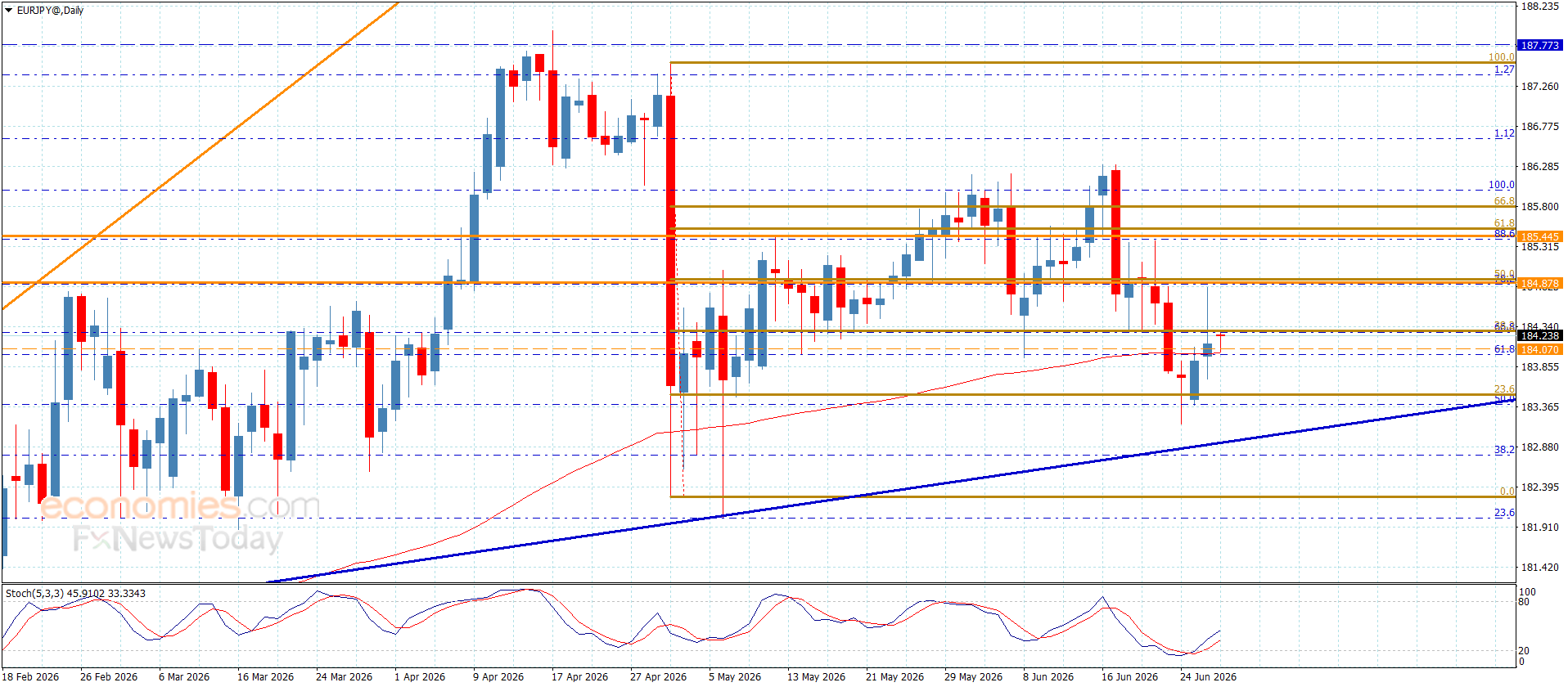
The EURJPY pair continued providing weak sideways trading, fluctuating near the extra support at 182.80, affected by the continuation of the main indicators besides forming extra obstacle at 183.50 level as appears in the above image.
Therefore, we will remain neutral until providing signal for detecting the main trend in the near and medium trading, while breaking the current support and providing negative close will confirm the bearish corrective trend, which might target 182.30 and 181.75 level initially, while breaching 183.50 level will ease the mission of detecting the bullish attempts, to expect its rally towards 183.85, to attack the broken channel’s support in order to find an exit for regaining the bullish trend again.
The expected trading range for today is between 182.80 and 183.50
The EURJPY pair continued providing weak sideways trading, fluctuating near the extra support at 182.80, affected by the continuation of the main indicators besides forming extra obstacle at 183.50 level as appears in the above image.
Therefore, we will remain neutral until providing signal for detecting the main trend in the near and medium trading, while breaking the current support and providing negative close will confirm the bearish corrective trend, which might target 182.30 and 181.75 level initially, while breaching 183.50 level will ease the mission of detecting the bullish attempts, to expect its rally towards 183.85, to attack the broken channel’s support in order to find an exit for regaining the bullish trend again.
The expected trading range for today is between 182.80 and 183.50
CIBC says the U.S. dollar is likely to weaken into the first half of 2026 before stabilising and recovering later in the year, describing its outlook as “U-shaped”.
The Canadian bank said “risks will push the USD lower in the next couple of quarters”, arguing that downside risks to the U.S. labour market and growth will outweigh any modest upside risks to inflation.
CIBC said unresolved questions over who ultimately bears the cost of tariffs are “stagflationary and should push USDs lower in the early months of 2026”.
GBP to USD Transfer Savings Calculator
How much are you sending from pounds to dollars?
Your potential USD savings on this GBP transfer:
$318
By using specialist providers vs high street banks
It warned that if firms absorb tariff costs, they may be forced to cut labour to protect margins, while if consumers pay, inflationary pressures would rise, both scenarios weighing on the dollar.
The bank also said uncertainty over Federal Reserve independence could be a major theme early next year, noting that “the appointment of the Federal Reserve Chair has yet to be decided”.
Legal challenges to Trump’s IEEPA tariffs could further undermine the greenback, with CIBC saying a ruling against them would likely trigger rallies in trade-sensitive currencies that would “mechanically lead to a weaker greenback”.
Above: Traders are betting the Fed will be the biggest cutter this year, underpinning a bearish USD consensus.
CIBC said these risks are front-loaded and “not long lasting”, arguing that markets will eventually conclude that expectations for U.S. interest rate cuts have gone too far.
The bank believes the Fed’s estimate of neutral interest rates is mispriced, saying “the true value is 50bps higher”, which should ultimately support the dollar later in 2026.
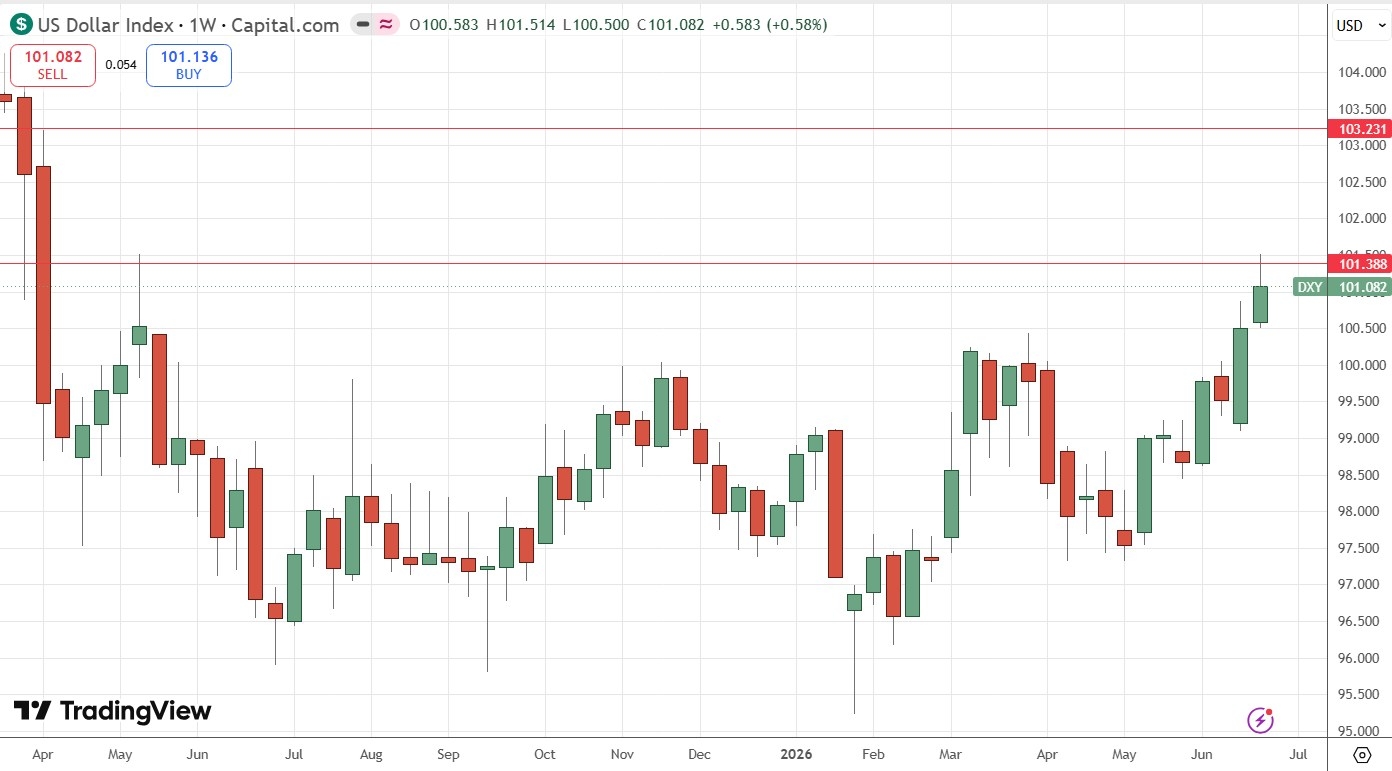
CIBC said it expects “an inflection point for the greenback to turn slightly higher” by mid-year, forecasting the dollar index to fall to 96.0 by the end of the second quarter before recovering to 97.30 by the end of 2026.
For the likes of EUR/USD and GBP/USD the implications are relatively straightforward: As long as the dollar index is falling, these pairs are rising.
All else equal, further advances into the middle of the year before falling into year-end.
I am not interested in shorting, as the interest rate differential is simply too great here.
The British pound initially pushed higher against the Japanese yen during trading on Tuesday, but has since pulled back just a bit.
All things being equal, this is a market waiting for some type of reason to go higher, and that reason will more likely than not come into play via risk appetite.
Regardless, this is a market that is very obviously strong, and I have no interest in fighting the overall trend.
The market could end up being a scenario where we just remain buy on the dips and slowly grind higher. When you look at the chart, you can see that the Monday session was a serious attempt to break out of a bullish flag, and if we look at that as a bullish flag, then we could be looking at a move to 216 yen based on the measured move.
Carry Trade Momentum
Ultimately, this is a scenario where I don’t have any interest in shorting this market because, quite frankly, I don’t want to pay the interest rate differential. Even though the Bank of England has recently cut rates, it is going to do so very slowly, while the Japanese are supposedly raising rates.
The situation is that the interest rate differential is so wide that it’s going to take a long time for that to truly come into play. You could also make an argument that most traders believe that the Japanese can only raise rates so high due to their debt load. With that being the case, we find ourselves in, and of course, the overall momentum, I think the carry trade is alive and well, and I will continue to take advantage of it by buying the British pound against the Japanese yen going forward.
Christopher Lewis has been trading Forex and has over 20 years experience in financial markets. Chris has been a regular contributor to Daily Forex since the early days of the site. He writes about Forex for several online publications, including FX Empire, Investing.com, and his own site, aptly named The Trader Guy. Chris favours technical analysis methods to identify his trades and likes to trade equity indices and commodities as well as Forex. He favours a longer-term trading style, and his trades often last for days or weeks.
The Euro has stabilized against the British Pound on Tuesday as we find ourselves testing the crucial 200-Day EMA.
If it holds, a “fade the rally” move could set up.
The fundamental context in this pair is that the British Pound had been trading very weakly against the Euro.
The interest rate cut from the Bank of England was more or less a hawkish cut, meaning that they brought rates down to 3.75% but they also mentioned the resilient service sector and the FTSE 100’s break above the 10,000 level as signs that there is still a lot of belief in the growth of the UK economy and perhaps it’s not as sluggish as people had thought. They thought that the central bank would have to come in and save everybody essentially.
Market Outlook and Key Levels
Conversely, the Euro has been struggling with risks following the Bulgarian entry into the Eurozone and a wait-and-see approach from the ECB. German inflation data has been released during the session; it’s easing towards 2.2%. It reinforces the view that the ECB doesn’t have a lot of room for hawkish surprises and therefore they probably have to sit fairly still. This could continue to hamper any Euro strength not only here, but everywhere else as well.
If we do rally from here, the market reaching towards the 0.8725 level is a very real possibility, with the 0.8750 level above there being an area that I would watch.
If we break down below the 200-day EMA, then the 0.86 level is your initial support, and if we break down below that, the bottom falls out here. I do think we are in the midst of some type of trend change, but we’ll just have to wait and see. I prefer to fade rallies that show signs of exhaustion.
Christopher Lewis has been trading Forex and has over 20 years experience in financial markets. Chris has been a regular contributor to Daily Forex since the early days of the site. He writes about Forex for several online publications, including FX Empire, Investing.com, and his own site, aptly named The Trader Guy. Chris favours technical analysis methods to identify his trades and likes to trade equity indices and commodities as well as Forex. He favours a longer-term trading style, and his trades often last for days or weeks.
The Pound to Dollar exchange rate (GBP/USD) climbed to three-month highs after rebounding from support in the low-1.34s, but the pair now faces stiff resistance as trading conditions thin and the dollar attempts to stabilise.
The next move will determine whether sterling can build momentum into the new year.
GBP/USD Forecasts: 3-Month Highs
The Pound to Dollar (GBP/USD) exchange rate found support below 1.3420 on Monday and rebounded strongly to above 1.3500 amid a firm Pound performance and dollar setback.
GBP/USD hit 3-month highs near 1.3570 before consolidation just below 1.3550 with markets still assessing whether there is scope for a decisive breakout.
According to UoB; “Although upward momentum has not increased significantly, GBP could rise to 1.3590. Currently, the odds of a continued rise above this level are not high.”
Scotiabank added; “Risk reversals are little changed, offering little in terms of sentiment-driven movement. We are neutral awaiting a break of the two-week range roughly bound between 1.34 and the mid1.35s.”
Save on Your GBP/USD Transfer
Get better rates and lower fees on your next international money transfer.
Compare TorFX with top UK banks in seconds and see how much you could save.
Overall risk appetite has held steady with the UK FTSE 100 index posting a fresh record high while there were further gains for precious metals and commodities.
The Pound will gain net support if risk appetite holds firm.
The dollar failed to gain sustained support from geo-political considerations, but there is a high degree of uncertainty over both Venezuela and the wider regional considerations.
ING is not convinced that there will be sustained dollar losses; “Despite the quick unwinding of safe-haven USD demand yesterday, we remain modestly biased to a stronger dollar in the near term. Seasonality is positive in January, and markets’ sanguine stance on geopolitics leaves risk assets and high-beta currencies exposed to re-escalations, both in Latam and potentially in Greenland.
Danske Bank also preached some caution; “Global markets generally performed well on Monday, but President Trump’s threats against Colombia and Mexico, along with renewed talk of annexing Greenland, underscore that geopolitical tensions remain elevated as the new year begins.”
The US ISM manufacturing index edged lower to 47.9 for December from 48.2 previously. This was slightly below consensus forecasts and the sector has been in contraction territory for the last 8 months which hampered the dollar.
Capital Economics commented; “The modest decline in the ISM Manufacturing Index in December confirms that the sector was struggling for momentum around the turn of the year, but we doubt that this will be enough to prevent overall GDP from expanding at a solid pace in the coming quarters.”
The dollar could gain some net support if the overall US economy holds firm, but the global perspective will also be important.
MUFG commented; “Evidence of strengthening global growth momentum is a supportive factor for our forecast for the US dollar to weaken further in 2026 even as US economic growth is expected to pick-up as well during the first half of this year driven by stimulus from President Trump’s One Big Beautiful Bill.”
Like this piece? Please share with your friends and colleagues:
International Money Transfer? Ask our resident FX expert a money transfer question or try John’s new, free, no-obligation personal service! ,where he helps every step of the way,
ensuring you get the best exchange rates on your currency requirements.
The USD/JPY forecast tilts to the downside as BoJ-Fed divergence favors yen.
Risk-off sentiment strengthens yen but limits gains amid dollar’s own haven appeal.
Today’s US ADP jobs report is crucial to watch, along with the US ISM PMI and JOLTS data.
The USD/JPY remains under mild pressure as the Japanese yen continues to find support from changing policy expectations and a weaker US dollar backdrop. Momentum has obviously slowed, indicating growing uncertainty over the next directional move, even though the pair is still trading at high levels around the mid-156 area. The market is increasingly focused on the widening policy divergence between the Bank of Japan, which is cautiously tightening, and the Federal Reserve, which is edging closer to an easing cycle.
–Are you interested in learning more about forex indicators? Check our detailed guide-
The yen’s recent resilience is largely driven by the growing acceptance that the BoJ’s long-awaited normalization process is not a one-off move. Governor Kazuo Ueda’s most recent remarks reaffirmed the likelihood of further interest rate hikes if inflation remains elevated. Rising wages, persistent pressure on service sector prices, and tighter labor conditions strengthen the argument for gradual tightening. This change has already caused yields on Japanese government bonds to reach multi-decade highs, reducing one of the main causes of yen weakness and closing the yield gap with the US.
At the same time, investors remain cautious about pushing the yen too aggressively higher. Uncertainty around Japan’s fiscal outlook, highlighted by the approval of a record budget, and questions over the exact timing and pace of future BoJ hikes continue to temper bullish conviction. As a result, USD/JPY has avoided a sharp sell-off and instead is grinding lower in a controlled manner.
Geopolitical risks add another level of complexity. The demand for safe havens has been boosted by growing tensions associated with Venezuela and other global flashpoints. However, the dollar’s inflows during periods of high US yields have lessened the yen’s influence. Even so, upside movements are still constrained, especially in the upper 150s, by the possibility of verbal intervention from Japanese authorities.
On the US side, the dollar is struggling to find sustained support. Markets are increasingly pricing in further Federal Reserve rate cuts later this year, with policymakers stressing the need to stay data-dependent as inflation cools and labour market conditions soften. This week’s run of US data, including ADP employment figures, ISM Services PMI, and JOLTS, may influence short-term moves, but the main event remains Friday’s Nonfarm Payrolls report. A weaker-than-expected jobs reading would likely reinforce expectations of a dovish Fed and put renewed downside pressure on USD/JPY.
USD/JPY Technical Forecast: Consolidating Near Key MAs
USD/JPY 4-hour chart
The USD/JPY 4-hour chart shows consolidation between 20- and 50-period MAs, while the confluence of 100- and 200-period MAs supports the pair’s upside bias. The RSI also remains flat under the 50.0 level, suggesting no clear bias in the short term.
A break above the 20-period MA at 156.60 could trigger a bullish breakout and look to test 157.30 ahead of 157.75. On the other hand, moving below the 200-period MA at 156.10 could prompt the pair to test the 155.55 support level ahead of 155.00.
Looking to trade forex now? Invest at eToro!
68% of retail investor accounts lose money when trading CFDs with this provider. You should consider whether you can afford to take the high risk of losing your money.
After rising toward 1.1750 early Tuesday, EUR/USD made a sharp U-turn in the second half of the day and closed in negative territory. The pair stays on the back foot early Wednesday and trades below 1.1700.
Euro Price This week
The table below shows the percentage change of Euro (EUR) against listed major currencies this week. Euro was the weakest against the Australian Dollar.
USD
EUR
GBP
JPY
CAD
AUD
NZD
CHF
USD
0.36%
-0.21%
-0.19%
0.53%
-0.91%
-0.43%
0.53%
EUR
-0.36%
-0.57%
-0.48%
0.17%
-1.27%
-0.78%
0.17%
GBP
0.21%
0.57%
0.00%
0.75%
-0.70%
-0.21%
0.74%
JPY
0.19%
0.48%
0.00%
0.69%
-0.76%
-0.27%
0.74%
CAD
-0.53%
-0.17%
-0.75%
-0.69%
-1.28%
-0.96%
0.00%
AUD
0.91%
1.27%
0.70%
0.76%
1.28%
0.49%
1.45%
NZD
0.43%
0.78%
0.21%
0.27%
0.96%
-0.49%
0.96%
CHF
-0.53%
-0.17%
-0.74%
-0.74%
-0.00%
-1.45%
-0.96%
The heat map shows percentage changes of major currencies against each other. The base currency is picked from the left column, while the quote currency is picked from the top row. For example, if you pick the Euro from the left column and move along the horizontal line to the US Dollar, the percentage change displayed in the box will represent EUR (base)/USD (quote).
The renewed US Dollar (USD) strength caused EUR/USD to turn south in the American session on Tuesday. Markets still see a less than 20% chance of the Federal Reserve (Fed) lowering the policy rate at the January meeting, according to the CME FedWatch Tool, and this positioning seems to be helping the USD stay resilient against its rivals.
In the second half of the day, the Automatic Data Processing (ADP) will publish the private sector employment data. Markets expect an increase of 45,000 in private sector payrolls in December, following the 32,000 decrease recorded in November. A reading better than expected could feed into expectations for a Fed policy hold and help the USD outperform its rivals. On the other hand, a negative print could trigger a USD selloff and open the door for a decisive rebound in EUR/USD with the immediate reaction.
Later in the session, investors will also pay close attention to the Institue for Supply Management’s Services Purchasing Managers’ Index (PMI) report for December. The headline PMI is forecast to come in above 50 and show an ongoing expansion in the service sector’s business activity. An unexpected drop below 50 could weigh on the USD. Conversely, a reading near the market expectation, combined with a recovery above 50 in the Employment Index of the survey, could boost the USD and force EUR/USD to stretch lower.
EUR/USD Technical Analysis:
The 20-period Simple Moving Average (SMA) extends its slide below the 50- and 100-period SMAs, while price holds beneath these averages and rests around the slowly rising 200-period SMA. The RSI (14) prints at 38, reflecting bearish momentum without oversold conditions. The 200-period SMA aligns as the immediate support level at 1.1675. Measured from the 1.1503 low to the 1.1800 high, the 50% retracement at 1.1652 could be seen as the next support level before 1.1615 (Fibonacci 61.8% retracement).
Recovery attempts could face immediate resistance at 1.1690-1.1705 (Fibonacci 23.6% retracement, 20-period SMA) ahead of 1.1730 (Fibonacci 23.6% retracement) and 1.1745 (50-peirod SMA, 100-period SMA).
(The technical analysis of this story was written with the help of an AI tool)
Euro FAQs
The Euro is the currency for the 20 European Union countries that belong to the Eurozone. It is the second most heavily traded currency in the world behind the US Dollar. In 2022, it accounted for 31% of all foreign exchange transactions, with an average daily turnover of over $2.2 trillion a day.
EUR/USD is the most heavily traded currency pair in the world, accounting for an estimated 30% off all transactions, followed by EUR/JPY (4%), EUR/GBP (3%) and EUR/AUD (2%).
The European Central Bank (ECB) in Frankfurt, Germany, is the reserve bank for the Eurozone. The ECB sets interest rates and manages monetary policy.
The ECB’s primary mandate is to maintain price stability, which means either controlling inflation or stimulating growth. Its primary tool is the raising or lowering of interest rates. Relatively high interest rates – or the expectation of higher rates – will usually benefit the Euro and vice versa.
The ECB Governing Council makes monetary policy decisions at meetings held eight times a year. Decisions are made by heads of the Eurozone national banks and six permanent members, including the President of the ECB, Christine Lagarde.
Eurozone inflation data, measured by the Harmonized Index of Consumer Prices (HICP), is an important econometric for the Euro. If inflation rises more than expected, especially if above the ECB’s 2% target, it obliges the ECB to raise interest rates to bring it back under control.
Relatively high interest rates compared to its counterparts will usually benefit the Euro, as it makes the region more attractive as a place for global investors to park their money.
Data releases gauge the health of the economy and can impact on the Euro. Indicators such as GDP, Manufacturing and Services PMIs, employment, and consumer sentiment surveys can all influence the direction of the single currency.
A strong economy is good for the Euro. Not only does it attract more foreign investment but it may encourage the ECB to put up interest rates, which will directly strengthen the Euro. Otherwise, if economic data is weak, the Euro is likely to fall.
Economic data for the four largest economies in the euro area (Germany, France, Italy and Spain) are especially significant, as they account for 75% of the Eurozone’s economy.
Another significant data release for the Euro is the Trade Balance. This indicator measures the difference between what a country earns from its exports and what it spends on imports over a given period.
If a country produces highly sought after exports then its currency will gain in value purely from the extra demand created from foreign buyers seeking to purchase these goods. Therefore, a positive net Trade Balance strengthens a currency and vice versa for a negative balance.
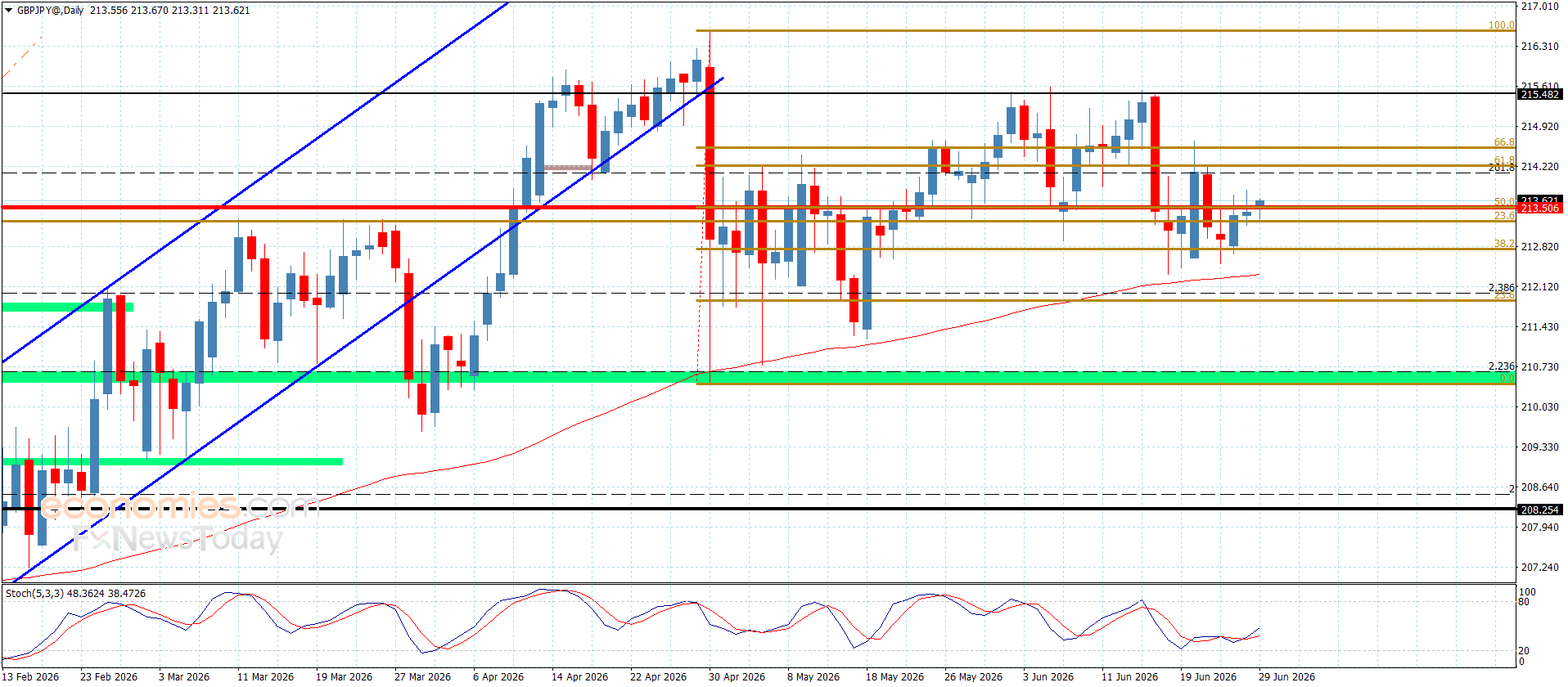
The GBPJPY pair ended the last bullish rally by recording 212.15 level, to bounce directly to settle near 211.30, which formed strong obstacle against the bullish attempts.
Note that the stability within the main bullish levels and forming extra support at 211.30 level, which makes us wait for gathering bullish momentum to reinforce the chances of recording the target at 212.55 and surpassing it might extend trading towards 213.75, while reaching below 211.30 and providing negative close will confirm delaying the bullish attack, to begin forming temporary corrective wave, to target 210.65 and 209.90 level.
The expected trading range for today is between 211.00 and 212.50
EUR/JPY extends its losses for the fourth successive session, trading around 182.80 during the European hours on Wednesday. The currency cross remains subdued following the release of Germany’s Retail Sales, which climbed 1.1% year-over-year (YoY) in November, following an increase of 0.9% in October. Monthly Retail Sales fell 0.6% in November, against a 0.3% decline in October and the market expectations of a 0.2% increase.
The technical analysis of the daily chart suggests that the 14-day Relative Strength Index (RSI) sits at 50.96 (neutral), confirming tempered momentum. The EUR/JPY cross remains above the rising 50-day Exponential Moving Average (EMA), while it stalls beneath a softening nine-day EMA, pointing to consolidation after the recent advance.
The EUR/JPY cross may navigate the region around the initial support at the three-week low of 181.57, recorded on December 17, followed by the 50-day EMA at 181.31. Holding above the 50-day EMA would keep the medium-term uptrend intact, while a drop through the first floor could expose the deeper level.
On the upside, the EUR/JPY cross may rebound toward the nine-day EMA at 183.44. Recovery through the nine-day EMA could re-establish upside traction and refocus the topside path toward the all-time high of 184.95, which was recorded on December 22, aligned with the psychological level of 185.00.
EUR/JPY: Daily Chart
Euro Price Today
The table below shows the percentage change of Euro (EUR) against listed major currencies today. Euro was the weakest against the Japanese Yen.
USD
EUR
GBP
JPY
CAD
AUD
NZD
CHF
USD
0.06%
0.04%
-0.09%
0.11%
0.00%
0.11%
0.09%
EUR
-0.06%
-0.01%
-0.16%
0.05%
-0.05%
0.04%
0.03%
GBP
-0.04%
0.00%
-0.15%
0.06%
-0.04%
0.06%
0.04%
JPY
0.09%
0.16%
0.15%
0.21%
0.11%
0.20%
0.19%
CAD
-0.11%
-0.05%
-0.06%
-0.21%
-0.10%
-0.01%
-0.02%
AUD
-0.00%
0.05%
0.04%
-0.11%
0.10%
0.10%
0.08%
NZD
-0.11%
-0.04%
-0.06%
-0.20%
0.00%
-0.10%
-0.02%
CHF
-0.09%
-0.03%
-0.04%
-0.19%
0.02%
-0.08%
0.02%
The heat map shows percentage changes of major currencies against each other. The base currency is picked from the left column, while the quote currency is picked from the top row. For example, if you pick the Euro from the left column and move along the horizontal line to the US Dollar, the percentage change displayed in the box will represent EUR (base)/USD (quote).
(The technical analysis of this story was written with the help of an AI tool.)