Shares in Chipotle Mexican Grill (CMG) rose by around 7% on Tuesday following an announcement by the board of the fast-food burrito chain of a 50-for-1 split they plan to make to their common stock in the next few months.
This move would see shareholders get 49 extra shares for every share held on 18 June. Their plan still needs approval from their shareholders, which will be sought at their next annual meeting which is due to be held on 6 June.
The post-split CMG stock will be traded from 26 June onwards if approved. The California-based company says it will be one of the largest stock splits ever carried out on the NYSE. This news helped fuel the share price rise to a record high of $2,797.56, which continues the strong performance, with CMG shares gaining 70% in value in the last year.
The company’s quarterly sales and profit figures released in February were better than the market estimated. It managed to retain clients in a challenging market despite increasing prices due to the higher cost of raw materials. This came as the American fast-food industry experienced a 1.6% fall in customer traffic in the quarter.
Chief Financial and Administrative Officer Jack Hartung said in a recent interview with Reuters that the coming rise in minimum wages for fast food workers is going to cause them to look at ways to protect their profit margin, saying:
That’s going to require some kind of pricing, we just haven’t decided what kind.
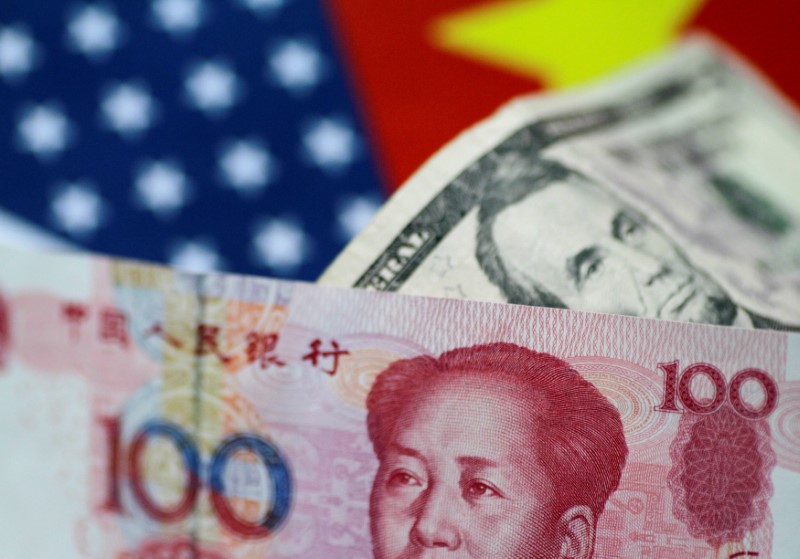
Investing.com – The U.S. dollar rose marginally in European trade Thursday, rebounding after the previous session’s sharp losses after the Federal Reserve maintained its projections for interest rate cuts this year, while the Swiss franc slumped after a surprise cut by the Swiss National Bank.
At 04:20 ET (09:20 GMT), the Dollar Index, which tracks the greenback against a basket of six other currencies, traded marginally higher at 103.065, after having fallen more than 0.5% on Wednesday.
Fed sticks with three rate cuts this year
The kept interest rates unchanged on Wednesday, as widely expected, but also stayed on track for three rate cuts this year, even though it projected slightly slower progress on inflation.
Sticky inflation readings had prompted fears that the Fed officials would rein in projections for rate cuts this year, but the central bank didn’t strike a more hawkish tone, which sent the greenback tumbling.
Traders were now pricing in an over 70% chance the Fed will cut rates by 25 bps in June, according to the CME Fedwatch tool.
The Fed is unlikely to delay rate cuts for an extended period and are planning the first reduction at the June meeting, according to Goldman Sachs analysts, in a note.
“We continue to expect cuts in June, September, and December, for a total of 3 cuts in 2024,” they added.
Swiss franc slumps after rate cut
In Europe, rose 0.9% to 0.8945 after the surprised the market, cutting its benchmark interest rate by 25 basis points to 1.5%, becoming the first major central bank to cut interest rates in this cycle.
The step comes after Swiss inflation dipped to 1.2% in February, the ninth month in succession that price rises have been within the SNB’s 0-2% target range, and is likely aimed at curtailing the recent appreciation of the Swiss franc.
SNB chief Thomas Jordan suggested, at Davos, that the franc’s recent appreciation was posing challenges for exporters, and this move is likely designed to weaken the currency.
fell 0.1% to 10.5484 after kept its benchmark interest rate unchanged at 4.50% on Thursday, as unanimously expected by analysts.
fell 0.1% to 1.2776 ahead of the Bank of England’s policy-setting meeting later in the session.
The is widely expected to keep interest rates unchanged, but U.K. inflation slowed in February – dropping to 3.4% in annual terms after a 4.0% increase in January, the weakest rate of inflation since September 2021 – suggesting the central bank could start cutting interest rates in the months ahead.
traded 0.1% higher to 1.0920, after notching a one-week high against the dollar earlier in the session.
The European Central Bank has tried to dampen speculation on a streak of interest rate cuts, with President saying on Wednesday that the ECB could not commit to a certain number of rate cuts even after it starts reducing borrowing costs.
Yen bounces from a four-month low
traded 0.2% lower to 150.99, falling from a four-month high with the prospect of U.S. interest rate cuts and a more hawkish Bank of Japan boding well for the yen, which was battered by rising U.S. interest rates over the past year.
Purchasing managers index data for March showed some resilience in the Japanese economy, with activity shrinking less than expected, while the sector grew further.
rose 0.4% to 0.6613, with the gains fueled chiefly by a substantially stronger-than-expected reading on the labor market, which also showed unemployment falling to a six-month low.
Yield optimization has emerged as a critical area of opportunity, ripe for disruption, in the rapidly evolving landscape of decentralized finance (DeFi). As blockchain technologies mature, companies like Bril Finance are leading the charge by developing sophisticated, transparent, and trustworthy models to maximize returns for investors, while delivering a more palatable user experience—akin to a dashboard that investors would recognize from non-web3 legacy products. The way they think about designing financial products, ranging from the quantitative modeling to user interface, provides a useful template for others in the emerging technology space.
The Rise of Decentralized Finance
DeFi saw an initial explosion of activity “with roughly 90,000 users at the start of 2020 to 4.28 million by the end of 2021,” fueled by the creative use of airdrops and governance tokens, according to my research in the Journal of Corporate Finance. As the sector expanded, the search for a high yield on tokens led to a “Wild West” and an absence of dependable products.
Many projects promised high yields, but failed to deliver. These poor-quality products lacked transparency, often leaving investors in the dark about how their funds were being utilized. For instance, yield farming platforms would offer astronomical returns, but they were unsustainable due to faulty tokenomic schemes. Investors would flock to them only to see their investments collapse when the protocol could not sustain the promised yields. Other developers would create a project, attract liquidity, and then disappear with investors’ funds—also known as “rug pulls.” These patterns made yield farming risky and unpredictable.
For instance, YAM Finance initially gained attention for its unique elastic supply model, aiming to maintain a stable value. However, a critical bug in the rebase mechanism led to a sudden collapse in value, wiping out investors’ funds. The project’s governance token, YAM, became worthless overnight. “Data from price site CoinGecko shows the total value of YAM collapsed from roughly $60 million at 07:40 UTC to $0 by 08:15 – barely 35 minutes later,” according to CoinDesk.
HotdogSwap was a fork of SushiSwap, another yield farming platform. Despite its humorous branding, HotdogSwap failed to gain traction due to lack of innovation and community interest. Investors who participated in its initial liquidity pools suffered losses. Pickle Finance aimed to optimize yield by automatically switching between different stablecoin pools. Despite initial interest, a series of smart contract vulnerabilities led to a significant loss of funds. These projects, and many more, are illustrative of a combined trust and tokenomics gap in the DeFi space.
These challenges, however, are not unique to the DeFi space alone. Centralized exchanges have also had a hard time navigating the prevalence of wash trading “whereby investors simultaneously sell and buy the same assets to create artificial transactions, distorting price and hurting investor confidence and participation, as seen in other financial markets.” Recent work published in Management Science led by Lin William Cong, a professor at Cornell University and director of the FinTech Initiative, has documented the ubiquity of wash trading.
Connor O’Shea, CEO of Bril Finance
Source: Bril Finance
A New Approach to MultiChain Yield
However, the industry has evolved, due to an increased focus on transparency, security, and sustainable growth to foster trust among investors. Much like how the expansion of artificial intelligence and nascent technology in the traditional financial service sector has led to increased democratization of powerful new tools that retail consumers have at their disposal as seen with firms like Wealthfront and Robinhood, a major transformation has also been taking place in Web3.
Founded in 2022 with the intent to help both extremely sophisticated and more novice traders efficiently deploy their capital, Bril Finance has shown impressive annual returns on BNB Chain. It will soon launch a unified UX that enables users to access native yield from liquidity provision on 22+ deployments across 16+ chains. Bril is a seamless yet sophisticated decentralized finance (DeFi) tool that actively optimizes and manages portfolio strategies in a secure, non-custodial manner.
The dApp allows users to deposit tokens into single-asset vaults, which drive yield based on automated liquidity strategies- giving anyone access to professional-grade tools that deliver high yields for risk-adjusted returns. Bril leverages an underlying liquidity provisions algorithm, which runs category-defining, automated rebalancing for high capital efficiency. When users deposit tokens into single asset vaults, they receive LP tokens representing their share in the liquidity pool. Single asset vaults remove the complexity of managing multiple assets in a liquidity pool. Bril deploys the deposited assets into concentrated liquidity AMMs across blockchain ecosystems via a premier cross-chain bridging partner. Positions are automatically adjusted based on market conditions, and users can then withdraw deposits and earnings at any time.
Bril Finance Product Dashboard Capture
Source: Bril Finance
“Bril is designed to respond accordingly to drastic market changes by making necessary rebalancing adjustments in real time, in a way we have yet to see in the space,” explained CEO Connor O’Shea. “Bril monitors the differences between fast (5 min) and slow (60 min) TWAPs [time-weighted average price] as well as between spot price and fast TWAP. Based on the price differences, we recognize high volatility (depending on the pool, typically set at 6% difference) and extreme volatility (typically set at 25% difference) situations. During periods of high volatility, a user’s position will be dispersed across the price range, thereby limiting the significant sale of your preferred token due to price changes. In situations of extreme volatility, the vault gets locked, preventing further deposits. At this point, the strategy team evaluates the market conditions before making any rebalancing decisions,” he added.
Financial services sectors rely crucially on forecasting expected returns and losses to decide how to deploy capital, while simultaneously managing against idiosyncratic and systemic risk. Bril Finance builds on the approach taken in traditional finance by building better models to forecast returns and, equally as important, actively monitors them. “I think people would be surprised to learn just how much of a real-time human element is involved in risk management across the global financial system regardless of whether we’re talking web2 or web3,” shared O’Shea. “The fact of the matter is that great technology is crucial, and we have it; but highly qualified humans will always need to be a key part of the front line here. We’re extremely transparent about that and proud that our team marries both best-practices and expertise from serious TradFi experience, with what I think is superior technology, a fresh approach, and overall, less bad legacy banking baggage.”
Bril leverages blockchain technology in two important ways. First, since trades are executed on-chain, data is plentiful, transparent, and readily accessible. Second, there is less scope for human error or malicious behavior. While there are still individuals who can execute a trade and build models, the performance is publicly accessible, providing an inherent check and balance. “Risk management is fundamentally different in web3 because there is no government to bail anyone out,” said O’Shea. “We take that reality very seriously, as everyone should, and it informs our entire approach to that side of the business.”
CEO Connor O’Shea (R) and Bril co-founder Uri Ferruccio (second from right) collaborate with … [+] prospective partners at a crypto conference, University of Texas, Austin
Source: Bril Finance
Institutional Pedigree
The founding team at Bril Finance has a both a high traditional finance and institutional pedigree, on top of its requisite crypto native expertise. O’Shea has spent years advising some of the world’s biggest banks as they aim to scale up their own private blockchains, prior to pivoting headlong into a full-time commitment to DeFi. At Binance and BnB Chain, he directed corporate development efforts and forged strategic Web3 and Web2 partnerships. Prior to Binance, he supported corporate strategy and deal-making with JPMorgan Chase & Co. out of New York. At WPP Kantar, he developed advertising and marketing strategies for fintech, luxury goods, and CPG clients. Before joining WPP, he was a corporate strategy associate with Strategy& in their New York, Tokyo and London offices, specializing in Financial Services growth and M&A. Connor dropped out of high school in his freshman year and founded a San Francisco-based payments startup, CCKV.
“We are solving for those who are heavier traders and looking for a way to trade and avoid actively deployed capital. We connect the exchange with the liquidity provider, and that generates yield back to the user. The capital provider wants the holdings to appreciate in value, but also to put capital to work. We cannot control the global supply of Bitcoin, but we can help you earn yield on top. The vast majority of platforms do not have sustainable APY, and ultimately it comes down to the algorithm. It is very difficult to build your own yield product, so just like JPMorgan has their own teams that looks for yield, we are also attuned to new money coming into Web3 where we can help users seamlessly connect to realize these kinds of possibilities,” Oshea shared.
O’Shea and team believe that yield optimization in web3 has already come a long way thanks to the recent greater convergence of principles from both tradFi and DeFi worlds. As blockchain investing matures, yield optimization no longer has to feel like a gamble, but a strategic opportunity with serious products and companies offering much greater transparency, dependability, and a single point of accountability.
Recent data from the U.S. Energy Information Administration (EIA) reveals a significant drawdown in crude inventories, which declined unexpectedly by 2 million barrels to 445 million in the week ended March 15. This reduction, against a forecasted 13,000-barrel rise, marks the second consecutive week of declining stockpiles. The drawdown is attributed to increased exports and heightened refinery activity, with gasoline inventories also falling for a seventh consecutive week. This trend indicates a robust demand for fuel, bolstering market sentiment.
Federal Reserve Policy Impact
The Federal Reserve’s latest decision to maintain interest rates between 5.25% and 5.50% has implications for the oil market. Policymakers are cautiously optimistic about reducing rates by the end of 2024, hinting at an extended period of higher borrowing costs. This scenario could potentially dampen economic growth and, by extension, future fuel demand.
Geopolitical Tensions and Supply Disruptions
The oil market is currently facing significant challenges due to the escalating conflict between Russia and Ukraine. The intensification of Ukrainian attacks on Russian refineries has had a substantial effect, impairing approximately 12% of Russia’s total oil processing capacity. This development is leading to a constriction in global oil supplies. Additionally, OPEC’s decision to reduce production is further exerting upward pressure on oil prices. These factors are influencing the market substantially, even in the context of broader economic considerations.
Chinese Oil Inventory and Market Trends
China’s strategy of bolstering its oil inventories in the early months of the year may influence future import patterns. While the country’s crude oil imports rose modestly in the first two months of 2024, the fact that a surplus was directed towards storage rather than processing suggests a more cautious approach to fuel demand.
Short-Term Market Forecast
In the short term, the market appears to be cautiously optimistic, leaning towards a bullish outlook. The sustained drawdown in US inventories, coupled with ongoing supply concerns due to geopolitical tensions, is likely to keep oil prices supported. However, factors such as the Federal Reserve’s interest rate policy and China’s oil import behavior could introduce elements of volatility. Traders should remain attentive to these developments as they could influence price movements in the near future.
Russell 2000 Set for a Stellar 50% Leap in 2024, Forecasts Fundstrat’s Tom Lee
Tom Lee of Fundstrat Global Advisors forecasts a 50% rise in the Russell 2000 for 2024, citing its relative value akin to 1999 levels—a prelude to a 12-year outperformance streak. Backed by the Fed’s dovish stance and increasing CEO confidence, Lee anticipates heightened M&A, IPO activities, and sector diversification to drive growth. With the index trading at appealing price-to-earnings ratios and a significant biotech presence, small caps could notably benefit from impending Fed rate cuts. (CNBC)
Traders Eagerly Await Key Earnings from Darden, FedEx, and Nike
Ahead of Thursday’s market bell, traders are set to closely watch earnings reports from Darden Restaurants, followed by FedEx and Nike after closing. Darden is expected to show a profit increase, with a forecast of $316 million and an earnings per share of $2.62. FedEx, facing a challenging period, anticipates a revenue of $22.02 billion and EPS of $3.50. Nike, with slowing revenue growth, expects earnings at $0.75 per share amid cautious market sentiment. (MarketWatch)
FCC Investigates Amazon, Others for Marketing Illegal Wireless Jammers
The Federal Communications Commission (FCC) is probing Amazon and other retailers for allegedly marketing and selling wireless signal jammers. FCC spokesperson Will Wiquist confirmed ongoing investigations into possible violations of rules against selling devices that disrupt legitimate signals, such as cellphones and GPS units. The details of other retailers involved remain unspecified. This investigation, first reported by NBC News, highlights the sale of these illegal devices on Amazon’s marketplace, which has yet to comment on the matter. (CNN)
Gold bug Peter Schiff keeps riling up Bitcoiners amid the ongoing price crash. This time, the controversial market commentator took another jab at struggling Bitcoin ETF offerings, arguing that their buyers have to “watch helplessly” without being able to exit the market.
Trapped in the middle of a crash
Unlike the Bitcoin market, which operates globally 24/7, the liquidity of Bitcoin ETF is limited only to US market hours.
Now that the market has crashed overnight, ETF buyers have no option to sell, and they have to wait until the market reopens in the morning.
As reported by U.Today, the price of the leading cryptocurrency came awfully close to crashing below the $60,000 level earlier today, extending its streak of losses.
The cryptocurrency market is showing no signs of resilience, with relentless selling resulting in more than half a billion dollars being liquidated over the last 24 hours.
Bitcoin is currently facing souring sentiment due to Bitcoin ETFs suffering from their biggest outflows to date.
Moreover, the upcoming rate cut decision by the Federal Reserve appears to be yet another bearish headwind.
So far, the market looks extremely dire for bulls, with the Bitcoin price plunging nearly 20% from its recent high.
Nothing new
James Seyffart, a leading ETF analyst at Bloomberg, recently took aim at Schiff’s post, arguing that the phenomenon that the gold bug described is not actually exclusive to Bitcoin ETFs. The same exact thing applies to gold-based ETFs and international equity ETFs. He further noted that there are market-moving events in the stock market that happen when trading is now available.
That said, Schiff claims that gold “doesn’t crash overnight” like its digital rival, so “there is nothing to worry about.”
High risk warning:
Foreign exchange trading carries a high level of risk that may not be suitable for all investors. Leverage creates additional risk and loss exposure. Before you decide to trade foreign exchange, carefully consider your investment objectives, experience level, and risk tolerance. You could lose some or all your initial investment; do not invest money that you cannot afford to lose. Educate yourself on the risks associated with foreign exchange trading and seek advice from an independent financial or tax advisor if you have any questions.
Advisory warning:
FOREXLIVE™ is not an investment advisor, FOREXLIVE™ provides references and links to selected news, blogs and other sources of economic and market information for informational purposes and as an educational service to its clients and prospects and does not endorse the opinions or recommendations of the blogs or other sources of information. Clients and prospects are advised to carefully consider the opinions and analysis offered in the blogs or other information sources in the context of the client or prospect’s individual analysis and decision making. None of the blogs or other sources of information is to be considered as constituting a track record. Past performance is no guarantee of future results and FOREXLIVE™ specifically hereby acknowledges clients and prospects to carefully review all claims and representations made by advisors, bloggers, money managers and system vendors before investing any funds or opening an account with any Forex dealer. Any news, opinions, research, data, or other information contained within this website is provided on an “as-is” basis as a general market commentary and does not constitute investment or trading advice, and we do not purport to present the entire relevant or available public information with respect to a specific market or security. FOREXLIVE™ expressly disclaims any liability for any lost principal or profits which may arise directly or indirectly from the use of or reliance on such information, or with respect to any of the content presented within its website, nor its editorial choices.
Disclaimer:
FOREXLIVE™ may be compensated by the advertisers that appear on the website, based on your interaction with the advertisements or advertisers.
The British currency has been presented with an opportunity to improve its position. After reaching the lower boundary of the ascending diagonal triangle, the price was able to sharply increase. Similar to the euro, there was a retracement movement towards the specified boundary before this surge.
The current impulsive move is likely part of wave 5 of [v] and appears unfinished at the moment. Therefore, we can expect further upward movement in the near future.
Buyers are probably aiming to retest the current local maximum set by wave 3. After this event, the price may reverse and start to decline, so it is advisable to be prepared to close long positions.
Investment idea: Buy at 1.2785, with a stop loss at 1.2750, and a take profit at 1.2930.
Investing.com– Most Asian currencies rose sharply on Thursday, while the dollar tumbled from two-week highs after comments from the Federal Reserve kept expectations of interest rate cuts largely in play.
The Fed on Wednesday and maintained its forecast for a 75 basis point reduction in rates this year. The move, particularly the Fed’s outlook, ramped up appetite for high-yielding, risk-driven assets.
Hawkish signals from some Asian economies also boosted regional currency markets.
USDJPY falls from four-month high on Fed signals, BOJ rate hike
The Japanese yen strengthened sharply on Thursday, with the pair falling 0.5% from a four-month high to 150.53.
The prospect of U.S. interest rate cuts and a more hawkish Bank of Japan bode well for the yen, which was battered by rising U.S. interest rates over the past year.
Purchasing managers index data for March showed some resilience in the Japanese economy, with shrinking less than expected, while the grew further.
The BOJ for the first time in 17 years this week, citing some confidence in the Japanese economy. Analysts said that any more monetary tightening by the central bank will be largely driven by the path of Japan’s economy.
AUDUSD surges on red-hot labor data
The Australian dollar was the best performer in Asia on Thursday, with the pair surging 0.6%.
Gains in the Aussie were fueled chiefly by a substantially stronger-than-expected reading on the , which also showed falling to a six-month low.
Labor market strength gives the Reserve Bank of Australia more headroom to keep interest rates higher for longer. This notion helped Aussie bulls to look past less hawkish signaling from the RBA at a meeting earlier this week.
Dollar slides as Fed rate cut bets grow
The and fell sharply in Asian trade on Thursday, amid growing bets that the Fed will begin cutting rates by as soon as June.
Fed officials said the bank was still considering at least a 75 bps cut in rates this year, while Fed Chair Jerome Powell also expressed some confidence in inflation remaining on a path towards the central bank’s 2% annual target.
Traders were now pricing in an over 70% chance the Fed will cut rates by 25 bps in June, according to the .
Broader Asian currencies strengthened on this notion.
The South Korean won’s pair slid 0.3%, while the Singapore dollar’s fell 0.2%.
The Indian rupee’s pair was flat at around 83.07, while the Chinese yuan’s also tread water around 7.1986.
Sentiment towards the yuan was dented by top People’s Bank of China officials signaling that they had enough headroom to enact more rate cuts this year.
FOMC Economic Projections Signal Three Fed Rate Cuts
On Wednesday, the FOMC left interest rates at 5.50%. Moreover, the FOMC projected a 2024 median Fed Funds Rate of 4.6%, unchanged from December. The FFR projection signaled three Fed rate cuts in 2024, driving demand for riskier assets. An upward revision to 2024 growth was also market-friendly.
Fed Chair Powell avoided spooking the markets, saying the Fed will likely cut rates later in the year.
On Wednesday, the Dow and the Nasdaq Composite saw gains of 1.25% and 1.03%, respectively. The S&P 500 advanced by 0.89%.
The Wednesday Market Movers
BASF led the way on Wednesday, rallying 2.53% on a stock upgrade from hold to buy.
However, auto and bank stocks had a mixed mid-week session in anticipation of the Fed policy decision and projections.
Commerzbank gained 0.12%, while Deutsche Bank declined by 0.71%. Bank stocks faced scrutiny after news hit the wires of the US investigating Raiffeisen over plans to acquire a stake in a construction group under the control of sanctioned Russian Oleg Deripaska.
Porsche and Volkswagen saw gains of 0.66% and 0.22%, respectively. However, BMW and Mercedes Benz Group declined by 0.71% and 0.47%, respectively.
Private Sector PMIs, the Economic Bulletin, and the ECB in Focus
On Thursday, preliminary private sector PMIs for Germany and the Eurozone warrant investor attention. A less marked contraction across the German and euro area private sector could drive demand for DAX-listed stocks.
Economists forecast the German manufacturing PMI to increase from 42.5 to 43.1 in March. Moreover, economists predict the services PMI to rise from 48.3 to 48.8.
Forecasts for the Eurozone paint a rosier picture of the euro area economy. Economists expect the manufacturing PMI to increase from 46.5 to 47.0 and the services PMI from 50.2 to 50.5.
However, investors must consider the sub-components, including prices that may influence bets on a June rate cut.
Beyond the numbers, the ECB Economic Bulletin and commentary also need consideration.
US Economic Calendar: Private Sector PMIs and Jobless Claims in the Spotlight
Later in the Thursday session, jobless claims and private sector PMIs also warrant investor attention.
A pickup in US service sector activity and tighter labor market conditions could test bets on a June Fed rate cut.
Economists forecast the US Services PMI to fall from 52.3 to 52.0 and the Manufacturing PMI to decline from 52.2 to 51.7. Moreover, economists expect initial jobless claims to increase from 209k to 215k in the week ending Mar 16.
Other stats include Philly Fed Manufacturing and existing home sales. A larger-than-expected fall in the Philly Fed would garner investor interest. Economists forecast the Philly Fed to fall from 5.2 to -2.3 in Mar.
Beyond the numbers, investors must consider FOMC member commentary. FOMC member Michael Barr is on the calendar to speak.
Short-term Forecast
Near-term trends for the DAX will hinge on private sector PMIs from the euro area and the US. A pickup in demand but downward price trends could boost buyer demand or DAX-listed stocks.
In the futures, the DAX and Nasdaq mini were up 173 and 111 points, respectively.
DAX Technical Indicators
Daily Chart
The DAX held well above the 50-day and 200-day EMAs, sending bullish price signals.
A DAX return to the Mar 20 all-time high of 18,045 would support a move toward the 18,200 level.
Private sector PMIs and central bank commentary need investor consideration.
Conversely, a fall through the 18,000 handle could give the bears a run at the 17,850 handle.
The 14-day RSI at 77.00 shows the DAX in overbought territory. Selling pressure may intensify at the Mar 20 high of 18,045.