The EURJPY pair is forced to provide weak sideways trading, affected by the contradiction between the main indicators, keeping its stability near 180.80, reminding you that the negative stability below 181.75 barrier forms main factors to motivate the dominance of the bearish corrective trend, to expect the attempt of pressing on 179.40 level, where surpassing it will form next main target at 178.60 for the bearish trading.
While breaching the mentioned barrier and holding above it will increase the chances of resuming the main bullish trend, to expect recording extra gains by its rally towards 182.30 and 183.05.
The expected trading range for today is between 179.30 and 181.10
The EURJPY pair is forced to provide weak sideways trading, affected by the contradiction between the main indicators, keeping its stability near 180.80, reminding you that the negative stability below 181.75 barrier forms main factors to motivate the dominance of the bearish corrective trend, to expect the attempt of pressing on 179.40 level, where surpassing it will form next main target at 178.60 for the bearish trading.
While breaching the mentioned barrier and holding above it will increase the chances of resuming the main bullish trend, to expect recording extra gains by its rally towards 182.30 and 183.05.
The expected trading range for today is between 179.30 and 181.10
The British pound is showing signs of life again as climbs to 1.3197, breaking above short-term moving averages and posting its strongest bullish daily momentum in weeks. With RSI crossing above the neutral 50 mark and price pushing through resistance, traders are asking whether this rebound marks the beginning of a larger recovery — or just another short-lived bounce in a broader downtrend.
The 15-day (1.3141) and 20-day (1.3132) moving averages have flattened, and price has broken above both, signalling short-term bullish momentum.
Recent candles show strong follow-through, a departure from the sluggish, weak rallies earlier in the month.
The RSI (14) at 50.79 has climbed back above the midpoint — often an early indicator of a momentum shift.
While the broader trend over the last two months remains down, the recent structure suggests a potential base forming near 1.31, especially if upside continuation holds.
Macro Drivers: Pound Rebounds as Dollar Softens
GBP/USD’s recovery is influenced by shifting macro conditions:
Pound-Supportive Factors
Improved risk sentiment across global markets
Stabilizing UK economic data, particularly in services and employment
Reduced the odds of deeper recession talks from UK analysts
Dollar Dynamics
The US dollar has cooled as Treasury yields stabilize
Traders increasingly speculate that the may have reached peak tightening
Demand for USD safe-haven flows has softened
This combination has allowed the pound to gain breathing room after weeks of pressure.
A breakout above 1.3230 would cement the bullish reversal and likely drive a move toward 1.3300.
But a drop back below 1.3150 weakens the rebound and puts 1.3100 back into play.
Sentiment Check: Traders Are Watching for Confirmation
Retail traders have begun lightly rotating into GBP longs
Institutional flows remain cautious but no longer aggressively bearish
GBP volatility readings have ticked lower, hinting at stabilization
Traders are waiting for follow-through above 1.3230 to confirm a meaningful shift.
The pair is showing real signs of stabilization, backed by improving technical momentum and a softer USD backdrop. But the pair still needs to break out above resistance to confirm a full trend reversal.
Bullish Scenario: A close above 1.3230 opens a path toward 1.3300–1.3350.
Bearish Scenario: A drop back below 1.3150 puts the pound at risk of falling toward 1.3100 again.
Right now, the pair is in recovery mode — but not yet in a confirmed uptrend.
Meanwhile, US economic data and FOMC members have fueled speculation of a December Fed rate cut, signaling a potential narrowing of US-Japan rate differentials, and favoring the yen. Monetary policy divergence could materially alter USD/JPY’s recently bullish trajectory, placing a greater emphasis on incoming data.
Japan Leading Economic Index in Focus
On Wednesday, November 26, Japan’s Leading Economic Index (LEI) will provide insights into business and consumer sentiment at the end of the third quarter. Economists expect the LEI to rise from 107.0 in August to 108.0 in September.
A higher LEI reading could point to increased business investment and higher wages, aligning with updates from wage negotiations. Crucially, higher wages could boost households’ purchasing power, leading to higher spending and rising demand-driven inflation. Furthermore, improving consumer sentiment may also translate into an upswing in private consumption.
For context, the LEI dropped to 104.2 in April, its lowest level in two years before edging higher. LEI trends reflected trade developments. These trends suggest a September pickup, given that the US lowered tariffs on Japanese goods to 15% in September. The softer yen could also lift sentiment, given that USD/JPY strength would offset the effect of tariffs on company profit margins.
GBP/JPY consolidates during Tuesday’s session as the Japanese Yen (JPY) appreciates on threats of possible intervention of the BoJ in the FX markets, and also as Pound Sterling traders wait for the release of UK’s fiscal budget. At the time of writing, the cross trades at 205.44, losing 0.08%.
GBP/JPY Price Forecast: Technical outlook
The GBP/JPY trades sideways but a daily close below 206.00 and 205.50, could sponsor a retest of last Friday’s low of 204.30. Momentum favors further upside as the Relative Strength Index (RSI) lies above its neutral line, an indication that buyers outweigh sellers.
That said, if the cross rises past 206.00, the next stop would be the yearly peak of 206.86, ahead of the 207.00 milestone. Once cleared, the next resistance is 208.00 ahead of 210.00.
For a bearish continuation, sellers must clear the November 21 low of 204.30. The next support would be 204.00 and the 50-day SMA at 202.17.
GBP/JPY Price Chart – Daily
GBP/JPY daily chart
Pound Sterling Price This week
The table below shows the percentage change of British Pound (GBP) against listed major currencies this week. British Pound was the strongest against the Canadian Dollar.
USD
EUR
GBP
JPY
CAD
AUD
NZD
CHF
USD
-0.48%
-0.49%
-0.34%
-0.01%
-0.17%
-0.13%
-0.14%
EUR
0.48%
-0.03%
0.13%
0.46%
0.29%
0.34%
0.34%
GBP
0.49%
0.03%
0.14%
0.49%
0.31%
0.37%
0.35%
JPY
0.34%
-0.13%
-0.14%
0.33%
0.10%
0.08%
0.21%
CAD
0.00%
-0.46%
-0.49%
-0.33%
-0.18%
-0.12%
-0.13%
AUD
0.17%
-0.29%
-0.31%
-0.10%
0.18%
0.07%
0.06%
NZD
0.13%
-0.34%
-0.37%
-0.08%
0.12%
-0.07%
-0.01%
CHF
0.14%
-0.34%
-0.35%
-0.21%
0.13%
-0.06%
0.01%
The heat map shows percentage changes of major currencies against each other. The base currency is picked from the left column, while the quote currency is picked from the top row. For example, if you pick the British Pound from the left column and move along the horizontal line to the US Dollar, the percentage change displayed in the box will represent GBP (base)/USD (quote).
The Pound-to-Dollar exchange rate (GBP/USD) edged toward a one-week high on Tuesday, supported by renewed speculation that the Federal Reserve could cut interest rates again in December.
At the time of writing, GBP/USD was trading around $1.3153, up almost 0.4% from Tuesday’s opening levels.
The US Dollar (USD) lost traction on Tuesday amid rising expectations for a December Fed rate cut, with the probability climbing to around 85%.
This marked a significant reversal from the end of last week, when hawkish Federal Reserve minutes pushed the chances of a cut down to just 25%.
The shift in sentiment followed the latest US retail sales report, which showed September’s growth slowing to its weakest pace since May.
Further downward pressure came from Fed policymaker Stephen Miran, who suggested the US economy is “calling for large interest rate cuts,” reinforcing the increasingly dovish tone in markets.
The Pound (GBP) remained muted on Tuesday as investors adopted a cautious stance ahead of Chancellor Rachel Reeves’s first autumn budget, set to be unveiled on Wednesday.
Save on Your GBP/USD Transfer
Get better rates and lower fees on your next international money transfer.
Compare TorFX with top UK banks in seconds and see how much you could save.
Reeves is expected to detail measures to close an estimated £20bn fiscal gap and potentially expand fiscal space compared to last year’s limited headroom.
With income tax rises effectively ruled out, analysts widely expect a patchwork of smaller tax increases and targeted spending reductions — an approach that has stirred concerns over the potential impact on household finances and business investment.
At the same time, markets continue to weigh how these fiscal plans may influence upcoming Bank of England (BoE) decisions, with considerable speculation that policymakers could deliver another rate cut in December.
GBP/USD Forecast: All Eyes on UK Budget
Looking ahead, Wednesday’s budget announcement is likely to dominate movement in the Pound US Dollar exchange rate.
Should Reeves unveil a package that raises concerns over economic growth or appears to increase pressure on the BoE to accelerate its cutting cycle, the Pound could face renewed losses.
Conversely, a budget seen as balanced, credible, and supportive of long-term stability may offer Sterling a lift after several turbulent weeks.
Meanwhile, USD investors will be watching the latest US durable goods orders data, with expectations that a slowdown in orders could place fresh pressure on the Dollar and deepen support for Fed rate-cut speculation
Like this piece? Please share with your friends and colleagues:
International Money Transfer? Ask our resident FX expert a money transfer question or try John’s new, free, no-obligation personal service! ,where he helps every step of the way,
ensuring you get the best exchange rates on your currency requirements.
EUR/USD moves higher on Tuesday, gaining 0.40% on the day to trade near 1.1570 at the time of writing, supported by persistent buying interest following US data releases. The move higher reflects a macroeconomic backdrop increasingly favorable to the Euro (EUR), as newly released US data reinforces the narrative of a cooling US economy and a forthcoming shift toward monetary easing by the Federal Reserve (Fed).
Euro Price Today
The table below shows the percentage change of Euro (EUR) against listed major currencies today. Euro was the strongest against the Australian Dollar.
USD
EUR
GBP
JPY
CAD
AUD
NZD
CHF
USD
-0.32%
-0.44%
-0.41%
-0.02%
0.17%
0.15%
0.05%
EUR
0.32%
-0.12%
-0.11%
0.30%
0.48%
0.46%
0.37%
GBP
0.44%
0.12%
0.02%
0.43%
0.61%
0.59%
0.49%
JPY
0.41%
0.11%
-0.02%
0.38%
0.57%
0.53%
0.44%
CAD
0.02%
-0.30%
-0.43%
-0.38%
0.19%
0.16%
0.06%
AUD
-0.17%
-0.48%
-0.61%
-0.57%
-0.19%
-0.02%
-0.13%
NZD
-0.15%
-0.46%
-0.59%
-0.53%
-0.16%
0.02%
-0.10%
CHF
-0.05%
-0.37%
-0.49%
-0.44%
-0.06%
0.13%
0.10%
The heat map shows percentage changes of major currencies against each other. The base currency is picked from the left column, while the quote currency is picked from the top row. For example, if you pick the Euro from the left column and move along the horizontal line to the US Dollar, the percentage change displayed in the box will represent EUR (base)/USD (quote).
The latest ADP figures showed that private employers shed an average of 13,500 jobs per week over the four weeks ending November 8, signaling a labor market losing momentum. ADP’s chief economist Nela Richardson noted that consumer strength “remains in question heading into the holiday hiring season”, echoing the recent slowdown in hiring dynamics.
Fresh Producer Price Index (PPI) data added to this picture. Headline PPI rose 2.7% YoY, in line with expectations. Core PPI slowed down to 2.6%, revealing some disinflationary developments, though not enough to alter the broader policy outlook. On a monthly basis, headline PPI printed at 0.3%, while core PPI registered 0.1%, a benign reading for most market participants.
Meanwhile, US Retail Sales disappointed with a 0.2% monthly increase in September, well below expectations of 0.4%. The slowdown comes after a strong August but reinforces the view of a more cautious consumer, adding to the expectation of softer growth in the fourth quarter.
These data points were accompanied by strongly accommodative comments from Fed Governor Stephen Miran, who stated that “the economy calls for large interest rate cuts” and argued that rising unemployment is the result of monetary policy being “too tight.” Miran also said he hopes the weakness in job figures will “convince” other policymakers to support a rate cut in December. His tone adds weight to already elevated expectations of at least a 25-basis-point reduction at the December meeting.
Against this backdrop, the Euro (EUR) remains supported by expectations of stable monetary policy in the Eurozone and by a global environment increasingly tilting future rate differentials in favor of the EUR.
Market attention will continue to focus on upcoming remarks from European Central Bank (ECB) policymakers, although the US macroeconomic cycle remains the key driver for the pair.
EUR/USD therefore remains firmly biased to the upside as long as investors anticipate faster monetary easing in the United States (US) than in the Eurozone, potentially opening the door to further gains should US data continue to soften.
EUR/USD Technical Analysis
In the 4-hour chart, EUR/USD trades at 1.1558. The 100-period Simple Moving Average (SMA) edges lower near 1.1554, keeping broader pressure in place, while price has reclaimed the SMA and attempts to stabilize above it. A sustained hold over the average would firm the near-term tone. The Relative Strength Index (RSI) rises to 58, indicating improving upside momentum after a sharp rebound from sub-30 readings.
The descending trend line from 1.1817 caps the upside, with resistance at 1.1622, followed by 1.1820. On the downside, the break of the earlier descending line from 1.1654 at 1.1533 establishes initial support, ahead of 1.1500. A 4-hour close above the trend-line barrier would extend the recovery toward the next resistance, while loss of the newly formed floor would bring the next support into view.
(The technical analysis of this story was written with the help of an AI tool)
The euro continues to see trouble just above, and ultimately, as the market’s rallying continues to bring in selling pressure. The 50-day EMA is sitting above and is offering a significant amount of resistance. The downtrend line, of course, comes back into the picture. All things being equal, this is a market that I think continues to be noisy, and I do think it continues to favor the US dollar over the longer term, as the US dollar is starting to see a lot of inflows and there are a lot of concerns about the overall global economy. All things being equal, the 1.14 level underneath is, I think, your target. It is not until we break above the 1.17 level that we start to look at the possibility of a continuation of the previous uptrend.
GBP/USD Technical Analysis
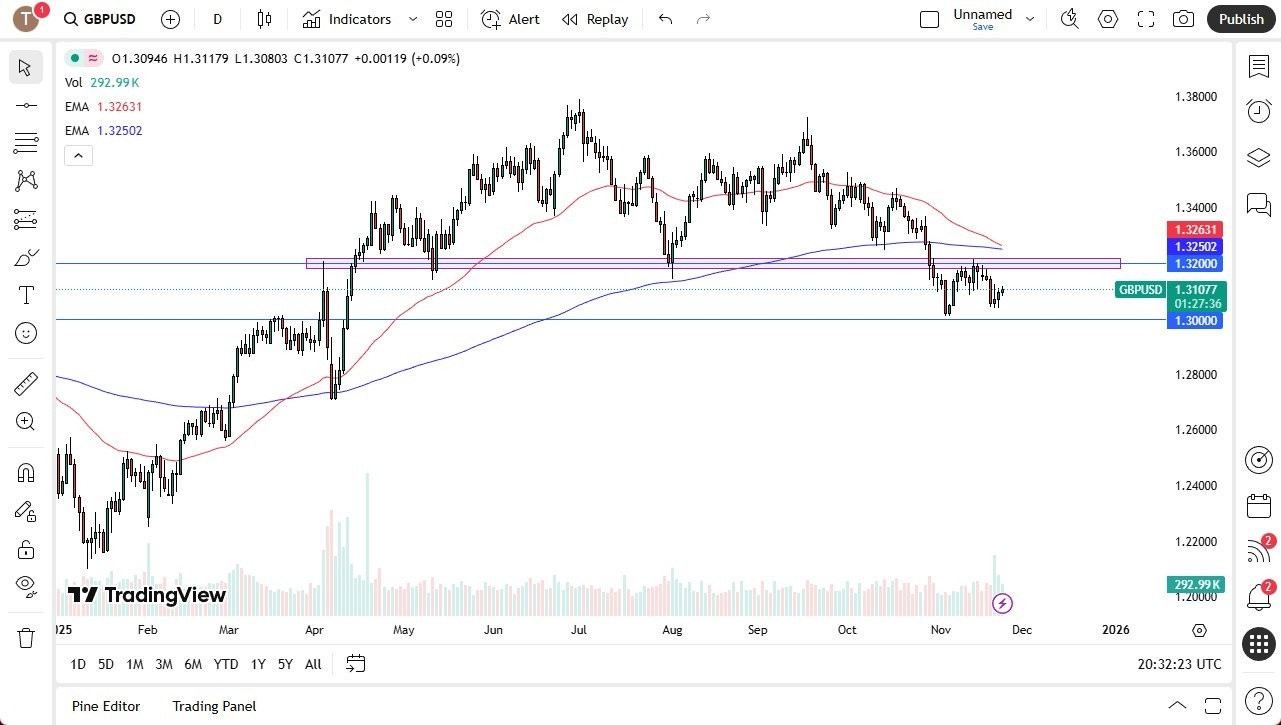
The British pound initially tried to rally during the trading session on Tuesday as well, but then gave back gains and showed a potential shooting star, and therefore, I think we have a real possibility of a drop from here to reach down to the 1.130 level. The 50-day EMA looks as if it is going to cross below the 200-day EMA, kicking off the so-called death cross. The 1.32 level above is significant resistance and 1.30 underneath is support, so we are in a range, but this could, and I believe is going to be, a continuation pattern. So we will just have to see how long it takes for the market to make its next move.
The British pound saw a mild rally as the US dollar weakened, but broader sentiment remains negative.
Key resistance at 1.32 could reinforce dollar strength, while technical signals point to potential further downside toward 1.2750.
The British pound rallied slightly during the trading session on Monday as we saw the US dollar lose some strength across the board. Ultimately, I think this is a pair that still sees a lot of negativity out there, and given enough time, we will likely see that end up being a selling opportunity on signs of exhaustion.
Key Levels and Technical Signals
This will be especially true near the 1.32 level, an area that previously had been significant support and now should be resistance. Rallies at this point in time that do show signs of exhaustion will only confirm the US dollar strength that we have seen across the board. And it’s worth noting that the Bank of England recently chose not to cut rates but came awfully close when you look at the vote count.
I think it is probably only a matter of time if the English cut rates and therefore the British pound will continue to have a little bit of an overhang. If it were to break above the 1.32 level, then I think the British pound could start to change its overall attitude. I don’t even know if that is necessarily the end of the downtrend. I just think it could bring in more volatility. It is worth noting that the 50-day EMA is now threatening to break down below the 200-day EMA, kicking off the so-called death cross. And that, of course, is something that some longer-term traders will pay attention to as a potential negative sign.
If we break down below the 1.30 level, then there is a swing low that I would be watching for a potential target in the form of 1.2750 underneath for a profit target on that move.
Christopher Lewis has been trading Forex and has over 20 years experience in financial markets. Chris has been a regular contributor to Daily Forex since the early days of the site. He writes about Forex for several online publications, including FX Empire, Investing.com, and his own site, aptly named The Trader Guy. Chris favours technical analysis methods to identify his trades and likes to trade equity indices and commodities as well as Forex. He favours a longer-term trading style, and his trades often last for days or weeks.
The US dollar advanced against the yen amid continued volatility, with strong interest rate differentials supporting buyers.
Multiple support zones down to 153 yen highlight persistent dip-buying potential, while a breakout above 158 yen could open the path toward 160.
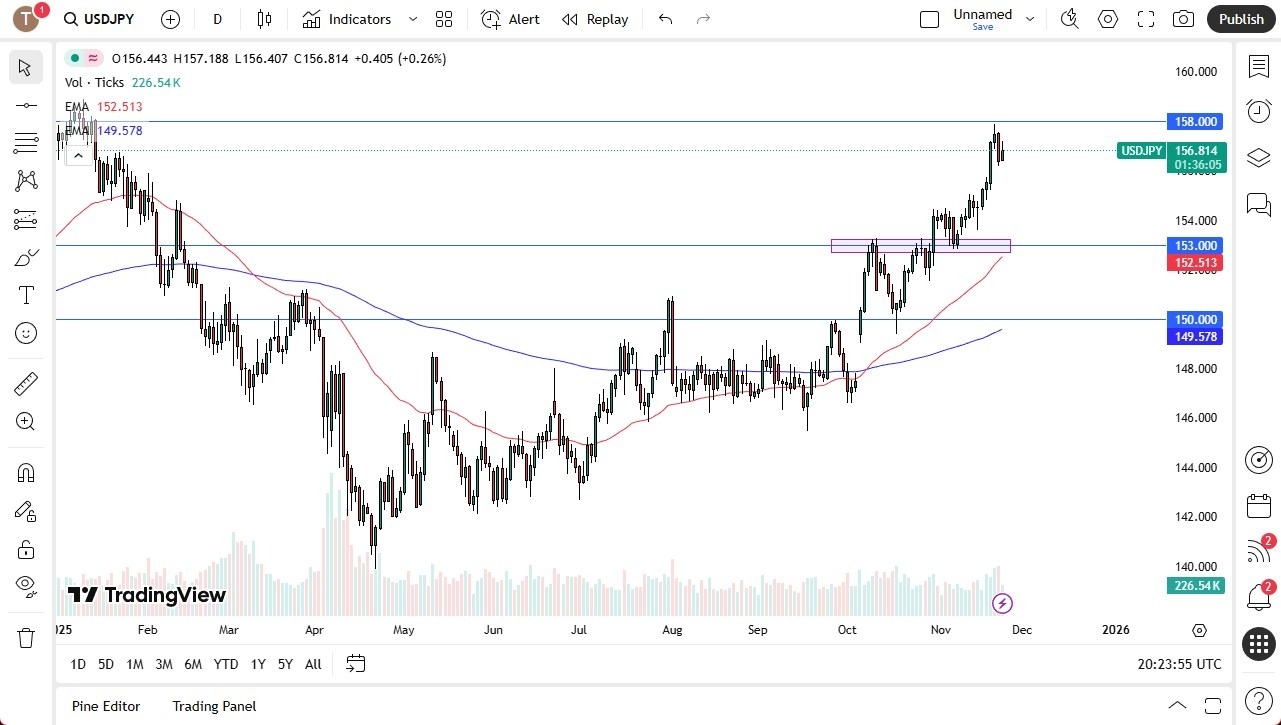
The US dollar rallied against the Japanese yen during the trading session on Monday as the market continues to see a lot of significant volatility. But that being said, the market is likely to continue to see a lot of choppy behavior. But I think even if we do fall from here, it’s likely that we continue to see a lot of buying opportunities all the way down to at least the 153 yen level.
Support Zones and Rate-Differential Dynamics
That being said, the market is likely to continue to see plenty of buyers willing to get involved due to the interest rate differential favoring the United States dollar, as the Bank of Japan simply cannot do anything whatsoever to tighten monetary policy in any significant manner.
If the market does fall from here, I think the 155 yen level is an area that you have to look for some type of bounce, followed by 154.50. And then the 153 yen level, which for me is the absolute floor, the 50-day EMA sits right around there as well. And I think you have a scenario where plenty of people are willing to sit on this trade and simply collect profit at the end of every day via swap. And then, of course, eventually the nominal gains.
If we can break above the 158 yen level, then it’s likely that the market will go to the 159 yen level, which is an area that’s been important. And then naturally we’ll be watching the 160 yen level after that. I have no interest in shorting this pair. And even if we did break down below the 153 yen level, then at that point in time, I’m probably going to check out the fundamental situation before I put any real money into this market.
Christopher Lewis has been trading Forex and has over 20 years experience in financial markets. Chris has been a regular contributor to Daily Forex since the early days of the site. He writes about Forex for several online publications, including FX Empire, Investing.com, and his own site, aptly named The Trader Guy. Chris favours technical analysis methods to identify his trades and likes to trade equity indices and commodities as well as Forex. He favours a longer-term trading style, and his trades often last for days or weeks.