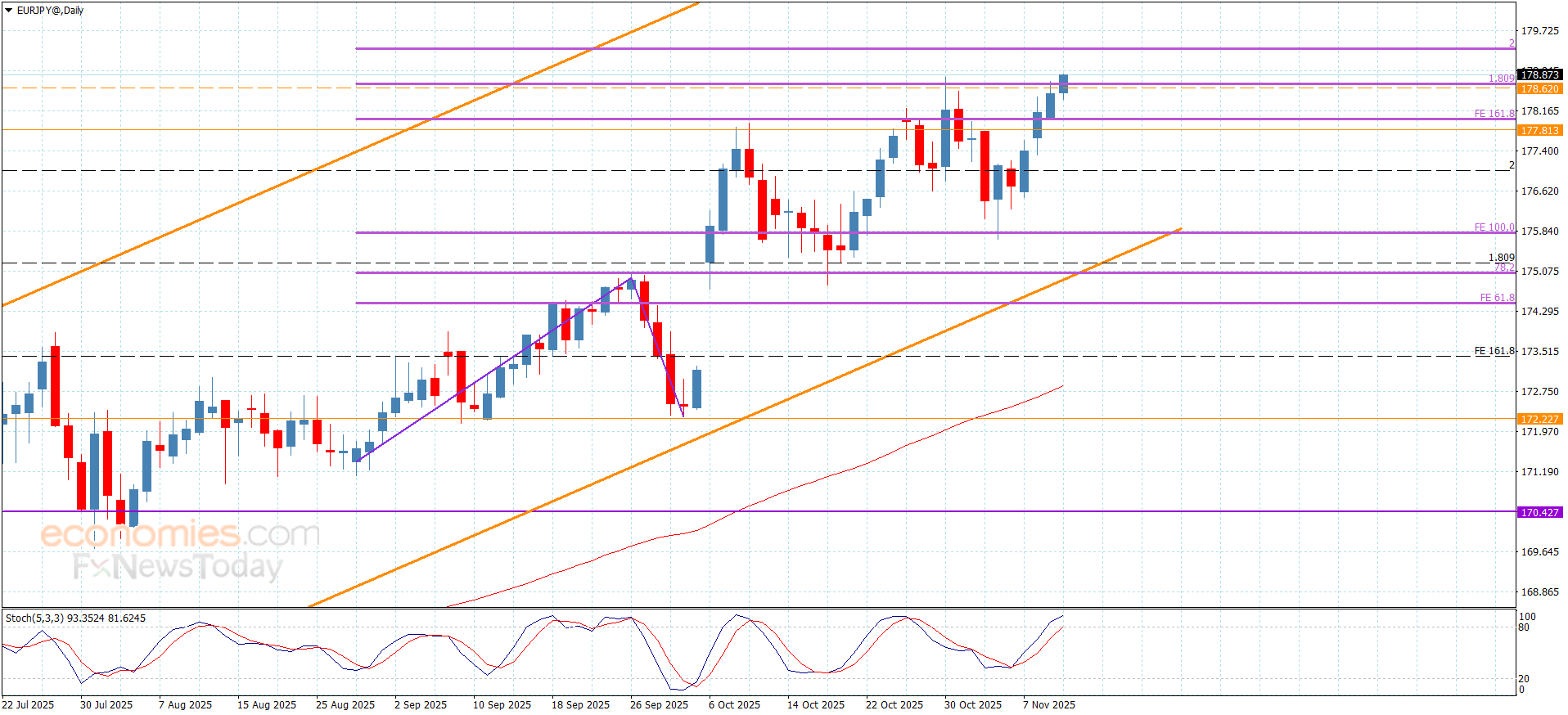
The EURJPY pair confirmed the continuation of the bullish scenario by providing new close above the extra support at 175.20 level, forming bullish moves by reaching 176.00.
Note that the continuation of the main indicators’ contradiction might force the price to provide new sideways fluctuated moves, but its success in surpassing the intraday barrier near 176.45 might increase the efficiency of the bullish track, to target 177.05 level reaching the achieved top at 177.90.
The expected trading range for today is between 175.50 and 176.45
Trend forecast: Fluctuated within the bullish track
The EURJPY pair confirmed the continuation of the bullish scenario by providing new close above the extra support at 175.20 level, forming bullish moves by reaching 176.00.
Note that the continuation of the main indicators’ contradiction might force the price to provide new sideways fluctuated moves, but its success in surpassing the intraday barrier near 176.45 might increase the efficiency of the bullish track, to target 177.05 level reaching the achieved top at 177.90.
The expected trading range for today is between 175.50 and 176.45
Trend forecast: Fluctuated within the bullish track
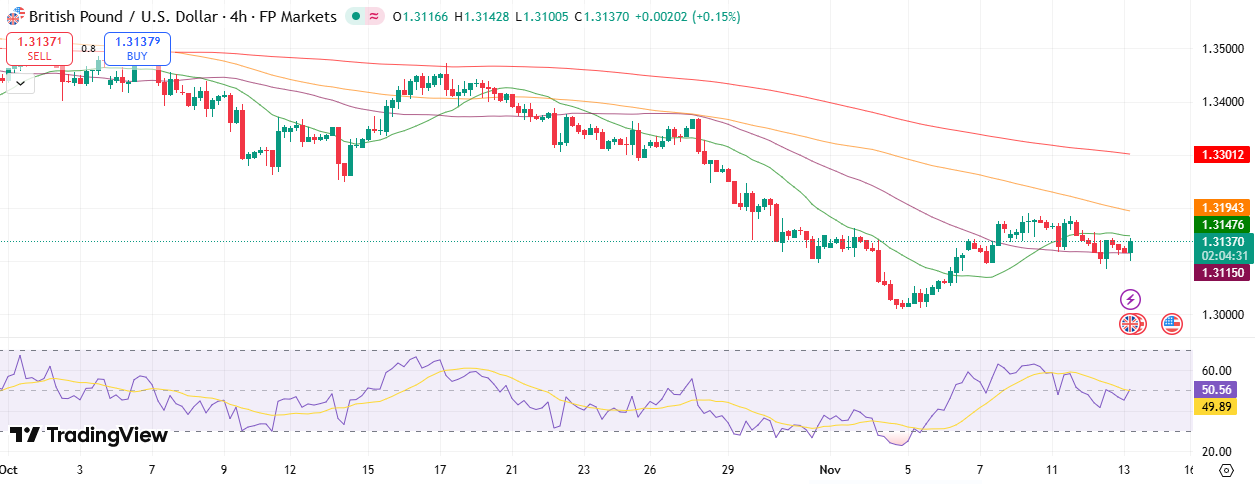
The Pound US Dollar exchange rate (GBP/USD) managed to edge higher on Wednesday, as the currency pair was bolstered by the day’s risk-on flows.
At the time of writing, GBP/USD was trading at approximately $1.3357, up roughly 0.3% from the start of Wednesday’s session.
The US Dollar (USD) struggled to attract support on Wednesday, weakening against the majority of its major peers as an upbeat market mood sapped demand for the safe-haven currency.
With investors showing greater appetite for risk-sensitive assets, the ‘Greenback’ lost ground during mid-week trade, as optimism in global markets diverted flows away from the traditionally safe USD.
Adding to the pressure, lingering reactions to Federal Reserve Chair Jerome Powell’s speech on Tuesday continued to weigh on sentiment.
Powell struck a notably dovish tone, prompting traders to scale back bets on the Dollar, and left USD exchange rates struggling to regain momentum throughout Wednesday’s European session.
The Pound (GBP), by contrast, held firm against most of its major counterparts on Wednesday and even managed to edge higher against several rivals, despite a quiet day on the UK data front.
Save on Your GBP/USD Transfer
Get better rates and lower fees on your next international money transfer.
Compare TorFX with top UK banks in seconds and see how much you could save.
With no domestic releases to drive direction, Sterling took its cues from broader market sentiment, finding support amid the day’s upbeat trading tone.
As a currency that increasingly benefits from risk-on trading conditions, the Pound strengthened against traditional safe-haven currencies, buoyed by improved investor confidence.
However, this same dynamic saw GBP struggle to keep pace with its more risk-sensitive peers, resulting in a mixed performance overall during Wednesday’s European session.
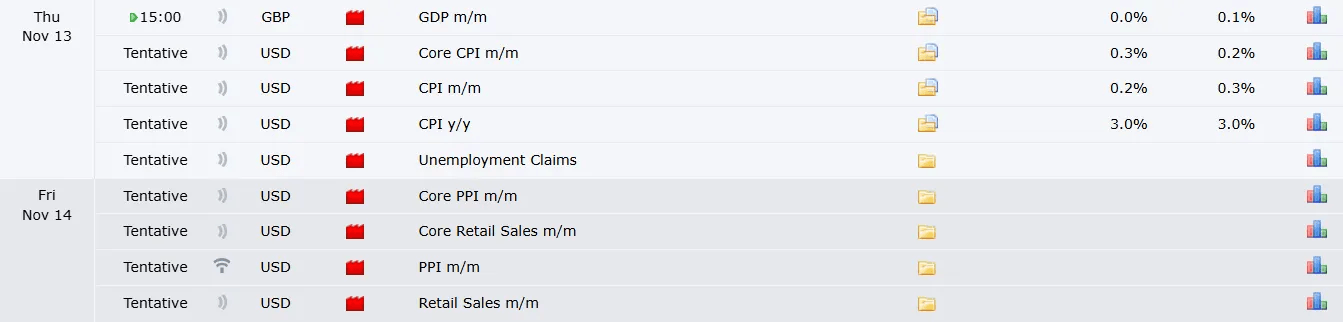
Looking ahead to Thursday’s European session, movement in the GBP/USD exchange rate is likely to hinge on the release of the UK’s latest GDP report.
The figures for August are expected to show a modest 0.1% expansion, which, while not particularly strong, could still lend the Pound some limited support if the data meets or exceeds forecasts.
Across the Atlantic, the ongoing US government shutdown means key data releases will once again be delayed, leaving the US Dollar vulnerable to broader market sentiment and commentary from Federal Reserve officials.
If upcoming Fed speeches lean dovish, reinforcing expectations of potential interest rate cuts later this year, the ‘Greenback’ could face additional selling pressure, paving the way for further USD losses through Thursday’s European trade.
Like this piece? Please share with your friends and colleagues:
International Money Transfer? Ask our resident FX expert a money transfer question or try John’s new, free, no-obligation personal service! ,where he helps every step of the way,
ensuring you get the best exchange rates on your currency requirements.
Register now to be able to add articles to your reading list.
” aria-hidden=”true”>
Quick overview
The British Pound rebounded on Wednesday as the US Dollar weakened, with a 94% chance of a Federal Reserve interest rate cut in October.
Federal Reserve officials are hinting at potential rate cuts due to a slowing labor market and economic uncertainty from the US Government shutdown.
Despite the short-term gains, the British Pound faces challenges from a slowing UK labor market, which may lead to a Bank of England rate cut later this year.
GBP/USD is currently testing a key resistance level at $1.34, with a bullish outlook if it closes above this mark.
The British Pound bounced back to life on Wednesday morning, ending a 2 day slide as the US Dollar looked to be weakening – and a cut in interest rates from the Federal Reserve seems to be on the cards. We now see a 94% chance of a rate slash in October, and 93% in December, according to the CME FedWatch tool.
Federal Reserve chief Jerome Powell has hinted that a further cut might happen this month, pointing to a slowing labour market and general uncertainty about the economy caused by the ongoing US Government shutdown. Boston Fed president Susan Collins nodded in agreement, pointing out that even while the cuts take place, the policy may still remain restrictive – and that’s a sign that the central bank is taking things at a gentle pace.
Markets are keeping a close eye on what the Fed’s Stephen Miran, Christopher Waller and Jeff Schmid – all have to say in speeches this week – as they look to figure out the timing and pace of any future policy shifts.
GBP/USD Pound Still Struggling – Despite a Weaker Dollar
The weaker dollar is certainly helping pound come back up in the short term – but the British Pound has its own problems to worry about too. The UK Labour market has been slowing down and that has led markets to think that the Bank of England may have to cut interest rates later this year – by about 46 basis points. This slowdown in hiring and wage growth is a sign the economy is getting a bit soft – which may cap the GBPs gains.
Investors are going to be keeping a close eye on what the Bank of England has to say this week, looking to see how they plan to balance their worries about inflation with the risk of economic stagnation. Any particularly dovish comments could make the pound a bit riskier, especially if the Fed sticks to its plan to take things slow.
GBP/USD Technical Outlook: It’s All About That $1.34 Level
GBP/USD is currently trading at $1.3355 and showing a bit of caution as it tries to get past a resistance line that has been blocking it since late September. The pair is generally in a downtrend, but it has managed to put in some higher low prices around $1.3260 – which is a bit of a sign of recovery.
GBP/USD Price Chart – Source: Tradingview
$1.3407 is a key level at the moment – the 100 period moving average is sitting right there – and as long as the pound stays below that, it may not be able to make much progress. A close above $1.3400 could be a signal that the trend has turned in the pound’s favour though – and that could open the way to even higher prices – we’re talking $1.3444 and $1.3529.
What’s also worth noting is that the pair put in a bit of a bullish engulfing pattern down at the lower end of its range – followed by a spinning top candle, that’s a bit of a sign of short term indecision before it decided to go up. The RSI is sitting at 57.5 just now – that’s a sign of improving momentum without getting too overbought – which is good news for the pound.
Trade Setup Highlights:
Entry Zone: Go long when you see a confirmed breakout above $1.3400
Targets: $1.3440 and $1.3520
Stop-Loss: Below $1.3250, dont risk more than you can afford to
Bias: We’re slightly bulllish as long as its over $1.3300
Summary
As investors try to get to grips with the fact that the Fed and the BoE are going in opposite directions with their interest rates – the GBP/USD remains in a bit of a tight spot but is leaning in a generally bullish direction. A close above $1.34 could be a sign that the pound is ready to take off – and that the dollar’s momentum is starting to slip.
Arslan Butt
Lead Markets Analyst – Multi-Asset (FX, Commodities, Crypto)
Arslan Butt serves as the Lead Commodities and Indices Analyst, bringing a wealth of expertise to the field. With an MBA in Behavioral Finance and active progress towards a Ph.D., Arslan possesses a deep understanding of market dynamics.
His professional journey includes a significant role as a senior analyst at a leading brokerage firm, complementing his extensive experience as a market analyst and day trader. Adept in educating others, Arslan has a commendable track record as an instructor and public speaker.
His incisive analyses, particularly within the realms of cryptocurrency and forex markets, are showcased across esteemed financial publications such as ForexCrunch, InsideBitcoins, and EconomyWatch, solidifying his reputation in the financial community.
Wednesday, October 15, 2025: Analysis of euro price against the dollar EUR/USD
EUR/USD Analysis Summary Today
General Trend: Bearish.
Today’s Support Points for EUR/USD: 1.1540 – 1.1460 – 1.1380.
Today’s Resistance Points for EUR/USD: 1.1670 – 1.1730 – 1.1800.
EUR/USD Trading Signals:
Buy the EUR/USD from the support level of 1.1510, target 1.1700, and stop loss 1.1420.
Sell the EUR/USD from the resistance level of 1.1720, target 1.1500, and stop loss 1.1700.
Technical Analysis of EUR/USD Today:
The Euro against the U.S. Dollar (EUR/USD) exchange rate continued its losses to reach a two-month low when it tested the 1.1542 support level. Subsequent attempts to bounce higher failed to move above the 1.1630 level amid declining buying interest, which kept the Euro trading lower. Forex currency market analysts warn of the potential for further losses toward the 1.15 support if sentiment does not improve.
According to performance across reliable trading company platforms, the dollar’s rise extended, with the U.S. Dollar Index (DXY) reaching a ten-week high above 99.50 before retreating to 99.30. Analysts suggest that the dollar’s recent rise went against market trends and forced partial covering of U.S. dollar short positions.
They added that there is still a high degree of skepticism about the U.S. dollar’s ability to significantly cross the 100 resistance level on the dollar index, a level that quickly reversed in May. However, some cautious analysts note that conditions remain oversold, but with no signs of stability yet, the Euro price might fall below 1.1540. The next support level at 1.1490 is unlikely to appear today.
Technically, if the EUR/USD pair takes another hit, we expect good buying on dips near 1.150… A return to the 1.170 resistance, albeit not smoothly or unilaterally, remains our preferred option.
Political uncertainty in France continues to cast a shadow. In this regard, President Macron is scheduled to meet with party leaders on Friday before naming a new Prime Minister. Rabobank warned: “Political risks remain until budget negotiations are complete. The incoming French Prime Minister still faces difficult negotiations… and any concessions will weaken fiscal discipline.”
Meanwhile, New York Fed President Williams hinted at further monetary easing, stating, “My focus is on the downside risks to the labor market,” pointing to reduced inflation pressures stemming from tariffs. Experts believe his statements reflect the majority view within the Federal Open Market Committee (FOMC) that further rate cuts are likely in upcoming meetings.
The scenario for the EUR/USD decline remains the strongest. According to the daily chart performance, the 14-day RSI is still around a reading of 43 (below the neutral line), confirming the bears’ dominance over the currency pair’s direction. At the same time, the MACD indicator lines are strongly tilted downwards. A break below the 1.1600 support signals a stronger bearish move until technical indicators reach the oversold peak. Conversely, over the same timeframe, the 1.1800 resistance will remain the most crucial for a clear change towards an uptrend in EUR/USD. The currency pair will be affected today by a new round of statements from U.S. Federal Reserve officials regarding the future of the bank’s interest rates and the outlook for the U.S. economy amid the ongoing government shutdown.
Trading Tips:
Dear TradersUp trader, look for stronger selling pressure before considering buying the Euro/Dollar again, but without risk, no matter how strong the trading opportunity is.Powell warns of weak US jobs.
Powell Warns of U.S. Job Weakness
Federal Reserve Chair Jerome Powell acknowledged during the National Association for Business Economics (NABE) meeting in Philadelphia that U.S. economic activity is slightly stronger than expected, but warned of increasing risks to employment. He stated: “While the country’s unemployment rate remained low through August, payroll gains have slowed sharply, likely due in part to lower labor force growth resulting from lower immigration and labor market participation rates. Amid a less dynamic and more flexible labor market, the downside risks to employment appear to have risen.”
Jerome Powell also indicated that the US Federal Reserve may complete its balance sheet reassessment in the coming months, indicating that liquidity conditions are gradually tightening. He warned that delaying action could exacerbate the impact of tariffs and the potential for job losses, while the recent lack of key data has increased uncertainty about the outlook for monetary policy.
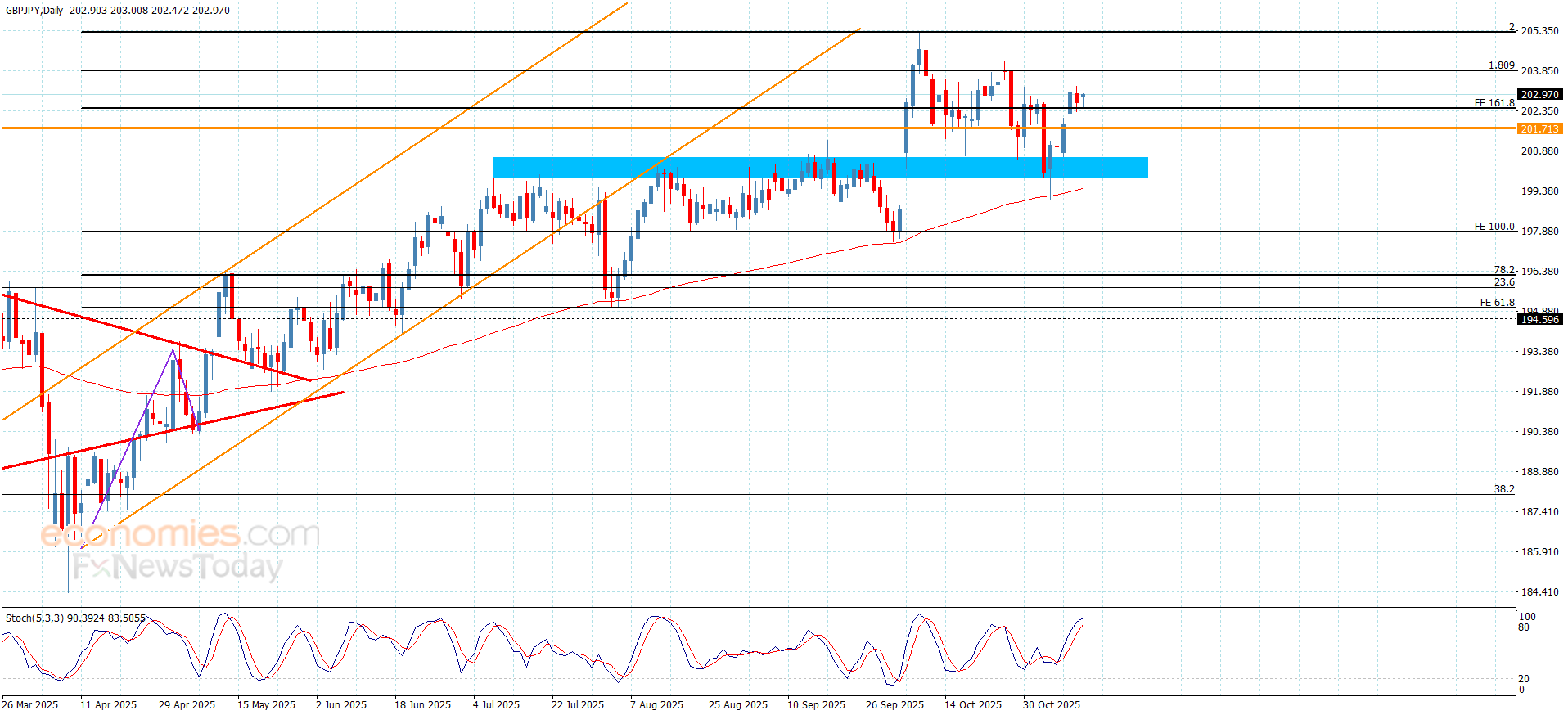
The British Pound is posting moderate gains on Wednesday, as a mild appetite for risk and ongoing political uncertainty in Japan weigh on the Japanese Yen. The Pair has returned beyond the 202.00 level, after bouncing from 201.35 lows on Tuesday.
The risk mood improved on Wednesday, as market expectations of upcoming interest rate cuts by the Federal Reserve were influenced by concerns about escalating trade tensions between Washington and Beijing, at least for now.
In Japan, the Yen found some footing amid the dwindling chances that the pro-stimulus Sanae Takaichi becomes Prime Minister. Still, the ongoing political uncertainty is keeping a lid on JPY recovery.
Technical analysis: The broader bias remains bearish below 203.50
The technical picture shows easing bearish pressure, yet with the upside momentum frail. The 4-hour Relative Strength Index is still below the 50 level, and price action remains trapped within an expanding bearish wedge from last week’s highs.
Bulls are testing Tuesday’s high, at 202.35, on their way to the wedge top, now at the 202.80 area, where they are likely to meet significant resistance. Beyond here, the October 13 high, at 203.50, is the key level to confirm that the correction from October 8 lows has been completed.
To the downside, immediate support is at the 201.25 area, where the 50% Fibonacci retracement of the early October rally meets October 6 and October 14 lows. Further down, the 200.40 level (September 26 highs and October 6 low) emerges as the next target ahead of Monday’s gap opening level, at 198.85.
Pound Sterling Price Today
The table below shows the percentage change of British Pound (GBP) against listed major currencies today. British Pound was the strongest against the US Dollar.
USD
EUR
GBP
JPY
CAD
AUD
NZD
CHF
USD
-0.16%
-0.29%
-0.26%
-0.06%
-0.52%
-0.08%
-0.12%
EUR
0.16%
-0.08%
-0.11%
0.08%
-0.34%
0.03%
0.04%
GBP
0.29%
0.08%
-0.02%
0.20%
-0.26%
0.11%
0.17%
JPY
0.26%
0.11%
0.02%
0.18%
-0.26%
0.03%
0.24%
CAD
0.06%
-0.08%
-0.20%
-0.18%
-0.47%
-0.09%
-0.03%
AUD
0.52%
0.34%
0.26%
0.26%
0.47%
0.37%
0.42%
NZD
0.08%
-0.03%
-0.11%
-0.03%
0.09%
-0.37%
0.06%
CHF
0.12%
-0.04%
-0.17%
-0.24%
0.03%
-0.42%
-0.06%
The heat map shows percentage changes of major currencies against each other. The base currency is picked from the left column, while the quote currency is picked from the top row. For example, if you pick the British Pound from the left column and move along the horizontal line to the US Dollar, the percentage change displayed in the box will represent GBP (base)/USD (quote).
The GBP/USD exchange rate remained in a tight range this week as investors focused on the recent statements by Jerome Powell and Andrew Bailey, and the recently released UK jobs numbers. It was trading at 1.3342 on Wednesday, down from the year-to-date high of 1.3790.
Dovish Federal Reserve statements
The GBP/USD exchange rate was under pressure after Jerome Powell hinted that the Federal Reserve will continue cutting interest rates in the coming meeting, citing the downward risks to the labor market.
Equally important, Powell hinted that the bank will either end or dramatically slow down the quantitative tightening process, which involves reducing the size of the balance sheet.
Other Federal Reserve officials have hinted that the bank will continue with its cuts. In her statement, Susan Collins, the head of the Boston Fed, said that she supported two more cuts this year. She justified the view noting that inflation risks were contained, but that the labor market was a bigger risk. She said:
“With inflation risks somewhat more contained, but greater downside risks to employment, it seems prudent to normalize policy a bit further this year to support the labor market.”
The next important catalyst for the GBP/USD exchange rate will be statements by some Federal Reserve officials, many who have supported interest rate cuts in the past.
Stephen Moran, who became a Fed governor in September, will likely continue to make the case for more cuts i the next meetings. He was the first governor to vote for a 0.50% cut in the last meeting.
Christopher Waller, another highly dovish official, will continue to make the case for cuts in the coming meetings. Other Fed members to talk will be Raphael Bostic and Jeffrey Schmid.
The GBP/USD pair will also react to the upcoming Federal Reserve Beige Book, which shows the performance of the key US regions.
UK GDP data ahead
The other key catalyst for the GBP/USD exchange rate will be the upcoming UK GDP data. Economists expect the data to show that the economy slowed to 1.3% in August from the previous 1.4%. On a MoM basis, the economy is expected to have grown by 0.1% after stalling in July.
The Office of National Statistics (ONS) will also react to the upcoming manufacturing and industrial production numbers.
These reports come two days after it reported weak jobs numbers. In a statement on Tuesday, Andrew Bailey, the BoE Chair hinted that the bank will hold rates steady in the coming meetings as inflation is a big challenge.
GBP/USD technical analysis
GBPUSD chart | Source: TradingView
The GBP/USD exchange rate has pulled back in the past few weeks. It dropped from a high of 1.3721 in September to the current 1.3350.
The pair has formed a head-and-shoulders pattern and is now at the neckline. It has retested that neckline. Therefore, the pair will likely continue falling as sellers target the key support at 1.3135, its lowest point on August 1.
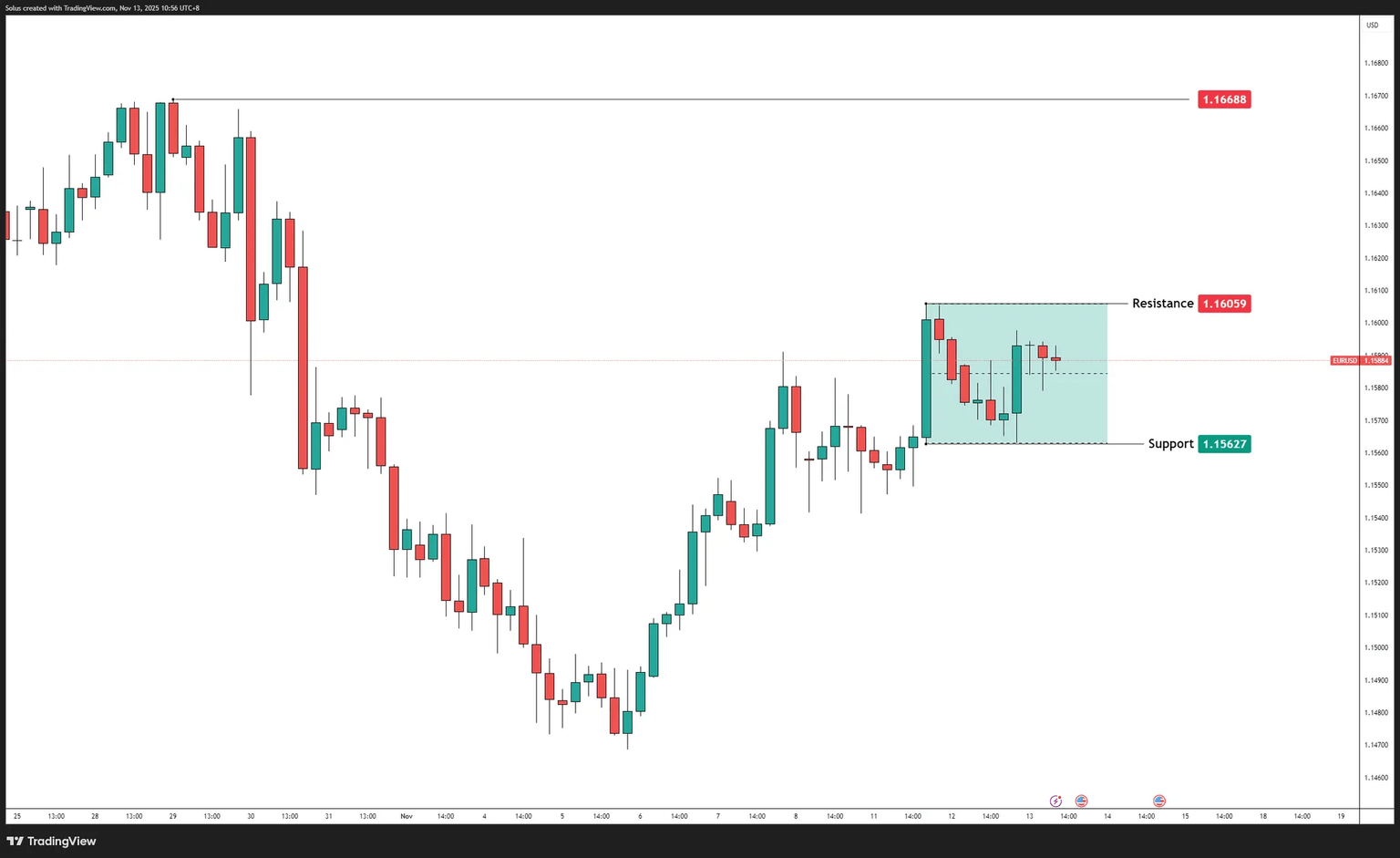
EUR/USD benefited from the renewed US Dollar (USD) weakness on Tuesday and closed the day in positive territory. The pair preserves its recovery momentum and advances toward 1.1650 in the European session on Wednesday.
Euro Price Today
The table below shows the percentage change of Euro (EUR) against listed major currencies today. Euro was the strongest against the US Dollar.
USD
EUR
GBP
JPY
CAD
AUD
NZD
CHF
USD
-0.24%
-0.25%
-0.36%
-0.01%
-0.50%
-0.04%
-0.20%
EUR
0.24%
0.04%
-0.14%
0.21%
-0.23%
0.14%
0.04%
GBP
0.25%
-0.04%
-0.18%
0.21%
-0.26%
0.10%
0.06%
JPY
0.36%
0.14%
0.18%
0.34%
-0.12%
0.17%
0.27%
CAD
0.00%
-0.21%
-0.21%
-0.34%
-0.49%
-0.11%
-0.15%
AUD
0.50%
0.23%
0.26%
0.12%
0.49%
0.36%
0.31%
NZD
0.04%
-0.14%
-0.10%
-0.17%
0.11%
-0.36%
-0.04%
CHF
0.20%
-0.04%
-0.06%
-0.27%
0.15%
-0.31%
0.04%
The heat map shows percentage changes of major currencies against each other. The base currency is picked from the left column, while the quote currency is picked from the top row. For example, if you pick the Euro from the left column and move along the horizontal line to the US Dollar, the percentage change displayed in the box will represent EUR (base)/USD (quote).
Federal Reserve (Fed) Chairman Jerome Powell’s neutral tone and growing concerns over a further escalation of the US-China trade conflict caused the USD to come under pressure in the second half of the day on Tuesday.
While speaking at the National Associations for Business Economics (NABE) Annual Meeting in Philadelphia on Tuesday, Powell acknowledged that downside risks to the labor market had risen, but also noted that there is a risk that the slow pass-through of tariffs could start to look like persistent inflation. “The future path of monetary policy will be driven by data and risk assessments,” he reiterated.
In the meantime, US President Donald Trump said in a social media post that they could start terminating some trade ties with China, adding that he believes China is causing difficulty for American farmers by purposefully not buying soybeans from the US.
The economic calendar will not offer any high-impact macroeconomic data releases later in the day. In case Trump, or other White House officials, switch to a softer tone on trade-related issues with China, the USD could regain its traction and make it difficult for EUR/USD to extends its recovery. On the flip side, the pair is likely to hold its ground if there are no signs of a de-escalation of the US-China conflict.
EUR/USD Technical Analysis
The Relative Strength Index (RSI) indicator on the 4-hour chart rises toward 60, pointing to an increasing buyer interest.
On the upside, the 100-day Simple Moving Average aligns as a key resistance level at 1.1650. In case EUR/USD rises above this level and starts using it as support, the pair could gather bullish momentum. In this scenario, 1.1700 (Fibonacci 38.2% retracement of the latest uptrend, 200-period SMA) could be seen as the next hurdle ahead of 1.1765 (Fibonacci 23.6% retracement).
Looking south, support levels could be spotted at 1.1580 (Fibonacci 61.8% retracement), 1.1550 (static level) and 1.1500 (Fibonacci 78.6% retracement).
Euro FAQs
The Euro is the currency for the 19 European Union countries that belong to the Eurozone. It is the second most heavily traded currency in the world behind the US Dollar. In 2022, it accounted for 31% of all foreign exchange transactions, with an average daily turnover of over $2.2 trillion a day.
EUR/USD is the most heavily traded currency pair in the world, accounting for an estimated 30% off all transactions, followed by EUR/JPY (4%), EUR/GBP (3%) and EUR/AUD (2%).
The European Central Bank (ECB) in Frankfurt, Germany, is the reserve bank for the Eurozone. The ECB sets interest rates and manages monetary policy.
The ECB’s primary mandate is to maintain price stability, which means either controlling inflation or stimulating growth. Its primary tool is the raising or lowering of interest rates. Relatively high interest rates – or the expectation of higher rates – will usually benefit the Euro and vice versa.
The ECB Governing Council makes monetary policy decisions at meetings held eight times a year. Decisions are made by heads of the Eurozone national banks and six permanent members, including the President of the ECB, Christine Lagarde.
Eurozone inflation data, measured by the Harmonized Index of Consumer Prices (HICP), is an important econometric for the Euro. If inflation rises more than expected, especially if above the ECB’s 2% target, it obliges the ECB to raise interest rates to bring it back under control.
Relatively high interest rates compared to its counterparts will usually benefit the Euro, as it makes the region more attractive as a place for global investors to park their money.
Data releases gauge the health of the economy and can impact on the Euro. Indicators such as GDP, Manufacturing and Services PMIs, employment, and consumer sentiment surveys can all influence the direction of the single currency.
A strong economy is good for the Euro. Not only does it attract more foreign investment but it may encourage the ECB to put up interest rates, which will directly strengthen the Euro. Otherwise, if economic data is weak, the Euro is likely to fall.
Economic data for the four largest economies in the euro area (Germany, France, Italy and Spain) are especially significant, as they account for 75% of the Eurozone’s economy.
Another significant data release for the Euro is the Trade Balance. This indicator measures the difference between what a country earns from its exports and what it spends on imports over a given period.
If a country produces highly sought after exports then its currency will gain in value purely from the extra demand created from foreign buyers seeking to purchase these goods. Therefore, a positive net Trade Balance strengthens a currency and vice versa for a negative balance.
Platinum price is affected by the stability of the barrier near $1690.00, despite the attempt to provide positive momentum by the main indicators, which forces it to provide new sideways trading near $1650.00 level, attempting to settle above the extra support at $1600.00.
Reminding you that the bullish scenario will remain valid by the stability of the price above 61.8% Fibonacci extension level that is located near $1625.00, which makes us wait to breach the current barrier, then targeting new historical stations that might begin at $1745.00 reaching the next main target near $1835.00.
The expected trading range for today is between $1610.00 and $1690.00
Trend forecast: Sideways until achieving the breach
Platinum price is affected by the stability of the barrier near $1690.00, despite the attempt to provide positive momentum by the main indicators, which forces it to provide new sideways trading near $1650.00 level, attempting to settle above the extra support at $1600.00.
Reminding you that the bullish scenario will remain valid by the stability of the price above 61.8% Fibonacci extension level that is located near $1625.00, which makes us wait to breach the current barrier, then targeting new historical stations that might begin at $1745.00 reaching the next main target near $1835.00.
The expected trading range for today is between $1610.00 and $1690.00
Trend forecast: Sideways until achieving the breach