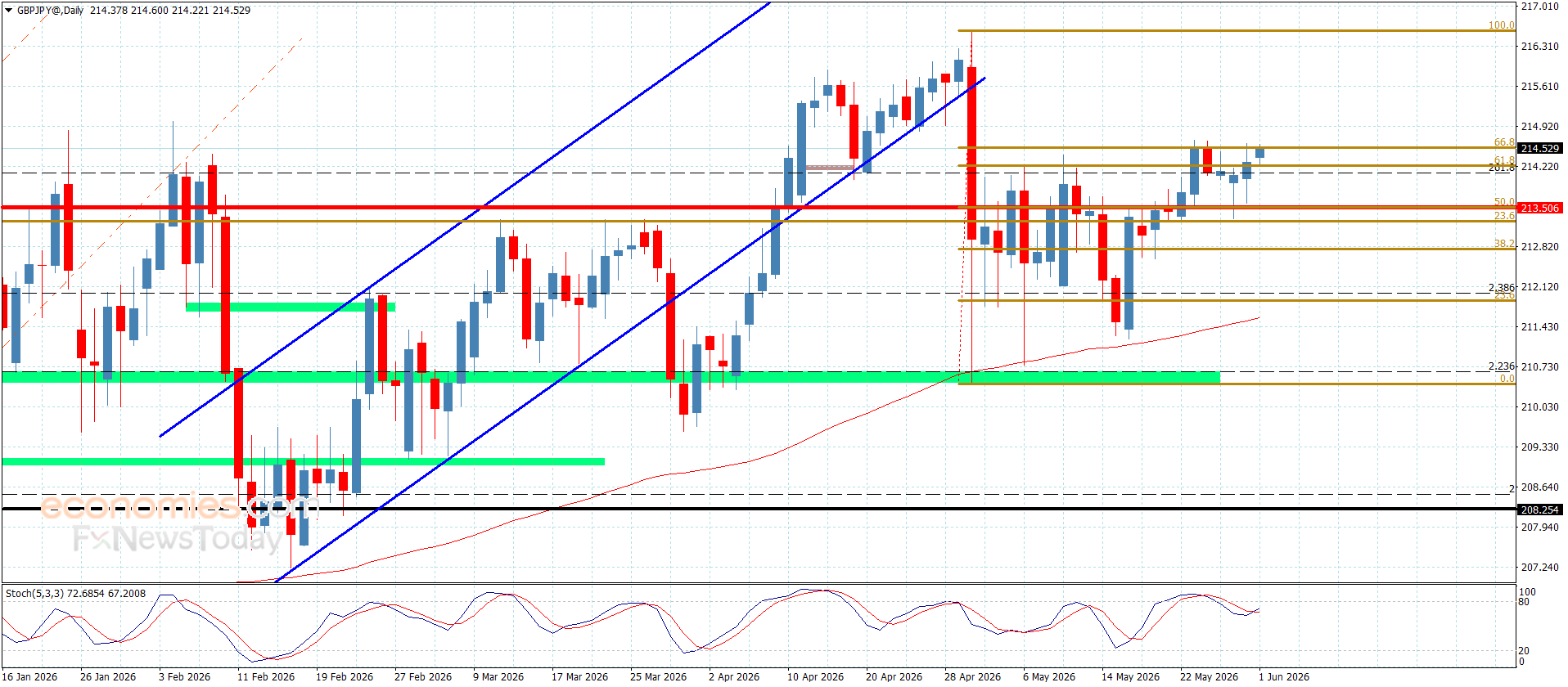
The GBPJPY pair ended yesterday’s trading by providing positive close above 214.50 barrier, announcing its readiness to readiness to renew the bullish attempts by reaching 215.00 level, providing positive momentum by stochastic will keep our bullish scenario, which might target 215.30 level, surpassing it will make the next target at 215.75 in he current trading.
While the attempt of activating the bearish corrective trend requires forming several negative waves, to settle below the extra support at 213.30.
The expected trading range for today is between 214.40 and 215.75
The Pound US Dollar (GBP/USD) exchange rate fell on Monday as escalating tensions in the Middle East and stronger-than-expected US data lifted the safe-haven ‘Greenback’.
At the time of writing, GBP/USD was trading at $1.3421, down more than 0.2% on the day.
The safe-haven US Dollar (USD) strengthened on Monday as a deterioration in market sentiment drove investors towards safer assets.
The latest bout of risk aversion followed an exchange of strikes between the US and Iran over the weekend. Iran subsequently accused the US and Israel of breaching the ceasefire agreement and stated that it would withdraw from peace talks until Israel halted its attacks on Lebanon.
Meanwhile, the currency also drew support from upbeat US economic data. The latest ISM manufacturing PMI showed that factory activity accelerated more sharply than expected in May, with the index rising from 52.7 to 54, beating forecasts of 53.
Meanwhile, the increasingly risk-sensitive Pound (GBP) weakened against its safer peers as the market mood soured.
Sterling had initially edged higher in the morning after the UK’s latest manufacturing PMI showed activity climbing to a four-year high in May. The survey also reported rising input price inflation, which fuelled expectations for further Bank of England (BoE) interest rate hikes.
Save on Your GBP/USD Transfer
Get better rates and lower fees on your next international money transfer.
Compare TorFX with top UK banks in seconds and see how much you could save.
While this may have helped to limit the Pound’s losses, domestic political uncertainty may have dented GBP. On Monday, the government published documents relating to the controversial appointment of Peter Mandelson as ambassador to the US, with the UK’s febrile political atmosphere potentially unnerving investors.
Near-Term GBP/USD Forecast: Could BoE Comments Boost Sterling?
Looking ahead, UK economic data is limited on Tuesday. However, BoE policymaker Megan Greene is due to speak in the afternoon. As Greene is considered one of the more hawkish members of the Monetary Policy Committee, Sterling could strengthen if she argues in favour of higher interest rates.
Tuesday will also see the publication of the latest US Job Openings and Labor Turnover Survey (JOLTS). The data is expected to show a marginal decline in job openings in April, which may have only a muted impact on the US Dollar. However, any surprises could spark sharper movement.
Elsewhere, developments in the Middle East could inject volatility into GBP/USD by influencing risk appetite. Hopes of peace may lift market sentiment and potentially support the Pound, while a fresh escalation in tensions would likely sour the mood and bolster the safe-haven US Dollar.
Like this piece? Please share with your friends and colleagues:
International Money Transfer? Ask our resident FX expert a money transfer question or try John’s new, free, no-obligation personal service! ,where he helps every step of the way,
ensuring you get the best exchange rates on your currency requirements.
2026.06.01 2026.06.01 Yen Under Pressure Near Key Intervention Threshold. Forecast as of 01.06.2026
Dmitri Demidenkohttps://www.litefinance.org/blog/authors/dmitri-demidenko/
The Bank of Japan’s policy meeting, combined with the government’s currency interventions, has tempered USD/JPY bulls twice. Will history repeat itself in June? Perhaps, if the BoJ refrains from raising rates. Let’s analyze the situation and make a trading plan.
The article covers the following subjects:
Major Takeaways
Disappointment with the BoJ will trigger a surge in USD/JPY quotes.
The risk of currency interventions may increase.
The yen’s position is better than it was a month ago.
A break above 160 followed by a pullback below that level is a reason to sell the USD/JPY pair.
Weekly Fundamental Forecast for Yen
If something happens once, it may never happen again. However, if it happens twice, it is bound to happen a third time. Just as in 2024, Japan intervened in the Forex market at the end of April and beginning of May, immediately following the BoJ meeting and the resulting decline in the yen. The central bank disappointed, and the government was forced to intervene to stop USD/JPY bulls. As the June Board of Governors meeting approaches, there is a sense of déjà vu.
The futures market indicates a 75% probability of an overnight rate hike at the Bank of Japan’s first summer meeting. However, the latest data on slowing inflation could allow doves to convince the rest of the BoJ officials of the need to continue the pause in the monetary tightening cycle. If that happens, the USD/JPY pair will likely surge above the psychologically important 160 level.
Speculative Positions on Japanese Yen
Source: Bloomberg.
Speculators are counting on this scenario. Hedge funds and asset managers have increased their net short positions in the yen to their highest levels in nearly two years, despite all the government’s warnings. As a result, Satsuki Katayama has resumed verbal interventions. The finance minister stated that the authorities were ready to take decisive action if they observed increased volatility or signs of speculative activity in the Forex market.
At the turn of April and May, Japan spent ¥11.7 trillion on currency interventions. The amount exceeded the market estimate of ¥10 trillion and sparked rumors that there may have been more than two interventions within a short period. If so, they could resume before the USD/JPY pair reaches the 160 level.
USD/JPY Rate and Interventions on Forex
Source: Bloomberg.
In reality, currency interventions are merely a way to buy time, not a turning point. Although the yen is currently trading at the same levels as in early May, the fundamental outlook is far more favorable for it now than it was then. The conflict in the Middle East is about to end, and oil prices will likely fall, benefiting Japan—a net importer of crude oil—more than the US. At the same time, the Fed will have less reason to raise the federal funds rate, and demand for the dollar as a safe-haven asset may decline.
All of this, combined with excessively inflated speculative positions on the yen, allows Eurizon SLJ Capital to forecast that the upward trend in USD/JPY quotes will reverse. It is quite possible that the authorities will not need to buy more time, especially if the Bank of Japan meets expectations and raises the overnight rate to 1% in June.
Weekly USDJPY Trading Plan
While in April and May I suggested buying the USD/JPY pair following currency interventions, such interventions could now reverse the uptrend. If the price pierces the 160 level, and a sharp downward move follows, short positions can be considered.
This forecast is based on the analysis of fundamental factors, including official statements from financial institutions and regulators, various geopolitical and economic developments, and statistical data. Historical market data are also considered.
The content of this article reflects the author’s opinion and does not necessarily reflect the official position of LiteFinance broker. The material published on this page is provided for informational purposes only and should not be considered as the provision of investment advice for the purposes of Directive 2014/65/EU.
According to copyright law, this article is considered intellectual property, which includes a prohibition on copying and distributing it without consent.
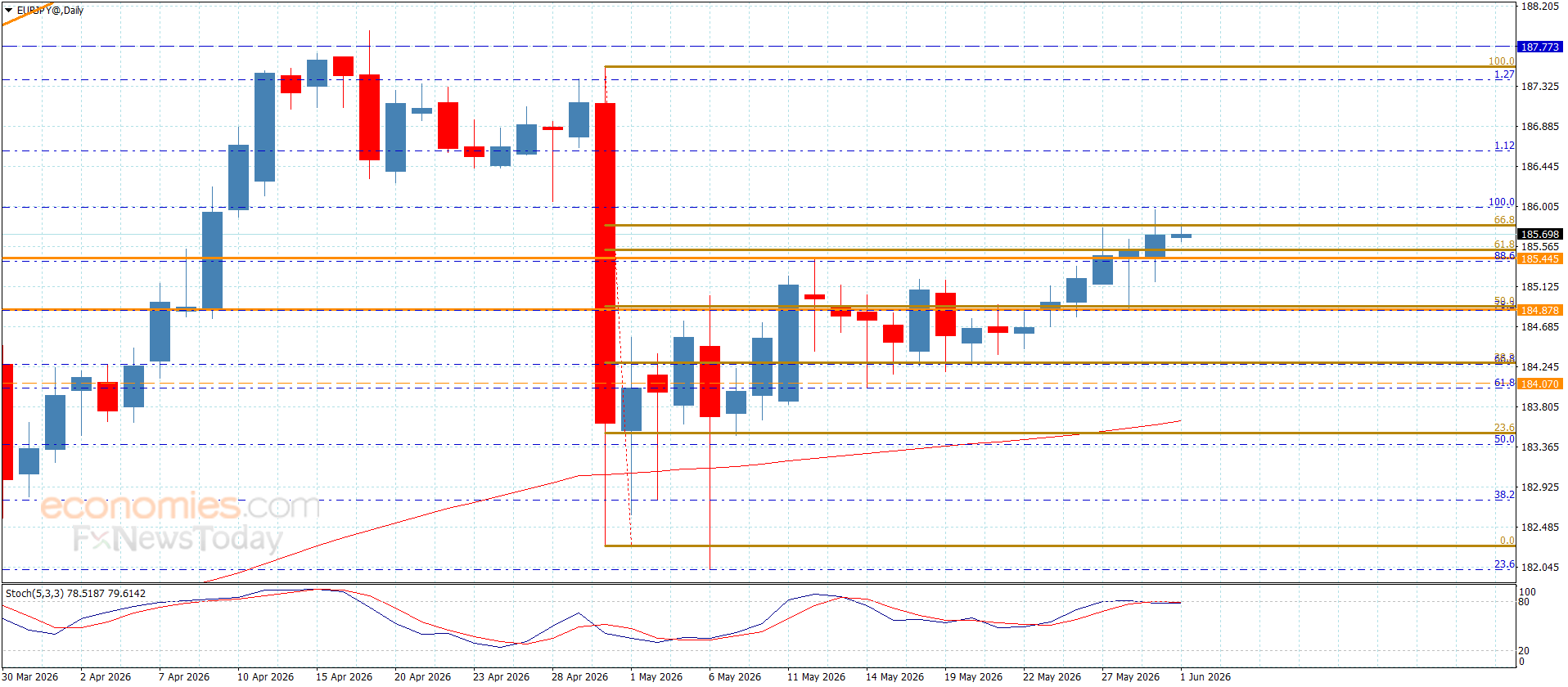
The EURJPY pair remains affected by the positivity of the main indicators, which forces it to delay the bearish correction trend, to notice its fluctuating near 185.80 level, attempting to find an exit for recording more gains in the near and medium period.
The continuation of providing positive momentum by the main indicators and the stability above the extra support at 184.80, we recommend waiting for achieving the required breach to ease the mission of recording extra gains by its rally towards 186.25 and 186.65.
The expected trading range for today is between 185.20 and 186.65
The GBPJPY pair returned to form some bullish waves, affected by forming an extra strong support at 213.30 level, to renew the pressure on 214.50 barrier, which represents %66.8 Fibonacci correction level.
The attempt of providing positive momentum by the main indicators, as stochastic approaches 80 level might ease the mission of surpassing the current barrier, announcing its readiness to record extra gains by its rally towards 214.95 and 215.25, while the failure of the breach will force it to provide mixed unstable trading with a new chance for the decline towards 213.30.
The expected trading range for today is between 214.00 and 215.25
The Pound to Dollar exchange rate (GBP/USD) remained on the defensive as investors focused on rising US bond yields, persistent inflation concerns and political uncertainty in the UK.
While Sterling found support below the 1.3400 level, markets continue to assess whether higher US yields and a potentially more hawkish Federal Reserve will keep the Dollar in demand through the summer.
GBP/USD Forecasts: Yields pivotal
UBS is positive on the Pound and has a 12-month Pound to Dollar (GBP/USD) exchange rate forecast of 1.40.
Standard Chartered, however, considers that there is a bearish bias for the currency and expects GBP/USD to weaken on a 12-month view.
GBP/USD edged lower during the week amid a firm dollar tone, but found support below the 1.3400 level.
Politics will inevitably be a key focus during June with the Makerfield by-election on June 18th and potential formal challenge on Prime Minister Starmer.
Save on Your GBP/USD Transfer
Get better rates and lower fees on your next international money transfer.
Compare TorFX with top UK banks in seconds and see how much you could save.
MUFG commented; “Based on the preferences of Labour Party members, a soft-left candidate such as Andy Burnham, Angela Rayner, or Ed Miliband is favoured to become the next leader, implying a potential shift to the left in policymaking. Andy Burnham’s commitment to the self-imposed fiscal rules has helped curtail Gilt market selling but if Burnham wins Makerfield and then becomes prime minister, there will no doubt be episodes when bond investors question his commitment to fiscal stability.”
UBS remains positive on the Pound; “While GBP/USD could remain suppressed in the near term due to UK political noise and elevated oil prices, we expect a recovery throughout the year due to several factors: We expect the Iran conflict to be resolved eventually, leading to lower oil prices that support the Pound; UK political uncertainty is likely to fade in coming months.
It added; “the pound is supported by robust UK data and a high yield with an upward bias while the USD is capped.”
Looking at the US outlook, UBS commented; “Political uncertainty is likely to shift from the UK to the US in 3Q-4Q ahead of mid-term elections in November.”
Standard Chartered is negative on the Pound fundamentals; “GBP/USD rangebound with bearish bias: The UK economy faces persistent stagflation pressures and a weakening labour market. While the BoE remains attentive to inflation, we anticipate that a deteriorating growth outlook will eventually force a more dovish pivot than currently priced.
It added; “Furthermore, the UK’s structural vulnerabilities, including limited fiscal flexibility and heightened political uncertainty bring further downside risk.”
MUFG is also positive on the dollar outlook; “US yields look set to continue to provide support for the dollar with Fed officials more aligned with focusing on inflation risks. Fed Governor Waller’s speech last week underlined the shift with a signal of a potential rate hike if “inflation does not abate soon”.
ING commented on upward pressure on US yields; “The market briefly priced one full 25bp Fed hike last Friday on his comments that the longer oil prices stay this high, the greater the risk of inflation expectations becoming unanchored and the Fed needing to hike. That briefly triggered some bearish flattening of the US yield curve – a clear dollar positive.
Like this piece? Please share with your friends and colleagues:
International Money Transfer? Ask our resident FX expert a money transfer question or try John’s new, free, no-obligation personal service! ,where he helps every step of the way,
ensuring you get the best exchange rates on your currency requirements.
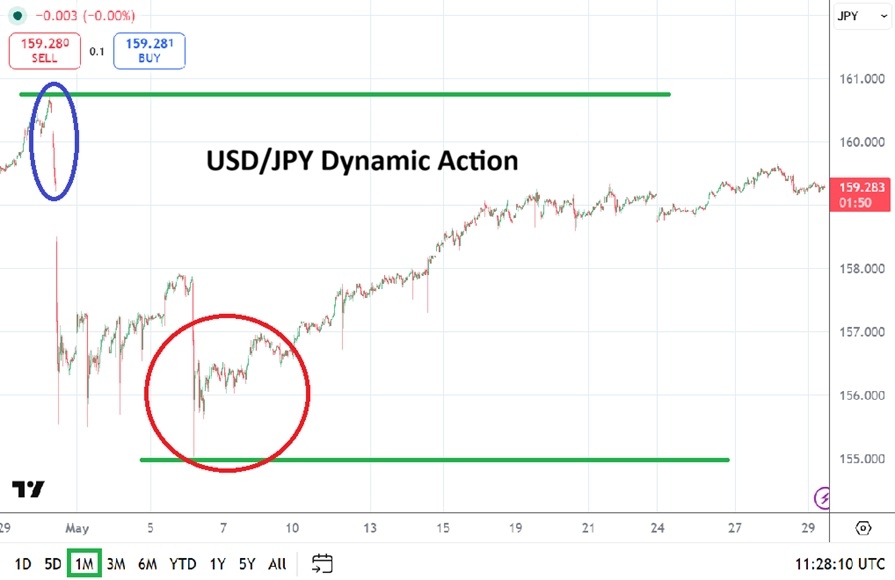
The USD/JPY as of this writing is near the 159.300 ratio with price action that has incrementally reestablished the higher realms of the currency pair, this after seeing dynamic volatility in late April and early May.
Big players and small traders in the USD/JPY are watching what can be compared to an old fashioned cowboy movie. One in which the bad guy gets warned repeatedly to stop acting in a certain way and does not. Then the person or group who has warned the bad guy to stop, gets mad and takes action. This is what large speculators and financial institutions have been doing with the Bank of Japan regarding the USD/JPY. The currency pair currently lingers near the 159.300 mark as the last day of trading in May still has a handful of hours to go.
As June’s trading gets ready to be underway early next week, a reminder of what we have seen in the past handful of weeks is important. In late April the USD/JPY was near blistering highs of almost 160.700 on the 30th of April. The Bank of Japan issued warnings to those who were buying the USD/JPY, and said they would intervene. The BoJ apparently did exactly that and a swift and dynamic rush downwards occurred. A low of 155.560 was seen briefly late on the 30th of April.
April’s Warning and May’s Reversals in the USD/JPY
By the 6th of May the USD/JPY was again testing lows and this time touched the 155.000 vicinity. However, since those lows were seen incremental buying has started again. Large players and financial institutions once again have been plowing into the buying side of the USD/JPY and as the month of June starts to approach it is not without reason that some folks are anticipating the Bank of Japan to be heard from again.
As the USD/JPY traverses above 159.250 as of this writing the currency pair is back within its higher realm. No, the currency pair has not yet hit 160.000 in May, but it is close enough to give folks a rather interesting choice regarding wagering on direction. Yesterday’s high in the USD/JPY hit the 159.660 area before trending slightly lower. Before going into this weekend, Forex traders will have to decide what they want to do as they anticipate a possible warning from the BoJ of intervention, and weigh that against depending on their betting stances – what is going to happen in the Middle East over the coming days when the markets are not trading and how it will effect risk appetite.
Near-Term Wagers and a Monthly Outlook
As the month of June gets ready to start, the USD/JPY is trading at highs. It has traded higher before, yes. But the Bank of Japan has retaliated against buying of the USD/JPY with loud rhetoric and also with cash interventions.
Traders who are tempted to be long – buy – the USD/JPY based on the knowledge the currency pair has gone higher are playing with fire. They need to be careful.
It is correct the Bank of Japan warnings about those who are buying the USD/JPY can be taught a lesson via a powerful intervention, but this also shows that the BoJ’s monetary policy is being looked at by financial institutions as poor.
It is clear financial institutions and large players are willing to bet against the BoJ even as the central bank threatens interventions to hurt them.
USD/JPY Outlook for June 2026:
Speculative price range for USD/JPY is 156.450 to 160.850
Day trading in the USD/JPY is extremely dangerous for limited retail speculators. A lot of risk management is needed. Betting on reversals lower via an intervention coming from the BoJ or just a shift in momentum might actually be a rather intriguing decision. However, incrementally the USD/JPY continues to traverse higher terrain and often shows an ability to move upwards, because large players do not like the BoJ’s policies.
Looking for more moves higher should be done with limited targets and not expose a day trader to too much time lapse. Because the Bank of Japan just like in the old fashioned cowboy westerns is warning folks to be careful. An interesting question is – who is the bad guy in this movie? Is it the Bank of Japan or the financial institutions betting against it? Small speculators may just want to watch from the sidelines to stay safe.
The Pound to Dollar exchange rate (GBP/USD) rebounded from intraday lows as improving sentiment surrounding US-Iran negotiations weighed on the US Dollar and encouraged investors back into risk-sensitive assets. Hopes that progress could eventually lead to the reopening of the Strait of Hormuz helped curb safe-haven demand for the Greenback, allowing Sterling to recover ground.
GBP/USD Forecasts: Rebound from Daily Lows
The Pound to Dollar (GBP/USD) exchange rate dipped to near 1.3400 early in Europe on Friday before recovering strongly to above 1.3475 during US trading as the dollar lost ground amid hopes that the US and Iran could secure some form of deal.
According to UoB; “GBP is unlikely to break the strong resistance at 1.3480. Support is at 1.3435.
It added; “A breach of 1.3415 would indicate that GBP is more likely to range-trade rather than continuing to rebound.”
Traders were reluctant to maintain aggressive positions into the weekend and there was also an element of choppy trading with month-end position adjustment also having an impact.
There was further choppy trading on Iran headlines with traders reacting to the latest comments and hopes for a deal.
Save on Your GBP/USD Transfer
Get better rates and lower fees on your next international money transfer.
Compare TorFX with top UK banks in seconds and see how much you could save.
Scotiabank commented; “Focus remains centered on the state of play between the US and Iran, with a renewed sense of confidence in the possibility of a deal that would reopen the Strait of Hormuz. Details include a 60 day ceasefire extension, Iran’s removal of all of its mines from the Strait within 30 days, and the launching of further talks on Iran’s nuclear program.”
According to MUFG; “If the reported details are true and if President Trump does accept these conditions and we have a 60-day extension with, crucially, the Strait of Hormuz reopened we certainly would expect further near-term downside pressure on front-end rates and for the US dollar to weaken further.”
ING expressed some caution; “The ceasefire extension in Iran is helping markets trade optimistically again, but we ultimately need to see a reopening of the Strait of Hormuz to take the dollar much lower from here.”
The outlook for monetary policy and interest rates will also be a key element. In comments on Friday, Bank of England Governor Bailey sounded cautious on the potential for interest rate hikes.”
He noted that allowing inflation to run above the BoE’s 2% target was justified given uncertainty over the economic impact of the Iran war and the weak pace of growth.” He did add; “that tolerance would weaken if signs of second-round effects begin to emerge.”
According to Kirstine Kundby-Nielsen, senior FX strategist at Danske Bank “I don’t expect the Bank of England to hike to the extent that it’s priced by market.”
She added; “The UK economy isn’t in great shape. If we get close to a ceasefire, some of these underlying macroeconomic developments start taking focus again.”
Like this piece? Please share with your friends and colleagues:
International Money Transfer? Ask our resident FX expert a money transfer question or try John’s new, free, no-obligation personal service! ,where he helps every step of the way,
ensuring you get the best exchange rates on your currency requirements.