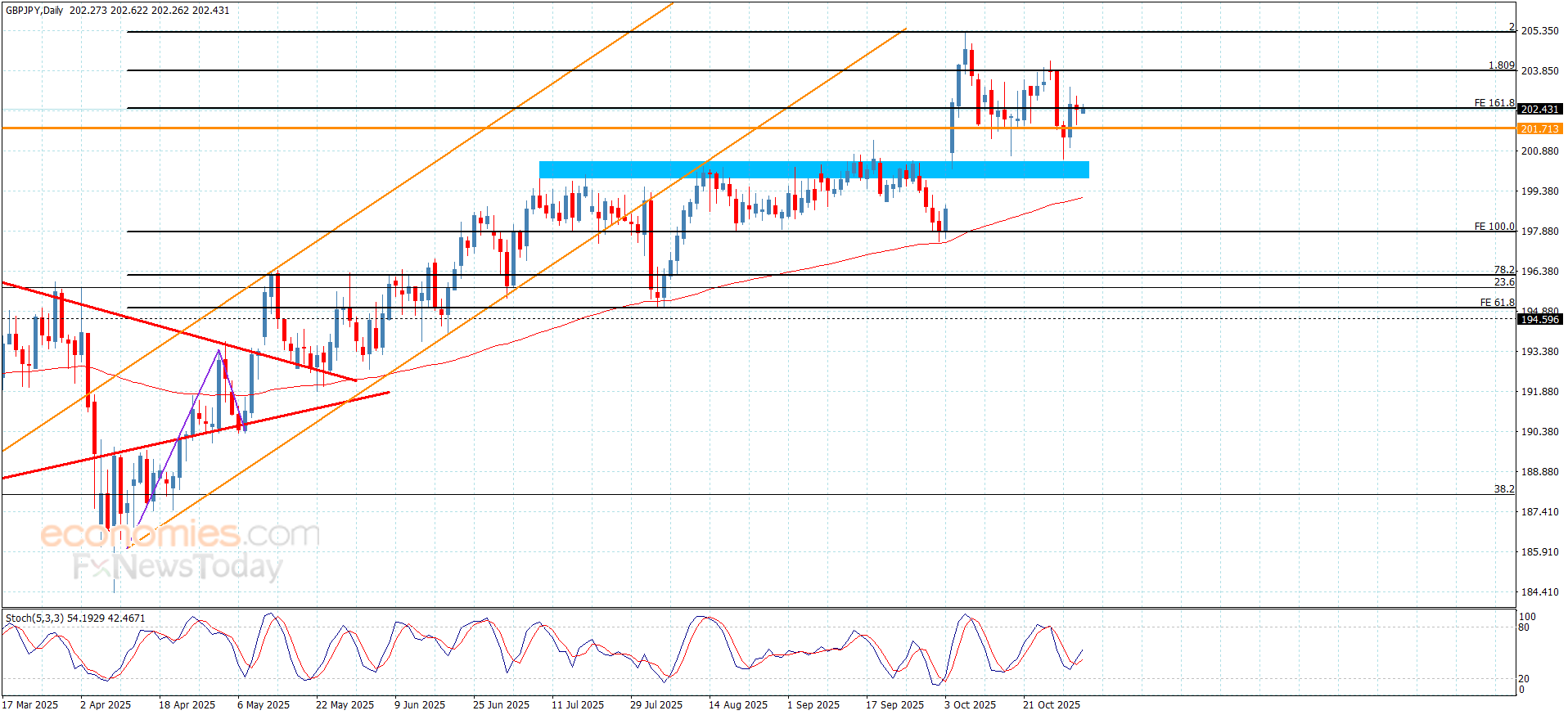
The GBPJPY pair didn’t move anything since yesterday, forming sideways trading by its stability near 202.30, affected by the contradiction between the main indicators, while its positive stability above the initial main support at 200.45 and attempt to form extra support at 201.70 level, these factors makes us keep the bullish suggestion, which might target 203.95 level and surpassing it will make the price record extra gains that begin at 204.60.
While breaking the extra support at 201.70 might force it to delay the bullish attack and provide mixed trading, and there is chance for retesting 200.45 level before reaching any new positive station.
The expected trading range for today is between 201.75 and 203.95
The Pound to US Dollar (GBP/USD) exchange rate weakened on Monday amid mixed central bank rhetoric, despite a broadly upbeat tone across global markets.
At the time of writing, GBP/USD was trading around $1.3121, down roughly 0.2% from Monday’s opening levels.
The Pound (GBP) struggled to find direction through the session, as fresh concerns over potential Bank of England (BoE) interest rate cuts continued to weigh on investor sentiment.
Reports from Barclays and Goldman Sachs on Friday suggested that the odds of a rate reduction at this week’s BoE meeting had increased, prompting traders to pare back Sterling exposure ahead of Thursday’s decision.
As one analyst noted, “Markets have begun to price in a clear shift in BoE policy direction — from tightening to easing — and that’s keeping Sterling on the defensive for now.”
The US Dollar (USD), meanwhile, held firm against most major counterparts, supported by lingering hawkish undertones from last week’s Federal Reserve meeting.
Although the Fed delivered a 25 basis-point rate cut, Chair Jerome Powell maintained a cautious tone, pushing back against expectations of an imminent follow-up move in December.
Save on Your GBP/USD Transfer
Get better rates and lower fees on your next international money transfer.
Compare TorFX with top UK banks in seconds and see how much you could save.
This stance helped to underpin the Greenback through Monday’s session, particularly as investors awaited fresh US data for direction.
Later in the day, the release of the ISM manufacturing PMI was expected to offer further insight into the health of the US economy. A stronger print could reinforce the Dollar’s resilience, extending its early-week gains.
GBP/USD Forecast: Market Sentiment in Focus
Looking ahead to Tuesday, the Pound to US Dollar (GBP/USD) exchange rate is likely to take its cues from overall market sentiment, with little in the way of key economic releases from either side of the Atlantic.
With the UK data calendar quiet, Sterling is expected to remain vulnerable to ongoing speculation surrounding the BoE’s next policy move. Traders are likely to stay cautious ahead of Thursday’s crucial rate decision, limiting the Pound’s recovery potential.
Meanwhile, in the US, the ongoing government shutdown means data visibility remains limited, leaving risk appetite as the primary driver of market direction.
If investors turn more cautious, the Dollar’s safe-haven appeal could see it extend its recent strength, keeping GBP/USD under pressure as the week unfolds.
Like this piece? Please share with your friends and colleagues:
International Money Transfer? Ask our resident FX expert a money transfer question or try John’s new, free, no-obligation personal service! ,where he helps every step of the way,
ensuring you get the best exchange rates on your currency requirements.
The Euro to Dollar (EUR/USD) exchange rate has failed to gain any traction in global markets and has retreated to 3-month lows just above the 1.1500 level before stabilising.
UoB sees scope for a limited correction; “While further EUR weakness is not ruled out, positive divergence is forming on momentum indicators and any decline is unlikely to threaten 1.1490 today.”
According to ING; “We suspect that 1.1500 could prove the bottom of the EUR/USD range this week, though that will require some softer US jobs data to provide some breathing space.”
On a longer-term view it added; “Market consensus is for 1.18 by year-end. We think EUR/USD could rally slightly more than that on a dovish Fed – but those views are under pressure.”
ING pointed to money-market developments as an important element for dollar strength. The Treasury is rebuilding cash reserves which is putting upward pressure on rates.
The bank added; “Tight money markets normally keep the dollar supported, and we’ll be watching to see whether this difficulty in accessing dollar funding extends internationally. This would be quite EUR/USD negative if seen, but there are no signs of that yet.”
Markets also remain less confident that the Federal Reserve will cut interest rates again at the December meeting with traders pricing in just below a 70% chance of a further cut.
Save on Your EUR/USD Transfer
Get better rates and lower fees on your next international money transfer.
Compare TorFX with top UK banks in seconds and see how much you could save.
The US government shutdown will also be increasingly important for markets as the economic impact will continue to build.
The Fed will be concerned over a negative impact on the economy, but will also be aware over the high degree of uncertainty.
MUFG commented; “The longer that US government shutdown goes on the bigger the negative impact on the US economy in the near-term but Chair Powell has signalled that the Fed would be more inclined to leaves rates on hold in December if they still lack clarity on the performance of the US economy.”
There are still important underlying concerns surrounding potential changes at the Fed, especially with a new chair coming next year.
Over the weekend Treasury Secretary Bessent criticised the central bank stating that their record on inflation forecasting had been extremely poor.
He added; “we’re going to find a leader who is going to revamp the entire institution in terms of process and inner workings”.
MUFG noted the risks; “The comments highlight that potential changes to the Fed under the next Chair remain a downside risk for the US dollar next year even if they skip cutting rates in December.”
Like this piece? Please share with your friends and colleagues:
International Money Transfer? Ask our resident FX expert a money transfer question or try John’s new, free, no-obligation personal service! ,where he helps every step of the way,
ensuring you get the best exchange rates on your currency requirements.
The Pound to Dollar exchange rate (GBP/USD) remains pinned near six-month lows, trading around 1.3130 as investors continue to favour the dollar amid fading expectations of another Federal Reserve rate cut in December.
GBP/USD Forecasts: Close to 6-Month Lows
The Pound-to-Dollar rate dipped further to 6-month lows at the 1.3100 level on Friday before a slight recovery to 1.3130 on Monday.
The dollar has maintained a strong tone in global markets with further doubts over another rate cut in the December meeting while US money-market conditions remain tight.
For the Pound to secure a sustained rebound, the first task for GBP/USD will be to regain 1.3140 on a sustained basis.
A slide below 1.3100 would potentially lead to a slide to 1.30.
According to UoB; “The rebound from deeply oversold conditions suggests that, instead of continuing to decline, GBP is more likely to consolidate today, probably between 1.3110 and 1.3170.”
Save on Your GBP/USD Transfer
Get better rates and lower fees on your next international money transfer.
Compare TorFX with top UK banks in seconds and see how much you could save.
Over the past few days, three regional Fed Presidents have stated that they preferred to leave rates on hold at the late-October meeting.
MUFG commented; “The change in rhetoric from Fed Chair Powell was likely intended to appease more hawkish voices at the Fed while they await more clarity from economic data releases when the US government shutdown finally ends.
With the on-going government shutdown still disrupting official data releases, the private surveys on economic activity and the labour market will be watched very closely this week.
National Australia Bank senior FX strategist Rodrigo Catril commented; “The lack of information is playing to sort of that calmness in markets. And for now, I suppose what could break that while the shutdown is still ongoing, (is) a big downward surprise or even upward surprise in terms of surveys or private data releases.”
He added; “But otherwise, at the moment, even those private data releases are not screaming or telling us that the Fed should be moving in a hurry.”
Domestically, the UK PMI manufacturing index was revised marginally higher to 49.7 from the flash reading of 49.6 and confirmed at a 12-month high.
Rob Dobson, Director at S&P Global Market Intelligence “The October PMI survey shows UK manufacturing production rising for the first time in a year, which is a positive in itself. However, there are real concerns that the bounce could prove short-lived.”
Markets will continue to focus on this Thursday’s Bank of England policy decision with the actual decision and policy guidance both crucial. Rate-cut speculation will make it more difficult for the Pound to recover ground.
According to ING; “The Bank looks likely to keep rates on hold on 6 November, despite better inflation and wage news. The committee is deeply divided, and we don’t expect clear signals on the Bank’s next steps. But assuming the Autumn Budget goes as expected, a December rate cut now looks more likely than not.”
Like this piece? Please share with your friends and colleagues:
International Money Transfer? Ask our resident FX expert a money transfer question or try John’s new, free, no-obligation personal service! ,where he helps every step of the way,
ensuring you get the best exchange rates on your currency requirements.
The US Dollar keeps trading within a narrow range, around 154.00, consolidating gains against a somewhat softer Japanese Yen. The Grrenback rallied from the mid-range of the 151.00s last week, following the Federal Reserve (Fed) and the Bank of Japan (BoJ) monetary policy decisions, and today, investors are awaiting US manufacturing activity data for further insight about the economic outlook and the US central bank’s immediate rate path.
The US Dollar maintains its firm tone after the Fed chairman, Jerome Powell, played down market hopes that the bank would lower borrowing costs further in December. The Yen, on the other hand, was hit by the Bank of Japan’s decision to keep interest rates on hold, despite Governor Ueda’s comments maintaining the commitment to monetary tightening.
Technical Analysis: USD/JPY is forming a smapp triangle pattern
Recent price action is showing a small triangle pattern with its axis right above 154.00. The triangle is considered a continuation pattern, which suggests a positive outcome. Technical indicators are mixed. The 4-hour Relative Strength Index (RSI) remains well above the key 50 level, although the Moving Average Convergence Divergence is about to cross below the signal line, pointing to the possibility of a deeper correction.
To the upside, the triangle top is now around 154.30, and the October 30 high lies at 154.45. Further up, the target is the February 13 high, at 154.85. The 127.2% extension of last week’s rally, at 155.30, is a plausible target further up.
A bearish reaction, on the contrary, would have to breach Friday’s low, at 153.65 to test support at previous resistances in the area between 153.00 and 153.25 (October 29, 27 highs) ahead of the October 30 low, at 152.20.
US Dollar Price Today
The table below shows the percentage change of US Dollar (USD) against listed major currencies today. US Dollar was the strongest against the Swiss Franc.
USD
EUR
GBP
JPY
CAD
AUD
NZD
CHF
USD
0.19%
0.16%
0.11%
0.21%
-0.07%
-0.04%
0.33%
EUR
-0.19%
-0.02%
-0.11%
0.02%
-0.25%
-0.22%
0.16%
GBP
-0.16%
0.02%
-0.06%
0.04%
-0.22%
-0.20%
0.20%
JPY
-0.11%
0.11%
0.06%
0.10%
-0.15%
-0.00%
0.26%
CAD
-0.21%
-0.02%
-0.04%
-0.10%
-0.30%
-0.24%
0.15%
AUD
0.07%
0.25%
0.22%
0.15%
0.30%
0.04%
0.44%
NZD
0.04%
0.22%
0.20%
0.00%
0.24%
-0.04%
0.39%
CHF
-0.33%
-0.16%
-0.20%
-0.26%
-0.15%
-0.44%
-0.39%
The heat map shows percentage changes of major currencies against each other. The base currency is picked from the left column, while the quote currency is picked from the top row. For example, if you pick the US Dollar from the left column and move along the horizontal line to the Japanese Yen, the percentage change displayed in the box will represent USD (base)/JPY (quote).
EUR/USD registered losses for three consecutive days and closed the previous week in negative territory. The pair stays relatively quiet early Monday and trades below 1.1550.
Euro Price Last 7 Days
The table below shows the percentage change of Euro (EUR) against listed major currencies last 7 days. Euro was the weakest against the Australian Dollar.
USD
EUR
GBP
JPY
CAD
AUD
NZD
CHF
USD
0.84%
1.41%
0.79%
0.06%
-0.18%
0.98%
1.11%
EUR
-0.84%
0.58%
0.02%
-0.77%
-0.94%
0.14%
0.27%
GBP
-1.41%
-0.58%
-0.69%
-1.34%
-1.50%
-0.44%
-0.34%
JPY
-0.79%
-0.02%
0.69%
-0.80%
-1.04%
0.08%
0.23%
CAD
-0.06%
0.77%
1.34%
0.80%
-0.30%
0.93%
1.01%
AUD
0.18%
0.94%
1.50%
1.04%
0.30%
1.08%
1.16%
NZD
-0.98%
-0.14%
0.44%
-0.08%
-0.93%
-1.08%
0.09%
CHF
-1.11%
-0.27%
0.34%
-0.23%
-1.01%
-1.16%
-0.09%
The heat map shows percentage changes of major currencies against each other. The base currency is picked from the left column, while the quote currency is picked from the top row. For example, if you pick the Euro from the left column and move along the horizontal line to the US Dollar, the percentage change displayed in the box will represent EUR (base)/USD (quote).
Following the Federal Reserve’s (Fed) policy decisions and Chairman Jerome Powell’s cautious comments on policy-easing, several Fed officials delivered hawkish remarks and helped the US Dollar (USD) preserve its strength heading into the weekend.
Kansas City Fed President Jeffrey Schmid explained that he voted to keep the policy rate unchanged at the October meeting because “the labor market is largely in balance, the economy shows continued momentum, and inflation remains too high.” Dallas Fed President Lorie Logan said that she would find it difficult to cut rates again in December, unless there is clear evidence of a faster drop in inflation or a rapid cooling in the labor market. Finally, Cleveland Fed President Beth Hammack argued that they need to main monetary restriction for inflation to continue to come down.
In the second half of the day, the US economic calendar will feature the Institute for Supply Management’s (ISM) Manufacturing Purchasing Managers’ Index (PMI) data for October. In case the headline PMI recovers above 50 and shows a return to expansion in the manufacturing sector’s business activity, the USD could continue to outperform its rivals in the second half of the day.
If the headline PMI arrives near the market expectation of 49.2, investors could react to the changes in the Employment Index of the survey. A reading below September’s 45.3 could hurt the USD in the near term, while a noticeable recovery toward 50 could have the opposite impact on the currency’s performance.
EUR/USD Technical Analysis
The Relative Strength Index (RSI) indicator remains below 40, suggesting that the bearish bias remains intact. Unless EUR/USD manages to reclaim 1.1550 (static level, former support), technical sellers could remain interested.
On the downside, 1.1500 (Fibonacci 78.6% retracement of the latest uptrend) could be seen as the next support level ahead of 1.1450 (static level) and 1.1400 (static level, beginning point of the uptrend). Looking north, resistance levels could be spotted 1.1550 (static level), 1.1615 (20-day Simple Moving Average (SMA)) and 1.1660 (100-day SMA).
Euro FAQs
The Euro is the currency for the 20 European Union countries that belong to the Eurozone. It is the second most heavily traded currency in the world behind the US Dollar. In 2022, it accounted for 31% of all foreign exchange transactions, with an average daily turnover of over $2.2 trillion a day.
EUR/USD is the most heavily traded currency pair in the world, accounting for an estimated 30% off all transactions, followed by EUR/JPY (4%), EUR/GBP (3%) and EUR/AUD (2%).
The European Central Bank (ECB) in Frankfurt, Germany, is the reserve bank for the Eurozone. The ECB sets interest rates and manages monetary policy.
The ECB’s primary mandate is to maintain price stability, which means either controlling inflation or stimulating growth. Its primary tool is the raising or lowering of interest rates. Relatively high interest rates – or the expectation of higher rates – will usually benefit the Euro and vice versa.
The ECB Governing Council makes monetary policy decisions at meetings held eight times a year. Decisions are made by heads of the Eurozone national banks and six permanent members, including the President of the ECB, Christine Lagarde.
Eurozone inflation data, measured by the Harmonized Index of Consumer Prices (HICP), is an important econometric for the Euro. If inflation rises more than expected, especially if above the ECB’s 2% target, it obliges the ECB to raise interest rates to bring it back under control.
Relatively high interest rates compared to its counterparts will usually benefit the Euro, as it makes the region more attractive as a place for global investors to park their money.
Data releases gauge the health of the economy and can impact on the Euro. Indicators such as GDP, Manufacturing and Services PMIs, employment, and consumer sentiment surveys can all influence the direction of the single currency.
A strong economy is good for the Euro. Not only does it attract more foreign investment but it may encourage the ECB to put up interest rates, which will directly strengthen the Euro. Otherwise, if economic data is weak, the Euro is likely to fall.
Economic data for the four largest economies in the euro area (Germany, France, Italy and Spain) are especially significant, as they account for 75% of the Eurozone’s economy.
Another significant data release for the Euro is the Trade Balance. This indicator measures the difference between what a country earns from its exports and what it spends on imports over a given period.
If a country produces highly sought after exports then its currency will gain in value purely from the extra demand created from foreign buyers seeking to purchase these goods. Therefore, a positive net Trade Balance strengthens a currency and vice versa for a negative balance.
Copper price remains affected by the stability of the extra barrier near $5.2000, reducing the chances of resuming the bullish attack, providing more sideways trading by its stability near $5.0500.
Reminding you that the bullish scenario will remain valid if the price settles above the support at $4.7500, to increase the chances of gathering the required positive momentum to surpass the barrier and target extra positive stations that might begin at $5.3200, while reaching below this support and providing negative close will force it to provide bearish corrective trading, to suffer clear losses by reaching $4.5100 and $4.3500.
The expected trading range for today is between $4.9000 and $5.2000
Trend forecast: Fluctuated within the bullish trend
Copper price remains affected by the stability of the extra barrier near $5.2000, reducing the chances of resuming the bullish attack, providing more sideways trading by its stability near $5.0500.
Reminding you that the bullish scenario will remain valid if the price settles above the support at $4.7500, to increase the chances of gathering the required positive momentum to surpass the barrier and target extra positive stations that might begin at $5.3200, while reaching below this support and providing negative close will force it to provide bearish corrective trading, to suffer clear losses by reaching $4.5100 and $4.3500.
The expected trading range for today is between $4.9000 and $5.2000
Trend forecast: Fluctuated within the bullish trend
Natural gas price approached its last bullish rally at $4.210, which forced it to form sideways trading, affected by stochastic exit from the overbought level, to settle near $4.110.
Reminding you that the stability of the trading above the extra support level at $3.830 confirms the continuation of the positive trading in the near and medium period, which makes us wait for gathering extra bullish momentum, to ease the mission of reaching the bullish channel’s resistance at $4.320, which forms a key for detecting the main trend in the upcoming trading.
The expected trading range for today is between $4.060 and $4.320
The Pound Sterling (GBP) accelerated its recent declines against the US Dollar (USD), as GBP/USD briefly revisited levels under the 1.3150 psychological mark.
Pound Sterling suffered amid UK budget woes, USD rebound
Market sentiment was largely driven by hopes of a US-China trade deal and the anticipation of dovish US Federal Reserve (Fed) monetary policy announcements at the start of the week, fuelling fresh declines in the USD.
The odds of a US-China trade deal ramped up after a preliminary consensus on topics including export controls, fentanyl and shipping levies was reached by both sides during their two-day talks in Malaysia.
On October 24, the Bureau of Labor Statistics (BLS) showed that the US Consumer Price Index (CPI) rose 0.3% in September, which drove the annual inflation rate from 2.9% to 3%, the highest it has been since January. The annual CPI inflation came in softer than the market forecast of 3.1%.
Following the softer-than-expected US inflation data, markets almost fully priced in two interest rate reductions this year, with a 25 basis points (bps) cut each in the October and December monetary policy meetings.
This Greenback weakness helped GBP/USD buyers gather some courage to briefly regain the 1.3350 barrier.
However, the pair quickly reversed course and resumed its downtrend after the US Dollar staged a solid comeback against its six major currency rivals on Wednesday, even as the Fed delivered on the expected 25 bps cut.
The rebound occurred because, during the post-policy meeting press conference, Fed Chairman Powell noted that policymakers are likely to become more cautious if the current government shutdown deprives them of further job and inflation reports, tempering bets for another rate cut by the Fed at year-end.
Following the Fed event, the CME Group’s FedWatch Tool showed a 72.8% probability of a quarter percentage point Fed rate cut in December compared with a 91.1% chance a week earlier.
Investors remained nervous heading into Thursday’s highly anticipated meeting between US President Donald Trump and his Chinese counterpart Xi Jinping in South Korea, exerting additional downside pressure on the higher-yielding Pound Sterling.
On Thursday, both leaders reached a major trade truce on the sidelines of the APEC Summit in Busan, South Korea. The landmark agreement covers key critical points, including rare earth minerals, fentanyl trade, and semiconductor sales.
Trump said that “tariffs on China will be 47% down from 57%.” Meanwhile, China’s Commerce Ministry confirmed that Beijing will pause rare earth export controls for a year, adding that “both sides reached consensus on fentanyl cooperation, expanding agriculture trade.”
The US-China trade deal optimism provided extra legs to the USD upswing, in the aftermath of a less dovish Fed, exacerbating GBP/USD’s pain. The currency pair breached critical support levels to reach six-month lows near 1.3115.
On the UK side of the equation, the Pound Sterling faced additional headwinds as investors grew increasingly anxious ahead of Chancellor Rachel Reeves’s Autumn Budget, due on November 26.
Reuters reported that the Office for Budget Responsibility (OBR) is expected to lower productivity forecasts, raising financial stress and boding ill for the British Pound.
The GBP was also undermined by the markets’ beliefs that mounting concerns over UK economic growth prospects could persuade the Bank of England (BoE) to resume its easing cycle in December after a rates-on-hold decision expected on Thursday.
US ADP jobs data, US ISM PMIs and BoE verdict grab eyeballs
With the Fed event and the Trump-Xi meeting finally out of the way, traders now focus on the BoE policy announcements and the private sector employment and economic activity data from the United States (US). While official data is very unlikely to be published due to the shutdown, some private-sector indicators are expected to provide insights into the state of the US economy and the labor market.
This leaves traders again in a data drought situation on the US calendar. In case the government reopens, a bunch of delayed top-tier statistics will be published. In this scenario, the spotlight would be on the September Nonfarm Payrolls (NFP) data.
Tuesday will see the release of the US ISM Manufacturing PMI data, while the JOLTS Job Openings survey is unlikely to be published unless the US government reopens.
On Wednesday, the monthly private employment data from the Automatic Data Processing (ADP) will be closely scrutinized to gauge the health of the US labor market. ADP’s employment report showed private payrolls decreased by 32,000 jobs in September.
Meanwhile, the ADP published its National Employment Report’s inaugural weekly preliminary estimate on Tuesday, showing that US private payrolls increased by an average 14,250 jobs in the four weeks ending October 11.
The US ISM Services PMI will also feature on Wednesday.
That being said, the BoE ‘Super Thursday’ will help determine the next trend in GBP/USD. The BoE is widely expected to hold the key policy rate at 4%, but the updated projections and Governor Andrew Bailey’s hints on future rate cuts will likely boost volatility around the Pound Sterling.
Apart from the economic news, trade and geopolitical headlines will be monitored in the upcoming week. Speeches from Fed policymakers will also affect the USD-driven GBP/USD price action.
GBP/USD: Technical outlook
On the daily chart, GBP/USD is currently trading at around 1.3155, with spot entrenched below all major moving averages and the near-term structure skewed lower. A bearish 21-day Simple Moving Average (SMA) slides below the longer 50 and 100 SMAs, collectively signaling sellers hold the grip and hinting at additional slides ahead. Despite the 200-day SMA edging higher, it remains above price and caps the topside, leaving the broader bias negative as falling short- and medium-term averages stack overhead.
Momentum gauges echo the downbeat tone, with the Relative Strength Index (RSI) (14) hovering near 30.4 after a dip to 29.9, indicating persistent bearish pressure with only tentative stabilization. Resistance levels align at 1.3248 (200-day SMA), 1.3345 (21-day SMA), 1.3434 (50-day SMA) and 1.3464 (100-day SMA). A sustained break above 1.3248 would be needed to ease selling pressure and open the path toward the 21-day/50-day SMAs, while failure to reclaim the 200-day line keeps risks tilted to the downside.
Looking down, GBP/USD meets initial support at the 1.3140 area (May 12, August 1, Wednesday’s lows), followed by 1.3116, the lowest level since mid-April, hit on Thursday. With no indicator-derived supports below current levels, bears retain the upper hand until momentum meaningfully improves.
(The technical analysis of this story was written with the help of an AI tool.)
Pound Sterling FAQs
The Pound Sterling (GBP) is the oldest currency in the world (886 AD) and the official currency of the United Kingdom. It is the fourth most traded unit for foreign exchange (FX) in the world, accounting for 12% of all transactions, averaging $630 billion a day, according to 2022 data.
Its key trading pairs are GBP/USD, also known as ‘Cable’, which accounts for 11% of FX, GBP/JPY, or the ‘Dragon’ as it is known by traders (3%), and EUR/GBP (2%). The Pound Sterling is issued by the Bank of England (BoE).
The single most important factor influencing the value of the Pound Sterling is monetary policy decided by the Bank of England. The BoE bases its decisions on whether it has achieved its primary goal of “price stability” – a steady inflation rate of around 2%. Its primary tool for achieving this is the adjustment of interest rates.
When inflation is too high, the BoE will try to rein it in by raising interest rates, making it more expensive for people and businesses to access credit. This is generally positive for GBP, as higher interest rates make the UK a more attractive place for global investors to park their money.
When inflation falls too low it is a sign economic growth is slowing. In this scenario, the BoE will consider lowering interest rates to cheapen credit so businesses will borrow more to invest in growth-generating projects.
Data releases gauge the health of the economy and can impact the value of the Pound Sterling. Indicators such as GDP, Manufacturing and Services PMIs, and employment can all influence the direction of the GBP.
A strong economy is good for Sterling. Not only does it attract more foreign investment but it may encourage the BoE to put up interest rates, which will directly strengthen GBP. Otherwise, if economic data is weak, the Pound Sterling is likely to fall.
Another significant data release for the Pound Sterling is the Trade Balance. This indicator measures the difference between what a country earns from its exports and what it spends on imports over a given period.
If a country produces highly sought-after exports, its currency will benefit purely from the extra demand created from foreign buyers seeking to purchase these goods. Therefore, a positive net Trade Balance strengthens a currency and vice versa for a negative balance.