Copper price attempted to activate the bullish trend, to end it after reaching the barrier at$5.2000, which forces it to decline correctively to settle near$5.0400.
We expect providing mixed trading, but its main stability within the bullish channel’s levels by forming extra support at $4.7500 level will increase the chances of gathering positive momentum, to repeat the attempts to achieve extra gains that might extend to $5.3200 and $5.5000.
The expected trading range for today is between $4.9200 and $5.2200
Trend forecast fluctuated within the bullish track
Copper price attempted to activate the bullish trend, to end it after reaching the barrier at$5.2000, which forces it to decline correctively to settle near$5.0400.
We expect providing mixed trading, but its main stability within the bullish channel’s levels by forming extra support at $4.7500 level will increase the chances of gathering positive momentum, to repeat the attempts to achieve extra gains that might extend to $5.3200 and $5.5000.
The expected trading range for today is between $4.9200 and $5.2200
Trend forecast fluctuated within the bullish track
TS Lombard says recent dollar strength won’t sustain.
“We retain a negative view on the U.S. dollar, despite recent stabilisation,” says Kiran Kowshik, Global FX Strategist at Lombard Odier.
The Swiss bank says the U.S. dollar has stabilised higher since mid-September, reflecting a voting pattern at the September Fed meeting where some members preferred a more cautious approach to cuts.
Globally, ex-USD weakness was also apparent due to the uncertain political news flow from France and Japan.
Looking aheada, Lombard Odier says dollar-specific drivers are to resume dominance of pairs like EUR/USD and GBP/USD.
Get More From Your GBP/USD Transfer
Pound Sterling Live consistently delivers stronger rates than major UK banks.
In July, you could have saved up to $1,515 on a £50,000 transfer thanks to our competitive pricing.
i – Based on average GBP/USD rates observed in July.
“While markets already price in the Fed funds rate eventually falling to 3%, the sequencing matters: the Fed is cutting rates just as several other major central banks (including in Europe and Switzerland) have ended their easing cycles,” says Kowshik.
“This type of sequencing was seen in the 1980s and 1990s and resulted in USD depreciation as the Fed eased (see chart 2). We maintain a 12-month EURUSD forecast of 1.22.”
“Combined with renewed weakness in the USD, GBP/USD could see a more significant move higher heading into December if the UK Budget does not surprise market expectations. Our 12-month GBP/USD forecast stands at 1.37,” says Kowshik.
He adds that the pre-budget anxieties that have pressed down on sterling over recent months are not unusual and the currency tends to recover after budget events.
“Historically, sterling tends to weaken heading into the Budget but sees relief thereafter,” says Kowshik.
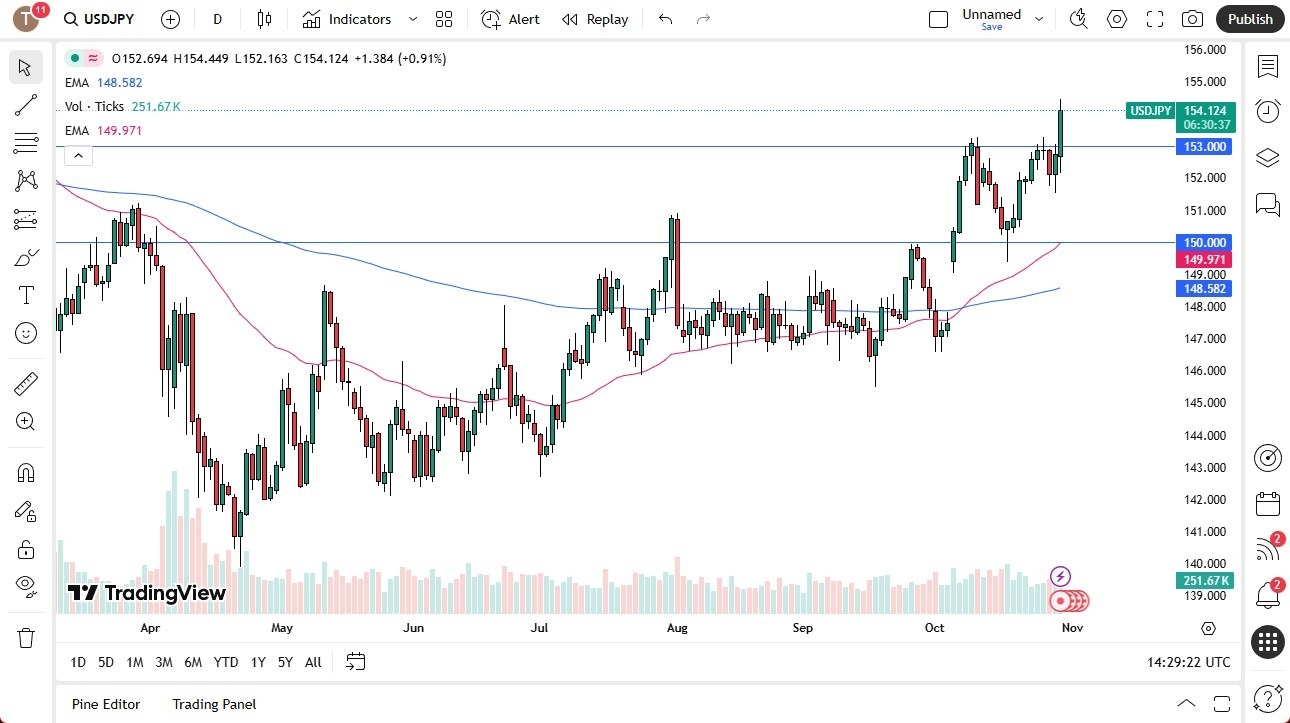
Today’s economic indicators signaled a potential pickup in economic momentum and rising national inflation, supporting a more hawkish BoJ rate path. Given these dynamics, USD/JPY maintains a bearish bias despite Powell downplaying the odds of a December rate cut. However, traders should closely monitor comments from Prime Minister Sanae Takaichi, an advocate for ultra-loose monetary policy.
Fed Speakers and Capitol Hill in Focus
While Japanese data may fuel speculation about a BoJ rate hike, the continued US government shutdown will likely delay key economic reports. In the absence of September’s Personal Income and Outlays Report, traders should closely monitor Fed speeches.
FOMC members Lorie Logan and Beth Hammack, along with Fed Reserve Bank of Atlanta President Raphael Bostic, are due to deliver speeches later in the Friday session. Economists consider the three regional bank presidents relatively hawkish, suggesting they may argue against a December rate cut.
Calls to delay a December Fed rate cut would reinforce Powell’s stance and may sustain US dollar strength. While short-term dollar strength could lift USD/JPY toward 154.45, the broader outlook remains bearish amid BoJ policy normalization.
According to the CME FedWatch Tool, the chances of a 25-basis-point cut in December fell from 91.1% on October 23 to 66.6% on October 29. This sharp repricing followed Powell’s press conference.
USD/JPY Scenarios: Monetary Policy Divergence
Bearish USD/JPY Scenario: hawkish BoJ rhetoric and dovish Fed commentary could push USD/JPY toward the 153 level.
Bullish USD/JPY Scenario: dovish BoJ comments and hawkish Fed chatter could send USD/JPY toward 155.
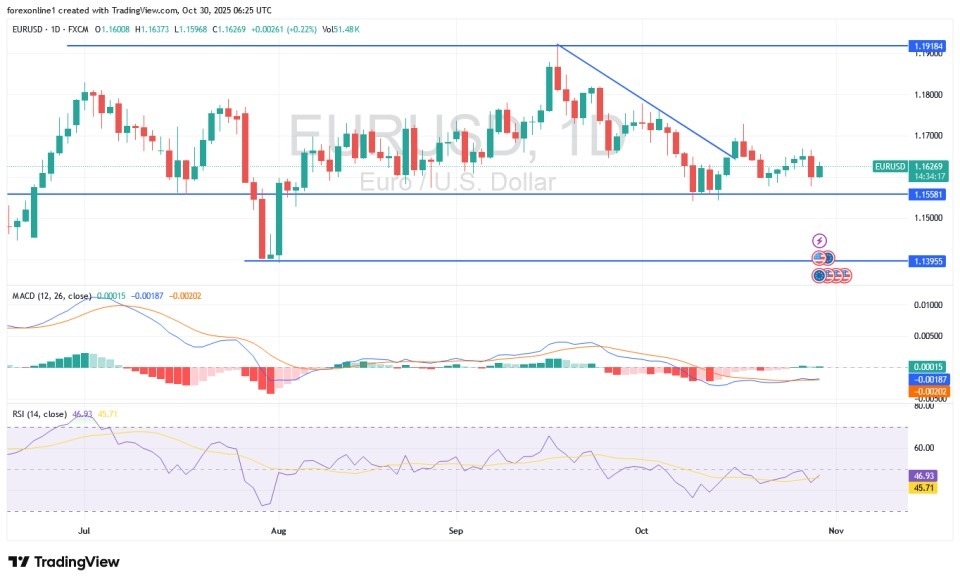
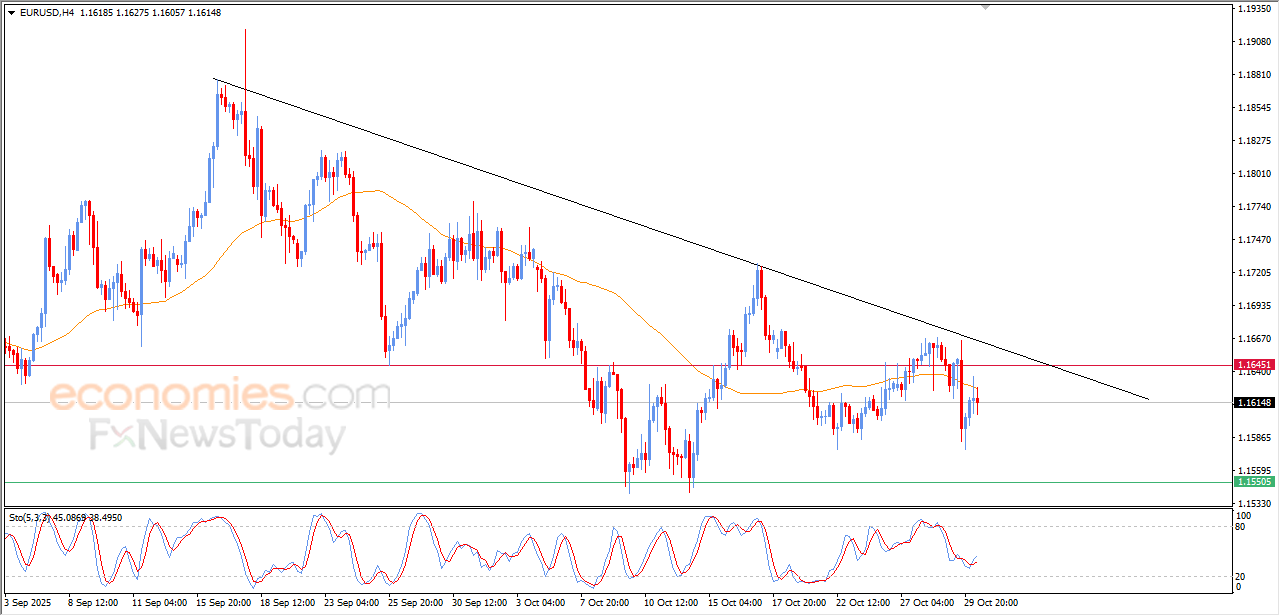
Support Levels for EUR/USD Today: 1.1600 – 1.1550 – 1.1480.
Resistance Levels for EUR/USD Today: 1.1685 – 1.1730 – 1.1800.
EUR/USD Trading Signals:
Buy EUR/USD from the support level of 1.1570 with a target of 1.1800 and a stop-loss at 1.1490.
Sell EUR/USD from the resistance level of 1.1760 with a target of 1.1600 and a stop-loss at 1.1810.
Technical Analysis of EUR/USD Today:
The bears quickly returned to the EUR/USD currency pair across trusted trading company platforms, breaking below the 1.1600 level again. This followed the Federal Reserve’s quarter-point interest rate cut. However, the Dow Jones and S&P 500 indices declined after Fed Chairman Jerome Powell stated that there is still a heated discussion about whether to follow up today’s rate cut with another. Powell added, “A further rate cut at the December meeting is not a foregone conclusion, quite the opposite. Monetary policy is not on a preset course.”
Future of US Interest Rates
In this regard, the Federal Reserve’s decision on US interest rates has sparked opposition from both sides, with one side calling for further rate cuts and the other advocating for keeping rates higher. President Trump, who has repeatedly called for faster U.S. interest rate cuts, again criticized Powell ahead of Wednesday’s decision, saying the administration would be “very happy” to see his term end.
Trump spoke from South Korea, where both sides said they were close to finalizing a trade deal—marking progress after months of thorny talks over a $350 billion investment pledged by Seoul to the US. In this context, the US President is scheduled to meet with Chinese leader Xi Jinping in South Korea tomorrow, and investors hope this meeting will pave the way for NVIDIA to regain access to the Chinese market.
Meanwhile, across stock trading company platforms, NVIDIA’s stock jumped, making it the first company to reach a market capitalization of $5 trillion. Booming sales of the company’s flagship AI chip were crucial to this surge.
Overall, Fed Chairman Jerome Powell’s comments about the December rate-setting meeting—which will be held in six weeks—went far beyond the usual disavowal that Fed decisions are not on a preset course. Instead, his comments revealed a broader discomfort among at least some of his colleagues with the unrealistic investor expectation that a December rate cut is guaranteed. Powell said: “It may be time for some Committee members to step back a little and see if there are actually downside risks to the labor market.” Powell added that this week’s meeting revealed a “growing chorus” of policymakers who are asking: “Maybe we need to wait a while.”
In the past, Powell has tried to deflect questions about upcoming policy decisions by refocusing attention on the policy actions at that particular meeting.
Technical Analysis for the EUR/USD Pair
Based on the daily chart trading, the EUR/USD bears have gained momentum to push the currency prices lower. This is confirmed by the 14-day Relative Strength Index (RSI) being stable around a reading of 47, below the neutral line, and having more time to head toward stronger downward levels before reaching oversold territory. In the same performance, the MACD indicator is steadily leaning downwards. The bears’ focus is directed towards the support levels of 1.1590 and 1.1480 first.
The current downward bias for EUR/USD is anticipating important events, led by the announcement of the European Central Bank’s (ECB) monetary policy decisions at 16:15 Cairo time, followed by statements from ECB Governor Lagarde half an hour after the bank’s decision is announced. Before that, the German economic growth reading will be announced at 12:00 PM Cairo time, and the Eurozone economic growth reading will be announced at 1:00 PM Cairo time. On the US side, no important data releases are expected today.
Conversely, as we mentioned before, the success of the EUR/USD bull scenario remains contingent on a return to the 1.1800 resistance level. Otherwise, the downward trend will continue until further notice.
Trading Advice:
We still advise selling the EUR/USD pair on any strong upward retracement, but never take unnecessary risks.
I was watching the British Pound try to rally early Thursday, but it couldn’t get above 1.32 before rolling over again.
The dollar’s gaining strength across the board, and with the pound breaking major support, I’m looking forward to shorting any rallies.
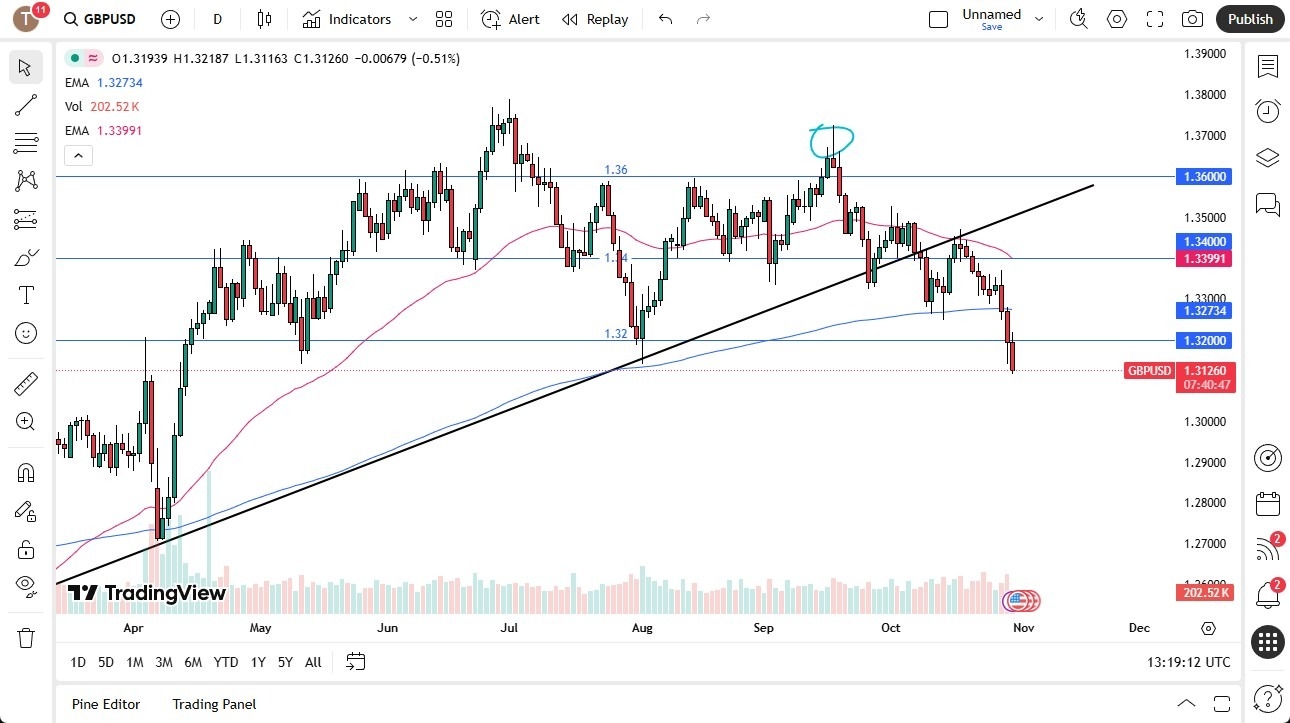
The British Pound initially tried to rally during the trading session on Thursday but has found the area above the 1.32 level to be a bit too much, and we have just fallen off again. I’ll bring to light that we’ve had two FOMC meetings since the peak, and we have done nothing but fall since then, with the occasional short-term bounce.
The US dollar is strengthening against almost everything, and it’s worth noting that the bond market yields really aren’t moving either. In other words, I do think that the US dollar has entered a bullish phase, and it is worth noting that we have broken a major support level during the trading session. If we break down below 1.31, then the market really could drop possibly as low as 1.2750 before it’s all said and done.
The Pound Used to Be Strong
Until recently, the British Pound was one of the better performers against the US dollar, but clearly, people are expecting the Bank of England to have to cut rates and loosen monetary policy, and the British Pound has been punished as a result. Short-term rallies at this point, I believe, end up being selling opportunities, with the 1.32 level offering resistance and, of course, the 200-day EMA offering resistance at the 1.3273 level.
Breaking down below there during the previous session was a very serious shot across the bow, and the fact that we are continuing that overall downward pressure really drives home the idea that the US dollar is accelerating to the upside. As far as buying is concerned, at minimum, you would need to see a move back above the 200-day EMA, perhaps even a move above the 50-day EMA, which is hanging around the 1.34 level—an area that’s been important more than once as well. We broke a major uptrend line, and it looks like the US dollar is strengthening against almost everything. Therefore, shorting this pair makes perfect sense.
Christopher Lewis has been trading Forex and has over 20 years experience in financial markets. Chris has been a regular contributor to Daily Forex since the early days of the site. He writes about Forex for several online publications, including FX Empire, Investing.com, and his own site, aptly named The Trader Guy. Chris favours technical analysis methods to identify his trades and likes to trade equity indices and commodities as well as Forex. He favours a longer-term trading style, and his trades often last for days or weeks.
The US dollar has been bullish during the trading session on Thursday, and that won’t be any different against the Japanese yen as it is against other currencies.
The 153 yen level is a significantly resistant area that is now in the rearview mirror of the US dollar, and it looks like we could continue to go much higher.
Keep in mind that recently we have seen a lot of momentum in the US dollar against multiple currencies, but the Japanese yen is a little bit special in the sense that we have recently had an election in Japan. The Japanese election ushers in a new government of doves, and it is thought that the Bank of Japan will continue to keep a very loose monetary policy, so it does make a certain amount of sense that the Japanese yen gets hammered by other currencies.
FOMC Surprised a Bit
Contrast that with the FOMC meeting that we had on Wednesday, where Jerome Powell stated in the press conference that a December rate cut wasn’t necessarily a given. This has driven the US dollar higher against most things, including the Japanese yen, so it all lines up as a central bank outlook differential. Furthermore, we have an interest rate differential between the two currencies because, despite the fact that the Federal Reserve did in fact cut, the reality is that the bond market sat still.
Therefore, the interest rate differentials are even ignoring the Fed at this point. All things being equal, this is a reasonably sized candlestick. It’s explosive, it’s strong, but at the same time, it’s reasonable. It’s not out of control and impulsive. And I think this shows that short-term pullbacks are more likely than not will be bought into in this pair, and I believe that a certain amount of market memory comes into the picture at the 153 yen level as potential support.
In fact, I don’t even have a scenario at this point where I’m willing to short this pair. I think we have so much more upside. The 155 yen level could be targeted pretty quickly. And then after that, you could be looking at a move to 158 yen.
Christopher Lewis has been trading Forex and has over 20 years experience in financial markets. Chris has been a regular contributor to Daily Forex since the early days of the site. He writes about Forex for several online publications, including FX Empire, Investing.com, and his own site, aptly named The Trader Guy. Chris favours technical analysis methods to identify his trades and likes to trade equity indices and commodities as well as Forex. He favours a longer-term trading style, and his trades often last for days or weeks.
Natural gas price surrendered to stochastic negativity, threatening the stability of the extra support at $3.830, suffering intraday losses by hitting $3.770 level, then attempts to settle above this support to confirm the dominance of the previously suggested bullish bias.
We recommend waiting for providing new bullish close for the upcoming four hours’ time frame above the current support, which reinforces the chances of forming several bullish waves, to target $4.050 level, reaching the barrier near $4.210, while facing new bearish pressures will confirm activating the bearish corrective track, which forces it to suffer more losses by targeting $3.690 and $3.550 level.
The expected trading range for today is between $3.800 and $4.050
The euro extended gains against the British pound on Wednesday ahead of the ECB’s rate decision.
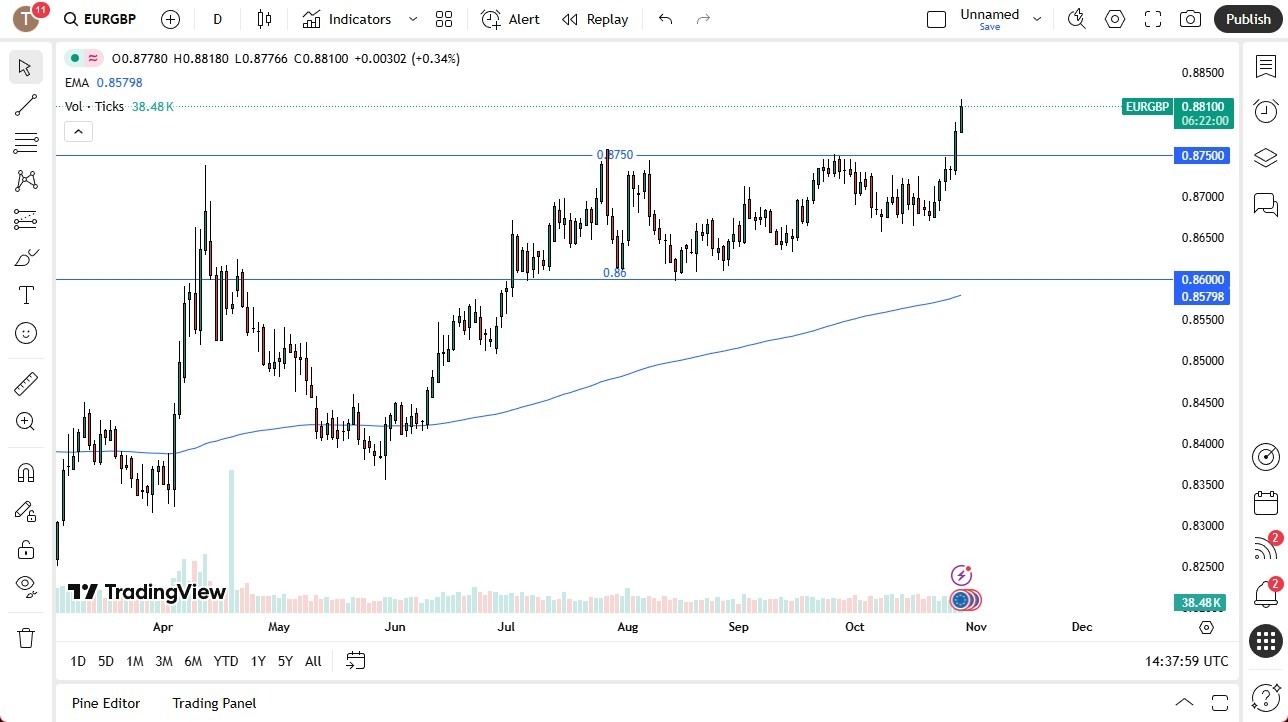
After breaking above key resistance at 0.8750, the pair targets 0.89, reflecting ongoing pound weakness rather than euro strength.
The euro continued to rally against the British pound during the trading session on Wednesday as markets awaited the European Central Bank interest rate decision on Thursday. It is worth noting that the pair broke above a major resistance barrier at 0.8750, a region that had acted as a ceiling in this market for a long time. Having previously consolidated within a 150-pip range, the so-called measured move suggests a potential advance toward the 0.89 level, an area that makes sense historically.
Over the longer term, the 0.89 level has proven significant on multiple occasions, creating a favorable technical setup. That said, the ECB decision could introduce volatility into the market, though any such movement should be short-lived unless the central bank delivers a genuine surprise. What stands out is that the British pound itself has been relatively weak in recent weeks, and this pair’s movement may reflect sterling’s softness more than any particular demand for the euro.
A Pullback Offer Value in this Pair
A pullback could present a buying opportunity, with 0.8750 expected to serve as a short-term floor. A dip toward that level would likely offer an attractive entry, though the market could simply continue higher. There appears to be little reason to short this pair unless the ECB delivers an unexpected shock, which seems unlikely at present. The euro has been in an uptrend since at least June, and even when viewed from a broader perspective—with some sharp corrections along the way—the prevailing trend remains higher. Accordingly, the 0.89 level appears to be a realistic target for the near term.
Christopher Lewis has been trading Forex and has over 20 years experience in financial markets. Chris has been a regular contributor to Daily Forex since the early days of the site. He writes about Forex for several online publications, including FX Empire, Investing.com, and his own site, aptly named The Trader Guy. Chris favours technical analysis methods to identify his trades and likes to trade equity indices and commodities as well as Forex. He favours a longer-term trading style, and his trades often last for days or weeks.
Markets are nervous of UK fiscal woes: While the public finances of many developed nations are currently somewhat dubious at best, this is particularly true for the United Kingdom, with a multibillion-pound hole that needs to be addressed by the upcoming budget in November.
While developments concerning the budget continue to do the media rounds, which will inevitably only increase as November 26th approaches, Rachel Reeves is stuck between a rock and a hard place, between honoring campaign pledges not to raise taxes on working people and VAT while simultaneously needing to find an estimated £30bn to balance spending with tax income.
To make matters worse, and coming at an inopportune time for the Chancellor of the Exchequer, an assessment to be released on Friday by the Office for Budget Responsibility (OBR) is expected to substantially downgrade UK productivity forecasts, resulting in a further estimate of £20 billion in shortfall.
Not to mention: government borrowing also exceeded estimates in the first half of 2025 by £7.2bn as per last week’s OBR commentary.
Tying this back to GBP/USD, however, is remarkably simple: the fiscal health of the UK economy appears to be worsening, and investors are collectively demanding a higher level of risk premium to hold sterling-denominated assets.
This fundamental downgrade in sterling’s rating when compared to other stores of wealth is what has led, in no small part, to recent GBP/USD downside.