The main tag of Forex News Today Articles.
You can use the search box below to find what you need.
[wd_asp id=1]

30 10, 2025
Euro remains fragile heading into ECB decision

By |2025-10-30T15:16:19+03:00October 30, 2025|Forex News, News|0 Comments

EUR/USD lost more than 0.4% on Wednesday and snapped a five-day winning streak. The pair holds steady and trades slightly above 1.1600 in the European morning on Thursday as investors await the European Central Bank’s (ECB) monetary policy announcements.

Euro Price This week

The table below shows the percentage change of Euro (EUR) against listed major currencies this week. Euro was the weakest against the Australian Dollar.

USD EUR GBP JPY CAD AUD NZD CHF
USD 0.21% 1.02% 0.48% -0.46% -0.56% 0.14% 0.36%
EUR -0.21% 0.82% 0.36% -0.66% -0.70% -0.07% 0.15%
GBP -1.02% -0.82% -0.61% -1.48% -1.50% -0.89% -0.71%
JPY -0.48% -0.36% 0.61% -1.04% -1.12% -0.46% -0.23%
CAD 0.46% 0.66% 1.48% 1.04% -0.14% 0.60% 0.78%
AUD 0.56% 0.70% 1.50% 1.12% 0.14% 0.62% 0.80%
NZD -0.14% 0.07% 0.89% 0.46% -0.60% -0.62% 0.18%
CHF -0.36% -0.15% 0.71% 0.23% -0.78% -0.80% -0.18%

The heat map shows percentage changes of major currencies against each other. The base currency is picked from the left column, while the quote currency is picked from the top row. For example, if you pick the Euro from the left column and move along the horizontal line to the US Dollar, the percentage change displayed in the box will represent EUR (base)/USD (quote).

The Federal Reserve (Fed) announced late Wednesday that it lowered the policy rate by 25 basis points (bps) to the range of 3.75%-4%. This decision came in line with the market expectation.

In the post-meeting press conference, Fed Chair Jerome Powell noted that another rate cut in December is “far from assured” and explained that the outlook for employment and inflation has not changed much since the September meeting. Powell further reiterated that they need to manage the risk of more persistent inflation.

Following these comments, the CME Group FedWatch Tool’s probability of a 25 bps rate cut in December declined to 70% from about 90%. In turn, the US Dollar (USD) gathered strength and caused EUR/USD to close the day deep in the red.

The ECB is widely anticipated to leave key rates unchanged on Thursday. Ahead of the ECB policy announcements, preliminary Gross Domestic Product (GDP) growth data for the Eurozone will be featured in the European economic calendar. Markets expect the Eurozone economy to expand at a quarterly pace of 0.1% in Q3. A negative print could revive expectations for an ECB rate cut in December and weigh on the Euro with the immediate reaction.

Investors will also pay close attention to comments from ECB President Christine Lagarde. In case Lagarde adopts an optimistic tone about the economic outlook and emphasizes upside risks to inflation, the Euro could stay resilient against its rivals and open the door to a recovery in EUR/USD. Conversely, EUR/USD could start stretching lower if Lagarde acknowledges heightened uncertainty on the economic outlook.

EUR/USD Technical Analysis

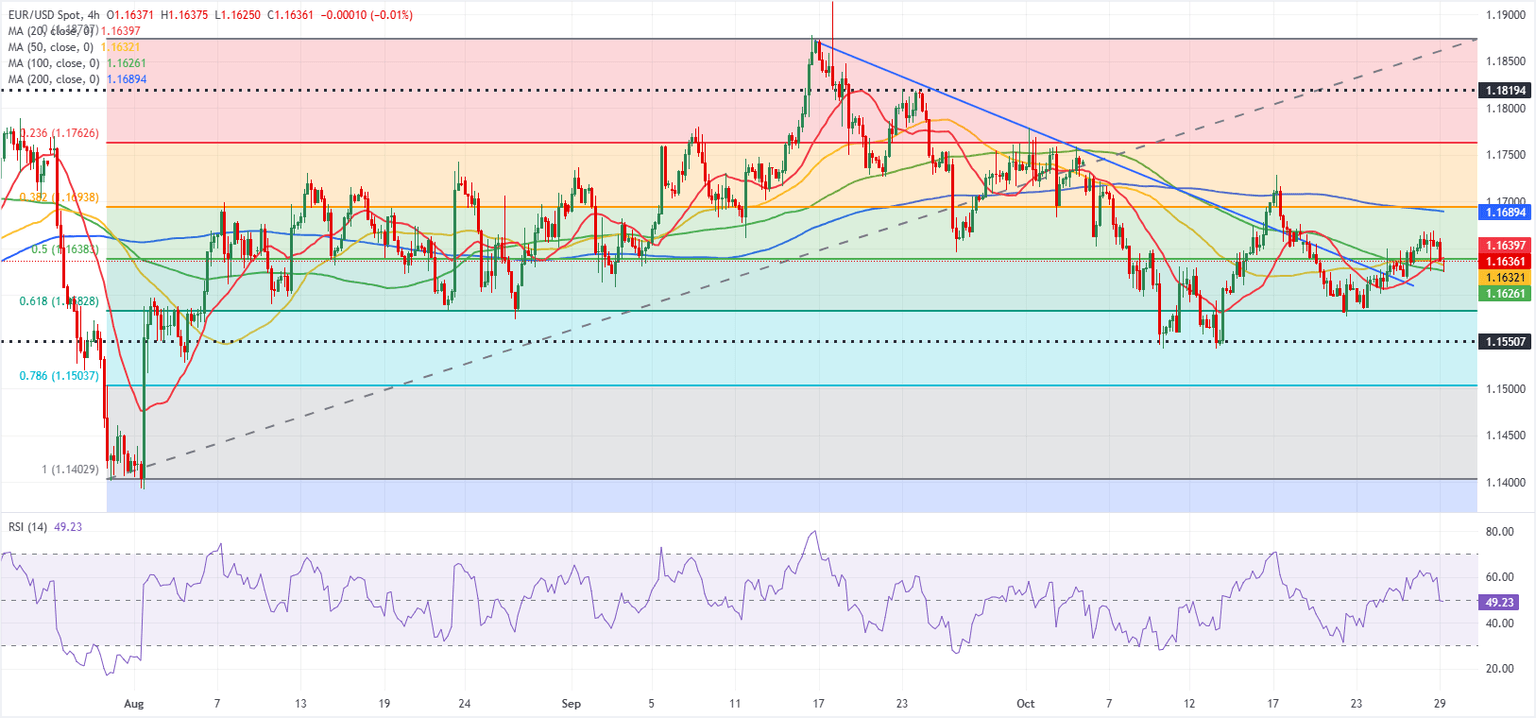
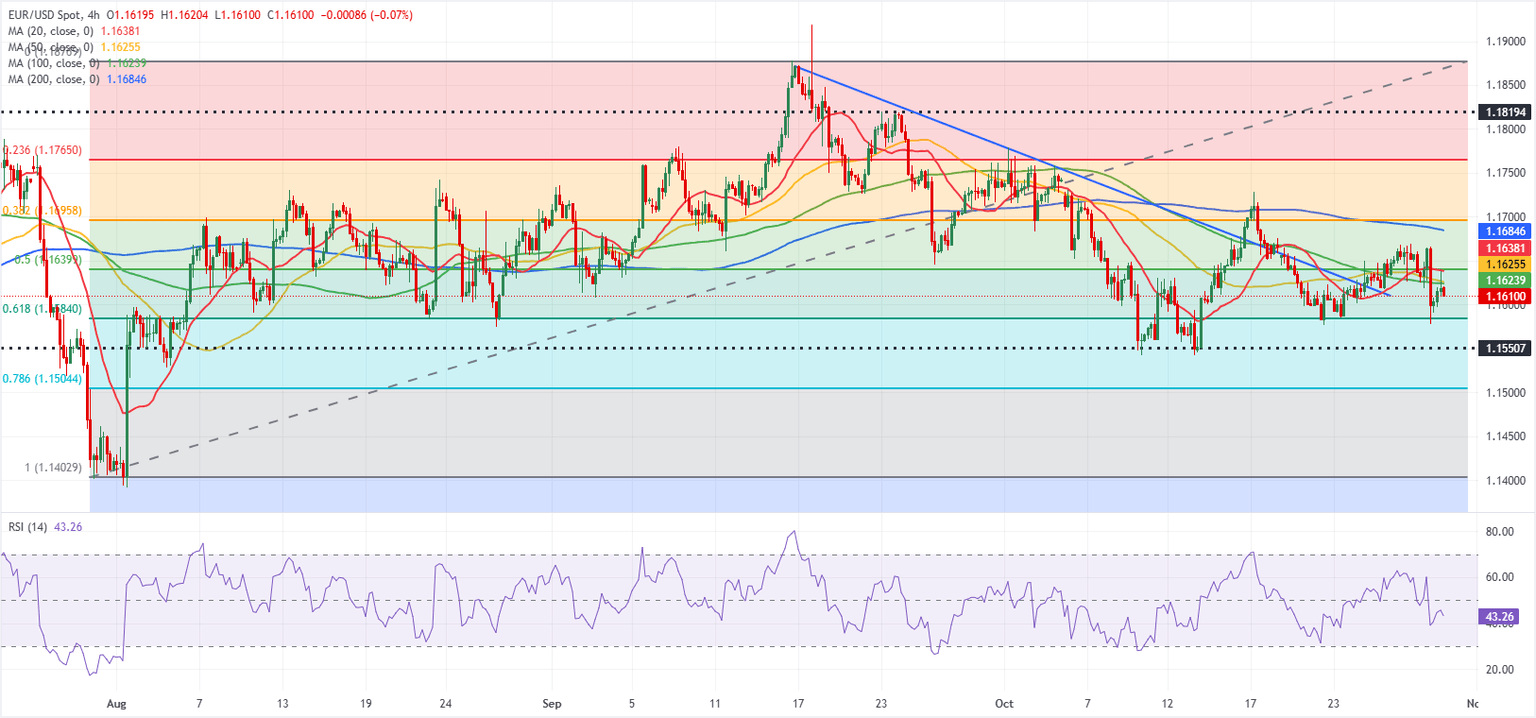
EUR/USD closed below the 100-day and the 20-day Simple Moving Averages (SMAs) on Wednesday and the Relative Strength Index (RSI) indicator on the 4-hour chart dropped toward 40, reflecting a bearish tilt in the short-term technical outlook.

Looking south, the first support level could be spotted at 1.1580 (Fibonacci 61.8% retracement of the latest uptrend) before 1.1550 (static level) and 1.1500 (Fibonacci 78.6% retracement). On the upside, the 20-day SMA aligns as an interim resistance level at 1.1630 ahead of 1.1670 (100-day SMA), 1.1690-1.1700 (200-period SMA, Fibonacci 38.2% retracement).

Euro FAQs

The Euro is the currency for the 20 European Union countries that belong to the Eurozone. It is the second most heavily traded currency in the world behind the US Dollar. In 2022, it accounted for 31% of all foreign exchange transactions, with an average daily turnover of over $2.2 trillion a day.
EUR/USD is the most heavily traded currency pair in the world, accounting for an estimated 30% off all transactions, followed by EUR/JPY (4%), EUR/GBP (3%) and EUR/AUD (2%).

The European Central Bank (ECB) in Frankfurt, Germany, is the reserve bank for the Eurozone. The ECB sets interest rates and manages monetary policy.
The ECB’s primary mandate is to maintain price stability, which means either controlling inflation or stimulating growth. Its primary tool is the raising or lowering of interest rates. Relatively high interest rates – or the expectation of higher rates – will usually benefit the Euro and vice versa.
The ECB Governing Council makes monetary policy decisions at meetings held eight times a year. Decisions are made by heads of the Eurozone national banks and six permanent members, including the President of the ECB, Christine Lagarde.

Eurozone inflation data, measured by the Harmonized Index of Consumer Prices (HICP), is an important econometric for the Euro. If inflation rises more than expected, especially if above the ECB’s 2% target, it obliges the ECB to raise interest rates to bring it back under control.
Relatively high interest rates compared to its counterparts will usually benefit the Euro, as it makes the region more attractive as a place for global investors to park their money.

Data releases gauge the health of the economy and can impact on the Euro. Indicators such as GDP, Manufacturing and Services PMIs, employment, and consumer sentiment surveys can all influence the direction of the single currency.
A strong economy is good for the Euro. Not only does it attract more foreign investment but it may encourage the ECB to put up interest rates, which will directly strengthen the Euro. Otherwise, if economic data is weak, the Euro is likely to fall.
Economic data for the four largest economies in the euro area (Germany, France, Italy and Spain) are especially significant, as they account for 75% of the Eurozone’s economy.

Another significant data release for the Euro is the Trade Balance. This indicator measures the difference between what a country earns from its exports and what it spends on imports over a given period.
If a country produces highly sought after exports then its currency will gain in value purely from the extra demand created from foreign buyers seeking to purchase these goods. Therefore, a positive net Trade Balance strengthens a currency and vice versa for a negative balance.

(This story was corrected on October 30 at 08:55 GMT to say that the Federal Reserve cut the policy rate by 25 bps to 3.75%-4%, not 4%-4.25%.)
Source link

30 10, 2025

The GBPJPY approaches the target– Forecast today – 30-10-2025

By |2025-10-30T13:15:18+03:00October 30, 2025|Forex News, News|0 Comments

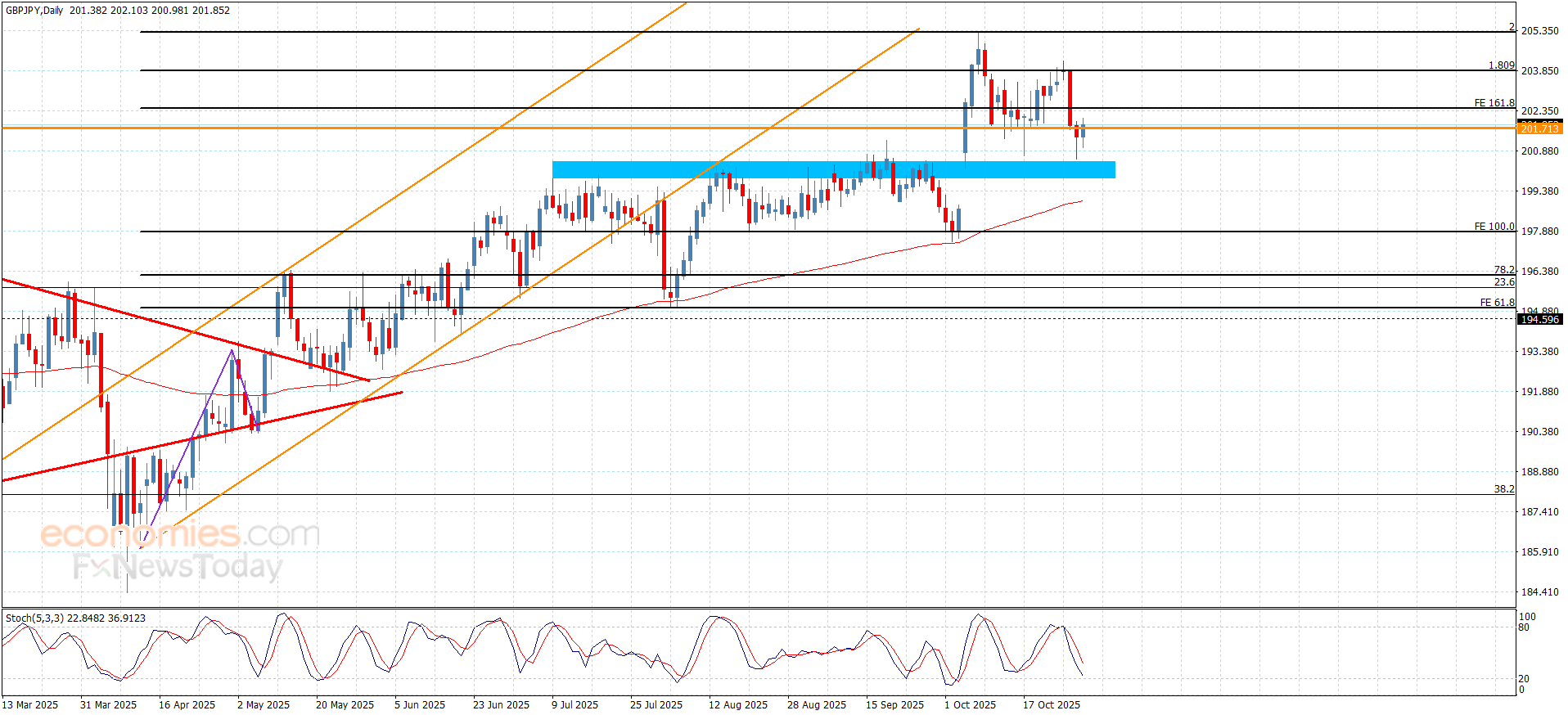
The GBPJPY pair approached the target near 200.45 in yesterday’s trading, which forms an important support level to push it to form bullish rebound by hitting 202.10 level, to indicate regaining the bullish trend.


The price needs a new bullish momentum that allows it to provide new bullish close above 201.70 level, reinforcing the chances of targeting positive stations that are located near 202.55 and 203.25, while declining and holding below 200.45 will force it to suffer extra losses, to expect targeting 199.20 level initially.


The expected trading range for today is between 200.80 and 202.55


Trend forecast: Bullish by the stability of 200.45


Source link

30 10, 2025

The EURJPY begins with strong bullish trading– Forecast today – 30-10-2025

By |2025-10-30T11:14:19+03:00October 30, 2025|Forex News, News|0 Comments

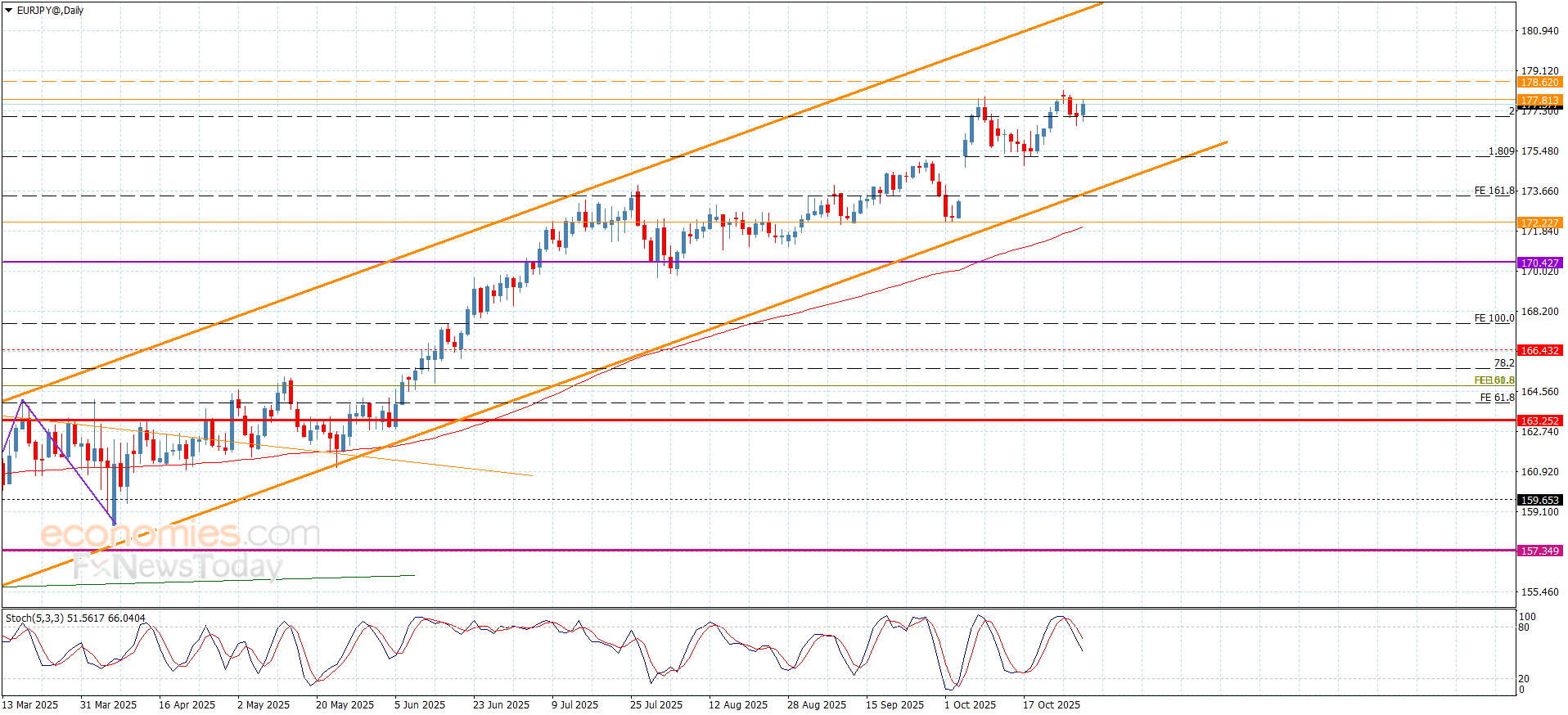
The GBPJPY pair approached the target near 200.45 in yesterday’s trading, which forms an important support level to push it to form bullish rebound by hitting 202.10 level, to indicate regaining the bullish trend.


The price needs a new bullish momentum that allows it to provide new bullish close above 201.70 level, reinforcing the chances of targeting positive stations that are located near 202.55 and 203.25, while declining and holding below 200.45 will force it to suffer extra losses, to expect targeting 199.20 level initially.


The expected trading range for today is between 200.80 and 202.55


Trend forecast: Bullish by the stability of 200.45


Source link

30 10, 2025

GBP Slides Sub-1.32 As Fed Cuts Rates

By |2025-10-30T03:10:29+03:00October 30, 2025|Forex News, News|0 Comments

The Pound to US Dollar (GBP/USD) exchange rate extended losses on Wednesday after the Federal Reserve delivered a widely expected 25bps rate cut, while UK fiscal concerns continued to weigh on Sterling sentiment.

Latest — Exchange Rates:
Pound to Dollar (GBP/USD): 1.3197 (-0.61%)
Euro to Dollar (EUR/USD): 1.1605 (-0.44%)
Dollar to Japanese Yen (USD/JPY): 152.683 (+0.63%)

DAILY RECAP:

The Pound (GBP) remained under pressure on Wednesday, extending its recent slide as concerns mounted ahead of next month’s Autumn Budget.

Investors continued to digest reports suggesting the Office for Budget Responsibility (OBR) is preparing a downgrade to the UK’s productivity outlook, potentially opening up a £20 billion fiscal shortfall.

Such a revision is expected to force Chancellor Rachel Reeves into announcing a mix of tax hikes and spending restraint, fuelling fears that tighter fiscal policy could undermine the fragile UK recovery.

While Reeves has argued the government can balance fiscal discipline with growth, markets remain sceptical — keeping Sterling on the defensive.

Meanwhile, the US Dollar (USD) initially traded mixed before stabilising after the Federal Reserve announced a widely expected 25bps rate cut, lowering the fed funds range to 3.75–4.00%.

Chair Jerome Powell struck a balanced tone, noting that while inflation progress allows some room to ease, further rate reductions are “far from assured.”

foreign exchange rates

The comments dampened expectations of aggressive near-term cuts, offering modest support to the Greenback even as Treasury yields edged lower.

Near-Term GBP/USD Forecast: Market Focus on Fed Outlook and UK Fiscal Risks

Looking ahead, the Pound to US Dollar exchange rate will likely hinge on post-Fed market reaction and evolving sentiment around the UK budget.

If investors continue to interpret Powell’s remarks as cautious rather than dovish, the Dollar could retain its recent gains.

However, any follow-through risk rally or weaker US data could prompt renewed Dollar selling later in the week.

For the Pound, the domestic backdrop remains clouded by uncertainty over fiscal tightening. Without fresh data to shift attention, Sterling may struggle to find a floor until clearer signals emerge from the Treasury or OBR.

Source link

30 10, 2025

Pound Falls to 1.3240 as £35B Fiscal Gap and Fed Decision Trigger Sell-Off

By |2025-10-30T01:09:09+03:00October 30, 2025|Forex News, News|0 Comments

GBP/USD Forecast: Sterling Slides Toward 1.3240 as Fiscal Gap, BoE Cut Odds, and Fed Decision Pressure Pound

GBP/USD Under Renewed Pressure as Fiscal Concerns Deepen and Dollar Strengthens

The British Pound to U.S. Dollar (GBP/USD) remains under intense selling pressure, trading near 1.3280 after briefly touching 1.3247, marking its weakest level since August. The pair has fallen more than 3.4% from September’s peak at 1.3725, extending a two-week decline as investors reassess the UK’s fragile fiscal position and upcoming monetary decisions on both sides of the Atlantic. Market sentiment toward Sterling has deteriorated sharply following the Office for Budget Responsibility’s (OBR) warning of a £20 billion shortfall in government finances, a gap that could widen to £35 billion under current productivity and growth assumptions.

The OBR’s findings fuel speculation that Chancellor Rachel Reeves may introduce tax hikes in the November Budget to stabilize public accounts. Such a move could tighten household spending and consumer demand, threatening the UK’s already sluggish recovery. The UK economy remains structurally weak — GDP growth is stalling near 0.2% quarter-on-quarter, productivity continues to lag, and inflation, though easing, underscores a fragile backdrop. The British Retail Consortium’s data revealed softer food prices and inflation slowing to 1.8%, giving markets confidence that the Bank of England (BoE) could pivot toward easing sooner than expected. Traders now assign a 68% probability of a 25-basis-point rate cut in December, a dramatic shift from earlier expectations of a prolonged pause.

Dollar Firm Ahead of Fed Rate Cut and Powell’s Guidance

On the U.S. side, the Federal Reserve is widely expected to announce its second 25-bps rate cut of 2025, lowering the target range to 3.75%–4.00%. However, the market’s focus is firmly on Chair Jerome Powell’s tone regarding future policy. A dovish statement signaling more cuts before year-end could provide some relief for the Pound, while a measured or hawkish stance could drive further downside toward 1.3140 or lower. The U.S. Dollar Index (DXY) trades steady near 98.70, supported by safe-haven demand amid global uncertainty and the Trump administration’s ongoing Asia visit, which produced a U.S.–Japan minerals alliance agreement aimed at securing rare earth supply chains.

The Fed’s decision comes as U.S. macro data weakens: Conference Board consumer confidence dropped to 94.1, ADP private payrolls fell by 36,000, and housing data showed prices slowing for the seventh consecutive month. Despite these signals, the Dollar remains resilient, reflecting investors’ preference for liquidity and yield amid heightened volatility in Europe and Asia.

Fiscal Anxiety and Volatility Build Ahead of Reeves’s Budget

The upcoming UK Autumn Budget has become a defining risk event for Sterling. With the implied volatility on GBP/USD options rising to a three-month high, traders are increasingly positioning for sharper moves as fiscal risk looms. If Reeves confirms new spending commitments without clear funding clarity, markets could interpret the plan as fiscally expansionary, reviving concerns similar to the 2022 mini-budget crisis that triggered a sharp Sterling collapse.

Investors are also monitoring BoE communication, with Governor Andrew Bailey expected to emphasize data dependency. Market pricing now implies 50 bps of total easing by mid-2026, though fiscal stress may accelerate that timeline. For Sterling, this combination of monetary and fiscal fragility leaves little room for optimism in the near term, especially as the Dollar continues to absorb risk-averse inflows.

Technical Breakdown: Double-Top at 1.3725, Neckline Targets 1.3140

From a technical standpoint, GBP/USD continues to trace a double-top pattern with the neckline around 1.3140, a level that has now become a key inflection point. The pair trades below the Supertrend indicator, confirming a sustained bearish bias. Short-term resistance is observed at 1.3340, 1.3400, and 1.3520, while support levels cluster around 1.3240, 1.3180, and 1.3140. A decisive close below 1.3140 could extend losses toward 1.3000, while only a breakout above 1.3400 would neutralize downside momentum.

Momentum indicators align with this bearish structure: the RSI remains in the mid-40s, showing no bullish divergence, while the Percentage Price Oscillator (PPO) remains in negative territory. Volume data from interbank flows show renewed selling each time GBP/USD attempts to recover above 1.3340, confirming strong resistance from institutional sellers.

Global Risk Environment: Gold Rally and Yen Strength Confirm Flight to Safety

The broader macro environment adds further weight to Sterling’s decline. The rally in Gold (XAU/USD) back above $4,000 per ounce and the surge in Japanese Yen (JPY) — with GBP/JPY nearing 201.00 — signal a pronounced flight-to-safety sentiment across global markets. Risk assets, including equities and emerging-market currencies, remain under pressure ahead of the Fed’s decision and potential follow-through from Trump’s trade policies.

This shift toward defensive positioning highlights the challenge for Sterling: investors are not only cautious about domestic fiscal policy but are also shifting capital toward assets perceived as safe havens. That dynamic leaves GBP/USD vulnerable to deeper retracements unless the Fed strikes an unexpectedly dovish tone or the UK Budget surprises positively.

Market Positioning and Volatility Signals Further Downside

Positioning data indicates that institutional traders remain net short Sterling. CFTC futures show a steady increase in GBP short positions over the past two weeks, while options market skew favors downside protection, with higher demand for puts around the 1.3150–1.3200 range. The increase in one-week implied volatility — now at 7.2%, the highest since August — suggests markets anticipate a 100–120 pip swing following the Fed statement.

Short-term sentiment remains bearish, with hedge funds and asset managers reducing long exposure in anticipation of further policy divergence. Traders see limited upside unless Powell explicitly commits to further easing or Reeves delivers a credible fiscal plan. Until then, the pair is likely to remain range-bound between 1.3140 and 1.3400, with rallies being sold aggressively.

TradingNews.com Verdict: SELL (Bearish Bias While Below 1.3400)

The data-driven narrative leaves GBP/USD in a clearly bearish setup. Fiscal fragility, widening budget uncertainty, soft inflation, and a market priced for BoE cuts all weigh against Sterling. Unless the Fed pivots sharply dovish or UK policymakers deliver fiscal clarity, the path of least resistance remains lower.

Verdict: SELL — bearish bias maintained while GBP/USD trades below 1.3400; next targets 1.3180 and 1.3140, with potential extension to 1.3000 if Budget risks escalate.

That’s TradingNEWS


Source link

29 10, 2025

Trade in Narrow Ranges (Chart)

By |2025-10-29T23:08:16+03:00October 29, 2025|Forex News, News|0 Comments

EUR/USD Analysis Summary Today

  • Overall Trend: : Remains bearish.
  • Support Levels for EUR/USD Today: 1.1610 – 1.1540 – 1.1470.
  • Resistance Levels for EUR/USD Today: 1.1685 – 1.1750 – 1.1830.

EUR/USD Trading Signals:

  • Buy EUR/USD from the support level of 1.1560 with a target of 1.1800 and a stop-loss of 1.1480.
  • Sell EUR/USD from the resistance level of 1.1740 with a target of 1.1600 and a stop-loss of 1.1800.

Technical Analysis of EUR/USD Today:

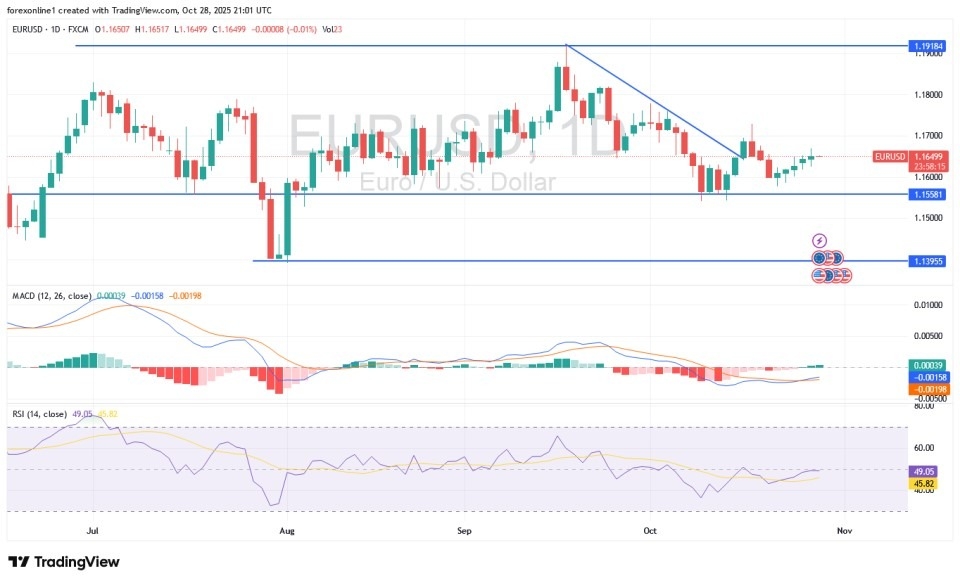
As expected, the EUR/USD price remained within narrow ranges at the beginning of this week’s trading, pending market and investor reaction to the policy announcements of both the US Federal Reserve and the European Central Bank. On trusted trading platforms, the EUR/USD price is stabilizing around 1.1650 at the time of writing.

EUR/USD Technical Forecast

The EUR/USD is resisting the strength of the US dollar better than most currencies, which is expected to allow it to trade strongly this week. The EUR/USD traded slightly higher against the US dollar last week, and this important week’s trading is witnessing a new high, surpassing the nine-day exponential moving average (EMA) at 1.1630.

This rise suggests that the near-term momentum has shifted to the upside, and there is potential for steady movement through the mid-to-late 1.16 range. Although the Euro is rising slowly, it is not decisively trending upward. It is worth noting that the EUR/USD pair remains trading within a multi-month consolidation range. The lower boundary of this range extends to 1.1550 (we disregard the July drop to 1.14 as it was quickly corrected), while the upper boundary is at 1.1750, with temporary spikes to 1.18 and above proving short-lived.

Therefore, we are likely to see a rally within this mentioned range, which means that both strength and weakness will be limited.

Amid the stability of the euro against the US dollar, much of course depends on the actions of the US Federal Reserve in the middle of this week. We know that it will cut US interest rates by 25 basis points, but we do not know its opinion on any further rate cuts later in the year. The general rule of thumb for trading is that any encouragement for further cuts will negatively impact the dollar and allow the EUR/USD pair to break the 1.17 resistance level. Overall, Recent US survey data confirms that the employment situation is slowly deteriorating, and the Federal Reserve will not want to risk exacerbating this situation by keeping US interest rates tight for an extended period. This will ensure that the possibility of further cuts remains.

Trading Tips:

As we advise, the EUR/USD will remain range-bound until the markets react to the US Federal Reserve’s announcement this week and then the outcome of the US/China trade dispute.

The Future of Central Bank Policies

However, if the U.S. Central Bank signals caution about another cut in 2025, it will have a negative impact on the EUR/USD pair. Ultimately, the Federal Reserve is currently short on official economic data due to the government shutdown and will not want to signal any major policy change if it feels it is navigating blindly. Given this, we believe we will receive very restrictive guidance from the Federal Reserve, as it does its best to maintain steadiness at the helm until official data begins to flow again.

Obvioulsy, this means that any subsequent reactions in exchange rates after the Fed’s decision will eventually fade. Also, we will end the week in a relatively stable position—meaning the EUR/USD is moving upward within its multi-week range.

On another influential front for currency exchange rates, we await the European Central Bank’s decision next Thursday, where no change in interest rates is expected. Consequently, a rate cut by the Federal Reserve and continued rate stability by the ECB would allow interest rates in the U.S. and the Eurozone to converge further, which is currently supportive of Euro trading.

Ready to trade our daily Forex analysis? We’ve made a list of the best online forex trading platform worth trading with.

Source link

29 10, 2025

EUR/USD, GBP/USD and EUR/GBP Forecast – Currency Markets Wait for Central Banks

By |2025-10-29T21:07:18+03:00October 29, 2025|Forex News, News|0 Comments

GBP/USD Technical Analysis

The British pound looks sick, quite frankly. If we break down below the 1.3150 level, then I think the bottom falls out. We go looking to the 1.27 level. We are hanging around the 200-day EMA, and I obviously believe that the FOMC interest rate decision, or perhaps more importantly, the press conference after that, will drive where the U.S. dollar goes next, which obviously will drive where this pair goes.

We do not have an interest rate decision coming out of the United Kingdom this week, unlike the European Central Bank. So, I think this is going to be all about the U.S. dollar. Short-term rallies, I think, open up the possibility of short opportunities at the first signs of exhaustion.

EUR/GBP Technical Analysis

Looking at the euro against the British pound, we continue to rally quite nicely as we are now threatening the 0.88 level. Short-term pullbacks should end up being buying opportunities, but keep in mind that we have the European Central Bank with its interest rate decision on Thursday that would cause some volatility. It looks like the 0.8750 level will be a bit of a floor in this market, so a pullback from here is going to turn around and bounce quite nicely.

I’m looking for dips as value. I don’t have any interest in shorting this market. Breaking above the 0.8750 level opened up the possibility of a move to the 0.89 level based on the measured move of the previous consolidation area.

For a look at all of today’s economic events, check out our economic calendar.

Source link

29 10, 2025

Slips Below 200-Day EMA (Chart)

By |2025-10-29T19:06:24+03:00October 29, 2025|Forex News, News|0 Comments

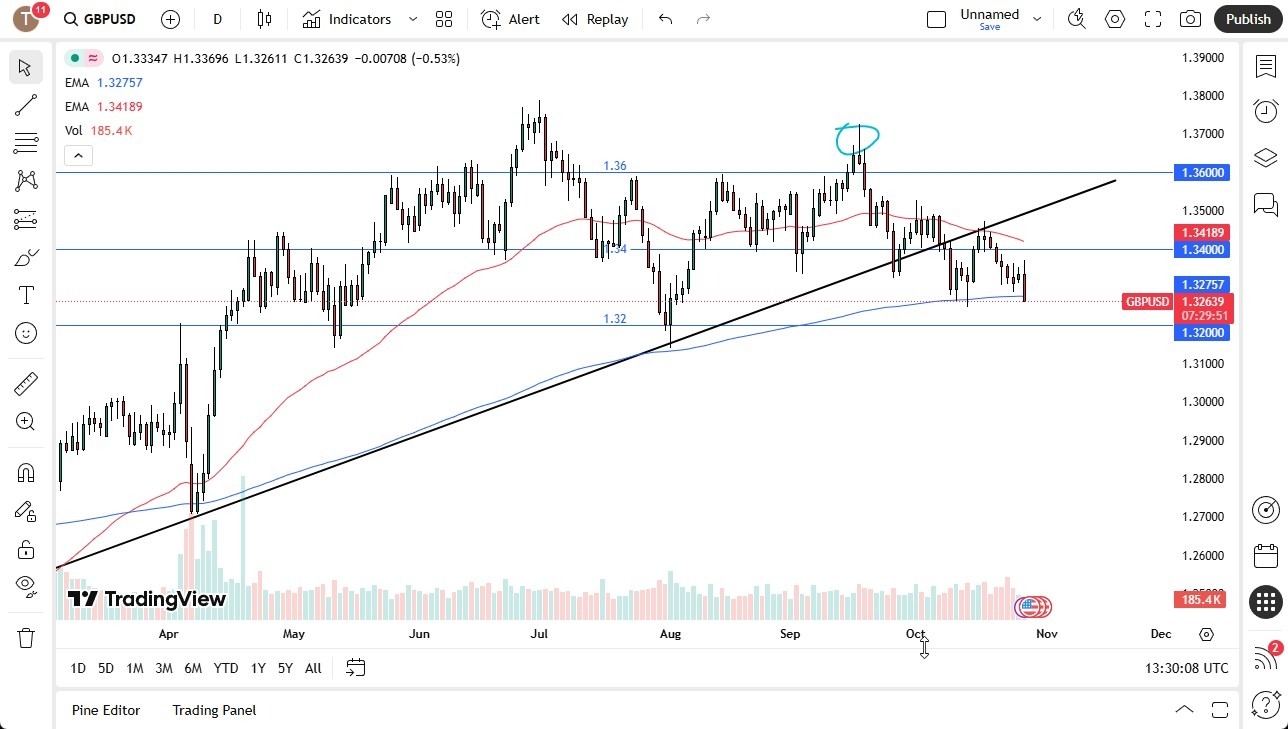
  • The British pound initially rallied on Tuesday but reversed sharply, falling below its 200-day EMA.
  • With the Federal Reserve poised to move before the Bank of England, the GBP/USD pair faces growing downside risk toward 1.32 and potentially 1.3150 support.

The pound initially rallied during the trading session on Tuesday, but then fell rather significantly to break below the 200-day EMA. At this point, I have to ask whether the British pound is going to start to fall apart. This currency seems to be in flux, as the British pound has, for the last year and a half or so, been a bit more stable against the US dollar than most of its counterparts. However, over the last couple of weeks, we’ve seen an acceleration to the downside.

The Bank of England does not have a meeting this week, unlike the Federal Reserve, so the Federal Reserve might be the next mover of this pair. If we continue to drop from here, the 1.32 level is an area I’d be very sensitive to because it represents significant support. Breaking down below the 1.3150 level could kick off the next leg lower and would usher in a new push to the upside for the US dollar—probably not only against the British pound but multiple other currencies as well.

The US Dollar Has Overperformed Others

The US dollar has outperformed most currencies, and I look at a weakening US dollar during any particular trading session as a potential buying opportunity to get my hands on more greenbacks. The British pound seems to have a bit of a brick wall near the 50-day EMA, which is currently just above the 1.34 level. I think the upside is somewhat limited.

As the US dollar goes, so go the rest of the currencies, and that’s exactly what we’re seeing here. The US dollar is showing signs of life, and it is starting to weigh upon the British pound. Whether we can continue to the downside remains to be seen, but clearly, at this point in time, it’s very difficult for the pound to gain traction against the US dollar.

Ready to trade our daily GBP/USD Forex forecast? Here’s some of the best forex broker UK reviews to check out.

Christopher Lewis has been trading Forex and has over 20 years experience in financial markets. Chris has been a regular contributor to Daily Forex since the early days of the site. He writes about Forex for several online publications, including FX Empire, Investing.com, and his own site, aptly named The Trader Guy. Chris favours technical analysis methods to identify his trades and likes to trade equity indices and commodities as well as Forex. He favours a longer-term trading style, and his trades often last for days or weeks.

Source link

29 10, 2025

GBP/JPY Forecast Today 29/10: Drops, Yen Strengthens (Chart)

By |2025-10-29T17:05:17+03:00October 29, 2025|Forex News, News|0 Comments

  • The British pound fell sharply against the yen in early Tuesday trading amid volatility following Bank of Japan comments.
  • Despite short-term weakness, the analyst sees buying opportunities near ¥200 and the 50-day EMA, targeting a return toward ¥205.

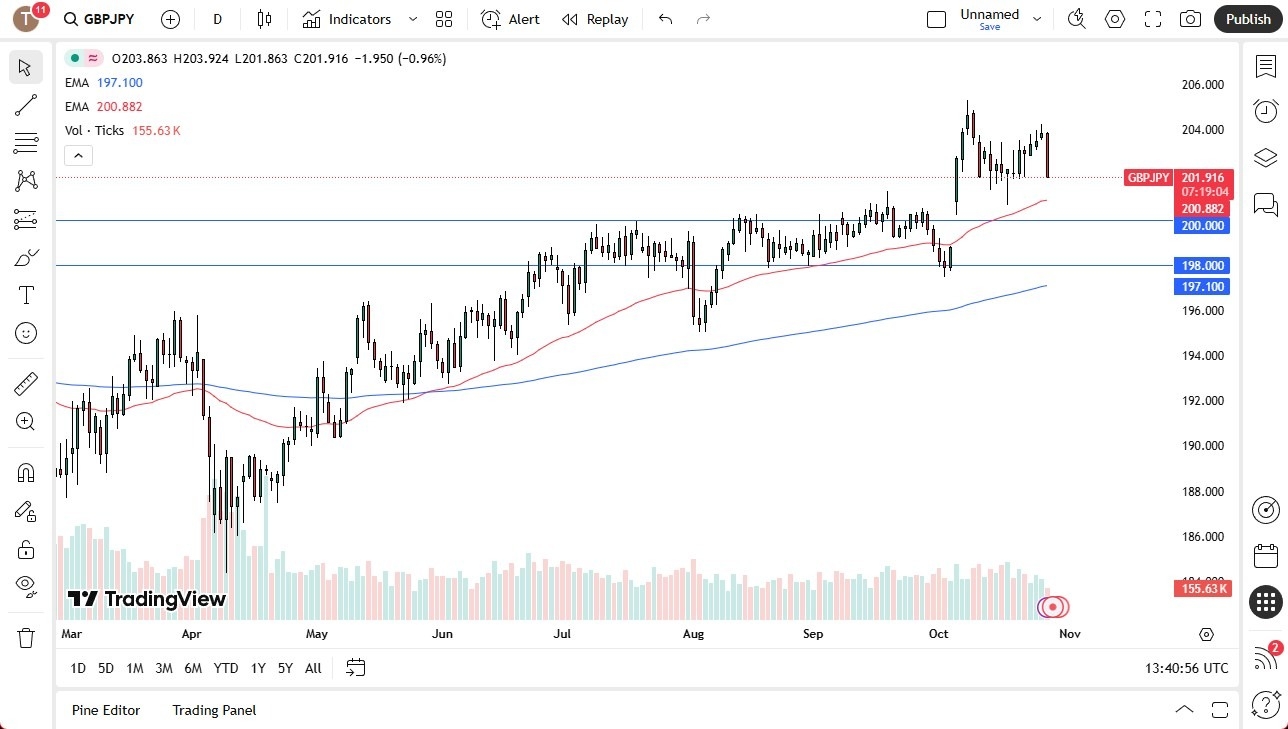
The British pound has fallen significantly against the Japanese yen during early trading on Tuesday, as the market continues to be very volatile. The Bank of Japan made a statement overnight that it believes forex moves should represent fundamentals. To me, that’s something they’ve said multiple times in the past, and it always leads to the same thing: the Japanese yen strengthening for a little bit, only to see buyers coming back into the market and shorting it again.

With that in mind, I’m looking at the area right around the 50-day EMA as an area that could offer support, right along with the ¥200 level. Because of this, I’m looking for an opportunity to buy this pair on some type of bounce. As things stand right now, it looks like we have plenty of pressure to the downside, so I would have to be very patient here. All things being equal, this is a scenario where I think you look for value and take advantage of it—not only are we in a significant uptrend, but we also have the interest rate differential between the British pound and the Japanese yen.

A Potential Target

All things being equal, this is a market that I think tries to get back to the ¥205 level, an area that has previously been very difficult to break above. If we can break above that level, then we could go much higher. Ultimately, I do think that’s what happens, and I favor the British pound over the Japanese yen. That’s probably true with most currencies, but the interest rate differential between the British pound and the Japanese yen is much wider than what’s found in other pairs, such as the Canadian dollar or even the Swiss franc against the yen.

Not all pairs are going to move with the same type of momentum, although they do tend to move in the same general direction. All things being equal, this is a market where I’m looking for a buying opportunity that I expect to take advantage of in the next day or two.

Begin trading our daily forecasts and analysis. Here is a list of Forex brokers in Japan to work with.

Christopher Lewis has been trading Forex and has over 20 years experience in financial markets. Chris has been a regular contributor to Daily Forex since the early days of the site. He writes about Forex for several online publications, including FX Empire, Investing.com, and his own site, aptly named The Trader Guy. Chris favours technical analysis methods to identify his trades and likes to trade equity indices and commodities as well as Forex. He favours a longer-term trading style, and his trades often last for days or weeks.

Source link

29 10, 2025

Buyers hesitate as key resistance stays intact ahead of Fed

By |2025-10-29T15:04:29+03:00October 29, 2025|Forex News, News|0 Comments

After posting small gains for five consecutive days, EUR/USD loses its traction in the European morning on Wednesday and trades below 1.1650. The pair’s near-term technical outlook highlights a loss of bullish momentum as investors await the Federal Reserve’s (Fed) monetary policy announcements.

Euro Price Today

The table below shows the percentage change of Euro (EUR) against listed major currencies today. Euro was the weakest against the Australian Dollar.

USD EUR GBP JPY CAD AUD NZD CHF
USD 0.13% 0.30% -0.03% -0.16% -0.49% -0.25% 0.09%
EUR -0.13% 0.17% -0.18% -0.29% -0.61% -0.38% -0.04%
GBP -0.30% -0.17% -0.34% -0.45% -0.78% -0.55% -0.20%
JPY 0.03% 0.18% 0.34% -0.16% -0.44% -0.20% 0.14%
CAD 0.16% 0.29% 0.45% 0.16% -0.34% -0.09% 0.25%
AUD 0.49% 0.61% 0.78% 0.44% 0.34% 0.24% 0.58%
NZD 0.25% 0.38% 0.55% 0.20% 0.09% -0.24% 0.34%
CHF -0.09% 0.04% 0.20% -0.14% -0.25% -0.58% -0.34%

The heat map shows percentage changes of major currencies against each other. The base currency is picked from the left column, while the quote currency is picked from the top row. For example, if you pick the Euro from the left column and move along the horizontal line to the US Dollar, the percentage change displayed in the box will represent EUR (base)/USD (quote).

The bullish opening in Wall Street, followed by a risk rally, highlighted a risk-positive market atmosphere and made it difficult for the US Dollar (USD) to find demand on Tuesday. Early Wednesday, US stock index futures trade mixed, reflecting a cautious mood, which caps EUR/USD’s upside.

The Fed is widely anticipated to cut the policy rate by 25 basis points (bps) following the October policy meeting. In case Fed Chair Jerome Powell adopts a dovish tone in the post-meeting press conference, citing possibly worsening conditions in the labor market because of the government shutdown and softer-than-forecast inflation data for September, the USD could come under renewed selling pressure.

On the other hand, EUR/USD could continue to push lower if Powell refrains from committing to further policy easing because of the uncertainty created by the lack of data releases and heightened upside risks to inflation.

On Thursday, the European economic calendar will feature third-quarter Gross Domestic Product (GDP) growth figures for Germany and the Eurozone before the European Central Bank (ECB) announces monetary policy decisions.

EUR/USD Technical Analysis

EUR/USD failed to clear 1.1660, where the 100-day Simple Moving Average (SMA) is located, and the Relative Strength Index (RSI) indicator on the 4-hour chart retreated slightly below 50, reflecting buyers’ hesitancy.

On the downside, 1.1580 (Fibonacci 61.8% retracement of the latest uptrend), aligns as the next support level before 1.1550 (static level) and 1.1500 (Fibonacci 78.6% retracement). Looking north, resistance levels could be spotted at 1.1660 (100-day SMA), 1.1690-1.1700 (200-period SMA, Fibonacci 38.2% retracement) and 1.1760 (Fibonacci 23.6% retracement).

Fed FAQs

Monetary policy in the US is shaped by the Federal Reserve (Fed). The Fed has two mandates: to achieve price stability and foster full employment. Its primary tool to achieve these goals is by adjusting interest rates.
When prices are rising too quickly and inflation is above the Fed’s 2% target, it raises interest rates, increasing borrowing costs throughout the economy. This results in a stronger US Dollar (USD) as it makes the US a more attractive place for international investors to park their money.
When inflation falls below 2% or the Unemployment Rate is too high, the Fed may lower interest rates to encourage borrowing, which weighs on the Greenback.

The Federal Reserve (Fed) holds eight policy meetings a year, where the Federal Open Market Committee (FOMC) assesses economic conditions and makes monetary policy decisions.
The FOMC is attended by twelve Fed officials – the seven members of the Board of Governors, the president of the Federal Reserve Bank of New York, and four of the remaining eleven regional Reserve Bank presidents, who serve one-year terms on a rotating basis.

In extreme situations, the Federal Reserve may resort to a policy named Quantitative Easing (QE). QE is the process by which the Fed substantially increases the flow of credit in a stuck financial system.
It is a non-standard policy measure used during crises or when inflation is extremely low. It was the Fed’s weapon of choice during the Great Financial Crisis in 2008. It involves the Fed printing more Dollars and using them to buy high grade bonds from financial institutions. QE usually weakens the US Dollar.

Quantitative tightening (QT) is the reverse process of QE, whereby the Federal Reserve stops buying bonds from financial institutions and does not reinvest the principal from the bonds it holds maturing, to purchase new bonds. It is usually positive for the value of the US Dollar.

Source link

Go to Top