The main tag of Forex News Today Articles.
You can use the search box below to find what you need.
[wd_asp id=1]

13 09, 2025

GBP/USD Weekly Forecast: Looming Fed Cut Bets to Boost Pound

By |2025-09-13T22:15:47+03:00September 13, 2025|Forex News, News|0 Comments

  • The GBP/USD weekly forecast suggests further upside for the pound.
  • The US CPI report revealed that inflation accelerated from 0.3% to 0.4%.
  • US unemployment claims were higher than expected, supporting Fed rate cut bets.

The GBP/USD weekly forecast suggests further upside for the pound as traders gear up for a Fed rate cut on Wednesday.

Ups and downs of GBP/USD

GBP/USD ended the week higher as the dollar fell ahead of an expected Fed rate cut. US data during the week pointed to a spike in inflation. However, unemployment was also high.

Are you interested in learning more about ETF brokers? Check our detailed guide-

The US CPI report revealed that inflation accelerated from 0.3% to 0.4% monthly. Meanwhile, the annual figure accelerated to 2.9% as expected. However, traders were more focused on a separate report showing a jump in unemployment claims. It highlighted the weakness in the labor market, keeping Fed rate cut bets elevated. As a result, the dollar declined, allowing the pound to rally.

Next week’s key events for GBP/USD

Next week, market participants will pay attention to data from the UK, including employment, inflation, and retail sales. Meanwhile, the US will release its retail sales report and the Fed will hold its policy meeting on Wednesday.

UK data will show the state of growth and inflation, which will shape the outlook for Bank of England rate cuts. Meanwhile, traders expect the Fed to lower borrowing costs by 25-bps after recent data revealed a rapid decline in the US labor market.

GBP/USD weekly technical forecast: Bulls eye the 1.3803 resistance

GBP/USD Weekly Forecast: Looming Fed Cut Bets to Boost Pound
GBP/USD daily chart

On the technical side, the GBP/USD price has reversed its recent decline to start trading above the 22-SMA, with the RSI above 50. However, although the bias has turned bullish, bulls are yet to confirm a new trend with higher highs and lows. Instead, they are struggling to break above the 1.3575 resistance level.

Are you interested in learning more about Canada forex brokers? Check our detailed guide-

GBP/USD has had a strong bullish run, mostly keeping above the 22-SMA. However, this trend paused when it got near the 1.3803 level. At this point, bears took over by pushing the price below the 22-SMA. At the same time, the RSI dipped below 50 to support bearish momentum. However, the decline could not go beyond the 1.3200 support. As a result, bulls took over, pushing the price back above the SMA.

Now, they must break above the 1.3803 resistance to continue the previous rally. If they fail a second time, bears could return stronger to try to reverse the trend.

Looking to trade forex now? Invest at eToro!

68% of retail investor accounts lose money when trading CFDs with this provider. You should consider whether you can afford to take the high risk of losing your money.

Source link

13 09, 2025

GBP/USD forecast ahead of Fed and BoE inflation data

By |2025-09-13T08:06:15+03:00September 13, 2025|Forex News, News|0 Comments

The GBP/USD exchange rate held steady as investors reacted to the latest UK inflation expectation and GDP numbers. It was trading at 1.3537, as focus now shifts to the upcoming Bank of England (BoE) and Federal Reserve interest rate decisions. It has risen by about 12% above the lowest level this year.

UK publishes GDP and inflation data

The GBP/USD exchange rate remained unchanged after the UK published relatively weak economic numbers. A report by the Office of National Statistics (ONS) showed that the economy stagnated in July after growing by 0.4% in the previous month.

Another report revealed that the country’s manufacturing production dropped by 1.3%  after growing by 0.5% in the previous period. Further, the industrial production softened by 0.9%, down from an expansion of 0.7% in the previous month.

Meanwhile, UK household inflation expectations continued soaring in a major setback for the Bank of England. 

A report by the BoE found that the headline Consumer Price Index (CPI) will rise to 3.6% in the next 12 months, up from the previous atr3.2%. These expectations are the highest they have been since 2019. In a note, Robert Wood, an analyst from Pantheon Macroeconomics, said:

“Inflation running nearly double the target and households expecting that to continue poses a trickier backdrop for the crucial pay settlements period later this year than we saw in 2024.”

Therefore, there are concerns that the UK is currently in a stagflation period, which is characterized by high inflation and slow economic growth. It is normally a central bank’s worst nightmare since interest rate hikes to lower interest rates would affect economic growth.

Therefore, economists expect that the Bank of England will leave interest rates unchanged next week. 

Federal Reserve interest rate cuts ahead 

The GBP/USD exchange rate also reacted to the latest consumer and producer inflation data.

A report by the Bureau of Labor Statistics (BLS) showed that the Producer Price Index (PPI) dropped from 3.1% to 2.6%, while the core PPI moved from 3.4% to 2.8%.

Meanwhile, another report by the BLS showed that the headline CPI rose from 2.7% to 2.9%, while the core CPI remained unchanged at 3.1%.

These numbers came a week after data showed that the economy created just 22,000 jobs, while the unemployment rate rose to 4.3%. Still, analysts expect the Fed will cut interest by 0.25% in its next meeting.

“On the face of it, this hints at a pick-up in the pace of lay-offs in an environment of already weak hiring and will re-affirm expectations of a 25bp Fed rate cut next week.”

GBP/USD technical analysis

GBP/USD
GBP/USD chart | Source: TradingView

The daily timeframe chart shows that the GBP/USD pair rose from a low of 1.2102 in January to 1.3535 today. It has moved above the 23.6% Fibonacci Retracement level at 1.3395. 

The pair has moved above the 50-day and 25-day Exponential Moving Averages (EMA), a sign that bulls are in control. It has formed an inverse head-and-shoulders pattern.

Therefore, the pair will likely have a bullish breakout, potentially to the year-to-date high of 1.3795, up by about 1.92% from the current level.

The post GBP/USD forecast ahead of Fed and BoE inflation data appeared first on Invezz

Source link

13 09, 2025

GBP/USD Price Analysis: Sterling Recovers on Renewed Fed Cut Focus

By |2025-09-13T04:03:41+03:00September 13, 2025|Forex News, News|0 Comments

  • The GBP/USD price analysis shows market focus returning to the looming Fed rate cut.
  • Data on Thursday revealed that US consumer inflation increased by 0.4%.
  • US unemployment claims jumped to 263,000, well above estimates of 235,000.

The GBP/USD price analysis shows the pound recovering as focus returns to the looming Fed rate cut. The sterling had dropped in the previous session as the US dollar rose after upbeat inflation figures. However, unemployment claims data raised more alarm about the labor market, solidifying bets for a rate cut.

Are you interested to learn more about ECN brokers? Check our detailed guide-

The dollar rose after data on Thursday revealed that US consumer inflation increased by 0.4%, compared to the forecast of 0.3%. Meanwhile, on an annual basis, inflation increased by 2.9% as expected. Though the numbers pointed to accelerating price pressures, it was not enough to dampen Fed rate cuts.

Meanwhile, unemployment claims jumped to 263,000, well above estimates of 235,000. The number highlighted the rising unemployment, putting pressure on the Fed to lower rates.

Elsewhere, traders are still focused on the UK’s fiscal health, with the next budget coming at the end of November. Another bond market turmoil could weaken sterling.

“Rising government borrowing costs, in the form of higher yields on its bonds, or gilts, mean Rachel Reeves will want to put together a tax-and-spending plan that appeases bond vigilantes,” Russ Mould, AJ Bell investment director, said in a note.

GBP/USD key events today

  • Preliminary University of Michigan Consumer Sentiment
  • Preliminary University of Michigan Inflation Expectations

GBP/USD technical price analysis: Bulls struggle to confirm channel breakout

GBP/USD Price Analysis: Sterling Recovers on Renewed Fed Cut Focus
GBP/USD 4-hour chart

On the technical side, the GBP/USD price has pulled back to retest he recently broken channel resistance. Moreover, bulls are struggling to make a new high that would confirm the breakout. The price has pulled back to retest the 30-SMA, and the RSI trades above 50, supporting bullish momentum. However, bulls are facing solid resistance at the 1.3575 level.

Are you interested to learn more about day trading brokers? Check our detailed guide-

Previously, GBP/USD was trading in a bearish channel, making lower highs and lows. However, this changed when there was a surge in bullish momentum that allowed the price to break above the channel resistance. As a result, it made a higher high, breaking the previous pattern.

However, bulls must now break above the 1.3575 resistance to confirm the channel breakout and start a bullish trend. On the other hand, if the resistance holds firm, bears might regain enough momentum to push the price below the 30-SMA and back into the channel.

Looking to trade forex now? Invest at eToro!

68% of retail investor accounts lose money when trading CFDs with this provider. You should consider whether you can afford to take the high risk of losing your money.

Source link

13 09, 2025

EUR/USD, USD/JPY and AUD/USD Forecast – US Dollar Shows Some Resolve Early on Friday

By |2025-09-13T02:03:07+03:00September 13, 2025|Forex News, News|0 Comments

USD/JPY Technical Analysis

The US dollar has rallied quite nicely during the trading session here on Friday, as we are now testing the 200 day EMA. All things being equal, this is a market that I think will continue to stay in the same range that we’ve been in, with 146.50 yen on the bottom offering support and the 149 yen level on the top offering resistance. We’re basically just stuck in the middle here.

AUD/USD Technical Analysis

The Australian dollar is pulling back a bit, but I have to say out of the three charts, this is probably the most bullish looking chart. I didn’t think I would say that anytime soon because, quite frankly, the Australian dollar has been a major laggard. I would anticipate a pullback, maybe towards the 0.66 level, where, right around that area, I think you will start to see buyers come back in. Whether or not they can hold remains to be seen, but the Australian dollar rallying like this is a fresh new look because even when it was rallying for all those months against the US dollar, it was doing so very slowly, especially in comparison to other places like the British pound, the Canadian dollar, or even the euro.

So, with all of this, I have to ask questions of whether or not the Australian dollar is about to play catch up. We don’t know, but it certainly looks the most bullish of the three charts at the moment, which is a sudden change. 0.6550 level has been like magnet for price. So, we’ll have to see if that continues if we get a substantial pullback.

For a look at all of today’s economic events, check out our economic calendar.

Source link

13 09, 2025

Euro to Dollar Forecast: Can EUR/USD Break 1.18 as Fed Cut Bets Grow?

By |2025-09-13T00:02:16+03:00September 13, 2025|Forex News, News|0 Comments


– Written by

The Euro to Dollar exchange rate (EUR/USD) rebounded to 1.1730 on Thursday as ECB President Christine Lagarde signalled the rate-cutting cycle may be over, lifting the single currency despite mixed US inflation and labour-market data.

Analysts expect EUR/USD to consolidate within the 1.1650–1.1750 range for now, with a sustained break above 1.18 only likely if the Fed accelerates rate cuts while the ECB holds firm.

EUR/USD Forecasts: Secure a Range Break?

The Euro to Dollar (EUR/USD) exchange rate briefly spiked higher after the latest US jobs data and then posted renewed gains as Lagarde’s hints of no further ECB rate cuts boosted the Euro.

EUR/USD advanced to 1.1730 from 1.1660 lows, but the question is whether the Euro can sustain gains and then break higher or whether the dollar will fight back again.

UoB commented; “Today, we expect EUR to trade in a range, most likely between 1.1675 and 1.1735.”

ING added; “For now, we are looking at a re-stabilisation in the 1.170-1.175 area in EUR/USD ahead of the weekend.”

Save on Your EUR/USD Transfer

Get better rates and lower fees on your next international money transfer.
Compare TorFX with top UK banks in seconds and see how much you could save.


Compare the Best EUR/USD Rates »

Scotiabank added; “We look to a near-term range bound between 1.1650 and 1.1750.”

Commerzbank commented on the overall EUR/USD outlook; “It is only when it becomes clear that the Fed will deliver further significant interest rate cuts in the coming months while the ECB shows no signs of lowering interest rates further, and Donald Trump continues to undermine the Fed’s independence, that we are likely to break through the 1.18 level on a sustained basis.”

US consumer prices increased 0.4% for August after a 0.2% increase previously and compared with consensus forecasts of a 0.3% increase with the year-on-year rate increasing to 2.9% from 2.7%.

Core prices increased 0.3% on the month with the year-on-year rate remaining at 3.1% with both figures in line with expectations.

Elsewhere, initial jobless claims surged to 263,000 in the latest week from 236,000 previously which was above expectations of 235,000 and the highest reading since June 2023.

Following the data market fully priced in three interest rate cuts by the end of 2025.

The potential for a 50 basis-point cut next week also ticked higher to around 12%.

Commerzbank is backing a 25 basis-point cut and on a short-term view added; “it is more likely that EUR/USD will continue to trade within the fairly narrow range of 1.16–1.18.”

ING commented; “relatively benign CPI data could give the go-ahead to re-enter USD shorts that might have been partly held back ahead of the release.”

The ECB held the deposit rate at 2.00% at the latest policy meeting which was in line with strong consensus forecasts.

There was a slight increase in the 2025 and 2026 inflation forecasts, but this was offset by a slight downward adjustment for 2027.

The bank provided little in the way of formal forward guidance.

Bank President Lagarde was, however, more positive on the outlook with comments that the risks to economic growth are now more balanced.

Lagarde also commented that the disinflation process was over. In response, traders are no longer backing further rate cuts by the ECB.

Some investment banks were still cautious.

Capital Economics Deputy Chief Euro-zone Economist Jack Allen-Reynolds; commented; “The bank is unlikely to change interest rates again this year, but we think the risks are skewed towards renewed cuts in 2026.”

Like this piece? Please share with your friends and colleagues:


International Money Transfer? Ask our resident FX expert a money transfer question or try John’s new, free, no-obligation personal service! ,where he helps every step of the way,
ensuring you get the best exchange rates on your currency requirements.

TAGS: Euro Dollar Forecasts

Source link

12 09, 2025

GBP/USD stabilizes ahead of US data

By |2025-09-12T21:59:37+03:00September 12, 2025|Forex News, News|0 Comments

GBP/USD Forecast: Pound Sterling stabilizes ahead of US data

GBP/USD stays under modest bearish pressure and trades at around 1.3550 after gaining about 0.3% on Thursday. Although the technical outlook is yet to point to a buildup in bearish momentum, the pair could find it difficult to hold its ground in case safe-haven flows dominate the action in financial markets heading into the weekend.

The US Dollar (USD) weakened against its rivals and allowed GBP/USD to stretch higher following the mixed macroeconomic data releases on Thursday. Read more…

GBP/USD bullish bias intact after CPI

Today’s US CPI release came in line with market forecasts, confirming that inflation is easing but without any major surprises. For the dollar, this result maintains the broader narrative of a softening macro backdrop—where growth momentum is cooling and rate cut expectations remain anchored.

From the UK side, inflation is still proving “sticky,” which has slowed the Bank of England’s path to easing compared to the Fed. This divergence continues to favor the pound over the dollar in the medium term. Read more…

Source link

12 09, 2025

Dollar Near 148, CPI at 2.9%, Fed Cut Odds Shape Outlook

By |2025-09-12T19:58:32+03:00September 12, 2025|Forex News, News|0 Comments

USD/JPY Holds Near 148.00 as CPI and Fed Policy Shape Market Conviction

Macro Drivers Push USD/JPY Volatility Higher

The USD/JPY pair advanced to nearly 148.00 after U.S. inflation data and renewed geopolitical tensions kept the dollar in demand. The August CPI rose 2.9% year-over-year, up from July’s 2.7%, while the core CPI printed at 3.1%, in line with forecasts. Monthly gains of 0.3% for both headline and core confirm that inflation remains sticky. This data hit just a week before the FOMC decision, where futures markets price in an 88% chance of a 25 bps cut and an 8% probability of a 50 bps cut, bringing rates to the 3.75–4.00% range. At the same time, Japan’s own data offered mixed cues: the PPI rose 2.7% in August, GDP for Q2 was revised higher to 2.2% annualized, and household spending showed its first real wage increase in seven months. These numbers strengthened the case for the Bank of Japan to hike by year-end, keeping yen demand alive despite short-term weakness.

Geopolitical Risk Keeps Dollar Supported

Geopolitics remain a crucial tailwind for the dollar’s safe-haven appeal. Reports of Russian drones entering Polish airspace during the Ukraine conflict added urgency to risk hedging, pushing the USD Index (DXY) back toward 98.00. While the yen is traditionally viewed as a safe-haven, political uncertainty following Ishiba’s resignation created hesitation. A new prime minister could shift Japan’s monetary stance abruptly, leaving markets reluctant to fully price in aggressive BoJ tightening. This divergence has kept the USD/JPY pair well bid above 147.00 despite fragile U.S. macro fundamentals.

Technical Landscape Defines the Battle Zone

Technically, USD/JPY reclaimed ground after a failed breakdown attempt near 146.50. Bulls forced the pair above the 30-day SMA, and momentum indicators turned supportive. The RSI trades above 50, showing controlled bullish energy, while the MACD buy signal holds. Resistance sits at 147.94–148.13, followed by the 200-day SMA near 148.75 and the critical 149.00–149.15 range, where sellers previously reloaded. A sustained break above 149.15 could expose the psychological 150.00 handle, shifting the market toward a stronger dollar bias. On the downside, initial support lies at 147.00, with deeper levels at 146.30–146.20 and 145.35, before the pivotal 145.00 round figure. Failure to defend 146.20 would likely tilt sentiment bearish and open the door toward 144.50.


Fed-BoJ Policy Divergence Shapes USD/JPY Trajectory

The divergence between the Fed and the BoJ defines the longer-term bias for USD/JPY. The Fed is widely expected to cut three times before year-end, with cumulative easing priced near 68 bps, while Japan edges closer to its first meaningful hike in decades. The Reuters Tankan poll revealed Japanese manufacturing confidence at a three-year high, signaling resilience that could embolden BoJ hawks. Yet, as long as U.S. policy maintains higher real yields compared to Japan, capital flow dynamics favor the dollar. Investors remain reluctant to aggressively sell USD/JPY until the Fed confirms the pace of cuts. If September delivers a dovish pivot alongside firm BoJ guidance, USD/JPY could break its range decisively lower. For now, range-trading dominates between 146.95 and 148.50, with breakout potential tied directly to the CPI-Fed-BoJ sequence of events.

Trading Strategy and Rating

At current levels around 147.90–148.00USD/JPY trades in a delicate balance between short-term bullish momentum and medium-term downside risk. A confirmed break above 149.00 favors bullish extension toward 150.00, while any sustained drop under 146.20 flips momentum to bearish. Given the CPI print, Fed cut expectations, and looming BoJ tightening, the pair is best rated a Hold, with tactical opportunities to Buy dips above 146.90 and Sell rallies against 149.00 resistance until a definitive macro trigger emerges.

That’s TradingNEWS


Source link

12 09, 2025

The EURJPY faces stochastic negativity– Forecast today – 12-9-2025

By |2025-09-12T17:56:48+03:00September 12, 2025|Forex News, News|0 Comments

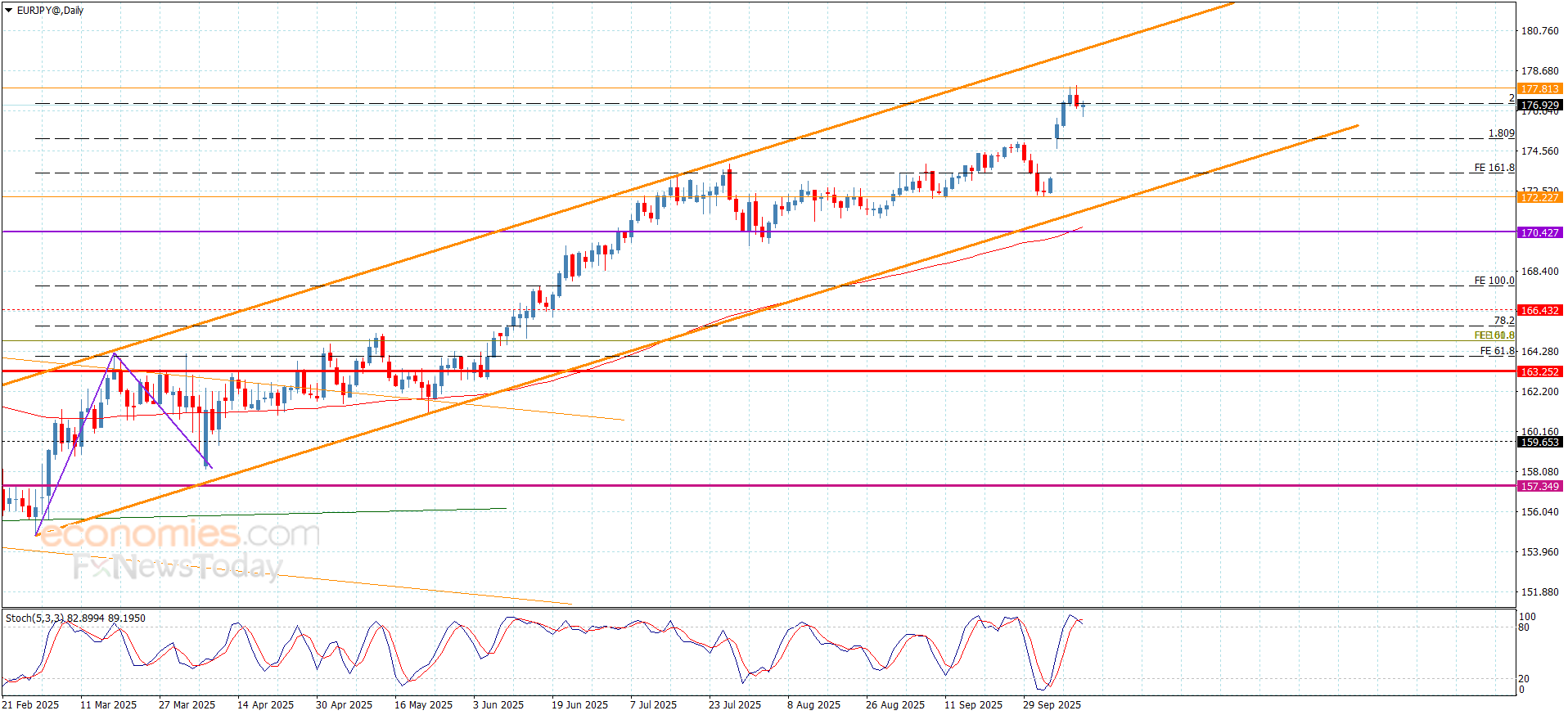
The EURJPY pair succeeded in facing stochastic negativity by its stability above 172.00 level yesterday, to form some of the bullish waves to approach from the barrier at 173.50, forming an obstacle against the attempts of resuming the bullish attack.


To confirm the attempts of resuming the bullish attack, we recommend waiting for breaching the barrier and providing positive close above it, to increase the chances for recording extra gains that might extend to 174.25 reaching 1.809%Fibonacci extension level at 175.20, while the price failure to breach this level will force it to provide more of the sideways trading, and there is a new chance to decline towards 171.60.


The expected trading range for today is between 172.60 and 174.25


Trend forecast: Bullish


Source link

12 09, 2025

Pound Sterling stabilizes ahead of US data

By |2025-09-12T15:56:07+03:00September 12, 2025|Forex News, News|0 Comments

  • GBP/USD moves sideways near 1.3550 in the European session on Friday.
  • The US UoM Consumer Sentiment Index will be the last data release of the week.
  • The cautious market stance could limit the pair’s upside heading into the weekend.

GBP/USD stays under modest bearish pressure and trades at around 1.3550 after gaining about 0.3% on Thursday. Although the technical outlook is yet to point to a buildup in bearish momentum, the pair could find it difficult to hold its ground in case safe-haven flows dominate the action in financial markets heading into the weekend.

Pound Sterling Price This week

The table below shows the percentage change of British Pound (GBP) against listed major currencies this week. British Pound was the strongest against the Canadian Dollar.

USD EUR GBP JPY CAD AUD NZD CHF
USD -0.19% -0.41% -0.33% 0.03% -1.47% -1.03% -0.27%
EUR 0.19% -0.23% -0.07% 0.20% -1.28% -0.79% -0.07%
GBP 0.41% 0.23% 0.06% 0.44% -1.05% -0.57% 0.15%
JPY 0.33% 0.07% -0.06% 0.29% -1.17% -0.85% 0.08%
CAD -0.03% -0.20% -0.44% -0.29% -1.41% -1.00% -0.29%
AUD 1.47% 1.28% 1.05% 1.17% 1.41% 0.48% 1.22%
NZD 1.03% 0.79% 0.57% 0.85% 1.00% -0.48% 0.73%
CHF 0.27% 0.07% -0.15% -0.08% 0.29% -1.22% -0.73%

The heat map shows percentage changes of major currencies against each other. The base currency is picked from the left column, while the quote currency is picked from the top row. For example, if you pick the British Pound from the left column and move along the horizontal line to the US Dollar, the percentage change displayed in the box will represent GBP (base)/USD (quote).

The US Dollar (USD) weakened against its rivals and allowed GBP/USD to stretch higher following the mixed macroeconomic data releases on Thursday.

The US Bureau of Labor Statistics (BLS) announced that the Consumer Price Index (CPI) rose 2.9% on a yearly basis in August. Additionally, the core CPI, which excludes volatile food and energy prices, increased 0.3% on a monthly basis. Both of these figures came in line with analysts’ estimates.

Other data from the US showed that the number of first-time applications for unemployment benefits climbed to 263,000 in the week ending September 6 from 236,000 in the previous week. This data revived fears over worsening conditions in the US labor market and weighed on the USD.

Later in the American session, the University of Michigan (UoM) will publish the preliminary Consumer Sentiment Index data for September. Rather than the headline number, markets could react to the 1-year Consumer Inflation Expectations component of the survey. A noticeable increase in this data could be supportive for the USD and cause GBP/USD to edge lower with the immediate reaction.

Meanwhile, US stock index futures trade mixed in the European session. A bearish opening in Wall Street could help the USD outperform its rivals and hurt GBP/USD. Conversely, an improving market mood is likely to open the door for a recovery in the pair.

GBP/USD Technical Analysis

The Relative Strength Index (RSI) indicator holds above 50 and GBP/USD trades above the 20-period Simple Moving Average (SMA), reflecting sellers’ hesitancy.

On the downside, the first support level could be spotted at 1.3500 (static level, round level) ahead of 1.3470-1.3460 (20-day SMA, 50-day SMA, Fibonacci 50% retracement of the latest downtrend) and 1.3450 (200-period SMA). Looking north, resistance levels could be spotted at 1.3590-1.3600 (static level, round level) and 1.3640 (Fibonacci 78.6% retracement).

Pound Sterling FAQs

The Pound Sterling (GBP) is the oldest currency in the world (886 AD) and the official currency of the United Kingdom. It is the fourth most traded unit for foreign exchange (FX) in the world, accounting for 12% of all transactions, averaging $630 billion a day, according to 2022 data.
Its key trading pairs are GBP/USD, also known as ‘Cable’, which accounts for 11% of FX, GBP/JPY, or the ‘Dragon’ as it is known by traders (3%), and EUR/GBP (2%). The Pound Sterling is issued by the Bank of England (BoE).

The single most important factor influencing the value of the Pound Sterling is monetary policy decided by the Bank of England. The BoE bases its decisions on whether it has achieved its primary goal of “price stability” – a steady inflation rate of around 2%. Its primary tool for achieving this is the adjustment of interest rates.
When inflation is too high, the BoE will try to rein it in by raising interest rates, making it more expensive for people and businesses to access credit. This is generally positive for GBP, as higher interest rates make the UK a more attractive place for global investors to park their money.
When inflation falls too low it is a sign economic growth is slowing. In this scenario, the BoE will consider lowering interest rates to cheapen credit so businesses will borrow more to invest in growth-generating projects.

Data releases gauge the health of the economy and can impact the value of the Pound Sterling. Indicators such as GDP, Manufacturing and Services PMIs, and employment can all influence the direction of the GBP.
A strong economy is good for Sterling. Not only does it attract more foreign investment but it may encourage the BoE to put up interest rates, which will directly strengthen GBP. Otherwise, if economic data is weak, the Pound Sterling is likely to fall.

Another significant data release for the Pound Sterling is the Trade Balance. This indicator measures the difference between what a country earns from its exports and what it spends on imports over a given period.
If a country produces highly sought-after exports, its currency will benefit purely from the extra demand created from foreign buyers seeking to purchase these goods. Therefore, a positive net Trade Balance strengthens a currency and vice versa for a negative balance.

Source link

12 09, 2025

Euro loses bullish momentum on mixed ECB commentary

By |2025-09-12T13:55:08+03:00September 12, 2025|Forex News, News|0 Comments

  • EUR/USD declines toward 1.1700 after closing in positive territory on Thursday.
  • Comments from ECB policymakers highlight a difference of opinion on inflation outlook.
  • The technical outlook points to a loss of bullish momentum in the short term.

EUR/USD struggles to hold its ground and declines toward 1.1700 on Friday after posting modest gains on Thursday. The pair’s near-term technical outlook points to a loss of bullish momentum as markets assess comments from European Central Bank (ECB) policymakers.

Euro Price This week

The table below shows the percentage change of Euro (EUR) against listed major currencies this week. Euro was the weakest against the Australian Dollar.

USD EUR GBP JPY CAD AUD NZD CHF
USD -0.05% -0.24% -0.25% 0.08% -1.44% -0.98% -0.16%
EUR 0.05% -0.19% -0.14% 0.12% -1.37% -0.88% -0.11%
GBP 0.24% 0.19% -0.04% 0.31% -1.19% -0.69% 0.08%
JPY 0.25% 0.14% 0.04% 0.26% -1.22% -0.87% 0.11%
CAD -0.08% -0.12% -0.31% -0.26% -1.43% -1.00% -0.24%
AUD 1.44% 1.37% 1.19% 1.22% 1.43% 0.50% 1.29%
NZD 0.98% 0.88% 0.69% 0.87% 1.00% -0.50% 0.78%
CHF 0.16% 0.11% -0.08% -0.11% 0.24% -1.29% -0.78%

The heat map shows percentage changes of major currencies against each other. The base currency is picked from the left column, while the quote currency is picked from the top row. For example, if you pick the Euro from the left column and move along the horizontal line to the US Dollar, the percentage change displayed in the box will represent EUR (base)/USD (quote).

The ECB left key rates unchanged after the September policy meeting, as widely anticipated. In the post-meeting press conference, ECB President Lagarde noted that the disinflationary process is over and noted that a stronger Euro could bring inflation down more than expected.

Meanwhile, the US Dollar (USD) came under bearish pressure on Thursday and helped EUR/USD push higher after the data from the US showed that the annual Consumer Price Index (CPI) inflation rose to 2.9% in August as expected, while the weekly Initial Jobless Claims climbed to 263,000 in the week ending September 6 from 236,000 in the previous week.

Early Friday, ECB officials’ mixed tone make it difficult for the Euro to preserve its strength.

ECB Governing Council member Gediminas Šimkus noted that inflation has stabilized at the targeted level but added that risks remain high. Similarly, Governing Council member Christodoulos Patsalides argued that there is currently no need for the ECB to lower interest rates further to deliver stable inflation.

On the other hand, policymaker Olli Rehn said that they must be mindful of downside risks to inflation stemming from cheaper energy prices and a stronger Euro, while Governing Council member Jose Luis Escriva noted that the Gross Domestic Product (GDP) growth is slow in the eurozone, with competitiveness causing a problem.

In the second half of the day, the US economic calendar will feature the University of Michigan’s (UoM) Consumer Sentiment Index data for August. In case the 1-year Consumer Inflation Expectations component of the survey rises further, the USD could hold its ground and cause EUR/USD to stretch lower heading into the weekend.

EUR/USD Technical Analysis

The Relative Strength Index (RSI) indicator on the 4-hour chart declines toward 50 and EUR/USD trades near the 20-period Simple Moving Average, reflecting a loss of bullish momentum.

On the downside, the 1.1680-1.1665 area, where the 20-day and the 50-day Simple Moving Averages (SMAs) are located, aligns as a key support level before 1.1650-1.1640 (200-period SMA, lower limit of the ascending regression channel) and 1.1600 (static level, round level).

Looking north, resistance levels could be seen at 1.1740 (static level), 1.1770 (static level) and 1.1790-1.1800 (upper limit of the ascending channel, static level).

ECB FAQs

The European Central Bank (ECB) in Frankfurt, Germany, is the reserve bank for the Eurozone. The ECB sets interest rates and manages monetary policy for the region.
The ECB primary mandate is to maintain price stability, which means keeping inflation at around 2%. Its primary tool for achieving this is by raising or lowering interest rates. Relatively high interest rates will usually result in a stronger Euro and vice versa.
The ECB Governing Council makes monetary policy decisions at meetings held eight times a year. Decisions are made by heads of the Eurozone national banks and six permanent members, including the President of the ECB, Christine Lagarde.

In extreme situations, the European Central Bank can enact a policy tool called Quantitative Easing. QE is the process by which the ECB prints Euros and uses them to buy assets – usually government or corporate bonds – from banks and other financial institutions. QE usually results in a weaker Euro.
QE is a last resort when simply lowering interest rates is unlikely to achieve the objective of price stability. The ECB used it during the Great Financial Crisis in 2009-11, in 2015 when inflation remained stubbornly low, as well as during the covid pandemic.

Quantitative tightening (QT) is the reverse of QE. It is undertaken after QE when an economic recovery is underway and inflation starts rising. Whilst in QE the European Central Bank (ECB) purchases government and corporate bonds from financial institutions to provide them with liquidity, in QT the ECB stops buying more bonds, and stops reinvesting the principal maturing on the bonds it already holds. It is usually positive (or bullish) for the Euro.

Source link

Go to Top