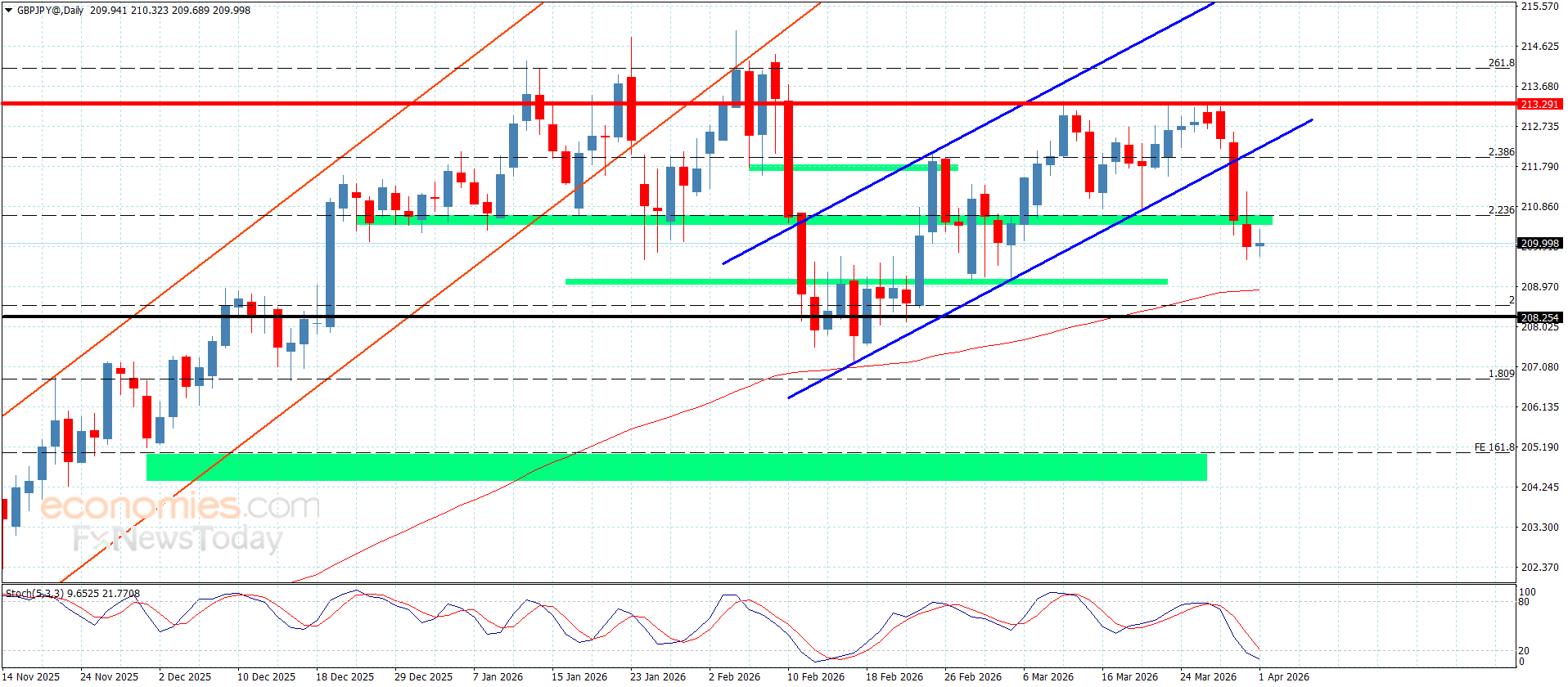
The GBPJPY pair succeeded in surpassing the negative pressure, keeping its stability above the initial support at 206.90, noticing the attempt of forming new bullish waves by its rally towards 208.10 barrier, announcing its surrender to the dominance of the sideways bias by the stability of the main levels.
The contradiction between the main indicators confirms the sideways trend in the current trading, to stay aside and monitor the price until surpassing the previously mentioned levels, breaching the barrier and holding above it will open the way for activating the bullish track again and holding below it will force it to force the price to resume the corrective decline, to expect reaching 206.25 and 205.80.
The expected trading range for today is between 207.00 and 208.10
The GBPJPY pair succeeded in surpassing the negative pressure, keeping its stability above the initial support at 206.90, noticing the attempt of forming new bullish waves by its rally towards 208.10 barrier, announcing its surrender to the dominance of the sideways bias by the stability of the main levels.
The contradiction between the main indicators confirms the sideways trend in the current trading, to stay aside and monitor the price until surpassing the previously mentioned levels, breaching the barrier and holding above it will open the way for activating the bullish track again and holding below it will force it to force the price to resume the corrective decline, to expect reaching 206.25 and 205.80.
The expected trading range for today is between 207.00 and 208.10
Stronger external demand and a pickup in economic momentum will likely strengthen the yen. Rising yen demand supports a bearish USD/JPY trajectory in the lead-up to the BoJ’s monetary policy decision, with 153 in view.
While market bets on a December BoJ rate hike have strengthened the yen, US retail sales data will give insights into the US economy, triggering USD/JPY volatility.
US Retail Sales to Spotlight the Greenback
Later on Wednesday, US retail sales will fuel speculation about a March Fed rate cut, influencing the US dollar’s trajectory. Economists forecast retail sales to rise 0.3% month-on-month in November after stalling in October.
Stronger retail sales would boost the US economy, given that private consumption accounts for roughly 65% of the GDP. Additionally, consumer spending typically fuels demand-driven inflation, suggesting a more hawkish Fed rate path. Fading bets on a March Fed rate cut will likely lift US dollar demand, cushioning the near-term downside for USD/JPY.
Beyond the data, traders should monitor FOMC members’ speeches for reactions to November’s jobs report and the timeline for a rate cut. Fed Board of Governors Christopher Waller, New York Fed President John Williams, and Atlanta Fed President Raphael Bostic are due to speak mid-week. Support for further monetary policy easing would overshadow upbeat retail sales data, sending USD/JPY lower on weaker US dollar demand.
For context, US unemployment rose from 4.4% in October to 4.6% in November, while wage growth slowed from 3.7% YoY to 3.5% YoY in November. Rising unemployment and softer wage growth may curb consumer spending and dampen demand-driven inflation.
A cooler inflation outlook would support a more dovish Fed rate path and weaken US dollar demand.
According to the CME FedWatch Tool, the probability of a March Fed rate cut increased from 51% on December 15 to 53.3% on December 16 as markets reacted to the US jobs data. A BoJ rate hike and a March Fed rate cut would narrow the US-Japan rate differential, favoring the yen.
The BoJ and the Fed’s policy outlooks support a bearish short- to medium-term outlook for USD/JPY.
Technical Outlook: USD/JPY on a Downward Trajectory
With markets focused on monetary policy, technical indicators, and fundamentals, they will offer critical insights into potential USD/JPY price trends.
Looking at the daily chart, USD/JPY remained above the 50-day and 200-day Exponential Moving Averages (EMAs), signaling a bullish bias. While technicals remained bullish, fundamentals are increasingly outweighing the technical structure, suggesting a bearish outlook.
A break below the Tuesday, December 16, low of 154.394 would bring the 50-day EMA into play. If breached, 153 would be the next key support level. Importantly, a sustained drop below the 50-day EMA would signal a bearish near-term trend reversal, exposing the 200-day EMA and 150.
The Pound-to-Dollar exchange rate (GBP/USD) surged on Tuesday, hitting a two-month high as a run of stronger-than-expected UK data fuelled demand for Sterling.
At the time of writing, GBP/USD was trading around $1.3427, up roughly 0.4% on the day, although it had eased slightly from an earlier two-month peak of $1.3451.
The Pound (GBP) climbed despite fresh signs that the UK labour market is cooling. While the latest employment report confirmed joblessness has risen to a four-year high and wage growth has slowed, the figures were notably less weak than markets had feared.
Average earnings growth eased from an upwardly revised 4.9% to 4.7%, comfortably outperforming expectations for a sharper slowdown to 4.4%. Employment also declined by just 16,000, far milder than the 60,000 drop forecast by economists. The data suggested the labour market remains relatively resilient, helping Sterling gain ground following the release.
Sterling’s momentum was reinforced by the UK’s preliminary PMI surveys. December’s services PMI was particularly supportive, showing activity strengthened as the index rose from 51.3 to 52.1. The improvement in the UK’s dominant services sector added to the positive tone and further underpinned the Pound.
The US Dollar (USD) struggled to attract support on Tuesday as markets awaited the long-delayed non-farm payrolls report.
Once released, the data painted a mixed picture of a softening US labour market. Payrolls rose by 64,000 in November, beating forecasts for a 50,000 increase, but followed a sharp 105,000 contraction in October. Job growth in August and September was also revised lower, while the unemployment rate climbed from 4.4% in September to 4.6% in November.
Save on Your GBP/USD Transfer
Get better rates and lower fees on your next international money transfer.
Compare TorFX with top UK banks in seconds and see how much you could save.
Several economists urged caution in interpreting the figures, noting distortions linked to the recent government shutdown, immigration policy changes and seasonal effects. Even so, the US Dollar experienced choppy trade after the release and remained on the back foot overall.
GBP/USD Forecast: UK Inflation to Fuel BoE Rate Cut Speculation?
Looking ahead, attention turns to Wednesday’s UK consumer price index release, which may shape expectations for the Pound ahead of the Bank of England’s (BoE) interest rate decision on Thursday.
Headline CPI is forecast to ease from 3.6% in October to 3.5% in November. Evidence that inflation continues to cool would reinforce the view that price pressures have peaked, potentially strengthening expectations that the BoE will continue cutting interest rates next year and leaving Sterling vulnerable.
A downside surprise could intensify pressure on the Pound, while a firmer-than-expected reading may offer some short-term relief.
In the US, the economic calendar is relatively light on Wednesday, leaving the ‘Greenback’ sensitive to shifts in broader market sentiment. A risk-on mood could sap demand for the safe-haven currency, while any deterioration in confidence may help support USD.
Like this piece? Please share with your friends and colleagues:
International Money Transfer? Ask our resident FX expert a money transfer question or try John’s new, free, no-obligation personal service! ,where he helps every step of the way,
ensuring you get the best exchange rates on your currency requirements.
The USD/JPY exchange rate has hovered at its highest level since July 17, after the latest Japanese wage income data. The pair, which is the third most popular forex cross, traded at 158.05, up by 13.25% from its lowest point in September 24. So, what next for the USD to JPY price ahead of the US NFP data?
Japan wage income data
According to Japan’s statistics agency, the average wage income data jumped from 2.2% in October to 3.0% in November.
Another report showed that the overtime pay rose from 0.70% to 1.60. These are important numbers because wages often has an impact on inflation, which then impacts the central bank’s decision.
The rising wages mean that Japan’s inflation may remain high in the coming months. Recent data showed that Japan’s inflation rose from 2.3% in October to 2.9% in November, the highest increase in three months. That figure was much higher than the Bank of Japan’s target of 2.0%.
Therefore, the strong wage numbers, high inflation rate, and the falling yen means that the Bank of Japan (BoJ) may continue to diverge from the Federal Reserve.
The BoJ raised interest rates twice in 2024, helping it exit negative rates. It pushed the benchmark rate to 0.25%, the highest number in years.
Therefore, there are rising odds that the bank will continue hiking interest rates later this year. Analysts see it hiking by 0.25% either in the January 24 meeting or later this year.
The main hindrance to BoJ hikes is Japan’s economy. A report released last month showed that the country’s GDP expanded by 0.7% in Q3, and analysts expect it to grow by 0.4% this year.
High interest rates hurts an economy by making the cost of borrowing capital for consumers and businesses higher.
Federal Reserve minutes
The USD/JPY pair also reacted to Wednesday’s Federal Reserve minutes. These minutes provided more details about last month’s meeting in which officials had a hawkish tilt.
Fed officials are mostly concerned about inflation, which may increase soon after Donald Trump becomes president. Trump has made many promises, including raising tariffs on goods entering the US.
Fed officials expect to deliver just two interest rates cuts this year instead of the previous four. And analysts anticipate that the first cut will happen in July this year.
The next important USD/JPY news will be the upcoming US nonfarm payrolls (NFP) data scheduled on Friday. While these numbers are important, their impact on the greenback may be muted since the Fed now focuses on inflation.
Economists expect the upcoming data to show that the economy added over 150k jobs in December, while the jobless rate remained at 4.2%. ADP’s report released on Wednesday showed that the private sector added just 122,000 jobs, lower than expected. Another report on Tuesday showed that job vacancies increased to over 8 million in November, the highest level in months.
The daily chart shows that the USD to JPY exchange rate has been in a tight range in the past few days. It has constantly remained slightly above the important support level at 156.78, its highest swing on November 5.
The pair has moved above the 78.6% Fibonacci retracement level and the 50-day moving average. It has also formed a bullish flag pattern, often leading to a strong bullish breakout. Therefore, barring any interventions by the Bank of Japan, there is a risk that the USD/JPY pair will have a strong bullish breakout as buyers target the psychological point of 160.
USD/JPY shows hesitation after an early rally, but support levels and yield differentials continue to favor the dollar.
Carry trade dynamics and structural Japanese policy constraints suggest pullbacks remain buying opportunities.
The US dollar initially tried to rally against the Japanese yen but then rolled over to show signs of hesitation on the bullish side. That being said, the 155 yen level does look like it’s trying to offer a little bit of support. And therefore, I think this could end up being a small buying opportunity. I recognize that there are a lot of questions right now about the Federal Reserve and what’s happening next. But at this point, the one thing that I do know is that the interest rate differential will continue to favor the US dollar.
Carry Trade Dynamics Still Favor the Dollar
Therefore, over the longer term, it should favor this pair going higher. Even if we were to break down from here, the 50-day EMA comes into the picture at just about 154 yen to offer support and then again at 152 yen, which I think is more likely than not, we do get a little bit of a pullback, but I think it ends up being a buying opportunity. That’ll be especially true once we get through the Bank of Japan later this week.
And therefore, I think a little bit of choppy sideways volatility makes a certain amount of sense. But as I’ve been saying for months, I’ve been holding this pair. I get paid every day to hold this pair. That’s the power of the carry trade. And the carry trade is expected to be a big thing again, especially if the United States remains a little more hawkish than originally thought.
And most of the leading economic numbers in the United States do suggest that 2026 may not be a bad year for the US economy at all. With this, and the fact that the Japanese have a structural problem with the ability to really tighten monetary policy, I think these dips continue to offer buying opportunities if you’re patient enough, probably a much longer-term one, but even shorter-term traders are jumping on this train.
Christopher Lewis has been trading Forex and has over 20 years experience in financial markets. Chris has been a regular contributor to Daily Forex since the early days of the site. He writes about Forex for several online publications, including FX Empire, Investing.com, and his own site, aptly named The Trader Guy. Chris favours technical analysis methods to identify his trades and likes to trade equity indices and commodities as well as Forex. He favours a longer-term trading style, and his trades often last for days or weeks.
Buy EUR/USD from the support level of 1.1640 with a target of 1.1850 and a stop-loss at 1.1580.
Sell EUR/USD from the resistance level of 1.1810 with a target of 1.1500 and a stop-loss at 1.1900.
Technical Analysis of EUR/USD Today:
For three consecutive trading sessions, the EUR/USD price has stabilized around its recent upward rebound gains, hovering near the resistance level of 1.1768—the highest for the pair in two months. Overall, based on performance across reliable trading platforms, the rise witnessed in the EUR/USD exchange rate this month indicates it is approaching overbought territory, making it a candidate for a correction amid profit-taking sales.
Technically: The rapid rise in the Euro price recently is pushing the Relative Strength Index (RSI) toward the 70 threshold, the level at which EUR/USD is officially considered overbought. The RSI tends to revert to the mean upon reaching this zone, implying an eventual decline. For this to occur, we need the EUR/USD price to enter a sideways path or a slight downward retreat.
In short, we believe Euro trading will see a slight dip after a strong rally; we would not be surprised to see a pullback below 1.17 this week before the next upward wave. However, charts can only offer limited information in a week marked by major economic data releases.
Important and Influential Events for the EUR/USD
According to Forex market trading, the EUR/USD exchange rate will be affected by the Eurozone PMI results for December, expected today, Tuesday, starting at 10:15 AM Egypt time. These are expected to confirm continued positive momentum for the region’s economy through the end of the year. Generally, the Eurozone Services PMI is expected to print at 53.3, while the manufacturing sector recovery is expected to confirm a slight rise to 49.9, placing it on the verge of returning to growth.
Overall, strong economic data would support the view that no further interest rate cuts are necessary from the European Central Bank. In fact, a better-than-expected Purchasing Managers’ Index (PMI) reading would reinforce expectations of continued interest rate hikes.
However, the US Dollar’s path will be the primary driver for EUR/USD during this trading week. The release of US labor market data is the standout event in global financial markets. Notably, this data was delayed by the US government shutdown, meaning it will fill a significant data gap. US November jobs data will be released today, Tuesday, at 15:30 Egypt time, with expectations pointing to an increase of 50,000 jobs and an unemployment rate of 4.4%. If the numbers fall below expectations, the market will increase bets on Fed rate cuts in 2026, negatively affecting US bond yields and the Dollar price today.
Conversely, if the data exceeds expectations, these expectations of an interest rate cut will diminish, and the US dollar may rise and potentially continue its gains for the remainder of the week, potentially hindering the euro’s appreciation against the US dollar.
Furthermore, keep an eye on US Retail Sales data, also scheduled for release today at the same time, which will indicate the strength of demand in the economy. Expectations suggest a figure exceeding 0.2% monthly for October. On Thursday, US Inflation (CPI) data will be released, with expectations of a rise to 3.1% annually in November, compared to 3.0% previously.
Obvioulsy, this trend appears unsatisfactory for the Federal Reserve. Any figure higher than expected will cast doubt on market expectations for rate cuts next year, thereby supporting the US Dollar.
Trading Tips:
Today’s trading session is crucial in determining the fate of the EUR/USD for the remainder of 2025 and will shape the start of the new year’s trading. Be cautious, as we may witness strong and rapid changes in currency prices.
The GBPJPY pair continued providing negative trading, affected by forming extra barrier at 208.10 level, with the negative momentum that comes from stochastic below 50 level, attacking the support at 206.90 that formed the suggested target in the previous report.
The effect of the temporary sideways bias dominance, however facing the negative pressures that might push it to resume the corrective decline, to target 206.25 and 205.80 level, while renewing the bullish attempts requires forming strong bullish attack, to settle above 208.10 then begin targeting new positive stations by its rally towards 209.15.
The expected trading range for today is between 206.25 and 207.65
The GBPJPY pair continued providing negative trading, affected by forming extra barrier at 208.10 level, with the negative momentum that comes from stochastic below 50 level, attacking the support at 206.90 that formed the suggested target in the previous report.
The effect of the temporary sideways bias dominance, however facing the negative pressures that might push it to resume the corrective decline, to target 206.25 and 205.80 level, while renewing the bullish attempts requires forming strong bullish attack, to settle above 208.10 then begin targeting new positive stations by its rally towards 209.15.
The expected trading range for today is between 206.25 and 207.65
The GBP/USD forecast edges higher as UK employment data relieves pressure.
The BoE’s potential rate cut expectations limit the upside pressure.
UK PMI and US NFP data are key to watch for fresh impetus.
GBP/USD traded modestly up as fresh UK labor data showed easing strain in the jobs market. The ILO unemployment rate rose to 5.1% in the three months to October, up from 5.0% previously. The reading met expectations but confirmed a gradual loss of momentum in employment conditions.
–Are you interested in learning more about copy trading platforms? Check our detailed guide-
Meanwhile, claimant counts increased by 20,100 in November, reversing October’s revised decline. Employment change remained negative, with payrolls down by 17,000 in October. While the pace of job losses slowed, the trend still points to weaker labor demand.
Wage growth stayed elevated but showed early signs of cooling. Average earnings excluding bonuses rose 4.6% YoY, slightly below the prior reading. Earnings including bonuses increased 4.7%, beating forecasts but still lower than earlier levels. Pay growth remains well above inflation, yet the direction no longer supports further policy tightening.
Hence, these figures reinforce expectations that the Bank of England will cut rates at its upcoming meeting. Markets now view a policy move as likely, limiting upside pressure on sterling. Traders remain cautious ahead of the decision, especially with recent data failing to justify a hawkish stance.
Attention is now shifting to incoming UK PMI data, which may offer clues on business activity and hiring trends. Still, central bank guidance remains the dominant driver for the pound in the near term.
On the US side, the dollar continues to trade under pressure due to uncertainty around Fed policy. Markets expect deeper rate cuts in 2026 than the Fed has signaled. This gap leaves the dollar vulnerable to sudden repricing.
The upcoming US Non-Farm Payrolls report will play a key role. It will include two months of data and comes after disruptions from a government shutdown. Forecasts point to modest job growth in November, though risks lean to the downside following weak private payroll figures.
Investors will focus less on the unemployment rate and more on payroll gains and wage growth. Average hourly earnings remain the clearest signal for inflation risk and future Fed decisions.
GBP/USD Technical Forecast: Buyers Eying 1.3440
GBP/USD 4-hour chart
The GBP/USD chart shows a modest rebound from the 1.3350 demand zone, coinciding with the 50-period MA, surging above the 20-period MA near 1.3380. Now the pair is eying the resistance at recent swing high near 1.3440 as the RSI climbs well above the 50.0 level.
–Are you interested in learning more about scalping forex brokers? Check our detailed guide-
On the flip side, any dip below the 1.3350 confluence could alter the pound’s bullish outlook. The pair could dip further down to 1.3300 round number ahead of 100-period MA support at 1.3280.
Looking to trade forex now? Invest at eToro!
68% of retail investor accounts lose money when trading CFDs with this provider. You should consider whether you can afford to take the high risk of losing your money.