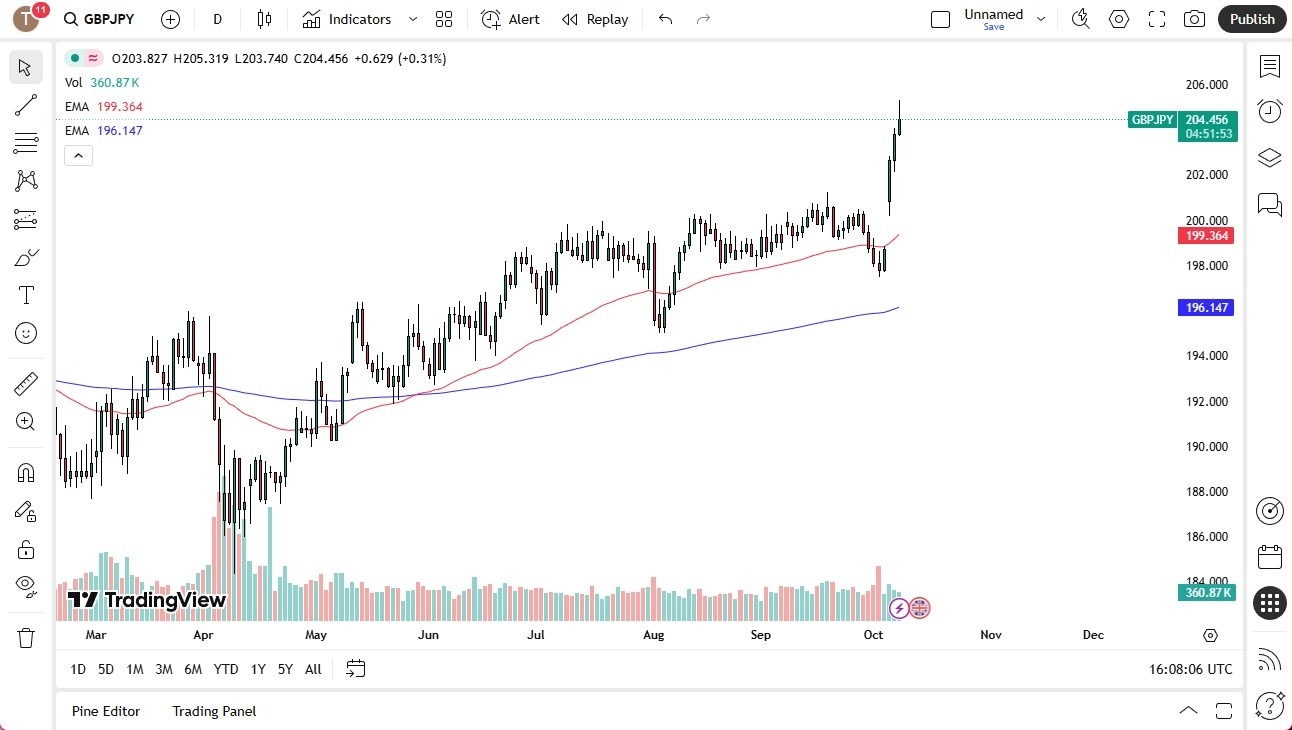
The British pound has rallied a bit against the Japanese yen during the trading session here on Wednesday, but we still see the same massive barrier above causing headaches.
That of course would be the area right around the 200 yen level.
And really at this point, it seems like it’s going to be a bit of a brick wall.
Nonetheless, this is a market where you can trade through the prism of buying dips, at least at this point. It looks as if the 198 yen level underneath will continue to be support, especially now that the 50 day EMA sits there. If we can break above the 200 yen level on a daily close at least significantly, maybe by 50 pips or so, then I think that would be an extraordinarily bullish sign.
However, there are lot of concerns out there about risk appetite, and that ends up being the case this pair might suffer. A breakdown below the 198 yen level in that environment would be very bearish because when you zoom out on the chart from a longer term standpoint, you can see that the 200 yen level has been very important, going back roughly a year and a half. And if you really zoom out, then you can see that it’s been that way a couple of times in the past.
At the Moment, I Still Like Longs
All things being equal, this is a market that I do like buying though, because the interest rate differential does favor the British pound over the Japanese yen, pretty much anything will pay you more interest than the Japanese yen. And you do get paid to wait. But again, if we were to break down below the 198 yen level, then I think we’ve got a problem.
I think at the very least you’d be looking at a move down to the 200 day EMA, which is sitting right around the 195.35 level. Watch risk appetite. Watch stock markets around the world. They’ll give you a heads up as to how this pair may behave.
Christopher Lewis has been trading Forex and has over 20 years experience in financial markets. Chris has been a regular contributor to Daily Forex since the early days of the site. He writes about Forex for several online publications, including FX Empire, Investing.com, and his own site, aptly named The Trader Guy. Chris favours technical analysis methods to identify his trades and likes to trade equity indices and commodities as well as Forex. He favours a longer-term trading style, and his trades often last for days or weeks.
The US dollar has gone back and forth during the trading session here on Wednesday as we got weaker than anticipated producers price index numbers, but really, it doesn’t change much. And we get CPI on Thursday.
So, all things being equal, I think you’ve got a situation where we are still very much in a range.
Which in this particular pair is not the worst scenario because there is an interest rate differential that favors the US dollar and therefore owning the dollar is not a bad idea.
You can see what happened on Tuesday where we plunged towards the 146.50 level only to turn around and bounce and form a nasty looking hammer. That hammer sitting on the 50 day EMA is basically where we’re hanging out now. I think this is a market that given half a chance will probably try to reach the 149 yen level or at least something close to it. And then repeat the process.
We do get a Federal Reserve interest rate decision statement and press conference next Thursday. And I think that might be pretty much what everybody’s waiting for. It’s not really a question as to whether or not the Federal Reserve will cut rates. I think we all pretty much assume that. But the question is, what will the outlook be from there? How aggressive are they going to be as far as cutting is concerned?
“Buy on the Dip?” Possibly.
In general, I think this is a buy on the dip market. Maybe it’s an interest collecting type of exercise and a longer term potential move. We’ll just have to wait and see. But really at this point, I’ve just been buying dips and selling it when it rallies a bit, letting it fall, buy it again, and repeating the process time and time again. It is worth noting that we saw this collapse back on August 1st after it was clear that the Federal Reserve was probably going to cut and then we haven’t done anything since then. So sometimes it’s all about what the market won’t do. In this case, it doesn’t look like it break down.
Christopher Lewis has been trading Forex and has over 20 years experience in financial markets. Chris has been a regular contributor to Daily Forex since the early days of the site. He writes about Forex for several online publications, including FX Empire, Investing.com, and his own site, aptly named The Trader Guy. Chris favours technical analysis methods to identify his trades and likes to trade equity indices and commodities as well as Forex. He favours a longer-term trading style, and his trades often last for days or weeks.
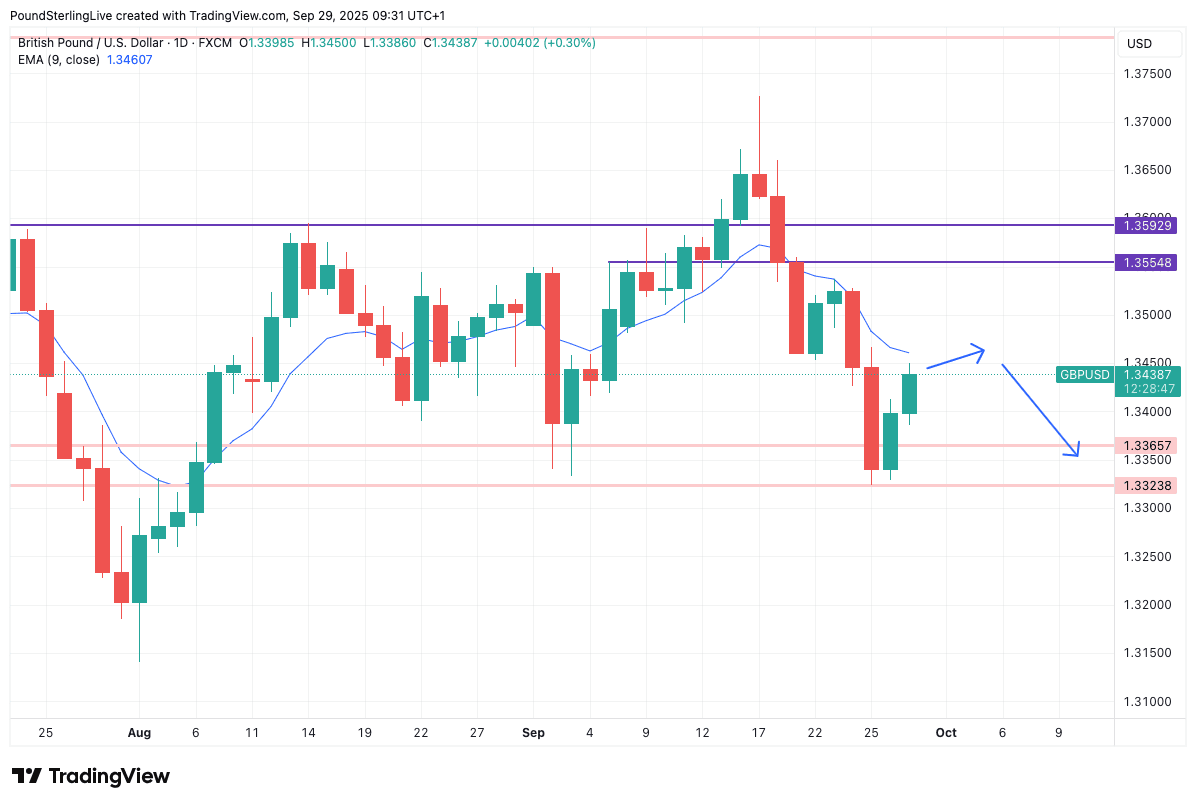
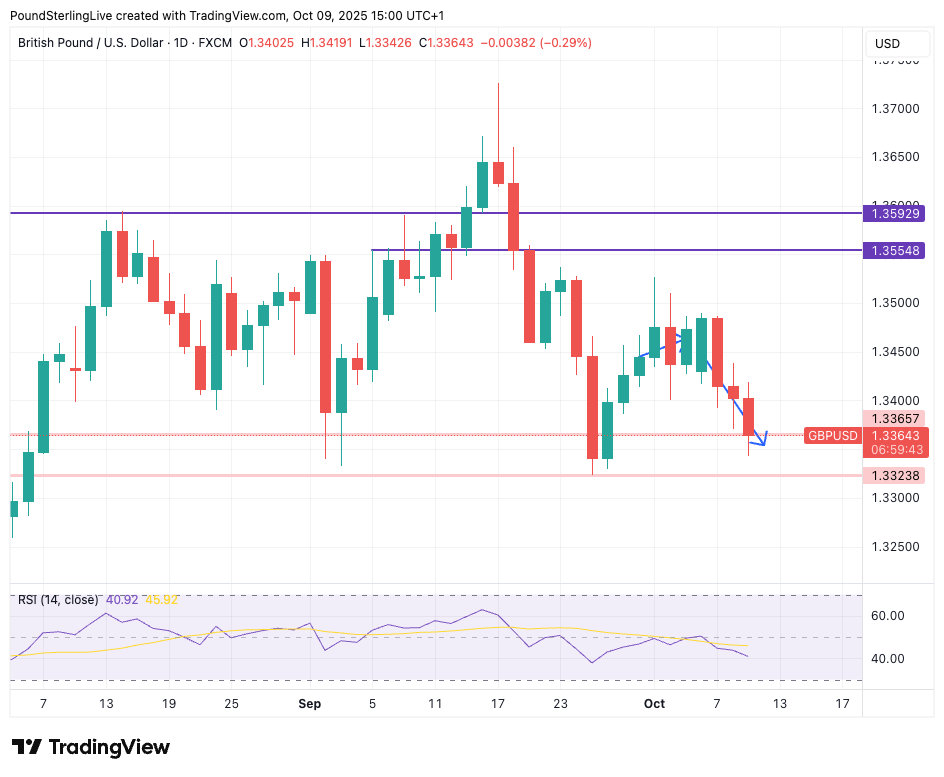
GBP/USD trades in negative territory near 1.3500 on Thursday.
The near-term technical outlook points to a bearish tilt in the short term.
August inflation data from the US will be watched closely by market participants.
After closing the day virtually unchanged on Wednesday, GBP/USD stays on the back foot early Thursday and trades in negative territory at around 1.3500. The pair faces a critical support level at 1.3470 as investors refrain from taking large positions ahead of August inflation data from the US.
Pound Sterling Price This week
The table below shows the percentage change of British Pound (GBP) against listed major currencies this week. British Pound was the weakest against the Australian Dollar.
USD
EUR
GBP
JPY
CAD
AUD
NZD
CHF
USD
0.23%
-0.02%
-0.19%
0.38%
-0.80%
-0.60%
0.13%
EUR
-0.23%
-0.26%
-0.35%
0.14%
-1.02%
-0.78%
-0.11%
GBP
0.02%
0.26%
-0.18%
0.40%
-0.76%
-0.53%
0.16%
JPY
0.19%
0.35%
0.18%
0.48%
-0.65%
-0.57%
0.32%
CAD
-0.38%
-0.14%
-0.40%
-0.48%
-1.07%
-0.90%
-0.25%
AUD
0.80%
1.02%
0.76%
0.65%
1.07%
0.23%
0.92%
NZD
0.60%
0.78%
0.53%
0.57%
0.90%
-0.23%
0.69%
CHF
-0.13%
0.11%
-0.16%
-0.32%
0.25%
-0.92%
-0.69%
The heat map shows percentage changes of major currencies against each other. The base currency is picked from the left column, while the quote currency is picked from the top row. For example, if you pick the British Pound from the left column and move along the horizontal line to the US Dollar, the percentage change displayed in the box will represent GBP (base)/USD (quote).
Although the US Dollar (USD) came under bearish pressure with the immediate reaction to the weaker-than-expected Producer Price Index (PPI) data for August on Wednesday, the cautious market stance helped the currency find support and made it difficult for GBP/USD to gain traction.
During a meeting of government ministers on Wednesday, Britain’s finance minister Rachel Reeves said that the government was focused on going further to support the Bank of England (BoE) in reducing inflation, controlling public spending and driving growth, Reuters reported, citing a Downing Street spokesperson. This headline failed to trigger a noticeable market reaction.
In the second half of the day, the Bureau of Labor Statistics (BLS) will publish the Consumer Price Index (CPI) data for August. On a monthly basis, the core CPI, which excludes volatile food and energy prices, is forecast to rise by 0.3%.
According to the CME FedWatch Tool markets are currently fully pricing in a 25 basis-points (bps) Federal Reserve (Fed) rate cut in September. Although the inflation data is unlikely to change markets’ mind about next week’s policy decision, it could influence the USD’s valuation and the pair’s action in the immediate term.
A soft print in the monthly core CPI could hurt the USD and help GBP/USD turn north. On the flip side, an increase of 0.5%, or higher, in this data could weigh on the pair.
GBP/USD Technical Analysis
The Relative Strength Index (RSI) indicator on the 4-hour chart declined below 50 and GBP/USD closed the last three 4-hour candles below the 20-period Simple Moving Average (SMA), reflecting a bearish tilt in the short-term bias.
On the downside, 1.3470-1.3460 (20-day SMA, 50-day SMA, Fibonacci 50% retracement of the latest downtrend) aligns as a key support level before 1.3445 (200-period SMA) and 1.3390-1.3400 (Fibonacci 38.2% retracement, static level). Looking north, resistance levels could be spotted at 1.3540 (Fibonacci 61.8% retracement) and 1.3590-1.3600 (static level, round level).
Pound Sterling FAQs
The Pound Sterling (GBP) is the oldest currency in the world (886 AD) and the official currency of the United Kingdom. It is the fourth most traded unit for foreign exchange (FX) in the world, accounting for 12% of all transactions, averaging $630 billion a day, according to 2022 data.
Its key trading pairs are GBP/USD, also known as ‘Cable’, which accounts for 11% of FX, GBP/JPY, or the ‘Dragon’ as it is known by traders (3%), and EUR/GBP (2%). The Pound Sterling is issued by the Bank of England (BoE).
The single most important factor influencing the value of the Pound Sterling is monetary policy decided by the Bank of England. The BoE bases its decisions on whether it has achieved its primary goal of “price stability” – a steady inflation rate of around 2%. Its primary tool for achieving this is the adjustment of interest rates.
When inflation is too high, the BoE will try to rein it in by raising interest rates, making it more expensive for people and businesses to access credit. This is generally positive for GBP, as higher interest rates make the UK a more attractive place for global investors to park their money.
When inflation falls too low it is a sign economic growth is slowing. In this scenario, the BoE will consider lowering interest rates to cheapen credit so businesses will borrow more to invest in growth-generating projects.
Data releases gauge the health of the economy and can impact the value of the Pound Sterling. Indicators such as GDP, Manufacturing and Services PMIs, and employment can all influence the direction of the GBP.
A strong economy is good for Sterling. Not only does it attract more foreign investment but it may encourage the BoE to put up interest rates, which will directly strengthen GBP. Otherwise, if economic data is weak, the Pound Sterling is likely to fall.
Another significant data release for the Pound Sterling is the Trade Balance. This indicator measures the difference between what a country earns from its exports and what it spends on imports over a given period.
If a country produces highly sought-after exports, its currency will benefit purely from the extra demand created from foreign buyers seeking to purchase these goods. Therefore, a positive net Trade Balance strengthens a currency and vice versa for a negative balance.
The USD/JPY forecast shows continued strength in the dollar amid geopolitical uncertainty.
Market participants are anticipating the US CPI report.
Data on Wednesday revealed softer-than-expected US wholesale inflation.
The USD/JPY forecast shows continued strength in the dollar amid geopolitical uncertainty. The greenback rose despite downbeat US wholesale inflation and ahead of the CPI report. Meanwhile, the yen remained fragile as traders worried about the outlook for Japan’s politics and monetary policy.
–Are you interested to learn more about Thailand forex brokers? Check our detailed guide-
The US dollar extended gains on Thursday as market participants eagerly awaited the US CPI report. Notably, the rally gained momentum after reports of an escalation in the Russia-Ukraine war. The conflict between the two countries spilled into Poland, which had to shoot down Russian drones. Consequently, there were worries of an escalation into other countries. As a result, traders sought safety in the dollar.
Meanwhile, data on Wednesday revealed softer-than-expected wholesale inflation, further supporting the view of a more dovish Fed.
“The market has positioned for the Fed to ease in September and potentially ease three times this year,” said Rodrigo Catril, currency strategist at National Australia Bank in Sydney. “The benign outcome from the PPI tells you pricing expectations look about right.”
Elsewhere, the yen remained subdued as Ishiba’s resignation caused uncertainty about the future. A new prime minister could assume a different stance regarding rate hikes, changing the outlook for monetary policy.
USD/JPY key events today
US core CPI m/m
US CPI m/m
US CPI y/y
US unemployment claims
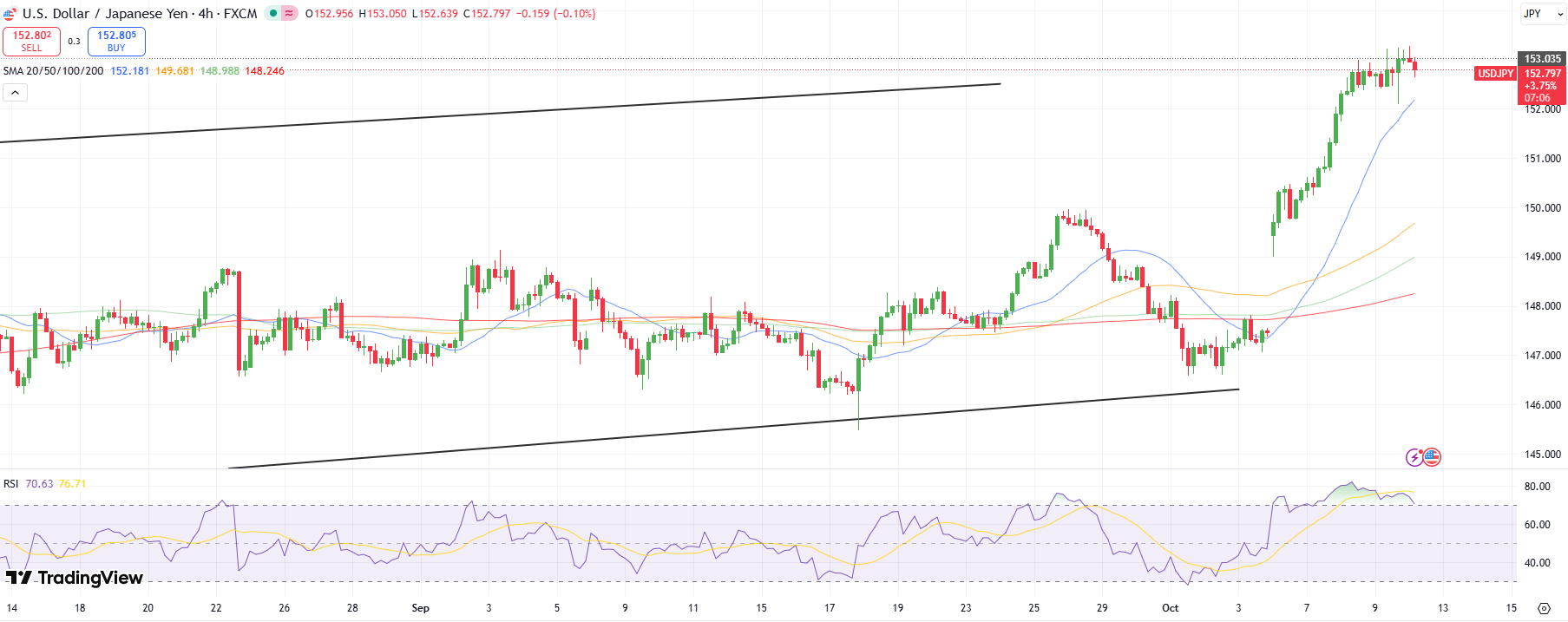
USD/JPY technical forecast: Bulls take charge after false channel breakout
USD/JPY 4-hour chart
On the technical side, the USD/JPY price has broken above the 30-SMA, indicating a bullish shift in sentiment. At the same time, the RSI trades above 50, suggesting stronger bullish momentum. This is a sign that bulls have taken charge and might send the price higher.
–Are you interested to learn more about MT5 brokers? Check our detailed guide-
USD/JPY has been trading in a shallow bullish channel. Recently, bears attempted to break out of this channel. However, they failed when the price could not break below the 146.50 key support level. As a result, it rose back into the channel and broke above the 30-SMA.
With bulls in the lead, the price might soon retest the channel resistance, near the 149.00 key level. A break above this level would signal a surge in bullish momentum, leading to a steeper bullish trend. On the other hand, if the level holds firm, USD/JPY will remain in its channel.
Looking to trade forex now? Invest at eToro!
68% of retail investor accounts lose money when trading CFDs with this provider. You should consider whether you can afford to take the high risk of losing your money.
Buy: Buy EUR/USD from the support level of 1.1580, with a target of 1.1800 and a stop-loss at 1.1500.
Sell: Sell EUR/USD from the resistance level of 1.1800, with a target of 1.1600 and a stop-loss at 1.1880.
Technical Analysis of EUR/USD Today:
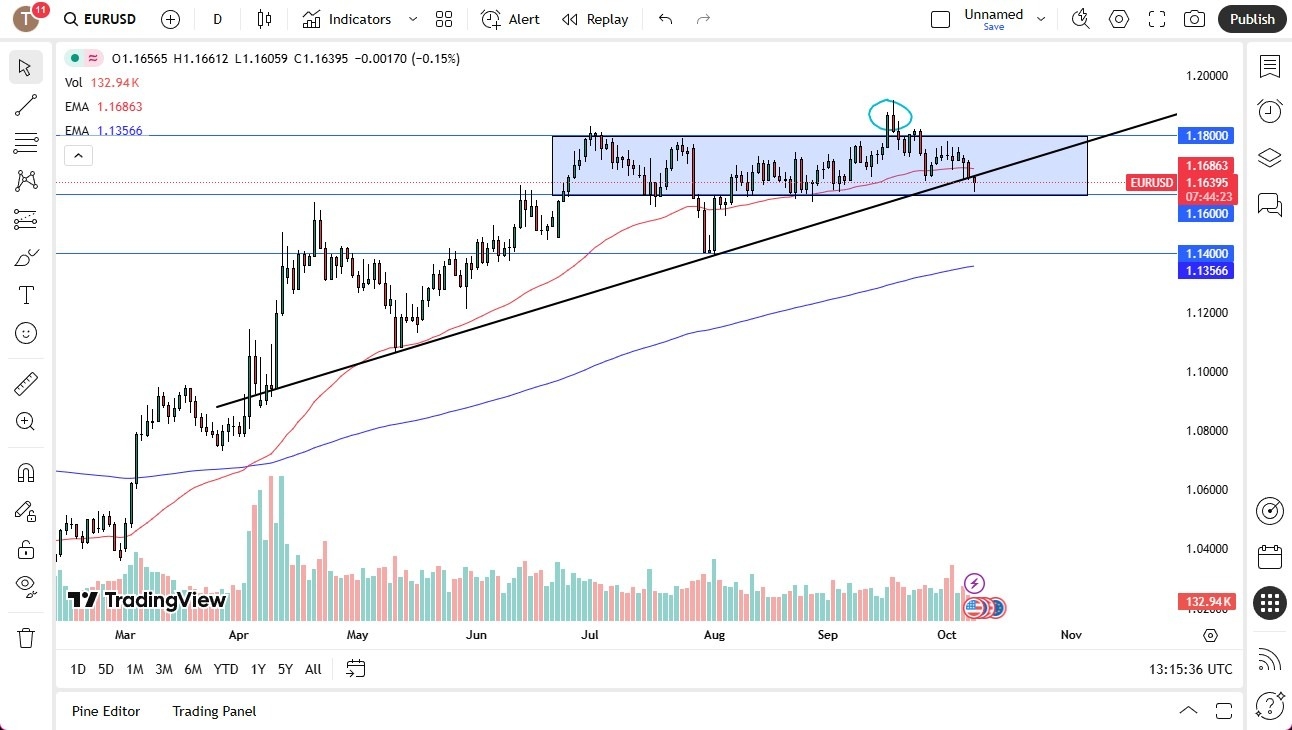
As anticipated, EUR/USD trading will remain cautious and within a narrow range until the market reacts to the release of U.S. inflation data, which is the most significant event for financial markets this week, especially after the setback from last week’s U.S. employment report. According to reliable trading platforms, attempts by EUR/USD to recover this week stalled at the 1.1779 resistance level. The pair then experienced profit-taking, which led to it settling around 1.1690 at the time of writing this analysis.
What Will the European Central Bank Deliver Today?
The European Central Bank (ECB) is widely expected to keep interest rates unchanged for its second consecutive meeting today, Thursday. The announcement will be at 3:15 PM, Egypt time. Policymakers are maintaining a cautious “wait-and-see” approach given the stability of inflation, the resilience of the economy, and uncertainty surrounding trade policy. The main refinancing rate is set to remain at 2.15%, while the deposit facility rate will stay at 2%. Investors will pay close attention to the ECB’s post-meeting macroeconomic projections, which will provide updated forecasts for growth and inflation. The ECB had previously cut borrowing costs by 200 basis points between June 2024 and June 2025, with the rate cuts halting in July.
Overall, financial markets currently expect interest rates to remain stable until the end of the year, with a potential return to tightening in late 2026. At the same time, Eurozone growth is projected to reach 1.2% this year, 1.1% in 2026, and 1.4% in 2027, although political instability in countries like France and Spain could cast a shadow over these forecasts.
Will U.S. Inflation Rise Today?
The most important event for forex markets today is the release of U.S. inflation figures at 3:30 PM, Egypt time. The annual inflation rate in the U.S. is expected to accelerate to 2.9% in August 2025, which would be its highest level since January, following its stabilization at 2.7% in June and July. On a monthly basis, the Consumer Price Index (CPI) is expected to rise by 0.3%, surpassing the 0.2% increase in July. This rise likely reflects retailers gradually passing on higher import tariffs, along with an increase in gasoline and supermarket prices.
Conversely, rents are expected to decline. Core inflation, which excludes food and energy, is expected to remain steady at 3.1%, the same level as in July and its peak in February, with the core CPI rising 0.3% month-on-month, in line with July’s pace.
Today’s EUR/USD Technical Outlook
As observed on the daily chart, EUR/USD trading remains neutral. The bullish outlook will strengthen if the bulls succeed in breaking the 1.1800 resistance level, which is a key waypoint for a move toward the psychological resistance of 1.2000. The 14-day Relative Strength Index (RSI) is currently near a reading of 52, closer to the neutral line, while the MACD lines also confirm the neutral performance. Conversely, over the same period, the 1.1580 support level will remain crucial for the bears to take control of the EUR/USD trend.
Trading Advice:
Traders are advised to wait for the market’s reaction to the U.S. inflation and ECB announcements to determine the most suitable trading direction for EUR/USD, whether to buy or sell.
Platinum price attacked the barrier at $1400.00 yesterday, to find an exit to resume the bullish attempts, but this attempt ended by a clear failure to force it to decline temporarily towards $1381.00.
The contradiction between the main indicators might force the price to provide mixed trading until gathering extra positive momentum, to ease the mission of breaching the current barrier and begin recording extra gains by its rally to $1412.00 and $1435.00, while the attempts of changing the main trend requires achieving a real break to the support at $1340.00.
The expected trading range for today is between $1370.00 and $1412.00
Trend forecast: Fluctuated within the bullish track
Platinum price attacked the barrier at $1400.00 yesterday, to find an exit to resume the bullish attempts, but this attempt ended by a clear failure to force it to decline temporarily towards $1381.00.
The contradiction between the main indicators might force the price to provide mixed trading until gathering extra positive momentum, to ease the mission of breaching the current barrier and begin recording extra gains by its rally to $1412.00 and $1435.00, while the attempts of changing the main trend requires achieving a real break to the support at $1340.00.
The expected trading range for today is between $1370.00 and $1412.00
Trend forecast: Fluctuated within the bullish track
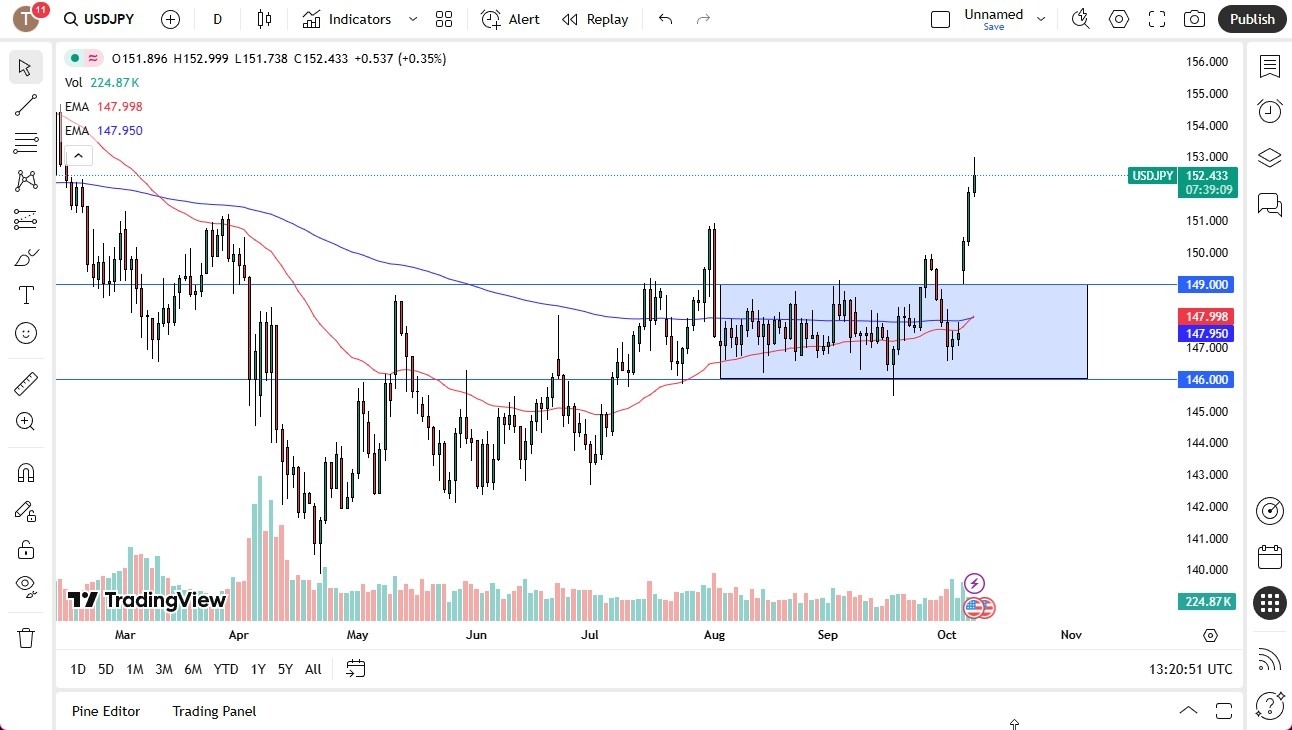
The US dollar initially plunged during the trading session on Tuesday, testing the crucial ¥146.50 level.
However, we have turned the market back around to show signs of life, and in fact, have broken back above the 50 Day EMA.
In other words, it looks like the market is going to try to recover and stay within the previous consolidation area. If we end up forming a hammer, a lot of technical traders will watch that very closely.
Technical Analysis
The technical analysis for this market remains somewhat flat, and we are hanging around the 50 Day EMA. All things being equal, this is a market that I think continues to see the pair dance around in the same consolidation area that we have been in before. The market is of course paying close attention to the Federal Reserve meeting next Thursday, and therefore I think you’ve got a situation where we are in a little bit of a “holding pattern.”
The 50 Day EMA is flat, and then again you have the 200 Day EMA sitting just below the ¥148 level. All things being equal, it does make a certain amount of sense that the market could just kill sometime between now and the September 17 session. Ultimately, I think this is a scenario where we will see quite a bit of choppiness, but I think we still see a lot of buyers on dips, as the market continues to favor the US dollar at least at the end of the day, as the swap is certainly positive.
If we were to break down below the ¥146 level, then we could see this market plunging toward the ¥143 level. If we were to break above the ¥148.50 level, then it’s possible that the market could go looking to the ¥151 level. Ultimately, I do favor the upside but I think the next couple of weeks could be very choppy and sideways overall.
Christopher Lewis has been trading Forex and has over 20 years experience in financial markets. Chris has been a regular contributor to Daily Forex since the early days of the site. He writes about Forex for several online publications, including FX Empire, Investing.com, and his own site, aptly named The Trader Guy. Chris favours technical analysis methods to identify his trades and likes to trade equity indices and commodities as well as Forex. He favours a longer-term trading style, and his trades often last for days or weeks.
Overall Trend: Neutral, with a slight upward bias.
Support Levels: 1.1680 – 1.1600 – 1.1540
Resistance Levels: 1.1750 – 1.1810 -1.1880
EUR/USD Trading Signals:
Buy EUR/USD from the support level of 1.1620, with a target of 1.1800 and a stop-loss at 1.1570.
Sell EUR/USD from the resistance level of 1.1810, with a target of 1.1600 and a stop-loss at 1.1880.
Technical Analysis of EUR/USD Today:
As you can see, the EUR/USD pair is trending higher within a newly formed ascending channel pattern. The EUR/USD pair is currently testing key Fibonacci retracement levels that could determine its next direction. The price recently retreated from its highs near 1.1776 and is now approaching potential support around the trend correction levels. Overall, the Fibonacci retracement tool reveals several key levels that buyers may be waiting to join the uptrend.
The 38.2% Fibonacci retracement level at 1.1719 appears to offer initial support, while the 50% retracement level at 1.1701 closely aligns with the lower boundary of the ascending channel. A deeper correction might test the 61.8% Fibonacci level at 1.1683, which represents a larger pullback but could maintain the overall bullish structure if it holds. If any of these Fibonacci levels successfully contain the current decline, the EUR/USD pair may resume its rise toward the swing high near the top of the channel at 1.1776 or other potential higher targets.
The moving average structure also appears to support further upward momentum, with short-term indicators positioned above their long-term counterparts. This formation confirms that the stronger trend remains upward, provided key support areas hold. However, momentum indicators are showing mixed signals. The Stochastic appears to be exiting the oversold zone, which could indicate that selling pressure is beginning to fade and buyers may be preparing to return. This development is consistent with a bullish pullback scenario.
The Relative Strength Index also appears to be stabilizing after reaching oversold levels, suggesting that a correction may be nearing completion. Any rise from current levels would enhance the likelihood of a continued trend towards the top of the channel.
Trading Tips:
Traders are advised to wait for the reaction to the announcement of U.S. inflation numbers and the European Central Bank (ECB) announcement this week to determine the most suitable EUR/USD trades. My preference is still to sell on every strong upward rebound.
EUR/USD trading will be affected by the ECB’s decision tomorrow, Thursday. A neutral or hawkish statement could allow the uptrend to resume. On the other hand, a cautious tone in the statement or press conference could push the price below support areas. Additionally, the release of the U.S. Consumer Price Index (CPI) at 3:30 PM (Egypt time) could affect U.S. dollar trends, as a weak reading could strengthen expectations for monetary easing by the Federal Reserve.
EUR/USD Forecast Amid European Political Concerns
This week’s EUR/USD forecast is swaying between European politics and a weak U.S. economy. At the start of this week’s trading on reliable trading platforms, the pair settled above 1.1700 after last week’s weak jobs report, but traders remain cautious ahead of a no-confidence vote in France, which could lead to new elections. While political risks are casting a shadow over the euro, the U.S. labor market remains the primary driver, with Federal Reserve interest rate cuts seen as inevitable, and the EUR/USD pair is expected to rise by the end of the year.
According to forex trading experts, the no-confidence vote in the French government will be a significant short-term issue, although the U.S. economy is likely to remain dominant in overall dollar movements. Currently, the dollar’s sentiment remains weak amid expectations of Fed rate cuts, but the French vote has increased caution.
According to experts, there appears to be potential for further volatility in the 1.1650-1.1750 range for the EUR/USD pair this week. Also, we doubt Thursday’s European Central Bank meeting will be a major market driver. Credit Agricole sees a risk of the EUR/USD pair falling above 1.1650 in the event of new elections. However, MUFG expects the US dollar to decline in the medium term, and the divergence in policy between the European Central Bank and the US Federal Reserve towards the end of the year supports our expectations of a rise in the EUR/USD pair above the psychological resistance level of 1.2000.
Despite the attempts of the main indicators to provide positive momentum but the stability of the GBPJPY pair below the barrier at 200.40 obstacle the chances for resuming the bullish attack, which forces it to provide sideways trading, activating the expected bearish correctional track.
While gathering the negative momentum will make the price begin targeting the negative stations by its decline to 198.60, then attempts to press on the initial support at 197.85, while the price success in breaching the barrier and holding above it will turn the bullish scenario to begin achieving clear gains by its rally to 200.90 and 201.55.
The expected trading range for today is between 198.65 and 200.30