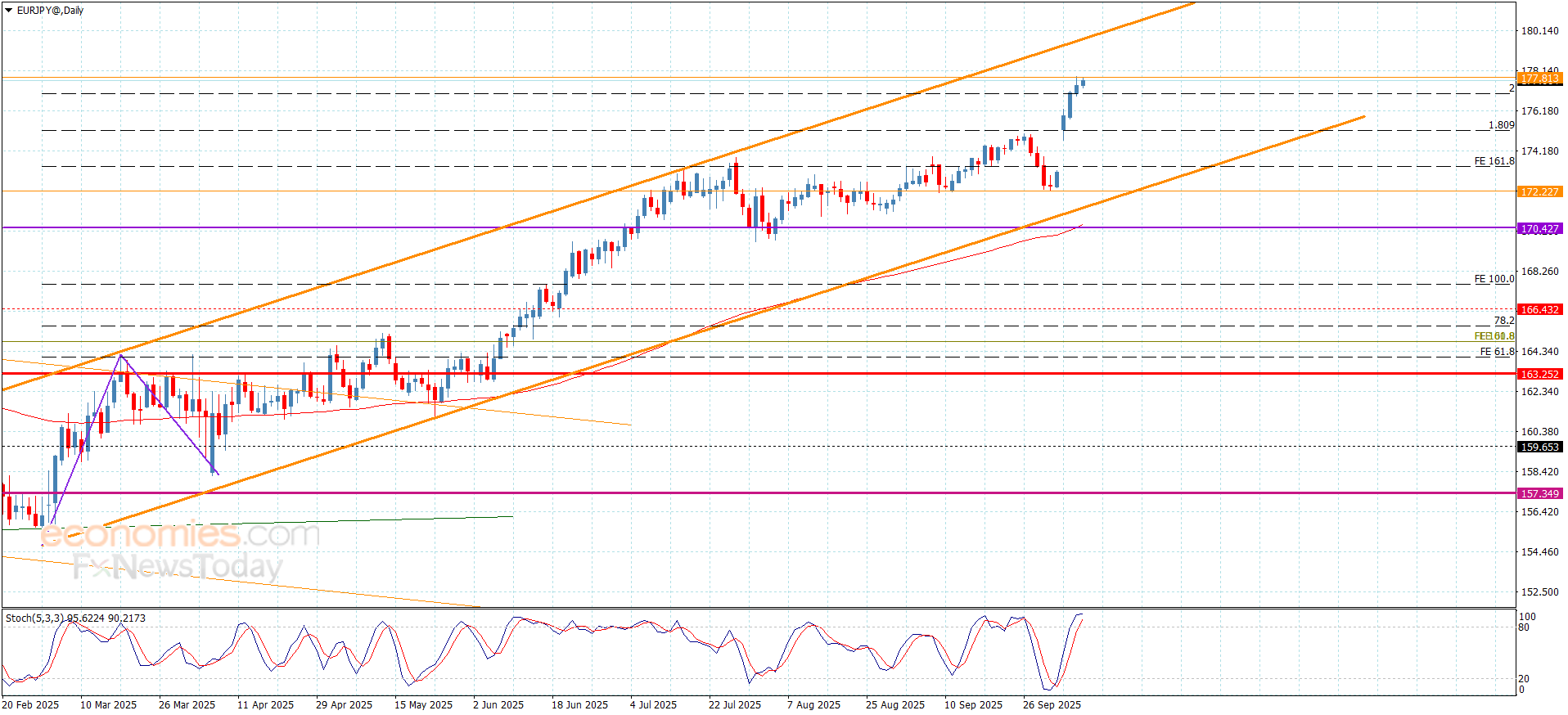
The EURGBP returned to fluctuate below 0.8700 level, forming extra barrier against the bullish attempts, which forces it to delay the bullish attack, and activating the attempts of gathering the gains by reaching 0.8650 facing 61.8%Fibonacci extension level.
Note that stochastic reach below 50 level will increase the negative intraday pressure on the price, which forces it to resume the correctional decline, to expect targeting 0.8625, then monitoring the price behavior due to the importance of this level by detecting the expected trend in the medium period trading.
The expected trading range for today is between 0.8625 and 0.8665
GBP/USD moves sideways in a narrow channel above 1.3500.
The US Dollar holds its ground despite downward revision to employment data.
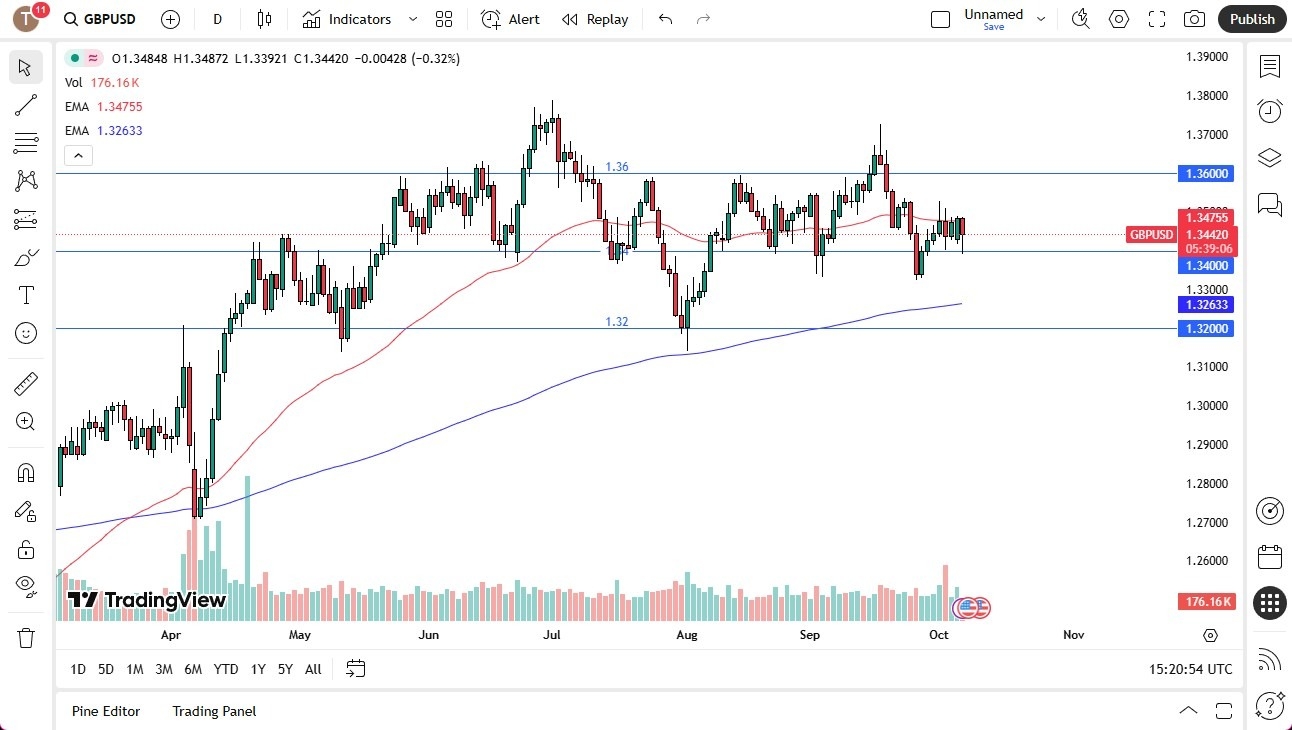
The pair faces a stiff resistance area at 1.3590-1.3600.
GBP/USD fluctuates above 1.3500 in the European session on Wednesday after posting small losses on Tuesday. The pair could attract technical buyers if it manages to clear the 1.3590-1.3600 resistance area.
Pound Sterling Price This week
The table below shows the percentage change of British Pound (GBP) against listed major currencies this week. British Pound was the strongest against the Canadian Dollar.
USD
EUR
GBP
JPY
CAD
AUD
NZD
CHF
USD
0.05%
-0.22%
-0.55%
0.11%
-0.79%
-0.83%
-0.17%
EUR
-0.05%
-0.29%
-0.50%
0.05%
-0.83%
-0.83%
-0.22%
GBP
0.22%
0.29%
-0.32%
0.34%
-0.53%
-0.55%
0.07%
JPY
0.55%
0.50%
0.32%
0.58%
-0.28%
-0.44%
0.39%
CAD
-0.11%
-0.05%
-0.34%
-0.58%
-0.80%
-0.89%
-0.28%
AUD
0.79%
0.83%
0.53%
0.28%
0.80%
-0.00%
0.62%
NZD
0.83%
0.83%
0.55%
0.44%
0.89%
0.00%
0.62%
CHF
0.17%
0.22%
-0.07%
-0.39%
0.28%
-0.62%
-0.62%
The heat map shows percentage changes of major currencies against each other. The base currency is picked from the left column, while the quote currency is picked from the top row. For example, if you pick the British Pound from the left column and move along the horizontal line to the US Dollar, the percentage change displayed in the box will represent GBP (base)/USD (quote).
The US Dollar (USD) staged a rebound in the second half of the day and caused GBP/USD to turn south, as markets turned risk-averse on escalating geopolitical tensions in the Middle East.
Meanwhile, the US Bureau of Labor Statistics announced that the preliminary benchmark revision showed that the total nonfarm employment in March 2025 was 911,000 less than initially reported. This announcement failed to convince markets of a large Federal Reserve (Fed) rate cut in September and triggered a ‘buy the rumor, sell the fact’ action in markets, helping the USD gather strength.
According to the CME FedWatch Tool, markets are currently pricing in about an 8% probability of a 50 bps rate cut at next week’s policy meeting, compared to nearly 11% on Tuesday.
Later in the day, producer inflation data from the US will be watched closely by market participants. On a yearly basis, the Producer Price Index (PPI) is expected to rise by 3.3% in August, matching July’s increase. For the month, the PPI is seen increasing by 0.3% following the 0.9% rise recorded in July.
The market reaction to the PPI data could be straightforward and short-lived ahead of Thursday’s key Consumer Price Index (CPI) data. A stronger-than-forecast increase in the monthly PPI could support the USD with the immediate reaction, while a soft print could weigh on the currency and help the risk mood improve, supporting GBP/USD in the American session.
GBP/USD Technical Analysis
The Relative Strength Index (RSI) indicator on the 4-hour chart holds above 50 and GBP/USD continues to trade above the 20-day, 50-day and 100-day Simple Moving Averages (SMAs), suggesting that the bullish bias remains intact but lacks momentum.
On the upside, 1.3590-1.3600 (static level, round level) aligns as a key resistance area before 1.3640 (Fibonacci 78.6% retracement of the latest downtrend) and 1.3700 (static level, round level).
Looking south, support levels could be seen at 1.3500 (static level, 20-day SMA), 1.3465-1.3460 (50-day SMA, 100-day SMA, Fibonacci 50% retracement) and 1.3440 (200-day SMA).
Pound Sterling FAQs
The Pound Sterling (GBP) is the oldest currency in the world (886 AD) and the official currency of the United Kingdom. It is the fourth most traded unit for foreign exchange (FX) in the world, accounting for 12% of all transactions, averaging $630 billion a day, according to 2022 data. Its key trading pairs are GBP/USD, also known as ‘Cable’, which accounts for 11% of FX, GBP/JPY, or the ‘Dragon’ as it is known by traders (3%), and EUR/GBP (2%). The Pound Sterling is issued by the Bank of England (BoE).
The single most important factor influencing the value of the Pound Sterling is monetary policy decided by the Bank of England. The BoE bases its decisions on whether it has achieved its primary goal of “price stability” – a steady inflation rate of around 2%. Its primary tool for achieving this is the adjustment of interest rates. When inflation is too high, the BoE will try to rein it in by raising interest rates, making it more expensive for people and businesses to access credit. This is generally positive for GBP, as higher interest rates make the UK a more attractive place for global investors to park their money. When inflation falls too low it is a sign economic growth is slowing. In this scenario, the BoE will consider lowering interest rates to cheapen credit so businesses will borrow more to invest in growth-generating projects.
Data releases gauge the health of the economy and can impact the value of the Pound Sterling. Indicators such as GDP, Manufacturing and Services PMIs, and employment can all influence the direction of the GBP. A strong economy is good for Sterling. Not only does it attract more foreign investment but it may encourage the BoE to put up interest rates, which will directly strengthen GBP. Otherwise, if economic data is weak, the Pound Sterling is likely to fall.
Another significant data release for the Pound Sterling is the Trade Balance. This indicator measures the difference between what a country earns from its exports and what it spends on imports over a given period. If a country produces highly sought-after exports, its currency will benefit purely from the extra demand created from foreign buyers seeking to purchase these goods. Therefore, a positive net Trade Balance strengthens a currency and vice versa for a negative balance.
EUR/USD fades its earlier move to multi-week tops near 1.1780.
The US Dollar regained upside impulse in response to prevailing risk-off trade.
The BLS revised down its payroll numbers by 911K to March 2025.
The Euro (EUR) gave back two days of gains on Tuesday, with EUR/USD sliding toward the 1.1720–1.1710 band. The pullback came as the US Dollar (USD) found fresh support on geopolitical jitters, even as markets continued to price in a 50 bps rate cut from the Federal Reserve (Fed) at next week’s meeting.
The US Dollar Index (DXY) rebounded from seven-week lows, reclaiming the 97.70 zone, helped by a bounce in US Treasury yields across the curve.
Trade tensions ease but tariffs still bite
Washington and Beijing agreed to extend their trade truce for another 90 days, giving markets some breathing room. President Trump delayed planned tariff hikes until November 10, and China pledged to hold off as well. Still, most levies remain in place: US imports from China face 30% tariffs, while Chinese goods entering the US carry a 10% charge.
Washington also reached a new trade deal with Brussels. The EU agreed to lower tariffs on US industrial goods and give wider access to American farm and fisheries products. In return, Washington slapped a 15% tax on most European imports. Car tariffs could be next in line to come down, depending on upcoming EU legislation.
French politics fuel uncertainty
In Europe, politics grabbed the spotlight. French Prime Minister François Bayrou lost a confidence vote on Monday and formally resigned to President Emmanuel Macron on Tuesday, reviving political uncertainty in the eurozone’s second-largest economy.
Fed keeps September cut in play
The Fed left rates unchanged at its last meeting, with Chair Jerome Powell noting risks in the labour market but pointing out that inflation is still running above target. That keeps a September cut firmly on the table.
The day’s standout data came from the Bureau of Labor Statistics (BLS), which said the economy added 911K fewer jobs in the 12 months through March than first estimated — a sign hiring was slowing even before Trump’s tariff push. Markets still expect a 25 bps cut at the September 16–17 meeting, though odds of a larger move are creeping higher.
ECB signals steady hand
The European Central Bank (ECB) struck a steady tone at its latest meeting. President Christine Lagarde described eurozone growth as “solid, if a little better,” hinting at little urgency to ease further. Markets expect the ECB to hold fire at its September 11 meeting and likely stay on pause through 2025, with the first cut not priced until spring 2026.
Traders trim Euro longs
CFTC data showed non-commercial net longs in the Euro easing to two-week lows near 119.6K contracts in the week to September 2. Institutional net shorts edged down to 171.3K, while open interest rose for a fourth straight week to around 846K contracts.
EUR/USD technical outlook
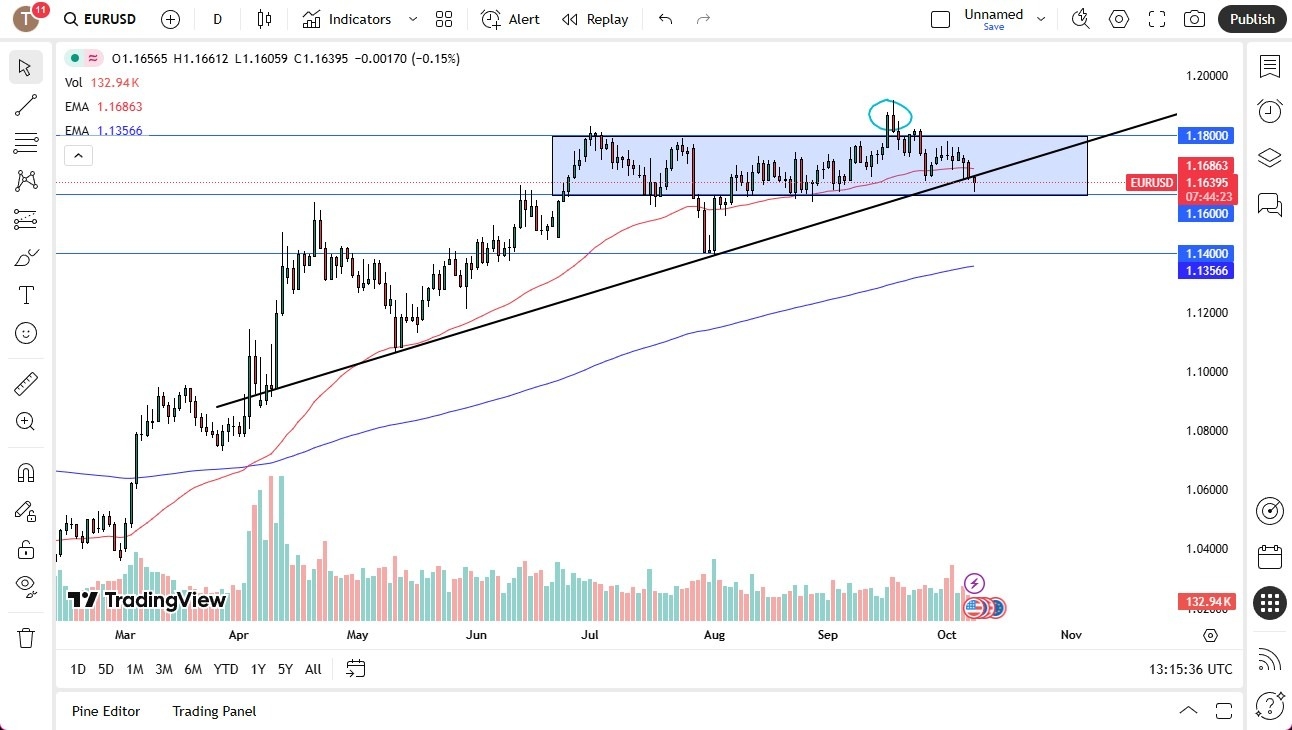
EUR/USD is still boxed into a broad 1.1400–1.1800 range. Resistance stands at the September high of 1.1779 (September 9), ahead of the weekly top at 1.1788 (July 24) and the 2025 ceiling at 1.1830 (July 1). A break higher could open the way to the September 2021 high at 1.1909, with the 1.2000 psychological level looming above.
On the downside, support is first seen at the short-term 100-day Simple Moving Average (SMA) at 1.1532, before the August base at 1.1391 (August 1) and the weekly low at 1.1210 (May 29).
Momentum signals are giving mixed messages: the Relative Strength Index (RSI) has eased back to 54, suggesting buyers are still in the game, while the Average Directional Index (ADX), just above 11, points to a trend that lacks real conviction.
EUR/USD daily chart
What’s next for EUR/USD?
For now, EUR/USD looks set to stay in consolidation mode. A breakout will likely need a fresh catalyst, whether from US data, a decisive Fed move, or another twist in Washington’s trade policy.
Employment FAQs
Labor market conditions are a key element to assess the health of an economy and thus a key driver for currency valuation. High employment, or low unemployment, has positive implications for consumer spending and thus economic growth, boosting the value of the local currency. Moreover, a very tight labor market – a situation in which there is a shortage of workers to fill open positions – can also have implications on inflation levels and thus monetary policy as low labor supply and high demand leads to higher wages.
The pace at which salaries are growing in an economy is key for policymakers. High wage growth means that households have more money to spend, usually leading to price increases in consumer goods. In contrast to more volatile sources of inflation such as energy prices, wage growth is seen as a key component of underlying and persisting inflation as salary increases are unlikely to be undone. Central banks around the world pay close attention to wage growth data when deciding on monetary policy.
The weight that each central bank assigns to labor market conditions depends on its objectives. Some central banks explicitly have mandates related to the labor market beyond controlling inflation levels. The US Federal Reserve (Fed), for example, has the dual mandate of promoting maximum employment and stable prices. Meanwhile, the European Central Bank’s (ECB) sole mandate is to keep inflation under control. Still, and despite whatever mandates they have, labor market conditions are an important factor for policymakers given its significance as a gauge of the health of the economy and their direct relationship to inflation.
Pound Sterling is struggling against the Euro at he star of the new week, trading around 1.1520 as political and fiscal headwinds dominate. The Pound to Euro (GBP/EUR) exchange rate remains close to 1.1500 support, with ING forecasting a tight 1.1500–1.1560 range this week and warning UK bonds are a weak link.
Foreign currency experts at Rabobank expect French political turmoil to limit fiscal tightening, while Danske Bank sees ongoing uncertainty in Paris capping Euro gains. COT data also shows speculative bets against Sterling at their highest since late 2022, underscoring negative sentiment.
GBP/EUR Forecasts: Held Near 1.1500?
The Pound to Euro (GBP/EUR) exchange rate has not been able to take advantage of political turmoil in France while the UK government reshuffle has not had any positive impact. GBP/EUR is trading around 1.1520, close to the 1.1500 support area.
ING considers the UK bond market is a potential weak link for the Pound, but expects limited developments this week. There are no major UK data releases until the GDP data on Friday with the 30-year bond yield holding close to 5.50%.
It expects a relatively narrow range this week; “We suspect EUR/GBP can trade in a 0.8650-0.8700 range this week, given that next week’s BoE meeting and news on quantitative tightening plans will be far more interesting.” (1.1500-1.1560 for GBP/EUR).
The French National Assembly will hold a confidence vote later in the day with widespread expectations that the government under Prime Minister Bayrou will be defeated.
Save on Your GBP/EUR Transfer
Get better rates and lower fees on your next international money transfer.
Compare TorFX with top UK banks in seconds and see how much you could save.
Danske Bank commented; “We expect political uncertainty in France to persist and view significant near-term improvements in public finances as unlikely.”
Assuming the government loses, President Macron could call fresh elections or appoint a new Prime Minister.
There has been some talk that Macron will look to form a coalition of centrists with the socialists.
Rabobank commented; “We believe that the most likely course is that Macron will appoint a new Prime Minister and plans for fiscal retrenchment will be necessarily curtailed by the unfriendly operating environment.”
Rabobank also noted relentless pressures; “This year, the budget deficit will improve a bit, to around 5.5%. But without fiscal tightening, the deficit is set to worsen in 2026. If the government does not act, several fiscal measures will roll over to next year. Add to that the rising interest expenditure and a weak economic outlook that may also limit the government’s revenues.”
The bank sees limited scope for further market stresses; “The recent widening of French spreads over Germany already accounts for a lot of the bad news. We believe the current trading range reflects many of the fiscal concerns already.”
As far as Euro-Zone data is concerned, the Sentix investor confidence index dipped to -9.2 for September from -3.7 in August and below expectations of -2.2.
Sentix commented; “The new September data from the sentix economic index dashes hopes of an economic recovery. Both the current situation and future expectations are deteriorating noticeably. This means that economic concerns are returning in full force.”
The latest COT data, released by the CFTC, recorded a net increase in short, non-commercial Pound positions to over 33,000 in the latest week from 31,500 the previous week and close to the highest level since late 2022 which indicates negative underlying Pound sentiment.
There may, however, be limited scope for further Pound selling unless there is a fresh jump in UK bond yields.
Like this piece? Please share with your friends and colleagues:
International Money Transfer? Ask our resident FX expert a money transfer question or try John’s new, free, no-obligation personal service! ,where he helps every step of the way,
ensuring you get the best exchange rates on your currency requirements.
The Pound US Dollar (GBP/USD) exchange rate ticked lower on Tuesday following the publication of the latest non-farm payrolls annual revision from the US.
At the time of writing, GBP/USD was trading at approximately $1.3526, down roughly 0.2% from the start of Tuesday’s session.
The US Dollar (USD) advanced on Tuesday, firming against most major peers following the publication of the latest annual revision to non-farm payrolls.
The updated figures showed that the economy generated 911,000 fewer jobs in the twelve months to March than previously thought, a result that highlighted ongoing weakness in the US labour market.
Despite the downbeat implications, the ‘Greenback’ proved resilient. The revision did little to alter expectations around the Federal Reserve’s monetary policy outlook, with interest rate cut bets largely unchanged. As a result, USD maintained its footing and even built momentum against several counterparts during the session.
The Pound (GBP) was able to hold its ground against most major rivals on Tuesday, even in the absence of fresh UK economic data.
Save on Your GBP/USD Transfer
Get better rates and lower fees on your next international money transfer.
Compare TorFX with top UK banks in seconds and see how much you could save.
With no significant domestic releases to provide direction, Sterling’s movement was largely muted through the session.
Instead, investors shifted their focus towards upcoming commentary from Bank of England (BoE) Deputy Governor Sarah Breeden. Should Breeden strike a dovish tone in her remarks, expectations for earlier policy easing are likely to intensify, a development that could place Sterling under renewed pressure.
Looking ahead to Wednesday’s European session, the spotlight is expected to fall on the latest US Producer Price Index (PPI) data for August, which could set the tone for movement in the GBP/USD exchange rate.
Forecasts point to a notable slowdown, with the index predicted to ease from 0.9% to 0.3%.
Should the figures confirm a loss of momentum in producer prices, the US Dollar may come under pressure as markets scale back expectations for further tightening from the Federal Reserve, creating potential headwinds for the currency in mid-week trade.
In contrast, the UK’s economic calendar is once again devoid of high-impact releases. This lack of domestic drivers will likely leave Sterling at the mercy of broader market trends. As a result, GBP movement is expected to remain closely tied to shifts in risk appetite and external factors.
Like this piece? Please share with your friends and colleagues:
International Money Transfer? Ask our resident FX expert a money transfer question or try John’s new, free, no-obligation personal service! ,where he helps every step of the way,
ensuring you get the best exchange rates on your currency requirements.
GBP/USD climbs toward 1.3600 in the European session on Tuesday.
The technical outlook suggests that the pair is about to turn overbought.
GBP/USD could preserve its bullish momentum if the BLS announces significant downward revisions to NFP.
GBP/USD gains traction in the European session on Tuesday and advances toward 1.3600 after posting modest gains on Monday. Although the technical picture starts showing overbought conditions for the pair, investors could refrain from positioning themselves for a correction unless there is a convincing recovery in the US Dollar (USD).
Pound Sterling Price This week
The table below shows the percentage change of British Pound (GBP) against listed major currencies this week. British Pound was the strongest against the US Dollar.
USD
EUR
GBP
JPY
CAD
AUD
NZD
CHF
USD
-0.44%
-0.58%
-1.23%
-0.23%
-0.97%
-1.05%
-0.67%
EUR
0.44%
-0.14%
-0.71%
0.21%
-0.53%
-0.56%
-0.22%
GBP
0.58%
0.14%
-0.64%
0.35%
-0.38%
-0.42%
-0.08%
JPY
1.23%
0.71%
0.64%
0.93%
0.22%
0.02%
0.58%
CAD
0.23%
-0.21%
-0.35%
-0.93%
-0.65%
-0.77%
-0.44%
AUD
0.97%
0.53%
0.38%
-0.22%
0.65%
-0.03%
0.31%
NZD
1.05%
0.56%
0.42%
-0.02%
0.77%
0.03%
0.34%
CHF
0.67%
0.22%
0.08%
-0.58%
0.44%
-0.31%
-0.34%
The heat map shows percentage changes of major currencies against each other. The base currency is picked from the left column, while the quote currency is picked from the top row. For example, if you pick the British Pound from the left column and move along the horizontal line to the US Dollar, the percentage change displayed in the box will represent GBP (base)/USD (quote).
Last Friday’s disappointing labor market data from the US, which showed an increase of only 22,000 in Nonfarm Payrolls (NFP) in August, caused the US Dollar to start the week under bearish pressure and allowed GBP/USD to push higher.
Meanwhile, the upbeat market mood further supported the pair in the American session, as Wall Street’s main indexes remained in positive territory after the opening bell. Early Tuesday, US stock index futures trade mixed.
In the second half of the day, the Bureau of Labor Statistics (BLS) will publish preliminary benchmark revisions to employment data. According to the CME FedWatch Tool, markets are currently pricing in about an 88% probability of a 25 basis-points (bps) and a 12% chance of a 50 bps Federal Reserve (Fed) rate cut at next week’s policy meeting.
In August 2024, the BLS announced the significant downward revisions to the past Nonfarm Payroll readings and paved the way for a 50 bps cut in September.
If the BLS’ revisions show that the NFP growth was much weaker than originally reported, markets could expect a similar scenario to play out and ramp up bets for a large rate cut. In this case, the USD could come under heavy selling pressure and trigger another bullish rally in GBP/USD. Conversely, the USD could rebound and weigh on GBP/USD in case the BLS announces positive revisions, or leaves NFP data largely unchanged.
GBP/USD Technical Analysis
The Relative Strength Index (RSI) indicator on the 4-hour chart climbed slightly above 70, suggesting that GBP/USD is turning technically overbought.
On the upside, 1.3600 (static level, round level) aligns as the first resistance level before 1.3640 (Fibonacci 78.6% retracement of the latest downtrend) and 1.3700 (static level, round level). Looking south, support levels could be seen at 1.3500 (20-day Simple Moving Average (SMA), static level), 1.3470-1.3460 (50-day MA, 100-day SMA) and 1.3440 (200-period SMA).
Pound Sterling FAQs
The Pound Sterling (GBP) is the oldest currency in the world (886 AD) and the official currency of the United Kingdom. It is the fourth most traded unit for foreign exchange (FX) in the world, accounting for 12% of all transactions, averaging $630 billion a day, according to 2022 data.
Its key trading pairs are GBP/USD, also known as ‘Cable’, which accounts for 11% of FX, GBP/JPY, or the ‘Dragon’ as it is known by traders (3%), and EUR/GBP (2%). The Pound Sterling is issued by the Bank of England (BoE).
The single most important factor influencing the value of the Pound Sterling is monetary policy decided by the Bank of England. The BoE bases its decisions on whether it has achieved its primary goal of “price stability” – a steady inflation rate of around 2%. Its primary tool for achieving this is the adjustment of interest rates.
When inflation is too high, the BoE will try to rein it in by raising interest rates, making it more expensive for people and businesses to access credit. This is generally positive for GBP, as higher interest rates make the UK a more attractive place for global investors to park their money.
When inflation falls too low it is a sign economic growth is slowing. In this scenario, the BoE will consider lowering interest rates to cheapen credit so businesses will borrow more to invest in growth-generating projects.
Data releases gauge the health of the economy and can impact the value of the Pound Sterling. Indicators such as GDP, Manufacturing and Services PMIs, and employment can all influence the direction of the GBP.
A strong economy is good for Sterling. Not only does it attract more foreign investment but it may encourage the BoE to put up interest rates, which will directly strengthen GBP. Otherwise, if economic data is weak, the Pound Sterling is likely to fall.
Another significant data release for the Pound Sterling is the Trade Balance. This indicator measures the difference between what a country earns from its exports and what it spends on imports over a given period.
If a country produces highly sought-after exports, its currency will benefit purely from the extra demand created from foreign buyers seeking to purchase these goods. Therefore, a positive net Trade Balance strengthens a currency and vice versa for a negative balance.
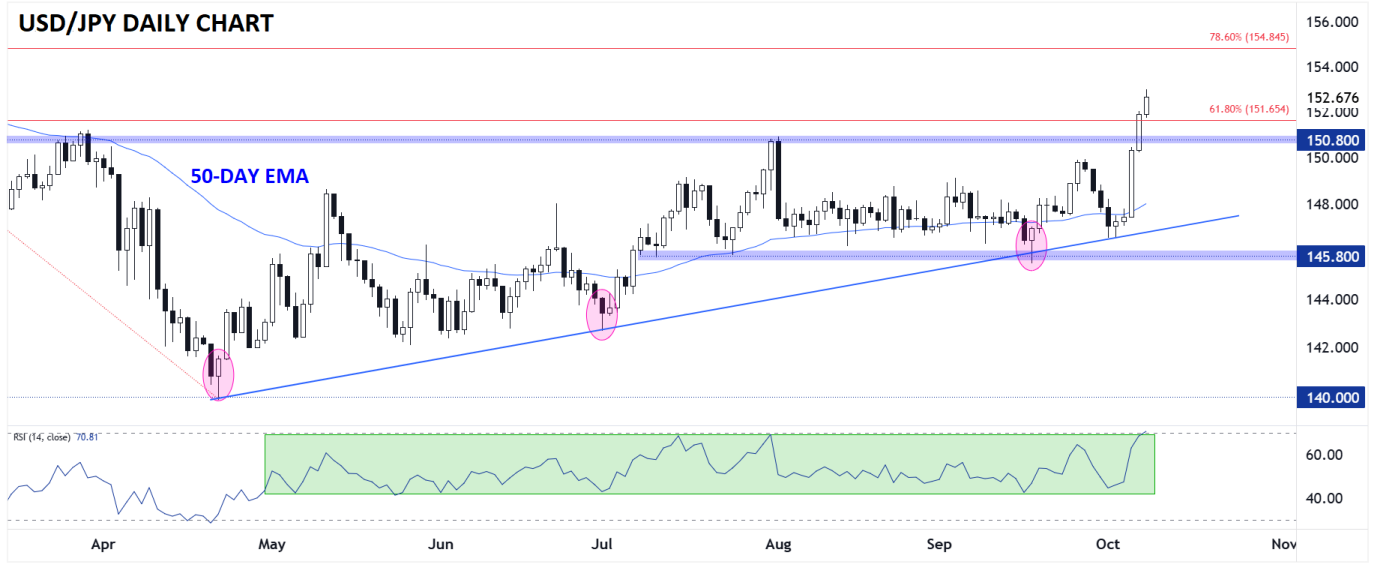
The USD/JPY price analysis points south as the yen finds relief from political uncertainty.
Traders are pricing a 12% chance of a massive Fed rate cut in September.
The US will release benchmark revisions for jobs data between April 2024 and March 2024.
The USD/JPY price analysis points south as the yen finds relief from political uncertainty due to a weak dollar. The US dollar traded near a 7-week low against its peers as traders awaited benchmark revisions for US jobs data. At the same time, market participants are anticipating the US consumer inflation report.
–Are you interested to learn more about MT5 brokers? Check our detailed guide-
The dollar remained fragile on Tuesday as Fed rate cut expectations increased after Friday’s poor jobs report. The shift to poor employment figures in the US was sudden and unexpected. As a result, the outlook for Fed rate cuts has changed drastically.
Friday’s report revealed an addition of only 22,000 jobs in August. This is a significant slowdown from previous months and puts more pressure on the Fed to lower rates. Currently, market participants are pricing three rate cuts before the end of the year. Additionally, they are pricing a 12% chance of a massive cut in September. Benchmark revisions for jobs data between April 2024 and March 2024 could reveal further weakness. This might increase the likelihood of a huge cut.
As a result, the yen recovered on Tuesday after dipping at the start of the week amid political uncertainty in Japan. The resignation of Prime Minister Ishiba could reshape monetary policy in the country.
USD/JPY key events today
Traders are not anticipating any high-impact releases from Japan or the US today.
USD/JPY technical price analysis: Bears test a solid channel support
USD/JPY 4-hour chart
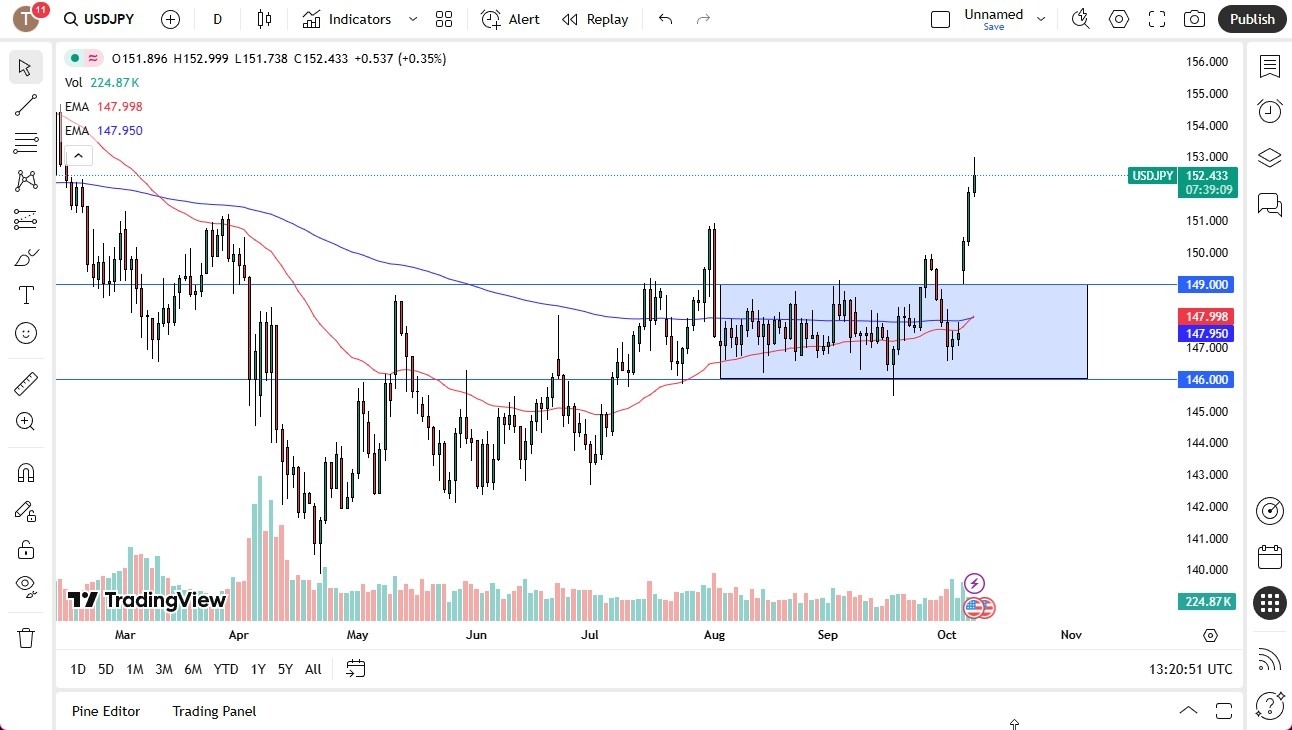
On the technical side, the USD/JPY price has dropped to its channel support, where bulls could emerge to push the price higher. However, the bearish bias within the channel is strong, with the price well below the SMA and the RSI under 50.
–Are you interested to learn more about Thailand forex brokers? Check our detailed guide-
For some time now, USD/JPY has traded within a shallow bullish channel. The price has been chopping through the SMA with no clear direction. At the same time, bears and bulls have shown almost equal strength. However, before the price entered this period of correction, bears had reversed the trend and were showing massive strength.
Therefore, the next impulsive move that breaks out of the shallow channel could be bearish. Nevertheless, bears would also have to break below the 146.50 support to confirm a continuation of the previous decline. Meanwhile, if the channel support holds, the price will likely retest the 149.00 resistance.
Looking to trade forex now? Invest at eToro!
68% of retail investor accounts lose money when trading CFDs with this provider. You should consider whether you can afford to take the high risk of losing your money.
Platinum price returned to settle above $1382.00 level, increasing the efficiency of the bullish track, fluctuating near the initial target at $1400.00, the continuation of the attempts to provide positive momentum by the main indicators will increase the chances of resuming the bullish attack, to expect its rally towards $1412.00, then attempts to press on the barrier near $1435.00.
While the price return to settle below $1382.00 will force it to delay the bullish attack and form new correctional waves, which forces it to suffer some of the losses before resuming the main bullish attack by reaching $1362.00.
The expected trading range for today is between $1382.00 and $ 1412.00
Platinum price returned to settle above $1382.00 level, increasing the efficiency of the bullish track, fluctuating near the initial target at $1400.00, the continuation of the attempts to provide positive momentum by the main indicators will increase the chances of resuming the bullish attack, to expect its rally towards $1412.00, then attempts to press on the barrier near $1435.00.
While the price return to settle below $1382.00 will force it to delay the bullish attack and form new correctional waves, which forces it to suffer some of the losses before resuming the main bullish attack by reaching $1362.00.
The expected trading range for today is between $1382.00 and $ 1412.00
The Pound to Dollar (GBP/USD) exchange rate found support below 1.3500 on Monday and pushed towards 1.3540, helped by softer US bond yields and a weaker dollar index at 6-week lows. Analysts see Sterling locked in a near-term range, with momentum capped below 1.3590 ahead of the September Federal Reserve decision.
GBP/USD Forecasts: Range-Bound for Now
UoB said;
“Coming off the previous steep decline, the sharp rebound did not translate into a meaningful build-up in upward momentum. Overall, we view the current price movements as part of a broad range, likely between 1.3430 and 1.3595.”
Scotiabank echoed the range view;
“We look to a near-term range of 1.3480 and 1.3580.”
Both banks see a decisive break above 1.3590 as crucial for GBP/USD to build a stronger rally.
Save on Your GBP/USD Transfer
Get better rates and lower fees on your next international money transfer.
Compare TorFX with top UK banks in seconds and see how much you could save.
Weaker US jobs data last week reinforced expectations that the Fed will cut rates in September, with markets pricing a 10% chance of a larger 50-point cut.
MUFG commented;
“There is clear evidence that the US labour market deteriorated sharply after President Trump’s Liberation Day tariffs announcement in April.”
Danske Bank was more cautious;
“While political pressure to accelerate policy easing inarguably complicates the outlook, we think risks are skewed towards slower, rather than faster, rate cuts given the risk of more persistent inflation.”
ING noted potential for a short-term dollar bounce;
“We think the US corporate tax payment deadline of 15 September could provide the dollar with some support this week. Seasonally, the dollar does OK in September. We suspect that the DXY could be driven a little higher this week, before a bearish switch into next Wednesday’s FOMC meeting.”
UK fiscal pressures remain in focus after the sharp rise in gilt yields earlier this month.
Rabobank warned;
“Fixing bloated fiscal positions without clobbering the economy and simultaneously finding ways to finance spending priorities has become a policy paradox. Is it simply ‘too late’ to fix? Or can out of the box economic thinking still find a solution?”
Scotiabank’s Shaun Osborne noted some upside for Sterling sentiment after the cabinet reshuffle;
“Markets appear to be endorsing the change, and risk reversals in the options market are showing signs of a shift following their recent dramatic (bearish) turn.”
Like this piece? Please share with your friends and colleagues:
International Money Transfer? Ask our resident FX expert a money transfer question or try John’s new, free, no-obligation personal service! ,where he helps every step of the way,
ensuring you get the best exchange rates on your currency requirements.