The main tag of Gold Price Articles.
You can use the search box below to find what you need.
[wd_asp id=1]
The main tag of Gold Price Articles.
You can use the search box below to find what you need.
[wd_asp id=1]
Spot Silver is edging higher on Tuesday after finding support inside a key support zone at a major moving average. The move so far is a technical bounce. There hasn’t been a meaningful rally.
The main trend is down according to the daily swing chart. A trade through $62.33 will signal a resumption of the downtrend. A move through $68.33 will change the main trend to up.
The range from the July 17 bottom at $54.78 to the August 28 top at $71.18 has formed a retracement support zone at $62.98 to $61.04. Inside this zone is the 50-day moving average at $62.64. Yesterday’s low at $62.33 and today’s low at $62.56 hit this zone. Today’s bounce overcame the upper, or 50%, level at $62.98.
Wednesday’s Fed decision is the trade. Silver absorbed the worst the yield and dollar markets had to offer this week and bounced. Short sellers who leaned on this metal at $63 watched it hold twice and come back through the 50% retracement level. That is uncomfortable positioning heading into a policy announcement where one sentence from Warsh can shift the rate story.
Crude above $100 and the Saudi pipeline outage are keeping inflation expectations firm. That pressure is real but it has had two full sessions to crack the floor and has not done it. The question is whether Warsh gives buyers enough room to build or whether he hands sellers another reason to come back.
The bias leans bearish with the main trend down on the daily swing chart. Monday’s low at $62.33 and Tuesday’s low at $62.56 both landed inside the retracement zone at $62.98 to $61.04 with the 50-day moving average at $62.64 sitting in the middle of it. Buyers defended the zone and pushed back above $62.98. Resistance above sits at $65.33 to $66.76 with the swing top at $68.33 needed to flip the trend. A break through $62.33 reopens the downside toward the support cluster at $61.04 and $60.835.
More Information in our Economic Calendar.
Domestic coffee prices
Coffee prices today in the domestic market simultaneously decreased by 800 VND/kg, on average maintaining at 92,900 VND/kg, anchored in the price range of 92,200-93,000 VND/kg.
In Gia Lai and Dak Lak, coffee prices were recorded at 92,800 VND/kg, down 800 VND/kg.
In Lam Dong, coffee prices also decreased by 800 VND/kg, listed at 92. 200 VND/kg.
The old Dak Nong area, although reduced by another 800 VND/kg, is still the highest price in the whole region at 93,800 VND/kg.
The USD/VND exchange rate according to Vietcombank was recorded at 25,800 VND/USD, an increase of 10 VND/USD.
World coffee prices
In the world market, coffee prices remain unchanged for all terms.
According to Barchart, the September 2026 Robusta futures contract anchored at 3,307 USD/ton, down 59 USD/ton. At the same decrease, the November 2026 futures were listed at 3,337 USD/ton. The term from January 2027 to May 2027 was listed in the price range of 3,300 – 3,312 USD/ton.
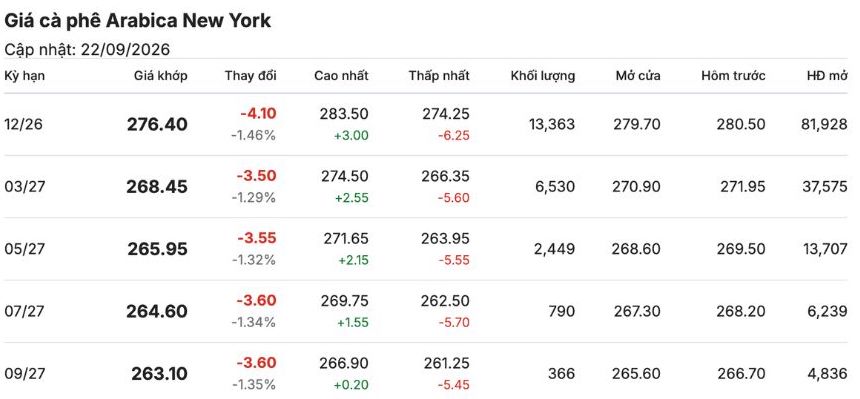
Similarly, the December 2026 Arabica contract fell to 276.40, down sharply 4.1 cents/lb. The March 2027 contract was offered to the market at 268.45 cents/lb, down 3.5 cents/lb. Further forwards were anchored in the 263.10 – 265.95 cents/lb range.
Assessments and forecasts
Coffee prices fell to a 3-month low. Coffee prices have been under pressure for about 3 weeks due to the prospect of abundant global supply. On September 10, the International Coffee Organization (ICO) forecast that global coffee production in the 2025/2026 crop year will reach a record level and the market will be oversupplied. ICO said that global coffee production in the 2025/2026 crop year has increased.
Favorable growing conditions in Brazil and Vietnam also put pressure on coffee prices. Rainfall higher than normal in Brazil during the current important flowering period may support the 2026/2027 coffee harvest, creating a disadvantageous factor for prices.
In Vietnam, according to forecasts, abundant rainfall has improved soil moisture and may support the coffee fruit development process in the Central Highlands region – the largest coffee production region in the country.
Meanwhile, Brazilian coffee is being brought to the export market as the harvest season in this country enters its final stage, supplementing global supply and putting pressure on prices.
China kept buying. Premiums held steady and investment demand stayed intact on weakness. Chinese buyers have been accumulating on dips consistently for weeks. At current prices that is not enough to reverse the decline. It keeps the physical market from falling apart underneath the rate selling. If gold trades back toward the September low, the steady Chinese accumulation starts to count for more. Right now it is a floor in search of a reason and the rate trade is not providing one.
Central bank speakers and inflation data this week are the catalyst. Kashkari called it broad Sunday. If the rest of the Fed follows that line there is nothing for gold to trade except the next lower high. The next data print either supports the hawks or gives the doves room to push back. Oil coming down only matters if yields come down after it and Monday said they are not interested. India stepping aside strips physical support during the correction. China buying every dip keeps a bid underneath but Chinese premiums alone are not going to reverse a decline running across three central banks.
Sellers own the chart below $4,384.59 and $4,405.59 with the main trend down and the lower high at $4,510.93 confirmed. Below $4,319.61, sellers have a path through the 50-day moving average at $4,295.83 and $4,282.62 into the $4,235.17 to $4,230.51 zone.
Gold has to clear $4,384.59 and then deal with $4,405.59 to put the $4,466.14 to $4,481.78 zone in play. The lower high at $4,510.93 and the 200-day at $4,541.86 both have to break to turn the trend.
If you’d like to know more about how to trade gold, please visit our educational area.
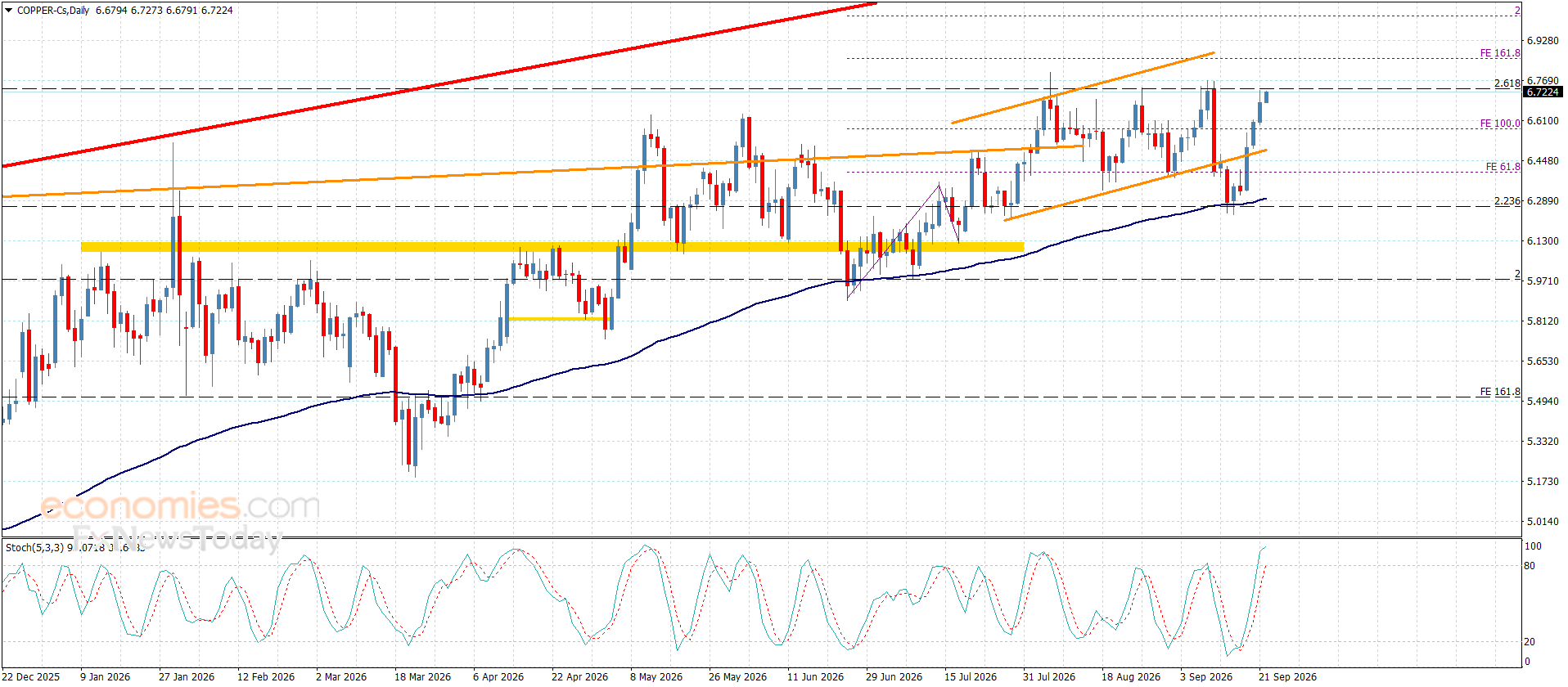
Copper price ended the last bullish rally by facing a key barrier at $6.7400, to settle below it, forming the confirmation key for the near and medium trading, therefore, we recommend waiting for the price to activate with the main indicators’ positivity and achieving the required breach to confirm its readiness to record extra gains by its rally towards the historical top near $6.8000, attempting to record new historical gains that might begin at $6.8600 and $6.9300.
While the failure in breaching this level will push the price to provide mixed trading with a chance to activate the bearish corrective trend, which forces it to decline towards $6.5700.
The expected trading range for today is between $6.6500 and $6.8600
Trend forecast: Bullish
Platinum price updates for Surat show the current rates as ₹55,420 (10g),
₹5,54,200 (100g), and ₹55,42,000 (1kg). Over September, prices changed
frequently. The 100g rate peaked at ₹5,76,000 and dropped to
₹5,25,300. For 1kg, it fluctuated between
₹52,53,000 and ₹57,60,000.
The cost of platinum is influenced by mining output, global market demand, and
geopolitical stability. Industrial reliance—mainly in cars and electronics—drives
additional volatility. Shifts in currency, especially the US dollar, as well as
macroeconomic indicators like inflation and interest rate policies, strongly shape its
pricing.
Stay informed on platinum price trends in Bangalore. Today’s rates stand at ₹55,420
for 10g, ₹5,54,200 for 100g, and ₹55,42,000 for 1kg. In September, platinum
saw fluctuations. The highest rate for 100g touched ₹5,76,000,
and the lowest fell to ₹5,25,300. For 1kg, prices ranged from
₹52,53,000 to ₹57,60,000.
Global supply chains, mining rates, and geopolitical issues are major drivers of platinum
prices. Demand from the auto and electronics industries adds pressure. Exchange rate
movements, especially against the US dollar, combined with inflation trends and central
bank strategies, contribute significantly to changes in platinum’s market price.
Welcome, my fellow traders! I have prepared a price forecast for US Crude, XAUUSD, and EURUSD using a combination of the margin zones method and technical analysis. Based on the market analysis, I have identified entry signals for intraday traders.
Oil has broken through the key support of the short-term uptrend.
The article covers the following subjects:
The oil price has pierced the key support of 95.55–94.90 within the short-term uptrend. The bearish target is now the lower Target Zone of 89.02–87.71.
Short trades can be considered once the price corrects up to resistance A at 98.02–97.56, with the first target at 95.60 and the second one around 93.20.
Sell near resistance A at 98.02–97.56. TakeProfit: 95.60, 93.20. StopLoss: 99.04.
Gold is trading within a short-term downtrend. Last week, the price tested the trend boundary at 4,415–4,398, but bears managed to defend this zone. Consequently, consider holding short trades today, targeting the 4,325 level. The second downside target will be 4,235.
If the gold price breaks above the 4,415 level, the downtrend may reverse. In this case, consider long trades, with a target in the upper the Target Zone of 4,595–4,562.
Hold short trades opened near resistance B at 4,415–4,398. TakeProfit: 4,325, 4,235. StopLoss: 4,443.
The euro is trading within a short-term downtrend and is attempting to break through the lower Target Zone of 1.1459–1.1434. If it breaches this zone, the next downside target will be the Gold Zone of 1.1375–1.1367.
Consider short trades once the price corrects higher to resistance A at 1.1546–1.1538. The first target will be 1.1500, and the second will be 1.1454.
Sell near resistance A at 1.1546–1.1538. TakeProfit: 1.1500, 1.1454. StopLoss: 1.1565.
Would you like to learn more about technical analysis methods and principles? Explore our comprehensive guide.
P.S. Did you like my article? Share it in social networks: it will be the best “thank you” 🙂
Useful links:
The content of this article reflects the author’s opinion and does not necessarily reflect the official position of LiteFinance broker. The material published on this page is provided for informational purposes only and should not be considered as the provision of investment advice for the purposes of Directive 2014/65/EU.
According to copyright law, this article is considered intellectual property, which includes a prohibition on copying and distributing it without consent.
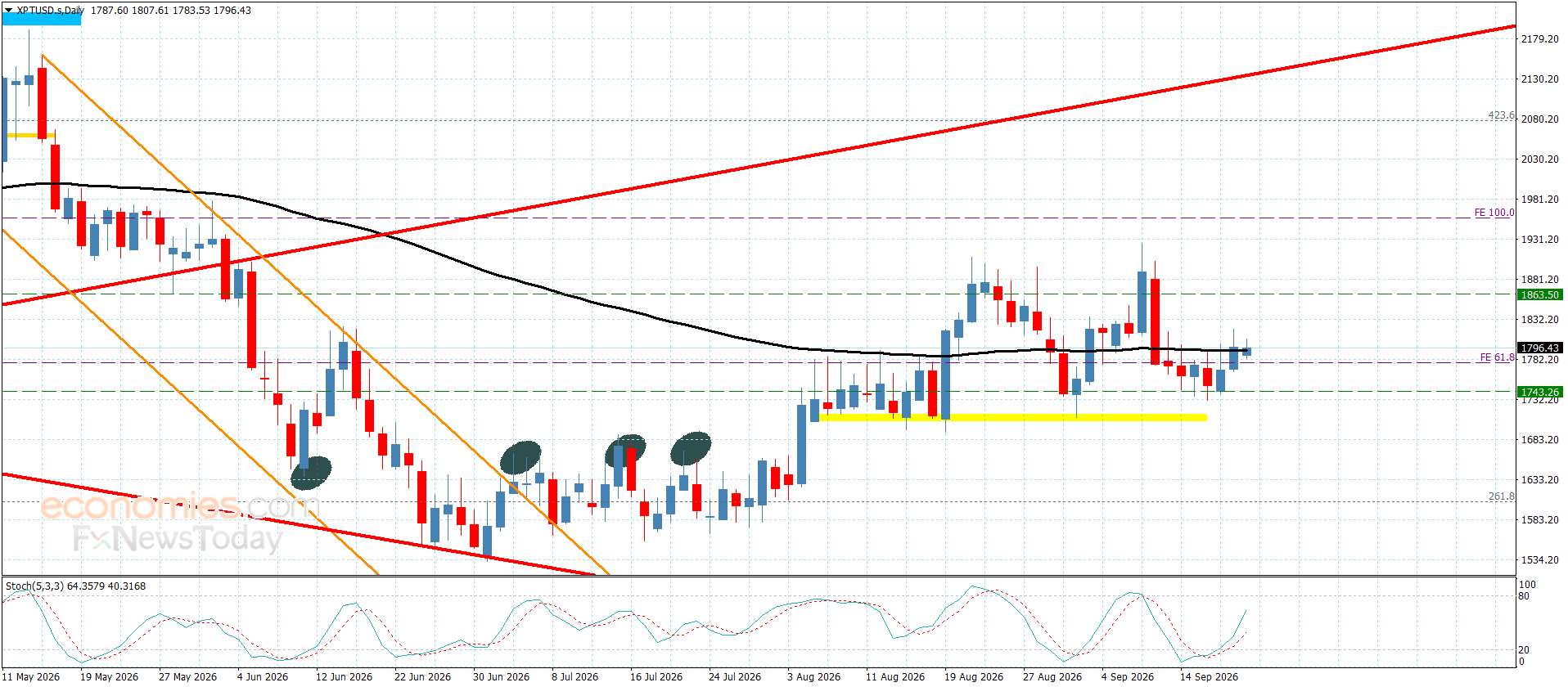
Platinum price remained unchanged up to this moment due to its repeated positioning below the resistance at $1,840.00. The price continues to fluctuate near the 55-period moving average. We note that the bullish scenario remains valid as long as the support level at $1,705.00 holds, which keeps us waiting for the required breakout before the price begins recording further gains, initially targeting $1,880.00 and then attempting to reach the next main target near $1,960.00.
On the other hand, a decline below the support level at $1,705.00 and sustained trading beneath it would confirm a shift into a bearish path, with the price expected to incur significant losses, initially moving toward $1,645.00.
The expected trading range for today is between $1760.00 and $1880.00
Trend forecast: Bullish
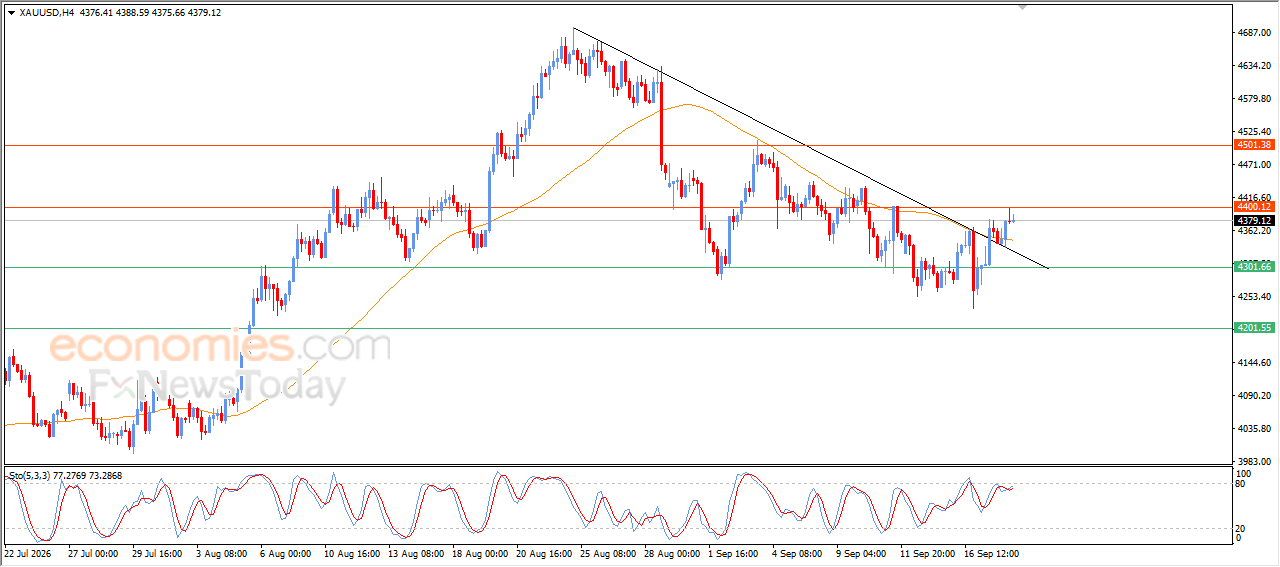
Gold is holding higher during its recent intraday trading, reaching $4,400 resistance level, which was our morning target, supported by the price continuing to trade above EMA50, giving it renewed momentum that strengthens the chances of extending these gains in the near term, particularly if it breaks above this resistance. The price is also benefiting from breaking above a short-term bearish corrective trendline, alongside positive signals from the relative strength indicators.
Domestic coffee prices
Today (September 20), the coffee market ended the price reduction week, currently the purchase price fluctuates in the range of 93,000 – 93,800 VND/kg, down from 1,500-1,700 VND/kg compared to the price range of the previous week. The average purchase price of coffee in the Central Highlands provinces today is 93,700 VND/kg, down 1,500 VND/kg.
The old Dak Nong area is still the province with the highest coffee purchasing price in the Central Highlands region, the difference with the average price is about 100 VND/kg. Compared to the closing price last weekend, the coffee price in this area decreased by 1,200 VND/kg, launched to the market at a price of 93,800 VND/kg.
In Dak Lak and Gia Lai, coffee prices both decreased by 1,100 VND/kg, down to 93,600 VND/kg.
Similarly, Lam Dong also decreased by 1,600 VND/kg, currently trading at a price of 93,000 VND/kg.
World coffee prices
On the London and New York exchanges, the coffee market had a week of price slippage on all terms.
On the online trading floor Robusta, the September 2026 futures contract on the London exchange was traded at 3,361 USD/ton, down 134 USD/ton compared to the previous closing session. The November 2026 contract decreased by 134 USD/ton, to 3,391 USD/ton.
On the New York Stock Exchange, Arabica coffee futures for March 2027 delivery were listed at 268.55 US cents/lb. December 2026 delivery contracts fell 11 cents/lb, reaching 276.5 US cents/lb.
Market outlook
According to the Vietnam Coffee – Cocoa Association (Vicofa), coffee exports in the last months of 2026 are expected to continue to maintain positive momentum. Production for the whole year 2026 is estimated to increase by about 8 – 10% compared to 2025, thanks to additional supply from the new crop year harvested in November.
In order to cope with price reduction pressure as global supply increases, the industry is shifting to focusing on increasing value instead of chasing output.
The coffee market is still under pressure due to increased Arabica inventories on the ICE exchange, Brazil’s exports being boosted and favorable weather conditions in Brazil as well as Vietnam.