The main tag of Gold Price Articles.
You can use the search box below to find what you need.
[wd_asp id=1]
The main tag of Gold Price Articles.
You can use the search box below to find what you need.
[wd_asp id=1]
Copper price has recently shown slow sideways trading, maintaining its position near the $6.3000 level, affected by the ongoing conflict between the attempt of Stochastic to provide negative momentum and the positioning of the 55-period moving average below the current trading levels, as shown in the attached chart.
We remind you that the previously suggested bearish corrective scenario remains valid, based on the continuation of the $6.6000 level acting as a strong resistance barrier. This keeps the negative outlook in place, with the price likely targeting the $6.1000 level soon. A break below this obstacle would allow the price to reach further corrective stations, starting from $5.9200 and $5.8000 respectively.
The expected trading range for today is between $6.1000 and $6.4200
Trend forecast: Bearish
Silver price (XAG/USD) halts its three-day losing streak, trading around $65.90 per troy ounce during the Asian hours on Monday. However, Silver price could further decline amid renewed concerns over a US-Iran peace deal, a development that keeps both inflation risks and the prospect of prolonged high interest rates at the forefront of investor worries.
According to a CNBC report on Sunday, US President Donald Trump threatened direct strikes on Iran if Hezbollah continues its attacks on Israel. This warning has severely clouded the outlook for diplomatic progress between Washington and Tehran.
Furthermore, President Trump threatened to completely dismantle the current peace framework, even as Vice President JD Vance met with Iranian officials for the first round of talks under an interim deal.
Adding to the friction, Tehran simultaneously announced it had once again closed the strategic Strait of Hormuz. While Iranian state media reported that Tehran had completely suspended negotiations in response to Trump’s remarks, sources close to the matter indicated that discussions are quietly ongoing.
The non-yielding Silver could face heavy pressure from expectations of tighter monetary policy. The Federal Reserve (Fed) kept interest rates steady last week but adopted a decidedly hawkish tone. Notably, 9 out of 19 Fed policymakers now project at least one interest rate hike this year, with market investors pricing in a potential increase as early as September.
“The resurgent US dollar, powered by the Fed’s newly hawkish tone under Kevin Warsh, has stolen the spotlight,” noted Tim Waterer, chief market analyst at KCM Trade, highlighting the growing headwinds facing precious metals.
Silver is a precious metal highly traded among investors. It has been historically used as a store of value and a medium of exchange. Although less popular than Gold, traders may turn to Silver to diversify their investment portfolio, for its intrinsic value or as a potential hedge during high-inflation periods. Investors can buy physical Silver, in coins or in bars, or trade it through vehicles such as Exchange Traded Funds, which track its price on international markets.
Silver prices can move due to a wide range of factors. Geopolitical instability or fears of a deep recession can make Silver price escalate due to its safe-haven status, although to a lesser extent than Gold’s. As a yieldless asset, Silver tends to rise with lower interest rates. Its moves also depend on how the US Dollar (USD) behaves as the asset is priced in dollars (XAG/USD). A strong Dollar tends to keep the price of Silver at bay, whereas a weaker Dollar is likely to propel prices up. Other factors such as investment demand, mining supply – Silver is much more abundant than Gold – and recycling rates can also affect prices.
Silver is widely used in industry, particularly in sectors such as electronics or solar energy, as it has one of the highest electric conductivity of all metals – more than Copper and Gold. A surge in demand can increase prices, while a decline tends to lower them. Dynamics in the US, Chinese and Indian economies can also contribute to price swings: for the US and particularly China, their big industrial sectors use Silver in various processes; in India, consumers’ demand for the precious metal for jewellery also plays a key role in setting prices.
Silver prices tend to follow Gold’s moves. When Gold prices rise, Silver typically follows suit, as their status as safe-haven assets is similar. The Gold/Silver ratio, which shows the number of ounces of Silver needed to equal the value of one ounce of Gold, may help to determine the relative valuation between both metals. Some investors may consider a high ratio as an indicator that Silver is undervalued, or Gold is overvalued. On the contrary, a low ratio might suggest that Gold is undervalued relative to Silver.
Domestic coffee prices today
Coffee prices today in the domestic market recorded a more positive development. The average price reached 89,300 VND/kg, an increase of 100 VND/kg compared to the previous update.
In Dak Lak, coffee prices increased by 100 VND/kg, to 89,300 VND/kg. Gia Lai also recorded a similar increase, bringing the purchase price to 89,300 VND/kg.
In the old Dak Nong area, coffee prices reached 89,400 VND/kg, an increase of 100 VND/kg and continued to be the highest level among the surveyed areas.
Lam Dong alone maintained the same level of 89,000 VND/kg, the lowest in the market.
Thus, domestic coffee prices currently range from 89,000-8,400 VND/kg. The gap between the region with the highest and lowest prices is 400 VND/kg.
The increase on June 22 took place after domestic coffee prices simultaneously decreased by 700 VND/kg in the previous update. However, the current price level is still below the threshold of 9,000 VND/kg.
The USD/VND exchange rate according to Vietcombank is recorded at 26,092 VND/USD.
World coffee prices
As of the update on June 22, the world coffee market has not had the closing results of the new trading session. The price list currently still reflects developments from the last weekend sessions.
On the London exchange, Robusta coffee futures for July 2026 stood at 3,640 USD/ton, down 45 USD/ton, equivalent to 1.22% compared to the previous session.
Robusta for September 2026 futures was at 3,592 USD/ton, down 37 USD/ton, equivalent to 1.02%. For November 2026 futures, it fell 32 USD/ton, to 3,555 USD/ton.
For further terms, Robusta in January 2027 stood at 3,522 USD/ton, down 23 USD/ton; March 2027 term reached 3,493 USD/ton, down 21 USD/ton.
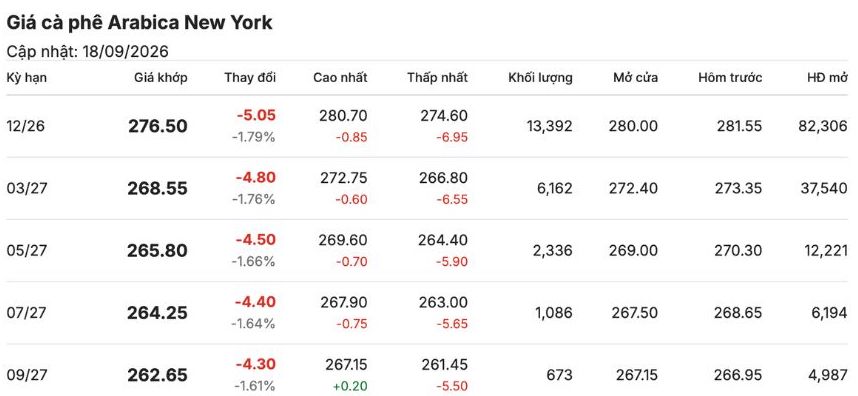
For Arabica, the New York Stock Exchange closed trading on June 19 on the occasion of the Juneteenth. Therefore, the price list on June 22 still retains the results of the trading session on June 18.
Accordingly, Arabica for July 2026 delivery stood at 275.10 US cents/lb, down 2.75 cents/lb, equivalent to 0.99%. September 2026 delivery reached 267.80 US cents/lb, down 4.10 cents/lb.
Arabica December 2026 futures stood at 257.90 US cents/lb, down 5.25 cents/lb; March 2027 futures reached 254.40 US cents/lb, down 5.45 cents/lb.
Coffee price assessment
Domestic coffee prices recovered slightly after a decrease of 700 VND/kg, but the increase of 100 VND/kg shows that market sentiment is still quite cautious.
In the world market, coffee prices have been under adjustment pressure after a period of strong increase. The rise in the USD price has promoted the liquidation of buying positions, especially for Arabica.
A strong USD often puts pressure on commodities valued in this currency, because it increases purchase costs for importers using other currencies.
Weather in Brazil continues to be a factor monitored by the market. The previous prolonged rain has raised concerns that harvest progress will be slowed down, affecting coffee harvesting, drying and quality.
However, forecasts that key coffee growing areas of Brazil will switch to drier weather have somewhat eased concerns about harvesting, creating pressure on prices.
Coffee inventory on the ICE exchange is sending mixed signals. Arabica inventory decreased to 394.267 bags, the lowest level in more than 2 years, thereby creating a certain support for prices.
Meanwhile, Robusta inventories increased to more than 4,000 lots, after hitting a 2-year low in mid-May. The amount of standard goods added may limit Robusta’s price increase.
Large output prospects also continue to put pressure on the market. USDA/FAS forecasts that Brazil’s coffee production in the 2026/27 crop year may reach a record level of 71.9 million bags, an increase of about 14% compared to the previous crop year.
Rabobank also raised its global Arabica surplus forecast for the 2026/27 crop year from 7 million bags to 9.5 million bags. Our country’s increased coffee exports also supplement Robusta supply to the market.
On the supporting side, El Niño is forecast to become very strong by the end of 2026, increasing weather risks for coffee producing regions in South America and Asia. NOAA currently assesses the possibility of El Niño reaching a very strong level in the period from November 2026 to January 2027 at 63%.
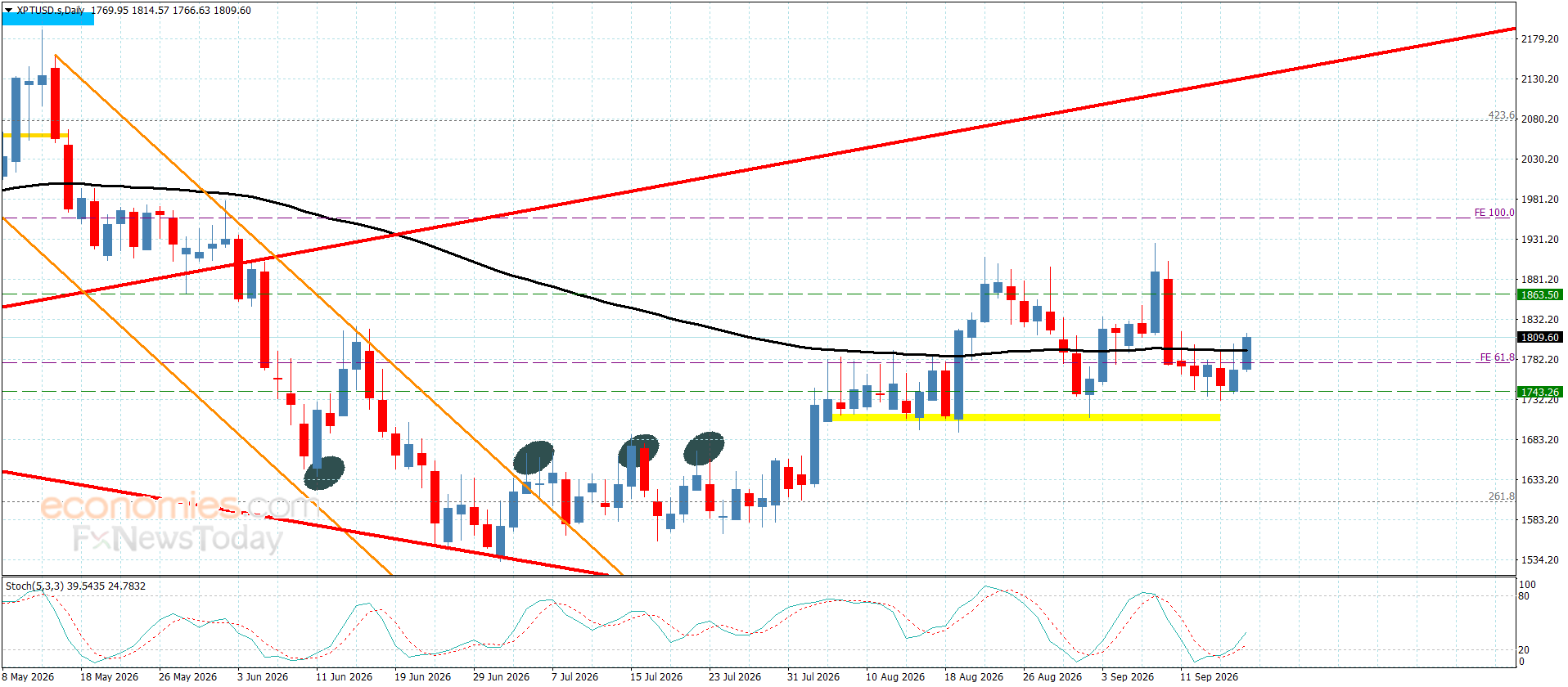
Platinum price formed several negative waves yesterday, benefiting from the alignment of the main indicators in providing negative momentum. As a result, the price has now reached the first target at $1,655.00, which has recently acted as an obstacle to further bearish movement.
The price may be forced to move sideways for a period in the short term. However, the continued presence of negative factors encourages expectations of a break below the current barrier, which would strengthen the chances of reaching additional bearish targets starting at $1,605.00 and then $1,565.00.
The expected trading range for today is between $1,605.00 and $1,745.00
Trend forecast: Bearish
I wrote on 14th June that the best trades for the week would be:
Long of the USD/JPY currency pair following a daily close above ¥160.44. This set up on Wednesday and ended the week higher by 0.39%.
A summary of last week’s most important data in the market:
US Federal Reserve Policy Meeting – the Fed left rates unchanged as expected, but the “dot plot” took a hawkish tilt with a new expectation of one rate hike of 0.25% before the end of 2026. This sent the US Dollar Index to a fresh 1-year high which has also affected several Forex currency pairs. It also boosted US Treasury Yields.
Bank of Japan Policy Meeting – the Bank hiked its interest rate as expected, by 0.25% to 1.00%. This could be seen as a very minor hawkish tilt but note that the Yen lost a little relative value over the week.
Bank of England Policy Meeting – the Bank left its interest rate unchanged as expected, but more members than expected voted for a rate hike of 0.25%, which was a minor hawkish tilt. Note that the British Pound lost value over the week, so this wasn’t influential.
Reserve Bank of Australia Policy Meeting – the Bank left its interest rate unchanged as expected, but delivered a clearly hawkish hold, stressing that policy is already restrictive, yet inflation risks remain uncomfortably high. The Australian Dollar gained a little value over the week, partly as a result.
Swiss National Bank Policy Meeting – the Bank left its interest rate unchanged as expected and reinforced its neutral to slightly dovish approach on rates. The Swiss Franc lost a little value over the week, partly as a result.
UK CPI (inflation) – this came in slightly lower than expected, unchanged at an annualized rate of 2.8%. This may have helped the Pound lose a little value over the week as it took some pressure off the Bank of England to hike rates.
New Zealand GDP – as expected.
UK Unemployment Claims – functionally as expected.
Despite the busy schedule last week of central bank policy meetings, markets were relatively quiet. The major takeaway is surely the stronger US Dollar driven by a more hawkish Federal Reserve. This was new Chair Kevin Warsh’s first meeting, and the forward guidance element has now been abolished. Risk sentiment, which is often tied to a weaker US Dollar, is still seen as positive and firm. This is mainly because markets have responded positively to the Memorandum of Understanding (MoU) which was formally agreed between the USA and Iran last week. The MoU reopens the Strait of Hormuz, which has led to crude oil reaching 3-month low prices, and this will remove a strong inflationary pressure from the global economy. Markets like this, so stock markets remain mostly bullish, albeit off highs in most cases.
I believe that while the short-term optimism of markets is warranted, this MoU, which now opens a 60-day period during which the USA and Iran will negotiate over a potential final deal, is a disaster for the USA and for the world overall. It is the most shocking foreign policy blunder by the USA in half a century. It will rehabilitate the terrorist, supremacist regime in Iran and provide it with massive funds to continue its holy war against the non-Shi’ite world. Reading the MoU, you would think Iran won the war, with every single clause favorable to Iran. Another shocker has been the immense disrespect towards and betrayal of Israel by the USA, its ally which just fought shoulder-to-shoulder with it, and whose home front (unlike America’s) absorbed the daily Iranian war crime of ballistic missiles targeted at residential area devoid of military targets (we won’t see international courts following up on that one). Israel was not only frozen out of negotiations, the USA purported to sign the MoU on behalf of Israel and is demanding that Israel halt its military operations against Hezbollah, an organization with plenty of American blood on its hands which is sworn to the destruction of America. On this issue, it is hardly an exaggeration to say that the USA is now acting as an Iranian proxy!
The most dangerous element in all this, is that the Americans seem to be accepting an equation where Iran is shown that escalation works, financing terrorism works, blackmailing the world by an illegal closure of an international waterway works, shooting one-ton ballistic missiles at civilian neighborhoods works, and the USA cannot stand up to it but folds. What message will China be taking from this?
President Trump’s credibility is completely shot. While he has always told lots of silly lies, it was possible to believe he had some kind of pro-Western compass which guided him beyond mere short-term financial gain for the USA. That illusion has been definitively shattered, and he has been revealed to be a weak and cowardly President, signing a deal even Jimmy Carter would be ashamed of, which indicates the Americans will achieve not one of their war aims – even the enriched uranium, it seems, will stay in Iran.
Why has Trump done this? While the USA could have withstood the long-term closure of the Strait of Hormuz, most of the rest of the world couldn’t, and Trump could not face dealing with the blow-back which would have come from that. I suspect a combination of threats and bribes were sent his way by China, Turkey, Pakistan, Qatar, and certain other nations, maybe even Gulf States. This, combined with the inability of the American public to countenance significant casualties, is probably what led to Trump folding. Another factor is that the US midterm elections this November are starting to approach, and if Republican candidates do badly, Trump will have a much tougher second half of his term and could even be impeached.
The issue will cause long-term damage to America and will certainly cause a new war in the Middle East driven by Iran within the next few years. The fallout from that war will certainly send the price of crude oil shy-high and send US stock markets tumbling. There is even a prospect of a nuclear strike or exchange in this scenario. The economic pain has been deferred, while American officials indulge their pipe dreams that the IRGC might beat its swords into ploughshares.
The world is watching America this week, and the world will be concluding that being an ally of the United States of America is a dangerous enterprise. US VP JD Vance quipped a few days ago that Israel might be wise not to criticize the only head of state left that likes it. If he had any self-awareness, he would be asking himself instead how many heads of state like the United States of America and will be prepared to stand by it during its next hour of need. Gulf states will be planning to kiss the Iranian ring, and Israeli will be preparing for the day after America with a massive expansion of its domestic armaments industry.
President Trump is hinting that when it comes to the negotiations with Iran over an actual deal, which are beginning now, he will be tough and will even be prepared to return to war if necessary. I doubt there is a single human being who believes him. However, over the short term, American weakness will be positive for global stock markets, although there are strong reasons to believe the tech sector particularly is generally highly over-valued and due a strong correction.
Finally, UK prime minister Keir Starmer is expected to resign tomorrow. He will be replaced by another member of parliament from the governing Labour Party, which could lead to some policy changes, so markets will be watching that.
Next week is relatively light. The coming week’s most important data points, in order of likely importance, are:
US Core PCE Price Index
US Final GDP
Canadian CPI (inflation)
Australian CPI (inflation)
Australian Unemployment Rate
Currency Price Changes and Interest Rates
For the month of June, as there was still no clear trend in the US Dollar, I made no monthly forecast.
Last week, I made no weekly forecast.
This week, I again make no forecast, as there were no exceptional price movements last week.
Volatility increased a little last week, with 19% of the notable currency pairs and crosses moving by more than 1% in value. Next week’s volatility is likely to remain low or decrease even further, although surprises in the US data could produce strong movement in many currency pairs.
You can trade these forecasts in a real or demo Forex brokerage account.
Key Support and Resistance Levels
The US Dollar printed a large bullish candlestick last week, closing not very far from the high of the range. The price made a fresh 1-year high, and a valid long-term bullish trend has clearly been established. The only factors bulls will find concerning are the upper wick and the resistance level marked in red in the price chart below which is not far away from the current price.
The new bullishness in the US Dollar is partly due to the Federal Reserve’s more hawkish tilt which it made at its policy meeting last week. Markets are now expecting the Fed will make a rate hike before the end of 2026. This has sent the greenback and its treasury yields higher.
I think it makes sense to be attentive to trade opportunities over the coming week which are long of the US Dollar, but if the price is already testing 101.39 it might not move much higher over the short term.
US Dollar Index Weekly Price Chart
The USD/JPY currency pair finally made its long-awaited bullish breakout last week, rising quite strongly to a new near 2-year high price, after weeks of declining volatility.
In my analysis above concerning the US Dollar Index, I explained what boosted the US Dollar Index last week, and why I have a bullish outlook on it for now. Turning to the Japanese Yen, the Bank of Japan hikes its interest rate by 0.25% to 1.00% last week as was widely expected, and it could be said that the takeaway from the policy meeting was slightly hawkish, but the Yen has enough residual weakness to be an acceptable short currency.
Potentially a bigger question is why the Bank of Japan has not intervened to try to prop up the Yen, as it did the last time this currency pair reached the level we saw last week. It might be that Japan feels it cannot justify intervention when the moves do not look speculative or disorderly but reflect changing fundamentals like last week’s hawkish Fed tilt.
Trend traders will be long of this currency pair and I am long also.
USD/JPY Weekly Price Chart
The USD/CAD currency pair made a strong bullish breakout last week, showing more bullish momentum than most other USD currency pairs, breaking out with a large bullish candlestick to a new 1-year high. I’ve already gone over the reasons why the US Dollar is showing some strength. The Canadian Dollar is interesting because, as a major exporter of crude oil, the Canadian Dollar can act as a proxy for crude oil. With the sharp decline in the price of crude oil to a new 3-month high as the MoU between the USA and Iran was concluded, the Canadian Dollar has tumbled strongly. As the weakest major currency last week along with the New Zealand Dollar, this pair was at the heart of Forex market volatility, which is very unusual.
As the US and Canadian economies are so intertwined, this currency pair usually moves little and tends to range in line with commercial demands for currency exchange. We are in one of the rare periods where we see strong directional movement.
This is all well and good and you might think that you want to go long here. While the US Dollar may well have more upside, you might want to ask how much further crude oil is likely to fall. I will cover crude oil later, and for now I will just say that there seems to be a technical floor in the $69 area, where the price traded before the USA/Iran war broke out. So, I am not sure there is much upside here. Day traders might be able to find a long trade here during the early part of the coming week.
USD/CAD Weekly Price Chart
The NASDAQ 100 Index printed a small inside candlestick last week, consolidating not far below recent all-time high prices.
There has been very strong bullish momentum in tech stocks in recent months, with enormous gains made within just a few months. There is definitely a strong trend and probably another bullish breakout to a record high coming. The big question is, how much further can this rally go, with valuations still over extended?
As a trend trader, I will go long here again where there is a new record high daily close, but I am not confident that this bull market will continue for much longer. Another factor which dampens my enthusiasm on the long side is that we are now in the summer months when the stock market tends to consolidate or fall in value.
I will go long if we get a New York close at or above 30,716.
NASDAQ 100 Index Daily Price Chart
Gold continued its medium-term bearish trend last week, breaking down to a fresh 1-year low closing price just above the big round number at $4,000.
Note how in April, we saw a bullish retracement to the 50% level of the crash move down, and then a bearish rejection of that price.
There is a descending trend line suppressing the price.
The failed breakdown and the fact that $4,000 was not even touched may encourage long-term buyers to think there is some value in buying now. However, there are still plenty of bearish indications. If you are thinking of buying, it will likely be wiser once the trend line I mentioned is decisively broken. Next week, this trend line will be sitting at about $4,350.
The sustained fall in the value of precious metals is getting a tailwind from the more hawkish policies of central banks which have begun to prevail anew in recent months, most notably the Federal Reserve.
Gold Weekly Price Chart
WTI Crude Oil made its lowest close at the end of last week since the war between the USA and Iran broke out last February. This is not surprising as the belligerents have just signed an MoU and practically the only thing the Americans get out of it is the reopening of the Strait of Hormuz. Progress towards this, and the news of the MoU signing, have driven down the price of crude oil and removed a recessionary and inflationary input into the global economy.
Ironically, the Iranians are now saying they have closed the Strait because Israel has been firing back against Hezbollah when Hezbollah shoots at the Israeli army. I’m not sure when Lebanon became a wholly owned Iranian property, but the US administration seems to view it so and has foolishly handed the Iranian regime another weapon with which to blackmail the global economy.
The Americans are saying, at the time of writing, that the Strait remains open and the Iranian claim is fictional. We will see because if it is true, we can expect the price of Crude Oil to open higher tomorrow.
I would refrain from trading crude oil right now, as I don’t think it can go much lower, and any rise it might have could be very short-lived. The American are making it very clear they are afraid and desperate, and the Iranians will exploit this for every drop, and Hormuz is their main weapon by far. Yet I think the Iranians will be careful not to push it too far, and we can probably rely upon VP Vance to hand them a suitable extra concession or two that might keep them happy for a week.
WTI Crude Oil Weekly Price Chart
I see the best trades this week as:
Long of the USD/JPY currency pair.
Long of the NASDAQ 100 Index following a daily close above 30,716.
Ready to trade our Forex weekly forecast? Check out our list of the top 10 Forex brokers.
Domestic coffee prices today
Coffee prices today in key production areas simultaneously decreased by 700 VND/kg. The average price was recorded at 89,200 VND/kg, significantly lower than the level of nearly 90,000 VND/kg in the previous update.
In Dak Lak, coffee prices decreased by 700 VND/kg, down to 89,200 VND/kg. Gia Lai also recorded a similar decrease, bringing the purchase price back to 89,200 VND/kg.
In Lam Dong, today’s coffee price reached 89,000 VND/kg, down 700 VND/kg and continues to be the lowest level among the surveyed areas.
Meanwhile, the old Dak Nong area had the highest price, reaching 89,300 VND/kg, but also decreased by 700 VND/kg compared to the previous update.
Thus, domestic coffee prices currently range from 89,000-8,900 VND/kg. The gap between the region with the highest and lowest prices is 300 VND/kg.
The USD/VND exchange rate according to Vietcombank is recorded at 26,090 VND/USD, unchanged.
World coffee prices
On the London exchange, Robusta coffee prices simultaneously decreased for all trading terms.
Robusta futures for July 2026 fell 45 USD/ton, equivalent to 1.22%, to 3,640 USD/ton. During the session, this contract at one point increased to 3,699 USD/ton but then turned around, hitting the lowest level of 3,634 USD/ton.
September 2026 futures fell 37 USD/ton, equivalent to 1.02%, to 3,592 USD/ton. Robusta futures for November 2026 fell 32 USD/ton, to 3,555 USD/ton.
For further terms, Robusta January 2027 decreased by 23 USD/ton, to 3,522 USD/ton; March 2027 term decreased by 21 USD/ton, to 3,493 USD/ton.
For Arabica, the New York Stock Exchange did not have a new trading session due to the US market’s Juneteenth holiday on June 19. Therefore, the updated price list on June 20 still reflects the closing level of the previous session.
Accordingly, Arabica for July 2026 futures stood at 275.10 US cents/lb; September 2026 futures at 267.80 US cents/lb and December 2026 futures at 257.90 US cents/lb.
Coffee price assessment
Robusta prices turned down after a period of strong recovery, in the context of the market seeing profit-taking activities and cautious sentiment in the face of supply prospects.
Previously, coffee prices were supported by concerns that prolonged rain in Brazil could slow down harvest progress. Rain during harvest time could cause difficulties for drying operations, while increasing the risk of reduced grain quality.
However, weather forecasts show that Brazil’s key coffee growing areas may move to a drier state. This helps reduce concerns about harvest progress and creates adjustment pressure on coffee prices.
Inventory on the ICE exchange continues to send mixed signals. Arabica inventory has decreased to 394.267 sacks, the lowest level in more than 2 years, thereby creating support for prices in the medium term.
Conversely, Robusta inventories have increased to more than 4,000 lots after falling to a 2-year low in May. The increase in the number of goods delivered to the standard warehouse system is one of the factors that could limit Robusta’s upward momentum.
In addition, the prospect of large supply continues to put pressure on the market. USDA/FAS forecasts that Brazil’s coffee production in the 2026/27 crop may reach a record level of 71.9 million bags, an increase of about 14% compared to the previous crop.
Rabobank also raised its global Arabica surplus forecast for the 2026/27 crop year from 7 million bags to 9.5 million bags. Meanwhile, Vietnam’s coffee exports continued to increase, continuing to supplement Robusta supply to the world market.
In terms of price support, the risk of El Niño affecting rainfall in Brazil during the coffee tree flowering period is still being monitored by businesses. However, the actual impact depends on the intensity and timing of this weather phenomenon.
Morgan Stanley and Goldman Sachs cut their forecast for oil prices towards the end of the year and 2027 following developments in the peace negotiations between the United States and Iran earlier this week.
Morgan Stanley now sees Brent crude averaging $80 per barrel in the last quarter of 2026, and $90 per barrel in the third quarter, Bloomberg reported, citing a note from the bank’s commodity team. Morgan Stanley’s earlier forecast was for an average of $100 per barrel of Brent in the third quarter, while the fourth-quarter price forecast was unchanged.
“Much is still to be negotiated, and key risks remain, but for now, this is a key step towards a de-escalation of the conflict and higher oil exports via the Strait of Hormuz,” the analysts said, expecting a speedy recovery in tanker flows once the strait is reopened.
Goldman Sachs, meanwhile, cut its price forecast for the fourth quarter to $80 per barrel from $90 per barrel, and the 2027 average forecast for Brent crude to $75 per barrel from $80 in earlier forecasts. According to the bank’s commodity analysts, tanker traffic via the Strait of Hormuz would recover fully by the end of July.
Citi is even more bearish than its peers on oil prices. On Monday, the bank cut its oil price forecast to $75 per barrel of Brent in the third quarter of this year, falling further to an average of $70 per barrel in the final quarter. For 2027, Citi expects an average Brent price of $65 per barrel. That’s down from an earlier 2027 forecast of $80 per barrel of Brent.
The international benchmark earlier this week fell to the lowest since early March following the news of a preliminary peace deal between Washington and Tehran. Set to be signed on Friday in Switzerland, the deal will see Iran reopen Hormuz within 30 days.
Brent dropped below $90 per barrel on the news earlier today, extending the loss to trade at $82.51 per barrel at the time of writing. WTI was trading at $80.23 per barrel.
By Irina Slav for Oilprice.com
Despite the potential for a bearish continuation, the next decision zone lies near the 78.6% Fibonacci retracement of the prior short-term advance at $4,102. If buyers respond positively there, signs of strength could emerge, leading to another bounce to test resistance. That would establish a new higher swing low and thereby create the potential for a double bottom pattern. An advance above this week’s high would trigger the reversal pattern.
However, the first area of resistance is marked by the 20-day moving average, currently near $4,356 and falling, since it was recently confirmed as dynamic resistance. After that, this week’s high at $4,382, which marks a lower swing high on the daily chart, is the next key structure resistance. A rally above that level would then target the 200-day moving average, currently around $4,468.
Alternatively, if the current support zone fails, the trend low of $4,023 will come at risk of being broken. Nonetheless, gold would then be approaching another potentially significant support area, highlighted by the recent bullish reaction and the confluence of several technical indicators. Most importantly, a long-term uptrend line currently converges near $4,000. Whether buyers step in there or support fails altogether should help determine if this correction is nearing completion or has further room to extend lower.
If you’d like to know more about how to trade gold and silver, please visit our educational area.
TradingKey – Since April 2025, copper prices have accumulated a gain of over 60%, with the core driving factor being the continuously growing market demand for copper amid the ongoing development of AI.
With the rapid development of AI in recent years, it has not only driven demand for chips, servers, and optical modules, but is also reshaping power systems, with copper being one of the most critical metals in power infrastructure.
On the demand side, AI data centers represent the most compelling source of incremental copper demand. AI training and inference place far higher demands on computing power, power supply, and heat dissipation than traditional data centers. Large-scale AI data centers require vast amounts of transformers, switchgears, busbars, cables, UPS, power distribution units, and cooling systems—all of which rely heavily on copper.
According to Wall Streetcn, a 1-gigawatt (GW) AI factory requires 50,000 metric tons of copper. Based on current industry projections of building 15 GW of capacity annually, data centers alone will add 750,000 metric tons of new copper demand each year. More importantly, AI data centers will further drive grid expansion, substation construction, and transmission and distribution line upgrades. This “external power infrastructure” could drive copper demand even more than the copper used inside the data centers themselves.
According to the IEA, global data center electricity consumption is projected to rise to approximately 945 TWh by 2030, roughly doubling current levels. Goldman Sachs also noted that the share of peak summer power demand from US data centers could rise from 4.1% in 2025 to 8.5% in 2027. This indicates that AI data centers are transitioning from marginal power loads into a critical variable shaping grid planning. As long as data centers continue to expand, investment in grid connections, transformers, transmission lines, and distribution equipment must keep pace, creating highly inelastic demand for copper in these segments.
In terms of the scale of copper demand, institutional forecasts are continuously being revised upward. S&P Global expects global copper demand to rise from 28 million metric tons per year in 2025 to 42 million metric tons per year in 2040, an increase of about 50%. Within this, copper demand from data centers is projected to grow from 1.1 million metric tons in 2025 to 2.5 million metric tons in 2040. BHP’s outlook emphasizes long-term trends, projecting that global data center copper usage will rise from around 500,000 metric tons per year today to approximately 3 million metric tons per year by 2050. Trafigura also believes that AI and data center-related demand could add an extra 1 million metric tons of copper demand by 2030. For a global copper market with an annual demand of roughly 20 million to 30 million metric tons, an incremental demand of this scale is enough to significantly alter the supply-demand balance.
Weekly Copper Price Chart, Source: FASTBULL
On the weekly copper price chart, as the highs and lows of the candlestick chart gradually shift upward, it indicates that the overall trend maintains a strong upward momentum. Meanwhile, multiple moving averages in the moving average system maintain a bullish alignment, further confirming that the medium-to-long-term trend for copper prices remains bullish.
Currently, the primary target for copper’s upside is to test the Fibonacci 0.382 extension level of $14,233. If it can break through strongly and hold above this level, further upside room will be unlocked, with the potential to test the Fibonacci 0.5 extension level of $15,000.
Downside support should be noted at 13,400-13,300.
This content was translated using AI and reviewed for clarity. It is for informational purposes only.
Domestic coffee prices today
Coffee prices today in the domestic market simultaneously increased in key production areas. The average coffee price was recorded at 89,900 VND/kg, an increase of 400 VND/kg compared to the previous update.
In Dak Lak, coffee prices today reached 89,900 VND/kg, an increase of 300 VND/kg. Coffee prices in Gia Lai were also recorded at 89,900 VND/kg, an increase of 400 VND/kg.
In Lam Dong, coffee prices reached 89,700 VND/kg, an increase of 300 VND/kg and the lowest level among the surveyed areas.
Meanwhile, the old Dak Nong area had the highest coffee price, reaching 9,000 VND/kg, an increase of 400 VND/kg.
Thus, domestic coffee prices currently range from 89,000-9,000 VND/kg. The difference between the region with the highest and lowest prices is 300 VND/kg.
The USD/VND exchange rate according to Vietcombank was recorded at 26,090 VND/USD, an increase of 9 VND.
World coffee prices
World coffee prices fluctuated in opposite directions in the most recent trading session. Robusta prices on the London exchange maintained a slight increase, while Arabica prices on the New York exchange turned down.
On the London exchange, Robusta coffee futures for July 2026 reached 3,685 USD/ton, up 5 USD/ton, equivalent to 0.14%. During the session, this contract at one point increased to 3,736 USD/ton.
Robusta futures for September 2026 reached 3,629 USD/ton, up 7 USD/ton, equivalent to 0.19%. For November 2026, it reached 3,587 USD/ton, up 13 USD/ton, equivalent to 0.36%.
For further terms, Robusta in January 2027 reached 3,545 USD/ton, an increase of 20 USD/ton; the March 2027 term also increased by 20 USD/ton, to 3,514 USD/ton.
On the New York exchange, Arabica coffee futures for July 2026 fell 2.75 US cents/lb, or 0.99%, to 275.10 US cents/lb.
Arabica futures for September 2026 fell 4.10 US cents/lb, equivalent to 1.51%, to 267.80 US cents/lb. December 2026 futures fell 5.25 US cents/lb, to 257.90 US cents/lb.
The March and May 2027 terms decreased by 5.45 US cents/lb and 5.25 US cents/lb respectively, to 254.40 US cents/lb and 254.55 US cents/lb.
Notably, Arabica for July 2026 futures once increased to 285.75 US cents/lb in the session but then reversed to decrease. This development shows that profit-taking pressure appeared after the strong increase in coffee prices in previous sessions.
Coffee price assessment
World coffee prices have increased sharply in the past week and at times reached a 5-week high. However, the market reversed from a high in the session when the USD index increased sharply, promoting the liquidation of buying positions in the coffee market.
The rising USD often puts pressure on commodity prices valued in this currency, making purchasing costs more expensive for users of other currencies. This impact is more evident with Arabica, as contracts on the New York exchange simultaneously fell.
Weather in Brazil is still an important factor supporting coffee prices. Prolonged rain in some coffee growing areas raises concerns about slow harvest progress, and may affect drying and grain quality.
However, the prospect of drier weather in key coffee growing areas of Brazil next week has somewhat reduced concerns about harvesting activities, causing coffee prices to narrow their gains in the session.
Coffee inventory on the ICE exchange is also sending mixed signals. Arabica inventory decreased to 394.267 bags, the lowest level in more than 2 years, thereby continuing to support prices.
Conversely, Robusta inventory has increased to 4,032 lots, the highest level in more than 2 months. The increase in the amount of Robusta coffee put into the ICE standard warehouse system may limit the increase of this item.
El Niño risk is also continuing to be monitored by the market. According to NOAA, El Niño is present and is forecast to strengthen in the North hemisphere winter of 2026-2027. This phenomenon may change rainfall in coffee producing regions in South America and Asia.
However, the impact of El Niño on coffee trees also depends on the timing and level of weather changes in each region. The market is particularly interested in rainfall in Brazil in September and October, the period when coffee trees usually enter the flowering season.
On the side of putting pressure on prices, USDA/FAS forecasts that Brazil’s coffee production in the 2026/27 crop year may reach a record level of 71.9 million bags, an increase of about 14% compared to the previous crop year. Rabobank also raised its global Arabica surplus forecast from 7 million to 9.5 million bags.
Robusta supply from our country continues to be a noteworthy factor in the market. According to data from the Ministry of Finance, our country’s coffee exports in the first 5 months of 2026 reached 922,000 tons, an increase of 7.9% compared to the same period.
In general, coffee prices are being interspersedly affected. Low Arabica inventories, Brazilian weather risks and El Niño support prices; while the strong USD, the prospect of a large crop in Brazil and increased Vietnamese supply may limit the upward momentum.