The main tag of Gold Price Articles.
You can use the search box below to find what you need.
[wd_asp id=1]
The main tag of Gold Price Articles.
You can use the search box below to find what you need.
[wd_asp id=1]
The 50-day average’s defense is a bullish signal, yet downside risks linger. Natural gas is caught in a short-term rising trend channel, contrasting with a broader declining channel. Recent highs stalled near the 200-day moving average at $3.38, aligning with the top of the falling channel, where resistance triggered a double top bearish reversal last Thursday. The rejection also coincided with the upper boundary of the rising channel, extended by 25%. A reversal from this level typically targets the channel’s lower boundary, a scenario still in play if today’s support falters.
Should the $3.03 low give way, a deeper support zone at $2.95 emerges as a key target. This level, projected for October 21, marks the intersection of the rising channel’s lower line and the falling quarter channel line of the larger bearish trend. Reinforcing its significance, a gap fill at $2.95 aligns with an anchored Volume Weighted Average Price (VWAP) at $2.98, rooted in the February 2024 lows. This convergence of technical markers makes $2.95 a high-probability floor if selling resumes.
Today’s rally suggests buyers are defending $3.03, but the broader bearish channel keeps pressure on. A close above $3.09 strengthens the bullish case, while a break below $3.03 targets $2.95. Monitor today’s close for confirmation of support or renewed weakness—$3.38 resistance remains a hurdle for any sustained recovery.
For a look at all of today’s economic events, check out our economic calendar.
Spot Gold’s run into unexplored territory continues on Monday, with the bright metal overcoming the $4,100 threshold early in the American session. Multiple factors are pushing the safe-haven metal higher.
On the one hand, the United States (US) government shutdown continues, with a resolution to the stalemate still out of the picture. The country is celebrating a holiday, Columbus Day, which further delays any agreement in the Senate. On the other hand, US President Donald Trump revived trade-war concerns late on Friday, accusing China of “strange” behaviour and threatening fresh, massive tariffs on Chinese imports. Trump was scheduled to speak with his Chinese counterpart, Xi Jinping, in the coming days, but the talks have been postponed.
Right now, the US President’s attention is on the Middle East. The first stages of a peace agreement between Israel and Hamas are underway. Hamas has freed the remaining hostages, hostilities have been interrupted, and people are slowly returning to Gaza. The peace could be fragile, but it is a major Trump victory.
From a technical point of view, the XAU/USD pair is bullish. In the daily chart, technical indicators resumed their advance within overbought levels after correcting extreme conditions, still reflecting that buyers are in control. Meanwhile, the pair develops far above all its moving averages, with the 20 Simple Moving Average (SMA) far above the longer ones and at around $3,841.
The near-term picture is pretty similar. In the 4-hour chart, the Momentum indicator aims firmly north within positive levels, while the Relative Strength Index (RSI) indicator advances at around 70, although with a limited upward slope. Meanwhile, the XAU/USD pair extends its recovery above all its moving averages, with a mildly bullish 20 SMA currently at around $4,026.
Support levels: 4,100.00 4,086.20 4,071.55
Resistance levels: 4,117.00 4,130.00 4,150.00
Silver (XAG/USD) found resistance at fresh four-year highs right above $51.70 and retreated sharply during Mondfday’s European morning session. The metal found support at the 50..15 area to pare some losses, but is struggling to remain above $51.00 at the time of writing.
The fundamental context is supportive for precious metals, which rallied during the Asian session with investors looking for alternative assets as the US trade rift on rare earths threatens to lead to a full-blown trade war, again.
Furthermore, the US Government shutdown enters its third week without prospects of a solution in sight, and with investors pricing in a Fed rate cut later this month and high chances of another one in December.
Silver maintains its bullish trend intact, with price action moving within an ascending channel from mid-September lows. The trend looks well overextended, and these structures tend to lead to corrections, but that option seems highly unlikely in the current circumstances.
Technical indicators show a significant bullish pressure, with immediate resistance at the intra-day highs of $51.70. Further up the ascending channel’s top, in the area of 52.00 and the 161.8 Fibonacci extension of the October 9 reversal, at $52.90, are plausible targets.
So far, pullbacks are attracting buyers, and the pair seems to have significant support in the area around the $50.00 psychological level, where bears were capped earlier today. Further down, the base of the ascending channel is in the vicinity of $49.55.
Silver is a precious metal highly traded among investors. It has been historically used as a store of value and a medium of exchange. Although less popular than Gold, traders may turn to Silver to diversify their investment portfolio, for its intrinsic value or as a potential hedge during high-inflation periods. Investors can buy physical Silver, in coins or in bars, or trade it through vehicles such as Exchange Traded Funds, which track its price on international markets.
Silver prices can move due to a wide range of factors. Geopolitical instability or fears of a deep recession can make Silver price escalate due to its safe-haven status, although to a lesser extent than Gold’s. As a yieldless asset, Silver tends to rise with lower interest rates. Its moves also depend on how the US Dollar (USD) behaves as the asset is priced in dollars (XAG/USD). A strong Dollar tends to keep the price of Silver at bay, whereas a weaker Dollar is likely to propel prices up. Other factors such as investment demand, mining supply – Silver is much more abundant than Gold – and recycling rates can also affect prices.
Silver is widely used in industry, particularly in sectors such as electronics or solar energy, as it has one of the highest electric conductivity of all metals – more than Copper and Gold. A surge in demand can increase prices, while a decline tends to lower them. Dynamics in the US, Chinese and Indian economies can also contribute to price swings: for the US and particularly China, their big industrial sectors use Silver in various processes; in India, consumers’ demand for the precious metal for jewellery also plays a key role in setting prices.
Silver prices tend to follow Gold’s moves. When Gold prices rise, Silver typically follows suit, as their status as safe-haven assets is similar. The Gold/Silver ratio, which shows the number of ounces of Silver needed to equal the value of one ounce of Gold, may help to determine the relative valuation between both metals. Some investors may consider a high ratio as an indicator that Silver is undervalued, or Gold is overvalued. On the contrary, a low ratio might suggest that Gold is undervalued relative to Silver.
Monday, October 13, 2025: Gold Forecast and Analysis of the price of gold XAU/USD today
Today’s Gold Analysis Overview:
Today’s Gold Trading Signals:
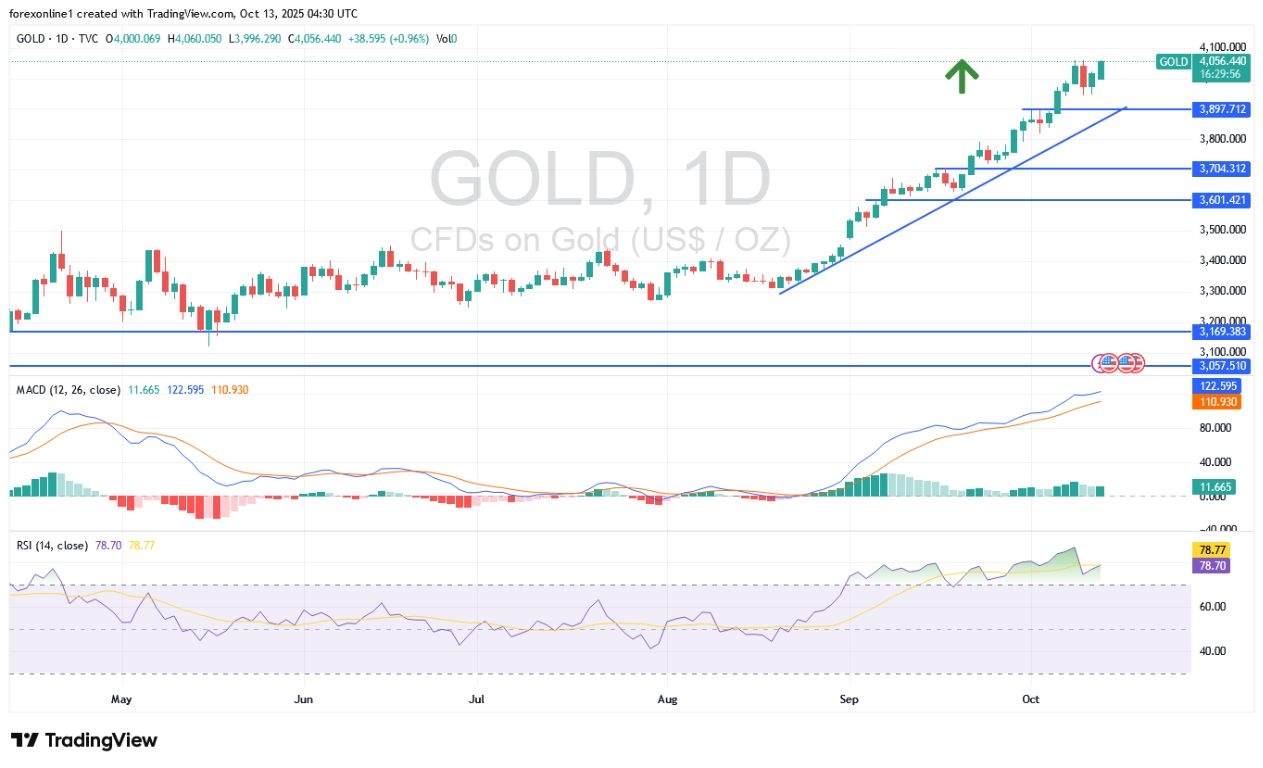
Gold bulls have once again stabilized above the historic psychological resistance of $4000 per ounce, following a period of limited profit-taking sales after gold prices reached an all-time high of $4059 per ounce. According to gold trading platforms, the recent sell-off did not extend beyond the $3944 per ounce level. Moreover, the previous week’s trading closed with the price stable around the $4018 per ounce resistance.
A positive start is expected for the gold price in the new week amid renewed fears of a global economic recession, driven by the continuing US government shutdown and the revival of the trade conflict between the United States and China. This follows a threat from Trump at the end of last week to impose harsh customs tariffs on Chinese imports starting next month, which increases investor demand for safe-haven assets, led by gold.
According to gold analysts, the outlook remains positive for the gold index to continue its record-breaking bullish breakouts, especially with stability above the $4000 per ounce resistance. As mentioned before, gold investors will remain focused on the factors driving the market’s gains, while ignoring technical indicators reaching overbought levels.
XAU/USD (Daily Chart)
According to commodity market experts, short-term technical indicators suggest the possibility of a correction if prices fall below the $3950 per ounce support level. However, looking ahead, developments related to the US government shutdown and a speech by Federal Reserve Chairman Jerome Powell could affect the near-term outlook for gold. In general, if US political risks remain a key theme, this could push the gold price index above the $4000 level, with the prospect of interest rate cuts reinforcing the upward trend.

Regarding factors influencing the gold market: with the fragility of peace in the Middle East, renewed drone and missile attacks on Ukraine, the ongoing US government shutdown, a weak US dollar, and another interest rate cut at the end of the month, the direction for gold is clear. Carefully, do not miss the opportunity to consistently buy gold.
Dear reader, keep in mind that long-term cash flows are flowing into gold, and buyers are reluctant to relinquish control, despite the gold price rising by more than 52% this year. Even at these historically high levels of overbought gold, the gold market is gaining renewed momentum from the retail market, which was absent at previous peaks, such as in 2011.
Gold bullion has boomed in recent months, supported by concerns about inflation expectations and the outlook for major currencies. These factors include the US dollar, which has weakened due to concerns that US President Trump is reversing the post-war economic order. Geopolitical tensions, including the war between Russia and Ukraine, are also boosting gold prices.
Trading Tips:
Dear TradersUp trader, we advise buying gold on every significant price dip. Ultimately, Renewed global trade and geopolitical tensions provide permanent support for gold’s gains.
Ready to trade our Gold price forecast? We’ve made a list of the best Gold trading platforms worth trading with.
The EURJPY pair resumed the bearish corrective attack in Friday’s trading, hitting some of the previously suggested targets, to form quick positive rebound to settle near 176.50, keeping the main bullish scenario that depends on the stability within the bullish channel’s levels that appears in the above image.
Note that the continuation of the contradiction between the main indicators that might force the price to provide more of the sideways trading, to keep waiting for breaching 177.05 to confirm its readiness to form new bullish attack by targeting the top at 177.80.
The expected trading range for today is between 175.90 and 177.05
Trend forecast: Fluctuated within the bullish trend
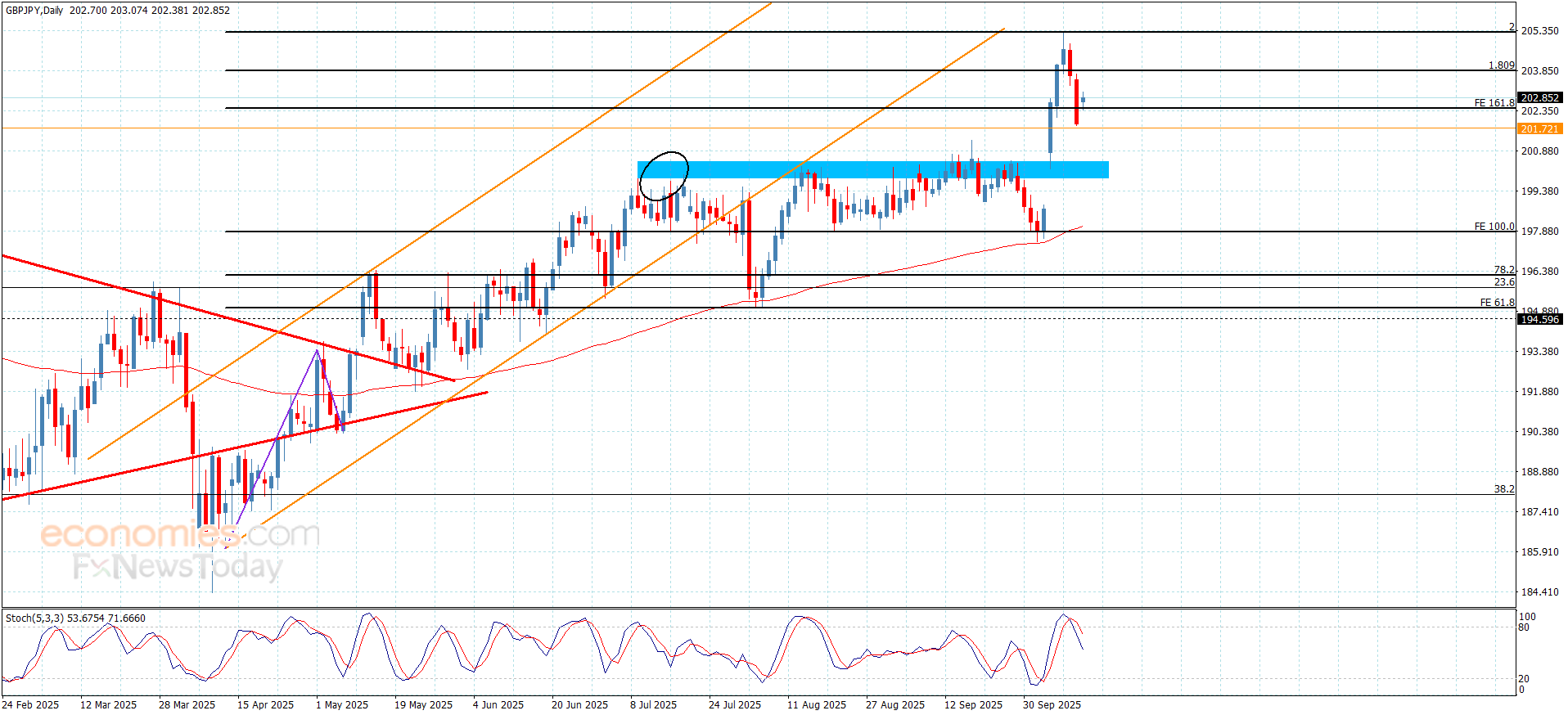
The GBPJPY pair activated negatively with the economic data on Friday to resume the bearish correction, to target 201.70 support, then bouncing positively to settle above %161.8 Fibonacci extension level at 202.40 to reinforce the chances of forming new bullish waves, to attempt to reach 203.40 then press on the barrier at 203.85.
While facing new bearish pressure and reaching below 201.70 support confirms its move to a new negative station, which forces it to suffer more losses by reaching 201.20 followed by the extra support at 200.45.
The expected trading range for today is between 202.40 and 203.85
Trend forecast: Bullish
Silver price (XAG/USD) extends its winning streak for the fourth successive session, reaching its all-time high of $51.69 during the Asian hours on Monday. The non-interest-bearing Silver receives support from the increased likelihood of the US Federal Reserve (Fed) further rate cuts by year-end.
Consumer confidence in the United States (US) deteriorated slightly in early October, supporting the Fed rate cut bets. The preliminary University of Michigan’s Consumer Sentiment Index edged lower to 55.0 for October, from 55.1 in September.
The Federal Open Market Committee (FOMC) Minutes from the September meeting suggested policymakers are leaning toward further rate cuts this year. The CME FedWatch Tool suggests that markets are now pricing in nearly a 96% chance of a 25-basis-point Fed rate cut in October and an 87% possibility of another reduction in December.
Federal Reserve Bank of St. Louis President Alberto Musalem said on Friday that the labor market is showing signs of potential weakness and that a balanced approach to monetary policy only works if inflation expectations are anchored. Meanwhile, San Francisco Fed President Mary Daly said that inflation has come in much less than she had feared. Daly further stated that the US central bank is projecting additional cuts in risk management.
The safe-haven Silver attracts buyers due to renewed US-China trade concerns. US President Donald Trump said that there’s no need to meet China’s President Xi Jinping at the upcoming South Korea summit and threatened to impose 100% tariffs on Chinese imports. However, Trump posted on Truth Social on Sunday, noting that China’s economy “will be fine” and that the US wants to “help China, not hurt it.”
Silver is a precious metal highly traded among investors. It has been historically used as a store of value and a medium of exchange. Although less popular than Gold, traders may turn to Silver to diversify their investment portfolio, for its intrinsic value or as a potential hedge during high-inflation periods. Investors can buy physical Silver, in coins or in bars, or trade it through vehicles such as Exchange Traded Funds, which track its price on international markets.
Silver prices can move due to a wide range of factors. Geopolitical instability or fears of a deep recession can make Silver price escalate due to its safe-haven status, although to a lesser extent than Gold’s. As a yieldless asset, Silver tends to rise with lower interest rates. Its moves also depend on how the US Dollar (USD) behaves as the asset is priced in dollars (XAG/USD). A strong Dollar tends to keep the price of Silver at bay, whereas a weaker Dollar is likely to propel prices up. Other factors such as investment demand, mining supply – Silver is much more abundant than Gold – and recycling rates can also affect prices.
Silver is widely used in industry, particularly in sectors such as electronics or solar energy, as it has one of the highest electric conductivity of all metals – more than Copper and Gold. A surge in demand can increase prices, while a decline tends to lower them. Dynamics in the US, Chinese and Indian economies can also contribute to price swings: for the US and particularly China, their big industrial sectors use Silver in various processes; in India, consumers’ demand for the precious metal for jewellery also plays a key role in setting prices.
Silver prices tend to follow Gold’s moves. When Gold prices rise, Silver typically follows suit, as their status as safe-haven assets is similar. The Gold/Silver ratio, which shows the number of ounces of Silver needed to equal the value of one ounce of Gold, may help to determine the relative valuation between both metals. Some investors may consider a high ratio as an indicator that Silver is undervalued, or Gold is overvalued. On the contrary, a low ratio might suggest that Gold is undervalued relative to Silver.
Gold is seeing a second consecutive day of gains early Monday, having managed to reclaim the key $4,000 level on Friday.
Gold sets off a new week with a bang, recording a new all-time high in early trades, responding positively to fresh developments surrounding the US-China tariff war.
US President Donald Trump slapped an additional 100% tariffs on all Chinese imports and introduced strict export controls on US-made critical software starting November 1.
This came in response to China tightening its export controls on rare earths and related technologies, while barring its citizens from participating in unauthorized mining overseas.
However, buyers quickly turn cautious, fuelling a brief retreat in Gold, as they digest Trump’s TACO (Trump Always Chickens Out) button pressed on Sunday.
Risk sentiment is on a solid recovery, courtesy of Trump’s conciliatory remarks, citing that “I think we’re going to be fine with China.”
US Vice President J.D. Vance also said on Sunday that “Trump is willing to be a reasonable negotiator with China.”
Meanwhile, a positive shift in risk sentiment dents the US Dollar’s (USD) safe-haven appeal, lending support to the bright metal. The Greenback bears the brunt of the protracted US government shutdown and lingering US tariffs on China, effective from November 1.
Looking ahead, it remains to be seen if Gold continues its record-setting rally, with traders closely eyeing fresh developments on the US-China trade front and speeches from US Federal Reserve (Fed) officials, in the absence of high-impact US economic data releases.
The US Bureau of Labor Statistics (BLS) is set to publish the critical Consumer Price Index (CPI) report on Friday, October 24.
Bracing for the eighth consecutive weekly advance, Gold buyers look to resume the record-setting rally in Asian trading on Friday.
The daily chart shows that the 14-day Relative Strength Index (RSI) is off the extreme overbought zone, while trending higher 78.80, as of writing.
The leading indicator suggests that buyers could extend their control, with a retest of the $4,100 level likely. A sustained break above that will call for a test of the $4,138 – the upper boundary of the month-long rising channel.
Alternatively, Gold needs acceptance below the lower boundary of the rising channel at $3,991 on a daily candlestick closing basis to sustain the correction toward the $3,950 psychological mark.
Deeper correction could challenge the $3,895 supply zone (October 1 and 2 highs).
Generally speaking, a trade war is an economic conflict between two or more countries due to extreme protectionism on one end. It implies the creation of trade barriers, such as tariffs, which result in counter-barriers, escalating import costs, and hence the cost of living.
An economic conflict between the United States (US) and China began early in 2018, when President Donald Trump set trade barriers on China, claiming unfair commercial practices and intellectual property theft from the Asian giant. China took retaliatory action, imposing tariffs on multiple US goods, such as automobiles and soybeans. Tensions escalated until the two countries signed the US-China Phase One trade deal in January 2020. The agreement required structural reforms and other changes to China’s economic and trade regime and pretended to restore stability and trust between the two nations. However, the Coronavirus pandemic took the focus out of the conflict. Yet, it is worth mentioning that President Joe Biden, who took office after Trump, kept tariffs in place and even added some additional levies.
The return of Donald Trump to the White House as the 47th US President has sparked a fresh wave of tensions between the two countries. During the 2024 election campaign, Trump pledged to impose 60% tariffs on China once he returned to office, which he did on January 20, 2025. With Trump back, the US-China trade war is meant to resume where it was left, with tit-for-tat policies affecting the global economic landscape amid disruptions in global supply chains, resulting in a reduction in spending, particularly investment, and directly feeding into the Consumer Price Index inflation.
Gold price (XAU/USD) extends the rally to around $4,040 during the early Asian session on Monday. The escalating trade tensions between the United States (US) and China provide some support to the precious metal. Traders await signs on when the US government will reopen and release data that will shape Federal Reserve (Fed) policy.
The rally in the yellow metal is bolstered by US President Donald Trump’s decision to impose fresh 100% tariffs on Chinese imports starting November 1. China warned the US that it would retaliate if Trump fails to back down on his threat to impose levies on Chinese imports. ”Heating up the trade war again will tank the dollar and be good for safe-havens,” said Tai Wong, an independent metals trader.
Furthermore, traders expect the Fed to cut interest rates by 25 basis points (bps) each in October and December. According to the CME FedWatch tool, markets are pricing in nearly a 97% possibility that the US central bank cuts rates by 25 bps at its October meeting, while the odds of an additional reduction in December are at 92%. Lower interest rates could reduce the opportunity cost of holding Gold, supporting the non-yielding precious metal.
Traders will take more cues from the US Retail Sales and Producer Price Index (PPI) reports, which will be released later on Thursday. Any signs of hotter inflation in the US could lift the US Dollar (USD) and weigh on the USD-denominated commodity price in the near term.
Gold has played a key role in human’s history as it has been widely used as a store of value and medium of exchange. Currently, apart from its shine and usage for jewelry, the precious metal is widely seen as a safe-haven asset, meaning that it is considered a good investment during turbulent times. Gold is also widely seen as a hedge against inflation and against depreciating currencies as it doesn’t rely on any specific issuer or government.
Central banks are the biggest Gold holders. In their aim to support their currencies in turbulent times, central banks tend to diversify their reserves and buy Gold to improve the perceived strength of the economy and the currency. High Gold reserves can be a source of trust for a country’s solvency. Central banks added 1,136 tonnes of Gold worth around $70 billion to their reserves in 2022, according to data from the World Gold Council. This is the highest yearly purchase since records began. Central banks from emerging economies such as China, India and Turkey are quickly increasing their Gold reserves.
Gold has an inverse correlation with the US Dollar and US Treasuries, which are both major reserve and safe-haven assets. When the Dollar depreciates, Gold tends to rise, enabling investors and central banks to diversify their assets in turbulent times. Gold is also inversely correlated with risk assets. A rally in the stock market tends to weaken Gold price, while sell-offs in riskier markets tend to favor the precious metal.
The price can move due to a wide range of factors. Geopolitical instability or fears of a deep recession can quickly make Gold price escalate due to its safe-haven status. As a yield-less asset, Gold tends to rise with lower interest rates, while higher cost of money usually weighs down on the yellow metal. Still, most moves depend on how the US Dollar (USD) behaves as the asset is priced in dollars (XAU/USD). A strong Dollar tends to keep the price of Gold controlled, whereas a weaker Dollar is likely to push Gold prices up.
Gold (XAU/USD) is sustaining momentum near historic highs as escalating geopolitical risks, a renewed U.S.–China tariff war, and intensifying debt concerns push investors deeper into defensive assets. The metal is trading at $4,012 per ounce, holding above the $4,000 psychological threshold after briefly touching $4,059.35, its highest level on record. The rally follows President Donald Trump’s decision to impose 100% tariffs on Chinese imports starting November 1, 2025, a move that triggered sharp declines in U.S. equities and reinforced gold’s dominance as a global hedge. The S&P 500 dropped 2.7% to 6,552, while the U.S. Dollar Index (DXY) slid 0.6% to 99.2, amplifying demand for non-yielding metals. Treasury yields retreated, with the 10-year yield at 3.88%, giving gold additional upside tailwind as lower yields reduce the opportunity cost of holding the metal.
Gold’s ascent since January has now surpassed 53% year-to-date, its best performance since 1979. Futures on the New York Mercantile Exchange are up 51%, reflecting both institutional accumulation and heightened speculative flows. The latest surge came after a sequence of macro events: the Federal Reserve’s cautious pivot toward rate cuts in September, Trump’s tariff escalation, and a wave of safe-haven repositioning amid rising fiscal stress. Economists estimate that global government debt has exceeded $312 trillion, and investors increasingly view precious metals as protection against fiscal debasement. In China, the world’s largest gold consumer, banks such as ICBC, CCB, and Agricultural Bank of China have raised investment thresholds for retail gold accounts, citing “intensified volatility and systemic risk.” These warnings underscore the scale of demand driving the rally—both speculative and institutional—while also signaling growing caution among regulators watching for overheating.
Behind the retail frenzy lies an institutional shift that continues to reshape the gold market. According to the World Gold Council, central banks have added more than 800 metric tons of gold in 2025 alone, on track for the largest annual accumulation since records began. China’s central bank has increased reserves for 11 consecutive months, while India, Turkey, and Poland also expanded holdings. Analysts attribute this trend to “de-dollarization,” as nations seek to diversify reserves away from the U.S. dollar following asset freezes during the Russia-Ukraine conflict. The surge in official sector demand has created a structural bid for gold, keeping the metal supported even as speculative traders rotate in and out. The council’s report shows that ETFs now hold roughly 3,590 tons, reversing outflows seen during 2023’s tightening cycle. This institutional demand underpins the view that the $4,000 breakout is not merely a speculative anomaly but part of a multi-year structural revaluation of gold as a reserve anchor.
The Federal Reserve’s September minutes revealed growing concern about weakening labor data, with the unemployment rate hovering near 4.1% and job openings declining for a fifth consecutive month. Market pricing now implies a 25-basis-point rate cut in October and another in December. The policy shift has softened real yields, fueling inflation expectations and reducing dollar demand. At the same time, Trump’s tariffs are stoking fears of imported inflation and slower global growth. Analysts estimate that a full tariff cycle could add 0.3 percentage points to U.S. headline CPI over the next quarter while cutting GDP by 0.4%. This macro combination—lower yields and higher inflation—creates the perfect environment for gold’s strength. Traders now view $3,888–$3,939 as the key support band, while the lack of overhead resistance above $4,059 opens potential extension targets toward $4,100 and $4,200.
The explosive rally has drawn regulatory attention. In China, major lenders including ICBC and CCB have tightened risk parameters, raising minimum investment amounts for gold savings accounts from 850 yuan ($119) to 1,000 yuan and revising circuit-breaker thresholds for volatility control. European commercial banks, meanwhile, are reporting record inflows into gold-backed products as the euro weakens near 1.06 USD and French political instability amplifies capital flight into tangible assets. Analysts warn that while systemic demand remains intact, excessive short-term speculation could trigger temporary corrections if liquidity dries up. Still, the World Gold Council confirmed that investor positioning remains net long by over 67%, while volatility metrics remain below March peaks—suggesting that market enthusiasm, though extreme, has not yet reached euphoric levels.
From a technical standpoint, XAU/USD remains firmly within its ascending channel structure. The price has consistently bounced off the 0.382 Fibonacci retracement at $3,965, reaffirming support strength. A bullish engulfing pattern formed at $3,975, and the RSI near 57 signals continued upside potential without reaching overbought extremes. The 50-day moving average, now climbing toward $3,592, provides long-term trend confirmation. Momentum will remain bullish unless the market breaks below $3,819, which would neutralize short-term bias. Institutional traders highlight that volume clusters between $3,910–$3,940 represent strategic accumulation zones, with buy orders concentrated just above these levels. On the upside, a sustained breakout above $4,059.35 could accelerate gains toward $4,133, and subsequently to $4,200, given the absence of technical resistance in this uncharted price range.
Markets are now preparing for a packed macro week that will shape the next phase of gold’s rally. Federal Reserve Chair Jerome Powell is scheduled to speak twice—on October 14 and October 17—and any deviation in tone could sharply impact expectations for monetary easing. Key economic data points include the Empire State Manufacturing Index (expected 0.2 vs −8.7 prior), the Philly Fed Index (forecast 9.1 vs 23.2), Core PPI, and Retail Sales, all of which will test the inflation trajectory. Analysts suggest that a further decline in inflation expectations, combined with weaker output data, would reinforce the Fed’s dovish path and extend gold’s bullish cycle. Conversely, stronger readings may trigger short-term profit-taking but are unlikely to alter the long-term structural trend.
Market veteran Ed Yardeni projects that gold could reach $5,000 per ounce in 2026 and possibly $10,000 by 2028–2029 if its current trajectory persists. His analysis attributes the rally to persistent inflation risk, rising geopolitical uncertainty, and global de-dollarization trends. The ongoing diversification of reserves, coupled with mounting debt burdens among advanced economies, is accelerating the “debasement trade,” where investors pivot from fiat assets into tangible stores of value like gold and Bitcoin. Even cautious strategists such as Hamad Hussain at Capital Economics admit that “FOMO” has entered the market, yet maintain that gold will “grind higher in nominal terms” as long as real yields stay compressed.
Silver has mirrored gold’s trajectory, advancing 73.5% year-to-date and briefly touching $51.23 per ounce, its highest in decades. Analysts view silver’s rally as both an industrial and monetary repricing, reflecting the broader revaluation of hard assets amid weakening faith in fiat systems. The gold-silver ratio, now hovering near 78, signals continued momentum for both metals, though gold remains the dominant hedge in institutional portfolios. Together, the synchronized rally across metals reinforces a structural repricing trend tied to the erosion of global monetary credibility and persistent policy shocks from Washington and Beijing.
All major indicators point to a market in the midst of a structural re-rating rather than a speculative spike. Gold’s resilience above $4,000, its 53% yearly gain, the record-high central bank demand, and the weakening dollar combine to define a powerful macro narrative. The short-term outlook depends on Powell’s guidance and inflation data, but the medium-term trajectory remains overwhelmingly positive. With no overhead resistance and fundamentals reinforcing scarcity, gold’s rally is supported by both policy and psychology.
Verdict:
XAU/USD (Gold): Strong Buy – Support $3,940 / Resistance $4,200 – Medium-Term Target $5,000 by 2026
Bias: Bullish (Structural Uptrend Supported by Tariffs, Rate Cuts, and Sovereign Demand)