The main tag of Gold Price Articles.
You can use the search box below to find what you need.
[wd_asp id=1]
The main tag of Gold Price Articles.
You can use the search box below to find what you need.
[wd_asp id=1]
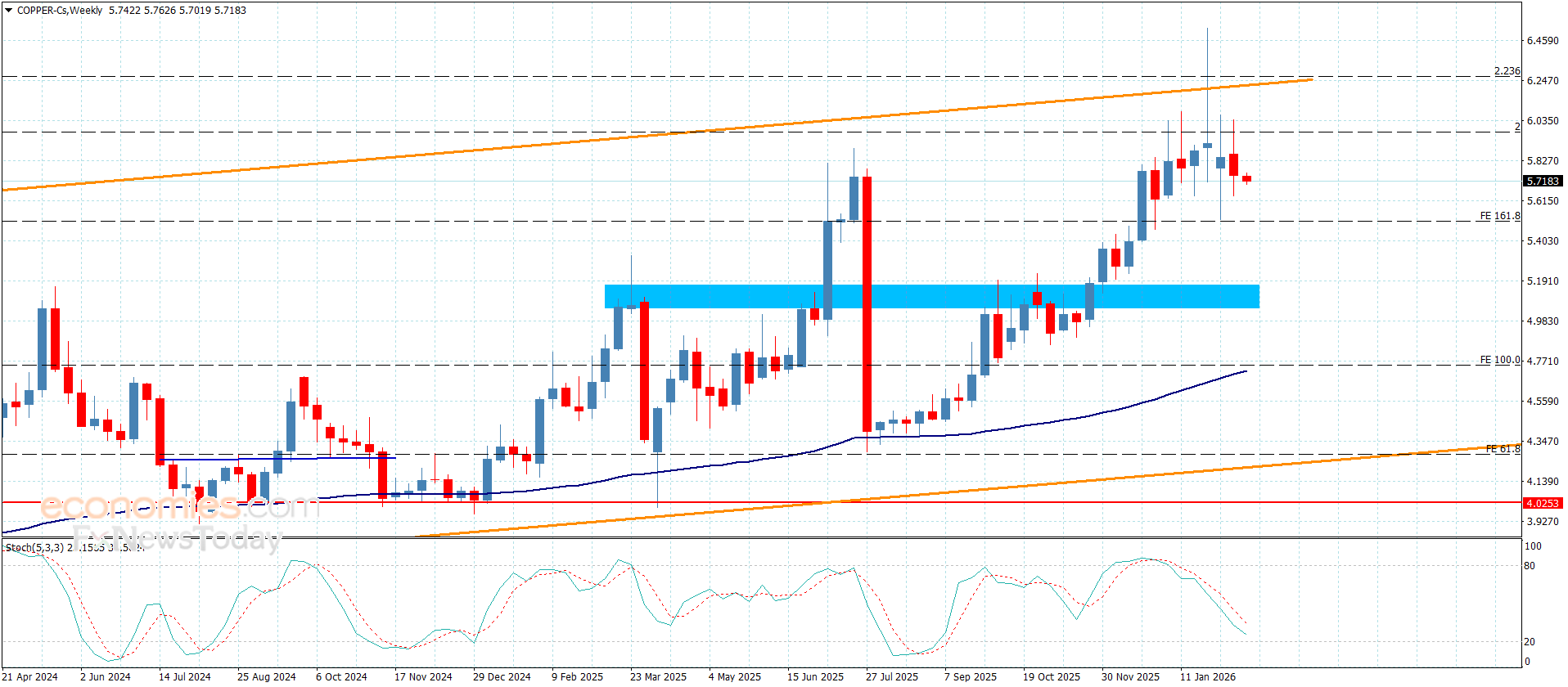
Copper price began this morning, activating with the negative factors that are represented by the stability of the barrier at $5.9700 besides the continuation of providing negative momentum, fluctuating near $5.7000 level.
We will keep our bearish corrective suggestion until facing extra support level at $5.5100, representing key for detecting the expected targets in the medium period trading
The expected trading range for today is between $5.5100 and $5.8500
Trend forecast: Bearish
Gold is on the defensive but holds the $5,000 threshold in early trading on Monday. Market holidays in the United States (US) and China leave the bright metal trading listlessly, so far.
Gold buyers seem to have taken a breather at the start of the week on Monday, following Friday’s solid return. Traders also take account of the latest US inflation and jobs data, while bracing for the US Gross Domestic Product for the fourth quarter of 2025.
The key US economic data will not be released until Friday and hence, China’s Lunar New Year holiday lull and sentiment surrounding the Fed and artificial intelligence (AI) concerns-driven rotation could continue to lead the way for the precious metal traders.
On Friday, the unexpected slowdown in the US Consumer Price Index (CPI) inflation data for January bolstered bets that the US Federal Reserve will deliver at least two interest rate cuts this year.
Futures imply a 68% chance the Fed will cut in June and have 62 basis points of easing priced in for the year, per Reuters.
The US Labor Department said that the CPI rose 0.2% last month after an unrevised 0.3% gain in December, falling short of the estimated increase of 0.3%. The headline annual inflation fell to 2.4% in January, against the forecast of 2.5%.
Excluding the volatile food and energy components, the CPI increased 0.3% after rising by an unrevised 0.2% in December, matching the market expectations.
US Treasury bond yields slipped on increased dovish Fed rate cut bets, smashing the US Dollar (USD) across the board, while lifting the USD-denominated Gold price.
The 21-day Simple Moving Average (SMA) climbs above the 50-, 100- and 200-day readings, underscoring a firm bullish alignment. All SMAs slope higher while price holds above them. The 21-day SMA at $4,973.78 offers immediate dynamic support. The 14-day Relative Strength Index stands at 54.62 (neutral), indicating momentum has normalized after the recent surge. Measured from the $5,597.89 high to the $4,401.99 low, the 50% retracement at $4,999.94 and the 61.8% retracement at $5,141.05 cap the recovery and would need to give way for an upside continuation.
The medium-term structure stays positive as the 50- and 100-day SMAs continue to rise above the 200-day one, and the price retains altitude over these baselines. Initial downside cushions emerge at the 50-day SMA at $4,644.95, while the 100-day SMA at $4,360.91 marks a deeper floor. A daily close above the immediate retracement barriers would open room for a continuation of the primary trend, whereas rejection near them would keep trade confined to the 21-day SMA-led range.
(The technical analysis of this story was written with the help of an AI tool.)
Gold has played a key role in human’s history as it has been widely used as a store of value and medium of exchange. Currently, apart from its shine and usage for jewelry, the precious metal is widely seen as a safe-haven asset, meaning that it is considered a good investment during turbulent times. Gold is also widely seen as a hedge against inflation and against depreciating currencies as it doesn’t rely on any specific issuer or government.
Central banks are the biggest Gold holders. In their aim to support their currencies in turbulent times, central banks tend to diversify their reserves and buy Gold to improve the perceived strength of the economy and the currency. High Gold reserves can be a source of trust for a country’s solvency. Central banks added 1,136 tonnes of Gold worth around $70 billion to their reserves in 2022, according to data from the World Gold Council. This is the highest yearly purchase since records began. Central banks from emerging economies such as China, India and Turkey are quickly increasing their Gold reserves.
Gold has an inverse correlation with the US Dollar and US Treasuries, which are both major reserve and safe-haven assets. When the Dollar depreciates, Gold tends to rise, enabling investors and central banks to diversify their assets in turbulent times. Gold is also inversely correlated with risk assets. A rally in the stock market tends to weaken Gold price, while sell-offs in riskier markets tend to favor the precious metal.
The price can move due to a wide range of factors. Geopolitical instability or fears of a deep recession can quickly make Gold price escalate due to its safe-haven status. As a yield-less asset, Gold tends to rise with lower interest rates, while higher cost of money usually weighs down on the yellow metal. Still, most moves depend on how the US Dollar (USD) behaves as the asset is priced in dollars (XAU/USD). A strong Dollar tends to keep the price of Gold controlled, whereas a weaker Dollar is likely to push Gold prices up.
The EURCHF continued to form bearish waves in the last period, to reach the second target at 0.9075 which represents %78.2 Fibonacci extension level.
The main indicators contradiction might push the price to provide mixed trading, however the negative stability below 0.9215 level and the stability of the moving average 55 above the current trading, these factors make us keep the negative scenario, which might target 0.8975 level reaching towards 0.8860.
The expected trading range for today is between 0.9030 and 0.9155
Trend forecast: Bearish
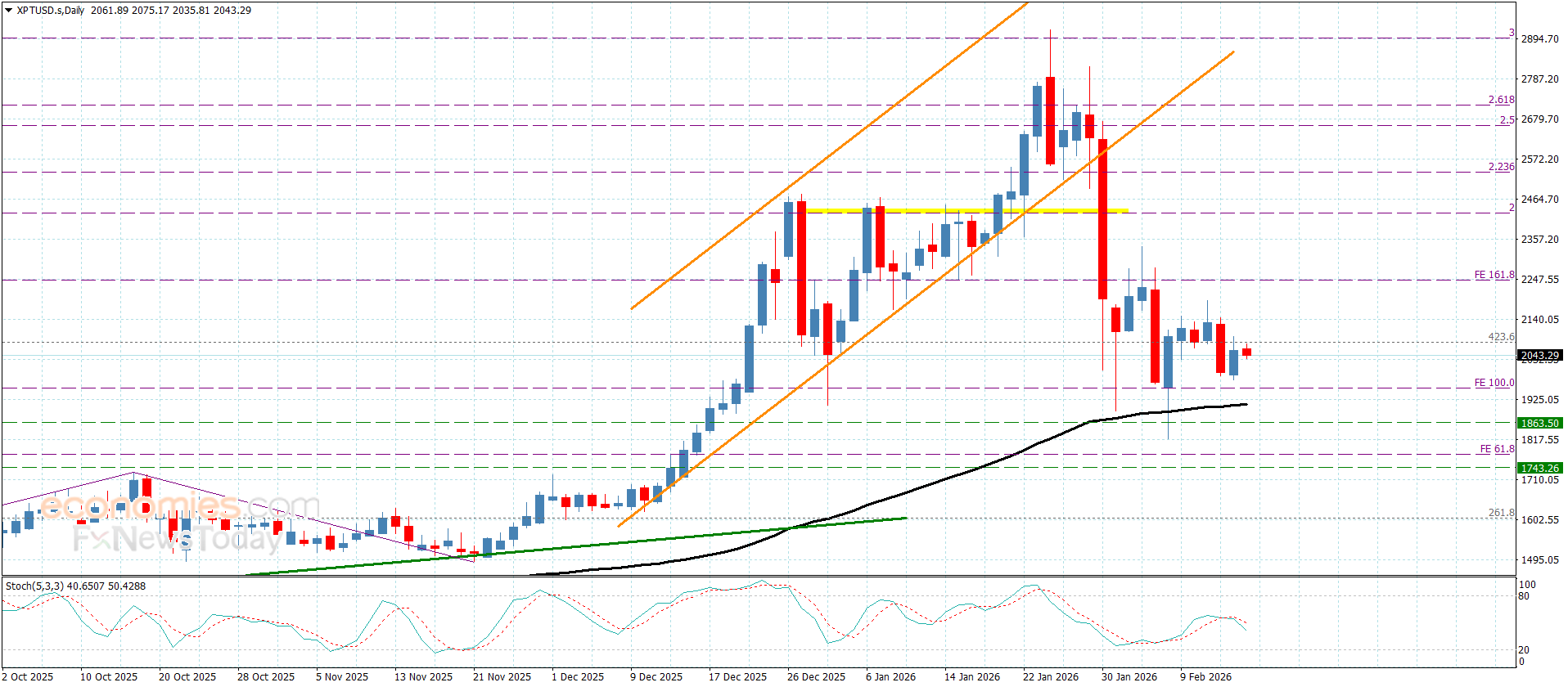
Platinum price remains under the dominance of the bearish trend until this moment, due to its stability below $2245.00 level, forming mixed trading to keep its stability near $2040.00.
We will keep waiting for the price to activate with stochastic negativity, to repeat the pressure on $1950.00 level, and breaking it will open the way for resuming the bearish moves until reaching the extra targets that are located at $1880.00 and $1785.00.
The expected trading range for today is between $1950.00 and $2100.00
Trend forecast: Bearish
Silver price (XAG/USD) trades 2% lower at around $75.00 during the Asian trading session on Monday. The white metal is under pressure as lower-than-expected United States (US) Consumer Price Index (CPI) data for January fails to prompt hopes of interest rate cuts by the Federal Reserve (Fed) in the near term.
Theoretically, lower inflation boosts hopes of monetary policy easing by the Fed in the near term. It seems that market participants are more focused on the labor market than on changes in price pressures.
According to the CME FedWatch tool, traders remain confident that the Fed will keep interest rates steady in the current range of 3.50%-3.75% in March and April.
The data showed on Friday that the US headline inflation cooled down to 2.4% Year-on-year (YoY) from 2.7% in December. On a monthly basis, the US headline CPI grew at a slower pace of 0.2% against estimates and the prior reading of 0.3%.
On the geopolitical front, investors remain concerned over tensions between the US and Iran. A report from Reuters has stated that the US military is preparing for the possibility of sustained, weeks-long operations against Iran if President Donald Trump orders an attack, a scenario that would force investors to shift to the safe-haven fleet.
XAG/USD trades down to near $75.61 as of writing. Price holds below the falling 20-EMA at $84.23, keeping the near-term bias heavy as trend pressure remains to the downside. The average continues to descend, underscoring persistent supply. RSI at 43.47 sits below the 50 midline, confirming weak momentum rather than capitulation.
Below the dynamic cap, rebounds could fade on approach to the average and keep the sequence of lower highs intact. A daily close above $84.23 would ease pressure and open room for a corrective recovery, with confirmation strengthened if RSI reclaims 50. Until that occurs, risk stays skewed toward further weakness, and rallies would be sold into.
(The technical analysis of this story was written with the help of an AI tool.)
Silver is a precious metal highly traded among investors. It has been historically used as a store of value and a medium of exchange. Although less popular than Gold, traders may turn to Silver to diversify their investment portfolio, for its intrinsic value or as a potential hedge during high-inflation periods. Investors can buy physical Silver, in coins or in bars, or trade it through vehicles such as Exchange Traded Funds, which track its price on international markets.
Silver prices can move due to a wide range of factors. Geopolitical instability or fears of a deep recession can make Silver price escalate due to its safe-haven status, although to a lesser extent than Gold’s. As a yieldless asset, Silver tends to rise with lower interest rates. Its moves also depend on how the US Dollar (USD) behaves as the asset is priced in dollars (XAG/USD). A strong Dollar tends to keep the price of Silver at bay, whereas a weaker Dollar is likely to propel prices up. Other factors such as investment demand, mining supply – Silver is much more abundant than Gold – and recycling rates can also affect prices.
Silver is widely used in industry, particularly in sectors such as electronics or solar energy, as it has one of the highest electric conductivity of all metals – more than Copper and Gold. A surge in demand can increase prices, while a decline tends to lower them. Dynamics in the US, Chinese and Indian economies can also contribute to price swings: for the US and particularly China, their big industrial sectors use Silver in various processes; in India, consumers’ demand for the precious metal for jewellery also plays a key role in setting prices.
Silver prices tend to follow Gold’s moves. When Gold prices rise, Silver typically follows suit, as their status as safe-haven assets is similar. The Gold/Silver ratio, which shows the number of ounces of Silver needed to equal the value of one ounce of Gold, may help to determine the relative valuation between both metals. Some investors may consider a high ratio as an indicator that Silver is undervalued, or Gold is overvalued. On the contrary, a low ratio might suggest that Gold is undervalued relative to Silver.
By mid-February 2026, gold prices have made a strong comeback, moving back above the key $5,000 per ounce level. After a volatile stretch with prices ranging from January’s record high of $5,600 to below $4,920, gold is regaining its appeal.
At the start of the new trading week, the market shows renewed optimism:
The mid-February rebound was driven by a mix of economic data and changing market expectations.
January’s CPI data showed annual inflation at 2.4% and core inflation at 2.5%. These lower-than-expected numbers have slowed the rise in Treasury yields and weakened the US Dollar. As a result, markets now expect the Federal Reserve to cut rates later in 2026.
Although central bank buying has slowed from the record 1,000-tonne years of 2022 to 2024, it still provides strong support. In 2026, net purchases are estimated at 800 tonnes, about 26% of yearly mine output.
XAU/USD
Emerging markets such as Poland, China, and Turkey are continuing to reduce their reliance on the US Dollar as a strategy to protect against currency risks.
As global divisions and trade tensions grow, gold’s role as a neutral asset is becoming more important. More portfolio managers are using gold to protect against rising government debt and economic uncertainty in major countries.
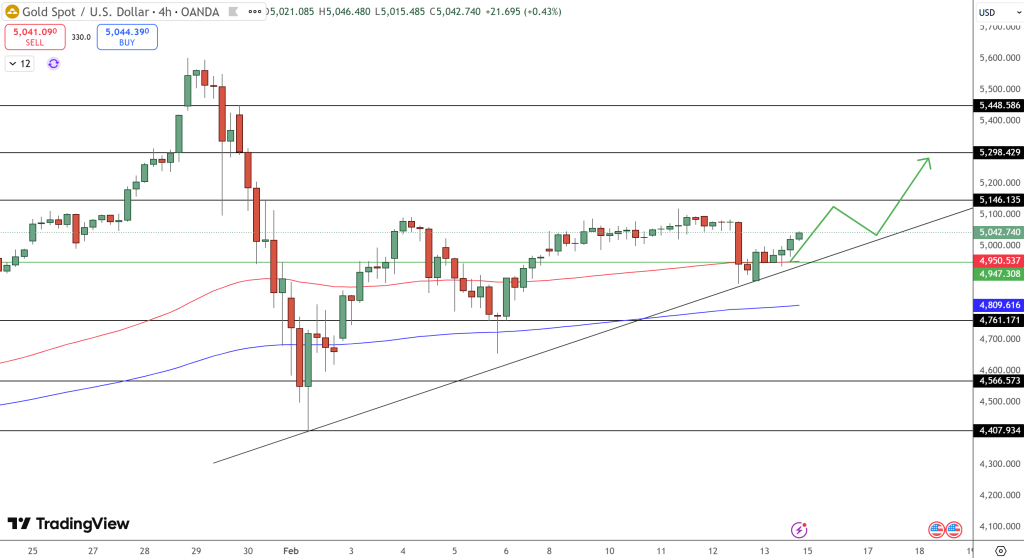
Gold’s technical outlook is still positive, even after the late-January speculative squeeze. The price is now well above the 50-day EMA ($4,947) and the 200-day EMA ($4,809).
| Level Type | Price Point | Significance |
| Primary Resistance | $5,146 | A break above this confirms the end of the consolidation phase. |
| Secondary Resistance | $5,298 | Target for a bullish breakout toward new quarterly highs. |
| Key Support | $4,950 | The “Must-Hold” zone; serves as the new baseline for buyers. |
| Deep Support | $4,761 | The floor established during the late-January correction. |
For the week of February 16, 2026, the outlook is bullish as long as gold stays above $4,950.
Some short-term volatility is likely, especially with lower trading volumes during the Chinese Lunar New Year break (Feb 16 to 23). However, strong fundamentals like supply shortages and institutional demand mean any price drops should be limited.
Analyst Note: “The $5,000 mark isn’t just a number; it’s a psychological rebasing of the market. As long as gold holds this level, the path of least resistance is toward the $5,300 handle.”

Arslan Butt
Lead Markets Analyst – Multi-Asset (FX, Commodities, Crypto)
Arslan Butt serves as the Lead Commodities and Indices Analyst, bringing a wealth of expertise to the field. With an MBA in Behavioral Finance and active progress towards a Ph.D., Arslan possesses a deep understanding of market dynamics.
His professional journey includes a significant role as a senior analyst at a leading brokerage firm, complementing his extensive experience as a market analyst and day trader. Adept in educating others, Arslan has a commendable track record as an instructor and public speaker.
His incisive analyses, particularly within the realms of cryptocurrency and forex markets, are showcased across esteemed financial publications such as ForexCrunch, InsideBitcoins, and EconomyWatch, solidifying his reputation in the financial community.
WTI crude oil (US crude) is trading around $58.41 per barrel in intraday trading, after moving between a low of $56.37 and a high of $58.44 based on Capital.com pricing at 10:49am UTC on 6 January 2026. Meanwhile, UK oil (Brent crude) is trading around $61.94 per barrel, close to the top of its intraday range between $59.88 and $61.99, as of 10:49am UTC on 6 January 2026. Past performance is not a reliable indicator of future results.
Intraday price movements are unfolding amid continued market attention on geopolitical developments in Venezuela, where recent US actions involving President Nicolás Maduro have contributed to a modest risk premium across crude benchmarks (Bloomberg, 6 January 2026). Price action is also taking place against a backdrop of a slightly softer US dollar, after the Dollar Index eased from recent highs near 98.8 (Trading Economics, 6 January 2026).
As of 6 January 2026, third-party oil price predictions generally cluster in the low- to mid-$50s per barrel range for annual averages, with some variation across agencies and banks. The figures below primarily reflect forecast annual average spot or benchmark prices, rather than specific year-end targets, and are typically framed around expectations for supply growth, demand trends and inventory balances.
A Reuters poll of analysts reported in early January 2026 that US crude is projected to average around $58.15 per barrel in 2026, slightly below the prior November consensus of approximately $59.00. The survey highlights expectations for ample supply and a relatively balanced market, with respondents citing rising non-OPEC output as a key factor (Reuters, 5 January 2025).
Goldman Sachs has been cited as expecting Brent crude to average around $56 per barrel, with WTI near $52 per barrel in 2026, below prevailing forward curves as of mid-November 2025. The bank notes that higher-than-expected supply growth alongside a softer demand profile could keep prices under pressure across the 2025–2026 period (BOE Report, 17 November 2025).
J.P. Morgan’s commodities research team, as referenced in industry coverage, forecasts WTI crude averaging about $65 per barrel in 2025 and around $54 per barrel in 2026. The bank points to factors such as strategic stockpiling, evolving sanctions affecting Russian exports, and a gradual moderation in demand growth as shaping a relatively contained price trajectory (Rigzone, 16 December 2025).
Research excerpts circulated via industry reports show Macquarie expecting WTI to average approximately $57.25 per barrel in 2026, while BMI, part of Fitch Solutions, projects a front-month WTI average closer to the low-$60s per barrel range for the same year, based on assumptions published in early December 2025. These institutions generally highlight the interaction between robust US and non-OPEC supply, slowing but still positive demand growth, and ongoing geopolitical and sanctions-related uncertainties (Investing.com, 31 December 2025).
The US EIA’s December 2025 Short-Term Energy Outlook indicates a Brent spot price forecast averaging around $55.08 per barrel in 2026, with quarterly projections centred on the mid-$50s per barrel range. The agency’s outlook suggests prices may ease from late-2025 levels into early 2026, reflecting expectations that growing global oil production and rising inventories could outweigh demand. OPEC+ policy decisions and China’s inventory trends are cited as important variables influencing the extent of any price adjustment ( U.S. Energy Information Administration, 9 December 2025).
Takeaway: Across these sources, third-party oil price predictions generally span from the low-$50s to the low-$60s per barrel, with common reference to ample supply, moderating demand growth and sanctions-related disruptions as underlying assumptions, rather than guarantees of any specific outcome.
Past performance is not a reliable indicator of future results. Projections and third-party forecasts are not recommendations and may not reflect actual future performance, as they cannot account for unforeseen events or changing market conditions.
Brent crude oil is trading near $61.94 as of 10:49am UTC on 6 January 2026, holding just above the Classic Pivot at $61.24 and below first resistance at $63.80, within a relatively tight intraday range. The 20-, 50-, 100- and 200-day simple moving averages sit between roughly $61.3 and $66.0, with shorter-dated averages positioned below longer-dated levels, suggesting a neutral-to-cautious technical structure. The 14-day RSI near 51 remains mid-range, while the ADX around 23 indicates only a modestly developed trend.
A daily close above $63.80 could bring the R2 zone near $66.60 into focus, while a break below the pivot would shift attention toward the S1 area around $58.40 (TradingView, 6 January 2026).
US crude technical analysis
US crude oil is trading around $58.41 per barrel as of 10:49am UTC on 6 January 2026, holding modestly above the Classic Pivot at $57.68 and below the R1 area near $60.39. On the daily chart, price remains supported above the short-term 10-, 20- and 30-day simple moving averages clustered around the high-$57 to low-$58 area, while the 50-, 100- and 200-day SMAs between roughly $58.8 and $62.6 continue to cap the upside. The 14-day RSI near 52.6 sits in neutral territory, while the ADX around 19.6 points to a weak trend environment rather than a strong directional move.
A sustained break above R1 could bring R2 near $63.19 into view, while a move below the pivot risks exposing S1 around $54.87 (TradingView, 6 January 2026).
|
Brent crude technical analysis
Brent crude oil is trading near $61.94 as of 10:49am UTC on 6 January 2026, holding just above the Classic Pivot at $61.24 and below first resistance at $63.80, within a relatively tight intraday range. The 20-, 50-, 100- and 200-day simple moving averages sit between roughly $61.3 and $66.0, with shorter-dated averages positioned below longer-dated levels, suggesting a neutral-to-cautious technical structure. The 14-day RSI near 51 remains mid-range, while the ADX around 23 indicates only a modestly developed trend.
A daily close above $63.80 could bring the R2 zone near $66.60 into focus, while a break below the pivot would shift attention toward the S1 area around $58.40 (TradingView, 6 January 2026).
|
This is technical analysis for informational purposes only and does not constitute financial advice or a recommendation to buy or sell any instrument.
US crude oil (WTI) spent much of 2024 trading within a broad $70–80 per barrel range, with several spikes above $80 around April and July before retreating towards the low-$70s into year-end. Prices then rolled over during late 2024 and early 2025, slipping from closing levels near $71–72 at the end of December 2024 into the low-$70s and upper-$60s by March, before rallying sharply towards $85 in mid-April 2025. This move was followed by a pullback, with prices easing into the low-$60s by early June.
The remainder of 2025 saw WTI gradually ease from early-summer highs around $70–75 into the mid-$60s and later the high-$50s, with the market closing the year at $57.35 on 31 December 2025 and edging slightly higher to around $58.40 by 6 January 2026.
BitcoinWorld
Silver Price Forecast: XAG/USD Faces Critical Resistance at $79.00 Amid Market Uncertainty
Global precious metals markets witnessed significant technical developments this week as silver prices, represented by the XAG/USD pair, failed to establish sustained momentum above the critical $79.00 psychological barrier. Market analysts observed this resistance level testing trader sentiment throughout Thursday’s trading session, creating important implications for both short-term speculators and long-term investors in the white metal.
Technical analysts closely monitored silver’s price action as XAG/USD approached the $79.00 threshold. The precious metal initially breached this level during early Asian trading hours, subsequently retreating below this critical resistance zone. Market technicians identified several key factors contributing to this price behavior. First, the $79.00 level represents a previous consolidation area from late 2024. Additionally, this price point aligns with the 61.8% Fibonacci retracement level from the September 2024 decline. Consequently, traders demonstrated hesitation when confronting this technical confluence zone.
Market data reveals that trading volume decreased by approximately 15% during the attempted breakout above $79.00. This volume contraction typically signals reduced conviction among market participants. Furthermore, the Relative Strength Index (RSI) registered at 68.5 during the peak, approaching overbought territory without confirming a decisive breakout. Technical indicators therefore suggested that silver required additional fundamental catalysts to sustain movement beyond this resistance level.
Historical price analysis provides valuable context for understanding current market dynamics. The $79.00 level previously served as both support and resistance throughout 2024’s volatile trading sessions. During March 2024, silver prices consolidated between $78.50 and $79.50 for nearly three weeks before breaking downward. Similarly, in July 2024, this zone capped multiple rally attempts over a ten-day period. Market memory therefore reinforces the technical significance of this price region, creating psychological barriers for both institutional and retail traders.
Multiple fundamental factors currently influence silver price dynamics, creating complex market conditions. Industrial demand remains robust, particularly from the solar panel manufacturing sector, which consumes approximately 100 million ounces annually. However, monetary policy developments present countervailing pressures. The Federal Reserve’s recent communications suggest continued caution regarding interest rate adjustments, supporting the U.S. dollar and creating headwinds for dollar-denominated commodities like silver.
Geopolitical developments also contribute to market uncertainty. Ongoing tensions in multiple regions typically boost safe-haven demand for precious metals. Nevertheless, silver’s dual nature as both monetary metal and industrial commodity creates unique price dynamics. Unlike gold, which responds primarily to monetary factors, silver exhibits stronger correlation with economic growth expectations and manufacturing activity. Current Purchasing Managers’ Index (PMI) data from major economies shows mixed signals, contributing to the indecisive price action around key technical levels.
| Indicator | Current Value | Impact on Silver |
|---|---|---|
| Global Industrial Demand | +3.2% YoY | Positive |
| ETF Holdings Change | -0.8% (Monthly) | Negative |
| Dollar Index (DXY) | +1.4% (Weekly) | Negative |
| Real Interest Rates | +1.8% | Negative |
| Mine Production Growth | +1.5% YoY | Neutral/Negative |
Financial institutions and commodity analysts provide diverse perspectives on silver’s near-term trajectory. JPMorgan’s commodity research team notes that silver often exhibits stronger momentum than gold during precious metals rallies, yet requires clear technical breaks to sustain advances. Their analysis suggests that a weekly close above $79.50 would signal potential toward $82.00 resistance. Conversely, Bloomberg Intelligence highlights silver’s historical volatility, noting that failed breakouts often precede corrections toward support levels.
Independent technical analyst Markus Müller observes specific chart patterns developing. “The daily chart shows a potential ascending triangle formation with the $79.00 level as the upper boundary,” Müller explains. “This pattern typically resolves with a breakout in either direction, but requires confirmation through both price action and volume expansion.” Müller emphasizes that silver’s current position represents a critical decision point for medium-term trend direction.
Commitments of Traders (COT) reports reveal important insights into market positioning. Commercial hedgers, typically mining companies and industrial users, increased short positions by 8% during the latest reporting period. Meanwhile, managed money accounts, including hedge funds and commodity trading advisors, reduced net long positions by approximately 12%. This positioning data suggests professional traders anticipate potential resistance near current levels, though sentiment could shift rapidly with new fundamental developments.
Silver’s performance must be contextualized within the broader precious metals complex. Gold prices maintained relative stability during silver’s resistance test, with the gold-silver ratio hovering around 85:1. This ratio remains above the ten-year average of 75:1, suggesting potential for silver outperformance if precious metals sentiment improves. Platinum and palladium exhibited mixed performance, with platinum showing relative strength while palladium continued its multi-month decline due to automotive sector uncertainties.
The comparative analysis reveals several important patterns:
Traders should monitor several technical indicators for potential trend developments. The $79.00 level represents immediate resistance, with $79.50 serving as a secondary barrier. Support levels appear at $77.20 (previous swing high), $76.00 (50-day moving average), and $74.80 (recent consolidation low). Moving average convergence divergence (MACD) shows bullish momentum but with decreasing histogram bars, suggesting potential momentum loss.
Volume profile analysis indicates high trading activity between $76.50 and $78.50, creating a value area that may influence future price discovery. Additionally, option market data reveals increased put buying at the $77.00 strike for monthly expirations, suggesting some traders anticipate potential downward movement. These technical factors collectively create a complex decision environment for market participants.
Historical seasonal analysis provides additional context for current price action. Silver typically exhibits strength during September and October, followed by consolidation in November. This pattern aligns with increased industrial purchasing ahead of holiday manufacturing cycles and year-end portfolio rebalancing. However, seasonal tendencies represent secondary factors that interact with dominant fundamental and technical drivers. Current price action appears consistent with typical November consolidation patterns, though the specific resistance at $79.00 creates unique technical circumstances.
Several risk factors could influence silver’s price trajectory in coming sessions. Monetary policy developments represent the primary macroeconomic risk, with Federal Reserve communications potentially impacting both dollar strength and real interest rates. Additionally, economic data releases, particularly manufacturing and employment figures, may affect industrial demand expectations. Geopolitical developments continue to represent wild cards, though silver typically responds less dramatically than gold to geopolitical shocks.
Market structure considerations also warrant attention. Exchange inventory levels remain adequate but have declined approximately 5% year-to-date. Physical market premiums for silver bars and coins have increased modestly, suggesting steady retail investment demand. These structural factors provide underlying support but may not overcome significant technical resistance without additional catalysts.
Silver price forecasts remain cautiously optimistic despite the current resistance at $79.00 for XAG/USD. The precious metal faces significant technical barriers that require fundamental catalysts for decisive突破. Market participants should monitor both technical developments around this critical level and evolving fundamental factors including monetary policy, industrial demand, and geopolitical developments. While near-term consolidation appears probable, silver’s long-term fundamentals remain constructive given its dual role as monetary asset and industrial commodity. The $79.00 level therefore represents not merely a technical resistance point, but a crucial battleground for determining silver’s medium-term trajectory within the broader commodities complex.
Q1: Why is the $79.00 level significant for silver prices?
The $79.00 level represents a key technical resistance zone based on previous price action, Fibonacci retracement levels, and psychological factors. Multiple rally attempts have failed at this level throughout 2024, creating strong market memory and trader hesitation.
Q2: What fundamental factors could help silver break above $79.00 resistance?
Sustained industrial demand growth, dollar weakness, lower real interest rates, or increased safe-haven flows could provide necessary catalysts. Additionally, technical confirmation through increased volume and follow-through buying would signal genuine breakout potential.
Q3: How does silver’s current performance compare to gold?
Silver demonstrates higher volatility but maintains strong correlation with gold. The gold-silver ratio remains above historical averages, suggesting potential for silver outperformance if precious metals sentiment improves, though silver faces stronger industrial demand headwinds.
Q4: What support levels should traders monitor if silver retreats from $79.00?
Key support levels include $77.20 (previous swing high), $76.00 (50-day moving average), and $74.80 (recent consolidation low). These levels represent potential accumulation zones if resistance holds.
Q5: How do institutional positions affect silver’s price outlook?
Commitments of Traders data shows commercial hedgers increasing short positions while managed money reduces net longs. This positioning suggests professional traders anticipate resistance, though positions can change rapidly with new information.
This post Silver Price Forecast: XAG/USD Faces Critical Resistance at $79.00 Amid Market Uncertainty first appeared on BitcoinWorld.
| Working gas in underground storage, Lower 48 states Summary text CSV JSN | |||||||||||||||||||||||||
|---|---|---|---|---|---|---|---|---|---|---|---|---|---|---|---|---|---|---|---|---|---|---|---|---|---|
| Historical Comparisons | |||||||||||||||||||||||||
| Stocks billion cubic feet (Bcf) |
Year ago (02/06/25) |
5-year average (2021-25) |
|||||||||||||||||||||||
| Region | 02/06/26 | 01/30/26 | net change | implied flow | Bcf | % change | Bcf | % change | |||||||||||||||||
| East | 438 | 502 | -64 | -64 | 474 | -7.6 | 506 | -13.4 | |||||||||||||||||
| Midwest | 510 | 584 | -74 | -74 | 566 | -9.9 | 611 | -16.5 | |||||||||||||||||
| Mountain | 209 | 213 | -4 | -4 | 194 | 7.7 | 152 | 37.5 | |||||||||||||||||
| Pacific | 273 | 272 | 1 | 1 | 225 | 21.3 | 202 | 35.1 | |||||||||||||||||
| South Central | 784 | 891 | -107 | -107 | 853 | -8.1 | 873 | -10.2 | |||||||||||||||||
| Salt | 176 | 228 | -52 | -52 | 227 | -22.5 | 243 | -27.6 | |||||||||||||||||
| Nonsalt | 608 | 663 | -55 | -55 | 626 | -2.9 | 631 | -3.6 | |||||||||||||||||
| Total | 2,214 | 2,463 | -249 | -249 | 2,311 | -4.2 | 2,344 | -5.5 | |||||||||||||||||
| Totals may not equal sum of components because of independent rounding. | |||||||||||||||||||||||||
Working gas in storage was 2,214 Bcf as of Friday, February 6, 2026, according to EIA estimates.
This represents a net decrease of 249 Bcf from the previous week. Stocks were 97 Bcf less than last year at this time and 130 Bcf below the five-year average of 2,344 Bcf.
At 2,214 Bcf, total working gas is within the five-year historical range.
For information on sampling error in this report, see Estimated Measures of Sampling Variability table below.
Note: The shaded area indicates the range between the historical minimum and maximum values for the weekly series from 2021 through 2025. The dashed vertical lines indicate current and year-ago weekly periods.
| Estimated measures of sampling variabilityDownload History (April 2015 to Present) | |||||||||||
|---|---|---|---|---|---|---|---|---|---|---|---|
| Coefficient of Variation for Stocks % of working gas |
Standard Error for Net Change billion cubic feet (Bcf) |
||||||||||
| Region | 02/06/26 | 01/30/26 | net change | ||||||||
| East | 0.9 | 0.8 | 0.5 | ||||||||
| Midwest | 0.9 | 0.9 | 1.3 | ||||||||
| Mountain | 1.8 | 1.9 | 0.3 | ||||||||
| Pacific | 0.0 | 0.0 | 0.0 | ||||||||
| South Central | 0.9 | 0.9 | 0.9 | ||||||||
| Salt | 2.0 | 1.6 | 0.7 | ||||||||
| Nonsalt | 1.1 | 1.0 | 0.6 | ||||||||
| Total | 0.5 | 0.4 | 1.7 | ||||||||
The GBPJPY pair surrendered to the negative factors, to resume the previously suggested negative attack, to notice breaking the targeted support at 209.10, forcing it to suffer extra losses by reaching 207.65 as appears in the above image.
Note that the continuation of the price stability below 209.10 level, which might form a strong barrier will force the price to resume the negative trading, to expect reaching 207.00 followed by the next support base at 205.10 level, while its rally above 209.10 will increase the chances of activating the attempts of recovering the losses by its rally gradually towards 209.75 and 210.45.
The expected trading range for today is between 207.00 and 208.80
Trend forecast: Bearish