The main tag of Gold Price Articles.
You can use the search box below to find what you need.
[wd_asp id=1]
The main tag of Gold Price Articles.
You can use the search box below to find what you need.
[wd_asp id=1]
Brazil’s unsweetened instant coffee market in 2026 occupies a distinctive position as both a dominant global supply hub and a mature, dynamic consumption market. The country processes a significant share of its robusta harvest—primarily from Espírito Santo, Rondônia, and Bahia—along with a portion of lower-grade arabica, into soluble coffee for domestic sale and international export. Unsweetened varieties have become the normative default in Brazilian retail, a shift that has accelerated as food-labeling regulations have tightened and consumer awareness of added sugar has risen.
The category encompasses everything from economy spray-dried powders sold in flexible pouches at price points accessible to C2DE households, to premium freeze-dried micro-ground products targeting the urban AB1 demographic. Unlike markets in Eastern Europe or East Asia, where instant coffee competes primarily against tea or alternative beverages, in Brazil it competes directly with a strong tradition of fresh-brewed filtered coffee. This competitive dynamic caps the frequency of instant consumption but also creates a sizable addressable market of coffee drinkers who value convenience without a radical departure from the coffee ritual.
Between the base year of 2026 and the forecast horizon of 2035, the Brazil unsweetened instant coffee market is projected to expand at a volume CAGR in the range of 3.5–5.5%, reflecting maturation in the Southeast and South regions offset by steady penetration gains in the Northeast and North. Value growth is set to run meaningfully higher—estimated at 6.0–8.5% CAGR—as the mix rotates toward freeze-dried, certified organic, and single-serve stick-pack formats, and as cost-push inflation from green coffee and energy is partially passed through at retail.
The market does not exhibit explosive category growth; rather, it is undergoing a structural value upgrade. The volume share of economy spray-dried unsweetened coffee is expected to decline from roughly 60–65% in 2026 to an estimated 50–55% by 2035, while the premium freeze-dried and specialty sub-segments are forecast to nearly double their volume base over the same period. This growth trajectory is supported by favorable demographics in the premium tier—rising urban incomes, smaller household sizes, and a growing cohort of younger consumers who prioritize speed and quality over price.
By processing type, spray-dried unsweetened instant coffee commands the majority of retail and food-service volume in Brazil, comprising an estimated 65–75% of total category tonnage. Freeze-dried coffee represents approximately 20–30% of value but less than 10% of volume, highlighting its premium positioning and higher per-unit price. Organic and decaffeinated sub-segments remain small—each representing under 5% of volume—but organic instant coffee is the fastest-growing tier, expanding at double-digit rates from a low base, driven by export pull and a small but vocal domestic health-conscious cohort.
By end-use sector, at-home consumption accounts for roughly 70–80% of unsweetened instant coffee sales volume. The HORECA sector contributes the balance, where unsweetened instant is used primarily in self-service breakfast setups, corporate canteens, and as a base for iced coffee beverages. Industrial demand, although representing less than an estimated 5% of total volume, provides a stable B2B offtake channel for unsweetened soluble coffee used as an ingredient in ice cream, baked goods, ready-to-drink coffee beverages, and confectionary.
Regional demand patterns within Brazil are distinct: the Southeast and South exhibit higher penetration of premium freeze-dried and organic products, while the Northeast and North are heavily oriented toward economy spray-dried formats, offering headroom for value upgrades as distribution infrastructure improves.
The cost structure of unsweetened instant coffee in Brazil is heavily weighted toward green coffee raw material, which typically constitutes 45–55% of the factory-gate cost for spray-dried product. The arabica–robusta price spread directly influences product formulation; when robusta prices spike relative to arabica, producers blend down or raise prices, compressing volume in the economy tier.
Energy costs for thermal processing—spray-drying and freeze-drying—represent the second-largest variable cost, accounting for an estimated 15–20% of conversion costs, with natural gas and electricity prices in Brazil subject to periodic volatility linked to hydropower availability and global energy markets. Labor, packaging, and logistics constitute the remainder.
At retail, a three-tier pricing structure is well established: economy brands and private label trade at a 25–40% discount to mainstream branded spray-dried coffee, while premium freeze-dried and single-serve stick-pack products command a 100–250% premium over mainstream spray-dried. The private-label price gap has widened slightly in the 2024–2026 period, as grocery chains have aggressively promoted their own store brands. Promotional intensity is high in the mainstream tier, with in-store discounts and temporary price reductions accounting for an estimated 25–35% of retail volume in supermarkets and hypermarkets.
The competitive landscape is concentrated among a small number of vertically integrated processors and brand owners, alongside a robust ecosystem of private-label and contract-manufacturing specialists. Nestlé, through its Nescafé brand family, holds a leadership position across both the mainstream spray-dried and premium freeze-dried tiers, supported by extensive distribution reach and a strong innovation pipeline.
JDE Peet’s, operating through the acquired Brazilian heritage brands such as Campeão, Caboclo, and União, maintains a strong national presence, particularly in the North and Northeast, where brand loyalty to traditional local labels remains high. Other significant domestic players include Cacique, Três Corações, and Marata. Cacique has invested heavily in freeze-drying capacity, positioning itself as a strong player in the premium and private-label export markets.
Marata functions predominantly as a large-scale B2B and private-label supplier, providing unsweetened instant coffee to grocery chains, food-service distributors, and international buyers. The competitive dynamic is characterized by intense price competition in the economy tier, with margins under structural pressure from private label. Differentiation is pursued primarily through packaging format innovation (e.g., stick packs, micro-ground blends), certification, and marketing investment, rather than through radical product technology changes.
Brazil’s soluble coffee manufacturing base is geographically clustered in the primary coffee-growing states, with the highest concentration of processing plants located in the south of Minas Gerais, the Zona da Mata of Minas Gerais, and the highlands of Espírito Santo. Total domestic soluble coffee production capacity is estimated in the range of 85,000–115,000 metric tons annually, with plant utilization rates fluctuating between 70% and 85% depending on export demand conditions and the size of the domestic harvest.
The technology base is split: the majority of installed capacity utilizes conventional spray-drying, which is capital-efficient but produces a powder with lower aroma retention and a larger particle-size distribution. Freeze-drying capacity, while representing a smaller share of total tonnage, has expanded meaningfully over the past decade, driven by investments by Nestlé, Cacique, and a few specialized co-packers. The supply chain is deeply integrated backward; major processors own or contract directly with large robusta farms, securing raw material supply but also absorbing direct exposure to climatic and disease risks.
Domestic green coffee stock levels, while not publicly reported at a granular level, are estimated by trade sources to cover 3–5 months of processing requirements, providing some buffer against harvest shortfalls but not against sustained global price rallies.
Brazil is a net exporter of unsweetened instant coffee by a very wide margin, with exports absorbing an estimated 50–65% of national soluble coffee production volume. Key export destinations include the United States, Japan, Russia, Eastern European markets (especially Poland and Ukraine), and the United Kingdom. Brazilian soluble coffee competes primarily on a combination of scale, cost efficiency, and robusta-based body, placing it in direct competition with Vietnamese and Indonesian suppliers in the economy and mainstream tiers.
The domestic market, however, retains a significant share of higher-grade production, as local consumers are less price-sensitive than emerging-market export destinations in Eastern Europe. Imports of unsweetened instant coffee into Brazil are negligible, estimated at less than 2% of domestic consumption, and are limited to specialized Colombian or Ethiopian single-origin soluble products targeting niche gourmet and ethnic retail outlets. The trade surplus in soluble coffee is a structurally important contributor to Brazil’s agribusiness trade balance.
Tariff protection, in the form of a 10–14% import duty on soluble coffee under Mercosur’s common external tariff, reinforces the competitive moat enjoyed by domestic producers, effectively limiting import penetration to specialty products unavailable locally.
Retail distribution of unsweetened instant coffee in Brazil is led by supermarkets and hypermarkets, which account for an estimated 60–70% of B2C sales volume. The wholesale and cash-and-carry channel serves as the primary conduit to small neighborhood retailers and the food-service sector, particularly in lower-income regions. E-commerce is the fastest-growing distribution channel, having risen from an estimated 3–5% of value sales in 2020 to 8–12% in 2026, driven by the expansion of Mercado Livre, Amazon Brazil, and subscription-based coffee services.
Food-service buyers—hotels, restaurants, cafes, and corporate caterers—represent a distinct procurement segment with low switching costs for unsweetened spray-dried coffee but higher brand loyalty in the freeze-dried segment. Corporate procurement for office coffee services is a small but stable demand pocket, favoring portion-controlled single-serve stick packs and larger institutional packages.
Private-label buyers, including major grocery chains such as Grupo Pão de Açúcar, Carrefour Brazil, and Assaí, are increasingly sophisticated, demanding consistent quality, certified sourcing, and customized packaging formats, often contracting directly with mid-tier processors such as Marata or Cacique rather than relying on third-party wholesalers.
The regulatory environment for unsweetened instant coffee in Brazil is defined primarily by ANVISA Resolution RDC 429/2020 and the associated Normative Instruction IN 75/2020, which govern food labeling, allergen declaration, and nutritional claims. Unsweetened instant coffee must carry clear labeling stating “zero açúcares” (zero sugars) or “sem adição de açúcares” (no added sugars) if it meets the regulatory threshold, and it may not contain any added sweeteners, sugar, or carbohydrate-based bulking agents.
The legislation has significantly reduced the number of products marketed as “soluble coffee mix” that contained high levels of added sugar, effectively clearing the shelf space for pure unsweetened coffee. Certification is a growing regulatory factor in the premium segment: Rainforest Alliance and Organic certifications (the latter overseen by MAPA and INMETRO-accredited certifiers) command a retail premium of 15–30% and are increasingly demanded by food-service and corporate procurement contracts. The use of non-coffee-based anti-caking agents and artificial aromas is tightly restricted, with labeling requiring disclosure of any additives.
Import tariffs on soluble coffee, set under Mercosur’s common external tariff at approximately 10–14%, are designed to protect the domestic processing industry and effectively block low-cost imports from Vietnam or Indonesia, maintaining a favorable pricing structure for Brazilian processors.
The Brazil unsweetened instant coffee market is forecast to evolve along a bifurcated growth trajectory between 2026 and 2035. The base economy tier—largely spray-dried product sold in flexible pouches—is expected to register minimal volume expansion, with a CAGR of only 1.0–2.0%, constrained by population aging, private-label margin pressure, and gradual trading up among younger consumers. In contrast, the premium freeze-dried, organic, and specialty unsweetened segments are projected to grow at a robust 6.0–10.0% CAGR, doubling their combined volume share from an estimated 12–15% of total category volume in 2026 to 25–30% by 2035.
Total category value is expected to increase at a CAGR of 6.0–8.0%, driven primarily by the mix shift toward higher-priced formats and the pass-through of green coffee and energy cost inflation. A key structural assumption underlying the forecast is that the health-and-wellness trend will deepen, accelerating the decline of sweetened instant blends and further entrenching unsweetened coffee as the default choice among younger, urban, and higher-income consumers.
Climate-related supply risks to arabica and robusta crops in Brazil and competing origins are expected to keep green coffee prices elevated in real terms relative to the 2015–2020 average, supporting higher retail pricing but also compressing volume growth in price-sensitive economy segments.
The most significant near- to medium-term opportunity lies in bridging the quality and flavor gap between commodity instant coffee and fresh brewed coffee through innovation in processing technology. The “specialty instant” segment—which uses high-grade arabica beans and proprietary aroma-preservation methods such as micro-grinding or nitrogen-flushed packaging—is vastly under-penetrated in Brazil relative to markets such as the United States, Japan, or South Korea, and offers high-margin growth for both established players and agile challenger brands.
A second major opportunity resides in B2B channels: food-service operators and industrial ingredient buyers are increasingly seeking suppliers that can offer traceable, certified, and consistent soluble coffee with sustainability documentation, creating an opening for processors who invest in Rainforest Alliance and Organic certification and who can provide reliable supply amidst green coffee volatility. Third, e-commerce and direct-to-consumer subscription models are reshaping channel economics.
DTC models bypass the 20–30% margins demanded by traditional retail intermediaries, allowing premium unsweetened instant coffee brands to invest in higher-grade raw materials and more sophisticated packaging while maintaining attractive unit economics. Private-label expansion represents a fourth opportunity: as grocery chains continue to build their store-brand credibility, processors willing to invest in dedicated private-label production lines and flexible packaging capabilities can capture growing volume at the expense of legacy economy brands.
Finally, export diversification into Southeast Asian and Middle Eastern markets—where soluble coffee consumption is growing and Brazilian robusta-based product is well suited to local taste preferences—offers an avenue to absorb the production capacity needed to fund domestic premiumization investments.
This report is an independent strategic category study of the market for unsweetened instant coffee in Brazil. It is designed for brand owners, general managers, category leaders, trade-marketing teams, e-commerce teams, retail partners, distributors, investors, and market entrants that need a clear read on where growth sits, which brands control the category, how pricing and promotion shape demand, and which channels matter most for scale and margin.
The framework is built for consumer packaged goods (CPG) category markets within consumer goods, where performance is driven by need states, shopper missions, brand hierarchies, price-pack architecture, retail execution, promotional intensity, and route-to-market control rather than by a narrow technical specification alone. It defines unsweetened instant coffee as Instant coffee powder or granules made from brewed coffee, processed to remove water, and sold without added sugar or sweeteners and maps the market through category boundaries, consumer segments, usage occasions, channel structure, brand and private-label positions, supply and availability logic, pricing and promotion mechanics, and country-level commercial roles. Historical analysis typically covers 2012 to 2025, with forward-looking scenarios through 2035.
This report is designed to answer the questions that matter most to brand, category, channel, and strategy teams in consumer-goods markets.
At its core, this report explains how the market for unsweetened instant coffee actually works as a consumer category. It is built to show where demand comes from, which need states and shopper missions matter most, which brands and private-label players shape the category, which channels control visibility and conversion, and where pricing power, repeat purchase, and margin are actually created.
Rather than framing the category through narrow technical attributes, the study breaks it into decision-grade commercial layers: product format, benefit platform, shopper segment, purchase occasion, pack-price architecture, channel environment, promotional intensity, route-to-market control, and company archetype. It is therefore useful both for teams shaping portfolio strategy and for teams executing growth through Household Shopper (B2C), Food Service Procurement (B2B), Corporate Buyer (Office Supply), Private Label Retailer, and Distributor/Wholesaler.
The report also clarifies how value pools differ across Hot beverage preparation, Baking and dessert ingredient, Smoothie and protein shake additive, and Quick cold brew preparation, how premiumization and private label reshape category economics, how retail concentration and route-to-market design affect scale, and which countries matter most for brand building, sourcing, packaging, and channel expansion.
The report is based on an independent market-intelligence methodology that combines category reconstruction, public company evidence, retail and channel mapping, pricing review, and multi-layer triangulation. It is built for consumer categories where no single public dataset captures the real structure of demand, brand power, promotion, and channel control.
The evidence stack typically combines company disclosures, investor materials, brand and retailer product pages, e-commerce assortment checks, packaging and claims analysis, public pricing references, trade statistics where relevant, regulatory and labeling guidance, and observable route-to-market evidence from distributors, retailers, merchandisers, and marketplace ecosystems.
The analytical model then reconstructs the category across the layers that matter commercially: category scope, shopper need states, consumer segments, pack-price ladders, brand and private-label hierarchy, channel power, promotional intensity, route-to-market design, and country role differences.
Special attention is given to Convenience and speed of preparation, Long shelf life and storage stability, Cost-effectiveness vs. fresh coffee, Health/wellness trend (sugar avoidance), Space efficiency (travel, small kitchens), and Growing at-home coffee culture. The objective is not only to size the market, but to explain where value pools sit, which segments drive mix and repeat purchase, which channels shape growth, and how leading brands defend or expand their positions across Household Shopper (B2C), Food Service Procurement (B2B), Corporate Buyer (Office Supply), Private Label Retailer, and Distributor/Wholesaler.
The report does not rely on survey-based opinion as its core evidence base. Instead, it uses observable commercial signals and structured public evidence to build a decision-grade view for brand, category, retail, e-commerce, investment, and market-entry teams.
This report defines unsweetened instant coffee as Instant coffee powder or granules made from brewed coffee, processed to remove water, and sold without added sugar or sweeteners and treats it as a branded consumer category rather than as a narrow technical product class. The objective is to capture the real commercial market that category, brand, trade-marketing, and channel teams are managing.
Scope is determined by how the category is sold, merchandised, priced, and chosen in market. That means the report follows product formats, claims, price tiers, pack architecture, need states, and retail environments that shape Hot beverage preparation, Baking and dessert ingredient, Smoothie and protein shake additive, and Quick cold brew preparation.
The study deliberately separates the category from adjacent baskets when they distort the economics or shopper logic of the market being measured. Typical exclusions therefore include Sweetened or flavored instant coffee mixes (e.g., 3-in-1), Ready-to-drink (RTD) canned/bottled coffee, Ground coffee beans, Whole bean coffee, Coffee pods/capsules (Nespresso, Keurig), Liquid coffee concentrates, Instant coffee with added creamer or milk powder, Coffee creamers and whitener, Coffee syrups and flavorings, Coffee substitutes (chicory, barley), Tea and other hot beverage instants, and Cocoa and chocolate drink mixes.
The report provides focused coverage of the Brazil market and positions Brazil within the wider global consumer-goods industry structure.
The geographic analysis explains local consumer demand conditions, brand and private-label balance, retail concentration, pricing tiers, import dependence, and the country’s strategic role in the wider category.
This study is designed for strategic and commercial users across brand-led consumer categories, including:
In many brand-driven, channel-sensitive, and consumer-demand-led markets, official trade and production statistics are not sufficient on their own to describe the true market. Product boundaries may cut across multiple tariff codes, several product categories may be bundled into the same official classification, and a meaningful share of activity may take place through customized services, captive supply, platform relationships, or technically specialized channels that are not directly visible in standard statistical datasets.
For this reason, the report is designed as a modeled strategic market study. It uses official and public evidence wherever it is reliable and scope-compatible, but it does not force the market into a purely statistical framework when doing so would reduce analytical quality. Instead, it reconstructs the market through the logic of demand, supply, technology, country roles, and company behavior.
This makes the report particularly well suited to products that are innovation-intensive, technically differentiated, capacity-constrained, platform-dependent, or commercially structured around specialized buyer-supplier relationships rather than standardized commodity trade.
The report typically includes:
Domestic coffee prices today
The domestic coffee market this morning, May 30, 2026, experienced a sharp downward adjustment as pressure from the world market spread directly to purchasing agents.
In all key provinces, the price of raw coffee beans simultaneously lost 1,800 VND/kg compared to yesterday’s trading session.
Specifically, in Dak Nong province (old), the purchase price retreated to 87,400 VND/kg, continuing to be the locality with the highest price in the whole region.
In Dak Lak and Gia Lai provinces, coffee prices both decreased to 87,300 VND/kg.
Meanwhile, in Lam Dong, the purchase price also dropped to the threshold of 86,800 VND/kg.
Along with the decline of coffee, pepper prices today stood still at the level of 141,000 VND/kg, while the USD/VND exchange rate at Vietcombank recorded a slight decrease of 10 VND, falling to 26,085 VND/USD.
World coffee prices
On international futures exchanges, panic was overwhelming as coffee prices fell sharply from the short-term peak set the day before.
On the London exchange, the price of Robusta for July delivery (RMN26) decreased by 78 USD, equivalent to 2.19%, closing the session at 3,476 USD/ton.
Similarly, the New York Stock Exchange witnessed the price of Arabica for July delivery (KCN26) plummeting 8.65 cents, equivalent to 3.15%, closing at 265.60 cents/lb. The simultaneous decline on both exchanges reflects the aggressive profit-taking sentiment of speculators in the face of the latest weather signals in South America.
Coffee price assessment
The direct cause of this decline stems from the latest weather forecasts showing that dry conditions will soon return to Brazil’s key coffee growing areas next week. This information helps harvesting – which was interrupted by heavy rain last week – to be expected to return to normal soon, thereby relieving concerns about short-term supply shortages.
However, the long-term supply and demand picture is still uncertain as Arabica inventories on the ICE exchange continue to fall to the lowest level in the past 3.5 months, along with the prolonged drought in the Central Highlands still being a major barrier to production prospects.
Before the strong and unpredictable fluctuations from both weather factors and speculative capital flows, farmers in this period should be very calm. It is understandable that the market adjusted down after a hot uptrend.
Silver (XAG/USD) trades flat on Friday, failing to capitalize on improving market sentiment surrounding a potential US-Iran peace deal, even as the US Dollar (USD) slides to a two-week low. At the time of writing, XAG/USD trades around $75.60 and is on track to end the week virtually unchanged.
US President Donald Trump said on Friday that the naval blockade on Iranian ports would be lifted. Traders are now awaiting final approval on a reported 60-day memorandum of understanding (MOU) that would extend the current ceasefire and reopen the Strait of Hormuz.
In reaction, the Greenback gave up earlier gains. The US Dollar Index (DXY), which tracks the Greenback’s value against a basket of six major currencies, trades around the 98.80 mark after hitting a seven-week high of 99.54 on Thursday.
However, uncertainty around the deal remains high. Iran’s Fars News Agency rejected Trump’s latest comments on a possible deal and said no final decision has been made yet. The report also said the proposed agreement is still in the final stages of ratification in Iran.
The subdued price action in Silver contrasts with Gold, which climbed more than 1.5% on Friday. Traders are avoiding aggressive bets while waiting for more clarity on whether a deal can be reached soon.
On the daily chart, XAG/USD holds below the short-term trend marker as the near-term tone turns mildly bullish. The 50-day simple moving average (SMA) at $75.85 is acting as immediate resistance just overhead, while the 100-day SMA at $81.32 marks a higher cap that reinforces the idea of a market consolidating underneath its medium-term slope.
Momentum studies are soft with the Relative Strength Index (RSI) hovering near 47 and Moving Average Convergence Divergence (MACD) readings below the zero line, which together hint at limited bullish pressure.
On the topside, a daily close above the 50-day SMA at $75.84 would be the first signal that buyers are attempting to regain control, exposing the 100-day SMA at $81.32 as the next notable barrier.
On the downside, the broader bullish structure remains intact while price holds well above the 200-day SMA at $66.94, which offers a key layer of underlying support and a potential zone where medium-term dip buyers could emerge.
(The technical analysis of this story was written with the help of an AI tool.)
Silver is a precious metal highly traded among investors. It has been historically used as a store of value and a medium of exchange. Although less popular than Gold, traders may turn to Silver to diversify their investment portfolio, for its intrinsic value or as a potential hedge during high-inflation periods. Investors can buy physical Silver, in coins or in bars, or trade it through vehicles such as Exchange Traded Funds, which track its price on international markets.
Silver prices can move due to a wide range of factors. Geopolitical instability or fears of a deep recession can make Silver price escalate due to its safe-haven status, although to a lesser extent than Gold’s. As a yieldless asset, Silver tends to rise with lower interest rates. Its moves also depend on how the US Dollar (USD) behaves as the asset is priced in dollars (XAG/USD). A strong Dollar tends to keep the price of Silver at bay, whereas a weaker Dollar is likely to propel prices up. Other factors such as investment demand, mining supply – Silver is much more abundant than Gold – and recycling rates can also affect prices.
Silver is widely used in industry, particularly in sectors such as electronics or solar energy, as it has one of the highest electric conductivity of all metals – more than Copper and Gold. A surge in demand can increase prices, while a decline tends to lower them. Dynamics in the US, Chinese and Indian economies can also contribute to price swings: for the US and particularly China, their big industrial sectors use Silver in various processes; in India, consumers’ demand for the precious metal for jewellery also plays a key role in setting prices.
Silver prices tend to follow Gold’s moves. When Gold prices rise, Silver typically follows suit, as their status as safe-haven assets is similar. The Gold/Silver ratio, which shows the number of ounces of Silver needed to equal the value of one ounce of Gold, may help to determine the relative valuation between both metals. Some investors may consider a high ratio as an indicator that Silver is undervalued, or Gold is overvalued. On the contrary, a low ratio might suggest that Gold is undervalued relative to Silver.
Domestic coffee prices today
The domestic coffee market this morning, May 29, 2026 witnessed an exciting trading session when the purchasing price of raw beans simultaneously surged sharply by 1,400 VND/kg in all key areas. With this increase, the average price level has approached the threshold of 90,000 VND/kg, bringing positive signals to farmers after a series of fluctuations.
In Dak Nong province (old), the purchase price recorded the highest level in the region at 89,200 VND/kg. Dak Lak and Gia Lai provinces both increased by 1,400 VND, currently trading at 89,100 VND/kg.
In Lam Dong, the price of raw coffee beans also reached 88,600 VND/kg. Contrary to the increase in coffee prices, pepper prices continued to stand still at 141,000 VND/kg, while the USD/VND exchange rate at Vietcombank recorded a slight decrease of 18 VND, down to 26,095 VND/USD.
World coffee prices
In the international market, price movements on the two main futures exchanges have established impressive new peaks thanks to the resonance of extreme weather factors in the two largest coffee “capitals” in the world.
On the London exchange, the price of Robusta for July delivery (RMN26) surged sharply by 82 USD (equivalent to 2.36%), closing the session at 3,554 USD/ton. At the same pace, the New York exchange recorded the price of Arabica for July delivery (KCN26) increasing by 4.40 cents (equivalent to 1.63%), closing at 274.25 cents/lb.
Coffee price assessment
The core reason for this strong increase is that unusual heavy rains in Brazil are seriously disrupting coffee harvesting progress, directly threatening the quality and supply of beans to the market.
In Vietnam, prolonged drought in the main growing areas of the Central Highlands is also increasing concerns about a shortage of Robusta supply, as rainfall is not enough to meet the development needs of coffee trees. These double risks have caused speculators to increase buying, pushing prices on both exchanges to the highest level in the past 2 weeks. In addition, Arabica inventories on the ICE exchange continued to fall to a 3.25-month low (440,785 bags), creating a very solid technical support for the market in the face of pressure from long-term supply surplus forecasts.
Although reports of a record harvest of nearly 76 million bags in Brazil are still a potential downside factor, in the short term, weather factors are temporarily controlling the price trend. The strong recovery of coffee prices shows that the market is still very sensitive to supply disruptions.
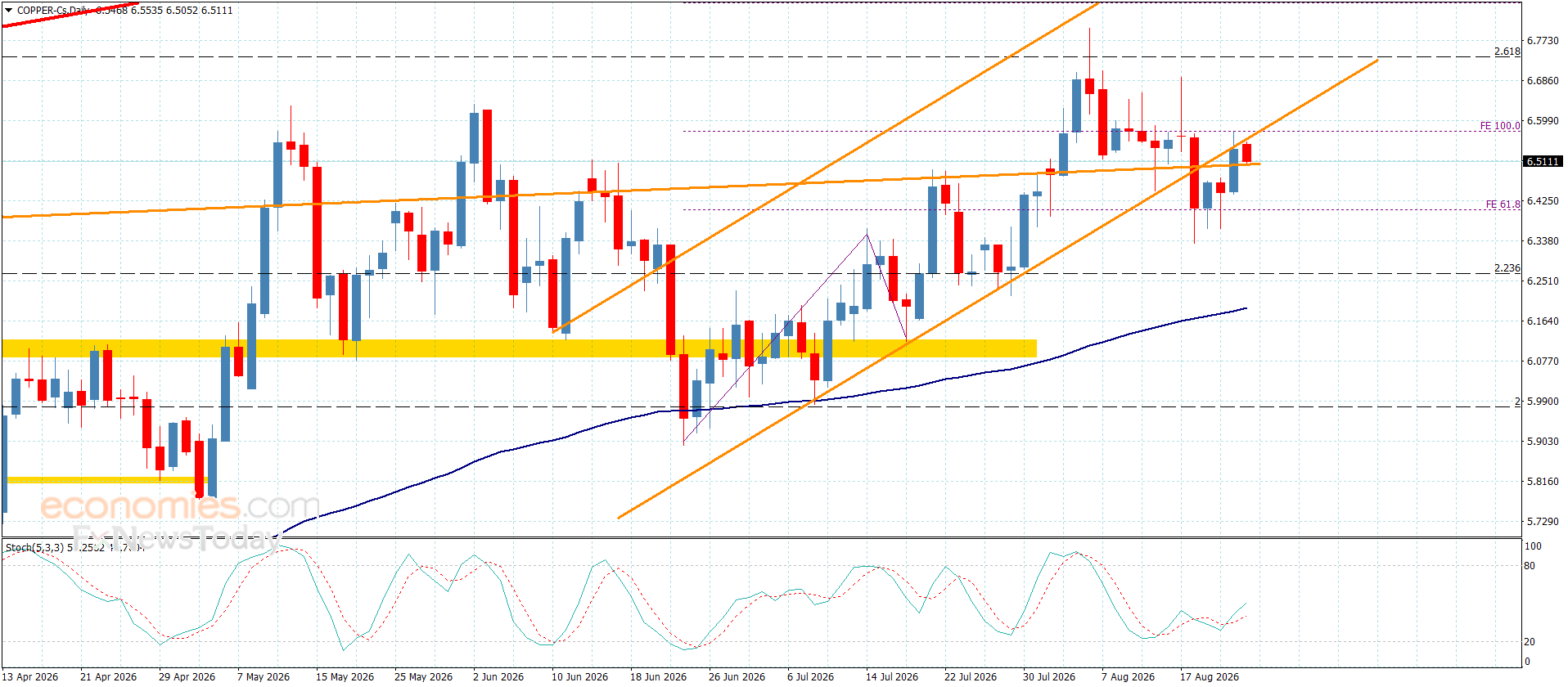
Despite the stability of copper price within the main bullish track, it remains confined between the initial support of $6.1000 and $6.4000 barrier, which pushes it to provide more sideways trading without recording any new positive target.
The contradiction of the main indicators confirms the dominance of the sideways bias currently, to keep waiting for surpassing the barrier to open the way for achieving extra gains that might begin at $6.5600 and $6.7500, while breaking the support and holding below it will force it to activate the bearish corrective track, and $5.9500 level represents the initial station.
The expected trading range for today is between $6.1000 and $6.4000
Trend forecast: Fluctuating within the bullish trend
Despite the stability of copper price within the main bullish track, it remains confined between the initial support of $6.1000 and $6.4000 barrier, which pushes it to provide more sideways trading without recording any new positive target.
The contradiction of the main indicators confirms the dominance of the sideways bias currently, to keep waiting for surpassing the barrier to open the way for achieving extra gains that might begin at $6.5600 and $6.7500, while breaking the support and holding below it will force it to activate the bearish corrective track, and $5.9500 level represents the initial station.
The expected trading range for today is between $6.1000 and $6.4000
Trend forecast: Fluctuating within the bullish trend
Key near-term resistance is a lower swing high at $4,589. A decisive advance above that level will trigger a bullish reversal of the short-term decline. Also, the 20-day moving average would be reclaimed, as it is now at $4,589 and falling. Nonetheless, the more significant next price level is indicated by the 50-day moving average.
It was successfully tested as resistance to the prior two advances. It converged with the downtrend line today, forming a key confluence resistance zone. Therefore, a bullish trend reversal signal will trigger above that average, currently near $4,631. Since the apex of a symmetrical triangle is shown around June 11, gold may trigger an upside breakout above the 50-day average before then.
Following the successful reclaim of the 50-day average, gold targets a lower swing high at $4,774 and the 100-day moving average, now near $4,804. A sustained advance above the lower swing high will trigger a bullish reversal and likely continuation of the advance toward higher resistance levels not yet tested in the current corrective phase.
If you’d like to know more about how to trade gold and silver, please visit our educational area.
Silver (XAG/USD) recovers on Thursday as the US Dollar (USD) eases following the latest US Personal Consumption Expenditures (PCE) data. At the time of writing, XAG/USD is trading around $734.11, rebounding after hitting a one-month low near $71.79 earlier in the day.
The core PCE Price Index, the Federal Reserve’s (Fed) preferred inflation gauge, rose 0.2% MoM in April, below market expectations and down from the 0.3% increase recorded in March. Meanwhile, the annual Core PCE reading accelerated to 3.3% YoY from 3.2% in March, matching market expectations.
The US Dollar Index (DXY), which tracks the Greenback’s value against a basket of six major currencies, is trading around 99.15 after hitting a seven-week high of 99.54 earlier in the day.
Meanwhile, fresh attacks in the Middle East region have dashed hopes for a quick end to the war, keeping Oil prices elevated amid ongoing supply disruption through the Strait of Hormuz.
The precious metal’s upside remains limited in the current macro environment. Even with the DXY pulling back slightly during the day, traders are still favoring the US Dollar (USD) for safety, which is keeping pressure on Dollar-denominated commodities.
Meanwhile, rising expectations that the Fed could raise interest rates to tackle energy-driven inflation are adding further pressure on non-yielding assets such as Silver.
On the daily chart, XAG/USD maintains a mildly bearish near-term tone, holding below the 20-period Bollinger Simple Moving Average (SMA) around $78 and well under the upper band near $86.76, which together suggest rallies are being capped by overhead supply.
Price still sits comfortably above the lower Bollinger band at about $69.29, but a soft Relative Strength Index (RSI) at 44 and a very low Average Directional Index (ADX) near 12 hint at downside momentum within a weakly trending environment.
On the topside, initial resistance is defined by the 20-period Bollinger SMA around $78, with a subsequent barrier at the upper band near $86.76 if buyers regain traction.
On the downside, immediate support emerges at the lower Bollinger band around $69.29, ahead of a more substantial horizontal floor near $60.00, where a deeper correction could seek stabilization if bearish pressure extends.
(The technical analysis of this story was written with the help of an AI tool.)
Silver is a precious metal highly traded among investors. It has been historically used as a store of value and a medium of exchange. Although less popular than Gold, traders may turn to Silver to diversify their investment portfolio, for its intrinsic value or as a potential hedge during high-inflation periods. Investors can buy physical Silver, in coins or in bars, or trade it through vehicles such as Exchange Traded Funds, which track its price on international markets.
Silver prices can move due to a wide range of factors. Geopolitical instability or fears of a deep recession can make Silver price escalate due to its safe-haven status, although to a lesser extent than Gold’s. As a yieldless asset, Silver tends to rise with lower interest rates. Its moves also depend on how the US Dollar (USD) behaves as the asset is priced in dollars (XAG/USD). A strong Dollar tends to keep the price of Silver at bay, whereas a weaker Dollar is likely to propel prices up. Other factors such as investment demand, mining supply – Silver is much more abundant than Gold – and recycling rates can also affect prices.
Silver is widely used in industry, particularly in sectors such as electronics or solar energy, as it has one of the highest electric conductivity of all metals – more than Copper and Gold. A surge in demand can increase prices, while a decline tends to lower them. Dynamics in the US, Chinese and Indian economies can also contribute to price swings: for the US and particularly China, their big industrial sectors use Silver in various processes; in India, consumers’ demand for the precious metal for jewellery also plays a key role in setting prices.
Silver prices tend to follow Gold’s moves. When Gold prices rise, Silver typically follows suit, as their status as safe-haven assets is similar. The Gold/Silver ratio, which shows the number of ounces of Silver needed to equal the value of one ounce of Gold, may help to determine the relative valuation between both metals. Some investors may consider a high ratio as an indicator that Silver is undervalued, or Gold is overvalued. On the contrary, a low ratio might suggest that Gold is undervalued relative to Silver.
Brent crude (BRN) climbed toward $97 a barrel on Thursday, rebounding from the previous session’s steep losses as renewed hostilities between the United States and Iran weakened expectations for a near-term peace agreement, while U.S. West Texas Intermediate (CL) recovered toward the $90–$92 zone after sinking 5.55% to settle near $88.68 on Wednesday. The catalyst for the bounce was a flurry of overnight military developments: U.S. forces reportedly struck an Iranian military site believed to threaten American troops and commercial shipping through the Strait of Hormuz, also intercepting several attack drones near the chokepoint, while Kuwait reported shooting down a missile and Iran’s Revolutionary Guard claimed to have targeted a U.S. airbase. The Guard further warned that it would respond forcefully to any disruption in Hormuz and said several ships attempting unauthorized entry into the Persian Gulf had been forced to turn back. Despite the rebound, crude remains sharply lower for both the week and the month, as the market continues to price in meaningful odds that Washington and Tehran eventually strike a deal to reopen the strait. This tension — a powerful geopolitical risk premium battling against persistent peace-deal optimism — has produced some of the wildest price swings in the history of the oil market, and Thursday’s recovery is merely the latest oscillation in an extraordinarily volatile trading environment.
To understand today’s price action, it is essential to grasp the magnitude of the shock that has gripped the oil market since the U.S. and Israeli-led war against Iran began in late February. Since the conflict’s outbreak on February 28, both Brent and WTI have surged more than 45% to 50%, a rally driven by the effective closure of the Strait of Hormuz and the resulting tightening of global supply. The price action has been nothing short of dramatic: Brent spot prices spiked to as high as $138 a barrel on April 7, with the April monthly average reaching $117 — the highest since June 2022, in the aftermath of Russia’s invasion of Ukraine. The international North Sea Dated benchmark traded in an unprecedented range of nearly $50 a barrel in April alone, swinging from a high around $144 down below $100 before rebounding again, a testament to the violent uncertainty surrounding the conflict’s trajectory. Energy infrastructure across nine nations has sustained damage to dozens of assets since hostilities commenced, and the disruption has been severe enough that one major energy agency compared the current crisis to both 1970s oil shocks occurring simultaneously. This is the backdrop against which every daily move must be understood: a market that has been fundamentally repriced by a major geopolitical conflict and that now trades on every incremental headline about war and peace.
At the epicenter of the crisis lies the Strait of Hormuz, the narrow waterway linking the Persian Gulf to global oil markets and the single most important chokepoint in the world’s energy supply chain. Traffic through the strait has been largely at a standstill, both because of the risk of attacks on oil tankers and because of a U.S. naval blockade against Iranian oil shipments through the passage. The de facto closure has dramatically reduced the availability of oil supplies to global markets, with cascading effects rippling across the entire supply chain as cargoes are rerouted, insurance costs soar, and shipping becomes hazardous. The strategic calculus around reopening the strait is daunting: military analysts have suggested that forcibly reopening Hormuz would require significant naval resources, ground troops, and could cost on the order of a billion dollars a week, underscoring why a negotiated solution remains the market’s preferred path. The strait’s importance cannot be overstated, as a substantial share of the world’s seaborne crude transits these waters, and any prolonged disruption forces the global market to scramble for alternative supplies that simply cannot fully replace the lost volumes. The repeated skirmishes near the strait, including Thursday’s drone interceptions and the Revolutionary Guard’s warnings, keep the market acutely focused on whether the passage will reopen in weeks or remain blocked for far longer, a binary outcome that carries enormous price implications.
The dominant variable swinging oil prices day to day is the on-again, off-again prospect of a peace agreement between the United States and Iran, with negotiations remaining genuinely difficult and the outcome highly uncertain. The core sticking points are formidable: Iran insists on maintaining control of the Strait of Hormuz and preserving its nuclear program, while the U.S. administration has rejected what it considers inadequate proposals, with the President describing Iran’s latest response as unacceptable and refusing to ease sanctions despite Tehran’s demands for financial relief. Earlier in the week, optimism had surged on reports that a memorandum of understanding had been largely negotiated and would reopen the strait, sending oil tumbling, only for those hopes to be dashed by the renewed military action and the persistent disagreements over fundamental terms. This whipsaw dynamic — peace optimism crushing prices one day, conflict escalation reviving the risk premium the next — explains the extraordinary volatility and the market’s inability to establish a stable trading range. The diplomatic complexity is compounded by the involvement of other powers, with speculation that Washington might enlist Beijing’s help in pressuring Tehran to accept U.S. terms. Until the negotiations produce a definitive resolution one way or the other, the oil market will remain hostage to headlines, with each statement from Washington or Tehran capable of triggering multi-dollar swings in the benchmarks. The base case embedded in most forecasts assumes an eventual deal, but the path there is anything but smooth.
Beneath the geopolitical drama lies a stark physical reality: the global oil market is in a severe supply deficit, with inventories drawing down at a record pace that provides fundamental support for elevated prices. More than ten weeks after the war began, mounting supply losses from the Strait of Hormuz have been depleting global oil inventories at an unprecedented clip, with one agency estimating that global stocks would fall by an average of 8.5 million barrels per day in the second quarter of 2026. This is a staggering rate of inventory depletion that, in a normal market, would send prices soaring far higher, and it is only the persistent expectation of an eventual deal that has kept prices from spiraling out of control. The latest weekly data reinforced the tightening, with U.S. crude inventories falling by 2.8 million barrels according to industry figures, adding to the bullish supply picture. The deficit is expected to persist until the final quarter of the year, even under the assumption that a deal allows Hormuz flows to gradually resume from the third quarter, because supply will be slow to recover even after the conflict ends. With global inventories already drawing at a record clip and the peak summer demand period approaching, the physical market remains structurally tight, and any further supply disruption or delay in reopening the strait would intensify the deficit and pressure prices upward. This underlying tightness is the bedrock beneath the volatile headline-driven trading.
The supply picture has been further complicated by significant shifts within OPEC and its allies, adding another layer to the already complex market dynamics. OPEC+ crude oil production fell by around 1.74 million barrels per day in April alone, a substantial reduction that reflects the conflict’s disruption to regional output and trade flows. Compounding the supply concerns, the cartel cut its 2026 global demand growth forecast to 1.17 million barrels per day, down from a previous estimate of 1.38 million, citing the conflict’s impact on trade flows and economic activity. A structurally important development was the UAE’s announcement of its departure from OPEC, effective May 1, 2026, a move that carries meaningful implications for the cartel’s spare capacity and cohesion. Because the UAE held significant spare crude production capacity, its exit reduces OPEC’s effective buffer, with one agency now expecting the cartel’s spare capacity to average just 2.5 million barrels per day in 2027, down sharply from a previous forecast of 3.8 million. This erosion of spare capacity is critical because it diminishes the market’s safety valve — the cushion of readily available production that can be brought online to offset supply shocks. With less spare capacity and ongoing conflict-related output losses, the market’s ability to absorb further disruptions has weakened considerably, leaving prices more sensitive to any incremental supply shock and reinforcing the bullish structural backdrop even amid the peace-deal optimism.
A revealing technical feature of the current market is the behavior of the spread between Brent and WTI, which has widened significantly and reflects the specific dynamics of the Hormuz disruption. The Brent-WTI spread widened to an average of around $12 a barrel in March, driven by the Hormuz-related shipping disruptions that have disproportionately affected the international Brent benchmark while elevated U.S. inventory levels have capped WTI’s gains relative to its global counterpart. This widening spread illustrates how the crisis has primarily struck seaborne international supply, where Hormuz transit is critical, while the more landlocked U.S. market has been somewhat insulated by domestic production and inventory buffers. The dynamic explains why WTI, trading near $90, sits meaningfully below Brent near $97, a gap that reflects the geographic concentration of the supply shock. For traders, the spread offers a window into the relative tightness of the international versus domestic markets, and its movements can signal shifts in how the crisis is propagating through the global supply chain. A narrowing of the spread would suggest either an easing of the Hormuz disruption or a tightening of U.S. supply, while further widening would indicate intensifying international stress. The elevated spread is yet another manifestation of how thoroughly the Hormuz crisis has reshaped the structure of the global oil market beyond just the headline price levels.
One of the most striking features of the current oil market is the extraordinary level of price volatility, which has reached generational extremes amid the conflict and the uncertainty surrounding its resolution. Recent Brent crude implied volatility has been the highest it has been since the onset of the COVID-19 pandemic in early 2020, a remarkable statement given the relative calm that prevailed for much of the period between, when implied volatility generally ran below 30%. The wild swings — Brent oscillating between $138 highs and sub-$100 lows, the North Sea Dated benchmark traversing a $50 range in a single month — reflect a market struggling to price an inherently binary geopolitical outcome. This elevated volatility has profound implications for all market participants: producers and consumers face enormous uncertainty in planning, traders confront amplified risk, and the broader economy must contend with unpredictable energy costs that feed directly into inflation. The volatility itself becomes a self-reinforcing factor, as the wide price ranges trigger technical trading, options-related hedging, and momentum-driven moves that amplify the underlying fundamental swings. For the foreseeable future, until the conflict reaches a definitive resolution, this heightened volatility appears likely to persist, particularly as the market approaches the peak summer demand period when any supply disruption would have an outsized impact. Traders navigating this environment must respect the potential for violent moves in either direction on any significant headline.
The professional forecasting community has scrambled to revise its oil projections sharply higher in response to the conflict, though the estimates vary considerably based on assumptions about the duration of the Hormuz disruption. The U.S. Energy Information Administration dramatically raised its full-year 2026 Brent spot price forecast to $96 a barrel in its April outlook, up from $78.84 in the prior month, while lifting its WTI forecast to $87.41 from $73.61, attributing the upgrade to the effective closure of the strait. In subsequent updates, the agency projected Brent would average around $106 a barrel in May and June amid the record inventory draws, before falling to an average of $89 in the fourth quarter and $79 in 2027 as Middle East production gradually recovers. Goldman Sachs has similarly raised its projections, lifting its fourth-quarter 2026 Brent forecast to $90 and WTI to $83, after an earlier upward revision of its 2026 Brent estimate. The common thread is an expectation that prices remain elevated through the deficit period of 2026 before easing as supply normalizes, though the timing hinges entirely on when and whether the strait reopens. Notably, the agencies warn that if the disruption extends beyond their base-case assumptions, prices could run more than $20 a barrel above current forecasts in the near term, underscoring the substantial upside risk that remains embedded in the market should the conflict drag on longer than anticipated.
While supply dominates the current narrative, the demand side of the equation carries important implications for the medium-term outlook, particularly as elevated prices begin to weigh on consumption. The downward revision to OPEC’s 2026 demand growth forecast, to 1.17 million barrels per day from 1.38 million, reflects the reality that high prices and the economic uncertainty stemming from the conflict are dampening oil demand growth. This demand erosion provides a counterweight to the supply deficit, helping explain why prices have not spiraled even higher despite the record inventory draws. The critical question for the market is the timeline to normalization, and here the forecasts are sobering. Even if a deal to end the war is agreed that allows flows through the Strait of Hormuz to gradually resume from the third quarter, supply will likely be slower to recover than demand, keeping the market in deficit until the final quarter of the year. One major producer’s chief executive warned that the oil market would take until 2027 to fully normalize if the strait remains blocked beyond mid-June, highlighting the long tail of disruption even after a resolution. The interplay between price-sensitive demand destruction and the slow recovery of supply means the market faces a prolonged adjustment period, with the peak summer demand season representing a particularly vulnerable window where any supply shortfall could send prices sharply higher before the eventual normalization takes hold.
The bullish scenario for oil rests on the possibility that the conflict escalates or that the Strait of Hormuz remains blocked for far longer than the market currently anticipates, a path that would intensify the already severe supply deficit. The most immediate bullish catalyst would be a complete breakdown in U.S.-Iran negotiations followed by further military escalation, which would extend the Hormuz closure and deepen the record inventory draws already underway. Should the strait remain blocked beyond mid-June, the market normalization timeline would stretch into 2027, and prices could surge well above current levels, with agency warnings suggesting upside of more than $20 a barrel beyond base-case forecasts in such a scenario. The structural backdrop strongly favors the bulls in this case: global inventories are drawing at a record 8.5 million barrels per day in the second quarter, OPEC’s spare capacity has been eroded by the UAE’s departure to just 2.5 million barrels per day, and the peak summer demand period is approaching when any supply shortfall would have maximum impact. The elevated risk premium reflected in Thursday’s rebound toward $97 demonstrates how quickly the market reprices higher on any escalation. For bulls, the combination of a record supply deficit, diminished spare capacity, generational volatility, and the ever-present risk of conflict escalation creates a powerful case that oil could retest its April highs near $138 if the geopolitical situation deteriorates, making any dip toward the lower end of the range a potential buying opportunity.
The bearish scenario, conversely, hinges on the successful conclusion of a peace agreement that reopens the Strait of Hormuz and allows the massive pent-up supply to flow back into the market, a path that would deflate the risk premium and send prices sharply lower. The fact that crude remains substantially lower for the week and month, even after Thursday’s rebound, reveals that the market is already pricing in meaningful odds of such a resolution. Should Washington and Tehran reach a deal allowing Hormuz flows to gradually resume from the third quarter, the agency forecasts point to Brent falling toward $89 in the fourth quarter and $79 in 2027 as Middle East production recovers and the deficit closes. The bearish case is reinforced by the demand-side erosion, with high prices and economic uncertainty already dampening consumption growth, and by the strategic stock releases that authorities have deployed to cushion the supply shock. Additionally, the eventual recovery of the roughly 1.74 million barrels per day of lost OPEC+ output, combined with non-OPEC supply growth, would add substantial volumes once the conflict resolves. For bears, the peace-deal optimism that has repeatedly crushed prices this week — including Wednesday’s 5.55% WTI plunge — demonstrates how violently oil can fall when diplomatic progress emerges, and a definitive agreement would likely trigger a sustained downtrend toward the $79 to $89 range that the forecasts envision for the post-conflict period.
Synthesizing the analysis, the oil market enters the end of May in an extraordinarily volatile, headline-driven state, caught between a severe physical supply deficit and the persistent prospect of a peace deal that would unleash pent-up supply. The actionable framework recognizes that the near-term price is hostage to the U.S.-Iran negotiations and the status of the Strait of Hormuz: any escalation reignites the risk premium and pushes Brent back toward and potentially beyond $100, while any genuine diplomatic breakthrough would trigger a sharp decline toward the $79 to $89 range that the major forecasts envision for the post-conflict period. With Brent rebounding toward $97 and WTI near $90 on Thursday’s fresh strikes, the immediate bias reflects the renewed conflict premium, but the fact that prices remain down for the week and month signals the market’s underlying expectation of an eventual resolution. The structural backdrop — record inventory draws of 8.5 million barrels per day, eroded OPEC spare capacity after the UAE’s exit, generational volatility, and the approaching summer demand peak — keeps substantial upside risk alive should the conflict drag on. The key variables to monitor are the diplomatic headlines, the physical status of Hormuz transit, weekly inventory data, and the pace of any production recovery. The base case embedded in most forecasts assumes an eventual deal that gradually normalizes the market by late 2026 into 2027, but the path there will be marked by violent two-way swings, and traders must respect the potential for multi-dollar moves in either direction on any significant development out of the Persian Gulf.
Silver has fallen a bit during the trading session as the 50-day EMA continues to offer resistance on Wednesday.
Ultimately, this is a market that I think given enough time probably goes back and forth between the $70 level below and the $80 level above.
This is a market that has an even larger consolidation area between $70 and $90, but currently we are tightening up. And that makes a bit of sense considering that this is a market that is starting to really try to determine whether or not we will be held hostage by events in the Middle East still, or are we going to finally start to focus on the supply and demand situation.
After all, there is nowhere near enough supply for the demand of silver out there, but with interest rates being tighter than usual, that does put a little bit of a dampening effect on rallies in this market. Once the Middle Eastern situation is settled, I expect that silver will be very bullish, but in the short term, expect a lot of choppy back and forth behavior.
I think it’s very difficult to expect this market to suddenly rip in one direction or the other. But if it did, you’d almost see some type of story being told in the 10-year yield. As things stand right now, I think we’ve dipped enough that perhaps there will be buyers willing to come in and try to pick up a little bit of silver as we bounce around. I’m not overly bullish, I’m not overly bearish, I’m very neutral at the moment.
Ready to trade our daily forex analysis and predictions? Here are the best Silver trading brokers to choose from.
Christopher Lewis has been trading Forex and has over 20 years experience in financial markets. Chris has been a regular contributor to Daily Forex since the early days of the site. He writes about Forex for several online publications, including FX Empire, Investing.com, and his own site, aptly named The Trader Guy. Chris favours technical analysis methods to identify his trades and likes to trade equity indices and commodities as well as Forex. He favours a longer-term trading style, and his trades often last for days or weeks.
As seen on: Pairs Of Aces Podcast,The Trader Guy, FXEmpire