The main tag of Gold Price Articles.
You can use the search box below to find what you need.
[wd_asp id=1]
The main tag of Gold Price Articles.
You can use the search box below to find what you need.
[wd_asp id=1]
Silver price (XAG/USD) climbs to around $49.70 during the Asian trading hours on Friday. The white metal holds positive ground after reaching the highest price in four decades, bolstered by safe haven flows, strong industrial demand, and expectations of the US interest rate cut.
It has been ten days since the US government shutdown began on October 1, owing to a failure by Congress to agree on a new budget by the September 30 deadline. Economic uncertainty from concerns about tariffs, the US federal shutdown, and geopolitical risks could boost the safe-haven asset like silver.
“There’s just a lot of concern about the global economy, and when that happens, people turn to hard assets like silver,” said Michael DiRienzo, CEO of the Silver Institute.
Additionally, the prospect of a rate cut from the Federal Reserve (Fed) might contribute to Silver’s upside. Traders are currently pricing in nearly a 95% odds that the Fed cuts rates by 25 basis points (bps) at its October meeting, while the possibility of an additional reduction in December declines to 82%, from 90%, in the past week, according to the CME FedWatch tool. Lower interest rates could reduce the opportunity cost of holding Silver, supporting the non-yielding precious metal.
Traders will keep an eye on the preliminary reading of the U-Mich Consumer Sentiment report later on Friday. Also, the Fed’s Goolsbee and Musalem are scheduled to speak later on the same day. If the report shows a stronger-than-expected outcome, this could lift the US Dollar (USD) and weigh on the USD-denominated commodity price.
Silver is a precious metal highly traded among investors. It has been historically used as a store of value and a medium of exchange. Although less popular than Gold, traders may turn to Silver to diversify their investment portfolio, for its intrinsic value or as a potential hedge during high-inflation periods. Investors can buy physical Silver, in coins or in bars, or trade it through vehicles such as Exchange Traded Funds, which track its price on international markets.
Silver prices can move due to a wide range of factors. Geopolitical instability or fears of a deep recession can make Silver price escalate due to its safe-haven status, although to a lesser extent than Gold’s. As a yieldless asset, Silver tends to rise with lower interest rates. Its moves also depend on how the US Dollar (USD) behaves as the asset is priced in dollars (XAG/USD). A strong Dollar tends to keep the price of Silver at bay, whereas a weaker Dollar is likely to propel prices up. Other factors such as investment demand, mining supply – Silver is much more abundant than Gold – and recycling rates can also affect prices.
Silver is widely used in industry, particularly in sectors such as electronics or solar energy, as it has one of the highest electric conductivity of all metals – more than Copper and Gold. A surge in demand can increase prices, while a decline tends to lower them. Dynamics in the US, Chinese and Indian economies can also contribute to price swings: for the US and particularly China, their big industrial sectors use Silver in various processes; in India, consumers’ demand for the precious metal for jewellery also plays a key role in setting prices.
Silver prices tend to follow Gold’s moves. When Gold prices rise, Silver typically follows suit, as their status as safe-haven assets is similar. The Gold/Silver ratio, which shows the number of ounces of Silver needed to equal the value of one ounce of Gold, may help to determine the relative valuation between both metals. Some investors may consider a high ratio as an indicator that Silver is undervalued, or Gold is overvalued. On the contrary, a low ratio might suggest that Gold is undervalued relative to Silver.
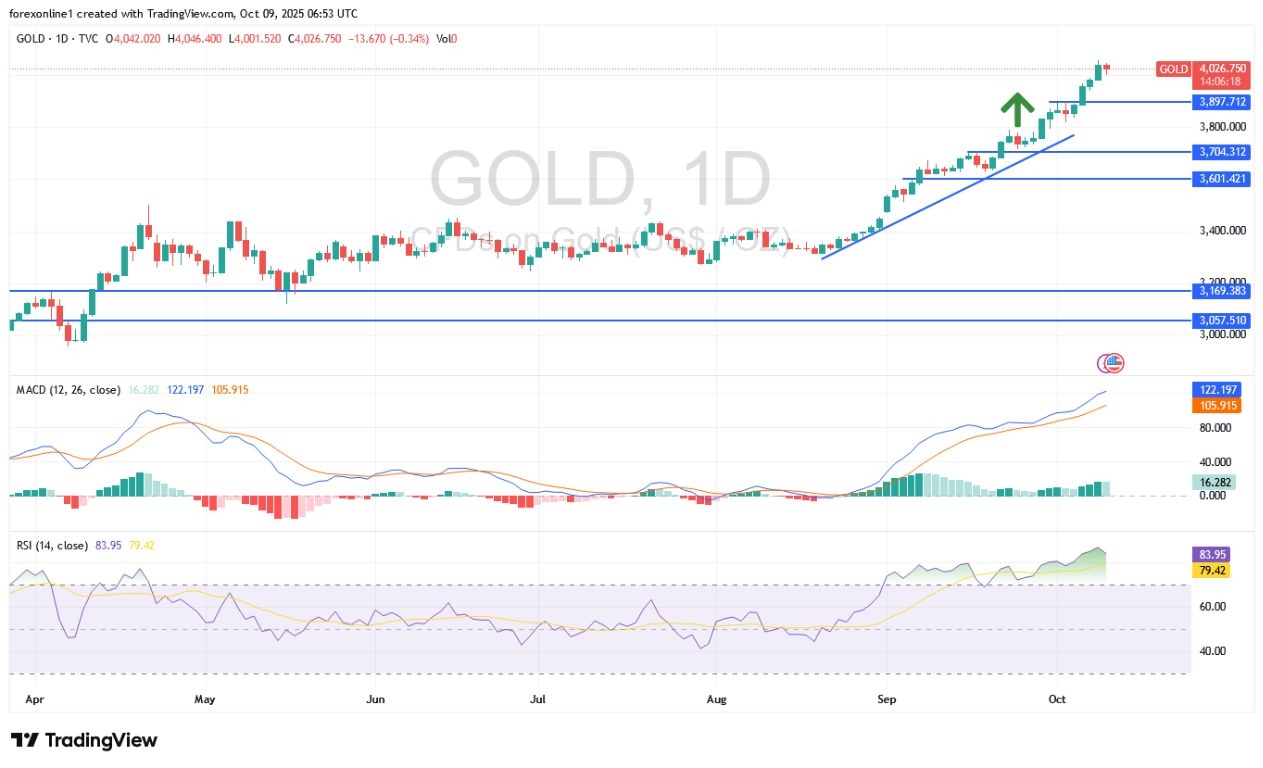
Spot Gold retreated from the record high of $4,059.36 posted on Wednesday, and plunged below the $4,000 mark in the American session. Broad US Dollar (USD) demand amid risk aversion dominates financial boards on Thursday, with fears revolving around the extended United States (US) government shutdown.
The US missed the release of another batch of employment-related data amid the shutdown, after another failed attempt to pass a funding bill on Thursday. The Senate rejected both the Democratic and the Republican bills, after holding a seventh round of voting.
Wall Street is under strong selling pressure, with the three major indexes trading in the red, also reflecting the market concerns. As for the Greenback, it stands victorious across the FX board, particularly firmer against commodity-linked currencies.
Other than that, speculative interest seems to have ignore the latest headlines related to the Gaza war. On Wednesday, US President Donald Trump announced a peace deal. The first phase is still to be approved by the Israeli Security cabinet, with a ceasefire expected within 24 hours of such approval. President Trump expects the remaining hostages to be released early next week.
The XAU/USD pair fell towards the $3,950 area, maintaining the bearish momentum. Technical readings in the daily chart indicate that the metal is correcting extreme overbought conditions, but still far from confirming an interim top. The Relative Strength Index (RSI) indicator heads sharply lower, but holds above the 70 level. At the same time, moving averages maintain their sharp bullish slopes far below the current level, with the 20 Simple Moving Average (SMA) currently standing at around $3,800.
The near-term picture, however is bearish. In the 4-hour chart, technical indicators crossed below their midlines, with the Momentum heading south almost vertically. At the same time, XAU/USD fell below a now flat 20 SMA, providing dynamic resistance at around $4,001.00. Finally, the longer moving averages maintain their upward slopes far below the current level, limiting the bearish scope in the longer term.
Support levels: 3,944.60 3,931.90 3,918.70
Resistance levels: 3,984.00 4,001.00 4,020.00
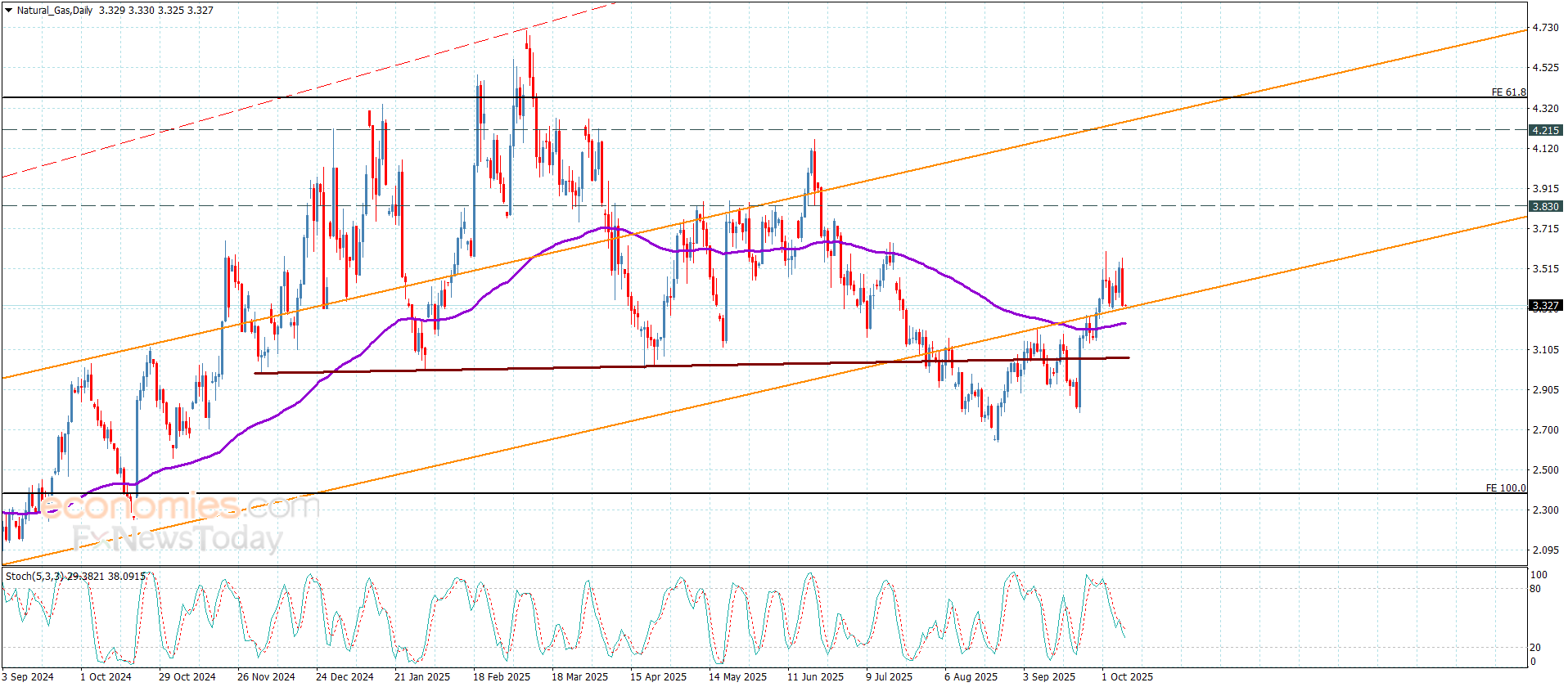
The rejection at the 200-day moving average underscores its role as a formidable resistance area. This was the first test of the 200-day line as resistance since it flipped from support in late July, amplifying the bearish implications of today’s price action. Prices lingering near the session’s lows suggest a close below the 10-day average, the $3.30 neckline, and the uptrend line, locking in the bearish outlook. This setup hints at more than a fleeting pullback, especially given the failure of a bullish breakout attempt, which often triggers sharp moves in the opposite direction.
A short-term rising channel highlights a minimum downside target near the channel’s midpoint, coinciding with the 20-day moving average at $3.15. However, the magnitude of today’s reversal raises the possibility of a deeper slide toward the channel’s lower boundary or the 50-day moving average at $3.03—a key dynamic support reclaimed in late September. The first test of the 50-day as support, after serving as resistance, should attract buyers, but a failure there could accelerate losses. The broader falling channel pattern, now marked by a failed bullish breakout, supports the case for further pressure from the bears.
The weekly chart aligns with the bearish daily chart, with natural gas poised to close near the week’s lows and forming a bearish inverted hammer inside last week’s range. This pattern strengthens the case for sustained selling. A decisive rally above this week’s high of $3.35 would challenge the bearish thesis, but for now, sellers hold the reins. Watch Friday’s close for confirmation—$3.15 looms as the next battleground.
For a look at all of today’s economic events, check out our economic calendar.
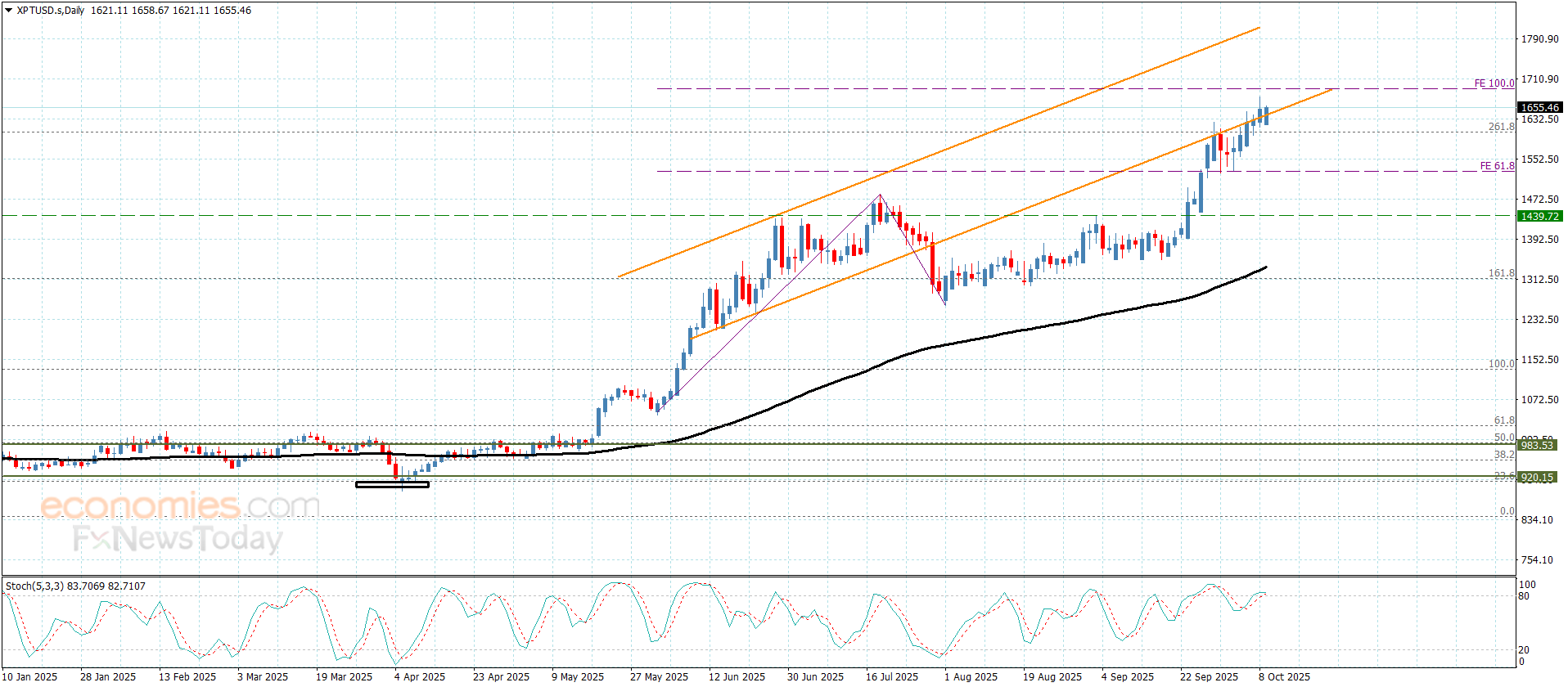
Platinum price repeated providing positive closes in the last period by its stability above $1600.00 level, forming an extra support against the bullish attempts, attempting to settle within the minor bullish channel’s levels by its fluctuating near $1655.00.
Note that stochastic attempt to settle within the overbought level might provide extra positive momentum, reinforcing the mission of recording positive stations, which might begin at $1690.00 and $1727.00, while the price decline below the mentioned extra support might force it to provide mixed trading, and there is a chance to decline towards $1665.00 before recording any of the suggested extra targets.
The expected trading range for today is between $1600.00 and $1690.00
Trend forecast: Bullish
Silver (XAG/USD) accelerated its recovery on Thursday, with precious metals trading firmer despite the US Dollar’s strength. The pair has reached fresh long-term highs, near 49.70, drawing closer to the $50.00 psychological levels.
Precious metals remain bid on Thursday, fuelled by the political uncertainty in France and Japan, while the US government shutdown enters its eighth day without a solution in sight.
Earlier in the day, New York Fed President John Williams showed his support for further rate cuts, while the focus now shifts to Fed Chairman Jerome Powell and Governor Michelle Bowman, who are expected to talk at a banking event in Washington later today.
Silver remains heading north, the pair has rallied more than 20% in the last three weeks and is looking overstretched, but the fundamental scenario remains supportive, and there are no signs of a correction other than the bearish divergence on the 4-hour RSI
The white metal bounced from $48.40 in early trading on Thursday and has reached the 49.70 area, with bulls targeting the $50.00 level, where the top of the ascending channel from the mid-September lows meets the price. Further up, the 161.8% Fibonacci extension of the early October rally is at $50.70.
On the downside, immediate support is at Wednesday’s low of $48.40 ahead of the confluence of trendline support with the October 7 lows, at $47.50, and the September 30 and October 2 lows, at the $45.90-$46.00 area.
Silver is a precious metal highly traded among investors. It has been historically used as a store of value and a medium of exchange. Although less popular than Gold, traders may turn to Silver to diversify their investment portfolio, for its intrinsic value or as a potential hedge during high-inflation periods. Investors can buy physical Silver, in coins or in bars, or trade it through vehicles such as Exchange Traded Funds, which track its price on international markets.
Silver prices can move due to a wide range of factors. Geopolitical instability or fears of a deep recession can make Silver price escalate due to its safe-haven status, although to a lesser extent than Gold’s. As a yieldless asset, Silver tends to rise with lower interest rates. Its moves also depend on how the US Dollar (USD) behaves as the asset is priced in dollars (XAG/USD). A strong Dollar tends to keep the price of Silver at bay, whereas a weaker Dollar is likely to propel prices up. Other factors such as investment demand, mining supply – Silver is much more abundant than Gold – and recycling rates can also affect prices.
Silver is widely used in industry, particularly in sectors such as electronics or solar energy, as it has one of the highest electric conductivity of all metals – more than Copper and Gold. A surge in demand can increase prices, while a decline tends to lower them. Dynamics in the US, Chinese and Indian economies can also contribute to price swings: for the US and particularly China, their big industrial sectors use Silver in various processes; in India, consumers’ demand for the precious metal for jewellery also plays a key role in setting prices.
Silver prices tend to follow Gold’s moves. When Gold prices rise, Silver typically follows suit, as their status as safe-haven assets is similar. The Gold/Silver ratio, which shows the number of ounces of Silver needed to equal the value of one ounce of Gold, may help to determine the relative valuation between both metals. Some investors may consider a high ratio as an indicator that Silver is undervalued, or Gold is overvalued. On the contrary, a low ratio might suggest that Gold is undervalued relative to Silver.
Thursday, October 09, 2025: Gold Forecast and Analysis of the price of gold XAU/USD today
Today’s Gold Analysis Overview:
Today’s Gold Trading Signals:
Amid moves that have amazed investors, gold futures are already heading towards a new milestone in the middle of the trading week. Just one day after surpassing $4000 per ounce for the first time, the gold price index is looking to reach $4100 per ounce. According to gold trading platforms, the yellow metal’s index has risen to the resistance level of $4060 per ounce, the highest in the history of the gold trading market. Overall, the price of gold has risen by more than 4% this week, bringing its year-to-date increase to about 54%.
In a similar performance, silver, gold’s sister commodity, is attempting to reach $49 per ounce. According to trades, the price of the white metal has risen by 3% this week, boosting its year-to-date gain to about 67%. Silver prices are closing near their all-time high from 1980.
According to the monitoring and expectations of gold analysts, gold prices have continued their meteoric rise amid a weak US dollar, lower interest rates, and massive demand from central banks. This is compounded by increasing global geopolitical tensions led by the ongoing US government shutdown and European political anxiety, most notably the situation in France.
According to forex market trading, the US Dollar Index (DXY), a measure of the greenback’s strength against a basket of other major currencies, has fallen by 9% this year, although it is expected to post consecutive gains. A weak US dollar is beneficial for dollar-priced commodities because it makes them cheaper for foreign investors to buy. Another influential factor in the gold market is that US Treasury yields have mostly declined, with the benchmark 10-year yield falling below 4.1%. Lower interest rates help reduce the opportunity cost of holding non-yielding bullion.
Meanwhile, data indicates that central banks and retail traders are buying gold at a rapid pace. In fact, figures show that central banks now hold an amount of gold equivalent to their holdings of US Treasury bonds, with many pointing to countries diversifying their investments away from the US dollar. Overall, the demand for gold also reflects the growing size of US holdings. Recent data shows that the value of US gold reserves has now surpassed $1 trillion for the first time, driven by price appreciation rather than new acquisitions. Globally, across reliable platforms, precious metals markets have seen a comprehensive recovery as investors hedge against inflation, currency risks, and geopolitical uncertainty, with silver and platinum prices reaching multi-year highs.

Looking ahead, investors remain optimistic about gold trading as the Federal Reserve and other global central banks are engaged in an interest rate-cutting cycle. According to the CME FedWatch Tool, the futures market is betting on two additional quarter-point rate cuts this year. Despite investors buying gold at record levels, conditions indicate that the metal is in a severely overbought state. The Relative Strength Index (RSI) for gold has reached approximately 89.72 on the monthly chart – its highest level since at least 1980.
Dear TradersUp trader, we advise against buying gold at its all-time highs and suggest waiting for a strong price pullback to consider buying again. According to a Morgan Stanley announcement, gold is their top pick among commodities, and they expect the metal to reach a higher-than-expected price of $4,400 next year.
Ready to trade our Gold price forecast? We’ve made a list of the best Gold trading platforms worth trading with.
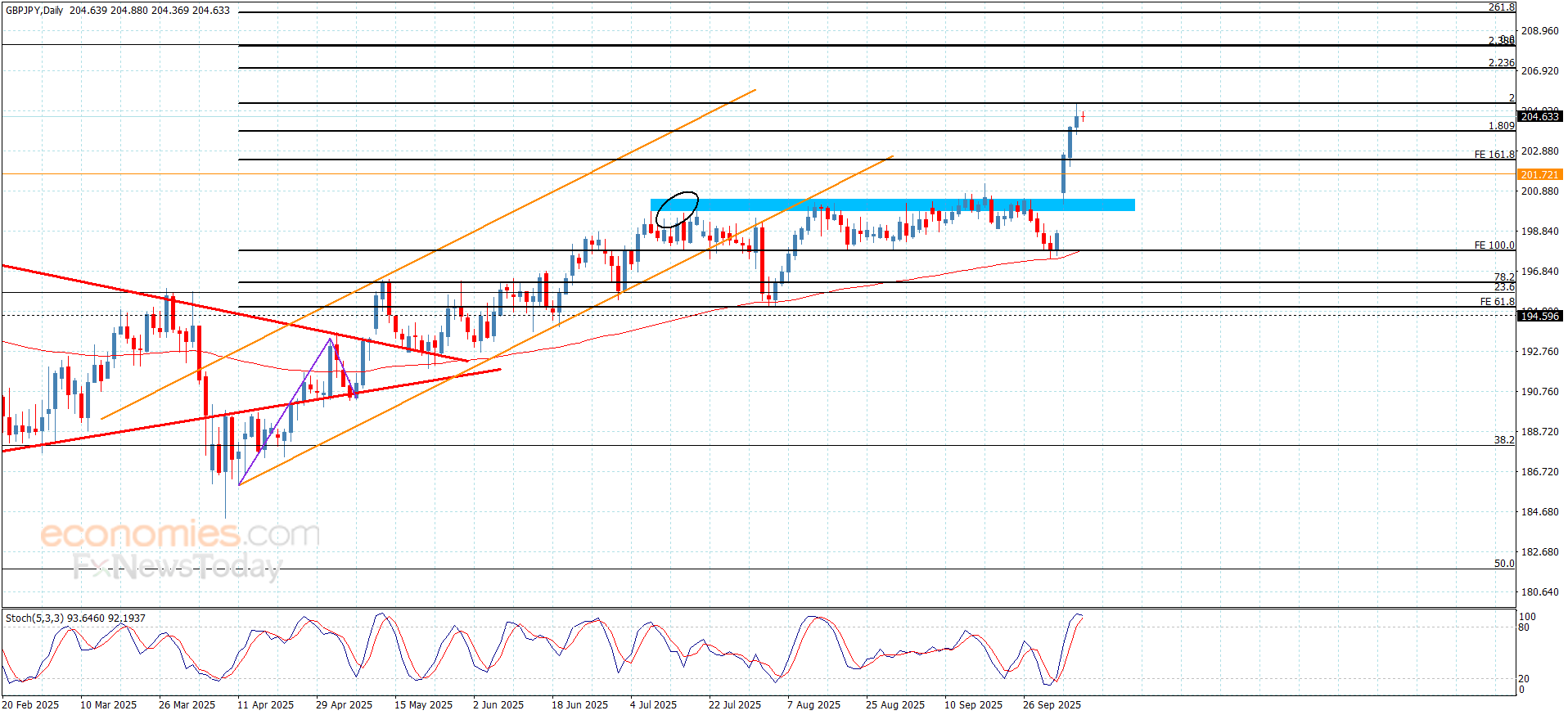
The EURJPY pair succeeded in resuming its bullish attempts yesterday, to hit the extra target at 177.80, to settle below it announces its confinement within tight track that is represented by the initial support at 176.95, and 177.80 level forms a key barrier against the bullish trading.
We remain neutral due to the instability of the price, until surpassing the previously- mentioned levels, to confirm the suggested targets in the near trading, the price success in breaching the barrier and holding above it will increase the chances for resuming the main bullish trend, attempting to reach 178.45 followed by the trading towards the bullish channel’s resistance at 179.60 level, while the decline below the extra support will support activating the attempts of gathering the gains, to reach 176.20 directly, then testing the next support near 175.20.
The expected trading range for today is between 176.90 and 177.80
Trend forecast: Neutral
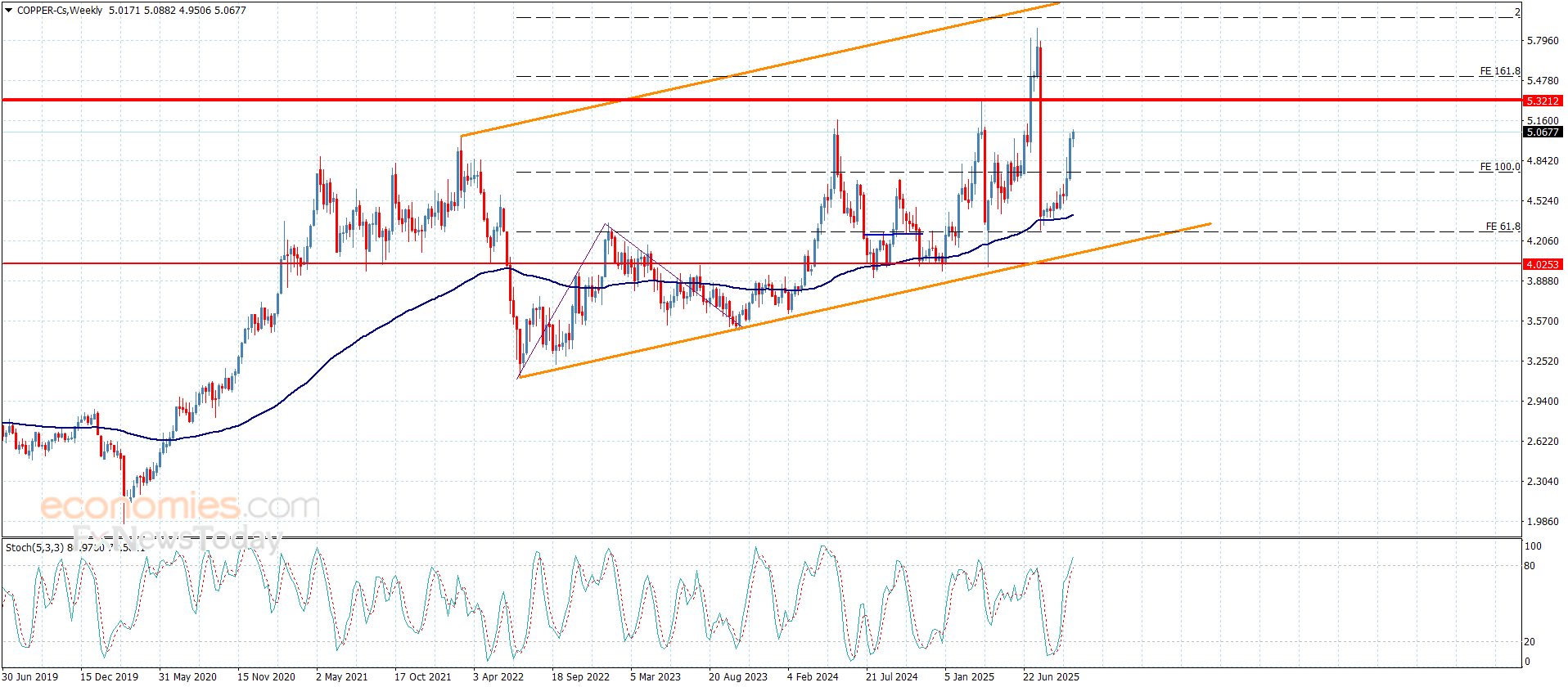
Copper price began today’s trading with a new positivity, attempting to breach the barrier at $5.0600 level, to confirm its surrender to the suggested bullish scenario.
We recommend waiting for confirming the activation of the price with the positivity of the main indicators by its rally towards $5.200 level, then attempt to press on the barrier at $5.3200, forming the initial main target of the current bullish track.
The expected trading range for today is between $4,988 and $5.2000
Trend forecast: Bullish
Platinum price repeated providing positive closes in the last period by its stability above $1600.00 level, forming an extra support against the bullish attempts, attempting to settle within the minor bullish channel’s levels by its fluctuating near $1655.00.
Note that stochastic attempt to settle within the overbought level might provide extra positive momentum, reinforcing the mission of recording positive stations, which might begin at $1690.00 and $1727.00, while the price decline below the mentioned extra support might force it to provide mixed trading, and there is a chance to decline towards $1665.00 before recording any of the suggested extra targets.
The expected trading range for today is between $1600.00 and $1690.00
Trend forecast: Bullish
West Texas Intermediate (WTI) Oil price falls on Thursday, early in the European session. WTI trades at $64.60 per barrel, down from Wednesday’s close at $64.68.
Brent Oil Exchange Rate (Brent crude) is also shedding ground, trading at $68.28 after its previous daily close at $68.37.
WTI Oil is a type of Crude Oil sold on international markets. The WTI stands for West Texas Intermediate, one of three major types including Brent and Dubai Crude. WTI is also referred to as “light” and “sweet” because of its relatively low gravity and sulfur content respectively. It is considered a high quality Oil that is easily refined. It is sourced in the United States and distributed via the Cushing hub, which is considered “The Pipeline Crossroads of the World”. It is a benchmark for the Oil market and WTI price is frequently quoted in the media.
Like all assets, supply and demand are the key drivers of WTI Oil price. As such, global growth can be a driver of increased demand and vice versa for weak global growth. Political instability, wars, and sanctions can disrupt supply and impact prices. The decisions of OPEC, a group of major Oil-producing countries, is another key driver of price. The value of the US Dollar influences the price of WTI Crude Oil, since Oil is predominantly traded in US Dollars, thus a weaker US Dollar can make Oil more affordable and vice versa.
The weekly Oil inventory reports published by the American Petroleum Institute (API) and the Energy Information Agency (EIA) impact the price of WTI Oil. Changes in inventories reflect fluctuating supply and demand. If the data shows a drop in inventories it can indicate increased demand, pushing up Oil price. Higher inventories can reflect increased supply, pushing down prices. API’s report is published every Tuesday and EIA’s the day after. Their results are usually similar, falling within 1% of each other 75% of the time. The EIA data is considered more reliable, since it is a government agency.
OPEC (Organization of the Petroleum Exporting Countries) is a group of 12 Oil-producing nations who collectively decide production quotas for member countries at twice-yearly meetings. Their decisions often impact WTI Oil prices. When OPEC decides to lower quotas, it can tighten supply, pushing up Oil prices. When OPEC increases production, it has the opposite effect. OPEC+ refers to an expanded group that includes ten extra non-OPEC members, the most notable of which is Russia.