The main tag of Gold Price Articles.
You can use the search box below to find what you need.
[wd_asp id=1]
The main tag of Gold Price Articles.
You can use the search box below to find what you need.
[wd_asp id=1]
The World Bank’s beverage price index eased in early to mid-May after reaching a record high in April 2024. This year, the index is expected to average over 20 percent higher than in 2023, with a projected decrease in 2025 as new supplies enter the market. However, the emerging La Niña could cause weather-related disruptions, posing risks to this forecast.
After reaching record highs in April, coffee prices eased in May. Both Arabica and Robusta prices declined following significant weather-related supply constraints in the first quarter of 2024, particularly impacting Robusta. The global coffee market is expected to see some relief with an anticipated addition of nearly 7 million bags this season, mainly from key Arabica producers such as Brazil and Colombia. However, the Robusta market will continue to face supply challenges, particularly in Vietnam—the world’s dominant Robusta supplier—where hot and dry conditions could impair yields. On the demand side, consumption is projected to increase by more than 1 percent from last season, reaching a record 170.5 million bags during the ongoing 2023-24 season. Arabica prices are expected to rise marginally in 2024 before easing in 2025. In contrast, Robusta prices are projected to average more than 40 percent higher in 2024 compared to 2023 before also easing in 2025. Risks to this forecast, especially for 2025, include the emerging La Niña, which could impact production in both South America and East Asia.
You have reached your limit of 5 free articles for this month.
Only $9.99 on your first month! And access to all our articles and insights.
Your coupon code
Gold remained weak throughout the first half of Tuesday, albeit holding on to familiar levels as financial markets traded with an optimistic yet neutral stance. XAU/USD fell to $2,349.31 yet quickly trimmed losses and bounced towards the current price zone just above $2,360 as investors assessed words from Federal Reserve (Fed) Chairman Jerome Powell.
Testifying before the Senate Banking Committee on monetary policy, Powell offered some hawkish headlines that helped the US Dollar. Among other things, he said that restrictive policies are helping put downward pressure on inflation, but adding that inflation remains above the 2% goal. Furthermore, he said that policymakers are not confident enough that elevated inflation will keep receding and that they need more confidence to abandon the tight monetary policy stance. Finally, he explained that decisions would be made meeting by meeting.
Powell will repeat its testimony on Wednesday before a different commission and may add some interesting headlines, although the most relevant comments have already been made.
From a technical point of view, the daily chart for XAU/USD shows it trades at around its daily opening, with the risk still skewed to the upside. The pair keeps trading above all its moving averages, with the 20 Simple Moving Average (SMA) flat, providing dynamic support at around $2,335. The 100 and 200 SMAs maintain their upward slopes far below it, while technical indicators turned flat right above their midlines.
In the near term, and according to the 4-hour chart, on the contrary, the risk skews to the downside. Sellers are aligned at around a flat 20 SMA, while technical indicators are crossing their midlines into negative territory without enough strength to confirm an upcoming slide. Finally, the 100 and 200 SMAs converge at around the $2,335 price zone, reinforcing its relevance as a support area.
Support levels: 2,349.30 2,335.00 2,318.40
Resistance levels: 2,368.60, 2,387.60 2,400.00
Gold remained weak throughout the first half of Tuesday, albeit holding on to familiar levels as financial markets traded with an optimistic yet neutral stance. XAU/USD fell to $2,349.31 yet quickly trimmed losses and bounced towards the current price zone just above $2,360 as investors assessed words from Federal Reserve (Fed) Chairman Jerome Powell.
Testifying before the Senate Banking Committee on monetary policy, Powell offered some hawkish headlines that helped the US Dollar. Among other things, he said that restrictive policies are helping put downward pressure on inflation, but adding that inflation remains above the 2% goal. Furthermore, he said that policymakers are not confident enough that elevated inflation will keep receding and that they need more confidence to abandon the tight monetary policy stance. Finally, he explained that decisions would be made meeting by meeting.
Powell will repeat its testimony on Wednesday before a different commission and may add some interesting headlines, although the most relevant comments have already been made.
From a technical point of view, the daily chart for XAU/USD shows it trades at around its daily opening, with the risk still skewed to the upside. The pair keeps trading above all its moving averages, with the 20 Simple Moving Average (SMA) flat, providing dynamic support at around $2,335. The 100 and 200 SMAs maintain their upward slopes far below it, while technical indicators turned flat right above their midlines.
In the near term, and according to the 4-hour chart, on the contrary, the risk skews to the downside. Sellers are aligned at around a flat 20 SMA, while technical indicators are crossing their midlines into negative territory without enough strength to confirm an upcoming slide. Finally, the 100 and 200 SMAs converge at around the $2,335 price zone, reinforcing its relevance as a support area.
Support levels: 2,349.30 2,335.00 2,318.40
Resistance levels: 2,368.60, 2,387.60 2,400.00
You have reached your limit of 5 free articles for this month.
Access all our articles, insights, and analysts.
Your coupon code
Gold price is attempting a tepid bounce while defending the $2,350 psychological support in Asian trading on Tuesday.
The renewed uptick in Gold price could be attributed to the downside consolidation phase of the US Dollar and the US Treasury bond yields. Traders eagerly await US Federal Reserve (Fed) Chairman Jerome Powell’s congressional testimonies for fresh hints on the interest-rate cut timing.
Markets are pricing a 77% chance that the Fed will lower rates in September, according to the CME Group’s FedWatch Tool. Another cut is expected by December.
Friday’s disappointing US labor market report affirmed a Fed rate cut in September after the headline Nonfarm Payrolls (NFP) increased by 206,000 in June, beating the market forecast for a 190,000 gain but April and May readings were significantly revised down by a combined 111,000. Average hourly earnings rose 3.9% year-on-year, as expected, registering its lowest since the second quarter of 2021.
Fed Chair Powell’s words could reinforce dovish Fed expectations, lifting Gold price to all-time highs beyond $2,400 at the expense of the US Dollar and the Treasury bond yields. Powell delivers two days of testimony before the Senate Banking Committee, beginning later on Tuesday and followed by the House Financial Services Committee on Wednesday.
Besides, several other Fed policymakers are also likely to speak on Tuesday, which could drive the Gold price action amid a data-light US calendar.
Gold price tumbled on Monday due to profit-taking and concerns over China’s Gold demand. Gold traders resorted to profit-taking after the bright metal failed at the $2,400 threshold while some repositioned ahead of Powell’s testimony and US inflation data due this week.
The People’s Bank of China (PBOC) said on Sunday, China held 72.80 million troy ounces of Gold at the end of June, unchanged from the end of May, the data showed. This was the second month in a row that the PBOC refrained from adding Gold to its reserves.
The short-term technical outlook for Gold price remains constructive, as the 14-day Relative Strength Index (RSI) turns north again, above the 50 level.
Gold buyers must take out the six-week high of $2,393 to resume the uptrend toward the all-time high of $2,450. Ahead of that, the $2,400 level could act as a tough nut to crack for them.
On the flip side, Gold price could face immediate support at the $2,350 psychological barrier, below which the $2,340 demand area will be challenged.
Around that level, the 50-day Simple Moving Average (SMA) and the 21-day SMA close in. A sustained move below the latter could trigger a fresh downtrend toward the $2,300 round level.
Federal Reserve Chair Jerome Powell testifies before Congress, providing a broad overview of the economy and monetary policy. Powell’s prepared remarks are published ahead of the appearance on Capitol Hill.
Read more.
Frequency: Irregular
Consensus: –
Previous: –
Source: Federal Reserve
Gold price is attempting a tepid bounce while defending the $2,350 psychological support in Asian trading on Tuesday.
The renewed uptick in Gold price could be attributed to the downside consolidation phase of the US Dollar and the US Treasury bond yields. Traders eagerly await US Federal Reserve (Fed) Chairman Jerome Powell’s congressional testimonies for fresh hints on the interest-rate cut timing.
Markets are pricing a 77% chance that the Fed will lower rates in September, according to the CME Group’s FedWatch Tool. Another cut is expected by December.
Friday’s disappointing US labor market report affirmed a Fed rate cut in September after the headline Nonfarm Payrolls (NFP) increased by 206,000 in June, beating the market forecast for a 190,000 gain but April and May readings were significantly revised down by a combined 111,000. Average hourly earnings rose 3.9% year-on-year, as expected, registering its lowest since the second quarter of 2021.
Fed Chair Powell’s words could reinforce dovish Fed expectations, lifting Gold price to all-time highs beyond $2,400 at the expense of the US Dollar and the Treasury bond yields. Powell delivers two days of testimony before the Senate Banking Committee, beginning later on Tuesday and followed by the House Financial Services Committee on Wednesday.
Besides, several other Fed policymakers are also likely to speak on Tuesday, which could drive the Gold price action amid a data-light US calendar.
Gold price tumbled on Monday due to profit-taking and concerns over China’s Gold demand. Gold traders resorted to profit-taking after the bright metal failed at the $2,400 threshold while some repositioned ahead of Powell’s testimony and US inflation data due this week.
The People’s Bank of China (PBOC) said on Sunday, China held 72.80 million troy ounces of Gold at the end of June, unchanged from the end of May, the data showed. This was the second month in a row that the PBOC refrained from adding Gold to its reserves.
The short-term technical outlook for Gold price remains constructive, as the 14-day Relative Strength Index (RSI) turns north again, above the 50 level.
Gold buyers must take out the six-week high of $2,393 to resume the uptrend toward the all-time high of $2,450. Ahead of that, the $2,400 level could act as a tough nut to crack for them.
On the flip side, Gold price could face immediate support at the $2,350 psychological barrier, below which the $2,340 demand area will be challenged.
Around that level, the 50-day Simple Moving Average (SMA) and the 21-day SMA close in. A sustained move below the latter could trigger a fresh downtrend toward the $2,300 round level.
Federal Reserve Chair Jerome Powell testifies before Congress, providing a broad overview of the economy and monetary policy. Powell’s prepared remarks are published ahead of the appearance on Capitol Hill.
Read more.
Frequency: Irregular
Consensus: –
Previous: –
Source: Federal Reserve
You have reached your limit of 5 free articles for this month.
Access all our articles, insights, and analysts.
Your coupon code
Gold prices were sharply lower on Monday, with XAU/USD trading in the $2,350 region after surpassing the $2,390 level on Friday. Financial markets started the week in a better mood after the surprise defeat of Marine Le Pen’s far-right party in the French elections. After coming up victorious in the preliminary polling, the party ended up in third place, while a coalition of left parties led the votes.
Additionally, market participants welcomed hints of easing inflationary pressures in the United States (US), reviving hopes for a Federal Reserve (Fed) interest rate cut in September. Chairman Jerome Powell acknowledged signs of disinflation, and the Nonfarm Payrolls (NFP) report showed wages rose at a slower pace in June, while the Unemployment Rate ticked higher to 4.1% in the same month.
Relevant macroeconomic news will come later in the week, as the US is scheduled to release the June Consumer Price Index (CPI) report next Thursday.
From a technical point of view, XAU/USD is under pressure, yet not bearish. In the daily chart, the pair keeps developing above all its moving averages, although the 20 Simple Moving Average (SMA) has lost its directional strength and stands pat above the bullish 100 and 200 SMA. At the same time, technical indicators turned lower, gaining downward momentum albeit within positive levels.
The near-term picture is bearish. The intraday slump put XAU/USD below a now flat 20 SMA, while the 100 and 200 SMA stand around the $2,330 level, reinforcing its relevance. The long bearish candles indicate strong selling interest, while technical indicators heading south almost vertically and crossing their midlines into negative territory anticipate another leg s th. Bulls may reappear on an approach to the $2,330 mark, although a break below the level could anticipate a steeper slide towards the $2,300 threshold.
Support levels: 2,341.50 2,329.20 2,313.60
Resistance levels: 2,368.60, 2,387.60 2,400.00
Gold prices were sharply lower on Monday, with XAU/USD trading in the $2,350 region after surpassing the $2,390 level on Friday. Financial markets started the week in a better mood after the surprise defeat of Marine Le Pen’s far-right party in the French elections. After coming up victorious in the preliminary polling, the party ended up in third place, while a coalition of left parties led the votes.
Additionally, market participants welcomed hints of easing inflationary pressures in the United States (US), reviving hopes for a Federal Reserve (Fed) interest rate cut in September. Chairman Jerome Powell acknowledged signs of disinflation, and the Nonfarm Payrolls (NFP) report showed wages rose at a slower pace in June, while the Unemployment Rate ticked higher to 4.1% in the same month.
Relevant macroeconomic news will come later in the week, as the US is scheduled to release the June Consumer Price Index (CPI) report next Thursday.
From a technical point of view, XAU/USD is under pressure, yet not bearish. In the daily chart, the pair keeps developing above all its moving averages, although the 20 Simple Moving Average (SMA) has lost its directional strength and stands pat above the bullish 100 and 200 SMA. At the same time, technical indicators turned lower, gaining downward momentum albeit within positive levels.
The near-term picture is bearish. The intraday slump put XAU/USD below a now flat 20 SMA, while the 100 and 200 SMA stand around the $2,330 level, reinforcing its relevance. The long bearish candles indicate strong selling interest, while technical indicators heading south almost vertically and crossing their midlines into negative territory anticipate another leg s th. Bulls may reappear on an approach to the $2,330 mark, although a break below the level could anticipate a steeper slide towards the $2,300 threshold.
Support levels: 2,341.50 2,329.20 2,313.60
Resistance levels: 2,368.60, 2,387.60 2,400.00
Moreover, since the downtrend price structure remains, a decline to test the next lower support zone is still a possibility. Keep in mind that rallies will be heading up into potential resistance around the 200-Day MA, currently at 2.47. Since it is a long-term moving average and the price of natural gas continued to fall after an initial decline below the line last Tuesday, it can be expected to mark an area where resistance may be encountered on the way up.
The next lower support zone looks to be around 2.23 to 2.17. It begins with a prior swing low from December and a resistance level from early-February. A 61.8% Fibonacci retracement completes within the price zone at 2.18, while an extended falling ABCD pattern completes at 2.20. In summary, there are four indicators pointing to the 2.23 to 2.17 price zone as potential support.
Further, on the weekly chart, the 20-Week MA shows within the price zone at 2.20. The 2.17 price level is shown to have a harmonic relationship with the price drop seen in the first AB leg of the decline. Rather than the AB and CD legs of the decline being equal, a Fibonacci ratio of 127.2% is applied to the price distance seen in the AB leg and that amount is subtracted from the beginning of the CD decline.
When more than normal indicators point to a price range, the market is telling us to pay attention. Therefore, natural gas may rally further from today’s low, but it is heading into potential resistance. If resistance is strong enough it may turn the price of natural gas back down for a potential test of support beginning from the 2.23 price area.
For a look at all of today’s economic events, check out our economic calendar.
U.S. crude oil futures fell Monday as traders monitored the impact of Tropical Storm Beryl on Gulf Coast refining, production and export infrastructure.
Beryl made landfall near Matagorda, Texas, as a Category 1 hurricane with maximum sustained winds of 80 miles per hour, according to the National Hurricane Center. Matagorda is about 150 miles northeast of Corpus Christi, a leading crude export facility in the U.S.
Beryl was subsequently downgraded to a tropical storm with maximum sustained winds of 70 miles per hour and is forecast to weaken further, according to the NHC. The storm is moving in a northeast direction.
U.S. crude oil closed lower on Friday while still booking a fourth consecutive weekly gain, as traders took advantage of recent prices after the benchmark touched a two-month high of $84.52 per barrel.
Here are today’s energy prices:
Shell shut in production and evacuated personnel from its Perdido platform about 200 miles south of Galveston, according to a company statement Friday. The platform was producing roughly 100,000 barrels per day, or bpd, about 5.5% of oil production in the Gulf of Mexico, according to Andy Lipow, president of Lipow Oil Associates.
“I don’t foresee this storm affecting either supply or price to any significant degree; the consumer will get their gasoline. Most people will not even notice,” Lipow said in a note on Sunday.
There will be some reduction in refining operations and a delay in getting products to Florida, but the price of gasoline should remain steady through the storm, Lipow said. Afterward, gasoline prices may drift higher as crude futures have risen recently, he said.
Investors are worried about hurricane season this year with Colorado State University forecasting an “extremely active” storm season this year.
Prices at the pump were averaging about $3.50 per gallon nationwide on Monday, about 1 cent higher than last week but 3 cents lower than last month, according to the motorist association AAA.
“There’s enough market momentum to push prices higher throughout the next couple weeks, probably up to about $3.60 or so,” Denton Cinquegrana, chief oil analyst at Oil Price Information Service, told CNBC’s “Fast Money” on Friday.
But gasoline prices are unlikely to hit the $4 per gallon mark unless “we have something really go nuts,” Cinquegrana said.
You can Download our Complimentary Q3 Gold Technical and Fundamental Forecasts below:
Recommended by Nick Cawley
Get Your Free Gold Forecast
Gold prices are under slight pressure as China’s central bank – the People’s Bank of China (PBoC) – holds off on purchases for the second straight month. This absence of a significant buyer – the PBoC have been a constant buyer of gold over the last 18 months – leaves the precious metal susceptible to profit-taking after last week’s NFP-inspired rally. The precious metal traded at a six-week high last Friday at just under $2,400/oz. but has drifted lower today after the weekend news.
US interest rate cut expectations nudged higher at the end of last week after the latest US Jobs Report suggested a hiring slowdown. While the headline NFP number was slightly higher than expected, the prior month’s revisions, and the increase in the jobless rate to 4.1%, more than outweighed the headline beat. There is now a 74% probability of a 25bp cut at the September 18th FOMC meeting with a further quarter-point cut priced in by the end of the year.
US Dollar Unchanged on Mixed US NFPs, Gold Grabs a Small Bid
Gold remains rangebound and is currently sitting in the middle of a multi-month range. The 20- and 50-day simple moving averages remain supportive, while a clean break above $2,287/oz. would leave range resistance at $2,450/oz. under threat. A break below the two moving averages would leave $2,320/oz. as the next level of interest.
Recommended by Nick Cawley
How to Trade Gold
Retail trader data shows 51.73% of traders are net-long with the ratio of traders long to short at 1.07 to 1.The number of traders net-long is 7.45% higher than yesterday and 14.76% lower than last week, while the number of traders net-short is 2.83% higher than yesterday and 17.61% higher than last week.
We typically take a contrarian view to crowd sentiment, and the fact traders are net-long suggests Gold prices may continue to fall. Positioning is more net-long than yesterday but less net-long from last week. The combination of current sentiment and recent changes gives us a further mixed Gold trading bias.
| Change in | Longs | Shorts | OI |
| Daily | 16% | 0% | 8% |
| Weekly | -7% | 19% | 3% |
What is your view on Gold – bullish or bearish?? You can let us know via the form at the end of this piece or contact the author via Twitter @nickcawley1.
DailyFX provides forex news and technical analysis on the trends that influence the global currency markets.
Silver price (XAG/USD) edges lower to $30.95 during the early European session on Monday. The white metal declines on the back of renewed US Dollar (USD) demand and higher US bond yields. However, the precious metal’s losses might be limited by the rising bets on the US Federal Reserve (Fed) rate cuts this year.
The US employment report on Friday showed that employers added fewer jobs in June and that the Unemployment Rate rose to its highest level since late 2021, according to the US Bureau of Labor Statistics (BLS). The Nonfarm Payrolls (NFP) in the United States saw 206K job additions in June. The previous month saw a sharp downside revision to 218K from the initial reading of 272K. Meanwhile, the Unemployment Rate ticked higher to 4.1% in June from 4% in May.
The downwardly revised NFP and a further rise in the jobless rate suggested that strength in labour market conditions has eased further, prompting the expectation of Fed rate cuts in the third quarter. This, in turn, weighs on the US Dollar (USD) and creates a tailwind for the precious metal. A lower interest rate generally lifts the Silver price as it reduces the opportunity cost of holding non-yielding assets. Investors are now pricing in nearly 77% odds of a Fed rate cut in September, up from 70% before the US employment report, according to the CME FedWatch tool.
Investors will keep an eye on the Fed’s Chair Jerome Powell’s testimony to the Senate Banking Committee on Tuesday ahead of the US Consumer Price Index (CPI) inflation data for June, which is due on Thursday. The hawkish stance from the Fed and hotter-than-expected CPI inflation data could dampen the rate cut speculation, which boosts the Greenback and exerts some selling pressure on the silver price.
(This story was corrected on July 8 at 08:06 GMT to say that the precious metal’s losses might be limited, not gains).
Silver is a precious metal highly traded among investors. It has been historically used as a store of value and a medium of exchange. Although less popular than Gold, traders may turn to Silver to diversify their investment portfolio, for its intrinsic value or as a potential hedge during high-inflation periods. Investors can buy physical Silver, in coins or in bars, or trade it through vehicles such as Exchange Traded Funds, which track its price on international markets.
Silver prices can move due to a wide range of factors. Geopolitical instability or fears of a deep recession can make Silver price escalate due to its safe-haven status, although to a lesser extent than Gold’s. As a yieldless asset, Silver tends to rise with lower interest rates. Its moves also depend on how the US Dollar (USD) behaves as the asset is priced in dollars (XAG/USD). A strong Dollar tends to keep the price of Silver at bay, whereas a weaker Dollar is likely to propel prices up. Other factors such as investment demand, mining supply – Silver is much more abundant than Gold – and recycling rates can also affect prices.
Silver is widely used in industry, particularly in sectors such as electronics or solar energy, as it has one of the highest electric conductivity of all metals – more than Copper and Gold. A surge in demand can increase prices, while a decline tends to lower them. Dynamics in the US, Chinese and Indian economies can also contribute to price swings: for the US and particularly China, their big industrial sectors use Silver in various processes; in India, consumers’ demand for the precious metal for jewellery also plays a key role in setting prices.
Silver prices tend to follow Gold’s moves. When Gold prices rise, Silver typically follows suit, as their status as safe-haven assets is similar. The Gold/Silver ratio, which shows the number of ounces of Silver needed to equal the value of one ounce of Gold, may help to determine the relative valuation between both metals. Some investors may consider a high ratio as an indicator that Silver is undervalued, or Gold is overvalued. On the contrary, a low ratio might suggest that Gold is undervalued relative to Silver.
So far, the correction down from the 3.16 peak (A) has seen the price of natural gas decline by 0.86 cents or 26.7%. How does that compare with prior bearish corrections? Since the initial February 2023 trend bottom there have been five corrections with a decline of greater than 20% and three that saw drops of more than 26%. Those three corrections were 55.1%, 38.7%, and 35.7%.
Given the history, since a 26% decline has already been exceeded as well as the support zone, the potential of a minimum 35.7% has become more likely. This does not mean that it will happen, but the chance for it to happen has increased. If natural gas reaches 2.03 it will have dropped by 35.7% from the most recent swing high. That will be a pivot zone to watch if it gets that low.
In the bigger picture the bears dominate as there remains a series of lower swing lows and lower swing highs on the chart. That pattern will remain unless there is a rally above the most recent swing high of 3.16, followed by a daily close above it to confirm strength. From the February bottom, the first upside breakout triggered on a move above the top of a symmetrical triangle bottom at 2.00. If a roundtrip is in process, the area around 2.00 could be tested as support given its significance initially as resistance. Of course, that would also more than match a 35.7% price correction.
For a look at all of today’s economic events, check out our economic calendar.
Microsoft has been publicly traded for almost 40 years. Its stock has risen consistently, reaching a $1 trillion market cap in 2019. Today, the tech giant has a market cap of more than $3 trillion.
Here’s what you need to know about MSFT stock.
Microsoft is one of the original tech giants. Its stock has had decades to weather various storms.
Take the turn of the 21st century, for example. On a split-adjusted basis, MSFT climbed as high as $59.97 in December 1999 during the dot-com bubble. But it dropped as low as $14.87 in 2009 during the Great Recession. It took the stock nearly 17 years to return to its dot-com bubble highs in October 2016.
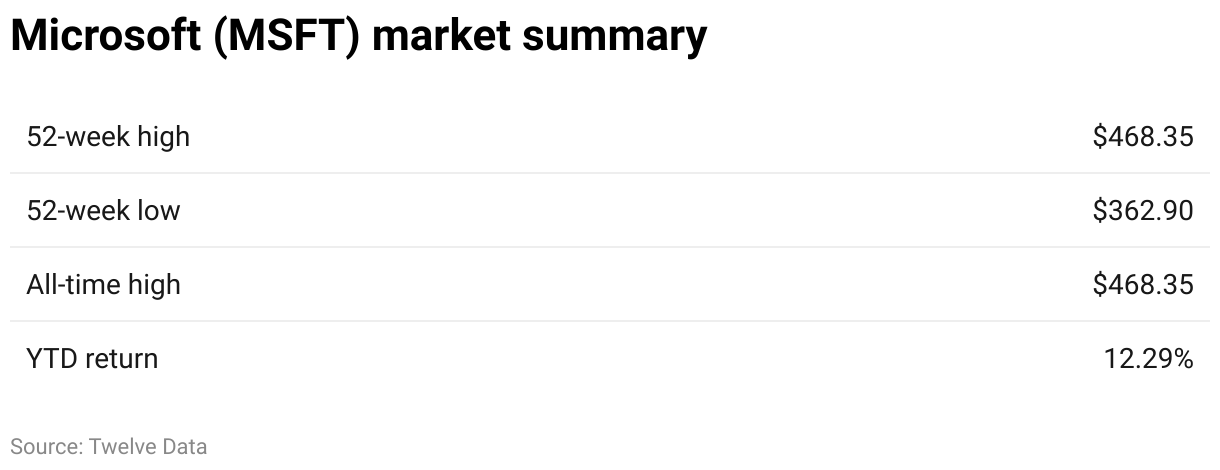
Since then, it has been on a tear. Shares reached nearly $350 in late 2021. The 2022 tech sector sell-off dropped the stock price to under $215. It rallied in 2023, hitting above $384 per share in November. The climb continued in 2024, with MSFT reaching a split-adjusted high of $446.50 on June 17, 2024.
The average target among 58 Wall Street analysts covering MSFT is $485.82.
MSFT has performed very well since its 1986 initial public offering.
Over the past 20 years ending June 13, Microsoft shares have generated returns of more than 1,400%.
Microsoft has increased its earnings over time. For fiscal 2023, revenue was $211.9 billion, up 7% from the previous year. Net income was $73.3 billion, a 6% increase. Gross margin increased $10.4 billion, or roughly 8%.
Research and development costs also increased by over $2.6 billion. Operating expenses increased by $5.3 billion, or 10%. Microsoft cited factors such as employee severance packages, acquisitions, investments in cloud engineering and LinkedIn.
Microsoft maintains a consistent net profit, with margins above 35% in the past four quarters. After seeing a decline in its cash and cash equivalents in 2021 and 2022, those figures increased in 2023.
In its early days, Microsoft focused on developing an operating system for IBM. The system, MS-DOS, was released in 1981 with IBM’s first personal computer. By the early 1990s, Microsoft had sold over 100 million copies of MS-DOS. It released its groundbreaking Windows operating system in 1985. But Windows didn’t gain traction until the 1990s.
Over the next 20 years, the company focused on shifting its business to a subscription model. It invested in its cloud services segment and expanded its presence in the gaming market.
Microsoft acquired the video collaboration application Skype in 2011. In 2016, it added LinkedIn to its portfolio. In 2020, the company bought game developer and publisher ZeniMax. It acquired cloud and artificial intelligence software company Nuance Communications the following year. In 2022, it bought Activision Blizzard, maker of “Call of Duty” and “World of Warcraft.”
The tech giant made a big splash in the AI world in 2019 when it invested $1 billion in ChatGPT maker OpenAI. That same year, it secured a deal with OpenAI to build Azure AI technologies. Microsoft announced another $10 billion investment in OpenAI in January 2023. About a month later, it integrated OpenAI technology into its Bing search engine.
Microsoft has been the subject of several controversies. In the late 1990s, the Department of Justice brought an antitrust lawsuit against the company. It alleged that Microsoft held monopoly power, citing its dominant PC market share and a high barrier to entry. As a result, customers lacked viable alternatives to Windows. The two parties later reached a settlement that restricted Microsoft’s conduct.
Microsoft has been criticized for its labor practices. In 2000, it paid $97 million to settle a lawsuit brought by temporary workers denied benefits.
The tech giant has also been accused of using its complex corporate structure to avoid paying taxes.
Microsoft is the subject of the largest audit in IRS history. The agency says the company owes $28.9 billion in back taxes, plus penalties and interest. Microsoft disputes that figure.
With an initial public offering in 1986, MSFT was priced at $21 per share. The company netted a valuation of $777 million. Before the close of the first trading day, shares reached $35.50. About 2.5 million shares were sold that day, raising $61 million.
During the IPO, co-founder Bill Gates, then 30 years old, sold $1.6 million in shares. He retained a 45% stake worth $350 million.
Purchasing MSFT during its IPO was one of the best investments of the 1990s. At the height of the dot-com bubble in 2000, its market cap reached nearly $600 billion.
The company’s most recent stock split was a 2-for-1 split in February 2003. The stock has split nine times. Today, a single share of Microsoft’s IPO stock represents 288 shares.
Microsoft is well positioned to continue outperforming. But it faces several potential stumbling blocks.
Public cloud computing is one of the largest growth markets in the tech world. Microsoft’s Azure is a leading provider in that market. The Microsoft 365 productivity software suite creates upselling opportunities and tremendous cash flow. This can help the company invest in Azure and other growth initiatives. A ChatGPT service is now on the market as ChatGPT Azure OpenAI Service. Microsoft’s relationship with OpenAI could give it a first-mover advantage in AI technology.
Unfortunately, Microsoft Office is a mature product and likely has limited growth opportunities. The company also faces competition for cloud services from other tech companies, such as Amazon.com (AMZN) and Alphabet (GOOG).
Developing AI technology is expensive. But Microsoft risks falling behind Google’s Gemini and other AI leaders if it doesn’t stay on the cutting edge of development.
MSFT is one of the top stocks in the Nasdaq composite index, with a weight of 11.78% as of March 28, 2024.
The table below orders the 10 stocks with the greatest weighting in the Nasdaq by market cap. It’s reordered daily at market close.
Analysts are generally optimistic about Microsoft’s business and stock price in 2024. The analysts covering MSFT project full-year adjusted earnings per share of $11.80 in fiscal 2024.
Microsoft’s fiscal 2024 already looks rosy. The company reported 20% net income growth in its fiscal third quarter. Revenue was $61.9 billion, increasing by 17%.
Microsoft’s revenue is expected to grow in 2025, with an average estimated $280.03 billion. That represents about a 14.3% increase from the 2024 estimate. Earnings are also expected to grow, with an estimated $13.27 per share in 2025.
AI technology is the biggest wild card for Microsoft investors in the next several years. The company is off to a strong start with its initial wave of AI product launches and investment in OpenAI.
Investors should monitor how the company integrates Activision Blizzard into its gaming business and its long-term strategy for the gaming segment.