The main tag of Gold Price Articles.
You can use the search box below to find what you need.
[wd_asp id=1]
The main tag of Gold Price Articles.
You can use the search box below to find what you need.
[wd_asp id=1]
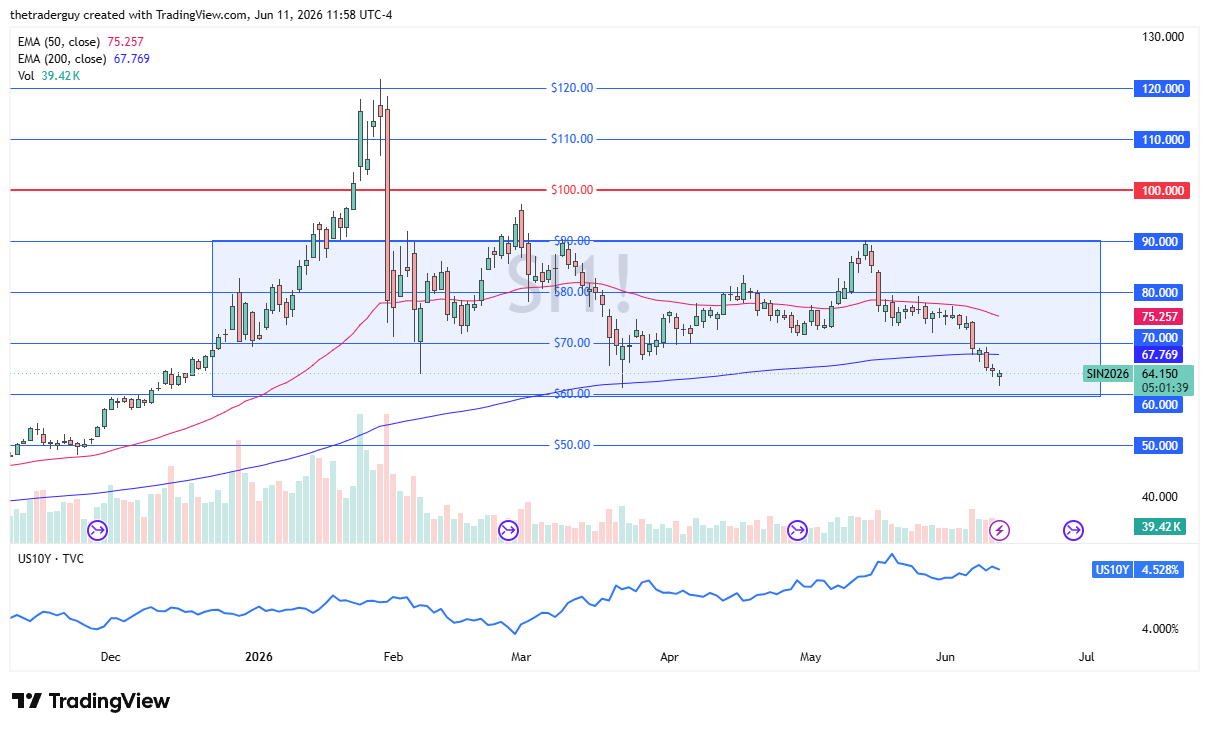
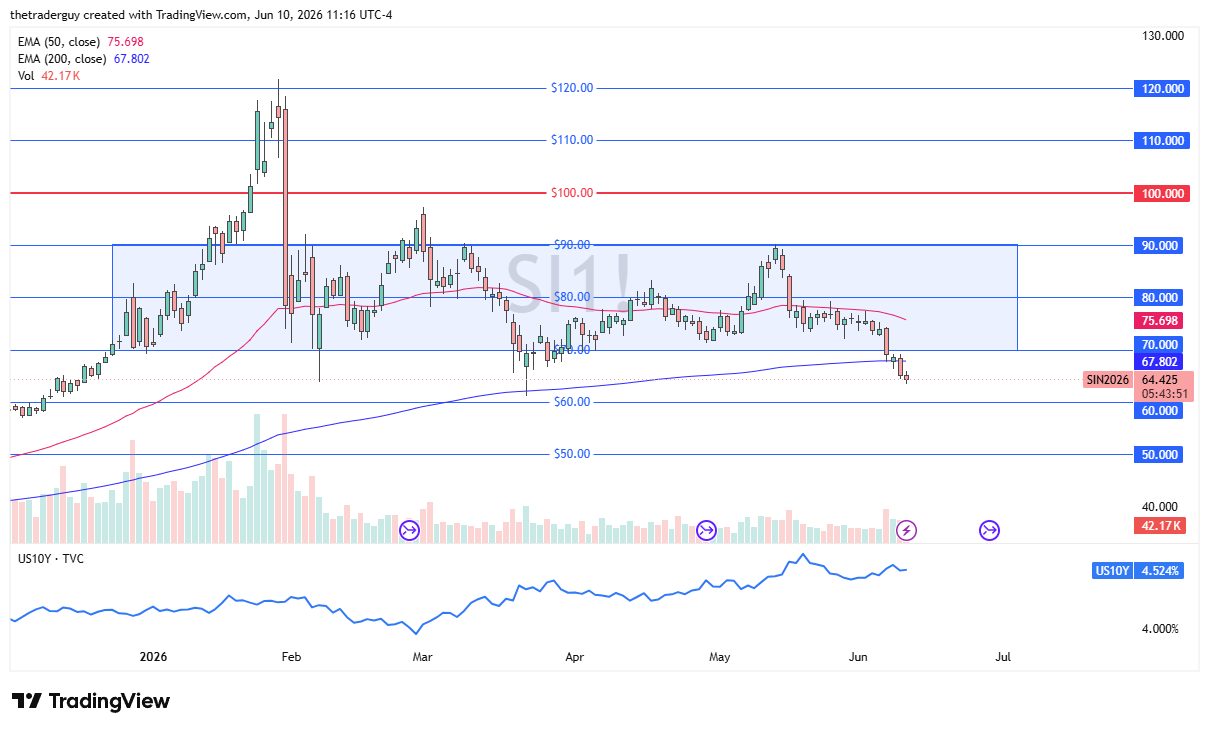
The silver market initially fell a bit during the trading session on Thursday, as the silver market continues to see a lot of pressure.
That being said, we have seen a nice bounce here with the 60-dollar level underneath, offering a bit of a floor.
If the market were to continue to see a little bit of a bounce, then we could make a move towards the 200-day EMA. That being said, I’m a little bit leery of buying a ton of silver.
It is worth noting, though, that the silver market typically has a negative correlation to interest rates, as the higher interest rates really crush these non-yielding assets. The $60 level is a large, round, psychologically significant figure that, of course, a lot of people will be watching. If we were to break down below there, then the market could go looking to the $50 level underneath.
If we rally from here, then we could see this market challenge the 200-day EMA. The 200-day EMA, of course, will cause technical traders to pay close attention to it. The headlines in the Middle East continue to be very volatile, and they, of course, have a major influence on the bond markets, so keep in mind that could be what we need to watch more than anything else.

The $60 level could be the bottom of a larger consolidation area all the way to the $90 level. Longer term, there is most certainly a massive amount of demand for silver, and the supply is nowhere near enough to keep up, at least not comfortably. So, I like silver longer term, but short term, I think we have to recognize that traders are paying more attention to the bond market than anything else. You do have to be very careful, and you do have to have the proper position size.
Ready to trade our daily forex analysis and predictions? Here are the best Silver trading brokers to choose from.
Christopher Lewis is a technical analyst and market commentator at DailyForex with more than two decades of trading experience in Forex and other leveraged markets. Based in Columbus, Ohio, he specializes in chart-based analysis of major currency pairs, stock indices, commodities, and energy markets, focusing on clear support and resistance levels, trend structure, and risk management. Christopher produces daily written and video analysis for traders who rely on technical setups to navigate volatile market conditions
As seen on: Pairs Of Aces Podcast,The Trader Guy, FXEmpire
Domestic coffee prices today
The domestic coffee market in the morning trading session of June 12, 2026 recorded a strong breakthrough after a series of days of struggling. According to data from key growing areas of the Central Highlands, the bulk bulk buying price simultaneously increased sharply from 2,200 to 2,300 VND per kg compared to the previous session, bringing the average price level of the whole region to the threshold of 87,600 VND/kg.
Specifically, in Dak Lak and Gia Lai, the price both increased by 2,200 VND, currently trading at 87,500 VND/kg. In Dak Nong (old), the purchase price increased impressively by 2,300 VND, reaching the threshold of 87,700 VND/kg.
In Lam Dong, the price of raw coffee beans increased by 2,200 VND, to 87,000 VND/kg. Along with the increase in coffee prices, pepper prices remained stable at 140,500 VND/kg, while the USD/VND exchange rate at Vietcombank was recorded at 26,102 VND/USD.
World coffee prices
In the world market, green color completely covered both futures exchanges in the nearest closing session.
On the London exchange, Robusta futures for July 2026 delivery exploded with an increase of 109 USD (equivalent to 3.25%), closing the session at 3,463 USD/ton.
On the New York exchange, Arabica futures for July 2026 delivery also increased sharply by 5.55 cents (equivalent to 2.23%), reaching 253.95 cents/lb.
Market outlook, coffee prices
The core reason for this increase is concerns about unfavorable weather in Brazil. Forecasts show that heavy and prolonged rains in key growing areas will hinder coffee harvest progress this week and may extend to next week, causing a risk of supply disruption.
Combined with warnings about the El Niño phenomenon and the high probability of “Super El Niño” this year, threatening global coffee production, has triggered a wave of subsidy buying from hedge funds.
Although long-term prospects are still under pressure from record crop forecasts, but with inventory on the ICE exchange at a low level for many months, the market is currently prioritizing response to short-term supply risks.
At 8:50 a.m. Eastern Time today, oil was priced at $89.94 per barrel with Brent serving as the benchmark (we’ll explain different benchmarks later in this article). That’s a drop of $5.21 compared with yesterday morning—but more than $19 higher than the price one year ago.
It’s impossible to forecast oil prices with detailed precision. Many different elements affect the market, but ultimately it boils down to supply and demand. When worries about economic recession, war, and other large-scale disruptions increase, oil’s path can shift fast.
Gas prices at the pump don’t only track crude oil. They also include what it takes to refine and move that fuel, the taxes layered on top, and the extra markup your local station adds to stay in business.
Since crude oil generally makes up a majority of the per-gallon cost, changes in its price have an outsized impact. When oil surges, gas prices typically rise in tandem. But when oil retreats, gas prices often lag on the way down, a trend sometimes described as “rockets and feathers.”
In case of emergency, the U.S. has a store of crude oil known as the Strategic Petroleum Reserve. Its primary purpose is energy security in case of disaster (think sanctions, severe storm damage, even war). But it can also go a long way toward softening crippling price hikes during supply shocks.
It’s not a long-term answer and is more meant to provide temporary relief, assisting consumers and keeping critical parts of the economy running, like key industries, emergency services, public transportation, etc.
Both oil and natural gas are key sources of the energy we use every day. Because of this, a big change in oil prices can affect natural gas. For example, if oil prices increase, some industries may swap natural gas for some segments of their operations where possible, which increases demand for natural gas.
To gauge oil’s performance, we often turn to two benchmarks:
Between these two, Brent better represents global oil performance because it prices much of the world’s traded crude. And, it’s often the best way to track historical oil performance. In fact, even the U.S. Energy Information Administration now uses Brent as its primary reference in its Annual Energy Outlook.
Looking at the Brent benchmark across several decades, oil has been anything but steady. It’s seen spikes due to factors such as wars and supply cuts, and it’s also seen crashes from global recessions and an oversupply (called a “glut”). For example:
All to say, oil’s historical performance has been anything but smooth. Again, it’s hugely affected by wars, recessions, OPEC whims, evolving energy initiatives and policies, and much more.
Looking to stay up-to-date regarding the latest energy developments? Check out our recent coverage:
The current price of oil per barrel depends largely on supply and demand, including news about potential future supply and demand (geopolitics, decisions made by OPEC+, etc.). In the U.S., prices also move based on how friendly an administration is to drilling, as it can affect future supply. For example, 2025 saw the Trump administration move to reopen more than 1.5 million acres in the Coastal Plain of the Arctic National Wildlife Refuge for oil and gas leasing, reversing the Biden administration’s policy of limiting oil drilling in the Arctic.
The price of oil updates constantly when the “futures” markets are open. A futures market is effectively an auction where people agree to buy or sell oil in the future. As long as people and companies are trading contracts, the oil price is changing.
In short, shale is rock that contains oil and natural gas. Think of shale as energy yet to be tapped. The more shale the U.S. accesses, the more energy we’ll have—and the more easily oil prices can keep from spiking as much thanks to a greater supply.
When oil is expensive, it tends to make everyday items cost more. This can be related to energy (your heating, gas utilities, etc.), but it’s also due to the logistics involved with making those items accessible to you. Shipping, for example, can affect the price of things at the grocery store, as it’s more expensive to get those products from warehouses and farms onto the shelf.
The article covers the following subjects:
Consider short positions from corrections below the level of 92.06 with a target of 78.00–65.00.
Breakout and consolidation above the level of 92.06 will allow the asset to continue rising to the levels of 105.17–115.45.
A descending correction appears to have formed as the second wave of larger degree (2) on the weekly chart, with wave C of (2) completed as its part. On the daily time frame, an ascending third wave (3) appears to have started developing. Within it, the first wave of smaller degree 1 of (3) has formed, and a downward correction is unfolding as the second wave 2 of (3). Wave c of 2 is presumably developing on the H4 chart; within it, wave (v) of c is unfolding. If the presumption is correct, WTI will continue to decline to the levels of 78.00–65.00. The level of 92.06 is critical in this scenario as a breakout above it will enable the asset to continue rising to the levels of 105.17–115.45.
This forecast is based on the Elliott Wave Theory. When developing trading strategies, it is essential to consider fundamental factors, as the market situation can change at any time.
The content of this article reflects the author’s opinion and does not necessarily reflect the official position of LiteFinance broker. The material published on this page is provided for informational purposes only and should not be considered as the provision of investment advice for the purposes of Directive 2014/65/EU.
According to copyright law, this article is considered intellectual property, which includes a prohibition on copying and distributing it without consent.
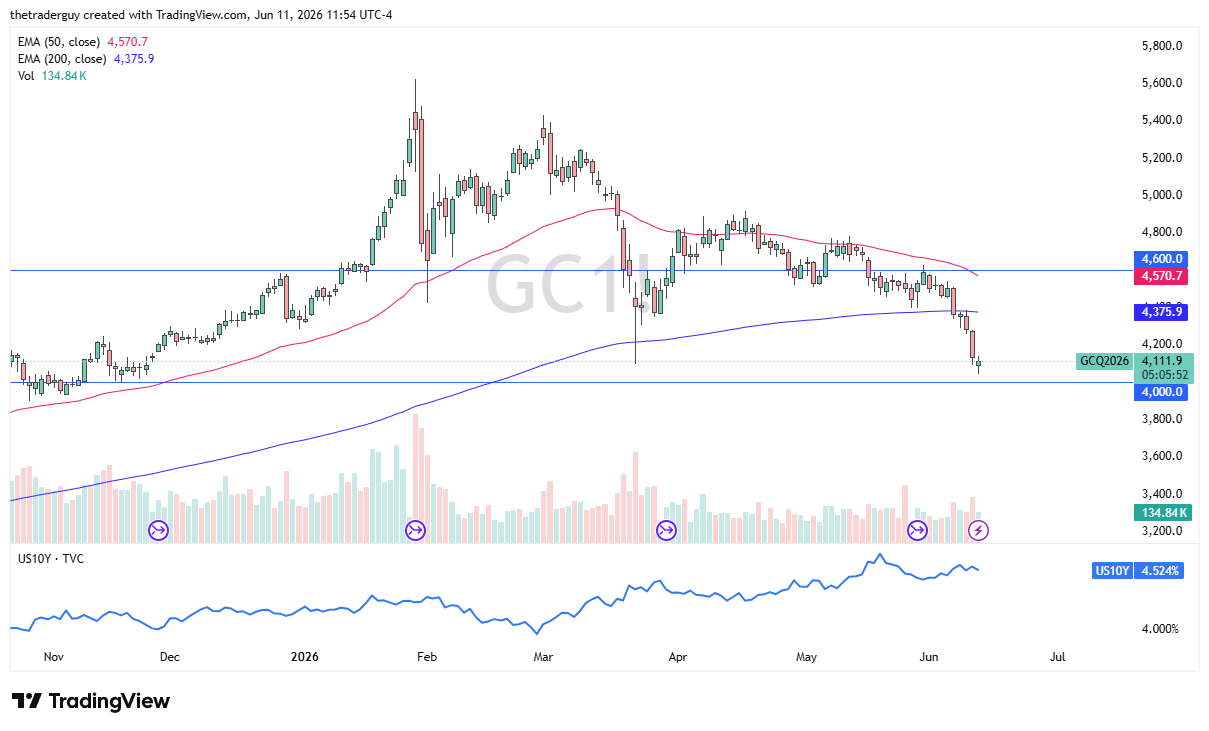
The gold market has chopped back and forth during the trading session here on Thursday as we are hovering just above the crucial $4,000 level.
The $4,000 level is an area that I think traders continue to look at very closely, mainly due to the idea that a large, round, psychologically significant figure probably attracts a lot of attention from options traders.
That being said, it’s interesting that the XAU/USD pair continues to look kind of sluggish despite the fact that interest rates are starting to drop. So that is a little bit of a move from the negative correlation between interest rates and gold that we saw. Regardless, the $4,000 level for me is crucial. If we give that up, we will probably drop another $500.
I’m not a big fan of shorting gold, although it clearly doesn’t do well buying it over the last couple of weeks. But if we do bounce from here, I can see a short-term opportunity might present itself for both buyers and sellers. I would anticipate that the 200-day EMA offers a bit of a barrier.
Ultimately, this is a market that I would fade signs of exhaustion until we see some type of change in attitude, and it’s probably worth noting that the US dollar is extraordinarily strong despite the fact that we have the overall attitude of the markets changing, and I think you have a market that I think remains noisy.
Longer term, I do like gold, but I think if we do pull back from here, and when you look at the longer-term charts, it does make a certain amount of sense, we could drop down to the $3,500 level, and it would just be a nice pullback in a huge uptrend.
So, with that being said, I like the idea of buying gold eventually, just not right now. If you’re a day trader, you might be able to trade the pop, but you have to be very nimble and get out at the first sign of trouble.
Ready to trade today’s Gold prediction? Here’s a list of some of the best XAU/USD brokers to check out.
Christopher Lewis is a technical analyst and market commentator at DailyForex with more than two decades of trading experience in Forex and other leveraged markets. Based in Columbus, Ohio, he specializes in chart-based analysis of major currency pairs, stock indices, commodities, and energy markets, focusing on clear support and resistance levels, trend structure, and risk management. Christopher produces daily written and video analysis for traders who rely on technical setups to navigate volatile market conditions
As seen on: Pairs Of Aces Podcast,The Trader Guy, FXEmpire
The price of copper recently tested the additional support level at $6.1000, which has formed a strong barrier against attempts to resume the corrective decline. As a result, we are currently seeing some positive waves forming, with the price stabilizing near $6.3600.
We expect the price to be influenced by sideways movement dominance due to its repeated confinement between the previously mentioned support level, while the $6.6600 level continues to act as a strong barrier at the moment. However, the stochastic indicator attempting to provide negative momentum increases the chances of renewed corrective moves, which may pressure the support again and create an opportunity to resume the corrective downtrend in the short to medium term.
Expected trading range for today: between $5.1000 and $6.4200
Today’s forecast: Bearish, as long as the resistance holds
Stay informed on platinum price trends in Jayankondam. Today’s rates stand at ₹51,060
for 10g, ₹5,10,600 for 100g, and ₹51,06,000 for 1kg. In June, platinum
saw fluctuations. The highest rate for 100g touched ₹5,95,300,
and the lowest fell to ₹5,10,200. For 1kg, prices ranged from
₹51,02,000 to ₹59,53,000.
Global supply chains, mining rates, and geopolitical issues are major drivers of platinum
prices. Demand from the auto and electronics industries adds pressure. Exchange rate
movements, especially against the US dollar, combined with inflation trends and central
bank strategies, contribute significantly to changes in platinum’s market price.
Silver (XAG/USD) price advances over 4% on Thursday after bouncing off daily lows of $61.51, its lowest level since March 23, after US President Donald Trump announced he cancelled scheduled attacks against Iran this evening, saying that final points of an agreement have been approved. At the time of writing, the XAG/USD pair trades at $65.91.
Silver turned downward biased. Even though it has recovered some ground, it remains below the 200-day Simple Moving Average (SMA) of $68.31, which is used to signal changes in the asset’s direction.
The Relative Strength Index (RSI) exited oversold territory, an indication that buyers moved in, but the index remains below the 50-neutral level, suggesting the white metal remains tilted to the downside.
If Silver rises past the $67.00 mark, this would open the door to challenge the 200-day SMA. Above this level, the next stop would be the $70.00 milestone.
On the bearish side, the first support for XAG/USD is the current week’s low at $61.50. A breach of the latter will expose the $60.00 mark, followed by the November 13, 2025, high turned support at $54.39.
Silver is a precious metal highly traded among investors. It has been historically used as a store of value and a medium of exchange. Although less popular than Gold, traders may turn to Silver to diversify their investment portfolio, for its intrinsic value or as a potential hedge during high-inflation periods. Investors can buy physical Silver, in coins or in bars, or trade it through vehicles such as Exchange Traded Funds, which track its price on international markets.
Silver prices can move due to a wide range of factors. Geopolitical instability or fears of a deep recession can make Silver price escalate due to its safe-haven status, although to a lesser extent than Gold’s. As a yieldless asset, Silver tends to rise with lower interest rates. Its moves also depend on how the US Dollar (USD) behaves as the asset is priced in dollars (XAG/USD). A strong Dollar tends to keep the price of Silver at bay, whereas a weaker Dollar is likely to propel prices up. Other factors such as investment demand, mining supply – Silver is much more abundant than Gold – and recycling rates can also affect prices.
Silver is widely used in industry, particularly in sectors such as electronics or solar energy, as it has one of the highest electric conductivity of all metals – more than Copper and Gold. A surge in demand can increase prices, while a decline tends to lower them. Dynamics in the US, Chinese and Indian economies can also contribute to price swings: for the US and particularly China, their big industrial sectors use Silver in various processes; in India, consumers’ demand for the precious metal for jewellery also plays a key role in setting prices.
Silver prices tend to follow Gold’s moves. When Gold prices rise, Silver typically follows suit, as their status as safe-haven assets is similar. The Gold/Silver ratio, which shows the number of ounces of Silver needed to equal the value of one ounce of Gold, may help to determine the relative valuation between both metals. Some investors may consider a high ratio as an indicator that Silver is undervalued, or Gold is overvalued. On the contrary, a low ratio might suggest that Gold is undervalued relative to Silver.
Silver has drifted a little bit lower during the trading session here on Wednesday as interest rates remain elevated.
What’s interesting is that the gold market really fell apart, and silver was a little bit more resilient, but I have a theory.
My theory, of course, is that there will be more demand for silver going forward than gold because not only do we have a scenario where interest rates have an influence, but we also have to keep in mind that the amount of supply of silver is nowhere near sufficient to satiate the demand that AI data centers and the electrification of the economy are going to demand.
It’s very similar to the situation copper’s in. I believe at this point in time that silver will fare better than gold, but that doesn’t necessarily mean that it will go higher. Interest rates being elevated the way they are and remaining elevated the way they are due to the concerns of, or in the Middle East and the supply chain, I think, continues to be the biggest headwind here.
Really at this point in time, if we do continue to drop, I think the $60 level is a fairly strong floor. Nonetheless, I think this is a market that, if we do see rates drop, this will be a natural place for buyers to jump in.
If we were to break to the upside, the 200-day EMA is a short-term ceiling, breaking above that then allows the market to challenge $70. Long-term, I fully anticipate that silver will reach $120 again, but we have a lot of work and a lot of things that have to fall in line. If you’re an investor, this might be an area where you would pick up a little bit of silver. If you’re a trader, you still have to see this as a bearish market.
Ready to trade our daily forex analysis and predictions? Here are the best Silver trading brokers to choose from.
Christopher Lewis is a technical analyst and market commentator at DailyForex with more than two decades of trading experience in Forex and other leveraged markets. Based in Columbus, Ohio, he specializes in chart-based analysis of major currency pairs, stock indices, commodities, and energy markets, focusing on clear support and resistance levels, trend structure, and risk management. Christopher produces daily written and video analysis for traders who rely on technical setups to navigate volatile market conditions
As seen on: Pairs Of Aces Podcast,The Trader Guy, FXEmpire
There is no change in natural gas price trading, trading in sideways range while remaining near the $3.200 level. This behavior is influenced by the ongoing conflict among the main technical indicators during the recent period.
Noting that Stochastic attempt to exit the overbought zone could increase negative pressure on current trading, making it easier for the price to target negative levels at $2.950 and $2.800.
The price’s move to bullish trend requires a strong bullish rally to settle above $3.520 level, which allows it to record several gains by its gradual rally towards $3.710 and $3.950.
Expected trading range for today: Between $2.950 and $3.300
Today’s price outlook: Bearish