The main tag of Gold Price Articles.
You can use the search box below to find what you need.
[wd_asp id=1]
The main tag of Gold Price Articles.
You can use the search box below to find what you need.
[wd_asp id=1]
Select market data provided by ICE Data Services. Select reference data provided by FactSet. Copyright © 2026 FactSet Research Systems Inc.Copyright © 2026, American Bankers Association. CUSIP Database provided by FactSet Research Systems Inc. All rights reserved. SEC fillings and other documents provided by Quartr.© 2026 TradingView, Inc.
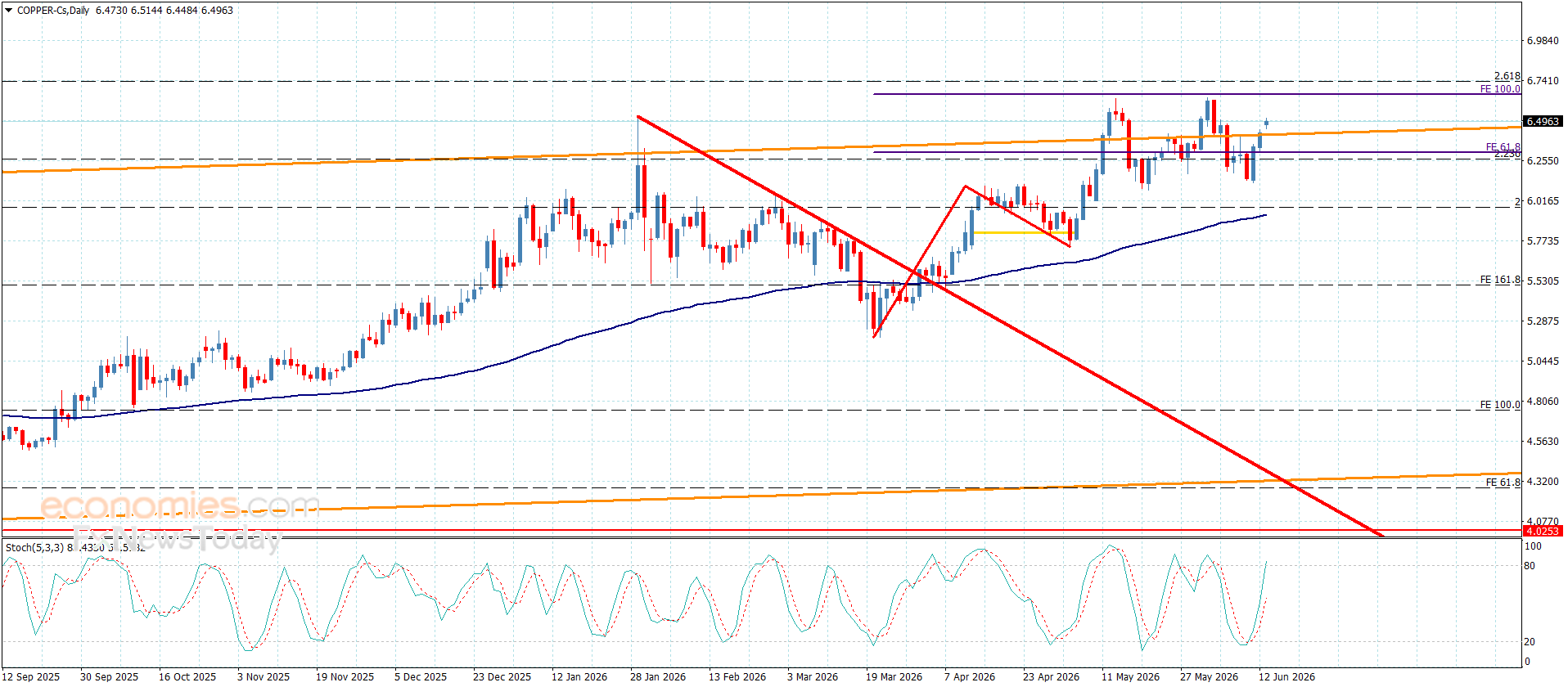
Copper price activated since this morning’s trading to the positive signals from the main indicators, maintaining its position above the stable support level at $6.1000, as we notice the beginning of forming new upward waves that have settled it near $6.5000.
We reiterate that confirmation of the price’s readiness to resume the upward momentum will remain valid unless the resistance level at $6.6000 is broken. In that case, the price may shift into new sideways trading. However, a successful breakout and stability above this resistance would make it easier for the price to reach additional targets, which may start at $6.7800 and $6.9200.
The expected trading range for today is between $5.3500 and $6.6000
Trend forecast: Fluctuating
WTI crude
oil traded at $80.73 per barrel on Monday, June 15, 2026, down almost 5% from
Friday’s $84.88 close, after the United States and Iran reached an interim deal
to reopen the Strait of Hormuz and drain the war premium from the oil market.
Brent fell more than 4% to below $84, a fresh three-month low.
The deal,
set to be signed June 19 in Switzerland, would restart a waterway that once
carried about a fifth of global oil supply. Traders now weigh a slow physical
recovery against a 60-day window of US-Iran nuclear talks that could still
collapse.
In this
article I am showing why oil prices are falling down today, how low can oil go,
and what are the newest oil price predictions from big banks.
Follow
me on X for real-time market analysis: @ChmielDk
WTI crude
has fallen straight into its 200-day exponential moving average, a level it
last touched more than four months ago. My chart shows price gapping lower at
the Monday open and slicing below $81, almost 5% under Friday’s settlement .
That break
ejects WTI from the choppy consolidation it has held since March, a range
without clean edges that traded between roughly $85 to $88 on the floor and
$110 to $115 on the ceiling.
WTI oil technical analysis: the test of the 200 EMA. Source: Tradingview.com
The
boundaries are not random. The upper zone aligns with the 2022 highs I flagged when Brent
topped $115, when
WTI briefly ran toward $125 before stalling; this cycle’s war spike topped out
near $120. The lower edge near $85 to $88 matches the April and July 2024
peaks. With that floor broken, the old support now flips to resistance.
The 200 EMA
read carries weight because it sits near $80, almost to the pip on the January
2025 highs, stacked on the round number and the June 2025 highs into one dense
support shelf.
In 15-plus
years as a trader and analyst, 10 of them at FinanceMagnates.com, I have rarely
seen technical levels matter less than they do in this oil market. My prior
calls are archived on my analyst page, from the $112 April peak down to today’s reversal. Price is
being written by the US, Iran and Trump, not by moving averages.
For now the
daily trend is still up. The consolidation has broken, but the 200 EMA is
printing a first demand reaction. My question is simple: does a bounce reclaim
the range, or does the former floor, now resistance, cap the buyers before a
stronger charge?
|
Level |
Type |
Notes |
|
$110 to $120 |
Resistance |
2022 |
|
$85 to $88 |
Resistance (flipped) |
Old |
|
$80.73 |
Spot / 200 EMA |
Monday, |
|
$80 |
Support |
Round |
|
$72 |
Support |
April 2025 reference level |
Oil dropped
after Washington and Tehran agreed to halt a war that erupted in late February,
when US and Israeli strikes on Iran’s nuclear program shut the Strait of Hormuz in early
March.
Officials
will meet in Switzerland on June 19 to sign the text, which neither side has
released, according to Bloomberg reporting. President Donald Trump said the
strait would reopen once mines are cleared from the waterway.
Before the
blockade, the strait handled roughly a fifth of the world’s oil supply in a
market of more than 100 million barrels a day. Nearly 600 vessels remain stuck
in the Persian Gulf awaiting departure, data firm Kpler told Bloomberg.
The unwind
already shows in the futures curve: Brent’s prompt spread narrowed to less than
$1 a barrel in backwardation, down from more than $12 in April.
Caution is
warranted: mines still need clearing , insurers may charge elevated rates, and
shut-in Gulf fields could take months to restart, per Reuters and Bloomberg
coverage. Trump also warned he could resume strikes if the 60-day talks fail.
Volatility
has run hot enough that brokers rolled out tokenized WTI exposure to capture the flows.
The drop
rests on four shifts:
Goldman
Sachs added a counterintuitive twist on June 12. The bank kept its Q4 2026
Brent forecast at $90, holding to near-term geopolitical risk, while cutting
its 2027 average to $80, down $5, according to Reuters reporting. The message
is that the current war premium does not become a lasting price surge.
Goldman
pointed to stronger supply from the US, Brazil, Guyana, Venezuela and the UAE,
alongside weaker demand tied partly to China’s shift to electric vehicles. The
bank assumes just over 10% of the demand lost during the shock sticks.
It stops
short of calling a collapse, because the physical market is still tight, the
same oversupply-versus-scarcity tension I covered when oil slipped after the Maduro
capture.
US crude
inventories underline that tightness. Stockpiles fell 7.2 million barrels to
426.5 million in the latest week, nearly 5% below the five-year average, while
distillates sat 13% below normal, per Investing data. Oil trading volumes climbed through Q1 as volatility
intensified.
The 2027
downgrade rests on:
How low oil
can go depends on whether the Hormuz reopening holds. Goldman’s $90 Q4 2026
Brent call still bakes in a war premium that is actively draining, so I read it
as a ceiling rather than a base if the deal sticks. Its $80 cut for 2027
matches my own bias: once Gulf barrels return, the structural surplus reasserts
and rallies get sold.
The
official forecasters agree on direction. The EIA’s June outlook sees Brent
easing to $89 in Q4 2026 and averaging $79 in 2027, assuming Hormuz reopens in
the third quarter. JPMorgan is more bearish at $75 for 2027, the lowest of the
majors, and that number looks reasonable to me if demand stays soft and US
output holds near record highs.
How low can WTI crude oil go according to my technical analysis? Source: Tradingview.com
On my
chart, the first WTI support is the $80 shelf, where the 200 EMA, the June 2025
highs and the round number converge. Lose it, and $72 from April 2025 opens up.
The bull case is a deal collapse: mines, insurance friction or a failed nuclear
track snap the premium back and drive WTI into the $110 to $120 consolidation
again.
|
Source |
Target |
Notes |
|
Goldman Sachs |
Brent $90 |
Q4 2026, |
|
Goldman Sachs |
Brent $80 |
2027 |
|
EIA (June STEO) |
Brent $89 / $79 |
Q4 2026 / 2027; Hormuz reopens Q3 |
|
JPMorgan |
Brent $75 |
2027 average; deepest major call |
|
My TA |
WTI $80, then $72 |
200 EMA |
|
My TA (bull) |
WTI $110 to $120 |
If deal |
Bull
case (deal fails, premium returns):
Bear
case (deal holds, surplus returns):
WTI crude
fell almost 5% to $80.73 on June 15, 2026, and Brent dropped below $84 after
the US and Iran agreed to an interim deal to reopen the Strait of Hormuz. The
waterway carried about a fifth of global oil supply before the war, so its
reopening drains the geopolitical premium that had lifted crude since late
February.
My
technical analysis puts the first WTI support at the $80 shelf, where the
200-day EMA and June 2025 highs converge. A break below it opens $72, the April
2025 level. The EIA sees Brent averaging $79 in 2027, while JPMorgan models
$75, so a move into the $70s is credible if the deal holds.
Goldman
Sachs cut its 2027 average Brent forecast to $80 a barrel on June 12, 2026, a
$5 reduction. The bank kept its Q4 2026 Brent call at $90 but expects stronger
supply from the US, Brazil, Guyana, Venezuela and the UAE, plus weaker Chinese
demand, to weigh on prices next year.
The US and
Iran are due to sign their interim deal on June 19, 2026, in Switzerland, after
which the strait is set to reopen once mines are cleared. The EIA assumes
shipments resume in the third quarter of 2026, with traffic taking until early
2027 to return to pre-conflict levels.
Yes, for
now. WTI broke its three-month consolidation on June 15, 2026, but the daily
trend remains up while the 200-day EMA near $80 holds. My read hinges on
whether a bounce reclaims the old range or the former floor at $85 to $88, now
resistance, caps the rebound.
WTI crude
oil traded at $80.73 per barrel on Monday, June 15, 2026, down almost 5% from
Friday’s $84.88 close, after the United States and Iran reached an interim deal
to reopen the Strait of Hormuz and drain the war premium from the oil market.
Brent fell more than 4% to below $84, a fresh three-month low.
The deal,
set to be signed June 19 in Switzerland, would restart a waterway that once
carried about a fifth of global oil supply. Traders now weigh a slow physical
recovery against a 60-day window of US-Iran nuclear talks that could still
collapse.
In this
article I am showing why oil prices are falling down today, how low can oil go,
and what are the newest oil price predictions from big banks.
Follow
me on X for real-time market analysis: @ChmielDk
WTI crude
has fallen straight into its 200-day exponential moving average, a level it
last touched more than four months ago. My chart shows price gapping lower at
the Monday open and slicing below $81, almost 5% under Friday’s settlement .
That break
ejects WTI from the choppy consolidation it has held since March, a range
without clean edges that traded between roughly $85 to $88 on the floor and
$110 to $115 on the ceiling.
WTI oil technical analysis: the test of the 200 EMA. Source: Tradingview.com
The
boundaries are not random. The upper zone aligns with the 2022 highs I flagged when Brent
topped $115, when
WTI briefly ran toward $125 before stalling; this cycle’s war spike topped out
near $120. The lower edge near $85 to $88 matches the April and July 2024
peaks. With that floor broken, the old support now flips to resistance.
The 200 EMA
read carries weight because it sits near $80, almost to the pip on the January
2025 highs, stacked on the round number and the June 2025 highs into one dense
support shelf.
In 15-plus
years as a trader and analyst, 10 of them at FinanceMagnates.com, I have rarely
seen technical levels matter less than they do in this oil market. My prior
calls are archived on my analyst page, from the $112 April peak down to today’s reversal. Price is
being written by the US, Iran and Trump, not by moving averages.
For now the
daily trend is still up. The consolidation has broken, but the 200 EMA is
printing a first demand reaction. My question is simple: does a bounce reclaim
the range, or does the former floor, now resistance, cap the buyers before a
stronger charge?
|
Level |
Type |
Notes |
|
$110 to $120 |
Resistance |
2022 |
|
$85 to $88 |
Resistance (flipped) |
Old |
|
$80.73 |
Spot / 200 EMA |
Monday, |
|
$80 |
Support |
Round |
|
$72 |
Support |
April 2025 reference level |
Oil dropped
after Washington and Tehran agreed to halt a war that erupted in late February,
when US and Israeli strikes on Iran’s nuclear program shut the Strait of Hormuz in early
March.
Officials
will meet in Switzerland on June 19 to sign the text, which neither side has
released, according to Bloomberg reporting. President Donald Trump said the
strait would reopen once mines are cleared from the waterway.
Before the
blockade, the strait handled roughly a fifth of the world’s oil supply in a
market of more than 100 million barrels a day. Nearly 600 vessels remain stuck
in the Persian Gulf awaiting departure, data firm Kpler told Bloomberg.
The unwind
already shows in the futures curve: Brent’s prompt spread narrowed to less than
$1 a barrel in backwardation, down from more than $12 in April.
Caution is
warranted: mines still need clearing , insurers may charge elevated rates, and
shut-in Gulf fields could take months to restart, per Reuters and Bloomberg
coverage. Trump also warned he could resume strikes if the 60-day talks fail.
Volatility
has run hot enough that brokers rolled out tokenized WTI exposure to capture the flows.
The drop
rests on four shifts:
Goldman
Sachs added a counterintuitive twist on June 12. The bank kept its Q4 2026
Brent forecast at $90, holding to near-term geopolitical risk, while cutting
its 2027 average to $80, down $5, according to Reuters reporting. The message
is that the current war premium does not become a lasting price surge.
Goldman
pointed to stronger supply from the US, Brazil, Guyana, Venezuela and the UAE,
alongside weaker demand tied partly to China’s shift to electric vehicles. The
bank assumes just over 10% of the demand lost during the shock sticks.
It stops
short of calling a collapse, because the physical market is still tight, the
same oversupply-versus-scarcity tension I covered when oil slipped after the Maduro
capture.
US crude
inventories underline that tightness. Stockpiles fell 7.2 million barrels to
426.5 million in the latest week, nearly 5% below the five-year average, while
distillates sat 13% below normal, per Investing data. Oil trading volumes climbed through Q1 as volatility
intensified.
The 2027
downgrade rests on:
How low oil
can go depends on whether the Hormuz reopening holds. Goldman’s $90 Q4 2026
Brent call still bakes in a war premium that is actively draining, so I read it
as a ceiling rather than a base if the deal sticks. Its $80 cut for 2027
matches my own bias: once Gulf barrels return, the structural surplus reasserts
and rallies get sold.
The
official forecasters agree on direction. The EIA’s June outlook sees Brent
easing to $89 in Q4 2026 and averaging $79 in 2027, assuming Hormuz reopens in
the third quarter. JPMorgan is more bearish at $75 for 2027, the lowest of the
majors, and that number looks reasonable to me if demand stays soft and US
output holds near record highs.
How low can WTI crude oil go according to my technical analysis? Source: Tradingview.com
On my
chart, the first WTI support is the $80 shelf, where the 200 EMA, the June 2025
highs and the round number converge. Lose it, and $72 from April 2025 opens up.
The bull case is a deal collapse: mines, insurance friction or a failed nuclear
track snap the premium back and drive WTI into the $110 to $120 consolidation
again.
|
Source |
Target |
Notes |
|
Goldman Sachs |
Brent $90 |
Q4 2026, |
|
Goldman Sachs |
Brent $80 |
2027 |
|
EIA (June STEO) |
Brent $89 / $79 |
Q4 2026 / 2027; Hormuz reopens Q3 |
|
JPMorgan |
Brent $75 |
2027 average; deepest major call |
|
My TA |
WTI $80, then $72 |
200 EMA |
|
My TA (bull) |
WTI $110 to $120 |
If deal |
Bull
case (deal fails, premium returns):
Bear
case (deal holds, surplus returns):
WTI crude
fell almost 5% to $80.73 on June 15, 2026, and Brent dropped below $84 after
the US and Iran agreed to an interim deal to reopen the Strait of Hormuz. The
waterway carried about a fifth of global oil supply before the war, so its
reopening drains the geopolitical premium that had lifted crude since late
February.
My
technical analysis puts the first WTI support at the $80 shelf, where the
200-day EMA and June 2025 highs converge. A break below it opens $72, the April
2025 level. The EIA sees Brent averaging $79 in 2027, while JPMorgan models
$75, so a move into the $70s is credible if the deal holds.
Goldman
Sachs cut its 2027 average Brent forecast to $80 a barrel on June 12, 2026, a
$5 reduction. The bank kept its Q4 2026 Brent call at $90 but expects stronger
supply from the US, Brazil, Guyana, Venezuela and the UAE, plus weaker Chinese
demand, to weigh on prices next year.
The US and
Iran are due to sign their interim deal on June 19, 2026, in Switzerland, after
which the strait is set to reopen once mines are cleared. The EIA assumes
shipments resume in the third quarter of 2026, with traffic taking until early
2027 to return to pre-conflict levels.
Yes, for
now. WTI broke its three-month consolidation on June 15, 2026, but the daily
trend remains up while the 200-day EMA near $80 holds. My read hinges on
whether a bounce reclaims the old range or the former floor at $85 to $88, now
resistance, caps the rebound.
Natural gas price started forming slow bearish waves, attempting to activate the previously suggested downside scenario as it moves toward $3.070, moving away from the resistance level at $3.350.
Currently, with the main indicators providing negative momentum, increasing the chances of attacking the $2.920 level. A break below this level would open the door toward additional bearish targets, potentially starting at $2.800, and extending to the support near $2.620.
On the other hand, a shift back into an upward trend would require a strong bullish surge, allowing the price to stabilize above $3.520. This would enable it to record further gains, gradually targeting $3.710 and $3.950 respectively.
The expected trading range for today is between $2.920 and $3.180.
Trend forecast: Bearish
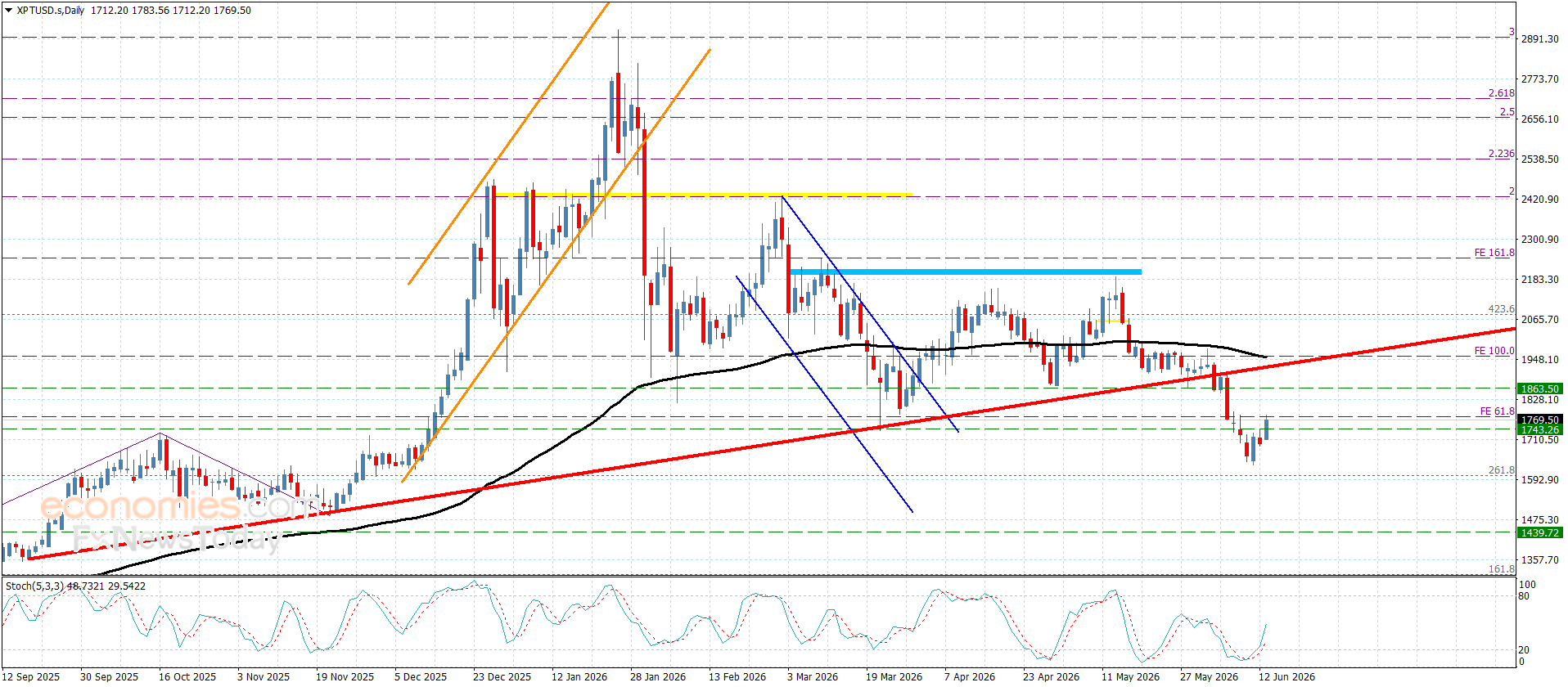
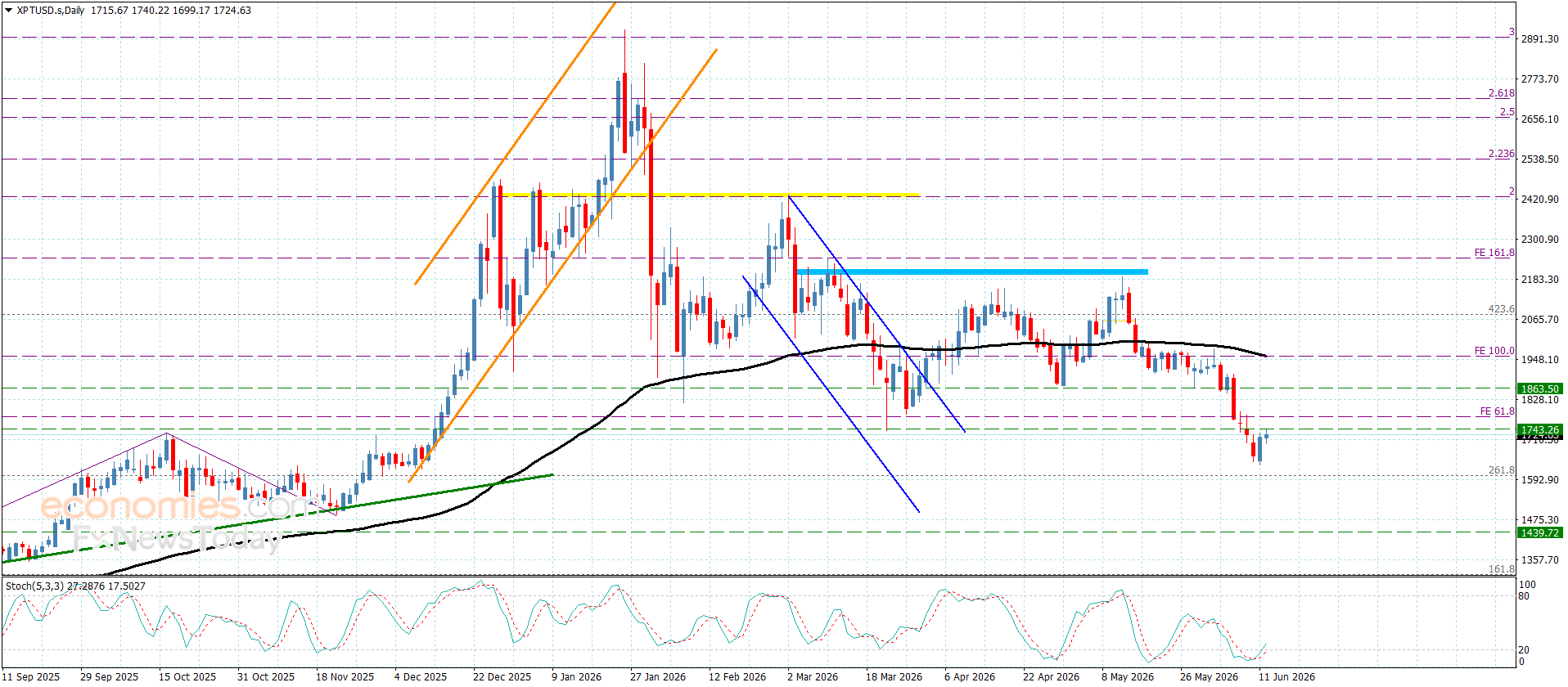
Platinum price continued to form positive trading, benefiting from the formation of the $1640.00 level as a strong additional support, leading to its current attempt to attack the initial barrier at $1770.00, to find a path for further upward waves in the near term.
Note that the attempt of stochastic to provide positive momentum could push the price to surpass the current barrier, to expect reaching $1865.00, to attempt to test the main resistance located around $1922.00. On the other hand, failure to break out would force mixed trading, with a renewed chance of declining toward $1690.00.
The expected trading range for today is between $1720.00 and $1865.00.
Trend forecast: Bullish
Goldman Sachs has lowered its average Brent crude oil price forecast for 2027 to $80 per barrel, citing stronger global supply growth and continued weakness in demand, particularly in China. According to a research note from the investment bank via Reuters, rising oil production from the United States, Brazil, Guyana, Venezuela, and the United Arab Emirates, combined with structural shifts in energy consumption, is expected to weigh on prices over the longer term. Goldman said it expects more than 10% of the current weakness in demand to persist as China’s transition toward alternative energy sources, including electric vehicles, accelerates.
Despite lowering its 2027 outlook, Goldman maintained its expectation that Brent crude will average $90 per barrel during the fourth quarter of 2026. The bank noted that the effects of a prolonged disruption in the Strait of Hormuz have been moderated by a smaller-than-anticipated supply shortfall and weaker global demand.
Goldman estimated that disruptions to Middle Eastern production initially reduced regional liquids output significantly, but the resulting global deficit during the second quarter amounted to approximately 5 million to 6 million barrels per day. Existing oversupply and lower demand helped cushion the impact. The bank now expects oil exports from Gulf producers to normalize by late August, compared with its previous expectation of late June.
The bank outlined several scenarios for oil prices. Under an adverse scenario involving prolonged export disruptions, Brent could average slightly above $110 per barrel in late 2026. A more severe scenario, in which disruptions in the Strait of Hormuz continue through 2027, could send prices as high as $140 per barrel.
On the other hand, Goldman said that a quicker recovery in supply and weaker-than-expected demand could push Brent prices down to around $70 per barrel by the end of 2026 and approximately $60 per barrel in 2027.
The revised forecast reflects the growing influence of both supply growth and changing consumption patterns on global energy markets, even as geopolitical developments continue to create the potential for significant price volatility.
Domestic coffee prices today
Coffee prices today in the domestic market simultaneously increased sharply compared to the previous session. The average coffee price currently reaches 89,600 VND/kg, an increase of 2,000 VND/kg.
In Dak Lak, coffee prices were recorded at 89,500 VND/kg, an increase of 2,000 VND/kg. Gia Lai also had the same price of 89,500 VND/kg, an increase of 2,000 VND/kg compared to the previous session.
In Lam Dong, today’s coffee price reached 89,000 VND/kg, the lowest among the surveyed localities but still increased by 2,000 VND/kg. Meanwhile, Dak Nong (old) continues to be the area with the highest price, reaching 89,000 VND/kg, an increase of 2,000 VND/kg.
This development brings domestic coffee prices back close to the threshold of 9,000 VND/kg, after a period of market pressure from the prospect of increased supply.
World coffee prices
On the London exchange, Robusta coffee futures for July 2026 closed at 3,594 USD/ton, up 131 USD/ton, equivalent to 3.78%. September 2026 futures reached 3,525 USD/ton, up 130 USD/ton, equivalent to 3.83%.
Further terms also simultaneously increased. Robusta November 2026 term reached 3,452 USD/ton, up 124 USD/ton; January 2027 term reached 3,390 USD/ton, up 121 USD/ton; March 2027 term reached 3,354 USD/ton, up 117 USD/ton.
On the New York exchange, Arabica coffee for July 2026 delivery reached 257.20 US cents/lb, up 3.25 cents/lb, equivalent to 1.28%. September 2026 delivery reached 253.40 US cents/lb, up 3.15 cents/lb; December 2026 delivery reached 246.45 US cents/lb, up 3.25 cents/lb.
The USD/VND exchange rate according to Vietcombank was recorded at 26,092 VND/USD, down 10 VND.
Coffee price assessment
According to Barchart, world coffee prices continued to rise in the last session of the week due to concerns that prolonged rain in Brazil’s coffee growing areas could slow harvest progress. Weather forecasts show moderate to heavy rain will also appear in some coffee production areas of Brazil this week and may extend to next week.
Besides weather factors, reduced coffee inventories on the ICE exchange also supported prices. Arabica inventories monitored on the ICE fell to the lowest level in many months, while Robusta inventories remained low compared to the same period.
The El Niño factor is also receiving more attention from the market. The US National Oceanic and Atmospheric Administration said that El Niño has appeared and is likely to strengthen in the Northern Hemisphere winter of 2026-2027. If this phenomenon changes rainfall in Brazil during the coffee flowering period, risks for the next crop supply may increase.
However, the upward momentum of coffee prices is still under pressure from the prospect of large supply. USDA/FAS forecasts that Brazil’s coffee production in the 2026/27 crop year may reach a record level of 71.9 million bags, an increase of more than 14% compared to the previous crop year. Rabobank also raised its forecast for a global Arabica surplus, showing that the market has not escaped supply pressure in the medium term.
On the Robusta side, the increase in our country’s coffee exports is a factor that can curb price increases. International organizations still assess Vietnam as the world’s largest Robusta producer, and production in the 2025/26 crop year is forecast to improve compared to the previous year.
In general, coffee prices today increased sharply thanks to the short-term impact of Brazil’s weather and low inventories. However, the upcoming trend still largely depends on the harvest progress in Brazil, El Niño developments and the rate of coffee exports from within the country.
A bounce from the midline of the channel would, by itself, suggest an eventual rally to test the top falling channel line as resistance. But since the 50-day moving average is nearby around $4,596, it represents a more significant dynamic resistance level. Until that average is reclaimed, the bearish structure that has formed takes precedence since it marks the top trend resistance indicator.
Despite the strong bullish reaction on Friday, further testing of support near the uptrend line may still occur. Also, if the trendline is broken, the next lower target zone is indicated from around $3,915 to $3,873, consisting of support near a swing low from October and the 127.2% projection for the falling ABCD pattern.
Bullish follow-through on Friday was muted, with a very narrow range day and a slightly higher daily high of $4,246 and higher low at $4,170. It provided little additional useful information other than that the bias remained to the upside in the short-term.
The 200-day moving average is a long-term trend indicator that was confirmed as support following the sharp decline in March, and it failed recently on a second test. If the counter-trend rally extends, the 200-day average is the key resistance zone to watch for sellers to get more aggressive. It is now at $4,452 and rising slightly. It takes on added significance given its confluence with other overhead resistance indicators.
The interaction between the recent failed breakdown and strong support zone suggests gold remains at a pivotal inflection point, where either a sustained reversal higher or another leg lower from this confluence area will define the next directional phase.
If you’d like to know more about how to trade gold and silver, please visit our educational area.
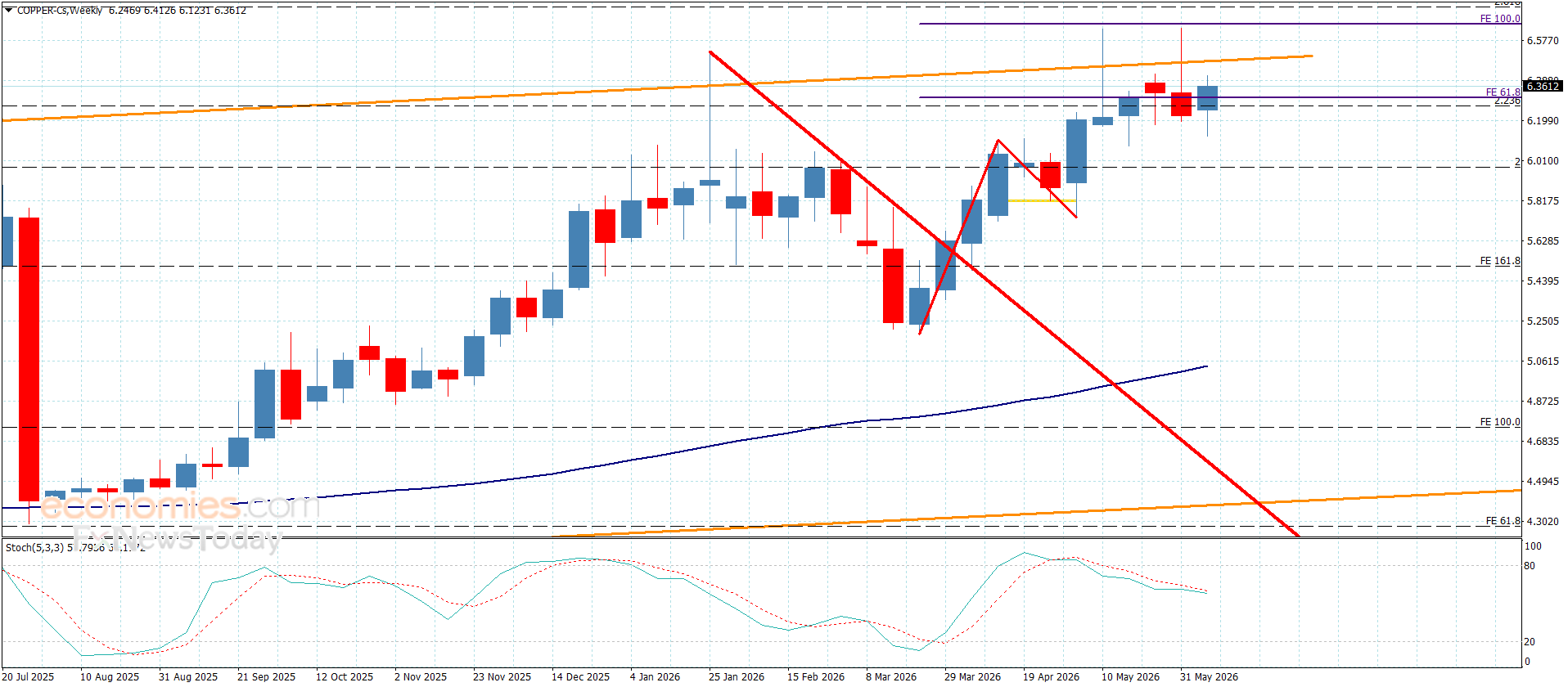
The price of copper recently tested the additional support level at $6.1000, which has formed a strong barrier against attempts to resume the corrective decline. As a result, we are currently seeing some positive waves forming, with the price stabilizing near $6.3600.
We expect the price to be influenced by sideways movement dominance due to its repeated confinement between the previously mentioned support level, while the $6.6600 level continues to act as a strong barrier at the moment. However, the stochastic indicator attempting to provide negative momentum increases the chances of renewed corrective moves, which may pressure the support again and create an opportunity to resume the corrective downtrend in the short to medium term.
Expected trading range for today: between $5.1000 and $6.4200
Today’s forecast: Bearish, as long as the resistance holds
The price of copper recently tested the additional support level at $6.1000, which has formed a strong barrier against attempts to resume the corrective decline. As a result, we are currently seeing some positive waves forming, with the price stabilizing near $6.3600.
We expect the price to be influenced by sideways movement dominance due to its repeated confinement between the previously mentioned support level, while the $6.6600 level continues to act as a strong barrier at the moment. However, the stochastic indicator attempting to provide negative momentum increases the chances of renewed corrective moves, which may pressure the support again and create an opportunity to resume the corrective downtrend in the short to medium term.
Expected trading range for today: between $5.1000 and $6.4200
Today’s forecast: Bearish, as long as the resistance holds