The main tag of Gold Price Articles.
You can use the search box below to find what you need.
[wd_asp id=1]
The main tag of Gold Price Articles.
You can use the search box below to find what you need.
[wd_asp id=1]
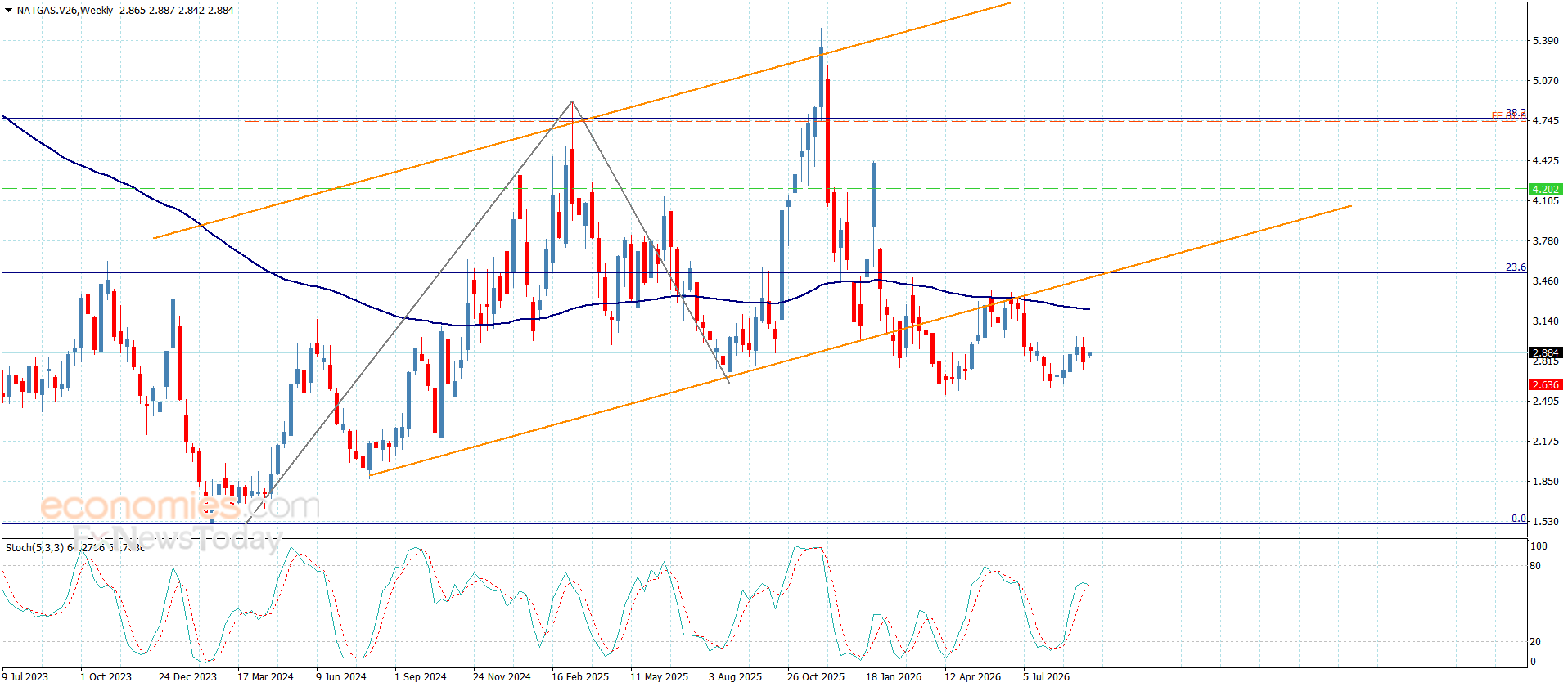
Despite the weakness of natural gas price’s last trading, its stability above the support level of $2.620 makes us keep the bullish trend, to notice its rally to settle near $2.880 level.
Note that stochastic stability above 50 level will increase the chances of gathering positive momentum in the current trading to form new bullish waves, paving the way towards surpassing $2.920 level and reaching the next target at $3.100.
The expected trading range for today is between $2.760 and $3.100
Trend forecast: Bullish
The Silver price recovered to $64.48 an ounce on Friday, clawing back less than a third of Thursday’s losses.
The 1.64% rebound still left XAG/USD down 2.6% over the week, with the metal needing a sustained recovery to reach UBS’s forecasts.
The bank’s silver price forecast starts at $70 in December 2026, rises to $75 in March and June 2027, then reaches $80 that September.
UBS has retained its earlier September projections, with December’s $70 estimate around 8.6% above Friday’s close and September 2027’s $80 target 24% higher.

Silver prices gained despite US core inflation accelerating to 0.3% month-on-month in August from 0.2% in July.
UBS had already anticipated a rate rise before those figures arrived.
The bank said on 10 September: “Our economists’ base case is that the Fed will raise its policy rate by 25bps. Given current market expectations, the hike itself should have a relatively limited impact.”
Its focus was the accompanying message: “More important will be whether markets interpret the decision and the tone of the subsequent press conference as leaning hawkish or dovish.”
In its currency outlook, UBS added: “In our base case, we do not expect a hawkish hike that would provide broad support for the dollar.”
That leaves room, in our view, for silver to recover even if US rates rise, provided the dollar does not strengthen materially.
The Fed’s 15–16 September meeting will test that reading, with most of Thursday’s silver losses still unrecovered.
Our currency coverage draws on live market data, official economic releases and published bank research.
The article covers the following subjects:
Consider long positions from corrections above 92.50 with a target of 115.50–125.50.
Breakout and consolidation below 92.50 will allow the asset to continue declining to the levels of 78.58–67.00.
On the weekly chart, a descending correction has likely finished developing as the second wave of larger degree (2) and an ascending third wave (3) is forming. On the daily chart, apparently, the first wave of smaller degree 1 of (3) has formed, a local correction has been completed as wave 2 of (3), and the third wave 3 of (3) is unfolding. Wave i of 3 continues developing on the H4 chart; within it, wave (iii) of i is unfolding. If the presumption is correct, WTI will continue to rise to 115.50–125.50. The level of 92.50 is critical in this scenario as a breakout below it will enable the asset to continue declining to the levels of 78.58–67.00.
This forecast is based on the Elliott Wave Theory. When developing trading strategies, it is essential to consider fundamental factors, as the market situation can change at any time.
The content of this article reflects the author’s opinion and does not necessarily reflect the official position of LiteFinance broker. The material published on this page is provided for informational purposes only and should not be considered as the provision of investment advice for the purposes of Directive 2014/65/EU.
According to copyright law, this article is considered intellectual property, which includes a prohibition on copying and distributing it without consent.
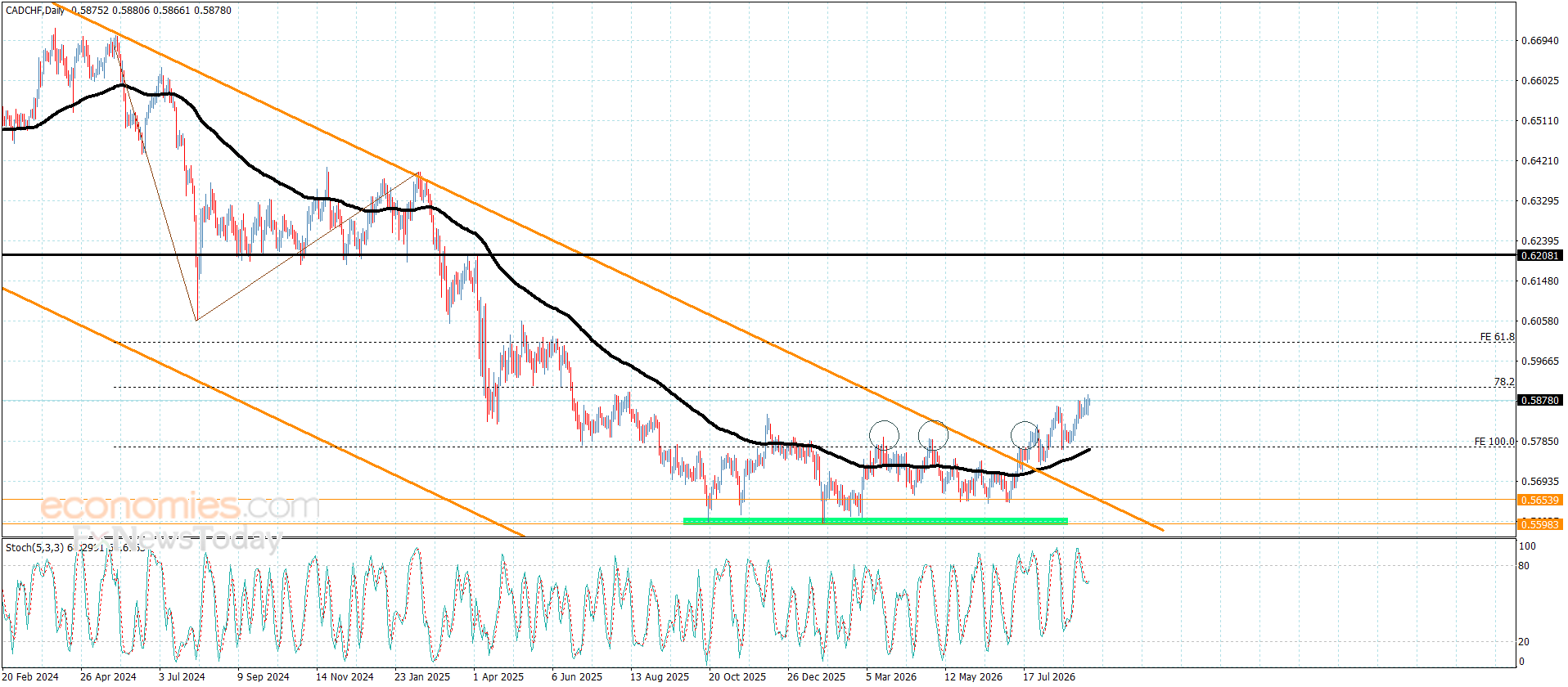
The CADCHF confirmed the bullish scenario by providing repeated bullish closes above the support level of 0.5770, forming several bullish waves and recording clear gains by its stability near 0.5880.
The attempt to provide positive momentum by the main indicators makes us prefer more bullish attempts, which might target 0.5910 barrier, where surpassing it will confirm that the price will enter a new positive pace by its rally towards 0.5945 reaching 0.6000.
The expected trading range for today is between 0.5850 and 0.5910
Trend forecast: Bullish
Domestic coffee prices
Coffee prices today in the domestic market turned down by 500 VND/kg. According to giacaphe. com, coffee prices on September 12 averaged at 95. 200 VND/kg, anchored in the price range of 94. 700-95. 300 VND/kg.
In Gia Lai and Dak Lak, coffee prices were recorded at 95. 200 VND/kg, down 500 VND/kg.
In Lam Dong, the listed coffee price is at 94. 700 VND/kg, down 500 VND/kg.
The old Dak Nong area also decreased by 500 VND/kg, recording a level of 95. 300 VND/kg.
The USD/VND exchange rate according to Vietcombank was recorded at 25,700 VND/USD, down 10 VND/USD.
World coffee prices
In the world market, coffee prices continuously fluctuate in rotation.
According to Barchart, the September 2026 Robusta futures contract today decreased by 29 USD/ton, anchored at 3,495 USD/ton. At the same decrease, the November 2026 futures were listed at 3, 525 USD/ton. The term from January 2027 to May 2027 increased and decreased alternately, listed in the price range of 3,482 – 3,508 USD/ton.
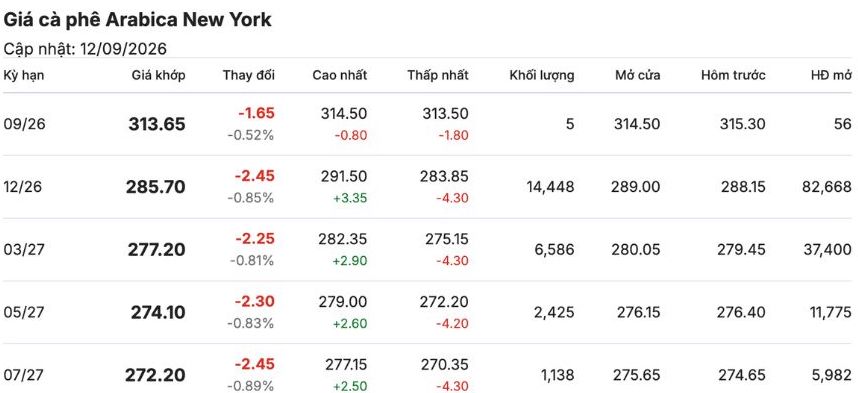
Meanwhile, the September 2026 Arabica futures contract continued to decline by 1.65 cents/lb (equivalent to 0.52%), down to 313.65 cents/lb. The December 2026 term fell even deeper by 2.45 cents/lb, bringing it to the market at a price of 285.70 cents/lb. Further forwards anchored in the 272.20 – 277.20 cent/lb range, down from 2.25-2.45 cents/lb.
Assessments and forecasts
Arabica coffee prices fell in yesterday’s trading session, fluctuating around the 7-week low set on Thursday.
Coffee prices fell after the Brazilian Coffee Exporters Association (Cecafe) said late Thursday that Brazil’s total coffee exports in August increased by 31% year-on-year, to 4.155 million bags, a record high in August. Arabica exports in August increased by 26%, to 2.87 million bags, while Robusta exports increased by 54%, to 953,592 bags. Brazilian coffee is being put on the export market as the harvest in this country is completed.
In another development, the Brazilian Ministry of Commerce said on Tuesday that the country’s coffee exports in August increased by 44.6% year-on-year, to 206,618 tons, the highest level in 8 months.
Arabica coffee prices fell after the International Coffee Organization (ICO) forecast that global coffee production would reach a record level and the market would fall into a state of oversupply. ICO said that global coffee production in the 2025/26 crop year increased by 4.4% over the same period, reaching a record level of 183.6 million bags, while consumption decreased by 0.9% to 180.6 million bags. This caused the global coffee market to have a surplus of 3 million bags, marking the first supply surplus in 5 years.
In addition, higher rainfall than normal in Brazil may promote the flowering process for next year’s coffee crop, thereby becoming a factor putting downward pressure on prices.
Robusta coffee prices are supported by concerns that heavy rain in the Central Highlands of Vietnam, the largest coffee producing region in the country, could flood farms and damage coffee crops. This makes supply negatively affected, which could push coffee prices up.
The article covers the following subjects:
Consider long positions above the level of 4,174.78 with a target of 4,900.00–5,610.00 once the correction ends.
Breakout and consolidation below 4,174.78 will allow the asset to continue declining to the levels of 3,954.50–3,720.00.
An ascending third wave of larger degree (3) is presumably developing on the weekly chart. Within it, a descending correction has been completed as the fourth wave of smaller degree 4 of (3). Apparently, the fifth wave 5 of (3) started developing on the daily chart, with wave i of 5 forming as its part. On the H4 chart, wave (iii) of i of 5 has formed, and a local correction is nearing completion as wave (iv) of i, with wave c of (iv) forming as its part. If the presumption is correct, XAU/USD will continue to rise to the levels of 4,900.00–5,610.00 after the correction ends. The level of 4,174.78 is critical in this scenario as a breakout below it will enable the asset to continue declining to the levels of 3,954.50–3,720.00.
This forecast is based on the Elliott Wave Theory. When developing trading strategies, it is essential to consider fundamental factors, as the market situation can change at any time.
The content of this article reflects the author’s opinion and does not necessarily reflect the official position of LiteFinance broker. The material published on this page is provided for informational purposes only and should not be considered as the provision of investment advice for the purposes of Directive 2014/65/EU.
According to copyright law, this article is considered intellectual property, which includes a prohibition on copying and distributing it without consent.
Natural gas price provided more of the mixed trading by reaching $2.750 level, keeping the positive stability above the support level at $2.620, as its stability reinforces the chances of activating the bullish trend in the near period.
Stochastic stability above 50 level will increase the chances of gathering positive momentum, to keep our bullish scenario by its rally towards $2.920, then to repeat the pressure at $3.100 barrier.
The expected trading range for today is between $2.700 and $2.920
Trend forecast: Bullish
The GBPJPY pair repeated providing weak sideways trading by its stability near 208.45 level, affected by the continuation of forming an obstacle at 280.10 level against the attempts of resuming the bearish trend, noticing the attempt of stochastic to exit the oversold level, which reinforces the dominance of the sideways range bias in the current trading, with a chance to retest the initial barrier near 210.40.
Achieving the required break and holding below 208.10 level will confirm its readiness to target more negative stations by reaching 206.70 initially, followed by 205.85.
The expected trading range for today is between 208.10 and 209.45
Trend forecast: Fluctuating within the bearish trend
Domestic coffee prices
Coffee prices today in the domestic market increased by at least 200 VND/kg. According to giacaphe. com, the average coffee price on September 11 remained at 95,700 VND/kg, anchored in the price range of 95,200-95,800 VND/kg.
In Gia Lai and Dak Lak, coffee prices were recorded at 95,700 VND/kg, an increase of 200 VND/kg.
In Lam Dong, the listed coffee price is at 95,200 VND/kg, an increase of 200 VND/kg.
The old Dak Nong area alone increased by 300 VND/kg, recording a level of 95,800 VND/kg.
The USD/VND exchange rate according to Vietcombank was recorded at 25,710 VND/USD, down 40 VND/USD.
World coffee prices
In the world market, coffee prices increase and decrease interspersed.
According to Barchart, the September 2026 Robusta futures contract today maintained an increase of 14 USD/ton, anchored at the mark of 3,442 USD/ton. In the same direction, the November 2026 term was listed at 3,554 USD/ton, an additional increase of 82 USD/ton. The term from January 2027 to May 2027 witnessed the highest increase of 48 USD/ton, to 3,472 – 3,510 USD/ton.
Meanwhile, the September 2026 Arabica futures contract decreased by 3.9 cents/lb (equivalent to 1.22%), down to the 315.30 cent/lb mark. The December 2026 term has the same decrease, offered to the market at a price of 288.15 cents/lb. Further forwards are anchored in the 274.65 – 279.45 cent/lb range, down from 4.20-4.60 cents/lb.

Assessments and forecasts
Coffee prices fluctuated in opposite directions, with Arabica falling to a 7-week low, while Robusta rose to a 1.5-week high. Arabica coffee prices fell in yesterday’s trading session after the International Coffee Organization (ICO) issued a forecast for record global coffee production and oversupply.
ICO forecasts that global coffee production in the 2025/26 crop year will increase by 4.4% compared to the same period, reaching a record 183.6 million bags, while consumption will decrease by 0.9% to 180.6 million bags. This caused the global coffee market to have a surplus of 3 million bags, marking the first time the market has had oversupply in 5 years.
Brazil’s termination of the coffee harvest is boosting arabica supply and putting pressure on prices.
In addition, higher rainfall than normal in Brazil may promote the flowering process for next year’s coffee crop, thereby becoming a factor putting downward pressure on prices.
Robusta coffee prices are supported by concerns that heavy rain in the Central Highlands of Vietnam, the largest coffee production region in the country, could flood farms and damage the coffee crop.
In Thursday’s session last week, Robusta prices fell to a 3-month low due to signs that coffee supply from Vietnam, the world’s largest Robusta producer, is increasing.
Concerns that the El Nino weather phenomenon may cause damage to the Brazilian coffee crop next year are also factors supporting prices. El Nino may cause rainfall in Brazil to be delayed in September and October, when coffee trees usually bloom, thereby affecting the 2026/27 Brazilian coffee crop.
TradingKey – On September 10 Eastern Time, the three major US stock indices fell for the fourth consecutive trading day. US August PPI showed upstream price pressures continued to rise, while international oil prices surged further, with WTI crude breaking back above $100 a barrel, bolstering expectations for a September Fed rate hike. US Treasury yields continued to climb, putting pressure on tech stocks and high-valuation assets, as market focus shifted to Friday’s upcoming US August CPI data.
At the close, the Dow Jones Industrial Average fell 0.61% to 52,069.22; the S&P 500 Index dropped 0.58% to 7,591.70; and the Nasdaq Composite Index slipped 0.65% to 26,081.72.
In sector and individual stock moves, semiconductor shares came under pressure. Nvidia (NVDA) fell 2.37%, while Micron Technology (MU) dropped 4.9%, ranking among the major tech heavyweights dragging down the S&P 500. Apple (AAPL) bucked the trend to rise 3.56% as investors continued to digest the company’s newly released $1,999 foldable iPhone.
In commodities, oil prices became the day’s most significant market driver. Brent crude (UKOIL) surged 7.43% to settle at $109.30 a barrel; WTI crude (USOIL) rose 7.51% to close at $103.94, reclaiming $100 for the first time since May. Military actions between Iran and the US targeting oil tankers continued to escalate, while Houthi forces took control of Yemen’s Mocha port, further elevating the risk of Red Sea shipping disruptions.
In precious metals, gold (XAUUSD) fell 1.94% to close at $4,316.64. Rising US PPI and oil prices fueled expectations for Fed rate hikes, while a strengthening US dollar and higher Treasury yields added pressure on gold.
In cryptocurrencies, Bitcoin (BTCUSD) remained under pressure, dropping 2.22%. Following the release of US PPI data, Bitcoin briefly slipped below $77,000, having previously traded mainly around $78,000. Oil prices breaking above $100 and rising US Treasury yields kept short-term crypto trading focused primarily on Fed policy expectations rather than industry-specific factors.
U.S. August PPI rose 0.4% month-over-month, rising to 5.4% year-over-year. Data from the U.S. Department of Labor showed that the Producer Price Index for August rose 0.4% month-over-month, in line with market expectations and higher than the revised 0.1% in July; the year-over-year gain accelerated from 4.8% to 5.4%. Among components, energy prices rose 4.2% in a single month, with diesel prices surging 24.1%. Following the release of the data, market expectations for a 25-basis-point rate hike by the Federal Reserve in September rose from around 62% to 70%.
Average U.S. diesel price tops $6 per gallon for the first time in history. GasBuddy data showed that the average national diesel price rose above $6 per gallon for the first time on Thursday. Because diesel is widely used in trucking, logistics, and agriculture, high fuel costs could further pass through to goods and service prices, drawing increased attention to the impact of rising oil prices on U.S. inflation.
Middle East conflict expands further as both WTI and Brent top $100. Iran claimed it had attacked 10 vessels near the Strait of Hormuz, while the U.S. struck five Iranian tankers. Meanwhile, Iran-backed Houthi rebels seized control of Yemen’s Mocha port, extending supply risks from the Strait of Hormuz to the Red Sea. OPEC also lowered its 2026 global oil demand growth forecast to 380,000 barrels per day, but supply disruption risks continue to dominate short-term oil prices.
ECB raises interest rates by another 25 bps, pushing deposit rate to 2.5%. The European Central Bank raised interest rates for the second time this year, primarily to address energy inflation triggered by the war in the Middle East. The ECB expects the average inflation rate in the eurozone to reach 3.0% in 2026 and upgraded its economic growth forecast from 0.8% to 0.9%. Lagarde stated that there remain clear upside risks to the inflation outlook.
Oracle beats earnings expectations, shares up about 4% after hours. Oracle (ORCL) reported a 30% year-over-year increase in first-quarter revenue to $19.3 billion, topping market expectations of $19.14 billion; adjusted EPS came in at $1.92, above the expected $1.74. The company added more than $30 billion in new AI cloud contracts during the quarter, bringing its remaining performance obligations to $664 billion, and raised its fiscal 2027 adjusted EPS forecast to $8.10.
Adobe beats revenue and earnings estimates, but shares fall about 2% after hours. Adobe (ADBE) posted third-quarter revenue of $6.76 billion, beating market estimates of $6.7 billion; adjusted EPS was $6.13, also topping expectations of $6.09. However, the midpoint of the company’s fourth-quarter revenue guidance was approximately $6.825 billion, slightly below market expectations of $6.85 billion, sending its stock down about 1.9% in after-hours trading.
Pentagon reportedly considering $5 billion loan to AI cloud company Fluidstack. The U.S. Department of Defense is discussing providing a loan of approximately $5 billion to Fluidstack through its Office of Strategic Capital, according to The Wall Street Journal. The funds will primarily be used to strengthen the supply chain and manufacturing capabilities for U.S. data center components, rather than directly constructing new AI data centers. The plan reflects that the U.S. government is increasingly viewing AI infrastructure as a strategic industry.
U.S. decision on refined copper tariffs reportedly delayed. Sources said the White House is still evaluating the pros and cons of imposing tariffs on refined copper, partly out of concern that higher copper prices could further push up manufacturing costs. Following the reports, copper prices fell more than 4%, while copper mining stocks such as Freeport-McMoRan plunged in tandem.
The table below lists the ten most actively traded stocks in the market. Supported by massive trading volumes and excellent liquidity, these assets have become key benchmarks for tracking global market dynamics.
This content was translated using AI and reviewed for clarity. It is for informational purposes only.