The main tag of Gold Price Articles.
You can use the search box below to find what you need.
[wd_asp id=1]
The main tag of Gold Price Articles.
You can use the search box below to find what you need.
[wd_asp id=1]
Domestic coffee prices
Today’s coffee prices in the domestic market mostly remained in the old price range, except for the old Dak Nong area. According to giacaphe. com, the average coffee price on September 10 remained at 95,500 VND/kg, down slightly 100 VND/kg.
In Gia Lai and Dak Lak, coffee prices were recorded at 95,500 VND/kg.
In Lam Dong, the listed coffee price is at 95,000 VND/kg.
The old Dak Nong area alone decreased by 300 VND/kg, recording a level of 95,500 VND/kg.
The USD/VND exchange rate according to Vietcombank is recorded at 25,750 VND/USD.
World coffee prices
In the world market, coffee prices are filled with green color on all terms.
According to Barchart, the September 2026 Robusta futures contract today reversed to increase by 14 USD/ton, anchored at the mark of 3,442 USD/ton. In the opposite direction, the November 2026 futures were listed at 3,472 USD/ton, up 14 USD/ton. The term from January 2027 to May 2027 witnessed the highest increase of 19 USD/ton, to 3,439 – 3,462 USD/ton.
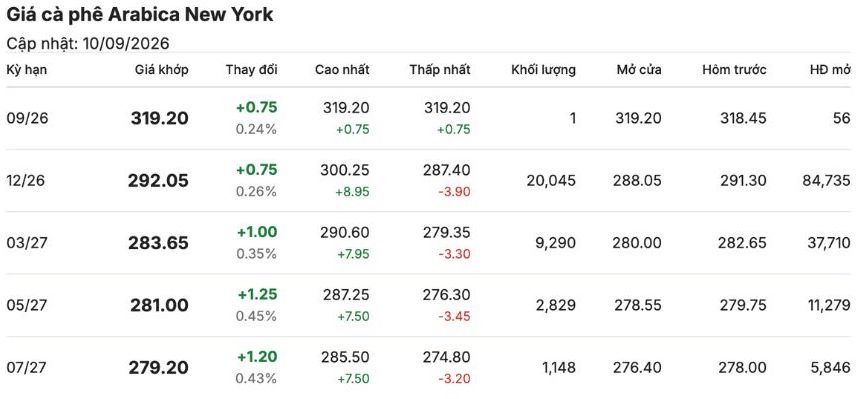
In the same direction, Arabica futures for September 2026 increased slightly by 0.75 cents/lb (equivalent to 0.24%), reaching 319.20 cents/lb. For December 2026, with the same increase, it was offered to the market at a price of 292.05 cents/lb. Further forwards are anchored in the range of 279.2 – 283.65 cents/lb.
Assessments and forecasts
Coffee prices closed the session up, with Robusta reaching a 1-week high. Short-term supply contraction is a factor supporting Arabica coffee prices, as Arabica inventories at ICE fell to a 27-year low, to 218,838 bags on Tuesday.
Robusta coffee prices are also supported by concerns that heavy rain in the Central Highlands of Vietnam, the largest coffee production region in the country, could flood farms and damage the coffee crop.
Coffee exports increased sharply from Vietnam, the world’s largest Robusta producer, which is a factor putting pressure on Robusta prices. Vietnam’s coffee exports in 2025 increased by 17.5% compared to the previous year, to 1.58 million tons. In addition, Vietnam’s coffee production in the 2025/26 crop is forecast to increase by 6% compared to the same period, reaching the highest level in 4 years at 1.76 million tons, equivalent to 29.4 million bags.
The US Department of Agriculture (USDA) forecasts global Arabica production to increase by 12% over the same period, while Robusta production is forecast to decrease by 0.7%. Global end-of-year inventories are forecast to increase by an additional 1.9 million bags, to 26.3 million bags.
HSBC has sharply raised its Brent crude price forecast for 2026, lifting its outlook from $80 to $90 per barrel as the crisis in the Strait of Hormuz drags on with no resolution in sight. The bank’s senior oil analyst, Kim Fustier, said global oil markets are unlikely to find balance again until the middle of 2027, a timeline that points to months of tight supply and elevated prices ahead.
HSBC’s revision marks one of the clearest signals yet that major banks now view the Hormuz disruption as a lasting feature of the oil market rather than a passing shock. The bank’s updated Brent crude price forecast reflects a market where supply constraints are expected to persist well into next year, not just through the current quarter.
The 2026 forecast climbed from $80 to $90 per barrel, but the more striking move came further out. HSBC also raised its 2027 Brent outlook to $85 per barrel, up sharply from a prior $65 estimate. That’s a $20 jump for a year in which, in calmer conditions, analysts might have expected prices to have already normalized. Looking further ahead, HSBC’s assumption for 2028 and beyond sits at $75 per barrel, suggesting the bank sees some cooling off eventually, but not a full return to the sub-$70 environment that prevailed before the crisis began.
Brent crude prices have climbed past $100 per barrel lately amid intensifying shipping attacks in the region, yet HSBC’s updated figures—though lower than current spot prices—reflect the bank’s outlook for where prices will land once the initial panic subsides. That distinction matters: a forecast below the current trading price isn’t a bet on relief so much as a signal that HSBC views today’s premium as partly driven by short-term volatility on top of a genuinely tighter underlying supply picture.
The Strait of Hormuz oil crisis is the reason behind HSBC’s entire recalibration. This narrow waterway between Iran and Oman normally carries roughly a fifth of the world’s daily oil consumption, and its disruption has rewritten supply assumptions across the industry.
Oil flows through the strait have stabilized at around 6 million barrels per day, about 30% of pre-conflict levels, according to HSBC’s analysis. That collapse followed a failed diplomatic push: a US-Iran memorandum of understanding designed to stabilize transit through the strait fell apart in July 2026, removing the market’s main hope for a quick fix. Fustier’s note comes in the direct aftermath of that failure, and it explains why HSBC is no longer treating the disruption as temporary.
Why it matters: a fifth of global oil consumption depends on a waterway that is currently operating at less than a third of its normal throughput. Any further deterioration in the diplomatic relationship between Washington and Tehran could keep that bottleneck in place for far longer than markets initially priced in.
HSBC does still see a path back toward normal, just a slow one. By mid-2027, the bank projects flows will climb to 9.5 million bpd, following a gradual rise to 8 million bpd by the end of 2026. Even under that relatively optimistic trajectory, transit volumes would remain well below historical norms for more than a year, which is exactly why the bank pushed its 2027 forecast up so aggressively.
HSBC’s global oil supply disruption scenario isn’t the only possible outcome, and the bank has laid out what happens if diplomacy keeps failing instead of stabilizing.
In a stalemate scenario, where negotiations keep collapsing and transit volumes stay depressed, Fustier’s analysis points to Brent surging as high as $120 per barrel before moderating sometime in 2027. That figure underscores how sensitive this market remains to political developments in the Gulf: a single failed round of talks, as seen in July 2026, was enough to force a $10 upward revision in the 2026 forecast alone.
Beyond the immediate volatility, HSBC’s broader HSBC oil price outlook assumes the market eventually settles into a new, somewhat higher normal. The bank’s 2028-and-beyond assumption of $75 per barrel implies that even a resolved Hormuz crisis would leave a lasting mark on pricing, since rebuilding shipping confidence and restoring full transit volumes tends to take longer than the initial disruption itself. Until flows return closer to their pre-conflict baseline, oil markets are unlikely to rebalance, and HSBC’s own timeline for that puts the turning point around the middle of 2027.
HSBC raised its 2026 Brent crude price forecast because the crisis in the Strait of Hormuz remains unresolved, causing prolonged disruptions to global oil supply.
Oil flows through the strait have dropped to around 6 million barrels per day, about 30% of the volume seen before the conflict began.
HSBC expects oil flows to gradually recover to 8 million barrels per day by the end of 2026 and 9.5 million barrels per day by mid-2027.
If diplomatic efforts keep failing, HSBC’s analysis suggests Brent crude prices could spike to $120 per barrel before moderating sometime in 2027.
Article produced with the assistance of artificial intelligence and reviewed by the editorial team.
Welcome, my fellow traders! I have prepared a price forecast for US Crude, XAUUSD, and EURUSD using a combination of the margin zones method and technical analysis. Based on the market analysis, I suggest entry signals for intraday traders.
Gold continues to trade in a short-term downtrend.
The article covers the following subjects:
Yesterday, the oil price continued to rise, reaching the Target Zone 2 of 94.49–93.68. Today, the price tried to break through this zone, but bears defended it. If the asset remains below the Target Zone 2, a correction may start.
Should a correction develop, the price may fall to the support zone A of 90.65–90.22. Once this zone is tested, consider long trades, with the first target at 92.61 and the second one around 95.01.
Buy near support A of 90.65–90.22. TakeProfit: 92.61, 95.01. StopLoss: 89.07.
Gold extends its short-term downtrend. The price is trading below resistance B of 4,451–4,436. Earlier this week, the asset reached the first bearish target of 4,367. The second target is at 4,282. Consequently, consider holding short trades or opening new ones today.
A breakout above 4,464 will invalidate the bearish scenario. In that case, the short-term trend will turn bullish, and one may consider long trades, targeting the upper Target Zone of 4,621–4,590.
Hold part of the short trades opened at resistance B of 4,451–4,436. TakeProfit: 4,282. StopLoss: at breakeven.
The euro is attempting to continue its short-term uptrend. The second bullish target is at 1.1711. Therefore, consider holding some of the long trades opened earlier near support B of 1.1585–1.1572.
If the EURUSD pair declines and settles below support B, the trend may turn bearish. In this case, consider short trades the next trading day, with a target in the lower Target Zone of 1.1459–1.1434.
Hold part of the long trades opened at support B of 1.1585–1.1572. TakeProfit: 1.1711. StopLoss: at breakeven.
Would you like to learn more about technical analysis methods and principles? Explore our comprehensive guide.
P.S. Did you like my article? Share it in social networks: it will be the best “thank you” 🙂
Useful links:
The content of this article reflects the author’s opinion and does not necessarily reflect the official position of LiteFinance broker. The material published on this page is provided for informational purposes only and should not be considered as the provision of investment advice for the purposes of Directive 2014/65/EU.
According to copyright law, this article is considered intellectual property, which includes a prohibition on copying and distributing it without consent.
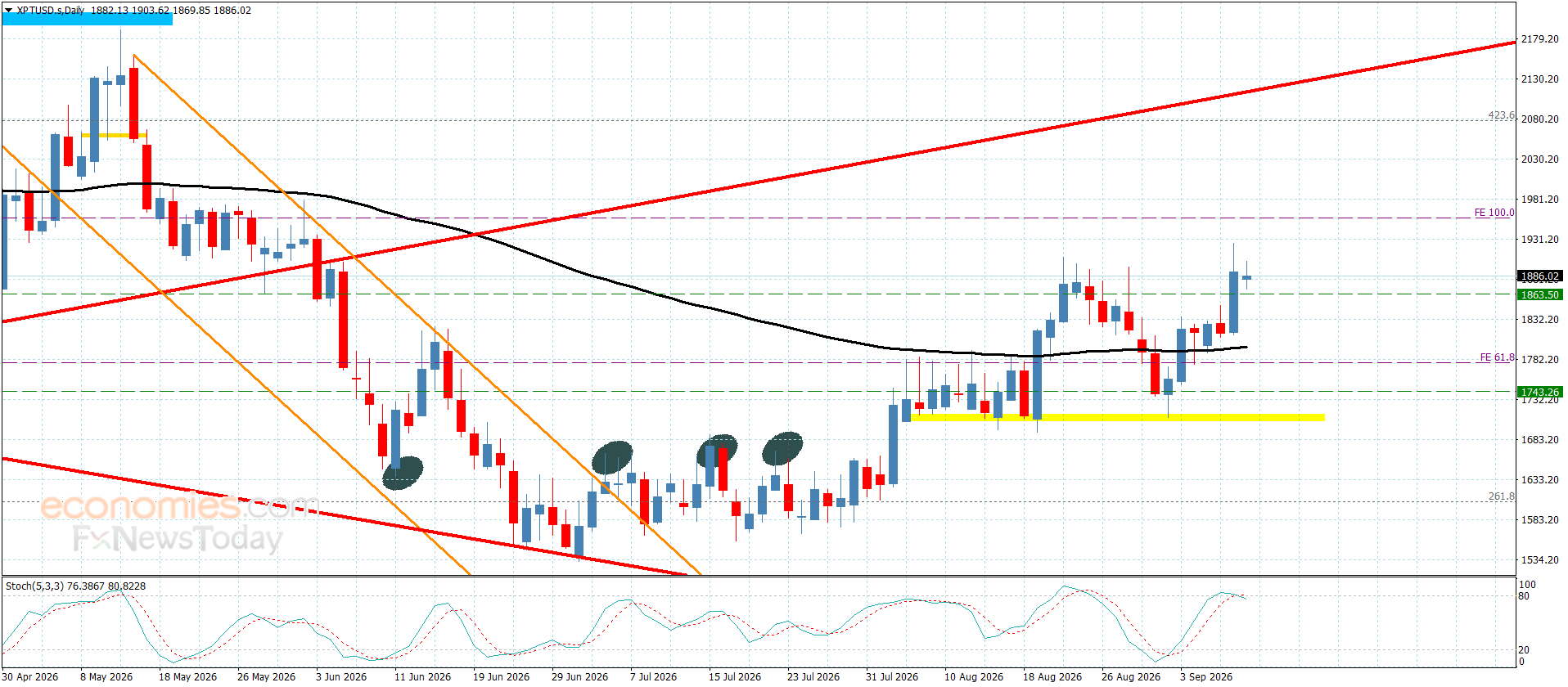
Platinum price succeeded in surpassing $1835.00 level yesterday, reaching the initial target by hitting $1926.00 level, despite the positive factors, we confirm the stability of the trading above $1900.00 to reinforce the chances of resuming the bullish trend and targeting new positive targets by reaching $1958.00 initially, followed by $2060.00, which represents the next main target in the medium trading.
While the price failure to settle above $1900.00 might force it to activate the corrective attempts, to expect reaching the 55-level moving average near $1790.00.
The expected trading range for today is between $1850.00 and $1958.00
Trend forecast: Bullish
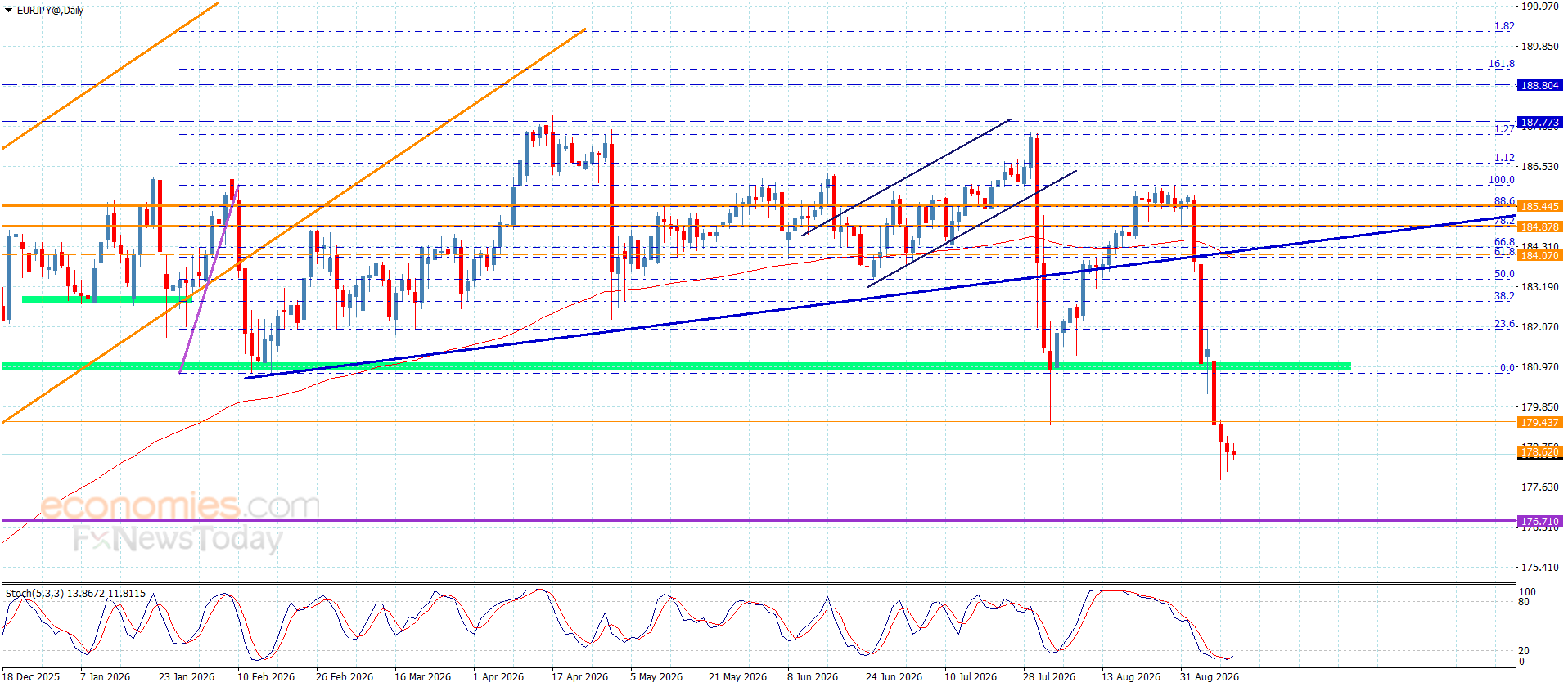
Despite the weakness of the last trading of EURJPY pair’s price and forming weak sideways fluctuation by its stability near 178.50, it will not affect the main bearish scenario due to its stability below 180.80 barrier.
Providing negative momentum continuously by the main indicators will increase the chances of attacking 177.80 barrier, as surpassing it will open the way for reaching extra negative stations that are represented by 177.35 and 176.70 level.
The expected trading range for today is between 177.35 and 179.40
Trend forecast: Bearish
Brent crude futures rose $2.15, or 2.2%, to $100.07 a barrel by 0721 GMT, while U.S. West Texas Intermediate crude was up $1.70, or 1.83%, at $94.73 a barrel.
Brent has risen by a quarter since early last month as hopes fade for a permanent resolution to the six-month-old conflict between the U.S. and Iran.
U.S. Secretary of State Marco Rubio said Washington would continue targeting Iranian oil tankers in response to attempted attacks on U.S. warships. “Iran continues to try to hit U.S. naval ships, and for every time they do that or try to do that, they’re going to lose tankers,” Rubio told reporters during a visit to Colombia.
U.S. Central Command said on Tuesday that its forces had destroyed five Iranian crude oil carriers on September 8 following attempted missile attacks on a U.S. Navy warship over the previous two days.
Jordan’s air-defence systems intercepted 18 of the 20 ballistic missiles launched from Iranian territory, while the other two fell in unpopulated areas, according to the country’s state news agency, which cited the military. No casualties were reported.
Goldman Sachs has warned that oil prices could reach as high as $120 a barrel if attacks on shipping in the Middle East intensify, with the renewed hostilities raising concerns about disruptions to crude supplies.Daan Struyven, co-head of global commodities research at Goldman Sachs, said in an interview with Bloomberg that recent developments indicated that the risk of wider and more severe shipping disruptions had become an important concern.
Struyven said Goldman Sachs sees “meaningful upside to crude oil prices”, while also suggesting that investors position for higher natural gas and refined product prices. He said the supply shocks in gas and fuels are larger than those in the crude market.
The duration of the disruption will be critical for the oil market. JPMorgan estimates that every additional month of disruption could add around $7 to $8 a barrel to Brent prices. If the disruption lasts three months, the bank expects average monthly Brent prices to reach around $114 a barrel.
Citi has raised its average Brent crude price forecast for the third quarter to $86 a barrel from $80, pointing to a longer-than-expected timeline for the reopening of the Strait of Hormuz.
ANZ analysts have also increased their short-term Brent forecast to $95 a barrel and warned that prices could rise further if the Middle East conflict escalates. They said a prolonged standoff involving calibrated military action by the U.S. and Iran appeared to be the most likely scenario, potentially delaying the return of full Middle East supply.
(Disclaimer: Recommendations, suggestions, views and opinions given by the experts are their own. These do not represent the views of The Economic Times)
Gold (XAU/USD) trims losses on Wednesday, with price action returning to the $4,400 area during the European morning session, after bouncing from $4,345 lows on Tuesday. The precious metal is drawing support from broad-based US Dollar (USD) weakness, although the broader trend remains bearish, after losing more than $100 in the previous three trading days.
The Greenback is on its back foot on Wednesday, with investors awaiting Friday’s US Consumer Inflation figures to confirm expectations that the Federal Reserve will hike interest rates next week.
Strategists at Brown Brothers Harriman argue that “a hot CPI print would all but seal a September hike and underpin a firmer USD,” whereas “a cooler reading would strengthen the case for a hold and leave USD vulnerable to a dovish Fed repricing.” BBH experts, however, warn that “even if a September Fed hike becomes a done deal, we doubt USD will make new cyclical highs,” noting that tightening by other major central banks “limits policy divergence, with the ECB widely expected to deliver a 25bps hike tomorrow.”
XAU/USD has trimmed losses, returning to $4,400, yet with price action contained within Tuesday’s range, and with the broader bearish structure intact. The precious metal remains capped below the 200-day Simple Moving Average (SMA), with last week’s knee-jerk reaction looking like the second shoulder of a bearish Head & Shoulders (H&S) formation.
Momentum indicators in the daily chart are neutral-to-bearish, with the Relative Strength Index (RSI) flat around 50 and the Moving Average Convergence Divergence (MACD) in negative territory, suggesting that rebounds are vulnerable.
Tuesday’s low in the mid-$4,300s is holding bears for now and closing the path to the H&S neckline between $4,311 and $4,282, the August 14 and September 2 lows, respectively. A confirmation below those levels brings the August 6 low, at $4,223, into focus. Upside attempts above $4,400, on the contrary, are likely to meet resistance at Tuesday’s high of $4,443, ahead of last week’s highs around $4,500 and the 200-day SMA at $4,537.
(The technical analysis of this story was written with the help of an AI tool. Know more.)
Gold has played a key role in human’s history as it has been widely used as a store of value and medium of exchange. Currently, apart from its shine and usage for jewelry, the precious metal is widely seen as a safe-haven asset, meaning that it is considered a good investment during turbulent times. Gold is also widely seen as a hedge against inflation and against depreciating currencies as it doesn’t rely on any specific issuer or government.
Central banks are the biggest Gold holders. In their aim to support their currencies in turbulent times, central banks tend to diversify their reserves and buy Gold to improve the perceived strength of the economy and the currency. High Gold reserves can be a source of trust for a country’s solvency. Central banks added 1,136 tonnes of Gold worth around $70 billion to their reserves in 2022, according to data from the World Gold Council. This is the highest yearly purchase since records began. Central banks from emerging economies such as China, India and Turkey are quickly increasing their Gold reserves.
Gold has an inverse correlation with the US Dollar and US Treasuries, which are both major reserve and safe-haven assets. When the Dollar depreciates, Gold tends to rise, enabling investors and central banks to diversify their assets in turbulent times. Gold is also inversely correlated with risk assets. A rally in the stock market tends to weaken Gold price, while sell-offs in riskier markets tend to favor the precious metal.
The price can move due to a wide range of factors. Geopolitical instability or fears of a deep recession can quickly make Gold price escalate due to its safe-haven status. As a yield-less asset, Gold tends to rise with lower interest rates, while higher cost of money usually weighs down on the yellow metal. Still, most moves depend on how the US Dollar (USD) behaves as the asset is priced in dollars (XAU/USD). A strong Dollar tends to keep the price of Gold controlled, whereas a weaker Dollar is likely to push Gold prices up.
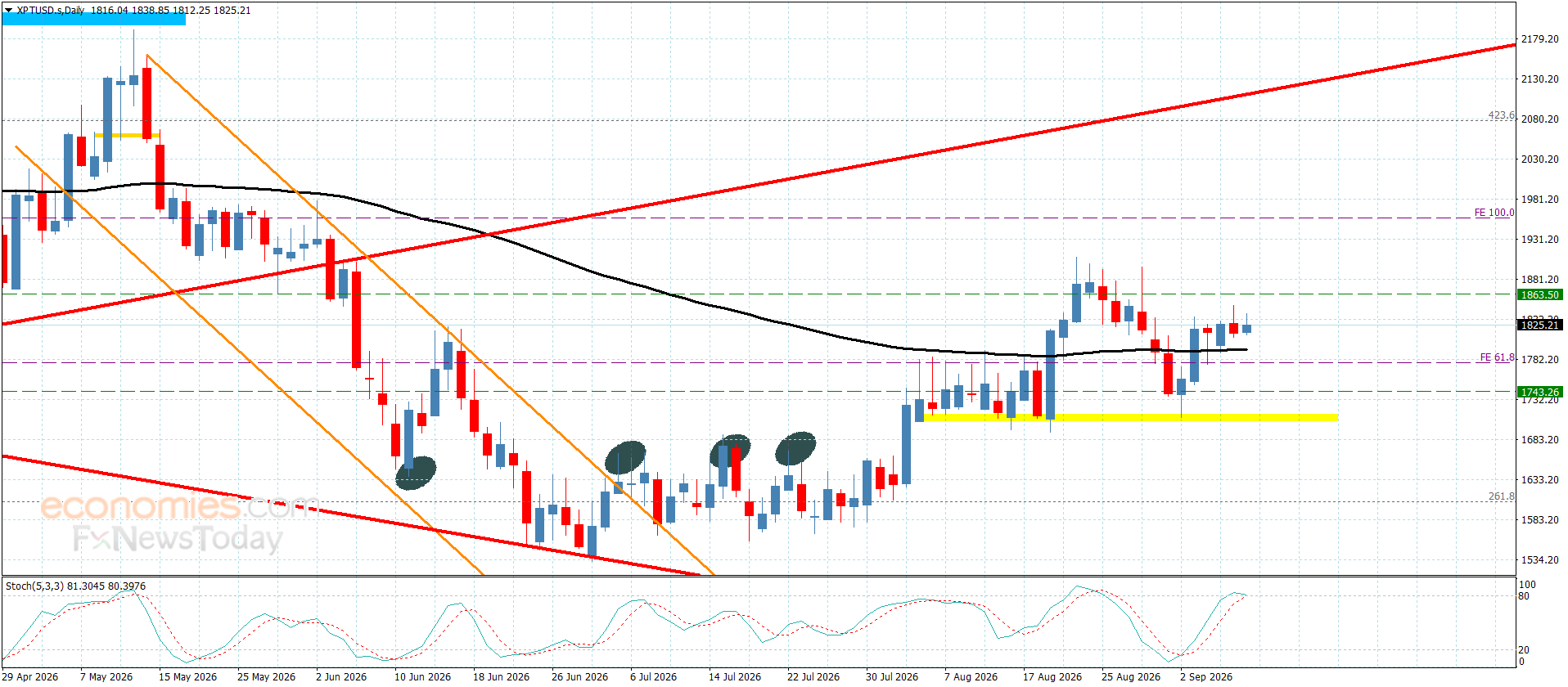
Platinum price didn’t move anything since yesterday, keeping its temporary sideways fluctuation near $1825.00 level, due to the continuation of forming an obstacle against the bullish rally at $1835.00 level.
We recommend waiting to confirm the required breach by providing positive closes above the current barrier, reinforcing the chances of reaching the positive stations, which might begin at $1910.00 and $1958.00, while the risk of changing the trend and begin a bearish trend depends on breaking $1705.00 support.
The expected trading range for today is between $1780.00 and $1910.00
Trend forecast: Bullish
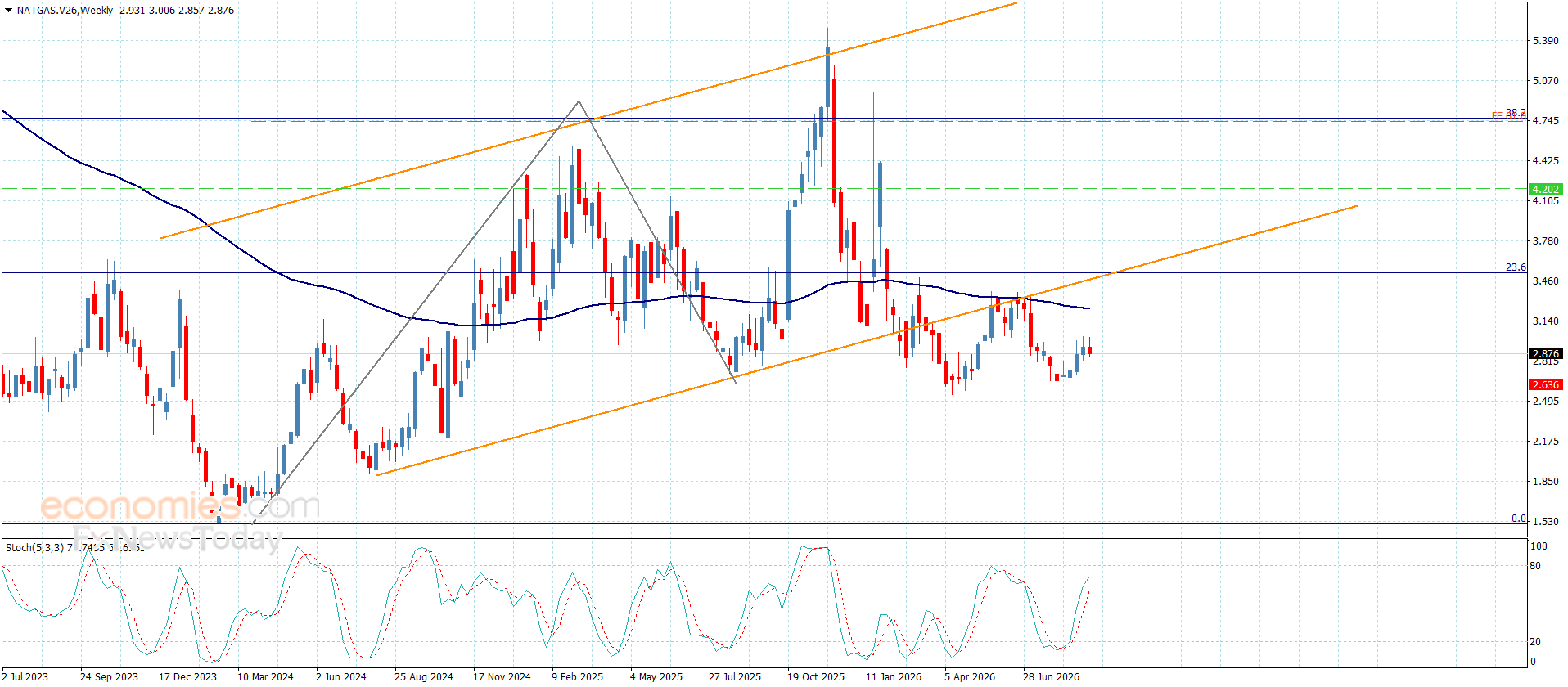
Despite the weakness in the natural gas price last trading, it formed a new sideways fluctuation by its stability near $2.880 level, however it didn’t affect the chances of forming new bullish waves, depending on the stability of the main support at $2.620 besides forming extra support at $2.810 level against the current trading.
The continuation of providing positive momentum by stochastic will help it renew the bullish attempts in the near period, to keep waiting for attacking $3.100 level, and surpassing it will ease the mission of achieving extra losses by its rally towards $3.250 and $3.450.
The expected trading range for today is between $2.800 and $3.100
Trend forecast: Bullish
Silver price (XAG/USD) is up almost 1% to near $66.40 during the Asian trading session on Wednesday. The white metal strengthens as the US Dollar remains under pressure despite expectations that the Federal Reserve (Fed) could raise interest rates at the policy meeting next week.
At press time, the US Dollar Index (DXY), which gauges the Greenback’s value against six major currencies, trades slightly lower to near 98.76. The USD Index is closer to its two-week low of 98.72 posted on Tuesday.
A lower US Dollar makes the Silver price a favorable risk-reward bet for investors.
According to the CME FedWatch tool, traders see a 60% chance that the Fed will raise interest rates in the September policy meeting. Hawkish Fed bets are propelled by a stronger-than-expected United States (US) Nonfarm Payrolls (NFP) report for August released on Friday.
Meanwhile, investors await the US Consumer Price Index (CPI) data for August scheduled for Friday to get fresh cues regarding the Fed’s monetary policy outlook.
According to TD Securities, core inflation likely continued to moderate in August, with the bank projecting that “core CPI rose 2.3% on a y/y basis, down 10 bps vs July,” while “headline inflation likely stayed unchanged at 3.4% y/y.” However, the economists caution that “we see the risks to our forecasts as skewed to the upside given that we’re assuming a number of large price declines in tariff-exposed goods categories.”
In the daily chart, XAG/USD trades at $66.42. The metal trades close to the 20-period Exponential Moving Average (EMA) at $65.79, reflecting a sideways trend.
The 14-period Relative Strength Index (RSI) at 53.68 sits in neutral-positive territory, suggesting modest bullish momentum rather than overbought conditions.
On the downside, initial support is seen near the August 19 low at $62.19, followed by the psychological level of $60.00. Looking up, the June high at $71.56 appears to be a strong barrier for the Silver price bulls.
(The technical analysis of this story was written with the help of an AI tool. Know more.)
Silver is a precious metal highly traded among investors. It has been historically used as a store of value and a medium of exchange. Although less popular than Gold, traders may turn to Silver to diversify their investment portfolio, for its intrinsic value or as a potential hedge during high-inflation periods. Investors can buy physical Silver, in coins or in bars, or trade it through vehicles such as Exchange Traded Funds, which track its price on international markets.
Silver prices can move due to a wide range of factors. Geopolitical instability or fears of a deep recession can make Silver price escalate due to its safe-haven status, although to a lesser extent than Gold’s. As a yieldless asset, Silver tends to rise with lower interest rates. Its moves also depend on how the US Dollar (USD) behaves as the asset is priced in dollars (XAG/USD). A strong Dollar tends to keep the price of Silver at bay, whereas a weaker Dollar is likely to propel prices up. Other factors such as investment demand, mining supply – Silver is much more abundant than Gold – and recycling rates can also affect prices.
Silver is widely used in industry, particularly in sectors such as electronics or solar energy, as it has one of the highest electric conductivity of all metals – more than Copper and Gold. A surge in demand can increase prices, while a decline tends to lower them. Dynamics in the US, Chinese and Indian economies can also contribute to price swings: for the US and particularly China, their big industrial sectors use Silver in various processes; in India, consumers’ demand for the precious metal for jewellery also plays a key role in setting prices.
Silver prices tend to follow Gold’s moves. When Gold prices rise, Silver typically follows suit, as their status as safe-haven assets is similar. The Gold/Silver ratio, which shows the number of ounces of Silver needed to equal the value of one ounce of Gold, may help to determine the relative valuation between both metals. Some investors may consider a high ratio as an indicator that Silver is undervalued, or Gold is overvalued. On the contrary, a low ratio might suggest that Gold is undervalued relative to Silver.