The main tag of Gold Price Articles.
You can use the search box below to find what you need.
[wd_asp id=1]
The main tag of Gold Price Articles.
You can use the search box below to find what you need.
[wd_asp id=1]
Silver (XAG/USD) trims part of its earlier gains on Thursday as geopolitical headlines from the Middle East continue to stir volatility across financial markets. At the time of writing, XAG/USD is trading around $79.62 after easing from a three-week high near $82.00 touched earlier in the American session, though the metal remains up nearly 3% on the day.
Iran has imposed new rules for vessels passing through the Strait of Hormuz, according to CNN, in an attempt to tighten control over shipping movements through the waterway, which handles 20% of global Oil flows.
Persistent tensions surrounding the Strait of Hormuz keep Oil prices elevated, fueling inflation concerns and supporting hawkish central bank expectations, which in turn continue to cap upside attempts in Silver.
However, renewed hopes that the US and Iran could reach a deal to end the war in the Middle East support the metal in the near term, while technical indicators also remain constructive.
In the daily chart, XAG/USD holds above the 20-day Simple Moving Average (SMA) Bollinger middle band at $76.32, keeping the near‑term bias constructive while it grinds toward the upper Bollinger band, now capping the upside around $81.43. The Relative Strength Index (14) at 57 sits in positive territory without being overbought, suggesting buyers retain control, while the subdued Average Directional Index (14) near 12.76 hints that the prevailing uptrend lacks strong directional conviction for now.
On the topside, immediate resistance is located at the upper Bollinger band at $81.43; a daily close above this barrier would open the door for a more impulsive extension of the bull leg. On the downside, initial support is provided by the 20-day SMA Bollinger middle band at $76.32, with a deeper pullback likely finding additional protection near the lower Bollinger band around $71.21 as long as the broader bullish structure remains intact.
(The technical analysis of this story was written with the help of an AI tool.)
The table below shows the percentage change of US Dollar (USD) against listed major currencies today. US Dollar was the strongest against the Japanese Yen.
| USD | EUR | GBP | JPY | CAD | AUD | NZD | CHF | |
|---|---|---|---|---|---|---|---|---|
| USD | -0.01% | 0.09% | 0.25% | 0.05% | 0.10% | 0.05% | 0.02% | |
| EUR | 0.00% | 0.09% | 0.28% | 0.06% | 0.10% | 0.05% | 0.02% | |
| GBP | -0.09% | -0.09% | 0.17% | -0.04% | 0.00% | -0.04% | -0.07% | |
| JPY | -0.25% | -0.28% | -0.17% | -0.22% | -0.16% | -0.26% | -0.23% | |
| CAD | -0.05% | -0.06% | 0.04% | 0.22% | 0.06% | 0.00% | -0.03% | |
| AUD | -0.10% | -0.10% | -0.01% | 0.16% | -0.06% | -0.05% | -0.09% | |
| NZD | -0.05% | -0.05% | 0.04% | 0.26% | 0.00% | 0.05% | -0.03% | |
| CHF | -0.02% | -0.02% | 0.07% | 0.23% | 0.03% | 0.09% | 0.03% |
The heat map shows percentage changes of major currencies against each other. The base currency is picked from the left column, while the quote currency is picked from the top row. For example, if you pick the US Dollar from the left column and move along the horizontal line to the Japanese Yen, the percentage change displayed in the box will represent USD (base)/JPY (quote).
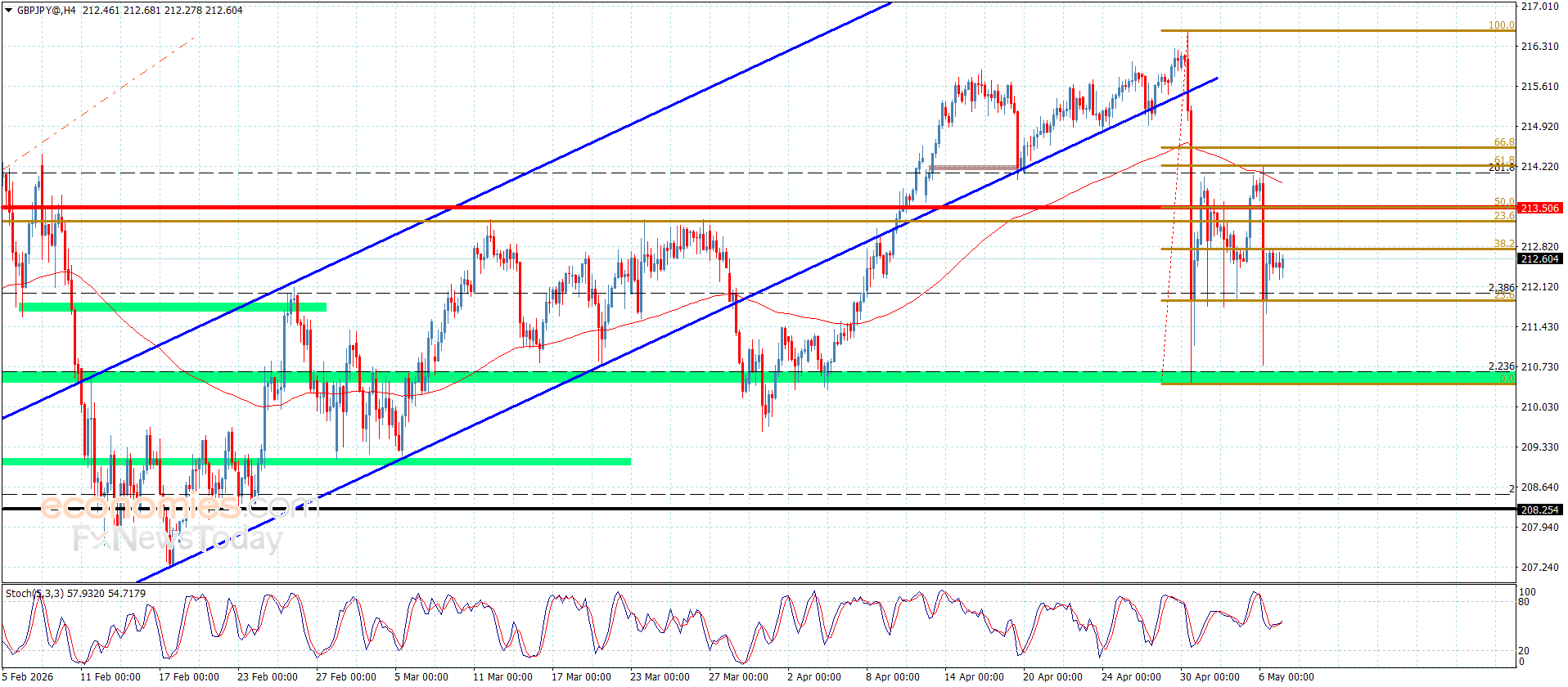
The EURJPY pair reached %23.6 Fibonacci correction level at 182.00, to form strong support to provide chances for recovering some losses by its rally near 183.70 level.
In general, the bearish scenario will remain valid depending on forming main barrier by 185.45 level against the current trading, which makes us wait for gathering negative momentum, which allows it to renew the negative attempts that might target 182.80 level, to attempt to renew the pressure on 182.00 support, while breaching the main barrier and holding above it will confirm its move to a positive station, to begin targeting several positive stations by its rally towards 186.00 and 186.60.
The expected trading range for today is between 182.80 and 184.30
Trend forecast: Bearish
Platinum price managed to settle above the moving average 55, confirming the attempt of activating the bullish trend again, to hit $2075.00 level, approaching the previously suggested initial main target.
Surpassing $2080.00 level, to open the way for resuming the bullish trend, to reach $2120.00, to extend the trading towards the next main target near $2190.00, note that the rise of changing the trend and forming bearish waves depends on breaking the support level at $1865.00.
The expected trading range for today is between $2020.00 and $2120.00
Trend forecast: Bullish
Domestic coffee prices today
The domestic coffee market this morning, May 7, witnessed an impressive breakthrough session in the Central Highlands provinces.
According to the latest data, the average purchase price of the whole region has increased by 1,000 VND/kg, officially exceeding the threshold of 87,000 VND/kg.
Specifically, in Dak Nong province (old), coffee prices increased the most with 1,100 VND, reaching 87,300 VND/kg.
Dak Lak and Gia Lai provinces both recorded an increase of 1,000 VND, currently trading stably at 87,000 VND/kg.
The Lam Dong area alone listed the price at 86,500 VND/kg after recovering by 1,000 VND compared to yesterday’s session. Meanwhile, pepper prices remained stable at 143,000 VND/kg and the USD/VND exchange rate at Vietcombank decreased slightly by 10 VND to 26,088 VND/USD.
World coffee prices
Developments in the international market last night recorded mixed differentiation between the two futures exchanges.
The London exchange became the main driver for domestic coffee prices when Robusta futures in July surged by another 35 USD (equivalent to 1.04%), reaching 3,413 USD/ton.
Conversely, the New York exchange sank into red when Arabica prices fell sharply by 5.90 cents (equivalent to 2.04%), falling to 283.85 cents/lb. Arabica’s decline stems from optimistic signals about the possibility of ending the US-Iran conflict, which opens up expectations that the Strait of Hormuz will soon be cleared again, helping to relieve global logistics pressure.
Coffee price assessment
Despite cooling geopolitical news, factors tightening supply in reality are still a solid pillar for coffee prices. Robusta inventories on the ICE exchange fell to a record low of 16.25 months (only 3,755 lots), while Arabica inventories also hit a 2.5-month low.
In addition, Brazil’s Real continued to maintain its strength at its highest level in 2.25 years against the USD, causing Brazilian farmers to limit export sales due to unfavorable exchange rate differences. These factors compensated for the pressure from the Vietnam’s export report in the first 4 months of the year increasing sharply by 15.8% (reaching 810,000 tons) and the forecast of a global surplus of 10 million sacks of StoneX.
The market is currently in an extremely sensitive phase when “good news” about geopolitics is “bad news” for prices due to reduced insurance and transportation costs. However, with stockpiles on the London exchange running out, Robusta’s upward momentum still has considerable room in the short term.
Welcome, my fellow traders! I have prepared a price forecast for the USCrude, XAUUSD, and EURUSD using a combination of the margin zones method and technical analysis. Based on the market analysis, I suggest entry signals for intraday traders.
Gold is trading in a bullish correction within the short-term downtrend.
The article covers the following subjects:
Oil’s short-term trend turned bearish yesterday. The price broke below the key support of 99.24–98.43 and reached the lower Target Zone of 91.15–89.53. After that, major market participants started closing their short trades, causing an upward correction.
During the correction, the oil price tested the resistance A of 92.82–92.28, but bears managed to keep the asset below this zone. Today, the price may continue to fall. Consequently, consider short trades with the first target at 89.85 and the second one around 86.89.
Sell near resistance A of 92.82–92.28. TakeProfit: 89.85, 86.89. StopLoss: 94.70.
Gold is trading in a correction within a short-term downtrend. Yesterday, the price pierced resistance A at 4,656–4,642 and reached resistance B at 4,734–4,713, the upper boundary of the trend. Consider short trades near this zone, with the first target at 4,617 and the second one at 4,500.
If the gold price breaks above resistance B, the downtrend will reverse. In this case, consider long trades, with the target in the upper Target Zone of 4,968–4,925.
Sell near resistance B of 4,734–4,713. TakeProfit: 4,617, 4,500. StopLoss: 4,788.
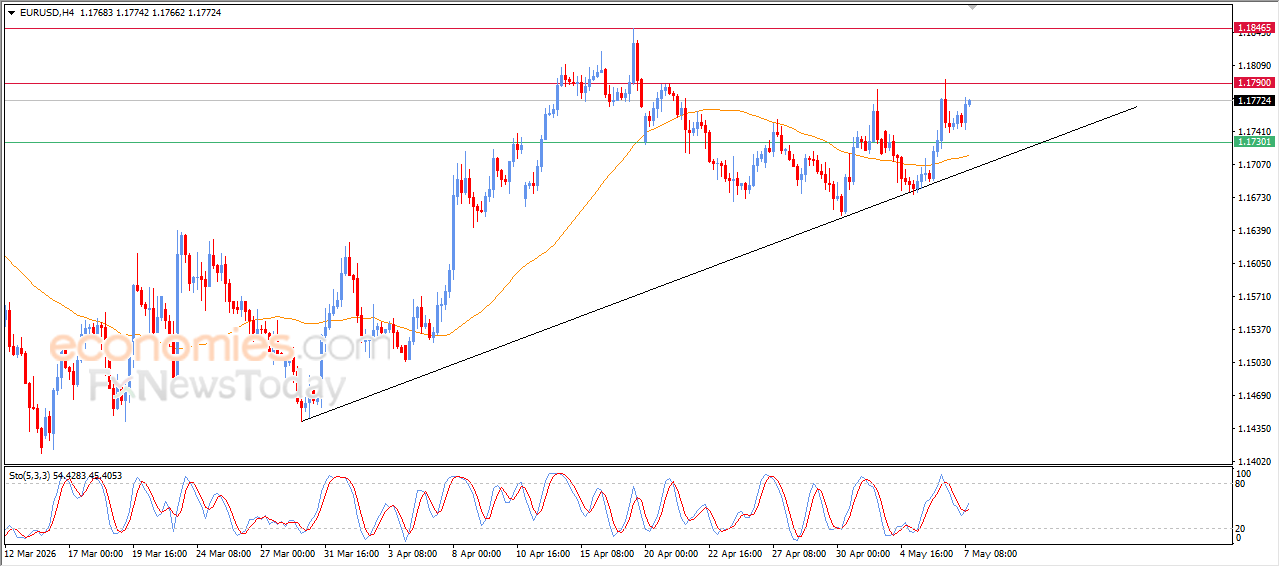
The euro extended its short-term uptrend yesterday. Bulls managed to hold the support B of 1.1687–1.1670, and the price reached the first upside target of 1.1760. If the price breaks above this level, the next upside target will be at 1.1849. Should the asset rise even higher, it may climb to the Target Zone 2 of 1.1972–1.1950.
If the euro price settles below the support B, the trend will shift to a downtrend. In this case, consider short trades, with the target in the lower Target Zone of 1.1525–1.1492.
Watch the market.
Would you like to learn more about technical analysis methods and principles? Explore our comprehensive guide.
P.S. Did you like my article? Share it in social networks: it will be the best “thank you” 🙂
Useful links:
The content of this article reflects the author’s opinion and does not necessarily reflect the official position of LiteFinance broker. The material published on this page is provided for informational purposes only and should not be considered as the provision of investment advice for the purposes of Directive 2014/65/EU.
According to copyright law, this article is considered intellectual property, which includes a prohibition on copying and distributing it without consent.
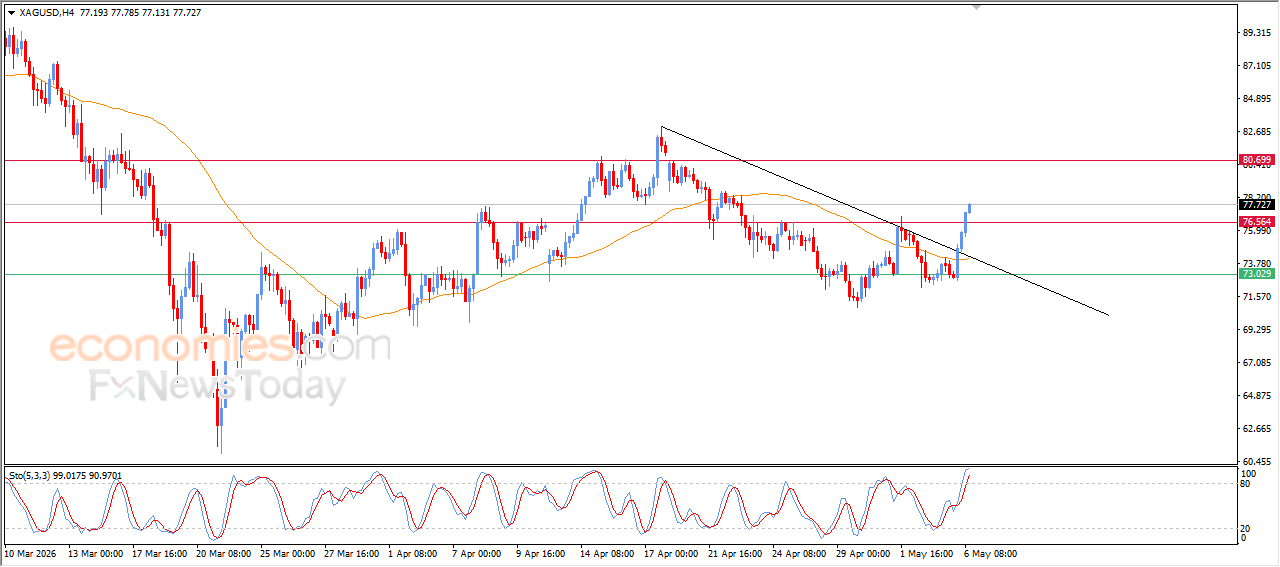
Silver (XAG/USD) gains traction on Wednesday as renewed optimism surrounding a potential US-Iran peace deal triggers a sharp decline in the US Dollar (USD) and Oil prices. At the time of writing, XAG/USD is trading around 77, up over 5.50% on the day.
The latest leg higher comes after Axios reported that Washington and Tehran are moving closer to a potential agreement aimed at ending the war and establishing a framework for detailed nuclear negotiations.
The sharp decline in crude Oil helped ease immediate inflation concerns, pushing US Treasury yields lower and providing additional support to the non-yielding metal. Traders also shifted back toward pricing in the possibility of Federal Reserve (Fed) rate cuts by year-end.
Despite the renewed optimism, uncertainty over whether the US and Iran can reach a final agreement continues to keep markets on edge, limiting further upside in Silver. The technical outlook also points to a possible consolidation phase following the intraday surge.
In the daily chart, XAG/USD remains capped in the near term, as spot holds below the 50-day Simple Moving Average (SMA) and the 100-day SMA, keeping recovery attempts vulnerable while those barriers stand overhead.
Momentum has improved, with the Relative Strength Index near 53 and the Moving Average Convergence Divergence (MACD) fractionally positive, but the subdued Average Directional Index around 12 suggests a weak underlying trend, hinting at consolidation rather than a sustained breakout.
On the topside, initial resistance is aligned at the 50-day SMA at $77, with a stronger hurdle emerging at the 100-day SMA near $80, where a daily close above would be needed to ease the current capped tone.
On the downside, initial support is seen in the $70.00-$71.00 zone, while the 200-day SMA at $63 offers the next significant structural support, and while it sits well below current prices, it defines the broader bullish floor that would need to give way to signal a deeper bearish reversal.
(The technical analysis of this story was written with the help of an AI tool.)
Silver is a precious metal highly traded among investors. It has been historically used as a store of value and a medium of exchange. Although less popular than Gold, traders may turn to Silver to diversify their investment portfolio, for its intrinsic value or as a potential hedge during high-inflation periods. Investors can buy physical Silver, in coins or in bars, or trade it through vehicles such as Exchange Traded Funds, which track its price on international markets.
Silver prices can move due to a wide range of factors. Geopolitical instability or fears of a deep recession can make Silver price escalate due to its safe-haven status, although to a lesser extent than Gold’s. As a yieldless asset, Silver tends to rise with lower interest rates. Its moves also depend on how the US Dollar (USD) behaves as the asset is priced in dollars (XAG/USD). A strong Dollar tends to keep the price of Silver at bay, whereas a weaker Dollar is likely to propel prices up. Other factors such as investment demand, mining supply – Silver is much more abundant than Gold – and recycling rates can also affect prices.
Silver is widely used in industry, particularly in sectors such as electronics or solar energy, as it has one of the highest electric conductivity of all metals – more than Copper and Gold. A surge in demand can increase prices, while a decline tends to lower them. Dynamics in the US, Chinese and Indian economies can also contribute to price swings: for the US and particularly China, their big industrial sectors use Silver in various processes; in India, consumers’ demand for the precious metal for jewellery also plays a key role in setting prices.
Silver prices tend to follow Gold’s moves. When Gold prices rise, Silver typically follows suit, as their status as safe-haven assets is similar. The Gold/Silver ratio, which shows the number of ounces of Silver needed to equal the value of one ounce of Gold, may help to determine the relative valuation between both metals. Some investors may consider a high ratio as an indicator that Silver is undervalued, or Gold is overvalued. On the contrary, a low ratio might suggest that Gold is undervalued relative to Silver.
Despite the neediness of coffee price to the positive momentum in the last period, its stability above 276.00 support helped to provide a chance for activating the previously suggested bullish trend, surpassing 295.00 level makes us begin targeting some positive stations by its rally towards 313.00 reaching 66.8%Fibonacci correction level at 329.60.
Facing new negative pressures and breaking the current support will force it to suffer several losses, to expect to reach 257.00 initially followed by 233.40 level.
The expected trading range for today is between 282.00 and 313.00
Trend forecast: Bullish
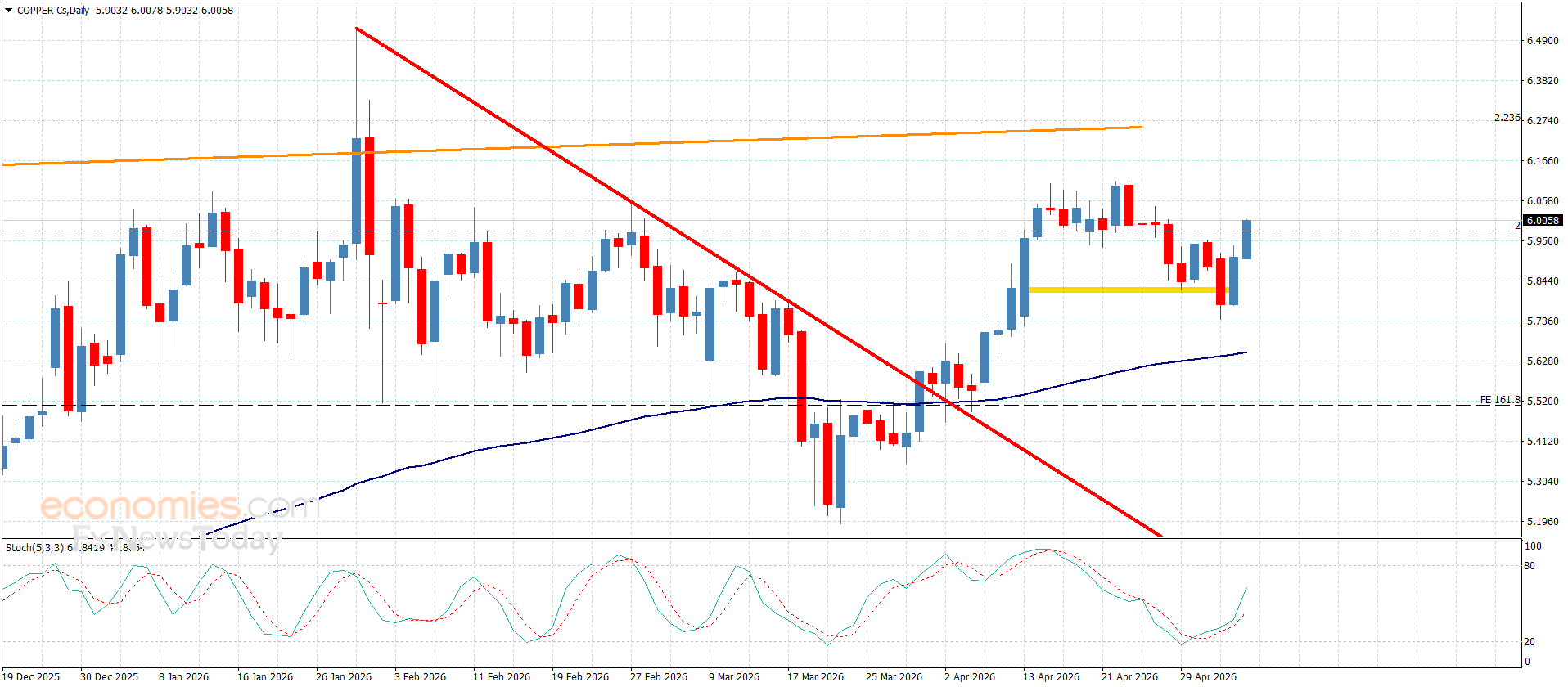
Copper price began this morning with strong positivity, to rally above $5.9700 level, taking advantage of the attempt to provide positive momentum by the main indicators, to settle near $6.0080.
Providing a positive close above the breached barrier is important to confirm its readiness to activate the bullish trend, to expect targeting $6.1200 and $6.2500 level initially, while activating the corrective trend requires providing negative close below $5.8100.
The expected trading range for today is between $5.8700 and $6.1200
Trend forecast: Bullish
Domestic coffee prices today
The domestic coffee market this morning, May 6, recorded a positive recovery after a series of gloomy days.
In key growing areas of the Central Highlands, purchasing prices simultaneously increased by 400 to 500 VND/kg, bringing the average price level of the whole region to the threshold of 86.100 VND/kg.
Specifically, in Dak Nong province (old), coffee prices recorded an increase of 500 VND, pushing the purchase price to the milestone of 86.2 million VND/kg, continuing to be the locality with the highest price in the region.
Dak Lak and Gia Lai provinces both had an increase of 400 VND, currently trading stably at 86,000 VND/kg.
Riêng khu vực Lâm Đồng niêm yết mức giá 85. 500 đồng/kg sau khi hồi phục thêm 500 đồng so với phiên hôm qua. Bên cạnh đó, giá hồ tiêu tiếp tục đi ngang ở mức cao 143. 000 đồng/kg, trong khi tỷ giá USD/VND tại Vietcombank giảm nhẹ 8 đồng về mức 26. 098 VND/USD.
World coffee prices
In the international market, the New York exchange became the focus when Arabica prices strongly broke through to the highest level in the past week.
At the end of the trading session, the July term increased by 4.25 cents (equivalent to 1.49%), closing at 289.75 cents/lb.
Following the same trend, Robusta prices in London also maintained green when increasing by another 14 USD (equivalent to 0.42%), reaching the 3,378 USD/ton mark. This recovery shows that the market is reacting very sensitively to fluctuations from the money market and the world geopolitical situation.
Coffee price assessment
The main driving force pushing coffee prices up comes from the resonance of many macroeconomic factors. Brazil’s Real has jumped to its highest level in 2.25 years against the USD, directly putting pressure on Brazilian farmers to limit export sales because they earn less domestic currency.
At the same time, the prolonged blockade in the Strait of Hormuz due to Middle East tensions is still disrupting the global supply chain, pushing transportation costs, insurance and especially fertilizer prices to skyrocket. In addition, Arabica inventories on the ICE exchange anchored at a 2.25-month low and Robusta inventories maintained at a record low of 16.25 months (3,755 lots) are also important pillars helping prices escape the short-term bottom.
However, the breakthrough momentum of coffee prices still faces a major resistance from forecasts of a nearing super surplus crop year. Organizations such as StoneX and Marex still maintain their assessment of a record harvest in Brazil with an expected output of up to 75.9 million bags, which could lead to a global surplus of 10 million bags for 2026. In Vietnam, export data for the first 4 months of the year increased sharply by 15.8% to 810,000 tons, also contributing to easing concerns about short-term Robusta supply in the international market.
Gold is rallying hard in Asia on Wednesday, reclaiming the $4,600 barrier while extending its recovery from over one-month lows of $4,501 set on Tuesday.
Gold is capitalizing on a return of risk appetite, and there in, reduced haven demand for the US Dollar (USD) as optimism over a likely peace deal between the United States (US) and Iran bolsters risk sentiment.
This follows an announcement by US President Donald Trump that he is pausing ‘Project Freedom’, the US effort to guide stranded vessels out of the Strait of Hormuz, citing progress
Meanwhile, US Secretary of State Marco Rubio told Reuters on Tuesday that “Operation Epic Fury is concluded,” adding that “we’re not cheering for an additional situation to occur.”
The Greenback receives another blow from easing inflation fears, led by the recent retreat in Oil prices, which temper bets for hawkish Fed monetary policy outlook.
If markets sense substantial progress on the Mideast peace deal, Gold could see an extension of the recovery rally. Additionally, repositioning ahead of Friday’s US Nonfarm Payrolls (NFP) report could provide extra legs to the renewed upside in Gold.
In the meantime, the US ADP Employment Change data will be eyed for fresh trading incentives, especially after Job Openings declined by 56,000 to 6.866 million by the last day of March, the Bureau of Labor Statistics (BLS) said in its Job Openings and Labor Turnover Survey (JOLTS) report on Tuesday. The market forecast was for 6.83 million.
The US ISM Services Employment Index improved to 48 in April from March’s 45.5.
In the daily chart, XAU/USD trades at $4,645.30. The metal holds below the short- and medium-term moving averages, with the 21-day simple moving average (SMA) near $4,699.78, the 100-day SMA around $4,770.06 and the 50-day SMA close to $4,798.27, keeping the broader tone capped despite a mild rebound from recent lows. The Relative Strength Index (14) at 47.19 sits just under the neutral band, hinting at subdued momentum and suggesting that recovery attempts could struggle while price remains under this layered topside supply.
On the downside, immediate support is aligned with the recently reclaimed falling wedge resistance-line break near $4,594.16, ahead of the former ascending trend-line break around $4,382.94. A sustained drop through these levels would expose the 200-day SMA at approximately $4,299.87 as the next major bearish objective. On the topside, bulls would need a daily close above the falling wedge resistance near $4,595 to confirm a bullish breakout. Up next, reclaiming the 21-day SMA at $4,699.78 is critical to easing near-term bearish pressure, with further resistance then seen at the 100-day SMA around $4,770.06 and the 50-day SMA near $4,798.27.
(The technical analysis of this story was written with the help of an AI tool.)
Gold has played a key role in human’s history as it has been widely used as a store of value and medium of exchange. Currently, apart from its shine and usage for jewelry, the precious metal is widely seen as a safe-haven asset, meaning that it is considered a good investment during turbulent times. Gold is also widely seen as a hedge against inflation and against depreciating currencies as it doesn’t rely on any specific issuer or government.
Central banks are the biggest Gold holders. In their aim to support their currencies in turbulent times, central banks tend to diversify their reserves and buy Gold to improve the perceived strength of the economy and the currency. High Gold reserves can be a source of trust for a country’s solvency. Central banks added 1,136 tonnes of Gold worth around $70 billion to their reserves in 2022, according to data from the World Gold Council. This is the highest yearly purchase since records began. Central banks from emerging economies such as China, India and Turkey are quickly increasing their Gold reserves.
Gold has an inverse correlation with the US Dollar and US Treasuries, which are both major reserve and safe-haven assets. When the Dollar depreciates, Gold tends to rise, enabling investors and central banks to diversify their assets in turbulent times. Gold is also inversely correlated with risk assets. A rally in the stock market tends to weaken Gold price, while sell-offs in riskier markets tend to favor the precious metal.
The price can move due to a wide range of factors. Geopolitical instability or fears of a deep recession can quickly make Gold price escalate due to its safe-haven status. As a yield-less asset, Gold tends to rise with lower interest rates, while higher cost of money usually weighs down on the yellow metal. Still, most moves depend on how the US Dollar (USD) behaves as the asset is priced in dollars (XAU/USD). A strong Dollar tends to keep the price of Gold controlled, whereas a weaker Dollar is likely to push Gold prices up.